The Liberal coalition government killing the ABC by 1000 cuts – but a possible way exists to save it
 With luck the ABC can be saved , Crispin Hull, 8 May 20, This week’s report on ABC funding should alarm Australians.
The death by a thousand cuts of the ABC and the slow strangulation of Medicare have become woven into in Liberal Party’s DNA since John Howard turned Robert Menzies’ broad church of a liberal-conservative Liberal Party into a purely conservative one by shutting out almost everyone left of the nave.
A different liberal-conservative Liberal Party, on the other hand, would have recognised them as essential Australian institutions to be nurtured and supported. After all, the ABC has been around since 1932 and Medicare (in one form or another) since 1973.
The Liberal Party’s desired outright abolition of both has been impossible because of the two institutions’ ingrained popularity. So the onslaught has to be cunningly dressed up as measures to “improve” Medicare and to voice support for the independence of the ABC and promise “no cuts” while ever trying to bully the ABC; sway its board to the right; and to apply cuts to stifle its voice.
This week’s report by the independent think tank Per Capita says that the ABC has lost $783 million in funding since the Coalition came to power in 2013, starting with $245 million in the 2014 Budget, despite Tony Abbott’s promise before the 2013 election that he would not cut the ABC.
More cuts in staff and programming will come before the end of this financial year. They follow seven years of program and staff slashing, critically a 50 per cent cut in the hours of scripted Australian drama.
The Per Capita report concludes that real funding per year since 1985-86 is down 30 per cent or $370 million. Per head of population, the ABC’s funding has been halved in that time. The cuts have come despite the ABC having to provide extra services to keep up with the digital age.
Very likely the Government will cut more as it seeks to claw back from the Covid-19 crisis, even though the ABC – especially the excellent Dr Norman Swan – did so much to inform Australians about the pandemic, as it always does in times of crisis.
What can be done? The ABC itself is down to the bone, though perhaps it could cut out all sport which the commercials to well enough. It is doubtful a Coalition Government would ever increase real funding for the ABC. Perhaps the best we can hope for is that Labor makes some suggestions that the Coalition feels obliged to match or that they become reality with a Labor Government (whenever that might be). ……..
funding solution used in Britain, New Zealand, and only Western Australia among the Australian states to fund culture which could help fund the ABC – a lottery. The Federal Government should set up its own national lottery to boost ABC funding……..
The BBC is well-funded and broadcasters throughout the world line up to pay for its product. The result is a lot of soft-power dividend for Britain. Australia, too, would get a lot of benefit from properly funding the ABC, not least a better-informed community.
Silly me. It’s that last bit the Coalition detests more than anything. http://www.crispinhull.com.au/2020/05/08/with-luck-the-abc-can-be-saved/?utm_source=mailpoet&utm_medium=email&utm_campaign=crispin-hull-column-16-nov-2019_99
Australian government stops listing major threats to species under environment laws
|
Australian government stops listing major threats to species under environment laws
Documents show department has stopped recommending assessment of ‘key threatening processes’ affecting native wildlife Lisa Cox ,Guardian 8 May 2020 The federal government has stopped listing major threats to species under national environment laws, and plans to address listed threats are often years out of date or have not been done at all. Environment department documents released under freedom of information laws show the government has stopped assessing what are known as “key threatening processes”, which are major threats to the survival of native wildlife. Conservationists say it highlights the dysfunctional nature of Australia’s environmental framework, which makes aspects of wildlife protection optional for government. The Environment Protection and Biodiversity Act is being reviewed, a once-a-decade requirement under the legislation, and there are calls for greater accountability rules to be built into Australia’s environmental laws. It follows longstanding criticism that the act is failing to curb extinction. ‘An unacceptable excuse’In a series of reports since 2018Australia has uncovered multiple failures including delays in listing threatened species and habitats, threatened species funding being used for projects that do not benefit species, critical habitat not being protected, and recovery actions for species not being adopted or implemented. The act lists threats such as feral cats, land clearing and climate change as key threatening processes that push native plants and animals towards extinction. Once a threat is listed, the environment minister decides whether a plan – known as a threat abatement plan – should be adopted to try to reduce the impact of the threat on native species. Advertisement
But a 2019 briefing document shows the department has stopped recommending the government’s threatened species scientific committee assess new key threatening processes for potential listing……… ‘It’s shocking really’Further government data shows that of the 21 listed major threats, only three of those were listed in the last decade of the act, the most recent was in 2014…… The process for listing threats can also take years and is subject to ministerial discretion. Major alterations to the flow of river systems – caused by industry and dams – was accepted by the department for assessment in 2016 but removed from the list by the then environment minister, Josh Frydenberg. The only major threat currently under assessment – “fire regimes that cause biodiversity decline” – has been on the assessment list since 2008 and remains incomplete 12 years later. Its deadline is listed as August 2013. Fire regimes that cause biodiversity decline refers to changes in the frequency and scale of fire due to human influence. Every state of the environment report identifies changed fire patterns as a major threat to the survival of native wildlife. “They haven’t even listed it as a threat, let alone done something about it. It’s shocking really,” Andrew Cox, the chief executive of the Invasive Species Council, said. ……. ‘The system’s broken’Environmental organisations and the threatened species scientific committee have highlighted the weaknesses of the KTP system in submissions to the EPBC review, chaired by Graeme Samuel. ‘The system’s broken’Environmental organisations and the threatened species scientific committee have highlighted the weaknesses of the KTP system in submissions to the EPBC review, chaired by Graeme Samuel……… “It’s all optional. That’s the problem,” James Trezise, a policy analyst at the Australian Conservation Foundation, said. “A threat abatement plan is this optional thing where it’s optional to establish them, it’s optional to implement them, there’s no system for tracking them and there’s not enough resources available.”…. https://www.theguardian.com/environment/2020/may/08/australian-government-stops-listing-major-threats-to-species-under-environment-laws |
|
Australian Renewable Energy Agency funds end in 2022 – a major blow for solar research
 ‘Major blow’ looms for top Sydney solar research unit as funds wither, SMH. By Peter Hannam, May 8, 2020 The future of a leading research centre whose designs power $50 billion in solar systems globally is at risk because of the uncertain future of the federal government agency that funds it.Richard Corkish, a senior lecturer at the University of NSW’s School of Photovoltaic and Renewable Energy Engineering, said as much as 80 per cent of his section’s money is provided by the Australian Renewable Energy Agency (ARENA) which is due to run out of funds in 2022. ‘Major blow’ looms for top Sydney solar research unit as funds wither, SMH. By Peter Hannam, May 8, 2020 The future of a leading research centre whose designs power $50 billion in solar systems globally is at risk because of the uncertain future of the federal government agency that funds it.Richard Corkish, a senior lecturer at the University of NSW’s School of Photovoltaic and Renewable Energy Engineering, said as much as 80 per cent of his section’s money is provided by the Australian Renewable Energy Agency (ARENA) which is due to run out of funds in 2022.
We’ll get significantly smaller unless something positive comes along,” said Dr Corkish, who is also chief operating officer of the UNSW-based Australian Centre for Advanced Photovoltaics. “It’s a major blow for us.” His school has already begun turning away prospective PhD students who would otherwise have contributed to multiple lines of scientific inquiry aimed at improving the efficiency and performance of solar cells, their integration into power networks and other renewable energy developments. …… Mark Butler, Labor’s climate spokesman, said “letting ARENA’s resourcing lapse is a devastating self-inflicted wound for Australia’s clean energy future that exposes the Liberals anti-renewable and anti-climate action ideology”. “Scott Morrison should be looking for a COVID-19 recovery plan which brings forward investment in new renewable projects which would create tens of thousands of new jobs, stimulate regional economies, and deliver cheaper power prices,” Mr Butler said. Mark Butler, Labor’s climate spokesman, said “letting ARENA’s resourcing lapse is a devastating self-inflicted wound for Australia’s clean energy future that exposes the Liberals anti-renewable and anti-climate action ideology”. “Scott Morrison should be looking for a COVID-19 recovery plan which brings forward investment in new renewable projects which would create tens of thousands of new jobs, stimulate regional economies, and deliver cheaper power prices,” Mr Butler said……. https://www.smh.com.au/environment/climate-change/major-blow-looms-for-top-sydney-solar-research-unit-as-funds-wither-20200507-p54r3j.html |
|
W.A. rare earths mine taps solar and battery storage — RenewEconomy
Northern Minerals signs PPA with Soluna Australia for 100kW solar, 200kWh battery system to help power its Brown’s Range rare earths mine in W.A. east Kimberley region. The post W.A. rare earths mine taps solar and battery storage appeared first on RenewEconomy.
via W.A. rare earths mine taps solar and battery storage — RenewEconomy
May 8 Energy News — geoharvey
Science and Technology: ¶ “Planting Trees Is No Panacea For Climate Change, Says Ecologist” • In a commentary that appears in Science, an ecologist at the University of California Santa Cruz and a forestry scientist at the University of São Paulo endorse the benefits of trees but caution against a simplistic view of tree-planting as […]
Queensland’s Yurika to install 15MW of solar on shopping centres — RenewEconomy

Queensland government-owned utility Yurika Energy inks deal with QIC Global Real Estate to install 15MW of rooftop solar across five major shopping centre sites. The post Queensland’s Yurika to install 15MW of solar on shopping centres appeared first on RenewEconomy.
via Queensland’s Yurika to install 15MW of solar on shopping centres — RenewEconomy
Helen Haines launches renewable energy plan for regional Australia — RenewEconomy
Independent Federal Member for Indi Helen Haines has launched a plan to ensure regional Australia benefits from a coming boom in renewable energy. The post Helen Haines launches renewable energy plan for regional Australia appeared first on RenewEconomy.
via Helen Haines launches renewable energy plan for regional Australia — RenewEconomy
Switching to renewables could cut industry energy costs by almost a quarter — RenewEconomy

Australian heavy industries could slash energy costs by turning to wind and solar, and the clean energy switch is key to a manufacturing revival. The post Switching to renewables could cut industry energy costs by almost a quarter appeared first on RenewEconomy.
via Switching to renewables could cut industry energy costs by almost a quarter — RenewEconomy
States so far ahead of Australia government, it’s as if they are in a different industrial era — RenewEconomy
A tri-partisan mix of Liberal, Labor and Greens energy ministers show that states and territories are so far ahead of federal Coalition government on climate and energy, it’s as though they are in a different industrial era. The post States so far ahead of Australia government, it’s as if they are in a different industrial…
Covid-19 co-operation lays out pathway for climate ambition, CMI says — RenewEconomy

Carbon Markets Institute chief says new found government cooperation provides chance to align Covid-19, bushfire responses with climate action. The post Covid-19 co-operation lays out pathway for climate ambition, CMI says appeared first on RenewEconomy.
via Covid-19 co-operation lays out pathway for climate ambition, CMI says — RenewEconomy
New environment laws must address main cause of the biodiversity crisis – climate change — RenewEconomy
A review of EPBC Act provides some hope for new laws to disable the onslaught of new fossil fuel projects and the demise of our natural environment. The post New environment laws must address main cause of the biodiversity crisis – climate change appeared first on RenewEconomy.
Victoria calls on feds to “put aside ideology” and pave way for offshore wind — RenewEconomy

Victoria energy minister says federal Coalition should get on with providing a proper legislative framework for the development of offshore wind projects. The post Victoria calls on feds to “put aside ideology” and pave way for offshore wind appeared first on RenewEconomy.
via Victoria calls on feds to “put aside ideology” and pave way for offshore wind — RenewEconomy
Nuclear issues and epidemiology – theme for May 2029

Epidemiology – a forgotten science? But now, in the time of pandemic, it has come into its own.
The coronavirus illness is a global phenomenon. Global economies have ground to a halt. Epidemiologists, formerly just boring old farts, in a world that reveres high tech and space scientists, now are called upon for guidance .
 Epidemiologists are not industry’s favourite people. Sir Richard Doll, in the 1950s, combined laboratory studies on mice with painstaking epidemiological research, proving that cigarette smoking causes cancer, British Tobacco did not like him.
The nuclear industry learned – to downgrade epidemiological research, and prevent it wherever possible. Subservient governments complied with the nuclear industry.
BUT – there has been epidemiological research applied to nuclear’s ionising radiation and its effect on health – just a few examples – on nuclear workers’ health., on residents of Belarus and Ukraine, on the developing foetus,
Right now, the world sees value in identifying cases, clusters – where the invisible coronavirus exists, with its threat of immediate illness and death.
Equally dangerous the cases and clusters of accumulating radioactive particles lead to the threat of later illness and death.
It is time that epidemiological research on ionising radiation was done, properly, thoroughly, like Richard Doll’s cigarette study. Time to no longer allow the nuclear industry to downplay and stifle such research, (and not to let them do their own biased studies)
Kerri-Ann Garlick – Lucas Heights is the correct place for Australia’s nuclear waste. The Kimba dump plan is unfair, undemocratic and dangerous.
 Kerri-Ann Garlick Submission 99 to Senate Committee on National Radioactive Waste Management Amendment (Site Specification, Community Fund and Other Measures) Bill 2020 [Provisions]
The National Radioactive Waste Management Amendment Bill amends the National Radioactive Waste Management Act to specify a site near Kimba in South Australia for a nuclear waste ‘facility’ ‒ a repository for low-level waste and an above-ground ‘interim’ store for long-lived intermediate level waste.
I have deep concerns about the federal government’s proposed changes to the National Radioactive Waste Management Act. They are unfair, undemocratic and dangerous.
The government has no valid case on safety or security grounds and not made a clear case about the need for the planned national nuclear waste facility at Kimba.
The necessary infrastructure, resources and expertise for nuclear operations and waste management are all located at Lucas Heights and transferring the waste component of the system to a remote location at Kimba is a recipe for disaster in the medium and long term – up to 10,000 years from now, in the case of intermediate waste.
The whole process has been restricted and inadequate. The traditional owners of the land were disrespected and excluded from the purportedly public and democratic approval process. All citizens of Australia have a stake in the successful resolution of our national nuclear waste problems yet we were not consulted either.
The Bill is deeply flawed and should be rejected.
In particular, I am concerned that the planned changes:
- restrict or remove options for judicial review of the government’s site selection under
current laws, - unreasonably reduce the rights and options of the Barngarla Traditional Owners and other
directly impacted parties and have not been made with proper consultation, - exempt key environmental and cultural heritage protection laws from being usedfail to make any clear or compelling radiological or public health case for doubling handling the long-lived intermediate level waste (ILW) at significant public expense
- do not provide any certainty about the long-term management of Australia’s radioactive
waste, - are not consistent with international best practice in relation to siting, community
consultation or procedural fairness around radioactive waste, - do not recognise or respect long standing South Australian legislation prohibiting any federal
radioactive waste facility.Against the current context of uncertainty and disruption due to the impact of Covid 19 the further
uncertainty and contest generated by the federal government’s approach to radioactive waste is not
helpful or justified.
Western Australian uranium projects floundering, as Cameco’s Kintyre environmental approval lapses
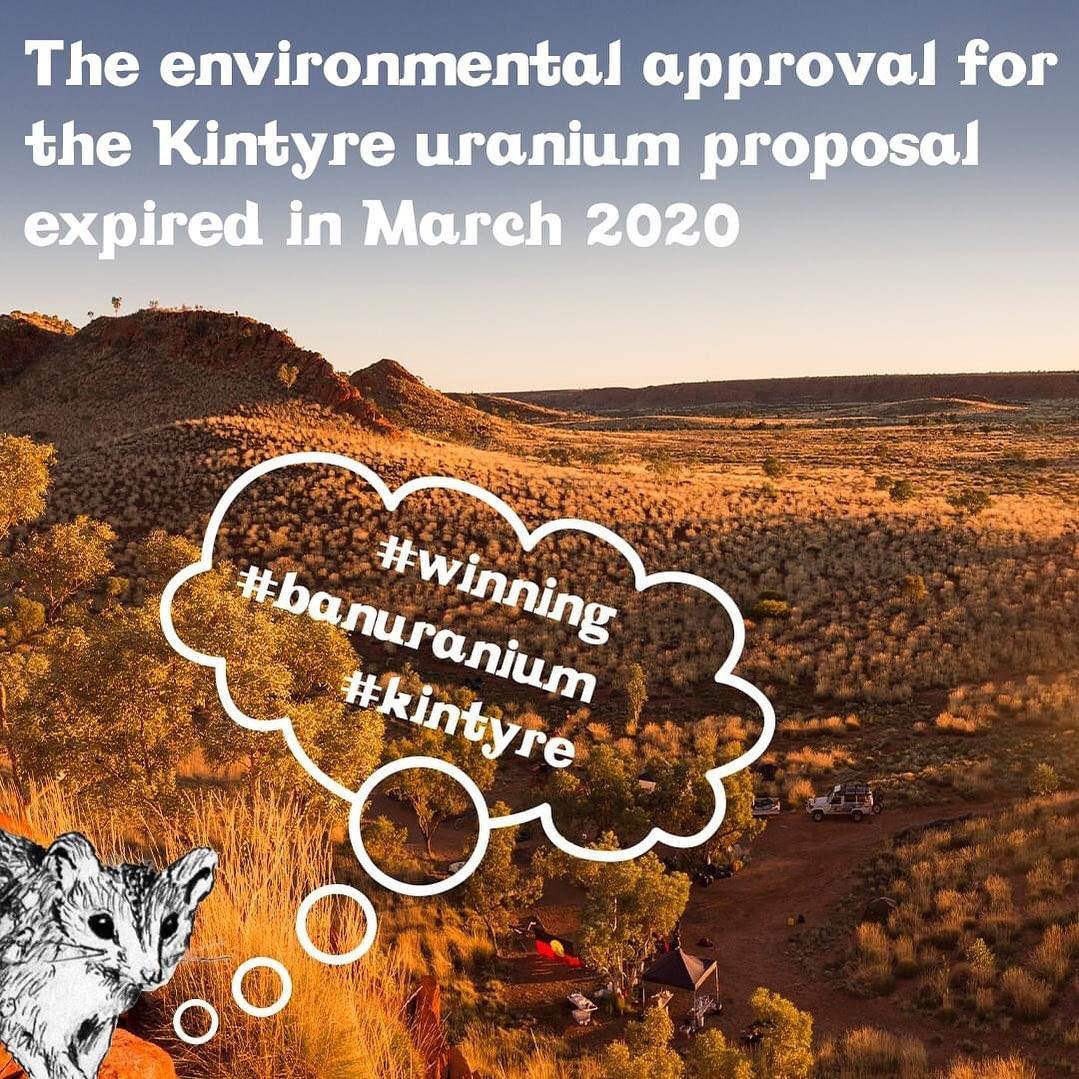 K-A Garlick at Nuclear Free WA, 6 May 20 The environmental approval for the Kintyre uranium project expired in March this year. So there is no valid environmental approval for Cameco. There can be no mining without changing or getting new environmental approval. This is great news for the campaign and shows the uncertainty of the uranium industry and Cameo who had applied for an extension but latter withdraw their application. It is great for the Martu community who have held strong and resisted over these many years. Let’s hope their beautiful country will one day be given back!
Keeping a track on all four projects and the process of asking questions on notice through State Parliament, we have found that Toro Energy, have failed to submit their annual environment reports on the Wiluna uranium project. This matter is now being pursued by the Department of Mines, Industry Regulation and Safety to ensure the report and plans are provided and any appropriate compliance action is taken.
Further good news, Yeelirrie is getting some really good attention with some upcoming media from the Freedom of Information process that has been investigated through the Australian Conservation Foundation that found an alarming lack of transparency in the Federal approvals process. The documents show that Cameco lobbied the former Federal resource Minister, Matt Canavan to fast track the approvals process and to change the conditions. If you haven’t seen the presentation from ACF, please click here.
We are excited organising a series of webinar nuclear talks that will focus on local, national and international impacts of Australian uranium industry. We will announce next week further details, but lock in Wednesday 10 June 5.30pm – 7 pm (tbc).
1 This month.


PETITION – To: Prime Minister Anthony Albanese and the Australian Labor Government
Chernobyl: The Lost Tapes – A good documentary on Chernobyl on SBS available On Demand for the next 3 weeks– https://www.sbs.com.au/ondemand/tv-program/chernobyl-the-lost-tapes/235274195556

19 May – Webinar- Webinar: No Nuclear Weapons in Australia
Start: 2026-05-19 18:00:00 UTC Canberra, Melbourne, Sydney (GMT+10:00)
End: 2026-05-19 19:30:00 UTC Canberra, Melbourne, Sydney (GMT+10:00)
20 May – Webinar – The dangerous world of AUKUS, US, military occupation and suppression of dissent

National Webinar, 20th May, 2026, 6.30pm AEST. Confronting laws restricting/suppressing protest speech and action
Speakers: Former Sen. Rex Patrick, Lawyer Nick Hanna ,Arthur Rorris ,Jorgen Doyle, Sen David Shoebbridge,
Facilitator Kelley Tranter.

of the week – Australians for War Powers Reform (AWPR)
To see nuclear-related stories in greater depth and intensity
 Antinuclear