USA’s new rules for nuclear workers – two weeks straight of 12 -hour days
 New rules for nuclear plant workers: 12-hour days for two weeks straight, Crains Chicago Business,20 Apr 20,
Exelon Corp., operator of the biggest U.S. nuclear fleet, says the move allows for “healthy workers to remain on site for more hours, reducing the need to bring in outside travelers and vendors.”
The Nuclear Regulatory Commission is already allowing six U.S. power plants to extend workers’ shifts, to as long as 12 hours a day for two weeks, and more may be coming. That’s up significantly from current standards that require people to get two-to-three days off a week when pulling shifts that long. Employees can also work as many as 86 hours in a week now, up from 72 hours.
To curb transmission of the virus, utilities also say they want to delay inspections that require people to work in close proximity. Environmental groups, though, warn the changes could have disastrous results, and worry they could lead to further deviations from safety rules.
“This is a step backward,” said Eric Epstein, chairman of Three Mile Island Alert, a Pennsylvania non-profit group. “It’s not a good idea to stretch workers and marginalize safety standards.”
The new rules come as at least 42 construction workers have tested positive for the coronavirus at a nuclear plant in Georgia where Southern Co. is building two new reactors. Last week, the utility and its partners announced they would reduce the 9,000-person workforce by 20 percent to slow the spread of the virus. The government considers nuclear power plants to be essential, and reactors will supply almost 21 percent of the country’s electricity this year…….
watchdog groups are concerned that employees may be overworked, leading to fatigue and potentially errors. “You want an alert workforce,” said Paul Gunter, a director at Beyond Nuclear. “You don’t do this with bus drivers, but they’re saying it’s OK for nuclear power plant workers.”
he NRC is also granting utilities utilities permission to defer some inspections as dozens of reactors go through the annual spring refueling cycle. These projects can involve more than 1,000 people converging on a power plant for a month or more of maintenance and testing.
Postponed Inspection
Pinnacle West Capital Corp. also has approval for longer hours and is postponing an inspection of components on the bottom of the reactor vessel at the 3.9-gigawatt Palo Verde nuclear plant in Arizona, the biggest U.S. nuclear plant. The company had initially planned to conduct the evaluation during its refueling outage this spring, but has now pushed that out until the next one, in late 2021. The utility owner determined that the task posed a potential risk of spreading the deadly virus, and could be safely delayed…….
Entergy Corp. is planning to defer some leak tests at pipes at its Grand Gulf reactor in Mississippi. The tests typically are due every 11 1/2 years, but will now be rescheduled for the next refueling outage in 18 months. Pushing that period out to 13 years won’t affect safety, the company said by email. And at the Indian Point facility north of New York City, Entergy is also seeking permission to postpone annual physical evaluations for firefighters……..https://www.chicagobusiness.com/utilities/new-rules-nuclear-plant-workers-12-hour-days-two-weeks-straight
April 20 Energy News — geoharvey

Opinion: ¶ “Covid-19 Could Be The End Of Globalization As We Know It” • The world we knew seems to have disappeared, only to be replaced by a strange new world where funerals and weddings occur virtually online. Work, if there is any, is done at home on a computer, people wear masks when they […]
Solar windows a step closer as Australian researchers team with glass manufacturer — RenewEconomy

Australian research team says its “game-changing” semi-transparent solar cell technology could be used to transform windows into active power generators. The post Solar windows a step closer as Australian researchers team with glass manufacturer appeared first on RenewEconomy.
via Solar windows a step closer as Australian researchers team with glass manufacturer — RenewEconomy
to April 20 – nuclear and climate news
Everything’s quieter, as we all batten down the hatches, and wait for that Covid 19 curve to flatten ….
The planet needs a green recovery. But are governments up for this? https://www.youtube.com/watch?v=Y1e7zXAGMKQ
Some bits of good news – Optimistic COVID Updates – Himalayan Mountaintops Visible for the First Time in 30 Years as Air Pollution Continues to Plummet in India.
AUSTRALIA
Coronavirus, climate change, and Australia’s national security.
Call for Australian government to delay review of its Environment laws. A brief Submission to the the Review of the Environment Protection and Biodiversity Conservation Act 1999.
Australia’s political revolving door between military industry and government – Reynolds and Reith.
NUCLEAR. Australian Radiation Protection and Nuclear Safety Agency (ARPANSA) is critical of Government propaganda on Kimba nuclear waste dump plan. Parliamentary committee finds that Kimba nuclear waste dump law may breach Indigenous human rights. 13 Australian peak Non Government Organisations seek stronger Environmental Law on Nuclear Issues. National Radioactive Waste Facility has strong community opposition – says Public Health Association of Australia. Uniting Church, South Australia, rejects National Radioactive Waste Bill as discriminatory against Aboriginal people.
CLIMATE. Bushfire Survivors for Climate Action taking legal action against NSW Environment Protection Authority. Amid climate change threat to the Murray Darling river system, the States haggle. Study finds that New South Wales rivers, lakes and lagoons are warming twice as fast as ocean. Climate Change Authority launches review into stalled Emissions Reduction Fund.
RENEWABLE ENERGY. Australia deploying new renewables at ten times global average. Australian renewables nudge milestone 25% share in last 12 months.
Rooftop solar owners are saving more while staying home. Australians installed 22,661 home battery systems in 2019 . Thousands rush to South Australia’s home battery scheme before subsidy winds back. South Australia Water to build solar farm on former oil refinery site. Australian scientists help unlock potential of flexible and wearable solar.
ARENA’s future clouded as Minister Angus Taylor fudges on board appointments “Performance issues” hobble output at ground-breaking solar farm.
INTERNATIONAL
2020 predicted to be Earth’s warmest year on record. Climate Change Multiplies the Threats of Infectious Diseases. To tackle the climate crisis, the world cannot return to normal after Covid-19. Changes for a low carbon economy are possible: we must advocate for this.
Artificial Intelligence in nuclear weapons and military systems.
Australian Radiation Protection and Nuclear Safety Agency (ARPANSA) is critical of Government propaganda on Kimba nuclear waste dump plan
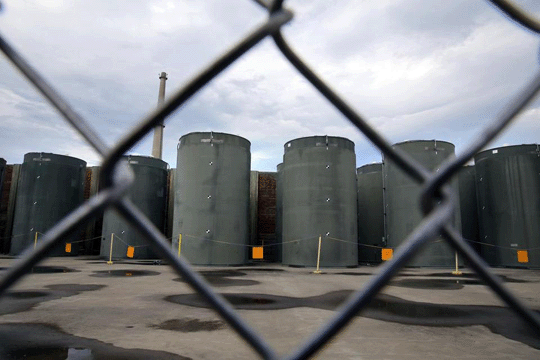
David Noonan, 20 Apr 2020, Australian Radiation Protection and Nuclear Safety Agency (ARPANSA) is  challenging govt propaganda more directly than we would usually expect:
“ARPANSA is aware that some stakeholders have interpreted ARPANSA’s decisions regarding the IWS as a requirement for relocation of the waste stored in the IWS, even suggesting that there is an urgent need for relocation. This is not correct. “
A Note so you may be aware of interesting matters raised in the ARPANSA submission to the Senate Inquiry:
Submission No.86 (7 pages) by the regulator Australian Radiation Protection and Nuclear Safety Agency (PDF 833 KB) has been posted on Senate Inquiry website: https://www.aph.gov.au/DocumentStore.ashx?id=41390f03-33ed-46be-bcb4-2913c6263b99&subId=680048
The UK reprocessed nuclear waste shipment is planned in 2022 – with ANSTO Lucas Heights the “only feasible destination”:
See p.3-4 under Headings:
Commonwealth waste holdings – role of the NRWMF
ANSTO
ANSTO
The Interim Waste Store (IWS) Facility
Additional ILW remains in the UK from reprocessing of HIFAR spent fuel, and is planned to be returned to Australia in 2022. Should the shipment take place at that time, the NRWMF will (again) not be available, which in all likelihood leaves Lucas Heights as the preferred (by ANSTO) option, and possibly the only feasible destination. ARPANSA is aware that the waste in this second shipment is likely to be immobilised and contained in a TN-81 cask with considerably less activity content than the first cask.
ARPANSA expects an application from ANSTO for approval to make a change with significant implications for safety under section 63 of the Regulations10, supported by a revised safety analysis report and an updated safety case, well in advance of the time the second shipment is intended to be loaded on a vessel for shipment to Australia.
So at this stage the UK reprocessed nuclear waste shipment is planned to go into Sydney (presumably to go over Port Kembla).
Unless the UK gov agree to a delay & that’s assuming the NRWMF is progressing to receive shipments of nuclear waste at a port in SA.
Noting the French gov did not agree to a delay back in 2015.
Also, ARPANSA making clear they intend an Application from ANSTO “well in advance of the time the second shipment is intended to be loaded on a vessel for shipment to Australia” – ANSTO didn’t do so in 2015.
So opponents of the nuclear waste plan and MUA may get some useful notice and can engage on that shipment publicly and formally.
If this UK shipment does go into Sydney (like the French reprocessed nuclear waste did in 2015), presumably they and MUA can raise a strong case that it shouldn’t later be moved a second time to ‘temporary’ (indefinite) above ground storage in SA, with a third move then required to a future disposal site…
And the federal gov case for an above ground interim (read indefinite) nuclear fuel waste store in SA is further significantly weakened.
Note – ARPANSA saying (p.4):
“ARPANSA has not raised safety concerns regarding storage of waste at the Interim Waste Store.”
(Regarding the IWS at Lucas Heights which holds the French reprocessed waste and was designed to also take the UK waste and operate for 40+ years)
And acknowledging ANSTO has identified two “contingency measures in short to medium term” – including what we are asking for:
- “Retention of the returned residues at ANSTO until the availability of a final disposal option”
( The other contingency measure is the ANSTO / Department / Minister’s plan for:
- Retention of the returned residues at ANSTO until the availability of the NRWMF for storage )
ARPANSA usefully counter some of the propaganda going around pro-dump circles on claimed ‘need’ to move key nuclear wastes:
“ARPANSA is aware that some stakeholders have interpreted ARPANSA’s decisions regarding the IWS as a requirement for relocation of the waste stored in the IWS, even suggesting that there is an urgent need for relocation. This is not correct. ARPANSA has not raised safety concerns regarding storage of waste at the IWS.”
On Transport:
ARPANSA flag a potential requirement (p.7) for “prior approval of a transport safety and/or security plan by ARPANSA” in a Safety Case before Site Licensing,
So we’d get an opportunity to publicly and formally contest these issues in consultation with the regulator, to show they are not ‘resolved’, before any licensing could happen.
Requiring community engagement / consultation on a ‘transport safety and/or security plan’ prior to Site licensing should become a specific ask of opponents of the plan.
“The safety case should acknowledge the existence of any unresolved issues and should provide information on work proposed to resolve these issues in future stages of the licensing process. Issues that have been resolved with ARPANSA and other stakeholders should be documented and form part of the safety case.
The safety of transport to, from and between radioactive waste management facilities should also be considered noting that the responsibility for transport of waste to a storage or disposal facility lies with the waste owner. This may require prior approval of a transport safety and/or security plan by ARPANSA.”
Note – To add to the call for the Senate Inquiry to be held over until Public Hearings can be held in Adelaide, Whyalla and Kimba:
For the Inquiry timeline to be extended to receive evidence of two ANSTO nuclear waste management reports that are due to ARPANSA by 30th June.
And for the Inquiry and community to be able to hear and consider the ARPANSA response and evaluation of ANSTO’s proposed Intermediate Level Waste plans.
- see p.4 on these two reports in the first two para’s at header: Implications of ILW generation and storage at Lucas Heights for the NRWMF
Also Note the fundamental point made well in the two-page ACF Briefing Note April 2010 to the Senate Inquiry
(attached to ACF submission No.97):
“Advancing responsible radioactive waste management in Australia”
https://www.aph.gov.au/DocumentStore.ashx?id=efb5c09a-d4eb-45cf-82e3-683fa4ef5b12&subId=680115
“There is no regulatory or radiological impediment to extended interim storage at Lucas Heights. ANSTO’s facility is prohibited from becoming a permanent disposal site, however there are no comparable constraints on it as a site for extended storage. Importantly, this approach also provides the ability to have an evidence based and open review of the best long-term management options.”
ANSTO’s own submission is seriously misleading in reading as though Lucas Heights can’t continue to store for decades the nuclear fuel wastes / Intermediate Level Wastes – just because it can’t be a permanent disposal site.
We have called for Extended Storage at Lucas Heights at least until scientifically defensible and publicly acceptable nuclear waste disposal plans may arise – which is one of the two accepted contingencies by the regulator ARPANSA & put forward by ANSTO.
The Committee are still posting submissions received, the Secretary summarises them for Members of Inquiry, and Members usually then decide on whom to call as Witnesses. The Inquiry may shortly hold a ‘tele-conference’ hearing in Canberra with Agencies (ANSTO, Department and ARPANSA) as way of getting started…
Bushfire Survivors for Climate Action taking legal action against NSW Environment Protection Authority
  ‘Kick them into action’: Fire group takes EPA to court over climate, SMH, By Peter Hannam, April 20, 2020 Lisa Roberts spent 25 years building a native plant business that was as sustainable as they come, with off-grid solar power and water harvesting, only to see it go up in flames in the recent bushfires.Her home and nursery in Wandella in southern NSW reduced to rubble, Ms Roberts fled to Canberra, powerless to act as fires threatened another venture in nearby Pialligo. Living in the smoke-choked capital also damaged her vocal cords, which have still not recovered. ‘Kick them into action’: Fire group takes EPA to court over climate, SMH, By Peter Hannam, April 20, 2020 Lisa Roberts spent 25 years building a native plant business that was as sustainable as they come, with off-grid solar power and water harvesting, only to see it go up in flames in the recent bushfires.Her home and nursery in Wandella in southern NSW reduced to rubble, Ms Roberts fled to Canberra, powerless to act as fires threatened another venture in nearby Pialligo. Living in the smoke-choked capital also damaged her vocal cords, which have still not recovered.
“A part of me totally rages at the world for its totally inadequate response to climate change,” Ms Roberts said. “Everybody’s safety is at risk.” That anger is being now channelled into a legal challenge against the NSW Environment Protection Authority. Bushfire Survivors for Climate Action, of which Ms Roberts is a member, began the suit last week with the NSW Environmental Defenders Office “to kick [the EPA] into action”, she said. EDO chief executive David Morris said the case, in the Land and Environment Court, would seek to force the EPA, which does not have a climate policy, to use its powers to keep communities safe from the increasingly severe impacts of a warming world. Mr Morris said the EPA was chosen as a test case among similar agencies nationally in part because of a section of the Protection of the Environment Operations Act 1997. That section requires the agency to “develop environmental quality objectives, guidelines and policies to ensure environment protection”. “It’s an opportunity for the EPA to recognise they have a legal obligation to take action,” he said. “They should have a policy and a plan to address the greatest threat to the environment.”…….. https://www.smh.com.au/environment/climate-change/kick-them-into-action-fire-group-takes-epa-to-court-over-climate-20200418-p54kzl.html
|
|
Climate Change Multiplies the Threats of Infectious Diseases
Climate Change Multiplies the Threats of Infectious Diseases, BY Daniel Ross, Truthout, April 19, 2020 
As the novel coronavirus continues to rage like a wildfire across the planet, its devastating toll has left many asking whether climate change — another multifaceted phenomenon with global reach — has played a part in spreading, even triggering, the pandemic. Some, like Katharine Hayhoe, a climate change scientist and professor of public policy at Texas Tech University, have been able to provide answers.
“Climate change didn’t cause the pandemic, and climate change directly causes very few of them,” Hayhoe told Truthout. “But what climate change does is it interacts with, and in many cases has the potential to exacerbate the impacts.”
For those well-versed in the mechanics of climate change, this comes as no surprise — scientists, policy makers and other experts have long acknowledged the links between global warming and the spread of infectious diseases, promulgating the sorts of findings described in the wide-ranging 2018 Intergovernmental Panel on Climate Change report, detailing what efforts are needed to limit global warming to 1.5 degrees Celsius.
Dig down, and this multilayered issue has knock-on effects — from the way rising temperatures exacerbate certain health problems to the disruptions that extreme weather events have on the global supply chain — that are inextricably linked with one another. What’s more, the governmental response to the coronavirus crisis, say experts, offers a troubling glimpse into what might happen in the future as the global thermometer inches upwards.
“What it underscores in the first instance is how underprepared we are,” said Sherri Goodman, a senior fellow at the Wilson Center’s Environmental Change and Security Program and Polar Institute.
As a former first deputy undersecretary of defense in environmental security, she coined the term “threat multiplier” to describe climate change’s kaleidoscopic impacts.
“Our systems — institutional, infrastructure, health, emergency response — could all be overwhelmed from the climate crisis,” Goodman said, warning that the time for wholesale climate resiliency preparedness is upon us. “What we have now is history accelerating itself — things are happening so fast.”
“Where Can These People Go?”
Perhaps most salient in terms of current events is the issue of zoonotic diseases spread between animals and humans, like the COVID-19 virus, which is believed to have originated in bats before being transferred to humans via scaly animals like pangolins. As the world’s population growth continues to rise, natural habitats will continue to be encroached upon and destroyed, not only removing valuable carbon sinks like rainforests but creating environments in which notorious zoonotic disease carriers like bats and rats thrive.
Climate change is also likely to encourage the spread — both in terms of seasonal risk and geographic reach — of “vector-borne” diseases. These are illnesses like West Nile Virus and Lyme Disease that are borne by mosquitoes, ticks and fleas, and already account for a significant number of deaths annually.
According to Sheri Weiser, a professor of medicine at the University of California, San Francisco (UCSF), there’s still much to learn about how rising temperatures are impacting the spread of infectious diseases. “But we know the common cause of climate change and COVID-19 — the globalization that’s driving fossil fuel emissions — contributes to the pre-conditions that pave the way for viruses like that,” Weiser said.
Indeed, there’s already an extensive library of medical literature detailing how climate change can impact human health. Extreme weather events — a symptom of a warming planet — can lead to fluctuating temperatures which have been shown to contribute to and worsen cardiovascular and cerebrovascular diseases, kidney disorders and a host of other illnesses. On top of that, extreme heat and humidity can limit the effectiveness of certain medications used to treat these conditions………
the Trump administration’s slash-and-burn approach to the scientific wing of the federal government is the elephant in the room during the COVID-19 pandemic.
Last September, for example, the U.S. Agency for International Development (USAID) effectively shuttered its PREDICT program, which was charged with identifying and combating new emerging viruses. With the COVID-19 death toll in the U.S. now well into five figures, USAID has injected more than $2 million to kickstart the program, at least temporarily. The Environmental Data and Governance Initiative recently found that the Trump administration has repeatedly, “and sometimes successfully,” sought to cut funding aimed at the Centers for Disease Control and Prevention for fighting global pandemics. Nevertheless, the Trump administration isn’t alone in neglecting science and research; for nearly two decades now, the amount of federal funds funneled toward basic research has shrunk markedly……. https://truthout.org/articles/climate-change-multiplies-the-threats-of-infectious-diseases/?eType=EmailBlastContent&eId=71649a96-ad00-4169-afc2-bb1b572e3345
David Attenborough – humans have last chance to save the planet
|
Attenborough’s grim warning on last chance, Herald Sun, Alison Kershaw, Press Association
April 19, 2020 Sir David Attenborough has urged people to “stop waste of any kind”, saying the world is precious and should be “celebrated and cherished”.
The broadcaster and naturalist warns humans have a “last chance” to change their behaviour and save the planet, as he urged politicians to address “the biggest problem humanity has ever faced”. In an interview on the BBC’s Andrew Marr Show, Attenborough, 93, said it will be the younger generation who will have to make changes because “they will be able to see the consequences of what they do”. He added: “My lot are dying off and we are the ones that caused the problem.” He suggested people should see the world and their time in it as precious, saying “that’s the fundamental attitude”. ….. Attenborough has worked with Netflix to produce an upcoming documentary called A Life On Our Planet which looks at the challenges facing earth and what can be done to address them. https://www.heraldsun.com.au/news/breaking-news/attenboroughs-grim-warning-on-last-chance/news-story/f0dd55d3c63f52df76909dbf4701c4ff |
|
After the pandemic, – the need for a new economic consensus

New Statesman 16th April 2020, To tackle the climate crisis, the world cannot return to normal after
Covid-19. This moment must be used to build a new economic consensus founded on justice, care and sustainability. The same fractures exposed by this pandemic are the fault lines along which the battle for climate justice is fought.
Many of the people most vulnerable in the current crisis will be worst affected by environmental breakdown, while those who are enriched by this pandemic are likely to benefit in the future. Reports this week that UK hedge funds are cashing in on Covid-19 ring eerily similar to now regular stories of investors betting on climate collapse, water
scarcity and crop failure, and investing in the infrastructures and technologies of disaster.
And just as many nations and communities have been abandoned in our response to this pandemic, it is all too easy to imagine a future in which communities from Jakarta to east Yorkshire are left to fend for themselves amid accelerating climate breakdown. Indeed, to imagine it one has only to look at the present.
Post-crisis stimulus should be directed towards green infrastructure and innately low carbon forms of work like health and social care, proven so vital and so undervalued by this crisis. Debts must be written off to allow those countries most vulnerable to climate crisis to build resilience against it. And having exposed austerity as an ideological choice, rather than a necessity, we must ensure these mistakes are never repeated, and social safety nets are both valued and strengthened.
Rapid Transition Alliance 16th April 2020, Andrew Simms: In the debate over the global response to Covid19 a battle of hashtags has broken out between those urging a quick return to ‘normal’, and those saying that ‘normal’ had many problems and the crisis has revealed both the need and an opportunity for changing direction, and a shift of economic purpose.
How rooftop solar owners are saving more while #stayinghome — RenewEconomy

#Stayinghome to help fight Covid-19 is not all bad news for power bills. We asked a number of solar households what they were experiencing at home. The post How rooftop solar owners are saving more while #stayinghome appeared first on RenewEconomy.
via How rooftop solar owners are saving more while #stayinghome — RenewEconomy
“Performance issues” hobble output at ground-breaking solar farm — RenewEconomy

The output at one of Australia’s landmark solar projects, and one of the biggest solar farms in Queensland, has been hobbled by “performance issues.” The post “Performance issues” hobble output at ground-breaking solar farm appeared first on RenewEconomy.
via “Performance issues” hobble output at ground-breaking solar farm — RenewEconomy
The women who told Chernobyl’s story — Beyond Nuclear International

Writers captured the pain — and the truth
via The women who told Chernobyl’s story — Beyond Nuclear International

April 19 Energy News — geoharvey

Opinion: ¶ “Designing An End To A Toxic American Obsession: The Lawn” • Lawns cover 2% of the US. Maintaining them produces more greenhouse gases than they absorb. They are biodiversity deserts that have contributed to vanishing insect populations. They require more irrigation than any agricultural crop grown in the country. But there are alternatives. […]
Parliamentary committee finds that Kimba nuclear waste dump law may breach Indigenous human rights

|
Kimba nuclear waste dump law risks breaching Indigenous human rights, committee finds https://www.abc.net.au/news/2020-04-16/risk-kimba-nuclear-dump-may-breach-human-rights-committee-says/12154474 ABC North and West SA By Gabriella Marchant 17 Apr 20, A cross-party parliamentary committee has found “significant risk” that local Indigenous groups were not consulted about a proposed nuclear waste facility to a standard required under international law.
Key points:
A report by the Joint Committee on Human Rights found that given Barngarla traditional owners unanimously vetoed the proposed facility, the Federal Government’s decision to press ahead with a bill to build it risked breaching Barngarla rights to culture and self-determination. The proposed site outside Kimba on South Australia’s Eyre Peninsula is on land traditionally associated with the Barngarla people and would store Australia’s low to medium-level radioactive waste, most of which is created by nuclear medicine. Two non-binding independent ballots were conducted to gauge community support for the proposal; one for residents in the local government area surrounding the site, the other among Barngarla Determination Aboriginal Corporation members, who largely did not qualify for the first ballot. While more than 60 per cent of voters in the Kimba local government ballot supported the facility, 100 per cent of Barngarla voters rejected the proposal. Rights ‘may not be sufficiently protected’The committee found the site’s nomination seemed to “rest heavily on the local council ballot from which native title holders were excluded, which the Minister uses as evidence of local community support”.
|
|
1 This month.

PETITION – To: Prime Minister Anthony Albanese and the Australian Labor Government
Chernobyl: The Lost Tapes – A good documentary on Chernobyl on SBS available On Demand for the next 3 weeks– https://www.sbs.com.au/ondemand/tv-program/chernobyl-the-lost-tapes/235274195556

19 May – Webinar- Webinar: No Nuclear Weapons in Australia
Start: 2026-05-19 18:00:00 UTC Canberra, Melbourne, Sydney (GMT+10:00)
End: 2026-05-19 19:30:00 UTC Canberra, Melbourne, Sydney (GMT+10:00)
20 May – Webinar – The dangerous world of AUKUS, US, military occupation and suppression of dissent

National Webinar, 20th May, 2026, 6.30pm AEST. Confronting laws restricting/suppressing protest speech and action
Speakers: Former Sen. Rex Patrick, Lawyer Nick Hanna ,Arthur Rorris ,Jorgen Doyle, Sen David Shoebbridge,
Facilitator Kelley Tranter.

of the week – Australians for War Powers Reform (AWPR)
To see nuclear-related stories in greater depth and intensity
 Antinuclear