Nuclear front group Energy Policy Institute joins with NuScam to promote Small Nuclear Reactors to Australia

A top Trump administration official has urged Australia to join the US in researching and building small “modular” nuclear reactors.Suzanne Jaworowski, chief of staff and senior adviser at the US Department of Energy, said about 45 companies in the US were working on small modular reactors and one could be built in Australia by the mid-2020s
“You could have up to 12 reactor modules each producing 60MW, even more reliably than coal and gas,” she told The Weekend Australian, recommending business and government work with NuScale Power, which is building an SMR in Idaho.
“They are at a point where they could work with a country like Australia,” she said.
Australia’s prohibition on nuclear energy, in force since the late 1990s, was “unfortunate”, she said. The growing push for zero emissions by mid-century could only be achieved with nuclear power, on current technology……
A federal inquiry into nuclear power suggested a partial reversal of the 1998 legislative ban on nuclear energy late last year. In NSW, state One Nation leader Mark Latham and state Nationals leader John Barilaro are pushing to dump a similar state ban.
Ms Jaworowski, who had to cancel a planned trip to Australia this year because of the coronavirus, said nuclear energy faced a “perception problem”. …… Ms Jaworowski said nuclear energy in the US could be supplied from small modular reactors at about $55 a MwH, “which is very competitive with other forms of energy”.
Liddell coal power station in NSW, with 2000MW capacity, is scheduled to close in 2023. The federal government, which has said lifting the nuclear ban would require bipartisan support, is putting together a “technology road map” to ensure large cuts in carbon emissions by 2050.
Ms Jaworowski said nuclear energy in the US could be supplied from small modular reactors at about $55 a MwH, “which is very competitive with other forms of energy”.
The Energy Policy Institute said the US, Russia and China were in a three-way contest to dominate the global nuclear generation market with SMRs. “The nuclear competition will be good for Australia because we need greater energy security than we’ve got at present,” institute executive director Robert Pritchard said. https://www.theaustralian.com.au/world/us-urges-australia-to-consider-nuclear/news-story/f555996beccc347f6b57bb9d1c126f77
A major scorecard gives the health of Australia’s environment less than 1 out of 10
|
A major scorecard gives the health of Australia’s environment less than 1 out of 10, The Conversation, Albert Van Dijk, Professor, Water and Landscape Dynamics, Fenner School of Environment & Society, Australian National University, Luigi Renzullo, Senior Research Fellow, Australian National University, Marta Yebra, Senior lecturer, Australian National University, Shoshana Rapley, Research assistant, Australian National University, March 30, 2020
2019 was the year Australians confronted the fact that a healthy environment is more than just a pretty waterfall in a national park; a nice extra we can do without. We do not survive without air to breathe, water to drink, soil to grow food and weather we can cope with.Every year, we collate a vast number of measurements on the state of our environment: weather, oceans, fire, water, soils, vegetation, population pressure, and biodiversity. The data is collected in many different ways: by satellites, field stations, surveys and so on.
We process this data into several indicators of environmental health at both national and regional levels. The report for 2019, released today, makes for grim reading. It reveals the worst environmental conditions in many decades, perhaps centuries, and confirms the devastating damage global warming and mismanagement are wreaking on our natural resources. Immediate action is needed to put Australia’s environment on a course to recovery. Environment scores in the redFrom the long list of environmental indicators we report on, we use seven to calculate an Environmental Condition Score (ECS) for each region, as well as nationally. These seven indicators – high temperatures, river flows, wetlands, soil health, vegetation condition, growth conditions and tree cover – are chosen because they allow a comparison against previous years. In Australia’s dry environment, they tend to move up and down together, which gives the score more robustness. See the interactive graphic below [on original] to find the score for your region. Nationally, Australia’s environmental condition score fell by 2.3 points in 2019, to a very low 0.8 out of ten. This is the lowest score since at least 2000 – the start of the period for which we have detailed data. Condition scores declined in every state and territory. The worst conditions were seen in the Northern Territory (0.2 points), New South Wales (0.3 points) and Western Australia (0.4 points), with the latter also recording the greatest decline from the previous year (-5.7 points). What is most striking is that almost the entire nation suffered terrible environmental conditions in 2019. In each case, the changes can be traced back to dry, hot conditions. Only parts of Queensland escaped the drought…… Even before the fires, 40 plant and animal species were added to the threatened list in 2019, bringing the total to 1890. Following the fires, more species are likely to be added in 2020. We’re not doomed yetLast year was neither an outlier nor the “new normal” – it will get worse. Greenhouse gas concentrations continued to increase rapidly in 2019, causing the temperature of the atmosphere and oceans to soar. Australia’s population also continued to grow quickly and with it, greenhouse gases emissions and other pollution, and our demand for land to build, mine and farm on. Whether we want to hear it or not, last year represented another step towards an ever-more dismal future, unless we take serious action. https://theconversation.com/a-major-scorecard-gives-the-health-of-australias-environment-less-than-1-out-of-10-133444 |
|
|
USA nuclear industry uses coronavirus to gouge $billions of tax-payer money
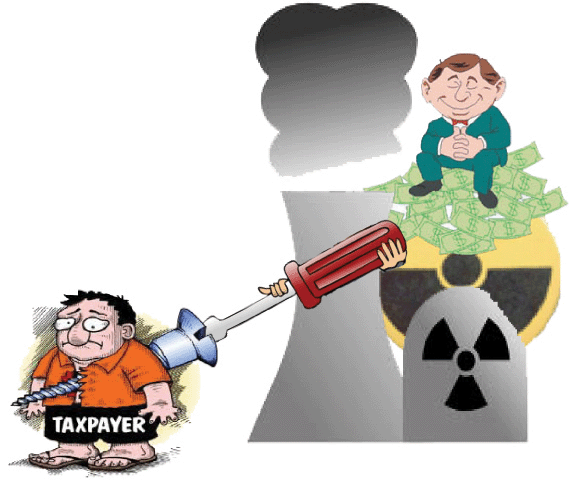 Out of control?, While industry looks for handouts, NRC gives nod to reduced safety oversight, https://wordpress.com/read/feeds/72759838/posts/2643325963By Linda Pentz Gunter 29 Mar 20, It was no surprise really, when the first to line up with outstretched palms as Congress debated and formulated its now passed $2 trillion coronavirus-prompted emergency relief bill, were nuclear corporations.The sinking nuclear power industry spotted an economic lifeline and couldn’t wait to make a grab for it. The Nuclear Energy Institute, the lobbying arm of the nuclear power industry, rushed off a letter to congressional leaders asking for a 30% tax credit and waivers for existing regulatory fees. Out of control?, While industry looks for handouts, NRC gives nod to reduced safety oversight, https://wordpress.com/read/feeds/72759838/posts/2643325963By Linda Pentz Gunter 29 Mar 20, It was no surprise really, when the first to line up with outstretched palms as Congress debated and formulated its now passed $2 trillion coronavirus-prompted emergency relief bill, were nuclear corporations.The sinking nuclear power industry spotted an economic lifeline and couldn’t wait to make a grab for it. The Nuclear Energy Institute, the lobbying arm of the nuclear power industry, rushed off a letter to congressional leaders asking for a 30% tax credit and waivers for existing regulatory fees.
One of NEI’s apparently needy recipients is the financial fiasco known as Vogtle 3 and 4, the new nuclear power plant construction project in Georgia, which is already more than five years behind schedule and is projected to cost $28 billion, double the original predicted price. The two new Georgia reactors aren’t needed, and their continued slow progress is by no means a matter of national security right now — or at all. But the NEI would like to see a nice fat grant go to Georgia Power to continue construction there, even though the company has already received two federal loan guarantees totaling $12 billion. In addition, the company is also gouging ratepayers in advance to cover the costs for the two reactors through the state’s Construction Work in Progress law, with no guarantee that they will ever reach completion. Before long, the nuclear weapons manufacturers got in on the act as well. Wrote the group, Code Pink: “Boeing has the audacity to demand a $60 billion taxpayer bailout for their shareholders and CEO.” Boeing is responsible for the Minuteman Intercontinental Ballistic Missiles, to be replaced this year with the misleadingly named Ground Based Strategic Deterrent. Boeing has also already received a $26.7 million contract from the U.S. Navy for Trident II D5 ballistic missile maintenance, rebuilding and technical services. Astonishingly, it was ultra conservative senator, Ted Cruz, who was one of those who pushed back against the corporate bailouts for the likes of Boeing and GE, manufacturer of the ill-fated Fukushima nuclear power plants and similar boiling water reactors in the US that are meltdowns waiting to happen. Cruz tweeted that “some are pushing for a special carve-out just for Boeing & GE. That would be WRONG. Millions are losing jobs; we don’t need bailouts or corporate welfare — those companies should participate in the same liquidity programs as everyone else.” But Boeing apparently got its wish. A $17 billion federal loan package contained in the stimulus bill passed by both the House and Senate and signed by President Trump on March 27, “was crafted largely for the company’s benefit,” according to reporting in the Washington Post. Boeing may also be able to dip its fingers into the “$58 billion the Senate package is providing in loans for cargo and passenger airlines, as well as the $425 billion in loans it is allocating to help firms, states and cities hurt by the current downturn,” wrote the Washington Post, even though, as Code Pink pointed out, alluding to the two 737 MAX disasters, Boeing is responsible for “defective civilian planes that plummet from the sky in mid-flight.” Boeing shares soared more than 24% on the day the Senate bill passed. The US is already spending $35.1 billion a year on its nuclear weapons arsenal. As the timely graph below [on original] from ICAN points out, this money could be redirected to a wealth of essential needs that would help quell the novel coronavirus in the US. … It’s not yet clear what portion of the stimulus money might go to the nuclear power industry, but the renewable energy sector took a hit. According to the San Diego Union Tribune, “the renewable energy industry had asked for — but did not get — extensions of deadlines related to construction or completion of solar and wind projects, without which they could lose access to time-sensitive tax credits. Industry associations were hopeful they’d be included in any later relief package.” There is also a $400 billion slush fund in the present legislation which can be used for loans and loan guarantees for large companies. Watch for the nuclear power industry to line up for a share of that in addition to its earlier pitch for a $23 billion bailout, which Lukas Ross, senior policy analyst with Friends of the Earth, called “a new low bar,,” and an attempt to use the coronavirus crisis “to try and brazenly grab more cash.” Meanwhile, the US Nuclear Regulatory Commission (NRC), in its usual fashion, has used the opportunity presented by the corona crisis to relax its already somnific safety oversight even more, and will allow nuclear power plant operators to defer safety maintenance, inspections and fitness for duty requirements during the outbreak. “Regulations to ensure safety should be strengthened at a time like this — not weakened,” Kevin Kamps, radioactive waste specialist at Beyond Nuclear, told Power Magazine. “It means operating nuclear plants without basic safety inspections.” One measure would be to allow workers to put in longer shifts than safety regulations allow, a measure that would place unnecessary additional “stress and strain on workers that need to be fully attentive and alert in sensitive jobs,” Kamps told the Carolina Public Press. He recommended powering down reactors instead, particularly given the current reduction in demand. But if the coronavirus pandemic causes higher than usual absenteeism among vital nuclear plant personnel, the NRC has a plan for that. Under normal circumstances, operating with too few control room staff is a safety violation. But under the coronavirus conditions, this would be exempted, or forgiven by the NRC, creating an added safety risk. During a recent NRC and industry telephone meeting on the topic, Beyond Nuclear’s director of reactor oversight, Paul Gunter, asked whether the NRC had supplied its reactor site personnel with sufficient protective equipment, masks, and respirators, as per the Centers for Disease Control guidelines. “They blew it off, Gunter said. “They claimed it was a matter for OSHA.” Industry representatives on the call remained silent on the matter. Gunter added that Kamps’s suggestion to power down reactors in regions where the demand was reduced and excess generating capacity was already high, could allow for resting the remaining workforce and keeping them healthy and ready to replace workers at still operating plants where personnel have been hit hardest by reactor operator shortages and extended security shifts. “We should be planning on how to keep stable and safety-compliant electricity going,” Gunter said. “One way would be to create a protected pool of sequestered nuclear utility workers. But that is not happening. The industry is dictating to the regulator what the agenda will be.” So, business as usual. |
|
Coronavirus Shows Us What Our Future Could Look Like During Climate Crisis

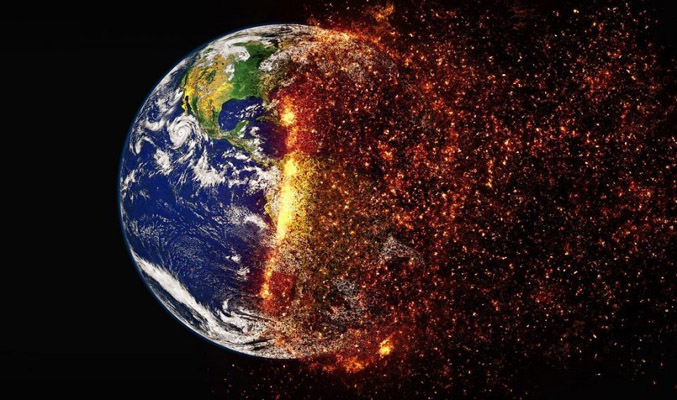
Coronavirus Shows Us What Our Future Could Look Like During Climate Crisis, BY Sharon Zhang, Truthout, March 29, 2020 The COVID-19 pandemic has rapidly been absorbed into our collective consciousness, remaking the fabric of our lives. Suddenly, millions are sheltering in place, strangers have started wishing each other well when exiting grocery stores, people have stopped touching their faces and shelves that are normally stocked with bleach and hand sanitizer are barren.
For many, the looming sense of dread is a new sensation….
But for those of us who have lived in acute awareness of the reality of the climate crisis, the current state of pandemic dread feels awfully familiar — just a more imminent version of the dread about the climate that we have been feeling for years.
It’s a psychological phenomenon known informally in the climate community as climate anxiety, climate grief or eco-anxiety…….
Though the pandemic-panic that Mull and others have written on has been ongoing for the past few weeks, climate writers started opening up about their climate grief years ago. …….
But it’s not just psychological trauma that these two crises share — if you take the time to look, the similarities run wide and deep. These are twin worldwide crises that require global cooperation to defeat; they will ravage the way of life as we know it; they will affect, in one way or another, nearly every single person on Earth.
The economy as we know it — rather, as we knew it three months ago — will be a thing of the past if we let the climate crisis continue unmitigated…….
Economists are currently struggling to model all of the short-term effects of the pandemic, so many of those remain unknown. Climate researchers, however, have had much more time to model the future economic impacts of the climate crisis. By 2090, in the U.S. alone and under the same high emissions scenario, NCA researchers predict that costs from mortality due to extreme temperatures will total $141 billion a year, losses of coastal property will total $118 billion a year, and labor losses will cost $155 billion a year. That’s equivalent to a Hurricane Katrina every single year, just from lost labor.
The health care system, too, will be overwhelmed by the climate crisis, just as hospital beds are rapidly being filled by COVID-19 patients. In some places, the climate crisis has already given a preview of this: In 2018, record heat waves caused U.K. hospitals to utilize emergency procedures, when people were being sent to the hospital in such an overwhelming volume that ambulances had to line up outside.
Though COVID-19 is causing hospitals to fill up simultaneously nationwide, “climate-related events will be more limited in their spatial scale, but will be increasingly frequent over time,” says Kristina Dahl, a senior climate scientist at the Union of Concerned Scientists. A heat wave in San Francisco won’t set the whole country ablaze, but it could overwhelm the local health care system.
The key difference between illness caused by a pandemic and the climate crisis, Dahl points out, is that it’s much easier to trace the illness caused by the former. “Things like hurricanes and heat waves and wildfires have always occurred,” she says, but, “to some extent, we know that we are amping them up by adding greenhouse gases to the atmosphere.”
This is likely, in part, why the federal government has quickly pivoted to action on COVID-19, while greenhouse gases have remained largely untouched by Congress for decades. While right-wing media and politicians denied the consequences of inaction on the virus just weeks ago, they have quickly had to change their tune as the spread of the virus has become undeniable. Whereas with long-term, gradual change, it’s easy for deniers to blame such things as the severity of the bushfires in Australia on anything but increasingly hot and arid conditions caused by climate change.
The ruling class has also had less motivation to address the climate crisis because the people suffering the most are, disproportionately, already marginalized. Poor, Black and health-compromised people are and will be the hardest hit by both crises — and some are already being affected by both at once. Air pollution is continually one of the most pronounced issues of environmental justice, and physicians have said those with continual exposure to air pollution are likely to be more vulnerable to the effects of coronavirus……..
“Coronavirus has made so clear that global issues can’t be easily categorized as just a health issue or just an environmental issue,” says says Kristina Dahl, a senior climate scientist at the Union of Concerned Scientists. “They really encompass our broader economy and encompass or entire social systems and ways of life.” ….. https://truthout.org/articles/coronavirus-shows-us-what-our-future-could-look-like-during-climate-crisis/?eType=EmailBlastContent&eId=5e383daa-77a3-48e3-a6f5-f82b689f50fc
Prime Minister Shinzo Abe and the “nuclear village” hoped the Olympics would normalize Japan’s radiological aftermath
 Abe’s decision to host the Olympics in the first place, and to plan to start the torch relay in Fukushima, as mere pretense that all is well in the prefecture, despite widespread contamination that continues since 2011.
The claim about the necessity of nuclear power makes little sense. Since 2011, the country has been generating only a fraction of the nuclear electricity it used to generate, and yet the lights have not gone off in Japan.
the Abe government seems to be involved in lowering incentives for the development of solar energy, and instead promoting nuclear power.
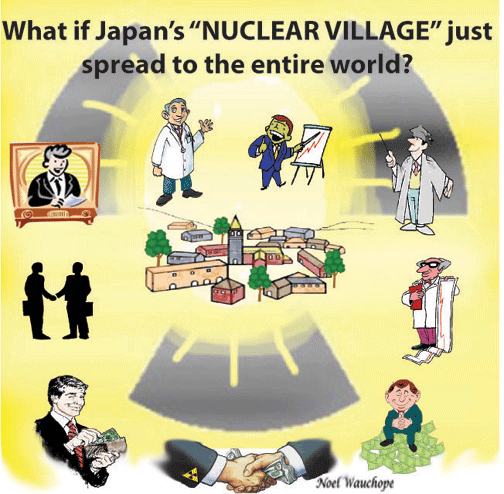
Efforts by Prime Minister Abe to support the failing and flailing nuclear sector in Japan are indicative of the significant political power wielded by the “nuclear village,” the network of power companies, regulators, bureaucrats and researchers that control nuclear and energy policy. The actions of the nuclear village is one of the factors responsible for the Fukushima accident.
Nuclear flame fizzles in Japan, But leaders still cling to failing nuclear power
Prime Minister Shinzo Abe and the “nuclear village” hoped the Olympics would normalize Japan’s radiological aftermath. But the Fukushima effect has meant zero nuclear exports, leading the government to shore up the nuclear industry at home at the expense of renewables. Beyond Nuclear, By Cassandra Jeffery and M.V. Ramana 29 Mar 20, Last week, International Olympic Committee President Thomas Bach and Japanese Prime Minister Shinzo Abe agreed to delay the 2020 Summer Olympic Games because of the COVID-19 pandemic. However, they will keep the Olympic flame burning in Fukushima Prefecture. The torch relay route was to have begun there, a poor decision, given the meltdown of multiple reactors in Fukushima nine years ago in March 2011. While radiation levels may have declined since 2011, there are still hotspots in the prefecture, including at the sports complex where the torch relay would have begun and along the relay route.
The persistence of this contamination, and the economic fallout of the reactor accidents, should remind us of the hazardous nature of nuclear power. Simultaneously, changes in the economics of alternative sources of energy in the last decade invite us to reconsider how countries, including Japan, should generate electricity in the future….
opposition is evident in Japan too, where opinion polls show overwhelming lack of support for the government’s plans to restart nuclear plants that have been shut down after the Fukushima accidents. Continue reading
March 29 Energy News — geoharvey

Opinion: ¶ “Off-The-Radar Renewable Energy Explosion After COVID-19 Dust Settles” • Renewable energy advocates raised the alarm when it became clear that the new $2 trillion stimulus package will not shine so kindly on wind, solar, and other clean tech. But the groundwork for a low carbon revolution was laid by another stimulus bill, passed […]
NSW approves coal mine expansion under drinking water catchment — RenewEconomy

NSW Berejiklian government quietly waves through planning approvals for coal mine expansion under Sydney drinking water catchment, ignoring criticism from environmental groups. The post NSW approves coal mine expansion under drinking water catchment appeared first on RenewEconomy.
via NSW approves coal mine expansion under drinking water catchment — RenewEconomy
Sydney car dealer makes electric cars available on subscription — RenewEconomy
Hyundai’s Kona Electric and Ioniq can now be booked under subscription model from Northern Beaches auto dealer Col Crawford. The post Sydney car dealer makes electric cars available on subscription appeared first on RenewEconomy.
via Sydney car dealer makes electric cars available on subscription — RenewEconomy
Covid-19 could stop new Australia wind and solar projects, wipe out global growth — RenewEconomy

The global Covid-19 pandemic is expected to hit planned wind and solar projects in Australia and other countries particularly hard, and wipe out any anticipated growth in renewables deployment in 2020, according to a new study. The Norway-based Rystad Energy says it had expected global solar additions to grow 15% to 140 gigawatts in 2020,……
via Covid-19 could stop new Australia wind and solar projects, wipe out global growth — RenewEconomy
What to do, in the time of pandemic?
Yes, this is an aberration from the real focus of this website.
 BUT – we’re all going to have to deal with the time of pandemic.
The positives. Much kindness is going on – people offering help to the disabled, the elderly … the courage of health workers – the music – the balcony cheerers, the social networking, the chance to be still at home, and reflect.
The negatives. The vulnerable millions of the poor and crowded, in India, and elsewhere – the losses of jobs and income, the loneliness, the family stress, domestic violence, the “digital divide” – for those without smartphones and computers. The big corporations that will emerge as the winners.
What to do? Here’s my suggestion, (if you can) :
Australia – lucky to be Nuclear- Free, in the time of Pandemic – theme for April 2020
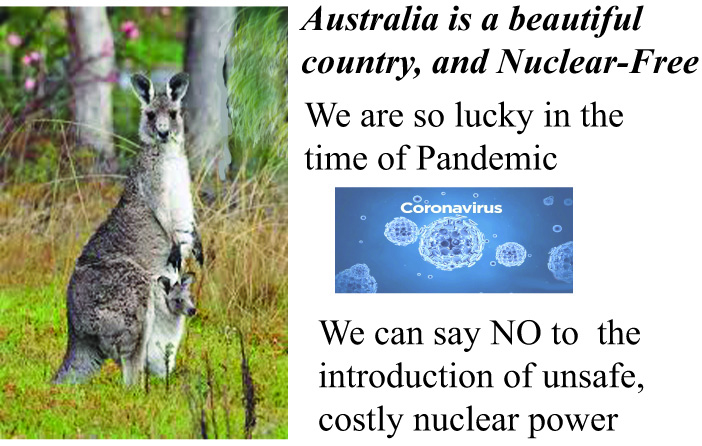
Australia really is “The Lucky Country” when it comes to nuclear issues, in this pandemic situation. . We don’t have to worry about staffing and securing dangerous nuclear reactors, nuclear waste facilities, nuclear submarines, nuclear weapons.
We do have one unnecessary nuclear research reactor – the industry’s “foot in the door”, and its high level wastes. The government may well be quietly proceeding with imposing a nuclear waste dump on Kimba, South Australia, – while everybody is distracted by the Covid19 .
The nuclear lobby is lobbying hard in the Australian Parliament and in the States, to overturn Australia’s very wise nuclear bans. This lobby is working for oversees supporters, “small nuclear power (SMRs)” companies like NuScam. In the present time of pandemic, Australians, especially politicians, should think about this – the exorbitant tax-payer cost of SMRs, along with the same dangers as in the large reactors. And with the advantages of renewable energy, especially home rooftop solar.
With the pandemic, and the bushfires, we now must strengthen the Environment Protection and Biodiversity Conservation Act (EPBC)
in the immediate term we need to advocate for vital improvements to the EPBC. It is extraordinary that the Howard legacy of deliberately excluding a project’s climate impacts from the triggers to require assessment still hasn’t been remedied. That must now be fixed, as must the fact that there is no mechanism for assessing the cumulative ecological impacts of various proposals. After this summer’s destruction of huge areas of remaining healthy ecosystems, we need to institute, in both legislation and the practice of assessment, a presumption of protection instead of a culture of managed destruction.

|
With the climate crisis and coronavirus bearing down on us, the age of disconnection is over https://www.theguardian.com/commentisfree/2020/mar/28/with-the-climate-crisis-and-coronavirus-bearing-down-on-us-the-age-of-disconnection-is-overTim Hollo
We can no longer pretend that we’re separate from each other and from the natural world @timhollo, Sat 28 Mar 2020 Everything is connected. It’s hard to imagine right now that, just weeks ago, the truism of ecological politics was treated as hippy nonsense by mainstream politics.
Announcing the statutory review of the commonwealth’s Environment Protection and Biodiversity Conservation Act (EPBC) last October, the Morrison government pitched it as an opportunity to weaken the Howard era laws even further and make it easier still for environmentally destructive projects to be approved. And, regardless of clear statements from scientists and strong advocacy by campaign groups, it looked like it would get away with it because, back then, we were still living in the age of disconnection when the environment and the economy could be seen as separate things, in competition with each other. But then the summer arrived, delivering one after the other two massive wake-up calls. In the age of consequences, with the climate crisis and a deadly pandemic bearing down on us, it’s impossible to pretend that we are separate from each other and from the natural world. A pandemic, more than almost any other phenomenon, shows that all our lives are inextricably intertwined, for now and forever, whether we like it or not. It brings into sharp focus the impossibility of trying to keep economics, health, environment, education and social justice treated as separate questions with separate answers. It heightens awareness of our vital need, as social beings, to stay connected to each other as well as we possibly can while keeping our physical distance. It shows how the “efficient”, on-demand world that capitalism has constructed is so incredibly fragile that a series of shocks can bring it to the point of collapse. And with the rules of neoliberal economics being broken by governments the world over, it demonstrates that massive policy interventions, shifting the entire structure of the global economy, are possible. This heralded a shift in thinking that went deeper than personal impact. Perhaps due to the remarkably low loss of human life compared with the scale of the disaster, there was a tremendous focus on the more than a billion mammals, birds and reptiles killed. We mourned the thousands of koalas and the numerous species being pushed towards extinction if their habitats aren’t restored. The true legacy of this summer could be a vital turning point in recognising that “the environment” isn’t something “over there”. The environment is the air we breathe and the water we drink; it’s the soil in which we grow our food; it’s the animals we identify with and the landscapes imprinted on our souls; the environment is us, all of us, together, integrally connected with everyone and everything else on this beautiful blue marble floating in space. Damage the environment and we damage ourselves. And not just some of us – all of us together. Continue to think in our compartmentalised, linear fashion, and we’ll keep missing what’s coming, be it weeks of smoke, runs on toilet paper, or deadly pandemic What started to become clear thanks to the fires was rammed home by Covid-19. We are only as healthy as the least healthy among us. Everything we do relies on extraordinary networks of activity by people we’ve never met, crisscrossing the globe. And responding to a health crisis that was likely triggered in part by environmental destruction has world-changing impacts on the economy, on education, on social justice, on geopolitics. The age of disconnection is over. To bring us back to where we started, where does that leave the review of the EPBC Act? We have an opportunity now to not just push for a new generation of environment laws, but to re-evaluate the whole deal, to cultivate a new political settlement based on ecological principles of living well together in harmony with the natural world, understanding our place as part of it as First Peoples did for millenniums, with an economy designed to serve people and planet.
As part of this, in the immediate term we need to advocate for vital improvements to the EPBC. It is extraordinary that the Howard legacy of deliberately excluding a project’s climate impacts from the triggers to require assessment still hasn’t been remedied. That must now be fixed, as must the fact that there is no mechanism for assessing the cumulative ecological impacts of various proposals. After this summer’s destruction of huge areas of remaining healthy ecosystems, we need to institute, in both legislation and the practice of assessment, a presumption of protection instead of a culture of managed destruction. All this will, of course, be attacked as “green tape” and we have to be ready to actively defend it instead of changing the subject – and defend it on ecological grounds. Regulation is a vital part of the connective tissue which holds the body politic together. Removing it sees us fall apart. Covid-19 is, among other things, showing us the consequences of deregulating markets in health services, food supply and more. Having that conversation in this way means we won’t just be advocating for marginal improvements, but will be working to change politics. We’ll be building into the political common sense the idea that corporations absolutely should be regulated to enforce environmental and social responsibilities, and that we can no longer consider shareholder profit to be their sole focus. That helps move our politics towards altering the DNA of corporations so they operate as part of the body politic rather than as cancer cells. The flip side of this systemic shift is to institute legal rights for the natural world. If BHP has legal rights, why shouldn’t the Great Barrier Reef? Rights of nature is an increasingly mature legal field, instituted from New Zealand to Bolivia, India to parts of the US. We can and should at least insert them as a normative principle in the goals of the EPBC. While we’re thinking at that level, a new ecological political settlement will need a rethink of federalism. Our system sees national and state governments cooperating to shut out community participation and scientific advice to facilitate destructive development. An effective regime based on a presumption of protection would see federal, state, territory and local governments enabling communities to collectively develop creative ideas at their local level, within the context of expert scientific advice, and coordinating those ideas at a regional and continental level. If we shift environmental regulation from a process that is primarily responsive to demands of developers into a proactive, constructive, community-led system, we can see it morph from a defensive protection stance into one of active restoration, repair and regeneration. It can lead to the greening of cities and towns as we embrace the fact that habitats are not just “over there” but among us. It can create industrial jobs in coalmine rehabilitation. It can support regenerative agriculture, and cooperative sharing of scarce water. It can even open space for community-led conversations about relocation as the overheating world retreats from rising seas and inland desertification is inevitable. Supporting and enabling communities to make decisions is also vital for rebuilding confidence in democracy, which has collapsed in recent years. The ongoing panic-buying response to Covid-19 suggests that the abject failure of government to provide leadership through the fires worsened this further. This is now an opportunity to rethink governance, reclaim agency for communities, build practices of trust and social cohesion, embedded in respect for expert advice. Now it’s important to recognise that with this government we’re not going to get these kinds of changes. At best we might hold off the push to weaken the EPBC even further. But that shouldn’t stop us advocating for what we need. Quite the opposite. Politics, like the natural world it operates within, is a system. It works in complex ways because all it is is the collected actions of humans, influenced by each other and by external impetuses such as the weather. Or viruses. Donella Meadows, the modern mother of systems thinking, wrote that the most effective leverage point to change a system is “the mindset or paradigm out of which the system … arises”. It’s critical, then, that we confront the paradigm which sees environmental protection as of marginal importance at best, and as a barrier at worst. It’s vital that we challenge the mindsets of human disconnection from and dominance over nature. Advertisement
Over the past three months, a huge number of people made that conceptual leap. In recent weeks the crisis has become such that even mainstream politics finds it impossible to ignore. At the same time, over this period numerous people decided to just get on with it, without waiting for government. In both bushfire response and the tremendous mutual aid response to Covid-19, millions of us are setting up local projects, or joining existing ones, that make life better, generate social cohesion, reduce our footprint, and cultivate an ethic of care – for ourselves, for each other, for the natural world we are part of. If enough of us start doing this in our communities, and if enough submissions to the EPBC inquiry call for reforms that are embedded in ecological thinking, we will be putting a whole lot of small chocks under the lever. Each of those chocks is tiny. But together they can tip the balance. All of a sudden, especially at a moment like this, change will come. • Tim Hollo is executive director of the Green Institute and visiting fellow at the Australian National University’s school of regulation and global government (RegNet)
|
|
Webinar: Yeelirrie – A Case for Environmental Law Reform
 Nuclear Free WA In an effort to bring our community together, we are hosting a webinar: Yeelirrie – A Case for Environmental Law Reform
The focus of this webinar will review the Yeelirrie uranium mine assessment process as a case study on the urgent need for improved environmental laws that prevent political influence in decision making and improves the agility in the Commonwealth environment department to identify and classify threatened and endangered species.
We are only weeks away from the deadline to make a submission to the EPBC Act review. The outcome will set the pace of environmental protection over the next decade. It is critically important for you to have your say on the urgent need for improved environmental laws. We have a stellar line up of speakers who will give some important insights to help with your submission. More information here.
CCWA Director Piers Verstegen will outline the state assessment process and decision for Cameco’s Yeelirrie uranium mine proposal in the Northern Goldfields of WA.
Environmental Defenders Office, Ruby Hamilton will give an outline of the Yeelirrie court challenge.
Australian Conservation Foundation, Environmental Investigator, Annica Schoo will give an update on her FOI findings from the Federal environmental approval of the Yeelirrie uranium mine just days before the election was called.
Mia Pepper, Mineral Policy Institute will identify problems with the current assessment process in the context of the current review of the Environmental Protection and Biodiversity Conservation Act 1999.
Submissions to the EPBC Act review close on 16th of April and we hope this will give you important insights to help with your submission.
Date: Thursday 2 April 5:00 pm (awst) | NSW/VIC/ACT: 8 pm | NT: 6.30 pm | QLD: 7 pm | SA 7.30 pm
Small Modular Reactors (SMRs), the great white hope of OLO’s nuclear enthusiasts, fail public liability and cost of security criteria.
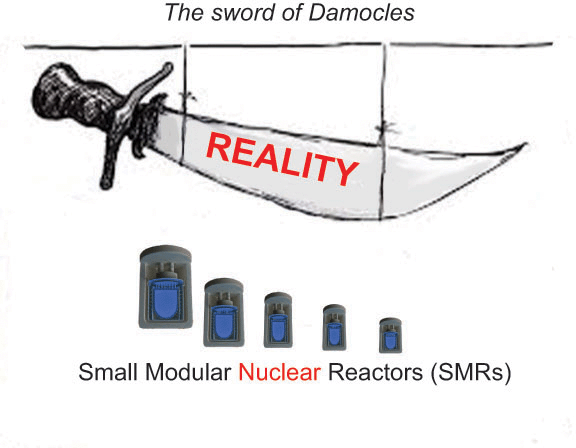 Small Modular Reactors (SMRs), the great white hope of OLO’s nuclear enthusiasts, fail public liability and cost of security criteria.
See http://www.aph.gov.au/DocumentStore.ashx?id=7a9318c0-aad6-405e-832f-66212a87d158&subId=669038
“Transport issues arising from the modular construction model are too often glossed over. Dr David Lowry notes that the UK’s so-called Expert Finance Working Group on Small Nuclear Reactors (EFWG)36
“makes no attempt to provide an analysis of how to provide market based insurance for SMRs, against accidents and terrorist attack on modules in transit to site and in situ; nor how to privately fund SMR radioactive waste management: yet these are real risks for nuclear power, SMRs included.
For example, the EFWG (p.11) talks of “road transportable modules which are easily installed on site” but makes no calculation of the exposure to disruption or indeed destruction of such an SMR module being transported on public roads from fabrication facility to operating site, possible hundreds of miles distant.”
Furthermore internal estimates indicate the size of the security protection unit (around 60 men and 10 attack dogs) for an SMR would be as expensive as that required for a large reactor.
Also the razor wire protected exclusion zones for SMRs would need to be as large as those for large reactors. Note population and siting concerns http://www.sciencedirect.com/science/article/pii/S1687850713000071
COVID-19 impacts nuclear industry worldwide

 COVID-19 impacts nuclear industry worldwide, Nuclear Engineering International, 26 March 2020
United States
In the USA, Maria Korsnick, president of the Nuclear Energy Institute told the New York Times that some operating reactors are “considering measures to isolate a core group to run the plant, stockpiling ready-to-eat meals and disposable tableware, laundry supplies and personal care items.”……
DHS Cybersecurity & Infrastructure Security Agency (CISA), has identified 14 employment categories as Essential Critical Infrastructure Workers, which include energy sector employees.
According to US media, electric power utilities are planning to set up housekeeping for cadres of healthy workers at the plants to keep them operating.
The Nuclear Regulatory Commission (NRC) said on 23 March that it expected to issue guidelines for operators to request permission for employees to work longer than allowed under current regulations…….
The NRC had hosted a phone meeting with the nuclear industry on 20 March to discuss regulatory impacts due to COVID-19.
During the call, Ho Nieh, director of the NRC’s Office of Nuclear Reactor Regulation said possible measures being discussed included steps to isolate key personnel to deal with major absenteeism in critical areas that may require increasing work limits.
He also said if a facility was unable to meet a regulatory requirement, the NRC had “a variety of mechanisms to consider,” including plant closures. “We are in an unprecedented situation,” he said……..
EDF told Reuters that its nuclear plants could operate for three months with a 25% reduction in staffing levels, and for two to three weeks with 40% fewer staff. There are currently 40 reactors in operation in France.
EDF has also scrapped its nuclear generation target for 2020 on an anticipated fall in output this year because of the coronavirus crisis. It said that its maintenance schedule for reactors had been “interrupted” by the order from authorities for workers to remain at home. As a result, EDF said its the projection of 375-390TWh of nuclear production in France in 2020 is being reviewed and will be adjusted downwards…….
Elsewhere in France, Orano has suspended operation of its La Hague reprocessing plant, saying it is taking measures to protect its employees and secure its industrial facilities while maintaining critical activities. Presenting its 2019 results, Orano suspended its outlook for 2020 “given the immediate and future impact on our markets and operations of this looming global health crisis.” …
France’s Nuclear Safety Authority (ASN) has also temporarily suspended most of its inspections in medical facilities carrying out nuclear activities to enable health professionals to focus on the response to the pandemic. …..
UK sees reduction in construction work at Hinkely Point C
In the UK, EDF Energy is reducing the workforce at its Hinkley Point C nuclear power plant by more than half. The number of workers at the site would be reduced to about 2000 from 4500, the company said, noting that the remaining skilled workers will focus on critical areas and work in shifts with extra transport and staggered breaks to minimise contact.
EDF Energy said it had taken steps such as home working for those who can, temperature checks for people at the site, extra cleaning and changes to movement patterns…….
Sellafield Ltd has implemented a controlled shutdown of its facilities, including the Magnox Reprocessing Plant, after 8% of its 11,500-strong staff were forced to self-isolate to avoid infection. Ithas told most of its workers to stay away from its main site and satellite offices and to work from home. ……
More broadly, NIA said the UK Office of Nuclear Regulation, has confirmed that all UK nuclear sites have minimum staffing levels, and contingency plans should they fall below these levels, to enable them to remain in control of activities that could impact on nuclear safety under all foreseeable circumstances……
Canada. Cameco said it is temporarily suspending uranium production at its Cigar Lake uranium mine in northern Saskatchewan and placing the facility in safe care and maintenance mode during the COVID-19 pandemic. In consultation with Cameco, Orano Canada is suspending production at its McClean Lake uranium mill, where ore from Cigar Lake is processed.
Russian nuclear industry reaction to COVID-19
Russian state nuclear corporation Rosatom said on 23 March that it had set up a special headquarters for the fight against COVID-19 in the Russian nuclear industry.
“We have introduced additional measures at all of Russia’s nuclear power plants, including regular health check-ups of our personnel,” said Rosatom CEO Alexei Likhachev.
“We have arranged for as many employees as possible to work remotely and purchased personal protective equipment and hygiene-related products in bulk; we are constantly disinfecting our production facilities and vehicles and have essentially cancelled all business trips,” he added.
Rosatom reported the first case of COVID-19 disease on 19 March after an employee of subsidiary company, Turbine Technologies AAEM tested positive for coronavirus after visiting a foreign country on vacation. All employees who had contact with her were quarantined……
Rosatom has also taken similar measures at its nuclear power construction sites, and is continuing with its export new build projects, despite the challenges related to the spread of the coronavirus in a number of countries.
Bulgaria sees delays to Belene tender
1 This month.


PETITION – To: Prime Minister Anthony Albanese and the Australian Labor Government
Chernobyl: The Lost Tapes – A good documentary on Chernobyl on SBS available On Demand for the next 3 weeks– https://www.sbs.com.au/ondemand/tv-program/chernobyl-the-lost-tapes/235274195556
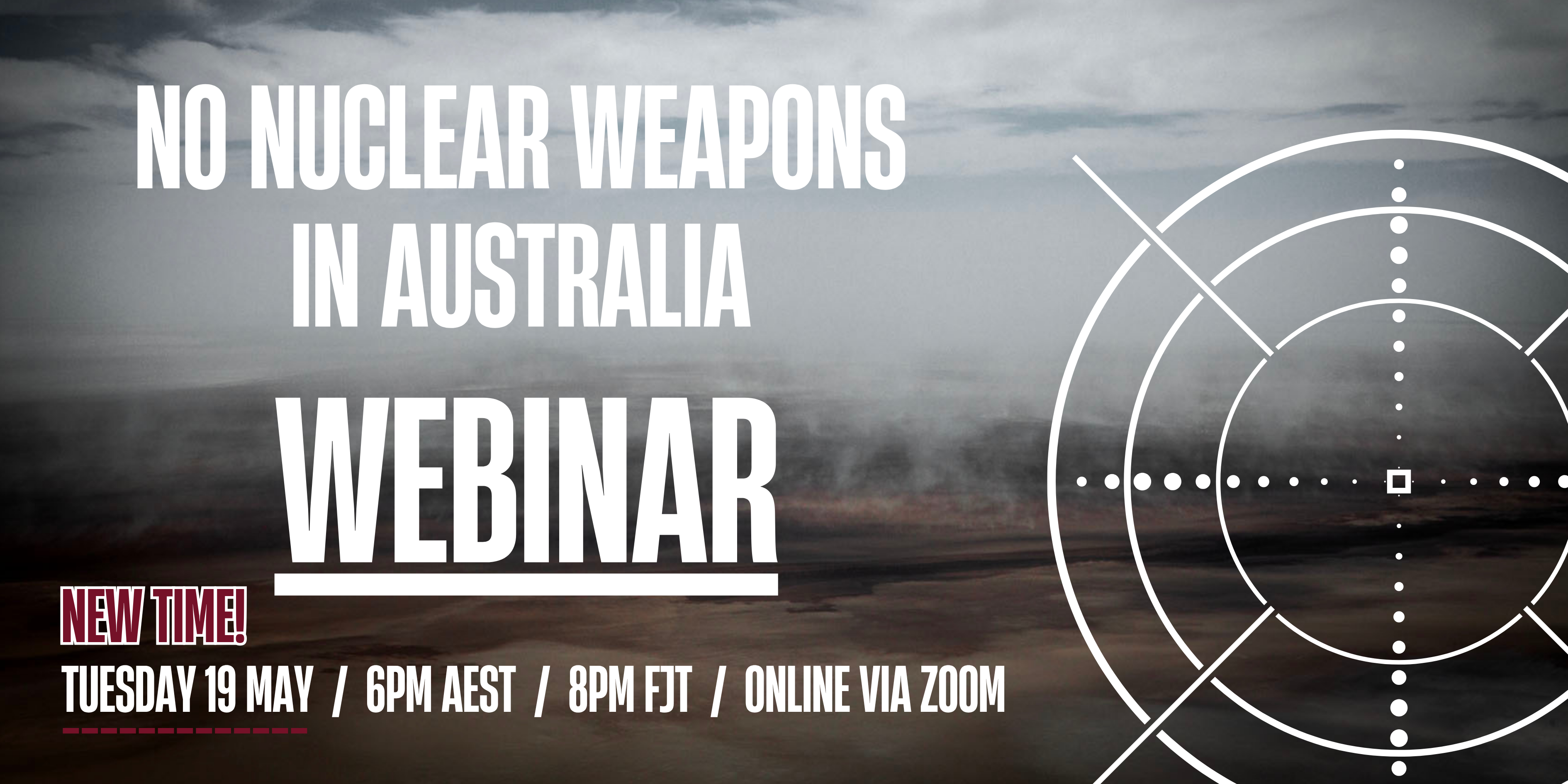
19 May – Webinar- Webinar: No Nuclear Weapons in Australia
Start: 2026-05-19 18:00:00 UTC Canberra, Melbourne, Sydney (GMT+10:00)
End: 2026-05-19 19:30:00 UTC Canberra, Melbourne, Sydney (GMT+10:00)
20 May – Webinar – The dangerous world of AUKUS, US, military occupation and suppression of dissent

National Webinar, 20th May, 2026, 6.30pm AEST. Confronting laws restricting/suppressing protest speech and action
Speakers: Former Sen. Rex Patrick, Lawyer Nick Hanna ,Arthur Rorris ,Jorgen Doyle, Sen David Shoebbridge,
Facilitator Kelley Tranter.

of the week – Australians for War Powers Reform (AWPR)
To see nuclear-related stories in greater depth and intensity
 Antinuclear