Impact of coronavirus on the nuclear industry’s operations, and the industry’s response
|
Nuclear industry’s response to Covid-19 outbreak, Power Technology, 1 Apr,20 “……..Impact of coronavirus on the nuclear industry’s operations The nuclear industry is assessing measures to safeguard their workforce and implementing business continuity plans to ensure continuous functioning of key aspects of their businesses. The nuclear industry already has a robust safety culture in place worldwide. Based on the guidance and directives put into practice across various countries and regions, actions have been taken. Since the time that coronavirus was first detected in China’s Wuhan region, before becoming a global pandemic, companies worldwide had time to execute business continuity plans and take the necessary steps for the dealing with the impact of the virus. Measures have been taken to screen workers and isolate those who show virus symptoms through temperature checks to detect fever, which is among the common Covid-19 symptom. Few countries have advised their staff to work remotely and not on-site, hence aiding with social distancing measures. For example, in the US, officials have recommended they may isolate or quarantine crucial nuclear power plant (NPP) technicians and allow them to live onsite to decrease their proximity with others in case this is needed. Many operators are getting hold of supplies of food, beds along with other essentials items required to support their staff for this purpose. Key NPP staff could be required to stay in assigned accommodation and commute to and from the nuclear facility in separate transportation. To safeguard the health of workers in regions where the occurrence of coronavirus may rise considerably, actions such as changing shift patterns are being assessed. Companies are also limiting or dropping their non-essential business travel plans and making use of conference video and audio calls for carrying out business meetings. France’s regulator, Nuclear Safety Authority (ASN), is avoiding direct physical contact to stop the spread of the coronavirus and is prioritizing control of operating facilities. A number of inspectors from the UK’s regulator, Office for Nuclear Regulation (ONR), will go ahead with travel plans to sites where needed but will restrict most of its business operations via phone, email and Skype. Currently, NPP operations are continuing in many countries. The US Nuclear Regulatory Commission (US NRC) has stated that it may close down any of the country’s 60 NPP if they cannot be aptly staffed. Few nuclear facilities have temporarily shut down their operations to avoid the spread of the coronavirus and secure their workforce. In the UK, authorities have idled a nuclear fuel reprocessing site located at Sellafield after 8% of its 11,500 workforce were asked to self-isolate or quarantine to avoid the spread of the coronavirus infection. This step came after a staff member was tested Covid-19 positive a few weeks earlier, and will eventually lead to a controlled shutdown of the site’s Magnox facility, expected to close down permanently this year. The EDF-owned Hinkley Point C (HPC) NPP in the UK, has also reduced its workforce by more than half and will further decrease its staff members as work in progress is finished. Rosatom’s overseas NPP construction projects have also progressed under the recommendations and guidelines of the disease control services as well as governments of the corresponding countries where construction work is going on. Work was suspended on few nuclear reactors which are under construction in China following the coronavirus outbreak. Now as work is slowly restarting in the country, countermeasures have been taken for all staff members returning to nuclear site. France, the most nuclear dependent country in the world, announced scaling down of staff at its Flameville NPP, operated by EDF, the country’s major nuclear operator. EDF stated that it is decreasing staff at the NPP from 800 to 100, because of the high regional Covid-19 infection rates. Three workers at the EDF’s Fessenheim NPP, Belleville NPP, and Cattenom NPP have already been tested positive for the coronavirus. French grid operator Réseau de Transport d’Électricité (RTE) presumes that nuclear availability will stay 3.6 Gigawatt (GW) below 2015 to 2019 average, in addition to a national fall in nuclear power demand. EDF has withdrawn its 2020 nuclear power generation target amidst an expected drop in its output this year due to the coronavirus outbreak. Orano, an integrated nuclear energy company, has also withdrawn its financial year (FY) outlook for 2020. When it comes to nuclear reactor operations, the Ascó I NPP in Tarragona and Almaraz I NPP in Cáceres, Spain, have notified about rescheduling or delaying of their outages for nuclear fuel loading. In Germany, NPP operators are stepping up precautionary measures to stop the spread of coronavirus. For instance, RWE, is involved in disinfecting radiation meters which are normally used by staffs quite often. The company has also shut down visitor centres and called off its scheduled group visits to decrease the risk of Covid-19 infections. The Finnish state-owned energy company Fortum Oyj’s Loviisa NPP is also undertaking precautionary measures to help stop the spread of the coronavirus. The company is adhering to the Covid-19 recommendations and guidelines put forward by the World Health Organization (WHO) and national authorities. External visitors are also prohibited at the NPP until further notice. MiningKazatomprom, Kazakhstan’s state-owned uranium production company, with a total uranium production volume (100% basis) of 22,808t of elemental uranium (tU) in 2019 has made announcement of drawing on its current uranium inventory if its mining activities are affected. The company’s uranium mining sites are located in remote areas of the country and so far the coronavirus outbreak has not yet affected its operations. However, considering the remoteness of these mining sites, the company needs to take precautionary measures if in case any outbreak occurs. The Canadian uranium company, Cameco, has also temporarily idled production of its Cigar Lake uranium mine located in northern Saskatchewan, Canada, as a response to the Covid-19 pandemic. This will reduce the staff members working on-site from around 300 to 35, hence leading to physical distancing and heightened safety precautionary measures. In addition, Cameco’s joint venture (JV) partner, Orano Canada, has also shut down operations at its McClean Lake uranium mill, which processes ore from the Cigar lake mine…… https://www.power-technology.com/comment/nuclear-industry-covid-19/ |
|
|
Climate threat underlies the pandemic emergency
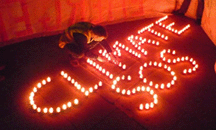 Beneath the virus lurks a bigger emergency, but the world is distracted from the climate threat, SMH, Bob Carr 2 Apr 20, What did our battered old planet do to bring this run of wretchedly bad luck? Just before the 2008 Wall Street disaster, Washington was about to force emitters to pay for the privilege of dumping carbon waste in the upper atmosphere. Congress approved a cap and trade scheme so its economy could trade its way to a low carbon future. In a similar spirit the Rudd government was legislating its own carbon trading model. Beneath the virus lurks a bigger emergency, but the world is distracted from the climate threat, SMH, Bob Carr 2 Apr 20, What did our battered old planet do to bring this run of wretchedly bad luck? Just before the 2008 Wall Street disaster, Washington was about to force emitters to pay for the privilege of dumping carbon waste in the upper atmosphere. Congress approved a cap and trade scheme so its economy could trade its way to a low carbon future. In a similar spirit the Rudd government was legislating its own carbon trading model.
Then the financial crisis knocked everyone sideways. The carbon lobby in both countries was able to talk job losses and higher taxes. The propaganda was a pushover. Legislation died in the US and Australian senates. And the world kept warming.
Last month the temperature on the Antarctic peninsular hit 65 degrees Fahrenheit, beating all previous records. For the globe, 2019 was the second hottest year on record, and the hottest without the contribution of a big El Nino. The coming decade may be our last chance to contain the chaos driven by humankind’s craziest experiment: the idea that carbon can be stored in the thin filigree of air around the planet. The Paris Agreement provides a road map and the falling price of renewables a market impulse. …. In the middle of the coronavirus crisis, The Sydney Morning Herald and The Age, to their credit, still find space to record the conclusion of leading reef scientist, Terry Hughes, that there is a third major bleaching of the Great Barrier Reef now under way. This follows the bleachings of 2016 and 2017. This is every bit a climate event as were the mega fires over Christmas. Yet the irrevocable loss of healthy coral may not galvanise the way fires did….. Meanwhile, the pandemic emergency may kill off the Glasgow conference on climate planned for November. The UN event is aimed at averting runaway climate change by keeping the temperature rise to 1.5 degrees. …… if the breaking up of permafrost in the Arctic circle assumes an extra ferocity. That would release plumes of methane, 30 times more lethal at trapping heat than carbon, but on a scale to blow apart every calibration of how fast climate is shifting. For Australia, Black Swan climate events could include a cyclone beyond what we have seen before, hitting the Queensland coast. Experts say there is still enough unburnt bush to give us a fire season as bad as the last, even next season – if we suffer the same malevolent mix of heat, low humidity and strong wind…… Beneath news of virus and slump there simmers an even bigger story. The planet keeps warming. And there’s no guarantee the rate may not pick up alarmingly. ……https://www.smh.com.au/environment/climate-change/beneath-the-virus-lurks-a-bigger-emergency-but-the-world-is-distracted-from-the-climate-threat-20200328-p54et4.html |
|
Universities form new global alliance to tackle climate in midst of pandemic — RenewEconomy

UNSW leads new group of 40 universities to form a new Climate Alliance to accelerate climate action, despite current focus on Covid-19 pandemic. The post Universities form new global alliance to tackle climate in midst of pandemic appeared first on RenewEconomy.
via Universities form new global alliance to tackle climate in midst of pandemic — RenewEconomy
Finally, Australia’s energy network planning will include climate policies — RenewEconomy

AEMO to be granted ability to incorporate state and federal climate change targets in network system planning. The post Finally, Australia’s energy network planning will include climate policies appeared first on RenewEconomy.
via Finally, Australia’s energy network planning will include climate policies — RenewEconomy
Glasgow climate talks postponed, but NGOs say it’s no excuse for go slow on action — RenewEconomy

Climate talks delayed to allow focus on Covid-19, but enviro groups warn that its not an excuse for Australia and other nations to go soft on climate action. The post Glasgow climate talks postponed, but NGOs say it’s no excuse for go slow on action appeared first on RenewEconomy.
via Glasgow climate talks postponed, but NGOs say it’s no excuse for go slow on action — RenewEconomy
April 1 Energy News — geoharvey

Opinion: ¶ “Silver Linings Playbook: Coronavirus Edition” • With the pandemic, we’re in the middle of a global wakeup call. But that doesn’t mean that it’s not possible to look forward and see what we’ll gain by waking up. Some things will be minor compared to the damage inflected by COVID-19, but some will be […]
The Climate Crisis Will Be Just as Shockingly Abrupt as the Coronavirus Pandemic
 The Climate Crisis Will Be Just as Shockingly Abrupt https://newrepublic.com/article/157078/climate-crisis-will-just-shockingly-abrupt The coronavirus isn’t a reason to put climate policy on hold. It’s a warning of the calamities ahead., By MELODY SCHREIBER, March 27, 2020
The coronavirus pandemic has reshaped the way we live, work, and interact in a matter of weeks. It has also shown that governments are able—and in many cases are expected—to take swift, significant action on crises. “Under these extraordinary circumstances, there can be quite decisive action from governance and policy that changes the way we’re all living day to day,” Lenton said. “It is possible to change large-scale patterns of human behavior, pretty quickly.”
The question is whether governments, and voters, can appreciate the true urgency of the task. In reality, the climate crisis cannot be solved incrementally, Lenton said, because it’s taken too long to spur action: Many warming-related changes are already underway. Global greenhouse gas emissions must be dramatically reduced and eventually eliminated. “If we’re going to avoid the worst of bad climate tipping points, then we’re going to need to find some positive tipping points in society and ourselves to transform the way we live—in a generation—to a more sustainable but also perhaps a more flourishing kind of future,” Lenton said.
Pandemics like this are expected to rise as the climate changes. The SARS-CoV-2 virus causing the disease known as Covid-19, scientists suspect, may have originated in a wild animal, like a bat, and transferred through an intermediate animal to people. Zoonotic spillovers like these, as well as illnesses carried by mosquitoes, ticks, and other animals, will likely increase on a hotter planet. It’s not just because more people are pressing into areas where wildlife lives; as their habitats change in new climate conditions, more animals are adapting to new environments and seeking relief in places where people live, thus increasing the chance of contact between people and animals.
“We are really messing up with the natural world, and with the climate system, and things like this can be expected to happen more often,” Otto said. “It’s one reason to think that climate change is actually a permanent threat and we have to think of fixing the whole system, not only the economy.”
The coronavirus is a real and urgent threat. But there’s also a pressing danger in failing to address climate change in policies and funding, both now and in the future. What’s happening to the planet, experts agree, isn’t going to stop just because we’re dealing with another crisis, and this is no time to ease up on the climate fight. In fact, because of the ways climate change contributes to poor health, it makes action even more urgent.
Melody Schreiber is a freelance journalist based in Washington, D.C. @m_scribe
Our war against the environment is leading to pandemics
Coronavirus is a wake-up call: our war with the environment is leading to pandemics, The Conversation, Fiona Armstrong Executive Director, Climate and Health Alliance, Occasional Lecturer, School of Public Health and Human Biosciences, La Trobe University, Anthony Capon, Director, Monash Sustainable Development Institute, Monash University, Ro McFarlane, Assistant Professor in Ecological Public Health, University of Canberra, March 31, 202 The COVID-19 pandemic sweeping across the world is a crisis of our own making.
That’s the message from infectious disease and environmental health experts, and from those in planetary health – an emerging field connecting human health, civilisation and the natural systems on which they depend.
They might sound unrelated, but the COVID-19 crisis and the climate and biodiversity crises are deeply connected.
Each arises from our seeming unwillingness to respect the interdependence between ourselves, other animal species and the natural world more generally.
To put this into perspective, the vast majority (three out of every four) of new infectious diseases in people come from animals – from wildlife and from the livestock we keep in ever-larger numbers.
To understand and effectively respond to COVID-19, and other novel infectious diseases we’ll likely encounter in the future, policymakers need to acknowledge and respond with “planetary consciousness”. This means taking a holistic view of public health that includes the health of the natural environment.
Risking animal-borne diseases
Biodiversity (all biological diversity from genes, to species, to ecosystems) is declining faster than at any time in human history.
We clear forests and remove habitat, bringing wild animals closer to human settlements. And we hunt and sell wildlife, often endangered, increasing the risk of disease transmission from animals to humans.
The list of diseases that have jumped from animals to humans (“zoonotic diseases”) includes HIV, Ebola, Zika, Hendra, SARS, MERS and bird flu.
Like its precursor SARS, COVID-19 is thought to have originated in bats and subsequently transmitted to humans via another animal host, possibly at a wet market trading live animals.
Ebola virus emerged in central Africa when land use changes and altered climatic conditions forced bats and chimpanzees together around concentrated areas of food resources. And Hendra virus is associated with urbanisation of fruit bats following habitat loss. Such changes are occurring worldwide.
What’s more, human-caused climate change is making this worse. Along with habitat loss, shifting climate zones are causing wildlife to migrate to new places, where they interact with other species they haven’t previously encountered. This increases the risk of new diseases emerging.
COVID-19 is just the latest new infectious disease arising from our collision with nature……. https://theconversation.com/coronavirus-is-a-wake-up-call-our-war-with-the-environment-is-leading-to-pandemics-135023
As nuclear waste piles up, scientists try to beat the problems of corrosion in waste containers
 As nuclear waste piles up, scientists seek the best long-term storage solutions. Researchers study and model corrosion in the materials proposed for locking away the hazardous waste C and EN, by Mitch Jacoby, MARCH 30, 2020 | APPEARED IN VOLUME 98, ISSUE 12
Regardless of whether you are for or against nuclear power, and no matter what you think of nuclear weapons, the radioactive waste is already here, and we have to deal with it.”
IN BRIEF
More than a quarter million metric tons of highly radioactive waste sits in storage near nuclear power plants and weapons production facilities worldwide, with over 90,000 metric tons in the US alone. Emitting radiation that can pose serious risks to human health and the environment, the waste, much of it decades old, awaits permanent disposal in geological repositories, but none are operational. With nowhere to go for now, the hazardous materials and their containers continue to age. That unsustainable situation is driving corrosion experts to better understand how steel, glass, and other materials proposed for long-term nuclear waste storage containers might degrade. Read on to learn how these researchers’ findings might help protect people and the environment from waste leakages.
That’s Gerald S. Frankel’s matter-of-fact take on the thousands of metric tons of used solid fuel from nuclear power plants worldwide and the millions of liters of radioactive liquid waste from weapons production that sit in temporary storage containers in the US. While these waste materials, which can be harmful to human health and the environment, wait for a more permanent home, their containers age. In some cases, the aging containers have already begun leaking their toxic contents.
“It’s a societal problem that has been handed down to us from our parents’ generation,” says Frankel, who is a materials scientist at the Ohio State University. “And we are—more or less—handing it to our children.”……..
Vitrification of nuclear waste seems to be well established by now, but actually it still faces complex problems,” says Ashutosh Goel, a materials scientist at Rutgers University. The plan at Hanford, for example, calls for entombing nuclear waste in borosilicate glass and encasing the glass in stainless-steel canisters. Yet the exact formulation of the glass, or glasses, is still under investigation.
Big swings to the Greens in Brisbane wards elections
Cr Sri said the shutdown of ordinary life due to the coronavirus pandemic meant the Greens could no longer doorknock, their most effective campaign strategy, and had to rely on telephoning prospective voters instead. …. https://www.brisbanetimes.com.au/national/queensland/greens-celebrate-record-swings-in-brisbane-wards-20200330-p54fbb.html
Introduction — Climate of Pandemic — robertscribbler

Climate change currently contributes to the global burden of disease and premature deaths (very high confidence). — IPCC One disease. Just a single nasty bug. COVID-19. An illness resulting from the virus SARS-CoV-2. That’s all it took to bring global civilization to a grinding, crashing, train-wreck like halt. Not a collapse. But more of […]
Renewable hydrogen to undercut gas on price, but not the answer for transport — RenewEconomy

Report says renewable hydrogen could beat out gas on power generation – but it’s not the answer for low-carbon automotive transport. The post Renewable hydrogen to undercut gas on price, but not the answer for transport appeared first on RenewEconomy.
via Renewable hydrogen to undercut gas on price, but not the answer for transport — RenewEconomy
March 30 Energy News — geoharvey

Opinion: ¶ “Is It the Death Knell For Dominion’s Pipeline?” • The fracking boom is over. Oil and gas prices have been hit by a perfect storm. There’s the coronavirus pandemic, a trade war between Russia and Saudi Arabia, fracking is enormously expensive, and wells don’t last long. All that has huge implications for the […]
To 30 March – nuclear and climate news.
 Yes, I know, it’s bad form to be writing about anything but the virus. But here goes, anyway. As to climate change, the current dread of the coronavirus feels awfully like a familiar version of the anxiety that many of us have felt about the climate crisis. There’s a bit of a silver lining, in that global greenhouse has emissions have dropped.
The pandemic, and its consequence – social isolation, have stalled industry, and are expected to wipe out global growth in renewables deployment in 2020.
The nuclear industry has put a bold face on it, claiming that construction of huge new reactor stations are essential, so that workers at UK’s Hinkley Point C build, and USA’s giant Vogtle nuclear build can count as “essential” so the building programmes can stay on track. But, even more remarkable, the USA nuclear industry uses coronavirus to gouge $billions of tax-payer money.
Anyway, what should we do about this truly awful global situation? I can think only of Voltaire’s famous advice – given by his fictional character Candide – “we must go and work our garden.” https://www.youtube.com/watch?v=fcTsMirQoG0&t=8s
A bit of good news – Chinese Company Ships Crates of Masks to Italy , Covered in Italian Poetry: We Are ‘Leaves of the Same Tree’
AUSTRALIA
A major scorecard gives the health of Australia’s environment less than 1 out of 10. With the pandemic, and the bushfires, we now must strengthen the Environment Protection and Biodiversity Conservation Act (EPBC). Webinar: Yeelirrie – A Case for Environmental Law Reform .
NUCLEAR. Nation Radioactive Waste Management Bill: Submission deadline extended to April 9. Submission re National Waste Dump Bill: Flawed process: the pretense that this National issue is just a Local issue. Nuclear front group Energy Policy Institute joins with NuScam to promote Small Nuclear Reactors to Australia.
CLIMATE. Environment department begins purging website of historical emissions data, projections. NSW approves coal mine expansion under drinking water catchment . Tax-payers funded MP Matt Canavan’s expensive trip to attend coalmine opening
RENEWABLE ENERGY. Australia’s newest and biggest wind farm sets benchmark for lowest price. Victoria council works around Covid-19 restrictions to approve 200MW solar farm. Big new solar farm in NSW begins production, on schedule for a change.
INTERNATIONAL
Action on Covid19 gives a lesson for action on climate change.
Pandemic brings a danger that is unique to the nuclear industry. Nuclear security must not be forgotten, even in times of pandemic.
With all eyes on pandemic, Nuclear Non Proliferation Treaty still needs attention.
Nuclear waste disposal: Why the case for deep boreholes is … full of holes.
How will the IAEA spin the mind-boggling costs of Small Modular Nuclear Reactors (SMRs)?
There’s still time to make a submission opposing the nuclear waste dump!
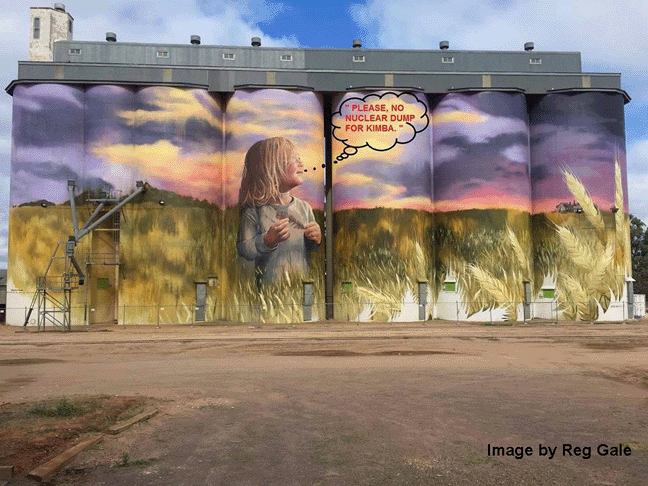
Friendsof the Earth, 30 Mar 20 Please lodge a submission opposing the federal government’s nuclear waste dump plans
Thanks to the 700+ people who have already made a submission! The deadline has now been extended to 9 April 2020.
The National Radioactive Waste Management Amendment Bill amends the National Radioactive Waste Management Act to specifically target South Australia for a national nuclear waste ‘facility’ ‒ a repository for low-level waste and an above-ground ‘interim’ store for long-lived intermediate-level waste including nuclear reactor fuel waste.
The Bill is deeply flawed and should be rejected. Among other problems, the Bill and the existing Act systematically disempower and dispossess Barngarla Traditional Owners who are unanimous in their opposition to the proposed nuclear waste facility.
Please make a submission on or before 9 April to the Senate Economics Legislation Committee which is holding an inquiry to the Bill.
The easiest and quickest way to make a submission is to simply sign our online submission, adding any comments you like.
Click here to use our proforma
Alternatively, you can write your own submission and email it to: economics.sen@aph.gov.au
For information on the inquiry, click here.
For information on the National Radioactive Waste Management Amendment Bill 2020, click here.
1 This month.
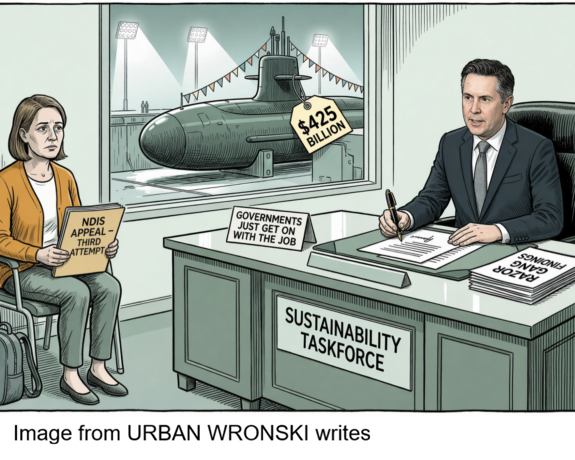

PETITION – To: Prime Minister Anthony Albanese and the Australian Labor Government
Chernobyl: The Lost Tapes – A good documentary on Chernobyl on SBS available On Demand for the next 3 weeks– https://www.sbs.com.au/ondemand/tv-program/chernobyl-the-lost-tapes/235274195556
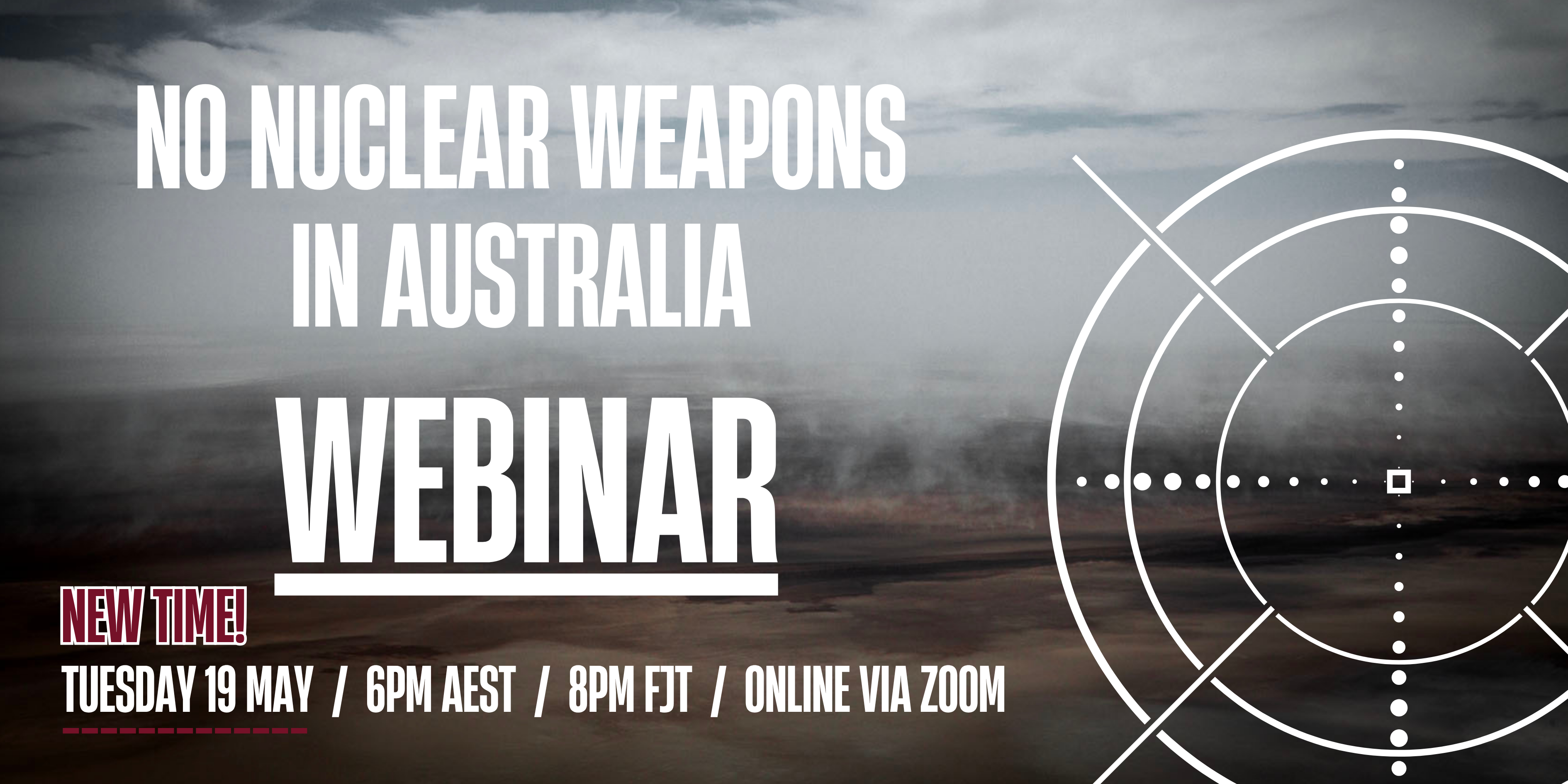
19 May – Webinar- Webinar: No Nuclear Weapons in Australia
Start: 2026-05-19 18:00:00 UTC Canberra, Melbourne, Sydney (GMT+10:00)
End: 2026-05-19 19:30:00 UTC Canberra, Melbourne, Sydney (GMT+10:00)
20 May – Webinar – The dangerous world of AUKUS, US, military occupation and suppression of dissent

National Webinar, 20th May, 2026, 6.30pm AEST. Confronting laws restricting/suppressing protest speech and action
Speakers: Former Sen. Rex Patrick, Lawyer Nick Hanna ,Arthur Rorris ,Jorgen Doyle, Sen David Shoebbridge,
Facilitator Kelley Tranter.

of the week – Australians for War Powers Reform (AWPR)
To see nuclear-related stories in greater depth and intensity
 Antinuclear