UK planning deep disposal of nuclear wastes
 How To Solve Nuclear Energy’s Biggest
  Problem https://oilprice.com/Alternative-Energy/Nuclear-Power/How-To-Solve-Nuclear-Energys-Biggest-Problem.html By Haley Zaremba – Jan 22, 2020, Nuclear waste is a huge issue and it’s not going away any time soon–in fact, it’s not going away for millions of years. While most types of nuclear waste remain radioactive for mere tens of thousands of years, the half-life of Chlorine-36 is 300,000 years and neptunium-237 boasts a half-life of a whopping 2 million years.
All this radioactivity amounts to a huge amount of maintenance to ensure that our radioactive waste is being properly managed throughout its extraordinarily long shelf life and isn’t endangering anyone. And, it almost goes without saying, all this maintenance comes at a cost. In the United States, nuclear waste carries a particularly hefty cost.
Last year, in a hard-hitting expose on the nuclear industry’s toll on U.S. taxpayers, the Los Angeles Times reported that “almost 40 years after Congress decided the United States, and not private companies, would be responsible for storing radioactive waste, the cost of that effort has grown to $7.5 billion, and it’s about to get even pricier.”
How much pricier? A lot. “With no place of its own to keep the waste, the government now says it expects to pay $35.5 billion to private companies as more and more nuclear plants shut down, unable to compete with cheaper natural gas and renewable energy sources. Storing spent fuel at an operating plant with staff and technology on hand can cost $300,000 a year. The price for a closed facility: more than $8 million, according to the Nuclear Energy Institute.”
With the United States as a poster child of what not to do with your nuclear waste, the United Kingdom is taking a much different tack. The UK is currently undertaking what the country’s Radioactive Waste Management (RWM) department says “will be one of the UK’s largest ever environmental projects.” This nuclear waste storage solution comes in the form of a geological disposal facility (GDF), a waste disposal method that involves burying nuclear waste deep, deep underground in a cocoon of backfill, most commonly comprised of bentonite-based cement. This type of cement is able to absorb shocks and is ideal for containing radioactive particles in case of any failure. The GDF system would also be at such a depth that it would be under the water table, minimizing any risk of contaminating the groundwater.
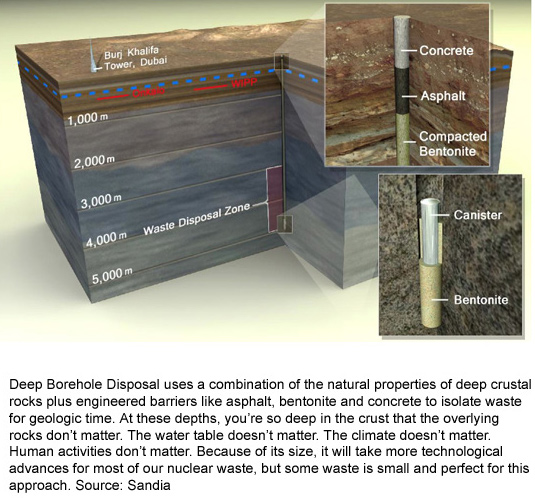
According to reporting from Engineering & Technology, nuclear waste is a mounting issue in Europe and in the UK in particular. “Under European law, all countries that create radioactive waste are obliged to find their own disposal solutions – shipping nuclear waste is not generally permitted except in some legacy agreements. However, when the first countries charged into nuclear energy generation (or nuclear weapons research), disposal of the radioactive waste was not a major consideration. For several of those countries, like the UK, that is now around 70 years ago, and the waste has been ‘stored’ rather than disposed of. It remains a problem.”
In fact, not only does it remain a problem, it is a mounting problem. As nuclear waste has been improperly or shortsightedly managed in the past, the current administration can no longer avoid dealing with the issue. In the past the UK used its Drigg Low-Level Waste Repository on the Cumbrian Coast to treat low and intermediate level waste, but now, thanks to coastal erosion, the facility will soon begin leeching radioactive materials into the sea, although that might not be quite as scary as it sounds.
Back in 2014, the Environment Agency raised concerns that coastal erosion could result in leakage from the site within 100 to 1,000 years, although it was counter-claimed that the levels of radioactivity after such a time would be low enough to be harmless,” Engineering & Technology writes. “This would definitely not be the case for high-level wastes, where radioactivity could remain a hazard into and beyond the next ice age, hence the need for longer-term disposal.”
Where exactly will that longer-term disposal be based? That’s up for debate. And it won’t be an easy thing to decide, as the RWM says that they will need a community to volunteer to be involved in such a costly, lengthy, and potentially unpopular project. And it’s not just an issue for the current inhabitants of potential locations in the UK, but for many generations to come over the next tens of thousands of years of radioactivity
Climate and the Coalition’s new denialism
Nick Feik, In recent months the federal government’s position on climate change has shifted. Not in policy terms: the change has been restricted to its rhetoric. It has a new strategy to avoid responsibility. Prime Minister Scott Morrison has become adept at evading questions on climate change and its links to bushfires and judging by his satisfied expression as he fronted up for ABC’s 7.30 recently, he remains confident he has a form of words that, like armour, journalists will be unable to penetrate…. (subscribers only – or buy the print version) https://www.thesaturdaypaper.com.au/opinion/topic/2020/01/25/climate-and-the-coalitions-new-denialism/15798708009296
‘Money talks’: Outrage at billionaire climate sceptic’s political donations
‘Money talks’: outrage at billionaire climate sceptic’s political donations
Justine Landis-Hanley and Kishor Napier-Raman
Andrew Wilkie, Adam Bandt and Stirling Griff condemn Australia’s donations system which can effectively block action on climate change…. (subscribers only) https://www.crikey.com.au/2020/01/24/michael-hintze-donations-outrage/
Greta Thunberg says climate demands ‘completely ignored’ at Davos
|
Greta Thunberg says climate demands ‘completely ignored’ at Davos, https://www.sbs.com.au/news/greta-thunberg-says-climate-demands-completely-ignored-at-davos 24 Jan 2020, Greta Thunberg says she isn’t surprised that calls to disinvest in fossil fuels have fallen on deaf ears at the World Economic Forum in Davos.
Teenage climate activist Greta Thunberg said calls to the corporate elite meeting in Davos to immediately disinvest in fossil fuels had been ignored. “We had a few demands (coming into the World Economic Forum). Of course these demands have been completely ignored. We expected nothing less,” Thunberg told reporters in the Swiss ski resort on the last day of the conference. Thunberg was a highlight of the 50th edition of the conference, drawing massive attention including barbs by US Secretary Steven Mnuchin who on Thursday told the teen to go “study economics”. Asked about Mnuchin’s comments, the Swede said: “Of course it has no effect. We are being criticised like that all the time.” “If we cared about that, we would not be able to do what we do. We put ourselves in the spotlight.” The spat between Mnuchin and Thunberg underlined the tensions over climate change at the World Economic Forum (WEF) in Davos, where governments and major firms have come under pressure to act now on global warming. Asked about the 17-year-old’s demand for an immediate halt to investment in fossil fuels, Mnuchin said on Thursday: “Is she the chief economist? Who is she? I’m confused,” adding after a pause that it was “a joke”. “After she goes and studies economics in college, she can come back and explain that to us.” In a speech on Tuesday, US President Donald Trump castigated the “prophets of doom” that predict a climate “apocalypse”, in comments widely seen as an attack on Thunberg who sat in the audience. But either by accident or design, there was no meeting between Trump and Thunberg at the forum. |
|
Olympic events close to radioactive sites: Fukushima’s nuclear wastes’anxiety hangs over Olympics

On an exclusive tour of the plant, spread over 3.5 million square meters (865 acres), Reuters witnessed giant remote-controlled cranes dismantling an exhaust tower and other structures in a highly radioactive zone while spent fuel was removed from a reactor.
Officials from Tokyo Electric, which owns the plant, also showed new tanks to hold increasing amounts of contaminated water.
About 4,000 workers are tackling the cleanup, many wearing protective gear, although more than 90% of the plant is deemed to have so little radioactivity that no extra precautions are needed. Photography was highly restricted and no conversations were allowed with the workers.
Work to dismantle the plant has taken nearly a decade so far, but with Tokyo due to host the Olympics this summer – including some events less than 60 km (38 miles) from the power station – there has been renewed focus on safeguarding the venues…….
The buildup of contaminated water has been a sticking point in the cleanup, which is likely to last decades, and has alarmed neighboring countries. In 2018, Tepco said it had not been able to remove all dangerous material from the water – and the site is running out of room for storage tanks.
Officials overseeing a panel of experts looking into the contaminated water issue said in December choices on disposal should be narrowed to two: either dilute the water and dump it in the Pacific Ocean, or allow it to evaporate. The Japanese government may decide within months, and either process would take years to complete, experts say……..
Athletes from at least one country, South Korea, are planning to bring their own radiation detectors and food this summer.
Baseball and softball will be played in Fukushima City, about 60 km (38 miles) from the destroyed nuclear plant. The torch relay will begin at a sports facility called J-Village, an operations base for Fukushima Daiichi in the first few years of the disaster, then pass through areas near the damaged station on its way to Tokyo.
In December, Greenpeace said it found radiation “hotspots” at J-Village, about 18km south of the plant.
When Tokyo won the bid to host the 2020 Summer Olympics Prime Minister Shinzo Abe declared that Fukushima was “under control” in his final pitch to the International Olympic Committee.
In 2016, the Japanese government estimated that the total cost of plant dismantlement, decontamination of affected areas, and compensation would be 21.5 trillion yen ($195 billion) – roughly a fifth of the country’s annual budget at the time.
(Reporting by Aaron Sheldrick: Editing by Gerry Doyle) https://mobile.reuters.com/article/amp/idUSKBN1ZK0CV?__twitter_impression=true
Nuclear-Free Earth – “Critical Need” : Karl Grossman —

A message from Professor Karl Grossman… “I’m speaking on the critical need for a nuclear-free Earth – no nuclear weapons, no nuclear power – on Libbe HaLevy’s Nuclear Hotseat this week. “I cite as a precedent for the practicality of the nuclear genie being put back in the bottle how chemical weapons were outlawed internationally […]
Bushfire crisis: The answer to future energy security lies on our rooftops — RenewEconomy

Australia’s bushfire crisis underscores urgent need to decentralise Australia’s electricity grid. Building up networks of solar batteries is the quickest, easiest, cheapest answer. The post Bushfire crisis: The answer to future energy security lies on our rooftops appeared first on RenewEconomy.
via Bushfire crisis: The answer to future energy security lies on our rooftops — RenewEconomy
January 24 Energy News — geoharvey

Opinion: ¶ “What The Minimum Offer Price Rule (MOPR) Means For Clean Energy In PJM” • PJM, which coordinates the movement of wholesale electricity in all or parts of 13 states and DC, submitted proposed MOPR values in its last filing as required by the Federal Energy Regulatory Commission. They will support fossil fuels and […]
Australia singled out for climate denial as “Doomsday Clock” ticks closer to midnight — RenewEconomy

“Doomsday Clock” moved to 100 seconds to midnight as Morrison government is slammed for “mendacious” climate denial. The post Australia singled out for climate denial as “Doomsday Clock” ticks closer to midnight appeared first on RenewEconomy.
via Australia singled out for climate denial as “Doomsday Clock” ticks closer to midnight — RenewEconomy
Tasmania’s new Liberal premier appoints himself as climate minister — RenewEconomy

New Tasmania Premier Peter Gutwein appoints himself minister for climate change, marking the first time the state’s Liberal Party has created a separate portfolio for climate. The post Tasmania’s new Liberal premier appoints himself as climate minister appeared first on RenewEconomy.
via Tasmania’s new Liberal premier appoints himself as climate minister — RenewEconomy
Australian bushfires drive up global emissions as economic costs mount — RenewEconomy

Australian bushfires to drive global greenhouse gas concentrations to new records, as more than half of Australians report experiencing bushfire impacts. The post Australian bushfires drive up global emissions as economic costs mount appeared first on RenewEconomy.
via Australian bushfires drive up global emissions as economic costs mount — RenewEconomy
South Australia on track to 100 pct renewables, as regulator comes to party — RenewEconomy

Regulator approval for new transmission line boosts South Australia’s push towards 100 per cent renewables, and unlocks up to 5,000MW of wind and solar. The post South Australia on track to 100 pct renewables, as regulator comes to party appeared first on RenewEconomy.
via South Australia on track to 100 pct renewables, as regulator comes to party — RenewEconomy
Australia’s megafires a wake-up call on the climate-nuclear danger
the task of civil society is to organize more strongly in order to increase awareness regarding the link between the climate crisis and the vulnerability of nuclear facilities so that public opinion may begin to be altered and political powers may be pressured to begin an exit from the innately dangerous nuclear path.
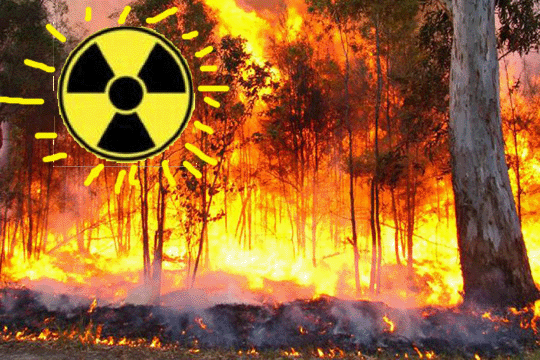
What Australia type fire may tell us about the possibility of nuclear disasters, https://www.dianuke.org/what-australia-type-fire-may-tell-us-about-the-possibility-of-nuclear-disasters/ JANUARY 22, 2020 Australia is one of the countries that have experienced extreme weather events, especially in the last decade due to the effect of global warming. According to experts, system interactions triggered global warming, and extinguishing fires has become impossible due to reduced water resources as a result of excessive evaporation and mismanagement of these resources in the last decade in the country. It is estimated that nearly 1.25 billion animal species and at least 27 people have lost their lives, in addition to annihilation of forests and vegetation due to the fires which could not be controlled for almost four months; other species are threatened with extinction and 1800 houses have reportedly burned down.
Unfortunately, the impact of the events is not limited to the period of their occurrence – while four months of carbon emissions, as much as the annual carbon emission amount to the atmosphere, there are scientific studies indicating that there may be an increase in various diseases, especially asthma, especially among children, with the air quality rising to nearly 21 times the dangerous level. Things could have been much worse if the fires had reached the region where uranium mines are located in Australia, which supplies 12% of the uranium fuel used in nuclear power plants operating worldwide; Australia however, has no nuclear power plant of its own. Continue reading
1980 spill of nuclear poisons – a warning note for Kimba area
 Potential nuclear spill a cause for concern, Port Lincoln Times, TY BRUUN 22 Jan 2020, I hope individuals from all over the Eyre Peninsula attend the protest rally (Kimba, February 2) to demonstrate the nuclear waste proposal affects more communities than just Kimba.
For those who are on the fence, please consider this realistic scenario.
The scene was attended by police officers. They were exposed to the radiation and became violently ill at the scene.
The following events bring doubt as to whether country SA could ever possess the expertise to deal with a nuclear waste accident, given this could not be sourced in the higher skilled population of Sydney.
The officers’ requested for assistance – it was refused on the grounds that no-one with nuclear waste spillage expertise could be sourced to prevent anyone else suffering radiation exposure.
The two officers and a council worker could only bury the waste beside the highway.
The sick officers tried to have the waste spillage formally acknowledged and cleaned up properly and spoke to the media.
It is truly questionable that, given this incident has still not been resolved despite other road workers becoming ill and construction of a new highway through the burial zone, the federal government will actually adequately resource the country town of Kimba (or anywhere else along the nuclear waste transport route) so that we can deal with this sensibly foreseeable emergency situation with radioactive waste.
I urge you all to consider what it would be like to wish your grown child a good day at work as they head off to deal with a radioactive spillage along Eyre Highway.
Is this really the legacy you will leave your children?
Remember, it has happened before; it is not over emotional or fear mongering to consider such scenarios, it’s rather sensible.https://www.portlincolntimes.com.au/story/6587692/potential-nuclear-spill-a-cause-for-concern/?fbclid=IwAR2NWWHE9A_5Uqog5nrcvC_o_3VukGgmUFcEfaxjiPMJ20r6edQVdcAEIsI
For those who are on the fence, please consider this realistic scenario.
The scene was attended by police officers. They were exposed to the radiation and became violently ill at the scene.
The following events bring doubt as to whether country SA could ever possess the expertise to deal with a nuclear waste accident, given this could not be sourced in the higher skilled population of Sydney.
The officers’ requested for assistance – it was refused on the grounds that no-one with nuclear waste spillage expertise could be sourced to prevent anyone else suffering radiation exposure.
The two officers and a council worker could only bury the waste beside the highway.
The sick officers tried to have the waste spillage formally acknowledged and cleaned up properly and spoke to the media.
It is truly questionable that, given this incident has still not been resolved despite other road workers becoming ill and construction of a new highway through the burial zone, the federal government will actually adequately resource the country town of Kimba (or anywhere else along the nuclear waste transport route) so that we can deal with this sensibly foreseeable emergency situation with radioactive waste.
I urge you all to consider what it would be like to wish your grown child a good day at work as they head off to deal with a radioactive spillage along Eyre Highway.
Is this really the legacy you will leave your children?
Remember, it has happened before; it is not over emotional or fear mongering to consider such scenarios, it’s rather sensible.https://www.portlincolntimes.com.au/story/6587692/potential-nuclear-spill-a-cause-for-concern/?fbclid=IwAR2NWWHE9A_5Uqog5nrcvC_o_3VukGgmUFcEfaxjiPMJ20r6edQVdcAEIsI
Honeymoon uranium mine might restart this year, and pigs might fly
 Uranium miner flags restart at Honeymoon within a year if prices jump, others aren’t so sure, ABC BROKEN HILL BY DECLAN GOOCH AND SARA TOMEVSKA 22 Jan 2020, The company behind a proposal to restart uranium mining in north-east South Australia says it would be ready to begin production within a year if prices improve.
But the Australian Conservation Foundation (ACF) has cast doubt on the likelihood of that occurring, arguing the market is moving away from uranium.
Key points:
- Honeymoon is one of only four Australian uranium mines with an export licence but has been mothballed since 2013
- New owner Boss Resources says technology will help it lower operational costs and will reopen the mine once uranium prices improve
- Anti-nuclear campaigners doubt the mine’s prospects, saying significant uranium producers have been deferring or halting development
The Honeymoon uranium mine was mothballed in 2013 because it had become too expensive to run.
But in 2015, the mine, which is about 80 kilometres north-west of Broken Hill, was purchased by WA exploration company Boss Resources.
Boss chief executive Duncan Craib said the company had developed new technology to lower operational costs and had finalised a feasibility study.
He said the mine would reopen once uranium prices improved, which he was expecting to happen soon.
“We don’t want to destroy the resource at low uranium prices, so we’d like an uptick in the market before proceeding,” Mr Craib said.
Honeymoon is one of only four Australian uranium mines with an export licence.
However, Mr Craib said uranium was under-utilised in Australia and he would like to see a domestic uptake of nuclear power…….
Optimism baseless, campaigner says
Anti-nuclear campaigner Dave Sweeney from the ACF said he believed the announcement was without substance.
“There is nothing new in their statement,” he said.
“It’s pretty much a holding-pattern statement from a mining company with not a lot of resources, not a lot of projects, that are trying to continue to hold a place in the market, where the market is increasingly in freefall.
“Obviously, Boss is going to say the uranium price is going to soar — they’re a uranium miner.
“We’ve got major producers in this country … We’ve got a third of the world’s uranium and we’re not digging much, and that is because the price is not there.
Mr Sweeney said significant producers were deferring or halting development.
Rio Tinto, a massive mining company, is exiting at the Ranger mine in Kakadu,” he said.
“Cameco, the world’s largest dedicated uranium producer, has written down an asset that it spent $500 million on a decade ago in WA, and says that the best way to preserve the value of uranium is to keep it in the ground.”…….. https://mobile.abc.net.au/news/2020-01-22/honeymoon-uranium-mine-production-within-a-year-company-says/11889466
1 This month.
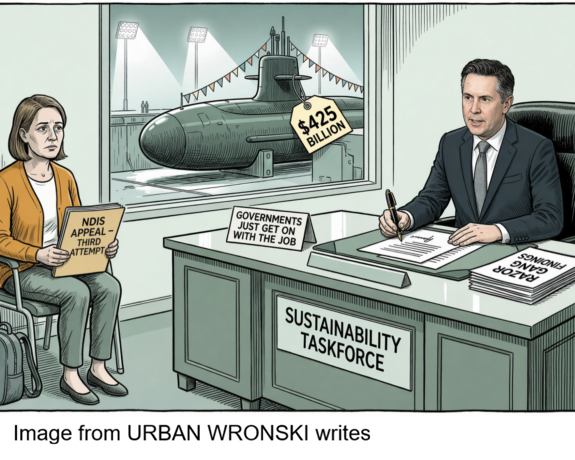

PETITION – To: Prime Minister Anthony Albanese and the Australian Labor Government
Chernobyl: The Lost Tapes – A good documentary on Chernobyl on SBS available On Demand for the next 3 weeks– https://www.sbs.com.au/ondemand/tv-program/chernobyl-the-lost-tapes/235274195556

19 May – Webinar- Webinar: No Nuclear Weapons in Australia
Start: 2026-05-19 18:00:00 UTC Canberra, Melbourne, Sydney (GMT+10:00)
End: 2026-05-19 19:30:00 UTC Canberra, Melbourne, Sydney (GMT+10:00)
20 May – Webinar – The dangerous world of AUKUS, US, military occupation and suppression of dissent

National Webinar, 20th May, 2026, 6.30pm AEST. Confronting laws restricting/suppressing protest speech and action
Speakers: Former Sen. Rex Patrick, Lawyer Nick Hanna ,Arthur Rorris ,Jorgen Doyle, Sen David Shoebbridge,
Facilitator Kelley Tranter.

of the week – Australians for War Powers Reform (AWPR)
To see nuclear-related stories in greater depth and intensity
 Antinuclear