Australia being left behind as global corporate renewable PPA market surges ahead — RenewEconomy

Corporate market for wind and solar rose sharply in 2019, but in Australia it slowed dramatically, partly due to growing grid connection frustrations. The post Australia being left behind as global corporate renewable PPA market surges ahead appeared first on RenewEconomy.
via Australia being left behind as global corporate renewable PPA market surges ahead — RenewEconomy
Morrison urged to act as ARENA funding about to be exhausted — RenewEconomy

As the Australian Renewable Energy Agency faces a funding cliff, the Australia Institute calls on the Morrison government to extend its funding. The post Morrison urged to act as ARENA funding about to be exhausted appeared first on RenewEconomy.
via Morrison urged to act as ARENA funding about to be exhausted — RenewEconomy
Trump “Peace Plan” Leaves ~ 15 Jewish Settler Ghetto Enclaves Within Palestinian Territory; Israel Would Maintain “Overriding Security Responsibility for the State of Palestine”; Control Air Space — Mining Awareness +
One need only look at the map and see that this won’t work. Reading the details it’s even worse. Trump’s supposed “Peace Plan” leaves approximately 15 Jewish settler enclave-exclave ghettos within Palestinian Territory. Israel would maintain “overriding security responsibility for the State of Palestine“. Furthermore, it allows for “punitive demolitions following acts of terrorism“, by […]
Nuclear and climate news – week to 27 January Australia
Australia’s bushfires still dominate the climate news. Despite helpful rain, as of last Tuesday, 107 fires were still burning.-More extreme heat, and more fires, are predicted. Indeed, as I write, a new bushfire is reported, in Australian Capital Territory.
Still, Australia is far from the only climate story this week. Climate change could unlock new microbes and increase heat-related deaths. Deadly flooding and landslides are striking Brazil. Extreme weather is causing falling iguanas, rise of deadly spiders and swarms of locusts. And, no doubt of prime importance to “sensible” and “corporate” humans, Climate Change could blow up the economy and the banks aren’t ready.
The Bulletin of the Atomic Scientists has moved the “Doomsday Clock” to 100 minutes to midnight, its closest to doomsday since it began ticking, due to nuclear proliferation, failure to tackle climate change and “cyber-based disinformation”.
AUSTRALIA
NUCLEAR. Australia’s megafires a wake-up call on the climate-nuclear danger.
“Ecomodernists” – Ben Heard, Oscar Archer, Barry Brook, Geoff Russell, – Australia’s pro-nuclear fake environmentalists. 1980 spill of nuclear poisons – a warning note for Kimba area.
Honeymoon uranium mine might restart this year, and pigs might fly. South Australian Greens senator Sarah Hanson-Young slams investment in South Australian uranium mine. Uranium prospects poor, but Indigenous Australians Minister Ken Wyatt and Northern Land Council agree on a new mine.
CLIMATE. Australian bushfires drive up global emissions as economic costs mount. Australia singled out for climate denial as “Doomsday Clock” ticks closer to midnight. Australia’s Finance Minister Mathias Cormann spruiks for coal and for Trump at Davos summit.
Secret research reveals rift in the Liberals, over climate change. Climate and the Coalition’s new denialism. ” Former Prime Minister Turnbull scathing about #MorrisonFromMarketing, on the climate issue. Experts slam Morrison’s false equivalence between emissions targets and hazard reduction. Tasmania’s new Liberal premier appoints himself as climate minister.
‘Money talks’: Outrage at billionaire climate sceptic’s political donations. Legal action over climate change is on the rise.
34 environmentalists and conservationists received Australia Day Awards.
RENEWABLE ENERGY
Australia May Add Record Amount of Renewable Power in 2020. 23 solar farms added to grid in 2019 as PV costs fall to record lows. Bushfire crisis: The answer to future energy security lies on our rooftops. South Australia on track to 100 pct renewables, as regulator comes to party. Boost for Canberra’s growing renewable sector. Western Australia has waited far too long for renewable energy.
INTERNATIONAL
Six legal arguments against the extradition of Julian Assange to America.
New interactive flood-risk map shows that global vulnerability to sea level rise is worse than previously understood. Davos conference – an expensive exercise in corporate spin. Greta Thunberg says climate demands ‘completely ignored’ at Davos.
The global danger as insect species disappear
Nuclear recycling is a bad idea. The nuclear nations push the fantasy of Small Modular Nuclear Reactors.
World’s first public database of mine tailings dams aims to prevent deadly disasters.
Solar, storage, and wind tipped as top energy job generators.
Six legal arguments against the extradition of Julian Assange to America
 Six legal arguments show why the US extradition of Julian Assange should be denied https://www.thecanary.co/uk/analysis/2020/01/25/six-legal-arguments-show-why-the-us-extradition-of-julian-assange-should-be-denied/ Tom Coburg 25th January 2020 The first of two articles examining Julian Assange’s upcoming extradition trial.
There are at least six legal reasons why the extradition request by the US against WikiLeaks founder Julian Assange should be dismissed by the UK courts. The main extradition hearing is scheduled to commence 24 February 2020, with district judge Vanessa Baraitser presiding. The evidence to support Assange is compelling.
1. Client-lawyer confidentiality breached
2. The initial charge is flawed
1. Client-lawyer confidentiality breached
3. Initial charge relies on co-operation from Manning
4. Additional charges raised by the US are political
5. US legal precedent argues that Assange’s work is protected by the US Constitution
6. Threats of violence against Assange mean he’s unable to receive a fair trial
1. Client-lawyer confidentiality breached Continue reading
Uranium prospects poor, but Indigenous Australians Minister Ken Wyatt and Northern Land Council agree on a new mine
|
NT uranium and gold mine exploration a step closer at Devil’s Elbow near Ranger Mine https://mobile.abc.net.au/news/2020-01-25/ken-wyatt-approves-new-nt-uranium-mine-exploration/11896844 BY FELICITY JAMES Traditional owners and the Indigenous Australians Minister Ken Wyatt have signed off on a new exploration proposal for a uranium, gold and palladium mine in the Northern Territory.Key points:
Traditional owners fought hard against the Ranger Uranium Mine in the Northern Territory.
The Eclipse Metals project still needs approval from the NT Resources Minister but the company said in an ASX announcement it was confident approval would be granted. The site earmarked for exploration, known as Devil’s Elbow, is within Arnhem Land’s Alligator Rivers Uranium Field and lies 65 kilometres east of the Ranger Uranium Mine. The area has previously been explored and abandoned by other companies, including Cameco in 2008. Rio Tinto withdrew from a joint venture to acquire a majority stake in Devil’s Elbow, according to Eclipse Metals’ most recent annual report. The deal had been negotiated in 2016. In its announcement, Eclipse Metals said Mr Wyatt consented to the licence after a “long-standing” negotiation with the Northern Land Council and traditional owners resulted in an agreement. “The terms of the agreement are quite viable in the current market economy, allowing us to develop the Devil’s Elbow’s full potential,” director Carl Popal said in the statement. “The company looks forward to working closely with the traditional owners and the NLC in making the most of each exploration field from 2020, with bilateral benefits.” Scientist says venture may not be worthwhileThe supervising scientist branch of the Environment Department is responsible for protecting the Alligator Rivers region from the effects of uranium mining through monitoring and research. Gavin Mudd, an associate professor of environmental engineering at RMIT University who sits on the Alligator Rivers scientific committee, assists with this role. Associate Professor Mudd was sceptical about the proposal, considering market conditions and the fact the region has already been heavily explored for more than 60 years. “Sometimes you find something that other drillers and other explorers have missed, but often that’s not the case, it’s actually pretty rare,” he said. “There’s not a long-term prospect there. “I think when you’re looking at the uranium industry globally the future is not bright at all, that’s certainly how I read the tea leaves.” Associate Professor Mudd was sceptical about the proposal, considering market conditions and the fact the region has already been heavily explored for more than 60 years. “Sometimes you find something that other drillers and other explorers have missed, but often that’s not the case, it’s actually pretty rare,” he said. “There’s not a long-term prospect there. “I think when you’re looking at the uranium industry globally the future is not bright at all, that’s certainly how I read the tea leaves.”
But Associate Professor Mudd said Rio Tinto deserved some credit for committing funds to the rehabilitation of Ranger. “They haven’t just walked away, which is often what you would see a mining company do when you’ve got a mine that’s not making money anymore,” he said. |
|
World’s first public database of mine tailings dams aims to prevent deadly disasters

|
World’s first public database of mine tailings dams aims to prevent deadly disasters https://www.eurekalert.org/pub_releases/2020-01/g-wfp012320.php Previously unreleased data offer unprecedented view into mining industry’s waste storage practices GRID-ARENDAL 24 JAN 2020 ENVIRONMENTAL ORGANIZATION GRID-ARENDAL HAS LAUNCHED THE WORLD’S FIRST PUBLICLY ACCESSIBLE GLOBAL DATABASE OF MINE TAILINGS STORAGE FACILITIES. THE DATABASE, THE GLOBAL TAILINGS PORTAL, WAS BUILT BY NORWAY-BASED GRID-ARENDAL AS PART OF THE INVESTOR MINING AND TAILINGS SAFETY INITIATIVE, WHICH IS LED BY THE CHURCH OF ENGLAND PENSIONS BOARD AND THE SWEDISH NATIONAL PENSION FUNDS’ COUNCIL ON ETHICS, WITH SUPPORT FROM THE UN ENVIRONMENT PROGRAMME. THE INITIATIVE IS BACKED BY FUNDS WITH MORE THAN US$13 TRILLION UNDER MANAGEMENT. Until now, there has been no central database detailing the location and quantity of the mining industry’s liquid and solid waste, known as tailings. The waste is typically stored in embankments called tailings dams, which have periodically failed with devastating consequences for communities, wildlife and ecosystems. “This portal could save lives”, says Elaine Baker, senior expert at GRID-Arendal and a geosciences professor with the University of Sydney in Australia. “Dams are getting bigger and bigger. Mining companies have found most of the highest-grade ores and are now mining lower-grade ones, which create more waste. With this information, the entire industry can work towards reducing dam failures in the future.” The database allows users to view detailed information on more than 1,700 tailings dams around the world, categorized by location, company, dam type, height, volume, and risk, among other factors. “Most of this information has never before been publicly available”, says Kristina Thygesen, GRID-Arendal’s programme leader for geological resources and a member of the team that worked on the portal. When GRID-Arendal began in-depth research on mine tailings dams in 2016, very little data was accessible. In a 2017 report on tailings dams, co-published by GRID and the UN Environment Programme, one of the key recommendations was to establish an accessible public-interest database of tailings storage facilities. “This database brings a new level of transparency to the mining industry, which will benefit regulators, institutional investors, scientific researchers, local communities, the media, and the industry itself”, says Thygesen. The release of the Global Tailings Portal coincides with the one-year anniversary of the tailings dam collapse in Brumadinho, Brazil, that killed 270 people. After that disaster, a group of institutional investors led by the Church of England Pensions Board asked 726 of the world’s largest mining companies to disclose details about their tailings dams. Many of the companies complied, and the information they released has been incorporated into the database. For more information on tailings dams, see the 2017 report “Mine Tailings Storage: Safety Is No Accident” and the related collection of graphics, which are available for media use. About GRID-Arendal GRID-Arendal supports environmentally sustainable development by working with the UN Environment Programme and other partners. We communicate environmental knowledge that motivates decision-makers and strengthens management capacity. We transform environmental data into credible, science-based information products, delivered through innovative communication tools and capacity-building services. |
|
Names of 34 environmentalists and conservationists who received Australia Day Awards
 Australia Day Honours, Maelor Himbury, 27 Jan 2020
Congratulations to the following people who received honours for contributions to the environment and/or conservation. (Apologies to any I may have missed)
Raymond Louis Specht, St Lucia QLD
Elaine Cafferty Carbines, Grovedale VIC
Graham John Faichney, Mosman NSW
David Ronald Leece, Beecroft NSW
Grant Donald Hunt, Isle of Capri QLD
Roderick Tucker Wells, Flagstaff Hill SA
Dedee Daryl Woodside, Umina Beach NSW
Graeme Leonard Worboys, Gilmore ACT
Maree Rosalie Byrne, Bowral NSW
Judith Anne Charnaud, Warriewood NSW
Fred Conway, QLD
Elizabeth Corke, VIC
Daryl James Akers, Melton South VIC
Eulalie Perry Brewster, Inverloch VIC
Raymond Brown, Bulli NSW
Leif Robert Cocks, Willagee WA
Brian Stuart Blythe, Portsea VIC
Marie Ann Ficcara, Cronulla NSW
Peter John Forster, Anglesea VIC
Sherryl Maree Garbutt, Brunswick VIC
Mary Julia Hutton, Stirling WA
William David Incoll, Monbulk VIC
Bronwen Jean Keichery, Subiaco WA
Gregory John Keichery, Subiaco WA
Diana Betty Laube, Tiatukia SA
Sarah Jane Lloyd, Birralee TAS
Peter Phillip Gash, Lady Elliott Island QLD
Lloyd Alwyn Nielsen, Mount Molloy QLD
Catherine Marie-Claire Oelrichs, Coopers Shoot NSW
Margaret Owen, Wembley WA
Carl John Rayner, Anglesea VIC
John Stanisic, Albany Creek QLD
Beverley Jean Weaver, Nundah QLD
Bruce Anthony Wilson, Seacliff Park SA
In Australia, legal action over climate change is on the rise
A class action might be out of the question but climate change litigation, at least against companies, is on the rise.
Australia has so far had the second-highest number of climate cases globally after the United States and the nation’s financial regulators have been warning about an increase of litigation for years now.
On top of that, in 2016 a legal opinion by Noel Hutley QC and Sebastian Hartford-Davis identified climate change as a material financial risk to businesses. As a result, Australian company directors might be legally obliged to consider and report on the risks.

|
Climate activists and lawyers itching to sue Australia government, https://thenewdaily.com.au/news/2020/01/25/climate-change-class-action/ Cait Kelly
As Australia experiences the worst bushfire season on record there are growing calls for a class action against the federal government for the lacklustre response to climate change. Emboldened by a recent case in the Netherlands where citizens successfully mounted a class action against their government for its failure to act on the climate crisis, there are mounting calls to do the same here. One change.org.au petition to rally support for a class action has received more than 63,000 signatures. “The government has failed to increase its emissions targets,” it reads. “Failed to increase the renewable energy target and failed the people of Australia. “We are now witnessing the effects of the climate emergency first hand, and still the government sits on its hands.” But mounting a class action against the government over the issue is “uncharted territory” and highly complicated, said Australian Lawyers Alliance’s Greg Barns. “There is certainly a strong and compelling moral argument that government inaction, in the face of uncontradicted expert evidence warning about the increased risk of number or, and magnitude of fires, should compel it to pay compensation to those impacted by the fires,” he told The New Daily. One argument thrown around for a class action is the historical precedent taken after Black Saturday fires in which 173 people died. Continue reading |
Secret research reveals rift in the Liberals, over climate change
 Secret research deepens Liberal divisions over climate Daily Telegraph , 26 Jan 2020, The results of secret research focus groups, conducted by the federal government nationally in November, reveal climate change is a key concern among voters after the devastating bushfire season across the country…. (Subscribers only)
Should women run the world? — Beyond Nuclear International

Would nuclear weapons go away if men leave power?
via Should women run the world? — Beyond Nuclear International

January 26 Energy News — geoharvey

Opinion: ¶ “What Should You Know Before Signing Up For A Tesla Solarglass Roof” • The Tesla Solarglass Roof finally makes solar beautiful and easy to look at for folks who don’t appreciate the look of conventional solar panels. I think the Solarglass roof tiles are more beautiful, more functional, and more durable than most […]
Kimba ‘no dump’ rally on Sunday Feb 2
 Kimba residents opposed to the federal government’s plan for a national nuclear waste dump on one of two sites near the town have organised a rally. All welcome! Kimba residents opposed to the federal government’s plan for a national nuclear waste dump on one of two sites near the town have organised a rally. All welcome!Rally: No Dump on SA Farming Land!
Sunday Feb 2, 11am
Eyre Highway, ‘Half Way Across Australia’ sign, Kimba
 |
|
UK planning deep disposal of nuclear wastes
 How To Solve Nuclear Energy’s Biggest
  Problem https://oilprice.com/Alternative-Energy/Nuclear-Power/How-To-Solve-Nuclear-Energys-Biggest-Problem.html By Haley Zaremba – Jan 22, 2020, Nuclear waste is a huge issue and it’s not going away any time soon–in fact, it’s not going away for millions of years. While most types of nuclear waste remain radioactive for mere tens of thousands of years, the half-life of Chlorine-36 is 300,000 years and neptunium-237 boasts a half-life of a whopping 2 million years.
All this radioactivity amounts to a huge amount of maintenance to ensure that our radioactive waste is being properly managed throughout its extraordinarily long shelf life and isn’t endangering anyone. And, it almost goes without saying, all this maintenance comes at a cost. In the United States, nuclear waste carries a particularly hefty cost.
Last year, in a hard-hitting expose on the nuclear industry’s toll on U.S. taxpayers, the Los Angeles Times reported that “almost 40 years after Congress decided the United States, and not private companies, would be responsible for storing radioactive waste, the cost of that effort has grown to $7.5 billion, and it’s about to get even pricier.”
How much pricier? A lot. “With no place of its own to keep the waste, the government now says it expects to pay $35.5 billion to private companies as more and more nuclear plants shut down, unable to compete with cheaper natural gas and renewable energy sources. Storing spent fuel at an operating plant with staff and technology on hand can cost $300,000 a year. The price for a closed facility: more than $8 million, according to the Nuclear Energy Institute.”
With the United States as a poster child of what not to do with your nuclear waste, the United Kingdom is taking a much different tack. The UK is currently undertaking what the country’s Radioactive Waste Management (RWM) department says “will be one of the UK’s largest ever environmental projects.” This nuclear waste storage solution comes in the form of a geological disposal facility (GDF), a waste disposal method that involves burying nuclear waste deep, deep underground in a cocoon of backfill, most commonly comprised of bentonite-based cement. This type of cement is able to absorb shocks and is ideal for containing radioactive particles in case of any failure. The GDF system would also be at such a depth that it would be under the water table, minimizing any risk of contaminating the groundwater.
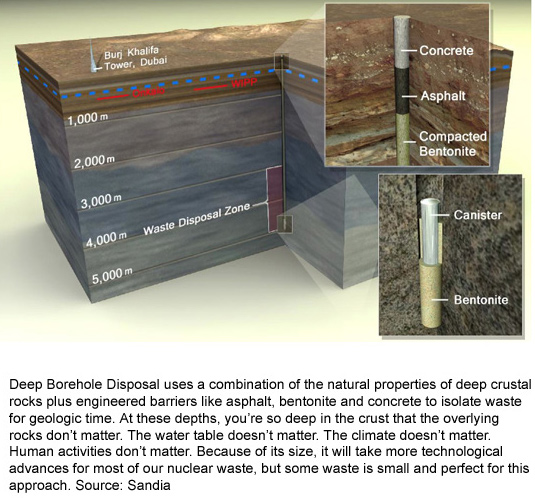
According to reporting from Engineering & Technology, nuclear waste is a mounting issue in Europe and in the UK in particular. “Under European law, all countries that create radioactive waste are obliged to find their own disposal solutions – shipping nuclear waste is not generally permitted except in some legacy agreements. However, when the first countries charged into nuclear energy generation (or nuclear weapons research), disposal of the radioactive waste was not a major consideration. For several of those countries, like the UK, that is now around 70 years ago, and the waste has been ‘stored’ rather than disposed of. It remains a problem.”
In fact, not only does it remain a problem, it is a mounting problem. As nuclear waste has been improperly or shortsightedly managed in the past, the current administration can no longer avoid dealing with the issue. In the past the UK used its Drigg Low-Level Waste Repository on the Cumbrian Coast to treat low and intermediate level waste, but now, thanks to coastal erosion, the facility will soon begin leeching radioactive materials into the sea, although that might not be quite as scary as it sounds.
Back in 2014, the Environment Agency raised concerns that coastal erosion could result in leakage from the site within 100 to 1,000 years, although it was counter-claimed that the levels of radioactivity after such a time would be low enough to be harmless,” Engineering & Technology writes. “This would definitely not be the case for high-level wastes, where radioactivity could remain a hazard into and beyond the next ice age, hence the need for longer-term disposal.”
Where exactly will that longer-term disposal be based? That’s up for debate. And it won’t be an easy thing to decide, as the RWM says that they will need a community to volunteer to be involved in such a costly, lengthy, and potentially unpopular project. And it’s not just an issue for the current inhabitants of potential locations in the UK, but for many generations to come over the next tens of thousands of years of radioactivity
1 This month.


PETITION – To: Prime Minister Anthony Albanese and the Australian Labor Government
Chernobyl: The Lost Tapes – A good documentary on Chernobyl on SBS available On Demand for the next 3 weeks– https://www.sbs.com.au/ondemand/tv-program/chernobyl-the-lost-tapes/235274195556

19 May – Webinar- Webinar: No Nuclear Weapons in Australia
Start: 2026-05-19 18:00:00 UTC Canberra, Melbourne, Sydney (GMT+10:00)
End: 2026-05-19 19:30:00 UTC Canberra, Melbourne, Sydney (GMT+10:00)
20 May – Webinar – The dangerous world of AUKUS, US, military occupation and suppression of dissent

National Webinar, 20th May, 2026, 6.30pm AEST. Confronting laws restricting/suppressing protest speech and action
Speakers: Former Sen. Rex Patrick, Lawyer Nick Hanna ,Arthur Rorris ,Jorgen Doyle, Sen David Shoebbridge,
Facilitator Kelley Tranter.

of the week – Australians for War Powers Reform (AWPR)
To see nuclear-related stories in greater depth and intensity
 Antinuclear