South Australia joins Denmark in elite club of two, “pushing the boundaries” of renewable energy integration
Sophie Vorrath, Sep 20, 2024, https://reneweconomy.com.au/south-australia-joins-denmark-in-elite-club-of-two-pushing-the-boundaries-of-renewable-energy-integration/
[excellent tables and graphs]
South Australia has joined an elite global club, after being listed alongside Denmark as the only other energy system in the world to be successfully managing significant volumes of surplus variable renewable energy across the year – albeit with a lot of hard work ahead.
In its latest global stocktake of variable renewable energy (VRE) integration across 50 power systems, the International Energy Agency says South Australia has joined the ranks of grids with the highest share of solar and wind in the world.
On the IEA’s scale, this puts South Australia in Phase 5 of the integration of renewables (Phase 6 is the top ranking), managing a share of solar and wind that averages out to be higher than fossil fuels over most of the year and at times surpasses 100% of local demand.
And while this is an achievement to be extremely proud of – of the 50 systems analysed by the IEA, 25 are in Phases 1 or 2, representing around 60% of global electricity generation – it also puts South Australia at the pointy end of renewable energy integration, where big changes need to happen fast, to keep the transition on track.
“A growing number of power systems are pushing the boundaries of VRE integration, successfully managing very high shares of variable renewables,” the report says.
But these “frontrunner systems” face complex challenges related to stability and flexibility, which the IEA says call for a transformation of how power systems are operated, planned and financed.
Certainly, South Australia is facing numerous challenges to get its grid from where it is now, to net 100 per cent renewables. And, as the report notes, some of these challenges are uniquely complex.
“In contrast to the case of Denmark, South Australia has limited interconnections with its neighbours, and the impact of solar PV on the net load is more visible,” it says.
“High VRE periods resulting in surplus generation are managed by a combination of measures including energy exports via interconnection to the
neighbouring state, storage with battery energy storage systems (BESS), demand response and curtailment.
“High ramps at sunrise and sunset hours resulting from solar PV generation are managed predominantly by fast-acting gas turbines and the BESS, as well as accessible resources in the rest of the NEM through the interconnector.”
To this end, Project EnergyConnect – a “nation critical” new transmission project that will join up key renewable energy zones in South Australia,
New South Wales and Victoria – is expected to help.
Meanwhile, other parts of Australia are not far behind – the IEA says Australia, as a nation, should be well into Phase 4 by 2030, where it will face “key operational challenges” to the way the power system responds to maintain stability immediately following disruptions in supply or demand.
Just this week in New South Wales, the state’s “potential output” of renewables – that is, the amount available for use or storage in ideal circumstances – was clocked at 99.8 per cent of native demand just before 11am on Sunday, with a combination of sunny weather and strong winds across most of the state.
But, as Renew Economy editor Giles Parkinson notes here, that level of variable renewables currently can’t be accommodated on the NSW system, for a combination of technical and economic reasons. And it is precisely this problem that the IEA report is hoping to address.
“By 2028 the main case of our renewables forecast shows that a range of countries …reach unprecedented annual shares of generation originating from wind and solar power plants – some above 65%,” the report says.
“This development calls for a better understanding of how this could affect electricity systems even further, and what measures can be taken on several fronts to ensure that those higher levels of VRE are integrated in an affordable and secure manner.”
And it warns that a failure to solve these challenges could derail the global climate effort.
“Should integration measures fail to be implemented in line with a scenario aligned with national climate targets, up to 2,000 terawatt-hours (TWh) of global VRE generation would be at risk by 2030, endangering achieving national energy and climate pledges,” the report says.
“This potential loss – equivalent to the combined VRE output of China and the United States in 2023 – stems from possible increases in technical and economic curtailment, as well as potential project connection delays.
“Consequently, the share of solar PV and wind in the global electricity mix in 2030 would reach 30%, lower than the 35% in the case where integration measures are implemented on time. If this decrease is compensated by increased reliance on fossil fuels, it could lead to up to a 20% smaller reduction of carbon dioxide (CO 2) emissions in the power sector.”
It is comforting to note, however, that Australia is not alone in the challenges it faces – even if it is at the leading edge of some of them.
The IEA says successfully integrating higher levels of solar and wind energy into the grid will increasingly rely on measures taken to meet two “critical
requirements:” electricity grids, and procuring flexibility from a broad range of assets.
Grid congestion is a worldwide issue, the IEA notes, considering that global investment in renewables almost doubled between 2010 and 2023, while from 2015 grid investment has stagnated at $US300 billion a year until 2024, when it rose to $US400 billion.
“As a result of insufficient grid investment, at least 1,500 GW of solar and wind projects at an advanced stage were waiting for grid connection as
of mid-2023,” the report says.
“Further, many countries are facing grid congestion issues, which are expensive to address due to the high cost of dispatching power plants to overcome
immediate issues and because of the large amount of investment necessary to overcome congestion in the future.
“It is crucial for countries to accelerate grid expansion and upgrades, as it enables benefits beyond solely integrating VRE, such as improved electricity access and supporting overall demand growth.”
But, as Australia is experiencing, grid development takes a long time to materialise, the report adds, which means any and all complementary solutions with shorter lead times must be tapped to improve the integration of solar and wind.
On power system flexibility, the IEA says most of these needs will be met by solutions that are already in use, such as batteries, demand response and, to a smaller extent, curtailment.
Flexibility also extends beyond conventional generators, the report adds, encompassing storage, new electricity-based end uses, and grid infrastructure, all of which vary regionally.
“This report calls for strategic government action, enhanced infrastructure, and regulatory reforms to ensure the successful large-scale integration of solar PV and wind in order to meet global energy transition targets,” the IEA says.
“Robust data, stakeholder collaboration and government prioritisation of integration measures are essential for overcoming these challenges and achieving a sustainable energy future.”
Sophie Vorrath Sophie is editor of One Step Off The Grid and deputy editor of its sister site, Renew Economy. She is the co-host of the Solar Insiders Podcast. Sophie has been writing about clean energy for more than a decade.
Global status report highlights parlous state of nuclear power sector

“the industry is essentially running to stand still.”
Jim Green, 20 Sept 2024, https://reneweconomy.com.au/global-status-report-highlights-parlous-state-of-nuclear-power-sector/
Two new reports have undermined the Dutton Coalition’s claims about nuclear power.
A report by the Institute for Energy Economics and Financial Analysis (IEEFA) undermines claims that nuclear power would reduce power bills, and the latest edition of the World Nuclear Industry Status Report undermines claims that nuclear power is on a growth trajectory and Australia risks being left behind.
The IEEFA report’s key findings are as follows:
– Under the Coalition’s nuclear plans, electricity bills could rise by $665 per year on average across jurisdictions and scenarios, for households using a median amount of electricity.
– The bill impact would be more acute for larger households, given their higher electricity consumption. For example, for 4-person households the average annual bill increase across regions and nuclear scenarios would be $972 and for 5+ person households it would be $1,182.
– The cost of electricity generated from nuclear plants would likely be 1.5 to 3.8 times the current cost of electricity generation in eastern Australia.
– Overnight capital costs (excluding financing costs) of recent nuclear power station builds analysed by IEEFA have blown out by a factor of between 1.7 and 3.4, creating significant financial difficulties for the companies involved.
World Nuclear Industry Status Report 2024
The World Nuclear Industry Status Report 2024 (WNISR-2024) was released yesterday. Since 1992, these reports have provided a wealth of factual information about the status and trajectory of nuclear power worldwide.
WNISR-2024 notes that as of 1 July 2024, a total of 408 nuclear power reactors were operating in 32 countries, 30 below the 2002 peak of 438 reactors.
At the end of 2023, nuclear capacity stood at 365 gigawatts (GW). As of mid-2024, operating capacity reached 367.3 GW, 0.2 GW more than the previous 2006 end-of-year record of 367.1 GW.
That’s something for the nuclear boosters to cheer about: record nuclear capacity. But some context is needed. Nuclear power has been stagnant for the past 30 years and a fleet of mostly young reactors is now a fleet of old reactors.
In 1990, the mean age of the global power reactor fleet was just 11.3 years. WNISR-2024 notes that the average age of the world’s operating reactor fleet has been increasing since 1984 and stands at 32 years as of mid-2024, up from 31.4 years in mid-2023.

As the rate of closure of ageing reactors increases, it will become increasingly difficult for the industry to maintain its 30-year pattern of stagnation by matching closures with start-ups, let alone achieving any growth.
Former World Nuclear Association executive Steve Kidd spoke to this problem in 2016, noting that “the industry is essentially running to stand still.”
In 2023, WNISR-2024 notes, there were five reactor start-ups (5 GW) and five permanent closures (6 GW) with a net decline of 1 GW in capacity. (This year has also been underwhelming: a net gain of 2 GW of nuclear capacity compared to several hundred GW of new renewable capacity.)
Nuclear’s share of global electricity generation declined from 9.2 percent to 9.1 percent in 2023, little more than half of its peak of 17.5 percent in 1996.
In the 20 years from 2004 to 2023, there were 102 startups and 104 reactor closures worldwide. Of these, 49 startups were in China with no closures. Outside China, there has been a net decline of 51 reactors over the same period, and net capacity declined by 26.4 GW.
As of mid-2024, 59 reactors were under construction worldwide, 10 fewer than in 2013. China had the most reactors under construction (27) but none abroad. Russia dominates the international market with 26 units under construction as of mid-2024, six of them in Russia and 20 in seven other countries.
WNISR-2024 states: “It remains uncertain to what extent these projects have been or will be impacted by sanctions imposed on Russia and other consequential geopolitical developments following Russia’s invasion of Ukraine.”
Construction started on six reactors in 2023 — down from 10 in 2022 — including five in China.
Chinese and Russian government-controlled companies launched all 35 reactor constructions in the world from December 2019 to mid-2024. Besides Russia’s Rosatom, only France’s EDF is currently building nuclear power plants abroad (two reactors in the UK) as lead-contractor.
Potential nuclear ‘newcomer’ countries
Peter Dutton claims that “50 countries are exploring or investing in next-generation nuclear technology for the first time.” That’s nonsense. WNISR-2024 notes that the number of countries building reactors fell by three from mid-2023 to mid-2024.
Reactors are under construction in 13 countries, down from 16 countries the previous year as the UAE and the US completed their last construction projects and Brazil suspended its only reactor construction project. Only three countries — China, India, and Russia — are building reactors at more than one site.
Just three potential nuclear newcomer countries had reactors under construction as of mid-2024: Egypt, Bangladesh and Turkiye.
WNISR-2024 notes that of 18 African countries analysed, only four would have grid systems large enough to meet minimum capacity criteria to host a large nuclear reactor (based on the rule of thumb that the largest unit in a grid system should not exceed 10 percent of total system capacity).
Small modular reactors might find a niche — but they don’t exist.
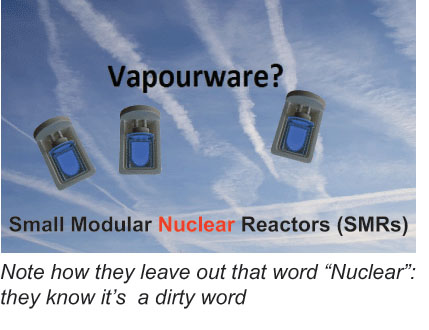
Small modular reactors
WNISR-2024 states: “The gap between hype about Small Modular Reactors (SMRs) and industrial reality continues to grow. The nuclear industry and multiple governments are doubling down on their investments into SMRs, both in monetary and political terms. So far, reality on the ground does not reflect those efforts.
“SMR projects continue to be delayed or canceled. Costs for nuclear projects in general and SMRs in particular are surging. The few available cost estimates for SMRs, especially when weighted by their electrical power generation capacities, show how expensive these are.”


Two developments over the past year have punctured the hype around SMRs. The first was NuScale’s decision to abandon its flagship project in Idaho after cost estimates rose to an absurd A$30,000 per kilowatt (A$14 billion for a 462 megawatt plant).
Then, French utility EDF announced that it had suspended the development of its Nuward SMR and reoriented the project “to a design based on proven technological building blocks.”
The two operating SMRs — a twin-reactor plant in China and a twin-reactor floating plant in Russia — weren’t built using serial factory construction methods so can’t be called SMRs. Nor are there plans to mass-produce these reactors types using serial factory construction methods, so the so-called SMRs in China and Russia can’t even be called prototype SMRs.
Dutton wants taxpayers to fund the construction of large reactors in the eastern states and SMRs in SA and WA. SA aims to reach 100 percent net renewable electricity generation as soon as 2027. Presumably Dutton wants to replace some of that renewable power generation with SMRs, for some unfathomable reason.
Nuclear vs renewables

Total investment in non-hydro renewable electricity capacity in 2023 was estimated by Bloomberg New Energy Finance (BNEF) at $US623 billion, up 8 per cent compared to the previous year. According to a WNISR estimate, this represents 27 times the reported global investment decisions for the construction of nuclear power plants of about $US23 billion for 6.7GW.
BNEF estimated investments in stationary storage capacity at around US$36 billion in 2023, which, for the first time, exceeded investments into new nuclear. Globally, utility-scale storage additions jumped from just over 10 GW added in 2022 to more than 25 GW in 2023.
In 2023, annual additions of solar and wind power grew by 73 per cent and 51 per cent, respectively, resulting in nearly 460 GW of combined new capacity, according to the International Renewable Energy Agency.
The solar PV market saw China alone adding around 217 GW — a 150-percent increase over 2022-additions — and the rest of the world 129 GW for a total of 346 GW or about 1 GW per day.
The Global Wind Energy Council reported a record of 117 GW of new wind installations, a 50 per cent year-on-year increase, with China accounting for 65 percent of total added onshore capacity and 58 per cent of total added offshore capacity. These numbers compare with a net addition of 1 GW nuclear capacity in China and a global decline of 1 GW in 2023.
WNISR 2024 states: “In 2021, the combined output of solar and wind plants surpassed nuclear power generation for the first time. In 2023, wind and solar facilities generated 50 percent more electricity than nuclear plants.
“Wind power alone generated 2,300 terawatt-hours (TWh) and is getting close to nuclear’s 2,600 TWh. Since 2013, non-hydro renewables added 3,500 TWh to the world’s power generation, 14 times more than nuclear’s roughly 250 TWh, and generated 80 percent more power than nuclear in 2023.”
In 2023, the European Union achieved its largest renewable capacity additions ever and the renewable share in total electricity generation reached a record 44 percent. Solar and wind plants together produced 721 TWh compared to nuclear’s 588 TWh.
For the first time ever, non-hydro renewables generated more power than all fossil fuels combined in 2023. Fossil fuel power generation dropped by a record 19 percent, reaching its lowest level ever and accounting for less than one-third of the EU’s electricity generation.
In China, solar PV produced a total of 578 TWh of electricity in 2023, 40 percent more than nuclear’s 413 TWh. Wind power generation first exceeded nuclear in 2012: in 2023, wind produced 877 TWh, more than doubling nuclear generation. Adding other non-hydro renewables like biomass to solar and wind, the net total generation of 1,643 TWh in 2023 was four times the nuclear output.
Keep in mind that China is the only country in the world with a significant nuclear power expansion program. It might be a stretch for WNISR-2024 to state that “nuclear power remains irrelevant in the international market for electricity generating technologies”, but it is heading in that direction.
Dr Jim Green is the national nuclear campaigner with Friends of the Earth Australia and a member of the Nuclear Consulting Group.
Nuclear debate stalls as detail goes missing in action

Angela Macdonald-Smith, https://www.afr.com/companies/energy/nuclear-debate-stalls-as-detail-goes-missing-in-action-20240920-p5kc56 21 Sept 24
Australia’s debate over nuclear power is going nowhere. Politicians are happy to roll out any argument that suits them, but the credible and comprehensive analysis and modelling needed is completely missing.
The upshot is that the energy industry – the people who need to make the transition happen – are disengaged, and consumers who will have to vote on these “policies” are confused.
The vacuum of information includes both the costings and details behind the Coalition’s seven-site nuclear power vision, but also a realistic assessment from the Albanese government about the difficulties in reaching its 2030 climate targets.
Federal Energy and Climate Change Minister Chris Bowen on Friday released energy department findings on the huge reliability gaps that the Coalition’s nuclear plan would cause.
Two scenarios were studied: one that assumed coal plant owners close their plants as projected by the Australian Energy Market Operator between now and 2035, and the Coalition caps investment in large-scale renewables and does not support new transmission builds; a second assumed all coal power stations set to close before 2035 are extended beyond 2040 to try to tide the power system over until nuclear reactors could come online.
According to the results released by Bowen’s office, the first would lead to a huge 49 per cent gap between the demand for energy of about 316 terawatt-hours and available supply – of about 160 TWh – by 2035. The second, an 18 per cent gap of “unmet energy”.
The minister’s office compared those numbers with AEMO’s current tolerance gap for an effectively operating electricity system of just 0.002 per cent of “unmet energy”.
Bowen says the analysis shows how the Coalition’s plan “will result in massive supply shortages over the next decade”. However, the full work carried out by the department was not made available.
Analysis released on Friday by the Institute for Energy Economics and Financial Analysis, which advocates a faster shift to clean energy, also played into Labor’s hands. The analysis sought to estimate the potential impact on household electricity bills using six scenarios that were based on international examples of nuclear power construction projects.
The results suggested that the median household bill would rise, on average, by about $665 a year. The work was based on six recent real-world examples of new nuclear plant builds, ranging from the cheapest location in the Czech Republic through to the most expensive, the Hinkley Point C reactor under construction in the UK at a cost that may top £46 billion ($90 billion).
“The cost of electricity generated from nuclear plants would likely be 1.5 to 3.8 times the current cost of electricity generation in eastern Australia,” IEEFA found.
The analysis was dismissed as “complete nonsense” by shadow treasurer Angus Taylor, while Opposition Leader Peter Dutton also questioned its credibility. He cited Labor’s failed pre-election promise to deliver $275 bill reductions by 2025 as evidence it can’t be trusted.
But the Coalition’s own arguments are just as flimsy, weakened by the continuing absence of the full costings and details of its energy plan.
Dutton is scheduled to speak on nuclear power at the Committee for Economic Development of Australia on Monday. It will not, however, include the much anticipated business case for nuclear. Coalition sources say that will have to wait until some time before the election, due by May next year.
A Coalition source said Monday’s speech would instead be “values”-based. That means a reaffirmation of the seven potential nuclear sites, and more words about why nuclear is better than Labor’s “renewables-only” approach.
The energy industry, meanwhile, is disengaged as the politics play out. While not writing the nuclear option off as impossible, the starting point for real action is much too far off for it to register.
Continuing delays in the build-out of the energy grid – caused by slow project approvals and rising costs, among many other issues – mean these companies have much more immediate challenges to worry about.
Coalition should show us its sums on nuclear
September 20, 2024, https://www.smh.com.au/national/nsw/coalition-should-show-us-its-sums-on-nuclear-20240920-p5kc2k.html
How many more studies are needed to show what is glaringly obvious to everyone? That nuclear power is not cheap and that it is potentially very expensive (“Extra cost of nuclear power revealed”, September 20)?
Despite this, the Coalition keeps sticking to its guns. They can’t be wrong and any study that says otherwise is “shallow and flawed”. They claim the latest study cherry-picks the worst cases, ignoring that any selection is needed to make the study more realistic. Australia won’t have access to cheap labour, so those cases should rightly be ignored. Also, nuclear energy is not where you want to cut corners to keep costs down. And yet, the Coalition has decided to go down the nuclear path.
How can you make a decision without the supporting numbers? If they have the numbers they should release them. David Rush, Lawson
Nuclear is not a viable option for Australia. It will be too expensive and it will take far too long to be of any use and by the Coalition’s own numbers, it will produce almost no electricity even if they are built. Every report from the CSIRO down that exposes Peter Dutton’s nuclear brain explosion has been belittled by the Coalition. The Coalition says it will release its costings eventually. Presumably, they don’t know what the cost will be yet, but given their wildly inaccurate estimates on Snowy 2.0 and inland rail, we have little cause for hope of an accurate figure. Ross Hudson, Mount Martha (Vic)
Coalition energy spokesman Ted O’Brien calls the first analysis of the Coalition’s nuclear plan shallow and flawed – in other words fake news. Having cherry-picked the lowest numbers in their discussions of this policy, and choosing their examples, the Coalition will now have to present their documentation as to how low electricity prices will be under their leadership. As a taxpayer, I’m concerned about the level of accountability if there are cost blowouts or hugely extended construction times. So even if the proposed nuclear plants can deliver cheaper electricity, what happens in the meantime? The Coalition’s switch to government ownership of this infrastructure and the cash splash to those communities who accept a nuclear plant is using taxpayer money to subsidise lower electricity prices to win this argument. We are not just building a few buildings – we are creating a whole new industry from scratch. Meanwhile, another decade or so will pass and more opportunities will be wasted for a better environment. Robert Mulas, Corlette
Ted O’Brien says the US non-profit think tank the Institute for Energy Economics and Financial Analysis has cherry-picked the costs for the opposition’s nuclear “plan”. Why it would do this is unclear but far from choosing selected examples, it has based its analysis on average bills for construction of large-scale nuclear plants by countries with comparable economies to Australia. As for who will put up the money, O’Brien says they will be built by a government entity while Angus Taylor says they will not be publicly subsidised. Peter Nash, Fairlight
More than a third of Australian households have solar power and they won’t like analysis from the Smart Energy Council that shows Dutton’s seven nuclear reactors will shut down solar panels for between 1.8 and 2.9 million homes. The council says that as nuclear power can’t be switched off, it will continue pushing power into the grid, “regardless of whether it’s the most expensive form of energy, or even needed”. Is this really the best energy policy Dutton can come up with, or is it simply an expensive smokescreen to extend the life of fossil fuels? Alison Stewart, Riverview
We are now told our power bills may rise by $665 a year to pay for nuclear energy infrastructure costs. Is this why Dutton is so reluctant to release his costings? Peng Ee, Castle Cove
“Catastrophic:” Coalition plan to stop renewables and push nuclear will result in massive supply gaps

Giles Parkinson, Sep 20, 2024, https://reneweconomy.com.au/catastrophic-coalition-plan-to-stop-renewables-and-push-nuclear-will-result-in-massive-supply-gaps/
Federal energy minister Chris Bowen has launched a new attack against the federal Coalition’s nuclear power policy, saying its plan to stop renewables and potentially “sweat” the remaining coal assets could lead to “catastrophic” supply gaps in the electricity market.
The federal government released new modelling on Friday, the same day as another independent report pointed to a $1,000 a year bill hike to consumers from a nuclear power policy, and just days before Coalition leader Peter Dutton is expected to outline more details at a Sydney event.
The Coalition has been vague about its nuclear power plans to date, identifying only seven potential sites for large scale nuclear or small modular reactors, but has said it intends to stop new wind, solar and battery projects, cease the rollout of new transmission lines, and boost coal and gas output.
In response, the federal department of energy has modelled several different scenarios, and both point to massive supply gaps in the future if the Coalition holds firm on its promise to stop renewable, and even “tear up” as some contracts, as National leader David Littleproud has threatened.
The department estimates that the Coalition’s energy plan will leave a “gaping black hole” of between 18 per cent to 49 per cent of unserved energy, ie the gap between supply and demand.
The biggest gap is created on the assumption that private coal operators do close their ageing coal fired generators between now and 2035, and that the Coalition does not build any new utility scale renewables beyond what’s currently committed, and does not support new transmission builds.
On that scenario, the department modelling estimates a shortfall of around 156 terawatt hours (TWh) between demand for energy (around 316 TWh) and available supply (arround 160 TWh).
The second scenario assumes that all coal plants are extended beyond 2040, to allow time for the Coalition to begin construction of its promised nuclear power plant, but that still results in a shortfall of 18 per cent if the Coalition delivers on its promise to stop the rollout of large scale renewables.
“These scenarios are so catastrophic for the economy, for ordinary Australians, and for Australia’s place as an advanced country they seem implausible,” the department report says.
“But that will be the result of the Coalition’s nuclear scheme.”
It’s ironic because the Coalition is pitching its nuclear scheme on three assumptions: That it is lower cost, that it is more reliable, and that it is compatible on a net zero strategy.
But analysis shows that it would fail on all three counts. Multiple reports have highlighted the higher cost of nuclear, and although the Coalition insists there higher costs affect only investors and not consumers (without ever explaining why), the new analysis from IEEFA points to a blow out in retail bills.
The Coalition insists that a reliance on wind and solar will lead to the destruction of industry, but that is proved a nonsense by South Australia, already at more than 70 per cent wind and solar and aiming for net 100 per cent by 2027, and its inability to explain what will be meeting growing demand needs.
“The fact of the matter is that Mr Dutton and Mr Littleproud and Mr O’Brien wander around the country saying that they will pause renewable energy investments,” Bowen told journalists on Friday.
“Even under their own scheme, they admit that we would not have any nuclear power in Australia until 2035 at the earliest, and that is wildly optimistic.
“Now the question that Mr Dutton has to answer is, where will the electricity come from? If we stop building renewables now and nuclear takes so long, as Australia’s electricity needs are increasing every day, where will he get the power from?
“He wanders around making outrageous accusations about black‑outs under this government, when in fact it’s his own scheme which is the biggest risk to reliability in Australia.”
The department report is just one of three released this week that undermines the Coalition’s case for nuclear in Australia. One is the IEEFA report on the impact on bills, and the World Nuclear Industry Status Report on nuclear that shows an industry that is barely advancing, despite the Dutton rhetoric.
And the problem around reliability is further highlighted by issues at Vogtle, the first nuclear power plant to be built in the US for more than three decades. (And despite Coalition claims of a nuclear renaissance, no other nuclear power projects are being built or committed).
One of the two units at Plant Vogtle, a plant that ran way over budget and time in the country with the biggest nuclear fleet of any, was shut down in July, and again in September, due to various valve issues in what critics note is the most expensive power plant on the planet.
The Coalition has been selling nuclear as reliable and “always on”, but like any generation source it can face hiccups, and the bigger the generation unit – the Westinghouse AP1000s at Vogtle (cited as a potential technology choice by the Coalition) have a capacity of 1,117 MW – the more back-up that is required.
And it is these unexpected interruptions, as opposed to the entirely predictable setting of the sun each day, that creates the biggest problems for the market operator.
“I’ve never said the shift to a clean, cheap, renewable energy system would be easy. But it is achievable, and our plan is working,” Bowen wrote in an op-ed in The Australian.
“Supporting new investment in generation and batteries, bringing on offshore wind projects, and underwriting crucial transmission lines through Rewiring the Nation are real policy solutions underway now.
“Last month AEMO confirmed on time delivery of federal, state and territory programs as planned and legislated, will be sufficient to meet demand out to 2035, within the stringent reliability standard.
“Contrast that with the Coalition’s ideological pursuit of its anti-renewable nuclear scheme that leave almost half Australia’s energy needs unserved in the same period.”
The challenge for Labor, however, is not to convince the Australian or even international energy industry of this. The industry understands just how unsuitable the nuclear option is.
But the Coalition, with the often uncritical and sometime active support of mainstream media and most conservative “think tanks”, is seeking only to win a public debate on this, and the public care little about the details.
“They are treating the Australian people like mugs, arrogantly holding the details of their costings, of the modelling, of the impact of their policies on Australians from the Australian people,” Bowen said.
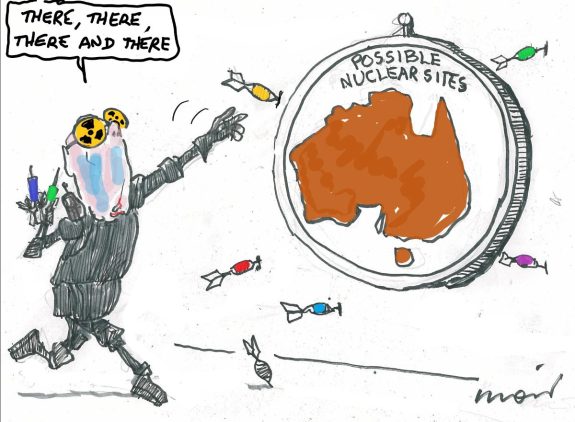
Peter Dutton and the pursuit of fame.
21 September 24 https://theaimn.com/peter-dutton-and-the-pursuit-of-fame/
Peter Dutton is the leader of Australia’s opposition party – the Liberal-National Coalition.
Which is pretty noteworthy and important, anyway. But of course, he would be more important if he is elected as Prime Minister in 2025. But is that enough fame for him?
Dutton aspires to a greater, global, significance. He would be the first world leader to introduce the commercial, peaceful, advanced nuclear industry to not just a country, but to an entire continent. And not to some “third-world” “undeveloped” country “in need of charity” – but to a prosperous, privileged, purportedly well-educated, and still mainly white population.
For the global nuclear industry – that would be a first! And not just any old first, but an extremely timely one. Just released this week, The World Nuclear Industry Status Report 2024 describes an industry on life support. Even back in 2016 Former World Nuclear Association executive Steve Kidd spoke to this problem, noting that “the industry is essentially running to stand still.”
For Australia to adopt a government-run nuclear industry involving both large and small nuclear reactors across a continent – what a wonderful shot in the arm for the global nuclear lobby. And Dutton – what a hero!
Dutton would be famous not just in Australia, but world-wide
Is this why Peter Dutton is promoting his nuclear policy?
I can’t think of any other reason.
Australia, especially in the State of South Australia, is becoming a world leader in renewable energy use – particularly in decentralised household rooftop solar, but also in large solar and wind programmes. Of course, Australia’s mining magnates are pretty happy with Dutton’s plan, as it will mean more mining, not just of uranium, but of coal and gas in the decades before nuclear power actually comes into use.
So – look – it’s a winner for Dutton’s fame.
And if that doesn’t work, there’s fame in another way
The last Liberal Prime Minister, Scott Morrison, is a great contender for the worst Prime Minister in Australian history. Just a few of his achievements to merit this award were:
- By 2022, Australia’s gross national debt was 42.5 per cent of GDP (Peak Whitlam government was 24.5. Peak Hawke-Keating was 24. Peak Rudd-Gillard Government debt was 20.)
- Notorious for taking a holiday during Australia’s 2019–20 bushfire season.
- Signed Australia up to the costly AUKUS nuclear submarine deal
- Secretly appointed himself to five ministerial positions without the knowledge of the public or his own government.
Economically, the nuclear power programme, added to the continuing AUKUS nuclear deal, could pretty well bankrupt Australia. Although Dutton claims that nuclear power will be cheap, he’s given no costings, and the over-riding opinion of energy and economics experts is that nuclear power would be the most expensive form of energy for Australia.
Environmentally, Dutton’s plan includes advanced nuclear reactors, which will require plutonium or enriched uranium – so this brings virtually eternal radioactive pollution into Australia (something that has been nearly avoided up until now). It also brings the hazards of nuclear weapons proliferation, and terrorism targets.
So – it’s a bold venture for Peter Dutton, to centre his election campaign on promoting the nuclear industry. He is to be commended for bravery in taking such a big risk.
If Dutton carries this through, as Prime Minister, he will rapidly gain world fame.
But also, as far as Australia is concerned, he could beat Scott Morrison into history as the nation’s worst Prime Minister.
Dutton’s big risk is that he might not get elected in 2025, and vanish very quickly from history.
Coalition’s nuclear plan will lead to ‘massive’ electricity shortages and risk blackouts, new analysis warns

Energy minister Chris Bowen says Peter Dutton must explain what happens to national grid over next decade if opposition stops building renewables
Guardian, Adam Morton Climate and environment editor, 20 Sept,24
The Coalition’s proposal to cap large-scale renewable energy and eventually build nuclear power plants would lead to “massive” electricity supply shortages risking blackouts, according to analysis released by the federal government.
The climate change and energy minister, Chris Bowen, released the findings of an energy department analysis that suggested electricity supply could be at least 18% less than what will be needed in 2035 under a scenario that reflects the few details of the Coalition plan that have been released.
Those details include the country building fewer solar and wind farms, the cancellation of the “rewiring the nation” policy to build transmission lines, extending the life of ageing coal plants and building nuclear plants at seven sites.
The Coalition’s proposal to cap large-scale renewable energy and eventually build nuclear power plants would lead to “massive” electricity supply shortages risking blackouts, according to analysis released by the federal government.
Under a scenario in which about 90% of remaining coal generation closes by 2035 – consistent with what the Australian Energy Market Operator (Aemo) projects – the gap between demand and supply could be 49%, according to the analysis.
Bowen said it showed Peter Dutton would “take to our finely tuned electricity system planning with a sledgehammer” and cause “massive supply shortages over the next decade”.
“The question that Mr Dutton has to answer is: where would the electricity come from if we stop building renewables now and nuclear takes so long?” Bowen said at a media conference. “He wanders around making outrageous accusations about blackouts under this government when in fact it’s his own scheme [that] is the biggest risk to reliability in Australia.”
The analysis, released via an opinion piece in The Australian, is timed to precede a speech by Dutton on Monday on whether nuclear power could work in Australia.
Dutton and the opposition treasury spokesman, Angus Taylor, rejected Bowen’s analysis in TV interviews on Friday, but declined to release details of their proposal. Speaking on Sky News Australia, Taylor said Bowen was “full of nonsense” and Labor’s policies would “always cost Australians more than our alternative policies”.
The Coalition has said if elected it would use public money to build nuclear plants at seven sites. It has suggested it would also cap investment in large-scale renewable energy and back more gas, a fossil fuel responsible for 21% of Australia’s climate pollution.
It has not released the expected cost of the plants, explained how the Coalition would lift legislated bans on nuclear power, or said why he believed the first two plants could be operating by 2035 or 2037 – a much faster timeframe than experts say would be possible.
Government agencies and independent analysts have found nuclear and more gas would be more expensive for households and businesses than Labor’s plan of running on variable renewable energy backed by “firming” from batteries, pumped hydro, more transmission lines and some gas.
Aemo last month suggested the country’s main power grid, covering the five eastern states, would remain reliable as it shifted from running on mostly coal to mostly renewables if planned investments in new generation were delivered “on time and in full”. Bowen said this would not be possible under the Coalition’s plan……………………………………….. more https://www.theguardian.com/australia-news/2024/sep/20/coalitions-nuclear-plan-will-lead-to-massive-electricity-shortages-and-risk-blackouts-new-analysis-warns?fbclid=IwY2xjawFZ80RleHRuA2FlbQIxMQABHRjcdt-9ZgyIv3BFzTaDCzbuWnZHwb4j4tAAT811vpZzm5UGVBP0h9xHpA_aem_LiV8Y3dC8T95lCzPdJNBHQ
Affordable nuclear? Dutton’s plan would add nearly $1,000 a year to the power bill of a family of four

Sophie Vorrath, Sep 20, 2024, https://reneweconomy.com.au/affordable-nuclear-duttons-plan-would-add-nearly-1000-a-year-to-the-power-bill-of-a-family-of-four/—
A family of four in living on the east coast of Australia would pay nearly $1000 more a year for electricity under the federal Coalition’s nuclear power plan, a new report has found, while the average Australian household would see bills rise by $665 a year.
In a major new report, the Institute for Energy Economics and Financial Analysis, IEEFA, has undertaken to calculate the cost to consumers of Peter Dutton’s plan to build seven nuclear power plants across Australia, including both large-scale reactors and small modular reactors (SMRs).
This has already been done, to a fashion, by Australia’s main scientific body, the CSIRO, whose GenCost report in May of this year found large-scale nuclear to be at least double the cost of integrated renewables, and impossible to deliver before 2040.
IEEFA has taken a different tack, seeking to measure the cost of nuclear to “mums and dads,” by calculating the electricity bill impact of a range of scenarios, based on the actual costs of six recent projects in countries comparable to Australia.
For large-scale reactors the first four scenarios are based on actual, recent nuclear power plant construction costs and timeframes for countries in liberal democracies where costs are transparent, IEEFA says.
This includes the real-life projects – Finland’s Olkiluoto Unit 3, France’s Flamanville Unit 3, the US’s Vogtle Units 3 and 4 and the UK’s Hinkley Point C.
For SMRs – where, as IEEFA notes, “no plants have been successfully completed in a democratic country” – costs are based on the one example of a binding contract offer to build such a plant in the US, the now-cancelled NuScale project.
It also used this approach to assess the costs to build South Korean APR technology (a design that the Coalition has cited for potential implementation in Australia) in a democratic country with laws protecting labour rights: the Czech Republic’s Dukovany proposed plant.
“In the international examples examined, the capital cost of nuclear power plants was very high – up to $90 billion,” says Johanna Bowyer, report coauthor and lead analyst for Australian electricity at IEEFA.
“Recent international large-scale nuclear projects have experienced construction challenges, delays and cost-blowouts. Capital costs, excluding financing costs, of recent nuclear power station builds we analysed had blown out by a factor of 1.7 to 3.4 times.”
When extrapolated to the Australian market, results vary – the more than 50-page report provides precise details on the differences in bill increases depending upon which nuclear power project cost experience you consider, which state (South Australia, Victoria, New South Wales or south-east Queensland) and the size of the household.
But the bottom line is that, in every scenario, bills increase by hundreds of dollars and in some cases by more than $1000.
At the bottom end, the bill increase for households consuming a median amount of electricity was as low as $260 a year based on the anticipated cost of a new nuclear plant in the Czech Republic – although given that is a pre-construction project IEEFA says it is highly likely to have underestimate final costs.
The lowest impact from a nuclear plant successfully completed (Vogtle) is $383-$461 per year for an average household. Meanwhile, the UK experience with the still under construction Hinkley Point C indicates electricity bill rises of up to $1,259 are possible.
Across all nuclear scenarios and regions, the report finds that for a four-person household the bill impact would average out at $972/year, and for a five-person household – like Peter Dutton’s – that figure would rise to an eye-watering $1,182/year.
Ultimately, it’s a finding that rather answers the question posed by next week’s CEDA luncheon discussion: “A nuclear powered Australia – could it work?”
“For nuclear power plants to be commercially viable without government subsidies and generating 24/7 – as the Coalition proposes – electricity prices would need to rise to these higher levels to allow the nuclear power plants to recover their costs,” says Bowyer.
“This would result in a large increase in wholesale market prices which would then flow through to household bills,” Bowyer says. “In a cost-of-living crisis, bill increases like this are a big deal.”
But what about those countries that use nuclear and have lower retail electricity prices than Australia? Aren’t they proof positive that nuclear power is affordable?
Nice try, but no, says IEEFA. “In almost all cases around the world, the cost of nuclear power plant construction and financing is not fully reflected in market prices for power,” the report says.
“This is because either nuclear power plants are very old and their costs are largely depreciated, or governments have acted to recover the costs either through taxpayers, or via levies which are independent of electricity markets – for example in France, the UK and Ontario, Canada.
“The Coalition has outlined something different, ruling out taxpayer subsidies and stating that any government investments in nuclear plants would receive a commercial return.”
Tristan Edis – a director at energy advisory firm Green Energy Markets and a contributor to the IEEFA report – says the mistaken perception that nuclear is a cost-effective technology is often based on the fact that it is in use across the globe.
But he says most of the plants built in the western world were committed based on projected costs and timeframes that turned out to be “horrible underestimates” that have cost governments dearly.
“They almost make Snowy 2.0 look good by comparison,” Edis says, referring to the federal government-owned 2.2GW pumped hydro project whose original price tag of $2 billion has ballooned to a massive $12 billion and is running seven years behind schedule.
“The end result has often been bankruptcy and taxpayer-funded bail-outs for many of the firms involved,” Edis adds, citing the examples of Ontario’s publicly owned utility, for Westinghouse with its AP1000 design, and for France’s AREVA and EDF.
“These cost blow-outs are sometimes not apparent in the electricity prices seen in other countries, but that’s just because it is the taxpayer picking up the tab instead,” he says.
In the case of Australia, the Coalition has repeatedly ruled out taxpayer subsidies for its nuclear plans, and repeatedly claimed that any government investments in nuclear plants would receive a commercial return.
Take shadow treasurer Angus Taylor’s comments to the National Press Club in May:
“The key for me as someone who really believes that we should make sure that we have affordable, reliable power, and I don’t want to commit subsidies that aren’t necessary, is to make sure that it’s [nuclear power] commercially viable, and we think it can be. … If it’s commercially viable, it’s not going to be
subsidies. It’s as simple as that.”
As the report notes, this line of logic implies that the Coalition expects wholesale electricity market prices will be sufficient for nuclear power plants in each state to recover their construction costs plus a commercial level of return.
Further, these nuclear power plants would be “always on,” which means power prices would need to average out at the level a nuclear plant needs to be commercially viable – to recover their costs – almost all of the time.
And the only way this can be achieved without substantial, taxpayer-funded government subsidies is for household power bills to rise significantly, says Bowyer.
“Our analysis indicates that the Coalition’s plan is unlikely to represent a realistic cost-effective energy solution for Australia,” she says.
“Any plan to introduce nuclear energy in Australia … should be examined thoroughly, with particular focus on the potential impact on electricity system costs and household bills, and with detailed analysis of alternative technologies such as renewables and firming.”
Australian nuclear news headlines 16 -23 September
Headlines as they come in:
- Peter Dutton refuses to divulge costs of going nuclear at anticipated ‘could it work’ speech
- Why is Peter Dutton so frightened of nuclear detail?
- Peter Dutton’s weird obsession with uncosted nuclear risks energy security, the economy and our kids’ future.
- Peter Dutton’s nuclear plan still has no costings, and no grid connection: It’s a political hoax
- Australian film-maker refused entry into India.
- We don’t need nuclear power – the path to cheaper electricity is renewables.
- AUKUS boss insists project remains on track despite frustrations and staff upheaval within submarine agency
- South Australia joins Denmark in elite club of two, “pushing the boundaries” of renewable energy integration
- Nuclear debate stalls as detail goes missing in action
- Coalition should show us its sums on nuclear
- Peter Dutton and the pursuit of fame .
- Affordable nuclear? Dutton’s plan would add nearly $1,000 a year to the power bill of a family of four
- Global status report highlights parlous state of nuclear power sector
- “Catastrophic:” Coalition plan to stop renewables and push nuclear will result in massive supply gaps
- The UK’s nuclear waste problem .
- Nuclear in Australia would increase household power bills
Jewish Council disappointed at Australia’s UN abstention, calls for strong international action to prevent Israeli war crimes

By Jewish Council of Australia, September, 19, 2024
The Jewish Council of Australia says it is deeply disappointed at Australia’s abstention from a critical United Nations General Assembly resolution calling on Israel to end its occupation of the Palestinian territories within 12 months. The resolution passed with 124 votes in favour, highlighting global frustration with Israel’s actions.
In a statement, the JCA said Australia’s abstention did not align with its commitments to international law and peace-building. While the Australian Government had indicated support for many aspects of the resolution, its failure to vote in favour was s a missed opportunity to show stronger, principled leadership, the Jewish group said.
“This vote comes at the same time as further apparent Israeli attacks on Lebanon, a day after the pager attacks,” a statement from the JCA said.
“The Jewish Council of Australia condemns these attacks. Their indiscriminate nature, killing dozens and injuring thousands of civilians, is an apparent war crime which underscores the urgent need for a collective international response to prevent Israel further breaching international law.
“We call on the government to join with other countries in condemning the killing of innocent civilians, and reiterate our calls for Australia to take material action by imposing sanctions and throwing its weight behind a global arms embargo.
JCA executive officer Sarah Schwartz said:
“We condemn the loss of any innocent life. Australia and the international community must take material steps to prevent, and ensure accountability for, the commission of war crimes. These indiscriminate attacks, which have killed innocent bystanders, are the behaviour of a rogue state and should be treated as such.”
JCA executive officer Dr Max Kaiser added:
“We urge the Australian government to join the vast majority of countries in the international community that are taking a firm stance. Australia can and should be doing more to hold Israel accountable for its unlawful presence in Palestinian territories. The time for decisive action is now.”
Nuclear in Australia would increase household power bills
Report Nuclear Electric Grid Energy Policy Australia
September 20, 2024, Johanna Bowyer and Tristan Edis, https://ieefa.org/resources/nuclear-australia-would-increase-household-power-bills
Key Findings
Typical Australian households could see electricity bills rise by AUD665/year on average under the opposition Coalition’s plans to introduce nuclear to the country’s energy mix.
IEEFA analysed six scenarios based on relevant international examples of nuclear power construction projects; in every scenario, bills increased by hundreds of dollars.
For households that use more electricity, bills could rise more – for a four-person household, the bill rise was found to be AUD972/year on average across nuclear scenarios and regions.
The cost of electricity generated from nuclear plants would likely be 1.5 to 3.8 times the current cost of electricity generation in eastern Australia.
Australia’s main federal opposition, the Liberal-National Coalition, has proposed building seven nuclear power plants across the country, including both large-scale reactors and small modular reactors (SMRs). This report seeks to detail the likely impact on household consumers’ electricity bills from such a plan, based on recent real-world experience from construction costs for nuclear power plants around the world.
Rather than use theoretical projected costs, we have calculated the potential electricity bill impact for a range of nuclear cost recovery scenarios, based on the following real-world examples:
Finland: Olkiluoto Unit 3. France: Flamanville Unit 3. UK: Hinkley Point C. US: Vogtle Units 3 and 4.US SMR: NuScale SMR. Czech Republic: Dukovany proposed plant expansion.
The first four scenarios are based on actual, recent nuclear power plant construction costs and timeframes for countries in liberal democracies where costs are transparent. Commenting on nuclear construction cost estimates, electricity market economist Professor Paul Joskow states: “The best estimates are drawn from actual experience rather than engineering cost models.”
In the case of SMRs, no plants have been successfully completed in a democratic country, so we instead used the one example of a binding contract offer to build such a plant in the US, the now-cancelled NuScale project. We also used this approach for assessing the costs for a proposal to build South Korean APR technology (a design that the Coalition has cited for potential implementation in Australia) in a separate democratic country with laws protecting labour rights, outside of its country of origin – the Czech Republic.
Household electricity bills impact
We found that electricity bills would need to rise in order for nuclear costs to be recovered. The chart below illustrates the resulting increase in typical household power bills if nuclear power plants with similar costs and characteristics to the international examples were built in Australia. The average bill increase was AUD665/year across states and nuclear scenarios for households with a median level of electricity consumption. The lowest impact is equivalent to bill increases of AUD260-AUD353 per year, linked to estimated costs for the pre-construction project Dukovany, which is highly likely to underestimate final costs. The lowest impact from a nuclear plant successfully completed (Vogtle) is AUD383-AUD461 per year for an average household. Meanwhile, the UK experience with Hinkley Point C indicates electricity bill rises of more than AUD1,000 per year are possible.
Figure 1 [on original]: Increase in typical household electricity bill to recover cost of nuclear plants based on different countries’ experience (AUD/year)
The range of costs is wide due to the significant cost differentials for large-scale nuclear in different countries, and the significant cost uncertainty for SMR technology, which is still under development. The impact in each state can vary due to differing typical electricity consumption levels in each state, and different electricity bill cost structures.
For households using more electricity than the median level, the bill increases from nuclear would be higher. For example, for a four-person household the bill impact would be AUD972/year on average across nuclear scenarios and states, and for a five-person household AUD1,182/year.
How nuclear costs are reflected on electricity bills
These results might come as surprising to some, because large-scale nuclear is a mature technology currently in use across a wide range of countries. In addition, misinterpreted data on retail electricity prices (which also include the costs of powerlines and taxes, not just generators and so is misleading) can show some cases of nations that use nuclear who have lower retail prices than Australia.
However, in almost all cases around the world, the cost of nuclear power plant construction and financing is not fully reflected in market prices for power. This is because either nuclear power plants are very old and their costs are largely depreciated, or governments have acted to recover the costs either through taxpayers, or via levies which are independent of electricity markets – for example in France, the UK and Ontario, Canada. In other jurisdictions, such as a number of US states including Georgia where the Vogtle power plant is located, there isn’t actually an electricity market in operation, with consumers instead served by a regulated monopoly without any competitive choice.
The Coalition has outlined something different, ruling out taxpayer subsidies and stating that any government investments in nuclear plants would receive a commercial return. This implies that the Coalition expect that wholesale electricity market prices will be sufficient for nuclear power plants in each state to recover their construction costs plus a commercial level of return. The Coalition has also outlined that these nuclear power plants would operate at full capacity almost all of the time. Therefore, power prices would need to average out at the level a nuclear plant needs to be commercially viable – to recover their costs – almost all of the time.
High costs of recent nuclear projects
The reason bills increased in this study is because recent large-scale nuclear projects across Europe and North America involved very high costs. The European Pressured Reactor (EPR) program had promised to deliver more efficient, safer nuclear power. However, the three recent projects (Olkiluoto 3, Flamanville 3 and Hinkley Point C), which have either just been completed or are under construction, have all faced construction challenges, delays and cost-blowouts. If plants with similar costs and characteristics were built in Australia, they would require a levelised cost of electricity (LCOE) between AUD250 per megawatt-hour (MWh) and AUD346/MWh to recover their costs.
A few other types of reactors are being built or considered internationally of a similar design to what the Coalition indicates might be built in Australia: the South Korean APR1000 design proposed at Dukovany in the Czech Republic; and a Westinghouse AP1000 design recently completed at Vogtle in the US. The Vogtle plant experienced seven years of delays and actual capital costs (excluding financing costs) 1.7 times the original estimates. Those plants present LCOEs of between AUD197 and AUD220 per MWh in an Australian context – noting the Dukovany costs are only initial pre-construction estimates and could rise.
Based on NuScale, we estimate that the LCOE of nuclear SMR in an Australian context would be AUD289/MWh – but could be far higher if construction extends beyond the 3.25 years used in this study – as financing costs increase as construction timelines extend.
Capital costs (excluding financing costs) of recent nuclear power builds have tended to blow out by a factor of between 1.7 and 3.4, leading to financial difficulties for companies involved. All conventional nuclear projects built in recent years in the US and Europe – Vogtle, Olkiluoto 3, Hinkley Point C and Flamanville 3 – have contributed to financial difficulties for companies involved. Westinghouse, which was the technology provider for Vogtle, filed for bankruptcy protection in 2017. France’s AREVA, who was the original technology provider for Olkiluoto 3, Flamanville 3 and Hinkley Point C, came close to bankruptcy over 2015, which required a French Government-sponsored bail-out.
The chart below [on original] details the wholesale market prices required for each of the recently constructed or quoted nuclear plants to be commercially viable, relative to the current wholesale electricity costs being passed through in household electricity bills in the regions of Victoria, NSW, South East Queensland (SEQ) and South Australia (SA).
[Figure 2: Current wholesale energy cost (WEC) component of current household bills compared to commercial price to recover nuclear plant costs in Australian context (AUD/MWh)]
Australia would likely face even higher large-scale nuclear costs than these recent international examples, due to the country’s limited nuclear capability and the small size of any potential Australian nuclear build-out program. With seven nuclear power stations proposed (two of them SMR-only), all at separate sites, there will be limited scope to achieve learning-based cost reductions like those seen in a large continuous build program, for example the build program in South Korea on which CSIRO’s GenCost costings are based. South Korea has built 26 reactors since the 1970s. Further, the assumptions in this report have provided an optimistic levelised cost of electricity for nuclear, for example using a 60-year economic lifetime, 93% capacity factor, and a low discount rate.
Our analysis suggests household power bills would need to rise significantly for nuclear power plants to become a commercially viable investment in the absence of substantial, taxpayer-funded government subsidies. In IEEFA’s opinion, any plan to introduce nuclear energy in Australia – such as that proposed by the Coalition – should be examined thoroughly, with particular focus on the potential impact on electricity system costs and household bills, and with detailed analysis of alternative technologies such as renewables and firming.
Peter Dutton is about to talk nuclear at CEDA. Will he be fact checked by Chris Uhlmann?
Dutton and his team have not come close to explaining how it will dance around rooftop solar, or how rooftop solar will be forced to dance around nuclear. Will Dutton tell solar households that their PV will be switched off in the middle of the day to accommodate his energy ideology?
Giles Parkinson, Sep 19, 2024
Federal energy minister Chris Bowen calls it the great distraction. Virtually everyone in the electricity market calls it a nonsense, but Opposition leader Peter Dutton’s efforts to put the nuclear debate on centre stage appears to be gaining traction.
On Monday, Dutton takes his nuclear campaign, complete with obvious untruths and exaggerations, to the august environment of the Committee For Economic Development of Australia. The event, on Monday, is titled “A nuclear powered Australia – could it work?
CEDA was established in 1960 to “better understand and interrogate public policy” and says it remains independent and not restricted by vested interests or political persuasion. It should, in that case, be the perfect place for Dutton’s nuclear claims to be fact-checked.
Dutton has so far revealed little about his nuclear policy, apart from a vague plan to build reactors, both large-scale and the yet-to-be-commercialised small modular reactors (SMRs) at seven sites across the country where coal fired power stations have or still do operate.
The premise, according to the Coalition, is simple. Just build them and plug them in where there is an existing grid connection, and Australians will be protected from the lights going out and the economy being sent back to the dark ages, something it insists will be the result of Labor’s renewable energy roadmap.
It’s not clear how much more Dutton will tell CEDA about the details of the nuclear plan. He has insisted that the first reactors could be up and running and producing power by 2035 – a fanciful idea according to the regulators and other experts who point out that the late 2040s might be closer to the mark.
Dutton insists that nuclear is essential for the net zero target. It might be for other countries, particularly those with inferior solar resources and a well-established nuclear industry, but for Australia that claim is a nonsense.
The clear intention of the Coalition to slow, even stop, the rollout of new wind, solar and battery storage projects, extend the life of ageing coal generators and invest heavily in new gas – all of which will blow Australia’s emissions budget over the coming decades. It is difficult to think of a worse idea if climate change is the motivation.
Dutton has been regularly fact-checked on a number of other claims both here, and on the Guardian – less so, if not at all, in the rest of mainstream media and on radio and TV, where the claims are often broadcast. It hasn’t deterred him.
It includes the claim that Labor is looking to build 28,000 km of transmission lines to support its green energy transition. Not true. it has only targeted little more than 5,000kms.
The 28,000 km is a target under the most optimistic green energy scenario – it was developed by the Australian Energy Market Operator in its modelling under the previous Coalition government, and has changed little since then.
Dutton claims that nuclear is cheaper than wind, solar and storage. Again, not true and not by a long shot, according to recognised and respected Australian and international experts – all of whom have come under fierce attack by the Coalition and its attack dogs on social media.
It includes the claim that nuclear leads to lower power bills for consumers. But that only happens when the nuclear power is heavily subsidised, as it is in France, and when consumers are protected from market forces.
Ontario is often cited by the Coalition as having cheaper electricity prices than Australia, but they forget to tell you Ontario’s electricity prices are significantly higher than other Canadian provinces, thanks to nuclear.
Australia’s bills are weighed down by the cost of networks, servicing a population nearly twice the size of Ontario in a land are more than seven times bigger.
Dutton’s claim that nuclear can be plugged in to existing power grids without the need for upgrades is also nonsense. Most of those sites already have replacement capacity – Port Augusta and Collie in particular, and the site owners at Liddell, Mt Piper and Loy Yang have their own plans that definitely do not include nuclear.
The Coalition and their choristers also insist that nuclear somehow requires no additional back-up. That would be a miracle. All forms of generation require back up to ensure the lights stay on in case of an unexpected outage, or planned and long term maintenance.
Nuclear is no exception – it was the cause of massive amounts of pumped hydro being built around the world, in France, the Americas and China – and the size of its units at large scale mean additional measures are needed should the units go offline, even if the cause is as mundane as a tree falling across power lines.
Dutton insists that nuclear is attractive because it is “baseload” and “always on.” But modern grids demand flexibility, and none more so than Australia where – because of its excellent solar resources, the falling cost of PV and the high retail prices – more rooftop solar has been installed per capita than anywhere else in the world.
That rooftop PV is already causing problems for the existing “baseload” generators – coal and gas: It destroys their business models, and is technically challenging. The economics of nuclear relies more than any other on being “always on”.
Dutton and his team have not come close to explaining how it will dance around rooftop solar, or how rooftop solar will be forced to dance around nuclear. Will Dutton tell solar households that their PV will be switched off in the middle of the day to accommodate his energy ideology?
Dutton’s event will be compered by Chris Uhlmann, the former ABC political editor who became an instant “expert” in grids and renewables when he seized on the South Australia state-blackout and blamed it all on wind energy, even though multiple reports from regulators and energy experts have shown that not to be the case.
Will Uhlmann fact-check Dutton in the way that CEDA might expect? Uhlmann has spent much of his time since joining Sky News and The Australian earlier this year attacking the same targets as the Coalition – the IPCC, climate science itself, emissions targets, and the transition away from fossil fuels.
One of his more egregious pieces was an attack last month on a research report “Fossil Fuels are a Health Hazard” that was put together by the Doctors for the Environment Australia. Uhlmann’s piece in the Weekend Australian was titled “Fossil fuel bans are hazardous to our health”.
It included claims by Uhlmann that products such as panadol and soap depend on fossil fuels. Nonsense, the doctors wrote in response: These products might source fossil fuels now, but they don’t need to. No, we can’t stop using fossil fuels overnight, but we can phase them out very quickly.
The promotion of nuclear and fossil fuels, and attacks and the downplaying of climate science often go hand in hand. Will that be the case at CEDA next week?
As Nicholas Talley and Kate Wylie wrote in the excellent Croakey:
“Journalists have an opportunity to raise public awareness of climate change, using their power to encourage transformative action on what is termed the defining story of our time. They have a responsibility to ensure their coverage is evidence based and reports on the very real scientific and health warnings.”
Monday’s event should be very interesting.
TODAY. The West embraces SOCIALISM – first of the nuclear kind, -and then?
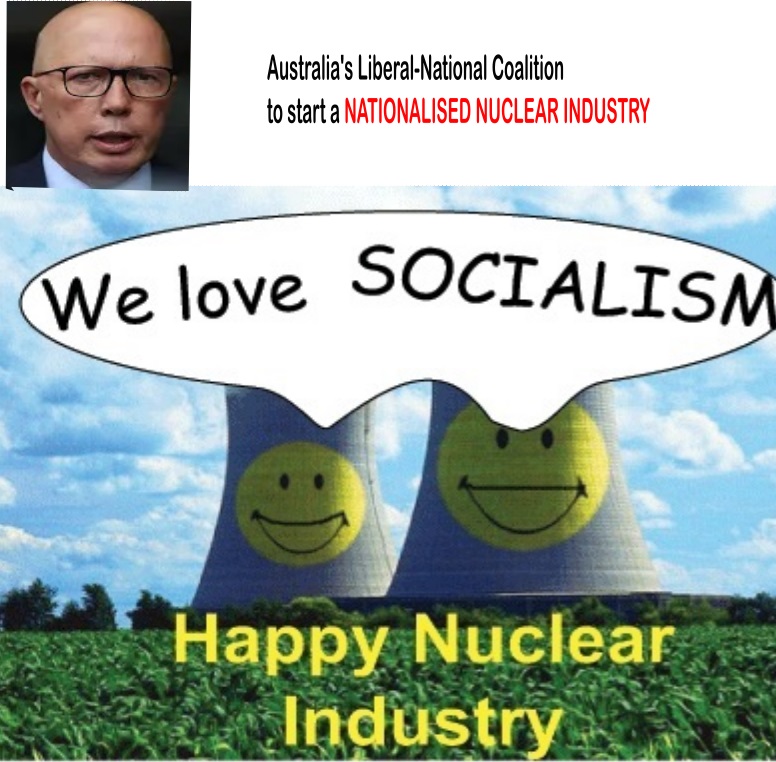
Proud defenders of individual liberty, private enterprise , and of the free market solving everything, the West has run into a spot of bother over the nuclear industry.
Good old dictatorships don’t have this problem. Russia , North Korea and China can develop government-run nuclear power programmes faster and cheaper, (though sadly, China is falling behind, due to the success of its renewable energy industry). Saudi Arabia has its Saudi National Atomic Energy Project (SNAEP). The Saudi one should do very well, as they don’t have pesky women in power, raising objections.
But never fear – things are looking up for nuclear power in the “free” West.
For one thing, everybody’s now realising that the “peaceful” nuclear industry is absolutely essential for the weapons nuclear industry. And as defence, (and attack) are a government responsibility, well, then, the tax-payer must cough up to help the “commercial” unclear industry.
And if we’re going to do the job properly, let’s take up the faster ?cheaper methods of Russia, North Korea, – maybe not China as they’re too much into renewable energy. Saudi Arabia’s system sounds promising – we don’t want silly emotional women bleating about cost and safety.
France has always recognised that the government should run all things nuclear – right from the days of its toxic nuclear bomb tests in the Pacific, and even today, despite a bit of trouble with costs, and the impacts of climate change causing rivers to overheat.
The USA government has always found devious ways to prop up its supposedly private nuclear industry.
Britain has come up with its system of “Regulated Asset Base” . This means that electricity customers are charged a fee from day one of the construction of the nuclear project, and cop the burden of cost overruns (as happened in the USA with the Vogtle nuclear fiasco). The UK government, rather than the developer, underwrites the risk of construction cost overrun “above a remote threshold” – referred to as the “Funding Cap”. – (more https://www.fieldfisher.com/en/insights/rab-and-go-getting-new-nuclear-underway).
The previous Tory UK government set up “Great British Nuclear” – with the tax-payer supporting the nuclear industry. Keir Starmer’s Labour government continued this , with – a new, publicly owned, energy company, “Great British Energy “.
In Australia, the Liberal-National Coalition Party, led by Peter Dutton, stands for private enterprise, individual freedom, and total opposition to socialism
In 2023 this Party had an amazing success, in turning Australian public opinion around towards an anti-indigenous stance in a referendum intended to give indigenous people a Voice to Parliament. This very right-wing party was helped by the Murdoch media, and also by a powerful social media campaign, and by the Atlas Network – to gain quite a degree of control over public opinion.
Again with the help of the Murdoch media, and the Atlas Network, the global nuclear lobby could have a resounding tax-payer funded success.
So – ironically – it will be a party dedicated to private enterprise and individual liberty that could bring in completely government-run nuclear industry to a whole Western democratic continent.
The UK’s nuclear waste problem

“more nuclear power means more nuclear waste”
By Chas Newkey-Burden, The Week UK, 16 Sept 24 https://theweek.com/environment/the-uks-nuclear-waste-problem
Safety concerns as ‘highly radioactive’ material could be buried in the English countryside
“Not in my backyard” is a term normally used in conversations about proposed new housing or rail lines, but a version of it could soon be heard about one of the most dangerous materials on the planet.
Nuclear power stations are filling up with radioactive waste, so “swathes” of the highly dangerous material are set to be “buried in the English countryside”, said The Telegraph. For local communities, it isn’t so much “not in my backyard” as “not under my backyard”, said the Financial Times.
‘100,000 years of hazard’
Sellafield, in Cumbria, is the “temporary home to the vast majority of the UK’s radioactive nuclear waste”, said the BBC, “as well as the world’s largest stockpile of plutonium”. It’s stuck there because no long-term, high-level waste facilities have been created to deal with it.
The “highly radioactive material” releases energy that can infiltrate and damage the cells in our bodies, Claire Corkhill, professor of radioactive waste management at the University of Bristol, told the broadcaster, and “it remains hazardous for 100,000 years”.
The permanent plan to handle the waste currently at Sellafield is to first build a designated 650ft-deep pit to store it. Although the contentious matter of its location has yet to be agreed, the facility will hold some of the 5 million tonnes of waste generated by nuclear power stations over the past seven decades. Then, in the second half of the century, a much deeper geological disposal site will be dug, which will hold the UK’s “most dangerous waste”, such as plutonium, said The Telegraph.
The problem is only going to get bigger because nuclear power is a central part of the government’s mission for “clean power by 2030” and “more nuclear power means more nuclear waste”, said the BBC.
With at least three new nuclear power stations planned, said The Telegraph, the country will quickly be “at odds with” the 1976 review of nuclear waste policy by the Royal Commission on Environmental Pollution, which warned the UK was amassing nuclear waste so fast that it should stop building reactors until it had a solution.
‘Poison portal’
Some believe part of that solution will be found overseas. Earlier this year, there were warnings that Australia could become a “poison portal” for the UK and US as a result of a new three-nation defence pact called Aukus. The original wording of the agreement would allow for facilities to be created to dispose of waste from “Aukus submarines”, which could have included UK and US vessels.
Dave Sweeney, the Australian Conservation Foundation’s nuclear free campaigner, warned at the time that Aukus partners could see Australia as “a little bit of a radioactive terra nullius”.
After pushback, the Australian government added a loophole to the legislation to “ensure Australia will not become a dumping ground for nuclear waste”, said The Guardian.
But the Australian Greens’ defence spokesperson, David Shoebridge, said the changes did not go far enough. The amendment only addresses high-level radioactive waste, he said, and “still allows the US and UK to dump intermediate-level waste, and Australian high-level waste, anywhere in Australia”.
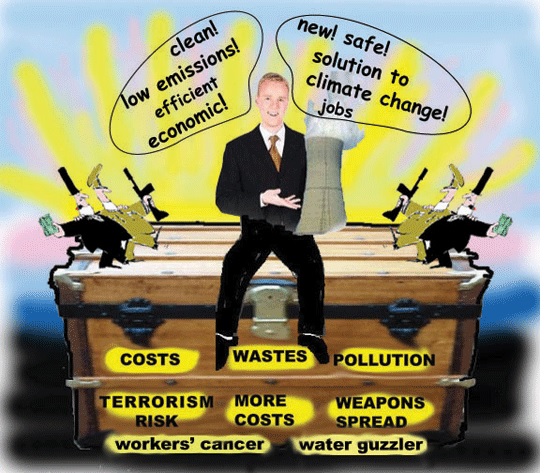
Hidden costs? Cheaper energy? ‘Farcical’ locations? Debunking the hype around nuclear
29 June 2024 , By Charis Chang, SBS News

Seven nuclear power plants could be built in Australia if the Coalition wins the next election, but will they live up to the hype?
Australians are being promised a brighter future with nuclear as the answer to rising energy costs.
As concerns grow over the cost of living and rollout of renewables, the Coalition has announced an alternative vision, promising to build seven nuclear power plants across the country if elected.
Last week, it confirmed it would push for nuclear power plants to be built at Tarong and Callide in Queensland, Liddell and Mount Piper in NSW, Port Augusta in South Australia, Loy Yang in Victoria and Muja in Western Australia.
“We have a vision for our country: to deliver cleaner electricity, cheaper electricity and consistent electricity,” Opposition leader Peter Dutton said on 19 June.
But can nuclear in Australia live up to the hype?
Can nuclear bring down electricity prices?
One of the biggest claims the Coalition makes is that
nuclear energy could bring down the price of electricity
in Australia.
Dutton told the Today show on 21 June: “In Ontario, for example — they have 60 per cent nuclear in the mix there, their electricity prices are a quarter of what it is here in Australia”.
But Tim Buckley, director of think tank Climate Energy Finance, questioned how a form of energy that would produce “zero” electricity for the next 15 to 20 years, could bring down power prices.
In the meantime, the Coalition’s plan would undermine investor confidence so Australia didn’t get as much electricity supply from other sources, Buckley said.
“Less supply means higher prices — that’s economics 101.”
He believes the Coalition’s nuclear strategy could increase electricity prices by 20-50 per cent over the next decade because of the need for more government intervention and funding to extend the life of coal plants.
Buckley said the GenCost report — produced by Australia’s national science agency, the CSIRO — found power from nuclear could also be double the price of firmed renewables.
“Therefore power prices go up, not down,” he said.
GenCost looked at the levelised cost of electricity, which is the estimated price that would need to be charged so the generator could cover its costs including a return on investment.
It found electricity generated by large-scale nuclear would be $155/MWh (per megawatt hour) to $252/MWh.
Integrating renewables such as solar photovoltaic (PV) and wind into the grid, including the cost of storage and transmission lines, was estimated to be much cheaper, costing between $90/MWh and $100/MWh.
The GenCost report noted overseas electricity costs may not reflect the prices that could be charged in Australia because of differences in installation, maintenance and fuel costs.
Other countries may also be benefiting from older projects where the costs to build the power plant had already been recovered by investors or governments.
“Such prices are not available to countries that do not have existing nuclear generation such as Australia,” the report said.
Batteries will need to be ‘ripped down’ for nuclear
The Coalition plans to locate its nuclear power plants in the locations of old and retiring coal-fired power plants to “avoid much of the new spending needed for Labor’s ‘renewables-only’ system”.
An electricity grid with a large proportion of intermittent renewables requires many new transmission poles and wires, “all of which will be passed on in the form of higher bills”, Opposition energy spokesperson Ted O’Brien has said.
But Buckley points out that most retired coal-fired power sites are already being used for new battery plants. This includes a 500-megawatt battery plant announced last year on the site of the old Liddell plant in NSW’s Hunter Valley.
Ted O’Brien and Peter Dutton are proposing nationalisation of private assets, and then they’re going to have to rip down the batteries that have just been built at billions of dollars in cost … in order to then wait for 20 years while they build their nuclear power plants,” he said.
“It’s a little bit farcical to me.”
An ambitious 13-year timeline
In a press release announcing its policy, O’Brien said large-scale nuclear would be built by 2037, in 13 years.
But the CSIRO has estimated a nuclear power plant in Australia would take at least 15 years to build.
Australia’s federal nuclear ban would have to be overturned and the government may also have to override several state-level bans
Site selection and acquisition, design, impact studies and environmental permits would then need to be completed before construction could even begin.
Buckley said getting the relevant planning approvals was a time-consuming hurdle for any energy project, let alone one that had never been done in Australia before.
Nuclear ‘will need to be refurbished after 30 years’
Dutton has said nuclear is “an investment for 80 years” and this longevity makes the technology superior to renewable sources of power such as wind energy.
“These nuclear plants can produce and provide 24/7 power for 80 to 100 years … wind turbines last 19 years, so you’ve got to cycle them in and out three or four times,” he told the Today show on 21 June.
Buckley said Coalition statements underestimated the life of renewable projects, noting that nuclear power plants needed to be refurbished after around 30 years.
Warranties on new solar modules now covered them for more than 20 years, he said. And those on batteries had doubled from 10 to 20 years.
“Most solar projects have a design life of 25 years, wind projects have a design life of 30,” he said.
Buckley said the price of refurbishment should also be included in the capital costs for nuclear, and so should decommissioning expenses, which can cost about $10 billion once the plant reaches the end of its life.
‘Who’s going to pay for other costs?’
Eventually, funding will also have to be found to store the nuclear waste generated, which has to be securely stored for tens of thousands of years.
“Who’s going to pay for 10,000 years of nuclear waste disposal?” Buckley said.
Even based purely on the initial construction cost, nuclear does not come out ahead.
Who’s going to pay for 10,000 years of nuclear waste disposal? Tim Buckley, Climate Energy Finance director
The GenCost report estimated the cost of a large-scale nuclear plant in Australia would be $8.6 billion for a 1,000kW plant built in 2023, although the first one would likely be much more expensive.
A small modular reactor (SMR) was estimated to be even more expensive, at $28.6 billion.
In comparison, onshore wind is estimated to cost $3 billion for 1000kW of generation, while large-scale solar PV is even cheaper, at $1.5 billion.
Costs for offshore wind rise to between $5.5 billion and $7.7 billion.
The capital cost for firming technologies such as batteries is separate, but — as mentioned above — the levelised cost of renewables is estimated to be $90-$100/MWh, even including the cost of storage and transmission lines.
Meanwhile, the levelised cost of nuclear is between $155-$252/MWh.
The Coalition hasn’t yet released costings for its nuclear plan, only saying they would come “very soon”.
Analysis from the Smart Energy Council suggests it could cost between $116-$600 billion to build seven nuclear reactors, and they would only supply 3.7 per cent of Australia’s energy mix in 2050.
Michael Preuss, director of research infrastructure at Monash University’s faculty of engineering, has previously told SBS News that while the initial investment in nuclear is expensive, those upfront costs could be recovered.
“There’s a huge upfront investment and once they’re built and they start operating, they’re relatively inexpensive to operate and then you recoup the investment. But it takes a long time,” he said.
There will also be ongoing costs to buy the fuel required to run the nuclear power plant, something renewables can source for free.
Australian communities facing an un-insurable risk?
The Coalition has dismissed concerns about government funding of the plants, saying local communities would welcome the investment.
“You can imagine what this means to local communities, to mums and dads and their kids as they look to the future,” O’Brien told reporters on 19 June.
But Buckley said government funding was required because nuclear power plants were not commercially viable without taxpayer subsidies. He said no private company could afford the insurance risk of a nuclear catastrophe………………………..
Is the world embracing nuclear?
Dutton told Today on 21 June: “I think if you look at the top 20 economies of the world, Australia is the only one that hasn’t embraced or hasn’t signed up to nuclear.”
But Buckley believes this statement is misleading.
“America has closed more nuclear units in the last two decades than they’ve opened so how is that embracing nuclear?”……………………………………………………….
He said other countries that had embraced nuclear did not have the wind and solar resources that Australia did.
“Why would Australia go and choose the most expensive source of electricity with massive water consumption issues, with massive site rehabilitation and massive waste disposal risks, when we don’t need to?
“When there’s a lower cost, commercially proven technology today?” https://www.sbs.com.au/news/article/hidden-costs-cheaper-energy-farcical-locations-debunking-the-hype-around-nuclear/7rd5ewmbr
1 This month
To see nuclear-related stories in greater depth and intensity
– go to https://nuclearinformation.wordpress.com/


 Antinuclear