Selective context: Why Isaac Herzog’s visit deepens Australia’s moral failure
It would be hard to imagine a more divisive guest in this country. The Jewish Council of Australia has expressed ‘outrage that the Albanese Government would fuel the flames of division by inviting Herzog to visit Australia, warning that his trip is completely inappropriate and offensive and will rightly spark mass protest’. Herzog, the Council said, ‘has played an active role in the ongoing destruction of Gaza, including the murder of tens of thousands of Palestinians and the displacement of millions’.
By Sue Wareham | 9 February 2026, https://independentaustralia.net/politics/politics-display/selective-context-why-isaac-herzogs-visit-deepens-australias-moral-failure,20660
Calls to ‘consider the context’ of President Herzog’s visit obscure Israel’s ban on dozens of NGOs in Gaza and the West Bank, writes Dr Sue Wareham.
AHEAD OF TODAY’S VISIT to Australia by Israeli President Isaac Herzog and the anticipated large protests against it, Foreign Minister Penny Wong asked us to ‘consider the context’ of the visit.
Part of that context is the horrific massacre of 15 Jewish Australians at Bondi in December and the deep sense of grief felt throughout Jewish communities and beyond.
However, the context also includes the destruction by Israel of practically every aspect of civilian society in Gaza, with over ten per cent of the population directly killed or injured since October 2023 and barely a soul alive who has not been traumatised in multiple ways, including bereavement, displacement, and deprivation of food, clean water, sanitation, shelter and other essentials.
Herzog is not an innocent bystander, as Israel’s breaches of international law in Gaza and the West Bank have become so commonplace as to be almost normalised. In September 2025, the United Nations Commission of Inquiry on the Occupied Palestinian Territory accused him of inciting genocide, citing his statement that “It’s an entire nation out there that is responsible”, made soon after Hamas’ brutal attacks of 7 October 2023. The entire Palestinian population has been punished ever since.
That collective punishment has deeply affected very many Palestinian Australians, as they grieve the loss of loved ones in Gaza, and have watched helplessly as remaining loved ones have faced deprivation, multiple displacements and a dire humanitarian situation.
Despite the “ceasefire” that began in early October 2025 (a ceasefire which appears to mean fewer bombs rather than no bombs), the collective punishment continues.
Israeli authorities have now de-registered and are effectively banning 37 international humanitarian organisations (INGOs) from operating in Gaza and the West Bank. Unless the organisations comply with Israeli demands to provide personal data on all their staff – in a context where over 500 humanitarian workers have been killed in Gaza since 7 October 2023 – they will have to withdraw from all the Occupied Palestinian Territory by the start of March.
This poses an impossible choice for INGOs — to either compromise staff safety or to abandon people who are in desperate need. Médecins Sans Frontières (MSF), as one of the affected agencies, has made the extremely painful decision that it will not comply with Israeli demands for staff information. MSF’s statement of 30 January said that ‘despite repeated efforts, it became evident in recent days that we were unable to build engagement with Israeli authorities on the concrete assurances [regarding staff safety] required’.
MSF states that if the agency is expelled from Gaza and the West Bank, ‘it would have a devastating impact, as Palestinians face a brutal winter amidst destroyed homes and urgent humanitarian needs’ with basic services including food, water, shelter, healthcare, fuel and livelihoods largely destroyed, and a health system that is ‘nearly non-functional’.
Oxfam’s assessment of 3 January is similar, stating that ‘Despite the ceasefire, humanitarian needs remain extreme’. The removal of these services would ‘close health facilities, halt food distributions, collapse shelter pipelines and cut off life-saving care’.
Oxfam noted that INGOs already operate according to strict compliance and due diligence standards.
Setting aside any moral imperative to provide aid for fellow humans who are suffering, Israel’s actions in banning INGO access violate the nation’s legal obligations, as the occupying force, to ensure the health and welfare of the civilian population.
They also violate the January 2024 International Court of Justice ruling that Israel ‘must take immediate and effective measures to enable the provision of urgently needed basic services and humanitarian assistance to address the adverse conditions of life faced by Palestinians in the Gaza Strip’.
Far from complying with the law, Israel continues to actively block the delivery of essential aid to a population in urgent need, and is now enforcing INGO registration conditions that exceed routine oversight and undermine humanitarian neutrality and independence.
For the many Palestinian Australians and their loved ones in Gaza, Israel’s actions have devastating consequences. And yet their grief and distress are not part of Minister Wong’s selective “context” for the visit of President Herzog.
It would be hard to imagine a more divisive guest in this country. The Jewish Council of Australia has expressed ‘outrage that the Albanese Government would fuel the flames of division by inviting Herzog to visit Australia, warning that his trip is completely inappropriate and offensive and will rightly spark mass protest’. Herzog, the Council said, ‘has played an active role in the ongoing destruction of Gaza, including the murder of tens of thousands of Palestinians and the displacement of millions’.
Australia’s stance could have been very different. Apart from choosing our guests more sensitively and avoiding those accused of the most grievous crimes, Australia should long since have applied meaningful sanctions against Israeli individuals and the State of Israel itself.
Foreign Minister Wong has the power to determine that Israel’s ongoing deliberate obstruction of aid and its collective punishment of the Palestinian people meet the threshold of “serious violation or abuse” under Australia’s sanctions regime. She has chosen instead to insulate Israel from accountability, thus undermining the universality of international law and eroding Australia’s credibility as an independent nation.
The people of Palestine and their loved ones here pay a heavy price for Australia’s failure to act.
Sanctions against Israel are not likely to be announced in the coming days, but the need for them is only growing.
If You Think Our Rulers Do Bad Things In Secret, Wait Til You See What They Do Out In The Open
Caitlin Johnstone, Feb 09, 2026, https://www.caitlinjohnst.one/p/if-you-think-our-rulers-do-bad-things?utm_source=post-email-title&publication_id=82124&post_id=187345674&utm_campaign=email-post-title&isFreemail=true&r=1ise1&triedRedirect=true&utm_medium=email
They launched a live-streamed genocide in full view of the entire world.
They’re openly targeting civilian populations with siege warfare in Iran and Cuba in full view of the entire world.
They openly kidnapped the president of a sovereign nation in full view of the entire world.
They deliberately provoked a horrific and dangerous proxy war in Ukraine in full view of the entire world.
They spent years actively backing Saudi Arabia’s monstrous genocidal atrocities in Yemen in full view of the entire world.
They’re plundering and exploiting the resources and labor of the global south in full view of the entire world.
They’re killing the biosphere we all depend on for their own enrichment in full view of the entire world.
They’re circling the globe with hundreds of military bases to secure planetary domination in full view of the entire world.
They engage in nuclear brinkmanship and wave around armageddon weapons like pistols in full view of the entire world.
People go homeless and die of exposure while billionaires buy private islands and choose the next president in full view of the entire world.
Weapons manufacturers lobby for wars and then profit from the death and destruction they cause in full view of the entire world.
The president of the United States has repeatedly admitted to being bought and owned by the world’s richest Israeli in full view of the entire world.
The US Treasury Secretary has been repeatedly admitting that the US deliberately sparked the violence and unrest in Iran by methodically immiserating the population via economic warfare, in full view of the entire world.
I keep seeing people freaking out and asking how it’s possible that the individuals in the Epstein files haven’t been arrested for their secret nefarious behavior. And I always want to ask them, mate, have you seen the nefarious behavior they’re engaging in right out in the open?
Pay attention to the Epstein files. Pay attention to what little we can learn about how these freaks conduct themselves behind closed doors. By all means, pay close attention to these things.
But don’t forget to also pay attention to the far greater evils they are inflicting in full view of the entire world.
US congressional report explores option of not delivering any Aukus nuclear submarines to Australia.
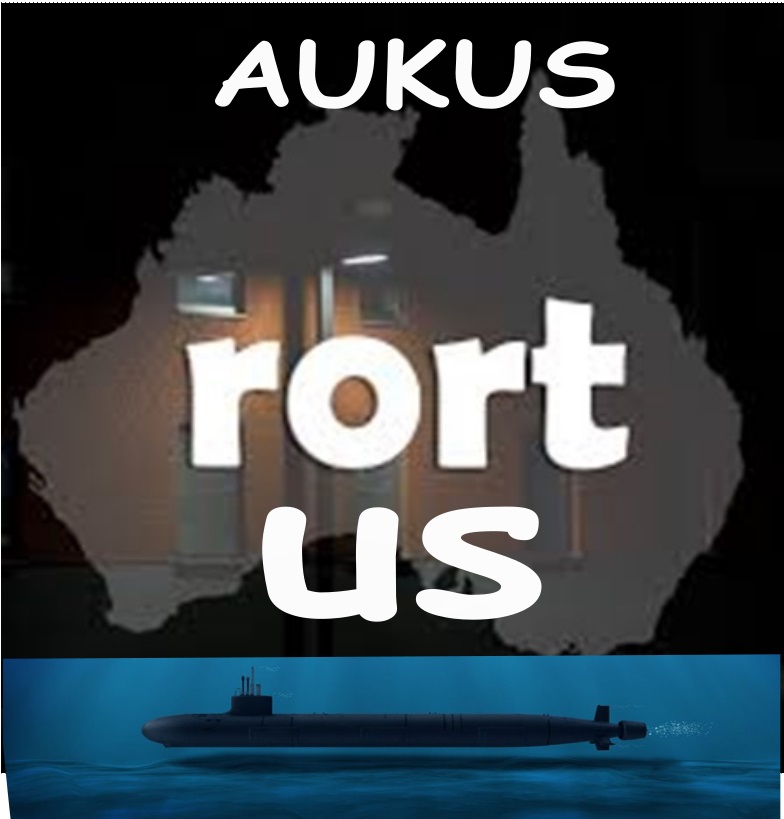
COMMENT – What a typical USA plan?
They reneg on delivering the “goods” sold, but keep the $368 billion!
the Congressional Research report describes an alternative “military division of labour”, under which the US would not sell any Virginia-class submarines to Australia.
Report offers alternative of the US navy retaining boats and operating them out of Australian bases
Ben Doherty, Guardian, 6 Feb 26
A new United States congressional report openly contemplates not selling any nuclear submarines to Australia – as promised under the Aukus agreement – because America wants to retain control of the submarines for a potential conflict with China over Taiwan.
The report by the US Congressional Research Service, Congress’s policy research arm, posits an alternative “military division of labour” under which the submarines earmarked for sale to Australia are instead retained under US command to be sailed out of Australian bases.
One of the arguments made against the US selling submarines to Australia is that Australia has refused to commit to supporting America in a conflict with China over Taiwan. Boats under US command could be deployed into that conflict.
The report, released on 26 January, cites statements from the Australian defence minister, Richard Marles, and the chief of navy that Australia would make “no promises … that Australia would support the United States” in the event of war with China over Taiwan.
“Selling three to five Virginia-class SSNs [nuclear-powered general-purpose attack submarines] to Australia would thus convert those SSNs from boats that would be available for use in a US-China crisis or conflict into boats that might not be available for use in a US-China crisis or conflict,” the report argues.
“This could weaken rather than strengthen deterrence and warfighting capability in connection with a US-China crisis or conflict.”
Under the existing Aukus “optimal pathway’, Australia will first buy between three and five Virginia-class nuclear-powered conventionally armed submarines, the first in 2032.
Following that, the first of eight Australian-built Aukus submarines, based on a UK design, is slated to be in the water “in the early 2040s”.
But the Congressional Research report describes an alternative “military division of labour”, under which the US would not sell any Virginia-class submarines to Australia.
The boats not sold to Australia “would instead be retained in US Navy service and operated out of Australia” alongside US and UK attack submarines already planned to rotate through Australian bases.
The report speculated Australia could use the money saved to invest on other defence capabilities, even using those capabilities as a subordinate force in support of US missions.
“Australia, instead of using funds to purchase, build, operate, and maintain its own SSNs, would instead invest those funds in other military capabilities – such as … long-range anti-ship missiles, drones, loitering munitions, B-21 long-range bombers … or systems for defending Australia against attack … so as to create an Australian capacity for performing other missions, including non-SSN military missions for both Australia and the United States.”
The report also raises cybersecurity concerns, noting that “hackers linked to China” are “highly active” in attempting to penetrate Australian government and contractors’ computers.
It argues that sharing nuclear submarine technology with another country “would increase the attack surface, meaning the number of potential digital and physical entry points that China, Russia, or some other country could attempt to penetrate to gain access to that technology”.
The debate over whether the US should sell boats to Australia is also grounded in ongoing concern over low rates of shipbuilding in the US: the country’s shipyards are failing to build enough submarines to supply America’s own navy, let alone build boats for Australia.
For the past 15 years, the US Navy has ordered boats at a rate of two a year, but its shipyards have never met that build rate “and since 2022 has been limited to about 1.1 to 1.2 boats per year, resulting in a growing backlog of boats procured but not yet built”.
The US fleet currently has only three-quarters of the submarines it needs (49 boats of a force-level goal of 66). Shipyards need to build Virginia-class submarines at a rate of two a year to meet America’s own needs, and to lift that to 2.33 boats a year in order to be able to supply submarines to Australia.
Legislation passed by the US Congress prohibits the sale of any submarine to Australia if the US needs it for its own fleet. The US commander-in-chief – the president of the day – must certify that America relinquishing a submarine “will not degrade the United States undersea capabilities”.
The report argues that Australia’s strict nuclear non-proliferation laws could also weaken US submarine force projection under the current Aukus plan.
Australian officials have consistently told US counterparts that, in adherence to Australia’s commitments as a non-nuclear weapon state under the Treaty on the Non-Proliferation of Nuclear Weapons, Australia’s attack submarines can only ever be armed with conventional weapons.
“Selling three to five Virginia-class SSNs to Australia would thus convert those SSNs from boats that could in the future be armed with the US nuclear-armed sea-launched cruise missile with an aim of enhancing deterrence,” the report states……………………………………………………………………. https://www.theguardian.com/world/2026/feb/05/not-delivering-any-aukus-nuclear-submarines-to-australia-explored-as-option-in-us-congressional-report
Albanese v Albanese
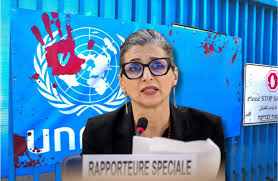
Then there is the damning evidence of Anthony Albanese’s Italian namesake, Francesca Albanese, by now an expert and fearless forensic rapporteur on Gaza, genocide and Israel.
She bows to no president or prime minister and wears the onslaught of their wrath as a badge of honour.
A United Nations Special Rapporteur on the Occupied Palestinian Territories, Albanese’s courageous reports have become a reliable touchstone for historians, academics, students, journalists, so-called ‘ordinary people’ humanitarians, intelligence personnel and key actors of all involved in the Gaza ‘Crime Scene.’
10 February 2026, Tess Lawrence, https://theaimn.net/albanese-v-albanese/
ALBANESE v ALBANESE
HERZOG, GENOCIDAL TERRORIST?
The Australian Government has rolled out the red carpet for Israel’s President Isaac Herzog, a carpet sodden in the blood of more than 71,000 people murdered in Gaza since the Hamas led terrorist invasion of October 7, 2023.
That audacious Hamas massacre and hostage taking of mostly civilians attending the Nova Festival, was a precision operation that easily penetrated Israel’s so-called invincible ‘iron dome’ in what was indisputably a monumental military embarrassment and collective security fail by all of Israel’s lauded security tiers as well as by self lauded ‘Mr Security’ himself, Prime Minister Benjamin Netanyahu, indicted on criminal charges in his own country and cited as a genocidal criminal, outside of it.
In an untidy and hasty attempt to assuage volatile community anger, unrest and widespread political dissent caused by Australia’s own security fail, the Bondi Beach Islamic State inspired terrorist attack on December 14, that also targeted Jews and others celebrating the festival – Hanukkah – Australia’s Prime Minister Anthony Albanese thought it wise to capitulate to a babel of political, religious and public dialects and invite a racist man of war to Australia, rather than a person of peace.
The notion that a visit by the rabid war mongering Herzog will help ameliorate swelling anti-semitism is preposterous. He may well bring comfort to some Australian jews and those who support Netanyahu’s fascist Far Reich but the reality is that not all Australian jews want this avowed genocidal terrorist to visit Australia or indeed for him to be deemed as representative of all jewish Australians, let alone jews in Israel. The constants protests and marches against Netanyahu in Israel atest to the latter.
Netanyahu’s Take On Nazism
Typically, jewish dissenters do not receive as much attention in both mainstream and indie media and endure all manner of toxic insult, including being branded by jewish Netanyahu supporters in the diaspora, as Hamas stooges, jewish traitors, et cetera, et cetera, et cetera. Hurled epithets of being ‘self-loathing jews’ have long worn thin as a horrified world – including horrified jews – are confronted with the ugly reality of Netanyahu’s latter day take on nazism and industrial strength ethnic cleansing.
Last month, a number of groups, the majority of them representing jewish organisations, wrote to Governor-General Sam Mostyn and Prime Minister Albanese, asking that Herzog’s invitation to visit Australia, be retracted:
Her Excellency the Honourable Ms Sam Mostyn AC
Governor-General of the Commonwealth of Australia
Government House
Dunrossil Drive
YARRALUMLA ACT 2600The Hon Anthony Albanese MP
Prime Minister
Parliament House
CANBERRA ACT 2600Monday, 5 January 2026
Dear Governor-General and Prime Minister,
We write to urgently ask for the retraction of the Australian Government’s invitation to President Isaac Herzog of Israel.
This invitation risks violating Australia’s international obligations and exacerbating racism and antisemitism during an incredibly fragile moment.
President Herzog is not a neutral or ceremonial head of state. The UN Commission of Inquiry on the Occupied Palestinian Territory concluded in September 2025 that Israeli President Isaac Herzog had “incited the commission of genocide and that Israeli authorities have failed to take action against them to punish this incitement.”
In October 2023, he publicly attributed collective responsibility to the civilian population of Gaza, stating: “It’s an entire nation out there that is responsible. This rhetoric about civilians not being involved – it’s absolutely not true. They could have risen up… And we will fight until we break their backbone.”
Herzog’s comments have been cited by international legal scholars and human rights organisations as normalising collective punishment, prohibited under international humanitarian law, and form part of the evidentiary context before the International Court of Justice (ICJ).
Australia’s obligations under the Convention on the Prevention and Punishment of the Crime of Genocide are clear. Article 1 imposes an obligation to prevent genocide that arises once a State becomes aware, or ought reasonably to have become aware, of a serious risk that genocide may be committed. Article III further prohibits not only genocide itself but also complicity, including conduct that knowingly aids, abets, or legitimises the commission or incitement of genocidal acts. The International Court of Justice’s provisional measures in South Africa v Israel place all States Parties on notice of a plausible risk of acts falling within the scope of the Convention. In these circumstances, proceeding with an official visit by President Isaac Herzog would expose Australia to credible claims that it has engaged in conduct inconsistent with its obligations under international law.
Herzog has been fully implicated in Israel’s military aggression. In December 2023 he was witnessed signing an artillery shell bound for Gaza and in 2024 he falsely denied Israeli responsibility for the illegal attacks using pagers and walkie-talkies in Lebanon, killing twelve people, including children, and wounding three thousand.
Facilitating this visit does nothing to support the healing of Jewish communities in Australia, following the horrific massacre in Bondi. Hosting a figure publicly associated with the continuation of the genocide of Palestinians in Gaza, and the ongoing occupation and displacement within Palestinian territories, risks further deepening divisions within a community already grappling with the harmful conflation of Zionism (a political ideology), Judaism (a religion), and Jewish identity and will further alienate our own community while increasing the risk of antisemitism. Publicly hosting this head of state risks exacerbating antisemitism by implicitly associating Jewish Australians with alleged war crimes over which they have no control.
Jewish communities are not united. Some, both religious and secular, are not Zionist or identify as anti-Zionist. Many fundamentally disagree with Israel’s brutal occupation and apartheid regime and are outspoken about the Gaza genocide and Australia’s complicity in it.
Mass protests must be expected if President Herzog arrives in Australia. Protests will include a very large contingent of Jewish participants, reflecting moral opposition to ongoing atrocities.
Official engagement in the face of such demonstrable community opposition would risk inflaming tensions, fracturing social cohesion, and undermining public safety. It would further undermine Australia’s credibility as a defender of international law and inflame anti-Palestinian racism by further dehumanising Palestinians. These consequences are foreseeable, preventable, and incompatible with Australia’s legal and moral responsibilities.
A principled decision to retract the invitation would affirm the Australian Government’s commitment to ethical values, international law and the protection of all communities from racism and antisemitism.
Yours sincerely,
Jewish Council of Australia
Jews for Palestine (WA)
Loud Jew Collective
Jews Against the Occupation ’48
Jewish Voices of Inner Sydney
Coalition of Women for Justice and Peace
Jewish Advocates for Understanding Antisemitism
Jews for Justice
Anti-Zionism Australia
Jews for a Free Palestine
Jewish Women 4 Peace Action Ready Group
Jews Who Do Not Support Netanyahu And Who Do Support
Two State Solution Don’t Get Equal Media Time
Typically, in mainstream and even indie media at times, the views of jews who support a two state solution for Palestine and Israel and who do NOT support Netanyahu, Herzog et al or their murderous genocidal implementation of a final solution to annihilate Palestine and Palestinians in this Holocaust 2, perpetrated by the Netanyahu Government, simply don’t get equal media time.
“Inviting a foreign head of state who is implicated in an ongoing genocide as a representative of the Jewish community is deeply offensive and risks entrenching the dangerous and antisemitic conflation between Jewish identity and the actions of the Israeli state. This does not make Jews safer. It does the opposite.” Sarah Schwartz, Executive Officer of the Jewish Council of Australia.
The Jewish Council of Australia
DIGNITY. EQUALITY. FREEDOM. FOR ALL.
‘The Jewish Council of Australia is an organisation of Jewish people in Australia who are committed to the Jewish values of tikkun olam (repairing the world), calling out injustice, challenging assumptions and promoting debate. We work towards ending antisemitism and all forms of racism and we support Palestinian freedom and justice.’
On January 28th, the Jewish Council of Australia issued a second statement condemning Herzog’s visit:
Read more: Albanese v AlbaneseJewish Council calls on Albanese to rescind Herzog invitation
28 January, 2026 / Media Release
The President of Israel, Isaac Herzog, has confirmed today that he will visit Australia from 8 to 12 February and will meet with members of the Australian Jewish community.
The Jewish Council of Australia as expressed outrage that the Albanese Government would fuel the flames of division by inviting Herzog to visit Australia, warning that his trip is completely inappropriate and offensive and will rightly spark mass protests.
President Isaac Herzog is directly implicated in Israel’s genocide against Palestinians in Gaza. He has made public statements, including that an “entire nation is responsible” for October 7, which have been cited by the International Court of Justice and other international bodies examining breaches of the Genocide Convention.
This should be a moment for collective mourning, reflection and care. It is not a moment to host the head of a state which has been found to have committed a genocide in Gaza.
“By inviting Herzog to visit, Albanese is using Jewish grief as a political prop and diplomatic backdrop,” said Sarah Schwartz, Executive Officer of the Jewish Council of Australia.
“Inviting a foreign head of state who is implicated in an ongoing genocide as a representative of the Jewish community is deeply offensive and risks entrenching the dangerous and antisemitic conflation between Jewish identity and the actions of the Israeli state. This does not make Jews safer. It does the opposite.”
Instead of proceeding with this visit, the Jewish Council urges the Government to pursue concrete actions, supported by over 60,000 Australians who have signed the Jewish Council’s petition, that address the root causes of violence, racism and impunity, and that uphold international law.
“Our safety will not come from aligning with Netanyahu or Trump,” said Schwartz. “It will come from dismantling racism, rejecting collective punishment, and standing consistently for human rights and justice for all.”
“Growing numbers of Jews in Australia and globally oppose the actions of the Israeli government and reject its attempts to speak in our name. We refuse to be ignored or silenced.”
“Conflating Judaism with the policies of a state accused of genocide and crimes against humanity erases our voice and fuels antisemitism rather than combating it.”
The last time I visited their website, 63,885 people had signed the JCA petition for Australians to unite against attempts to divide the community.
From the website:
”… Pitting Jewish safety against Palestinians, Muslims and migrant communities, and eroding all of our civil liberties, doesn’t make Jews safer. It makes the real fight against antisemitism harder… “
On January 30th, Medianet published a press release by The Jewish Council of Australia, the Australian National Imams Council and The Hind Rajab Foundation announcing that esteemed barrister Robert Richter KC had filed a formal legal complaint sent to Attorney-General Michelle Rowland, Home Affairs Minister Tony Burke and the Australian Federal Police (AFP) alleging that “Herzog has incited genocide and aided and abetted war crimes, rendering him unfit to enter the country under Australian law.”
The 30 page submission warns that the visit of President Herzog is “highly infammatory.”
From the press release:
The groups are calling on the AFP to initiate a criminal investigation of Herzog under the Commonwealth Criminal Code.
The urgent request details a “sustained pattern of incitement and hate speech” by the President, specifically citing:
- The “Entire Nation” Declaration: Herzog’s October 2023 statement that there are no “uninvolved” civilians in Gaza, which the groups argue stripped 2.3 million people of their protected status under international humanitarian law and urged the IDF to treat the entire population as a military target.
- Famine Denial: Herzog’s August 2025 claims that images of starving Gazan children were “staged – a statement made while famine was setting in and which the brief describes as a “conscious effort to obscure war crimes.”
- Endorsement of Military Operations Involving War Crimes: A December 2023 visit to the Nahal Oz military base where Herzog reportedly “encouraged” troops 48 hours before the “wanton destruction” and “flattening” of the Palestinian town of Khuza’a.
The submission rejects any claim that Herzog has diplomatic immunity, citing the Nuremberg Principles and international law to argue that heads of state have no shield against charges of genocide or war crimes. The groups warn that if the government fails to act, it would signal “acquiescence to genocidal rhetoric.”
“If the Prime Minister of Israel is not permitted to visit Australia, the President should not be allowed to act as his surrogate,” the complaint states, referencing the International Criminal Court’s arrest warrants for Israeli Prime Minister Benjamin Netanyahu.”
Bilal Rauf, Senior Advisor, Australian National Imams Council (ANIC):
“In recent times, Australia’s social cohesion has been under threat. Now more than ever, it is incumbent upon all of us, particularly our political leaders, to seek to protect our social cohesion as a country and society and ensure that individuals who may inflame the situation by their very presence, are not permitted into our country. The proposed visit by the Israeli President Isaac Herzog, a highly controversial foreign head of state accused of serious international crimes, risks inflaming social tensions, undermining Australia’s hate-speech protections, and placing Australian communities at risk. ANIC calls on the Government, which has hurriedly passed laws in the name of social cohesion, to refuse or cancel any visa held by President Herzog. In pursuing this, among other outcomes, ANIC joins with the Jewish Council of Australia and the Hind Rajab Foundation, in pursuing the complaint.”
Dyab Abou Jahjah, Hind Rajab:
“When a head of state publicly denies civilian protection, dismisses famine, and encourages military operations marked by widespread civilian harm and destruction, those acts carry legal consequences everywhere. No country – including Australia – should become a safe haven for individuals credibly accused of inciting genocide or aiding and abetting war crimes. Australia has a duty to uphold the rule of law and protect its communities from such threats.”
Ohad Kozminsky, Executive Member, Jewish Council of Australia:
“President Herzog represents a state found to be committing genocide in Gaza. His presence in Australia would identify this state with Australian Jews, which risks exacerbating social division and endangering Australian Jewish communities. We stand firmly against all forms of racism, and President Herzog’s statements attributing collective guilt to an entire people are a textbook manifestation of anti-Palestinian racism and Israel’s ongoing campaign of dehumanisation.”
Francesca Albanese
Then there is the damning evidence of Anthony Albanese’s Italian namesake, Francesca Albanese, by now an expert and fearless forensic rapporteur on Gaza, genocide and Israel.
She bows to no president or prime minister and wears the onslaught of their wrath as a badge of honour.
A United Nations Special Rapporteur on the Occupied Palestinian Territories, Albanese’s courageous reports have become a reliable touchstone for historians, academics, students, journalists, so-called ‘ordinary people’ humanitarians, intelligence personnel and key actors of all involved in the Gaza ‘Crime Scene.’
AIMN will publish some of her work in full, so readers can learn from the source herself, without filters and without selective reduction by we journalists.
You will come to understand why she is feared by both the Hamas led terrorist cohort in Gaza and Netanyahu and his Far Reich.
She exposes the atrocities of these murderous thugs without fear or favour and goes to war against genocide and perpetrators, weaponless and without flak jacket, armed only with her brief to bear witness for the world. For us. For them. For the least of us.
Left to Bleed: How Israeli Forces Treat the Killing of Palestinian Children as Routine

February 8, 2026, by Joshua Scheer, https://scheerpost.com/2026/02/08/left-to-bleed-how-israeli-forces-treat-the-killing-of-palestinian-children-as-routine/
New reports have surfaced regarding a 14-year-old Palestinian boy, Jadallah Jadallah, who was shot by Israeli paratroopers in the al-Fawar (also spelled al-Faraa) refugee camp in the northern West Bank in November 2025. Video footage cited by Haaretz shows Jadallah bleeding on the ground for nearly 45 minutes while Israeli soldiers remained nearby, with no immediate medical assistance despite his pleas for help. The delay has drawn widespread scrutiny from rights groups and critics of the military’s conduct, raising questions about the handling of the incident and broader practices surrounding the use of force in occupied territory. The Israel Defense Forces have stated that troops engaged a threat and provided initial treatment, but the footage and eyewitness accounts continue to fuel debate over the response to the teenager’s wounding.
Jadallah Jadallah, a 14-year-old Palestinian, was shot by an Israeli paratrooper unit in the al-Far’a refugee camp. Video footage shows him bleeding on the ground while pleading for help, as his family reportedly watched from a distance. Israel is currently holding his body. According to the Israel Defense Forces, “a terrorist who posed an immediate threat was identified, the force fired at him and provided first aid.”
For more on the story
None of this is new. The killing of Palestinian children has become so routine that individual cases blur into one another, barely registering before the next name is added to the list. In today’s Palestine, Israeli violence is not an aberration or a “tragic mistake,” but a system—one sustained by decades of impunity, political cover, and media fatigue. Each child’s death is treated as an isolated incident, even as the pattern is unmistakable: an occupation that normalizes lethal force and renders Palestinian lives, especially those of children, disposable. With Al Jazeera reporting among others a long list of murders of Children with Israeli human rights group B’Tselem saying
“Israel’s army routinely fires live ammunition, tear gas, stun grenades, and other weapons at Palestinians in the occupied territories, often justifying the assaults by claiming stones were thrown. B’Tselem has described the military’s conduct as an “open-fire policy” that permits the “unjustified use of lethal force” and “conveys Israel’s deep disregard for the lives of Palestinians.”
The consequences are especially severe for children. “Decades of systemic impunity has created a situation where Israeli forces shoot to kill without limit,” Defense for Children International–Palestine (DCI-P) said last month following the killing of a 16-year-old Palestinian boy by Israeli forces in the northern West Bank. “As Palestinian children are increasingly targeted in the West Bank, Israeli forces’ rules of engagement seemingly allow for the direct targeting of Palestinian children where no threat exists to justify the use of intentional lethal force.”
And so the killings continue—not because they are hidden, but because they are allowed and most damning is not that these deaths occur, but that they clearly no longer shock anyone who has the power to stop them.
The non-corporate nuclear news – week to 8th February

Some bits of good news
–
The malaria vaccines are working. Toronto’s Don River was declared “biologically dead” decades ago — now fish are returning after a major wetland restoration. Australia returns an extinct frog to the wild after four decades.
TOP STORIES The Military’s AI Strategy Threatens Everything We Love.
Russia says will act responsibly despite New START nuclear treaty expiry.
The only remaining US-Russia nuclear treaty expires this week- Could a new arms race soon accelerate?
We Asked Two AIs What’s Driving the Doomsday Clock: The Answer Was Human Power.
I spent decades in energy -Here are the problems with UK nuclear plans – ALSO AT https://nuclear-news.net/2026/02/05/4-a-i-spent-decades-in-energy-here-are-the-problems-with-uk-nuclear-plans/
Small Modular Reactors: Game changer or more of the same?
The long half-life of France’s nuclear tests in Polynesia.
Climate. Europe feels the impact of weeks of wet weather and freezing cold. What Trump’s plans for the Arctic mean for the global climate crisis.
Noel’s notes. Beware these dangerous writers in the world of journalism.
AUSTRALIA.
- Why I Cannot Stand By: Protesting Israeli President Herzog’s Visit to Australia. Cancel Herzog tour; defy police intimidation. ISIS vs IDF- Selective justice and the fall of Australian law. Precarious Invitations: Israel’s President Isaac Herzog’s Visit to Australia. https://www.youtube.com/watch?v=RwRRuLQx5X8&t=36s Australia: HRF, Jewish Council and ANIC Demand Arrest or Entry Ban of Israeli President.
- US congressional report explores option of not delivering any Aukus nuclear submarines to Australia. Possibility of US ever selling Australia nuclear submarines is increasingly remote, Aukus critics say. Let’s stop pretending AUKUS makes us safer – ALSO AT https://antinuclear.net/2026/02/05/3-lets-stop-pretending-aukus-makes-us-safer/
- Southern suburbs residents call for City of Cockburn to be nuclear-free as AUKUS partnership rolls on.
- The Rules-Based Order: Where America Gets Away with Murder, and Everyone Else Gets the Bombs.
- As Trump Threatens Weekend Strike on Iran, Albanese Pretends Pine Gap Isn’t Complicit.
- The Opportunity Cost of Permanent War: How Australia is Bankrupting its future.
NUCLEAR RELATED ITEMS
| ATROCITIES. Why Trump’s Denunciations of the Iranian Killings Ring Fatally Hollow. |
| ECONOMICS. Britain courts private cash to fund ‘golden age’ of nuclear-powered AI. Will soaring electricity rates kill Ontario’s nuclear expansion? Ontario’s Nuclear Rate Shock Reveals a Deeper Affordability Problem. How Flexibility, Not Nuclear, Can Secure Ontario’s Electricity Future. |
| EDUCATION. University of Cumbria, Nuclear Waste, AI / Bitcoin and a Strange Tale of Tapping Epstein for Money.. |
| EMPLOYMENT. Mediterranean Dockworkers Launch Historic International Strike |
| ENVIRONMENT. Controversial plans for 139 homes on old Marchon site approved.Sellafield is Awash with Acid Chemicals – Rivers, Sea, Soil, Nothing is Off Limits for “Disposal” of This Toxic Brew Mixed with Dangerous Radioactive Isotopes at the Arse End of Atomic “Clean Energy”Harbour activity to increase at Sizewell C amid more work. |
| ETHICS and RELIGION. The Plutocrats Who Rule Our World Aren’t Even Enjoying Themselves.Hedonism’s Dance: How the Governing Classes Fell for Jeffrey Epstein.HerStory: Feminism is the Route to Peace. |
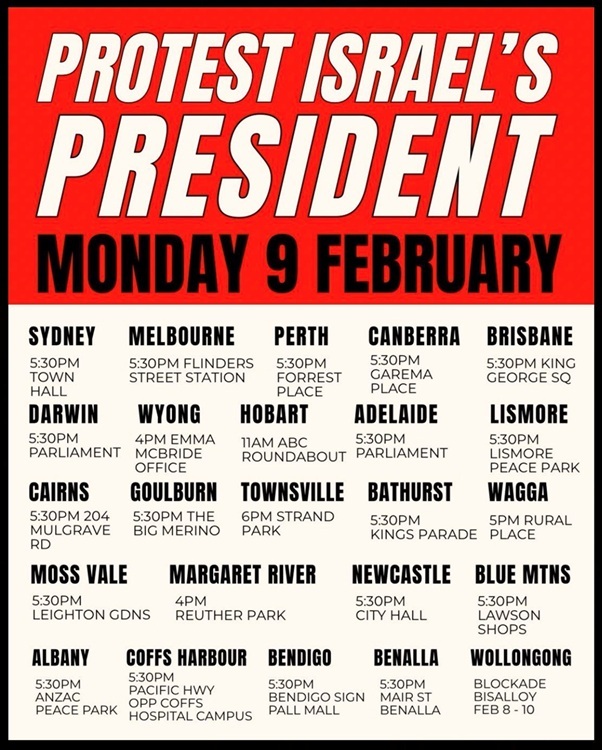
EVENTS. 9th February Protesting Israeli President Herzog
Stop the AUKUS nuclear submarines! Online public meeting Feb 11
12 February – Webinar The Big Push: New Nuclear Projects in Canada.
| MEDIA. The Media is Whitewashing Trump’s Board of Peace. “Journalism Deserves Better”: Ex-Washington Post Staffers Slam Billionaire Bezos for Gutting Paper. |
| OPPOSITION to NUCLEAR . One year on, the Green party continues to voice concerns about the Last Energy Nuclear Power plant in the Llynfi Valley. From the ashes, arises a Phoenix: Scottish Nuclear Free Local Authorities resolve to chart a new path. |
| PERSONAL STORIES. Radiation – and a cancer ward, letter in this week’s Westmorland Gazette. |
| POLITICS. Lawmakers spark backlash with controversial fee imposed on residents: ‘Colossal financial risk. Labour backbenchers revolt over Starmer’s nuclear plans -ALSO AT https://nuclear-news.net/2026/02/05/4-b1-labour-backbenchers-revolt-over-starmers-nuclear-plans/SNP rules out any new nuclear power plants in Scotland. ‘Deeply ideological’: the rationale behind Iran’s insistence on uranium enrichment. Malaysian Officials take action as concerns arise about nuclear power plants: ‘Preparing for that possibility’. Trump to Congress: “I don’t need your stinkin’ approval to fund Israeli genocide in Gaza” |
| POLITICS INTERNATIONAL and DIPLOMACY. The U.S. occupation of Gaza has begun. Europe in Panic: Trump’s Power Play Shakes the World Order. In nuclear race with Russia, Trump goes back to a Cold War future. Sorrowful day for peace largely ignored thruout America. US and Russia negotiating New START deal – Axios. With Trump silent, last US-Russia nuclear pact set to end. Without START, everything could end. Sir Keir Starmer backs a USA strike on Iran. The US Keeps Openly Admitting It Deliberately Caused The Iran Protests .Iran says US nuclear talks off to ‘good start’ but draws line at missile, proxy issues. Trump says he believes Iran wants to make deal as he extols size of US ‘armada’. Is it time to replace NATO with EATO? |
| RADIATION.Finland detects small amount of radioactivity, sees no health impact |
| SAFETY. Trump slashing nuclear reactor safety and security rules. ‘Significant’ fire risks at nuclear plant site. |
| SPACE. EXPLORATION, WEAPONS. NASA wants a nuclear reactor on the Moon – What would happen during a meltdown? Jeff Bezos and the audacious bid to put nuclear reactors on the Moon – ALSO AT https://nuclear-news.net/2026/02/04/jeff-bezos-and-the-audacious-bid-to-put-nuclear-reactors-on-the-moon/ |
| SPINBUSTER. No evidence to support US claim China conducted nuclear blast test: Monitor. Looking to Blame Anyone But Israel for Youth’s Anti-Israel Turn. Dissecting The Belief That The US Should Forcibly Remove Tyrannical Governments . A Nuclear Renaissance for Scotland? There’s a lot of hype around small modular reactors. |
| TECHNOLOGY.U.S. Tech Park in Israel May Have a Nuclear Power Plant .Iran’s mysterious Pickaxe Mountain a ‘candidate’ for new nuclear activities. Germany: Ministry of the Environment: Mini‑reactors [SMNRs] not an option . |
| WASTES. Northwatch Comments on the NWMO’s Initial Project Description of a Proposed Deep Geological Repository for High-Level Nuclear Waste. Comments on the Deep Geological Repository (DGR) for Canada’s Used Nuclear Fuel Project December 2025 APM-REP-05000-0211 Growing stockpiles of radioactive waste beside the Ottawa River upstream of Parliament Hill causing widespread concern. Decommissioning. Impact Assessment of the Planned Dismantling of the Core of the Gentilly-1 reactor. Decommissioning of Gentilly 1. |
| WAR and CONFLICT. It is 85 seconds to midnight. Israel’s War on Iran – The Overkill No One Calls War |
| WEAPONS AND WEAPONS SALES. The new era of Israeli expansionism and the war economy that fuels it . Iran resumes activity at sites, satellite images show.Israel’s War on Iran: The Overkill No One Calls War. Trump’s $1.5 Trillion “Dream Military”. |
Possibility of US ever selling Australia nuclear submarines is increasingly remote, Aukus critics say.

“The Aukus deal is a very attractive one for the Americans because they get a submarine base and dockyard at Australia’s expense in Western Australia, and they do not have any obligation to sell any Virginia-class submarines to us unless their navy can spare them.
“If the US say ‘there are no subs for you Australia’, it is not reneging on the deal: that is the deal, that is what Australia signed up to. That’s why it’s always been a bad deal for Australia.”
“The Australian government seems to be engaged in an exercise of denial: whenever these figures come out they have apologists who say ‘everything’s fine, there’s nothing see here’.
Malcolm Turnbull says government is ‘engaged in an exercise of denial’, as defence minister insists $368bn deal is ‘full steam ahead’
Ben Doherty, 6 Feb 26, https://www.theguardian.com/world/2026/feb/05/aukus-nuclear-submarine-deal-us-australia
Australia’s submarine agency insists the Aukus agreement is progressing “at pace and on schedule”, but sceptics of the $368bn deal argue the chances of the US ever selling promised Virginia-class submarines to Australia are increasingly remote.
The former prime minister Malcolm Turnbull has said the Australian government is engaged “in an exercise of denial” about the parlous state of Aukus’s progress, while the Greens senator David Shoebridge said the deal was a “pantomime”, hopelessly one-sided in the US’s favour.
A new United States congressional report has openly contemplated the US navy not selling any nuclear submarines to Australia – as promised under Aukus – because the US wants to retain control of the submarines for a potential conflict with China over Taiwan.
The US fleet currently has only three-quarters of the submarines it needs (49 boats of a force-level goal of 66). Shipyards need to build Virginia-class submarines at a rate of two a year to meet the US’s own needs, and to lift that to 2.33 boats a year in order to be able to supply submarines to Australia.
Legislation passed by the US Congress prohibits the sale of any submarine to Australia if the US needs it for its own fleet. The US commander in chief – the president of the day – must certify that the US relinquishing a submarine “will not degrade the United States undersea capabilities”.
Turnbull said US shipbuilding rates had “remained stubbornly set at that low level for a long time, despite many billions of dollars of extra investment”, and that expecting build rates to almost double within a couple of years in order to supply Australia with vessels was unrealistic.
“The Australian government seems to be engaged in an exercise of denial: whenever these figures come out they have apologists who say ‘everything’s fine, there’s nothing see here’.”
The January report by the US Congressional Research Service, Congress’s policy research arm, posits an alternative “military division of labour” under which the submarines earmarked for sale to Australia are instead retained under US command to be sailed out of Australian bases.
The report argues both for and against the US selling three Virginia-class submarines to Australia, beginning in 2032. But it makes the case that, in the event of a “conflict or crisis” with China over Taiwan, submarines under Australian command could not be ordered into operation, whereas US-commanded vessels, operated out of Australian bases, could be immediately deployed. Australia has consistently maintained it could offer no guarantees of supporting the US in a conflict with China.
“This could weaken rather than strengthen deterrence and warfighting capability in connection with a US-China crisis or conflict,” the report says.
The defence minister, Richard Marles, dismissed the report as “commentary” when asked on Thursday, insisting Aukus was “full steam ahead”.
“You’re going to hear a whole lot of commentary at the end of the day from the US Congress,” Marles said.
“We’ve heard the US president make clear the position of the United States in respect of this question, and he has said that we are full steam ahead in respect of this, and it includes the transfer of the Virginias.”
A spokesperson for the Australian Submarine Agency told the Guardian that Aukus remained firmly in the strategic interests of its three partners – Australia, the US and the UK – and that “Australia’s commitment to the Aukus partnership is unwavering”.
“All three Aukus partners are investing significantly in our respective industrial bases to ensure the success of Aukus, to meet respective requirements and timelines, including the delivery of three Virginia-class submarines to Australia by the US.”
The spokesperson said Aukus was progressing “at pace and on schedule”.
“The optimal pathway has been designed to ensure a methodical, safe and secure transition from Australian conventional submarines, drawing on more than 70 years’ experience and expertise of our Aukus partners in the safe and effective operation of naval nuclear propulsion.”
Turnbull: ‘It’s always been a bad deal for Australia’
Politically, in the US the Aukus agreement won approval from a Pentagon review last year, which supported the deal continuing. President Donald Trump – who won’t be the president to decide whether or not to sell US submarines to Australia – told reporters the deal was “full steam ahead”.
But Turnbull, the prime minister whose deal to buy submarines from the French group Naval was torn up by Scott Morrison in favour of Aukus, has long argued the Aukus agreement has always been irretrievably lop-sided in the US’s favour.
“The Aukus deal is a very attractive one for the Americans because they get a submarine base and dockyard at Australia’s expense in Western Australia, and they do not have any obligation to sell any Virginia-class submarines to us unless their navy can spare them.
“If the US say ‘there are no subs for you Australia’, it is not reneging on the deal: that is the deal, that is what Australia signed up to. That’s why it’s always been a bad deal for Australia.”
The congressional research report highlighted, again, the lagging rates of US shipbuilding.
For the past 15 years, the US navy has ordered Virginia-class submarines at a rate of two a year, but its shipyards have never met that build rate “and since 2022 has been limited to about 1.1 to 1.2 boats per year, resulting in a growing backlog of boats procured but not yet built”.
Senator David Shoebridge, the Greens’ defence and foreign affairs spokesperson, said the US’s division of labour proposal exposed the “pantomime” that the Aukus agreement was concerned with Australia’s defence.
“No matter what flag is painted on the side of any nuclear submarines Australia gets, they will be US-controlled and US-directed.
“Critics of Aukus have always assumed that the US will not hand over any nuclear submarines unless Australia guarantees they will use them in a US war with China. This report now confirms this is the dominant view in Washington.”
Shoebridge said the Aukus deal was dangerously compromising Australian sovereignty to US interests, at the cost of billions in public funds.
“The fact that Trump, with his ‘America first’ approach to squeezing and humiliating US allies, is willing to press on with Aukus tells you all you need to know about the one-sided deal. If Trump wants it, we should resist it.”
Cancel Herzog tour; defy police intimidation
6 February 2026 AIMN Editorial, https://theaimn.net/cancel-herzog-tour-defy-police-intimidation/
Stop the War on Palestine rejects police intimidation and threats of arrest against protesters at the rally opposing the Isaac Herzog visit on Monday, 9 February, 5:30pm at Town Hall.
“No amount of police threats change the fact that Isaac Herzog is a war criminal. We will be protesting whether Chris Minns or the police like it or not,” said Stop the War on Palestine spokesperson, Adam Adelpour.
“The NSW Police and Minns are showing exactly why the anti-protest laws need to be defied. They are being used to protect Isaac Herzog who has incited genocide according to the U.N. Herzog is the supreme representative of a genocidal state whose officials now admit it has slaughtered at least 70,000 Palestinians. Minns and the police should be threatening to arrest Herzog, not protestors,” he continued.
“There is no law against static protests,” Adelpour said, “The police commissioner’s comments about potentially making arrests are a blatant attempt to intimidate Palestine supporters from attending the rally. We faced down previouhs attempts to intimidate us; we rallied at Town Hall on 16 January 16 and we will be back on Monday to take a statnd against against genocide.”
He continued: “Chris Minns is resorting to repression because he is losing the argument. U.N Commissioner Chris Sidoti is opposing the Herzog visit and three state Labor MPs and other federal MPs have said they will join the rally against Herzog. The Maritime Union of Australia has also come out in support of the protest, and called for Hewrezog to be arrested. Albanese and Minns are on the wrong side of history.
“The best answer to Herzog, the anti-protest laws and the police threats is to turn out in such big numbers that they can’t ignore our right to march against genocide.”
The Opportunity Cost of Permanent War: How Australia is Bankrupting Its Future
Australian Independent Media ,7 February 2026 Dr Andrew Klein, PhD
This article quantifies the true cost of Australia’s strategic and political choices: the opportunity cost of permanent war and security theatre. By tracing capital flows away from societal foundations (housing, health, education, infrastructure) and towards militarisation, surveillance, and a dysfunctional mental health system, we demonstrate a generational wealth transfer. This transfer benefits a nexus of political elites, defence contractors, and foreign interests while actively dismantling Australian sovereignty and quality of life. Using government data, academic research, and public financial records, I argue that Australia’s political class is presiding over the deliberate, observable failure of the nation-state project.
The Great Diversion: From Foundations to Fortresses
The central economic fact of 21st-century Australia is not a lack of wealth, but its malignant allocation. Every dollar spent on fruitless foreign wars or domestic surveillance is a dollar stolen from the future.
1. The Military-Industrial Drain
Australia’s direct expenditure on post-9/11 conflicts (Afghanistan, Iraq) exceeds A$50 billion (DFAT, Cost of War summaries; Watson Institute). The commitment is accelerating. The AUKUS pact, centred on acquiring nuclear-powered submarines, is estimated to cost between A$268-368 billion over three decades (Australian Parliamentary Budget Office, 2023). This single project’s opportunity cost is staggering: it equals nearly the entire annual federal budget for education, health, and social security for multiple years.
2. The Security Theatre & Surveillance State
The annual budget for the national security apparatus (ASIO, AFP, Border Force, cyber) now exceeds A$7 billion (Home Affairs Portfolio Budget Statements). This funds a vast surveillance architecture, including the costly and rights-infringing metadata retention scheme, which has shown negligible public safety ROI (Law Council of Australia, Review of Data Retention Regime). This expenditure creates not safety, but a climate of fear and control, while starving cybersecurity and critical infrastructure hardening of funds…………………………………………………………
Sovereignty Sold: Membership in Five Eyes and subservience to US foreign policy – particularly the provocative stance toward China, Australia’s largest trading partner – has sacrificed independent statecraft for vassalage. This has resulted in tangible economic damage from trade disruptions (Australian National University, The Economic Impact of Australia-China Tensions).
Foreign Influence: The influence of the State of Israel on Australian policy is a case study in captured sovereignty. From bipartisan support during the Gaza genocide to the stifling of criticism via weaponised accusations of antisemitism, Australian policy is demonstrably aligned with a foreign nation’s interests over its own moral and legal obligations (see The Australia Israel Cultural Exchange and parliamentary voting records).
The Think-Tank & Lobbyist Pipeline: Policy is increasingly crafted by opaque think-tanks (e.g., Australian Strategic Policy Institute – heavily defence contractor-funded) and enforced by lobbyists. The fossil fuel, gambling, and defence sectors wield disproportionate influence, writing legislation that privatises profit and socialises risk (Centre for Public Integrity, Lobbying in Australia).
The Political Cartel: A Duopoly of Failure
Both major parties are complicit in this wealth transfer.
The Albanese Labor Government: Has betrayed its base by escalating military spending, deepening AUKUS, maintaining cruel refugee policies, and failing to address the housing/ cost-of-living crisis it decried in opposition. Its commitment to stage-three tax cuts, which overwhelmingly benefit the wealthy, is the final proof of its allegiance to capital over citizens (Parliamentary Budget Office analysis).
The Liberal-National Coalition: Under leaders like Sussan Ley and influenced by the hard-right, it advocates for even deeper militarisation, climate inaction, and further erosion of social services. Its role is to drag the Overton window further toward oligarchy……………………………………………………………………………………………………………………… https://theaimn.net/the-opportunity-cost-of-permanent-war-how-australia-is-bankrupting-its-future/#google_vignette
Why I Cannot Stand By: Protesting Israeli President Herzog’s Visit to Australia
Herzog isn’t just any visiting dignitary. He reportedly signed artillery shells destined for Gaza – a symbolic endorsement of actions that have killed tens of thousands of civilians, the majority women and children.
By Sue Barrett, 7 February 2026 AIMN Editorial, https://theaimn.net/why-i-cannot-stand-by-protesting-israeli-president-herzogs-visit-to-australia/
When the Jewish Council of Australia says ‘not in our name,’ we have a moral duty to stand with them. Join us on 9th February 2026.
This Monday, I’ll be protesting Israeli President Isaac Herzog’s visit to Australia. This isn’t about politics. It’s about moral clarity.
The Context
On December 14, 2025, fifteen people were killed in a horrific attack at a Hanukkah event on Bondi Beach. The grief is real. The trauma is profound.
Nine days later, on December 23, the Zionist Federation of Australia invited Herzog to meet with victims’ families and survivors. That same day, Prime Minister Anthony Albanese elevated this to an official state visit. Herzog arrives Sunday, February 8, with full red-carpet protocol.
The intention – solidarity with Jewish Australians – is understandable. The execution is appalling.
Why This Matters
Because grief should never be weaponised to provide political cover for someone implicated in grave human rights violations.
UN experts, including Special Rapporteur Francesca Albanese and Professor Ben Saul, have flagged Herzog’s statements as potentially inciting genocide in Gaza. The International Criminal Court has issued arrest warrants for Israeli Prime Minister Netanyahu and former Defence Minister Gallant for war crimes. Australia has obligations under international law.
Human rights lawyer Chris Sidoti has called for rescinding the invitation “for the sake of social cohesion,” arguing that Herzog’s presence inflames rather than heals divisions. Federal Labor MP Ed Husic has voiced deep concerns. Greens Senator David Shoebridge urges the government to withdraw the invitation immediately.
This is not about denying Jewish Australian grief. It’s about refusing to let that grief be used as a political prop while there is genocide in Gaza.
I Stand With the Jewish Council of Australia
The most powerful voices against this visit are progressive Jewish Australians themselves.
The Jewish Council of Australia launched a petition declaring: “Israeli President Herzog does not speak for us and is not welcome here.”
Their statement is unequivocal: “This visit betrays Jewish communities, multicultural Australia, and advocates for Palestinian human rights. It conflates Jewish identity with Israeli state actions – a dangerous and offensive move that puts Australian Jews at greater risk, not less.”
Executive Officer Sarah Schwartz warns against “using Jewish grief as a political prop.” The Council has joined a historic legal complaint with the Hind Rajab Foundation and Australian National Imams Council, calling for Herzog to be arrested or barred entry over allegations of incitement to genocide and war crimes.
Progressive Jewish groups like Jews Against the Occupation ‘48 are organising protests. These are not fringe voices – these are Jewish Australians refusing to let their identity be weaponised to justify the unjustifiable.
What Herzog Represents
I stand with them. I support their work. This is what true solidarity looks like
Herzog isn’t just any visiting dignitary. He reportedly signed artillery shells destined for Gaza – a symbolic endorsement of actions that have killed tens of thousands of civilians, the majority women and children.
When UN experts warn that a leader’s rhetoric contributes to potential genocide, when the ICC issues arrest warrants for war crimes against his government’s senior officials, when respected Australian human rights lawyers call for his arrest upon arrival – we have an obligation to listen.
Australia Deserves Better
This visit doesn’t foster unity. It deepens divisions.
It tells Palestinian Australians their lives matter less. It tells progressive Jewish Australians their voices don’t count. It tells the world that Australia will provide red-carpet protocol to leaders implicated in humanitarian catastrophes as long as they claim to represent “the Jewish community.”
That’s not solidarity. That’s complicity
True solidarity means:
Condemning all violence unequivocally- Supporting Jewish Australians in their grief
- AND refusing to let that grief be exploited to normalise violations of international law
- AND standing with Palestinians facing unimaginable suffering
- AND listening when progressive Jewish voices say “not in our name”
These things are not contradictory. They’re all essential to justice.
Monday, February 9
Protests are planned across Sydney, Melbourne, Adelaide, Perth, and beyond. Thousands will gather. NSW Police have extended restrictions on demonstrations, citing “safety concerns” – an attempt to stifle dissent rather than address the root problem.
I’ll be there because silence is complicity
I’ll be there alongside the Jewish Council of Australia, Jews Against the Occupation, Palestinian Australians, and people of conscience from every background.
I’ll be there because when a government provides honours to someone implicated in potential genocide, when UN experts warn us, when our own international law obligations demand action – we have a moral duty to speak.
This Is About Values
Australia prides itself on fairness, multiculturalism, and standing against atrocities. We signed the Genocide Convention. We claim to uphold international law. We say we care about human rights.
Then we must act like it.
Hosting Herzog isn’t just poor judgement – it’s a betrayal of everything we claim to stand for. It says Australia’s commitment to human rights is conditional. It says some lives matter more than others. It says international law applies only when convenient.
I reject that. So do thousands of Australians who will protest Monday.
What I Ask
Join us Monday. If you can’t attend, speak out. Share the Jewish Council of Australia’s petition. Contact your MP and demand they condemn this visit. Support organisations doing the hard work of building true solidarity across communities.
Listen to progressive Jewish voices. The Jewish Council of Australia, Jews Against the Occupation, and countless Jewish Australians who refuse to let their identity be weaponised are showing us what courage looks like.
Understand that opposing this visit is not antisemitic – it’s anti-racist. It refuses the conflation of Jewish identity with Israeli state actions. It protects Jewish Australians by rejecting the very logic that puts them at risk.
Demand better from our government. Australia can support Jewish Australians in their grief without providing state honours to leaders implicated in war crimes. These are not incompatible positions.
Final Word
On December 14, fifteen people were murdered in a tragic attack. That grief is sacred. Those lives mattered. That horror demands justice.
However, justice cannot be built on hypocrisy
We cannot condemn violence against Australians while honouring a leader whose government’s actions are under investigation for war crimes and potential genocide. We cannot claim to stand for human rights while rolling out red carpets for those who violate them.
The families who lost loved ones at Bondi Beach deserve genuine solidarity – not the politicisation of their grief. The Jewish Council of Australia is showing us what that looks like: refusing to let tragedy be exploited, demanding accountability for all, building a future where no community’s safety depends on another’s suffering.
That’s the solidarity I choose. That’s the Australia I believe in
Monday, February 9. We stand for justice. We stand with progressive Jewish voices. We stand against complicity.
We cannot – we will not – stand by.
Join us.
You know what to do.
Onward we press
Details:
When: Monday, February 9, 2026
Where: Protests in Sydney, Melbourne, Adelaide, Perth, and other cities – see the list below.
Who: Jewish Council of Australia, Jews Against the Occupation ‘48, Palestine Action Group, and thousands of Australians of conscience.
This is a peaceful protest. If you’re attending, bring water, wear comfortable shoes, know your legal rights. Legal observers will be present.
Support: Jewish Council of Australia petition and information at jewishcouncil.com.au
Stop the AUKUS nuclear submarines! Online public meeting Feb 11
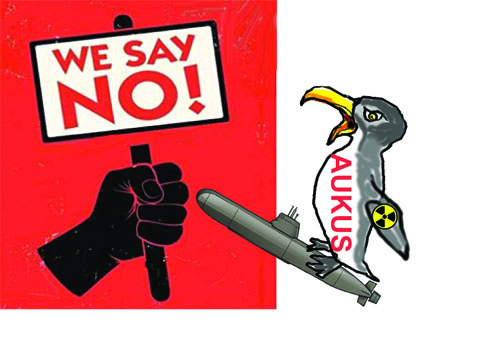
Organised by No Nuclear Subs SA
Wednesday February 11, 2026. 6pm to 7.15pm SA time (6.30-7.45pm Vic/NSW))
Zoom details below
Please share our facebook event. https://www.facebook.com/events/2299752357158550/
Speakers:
* Dr. Margie Beavis (Medical Association for Prevention of War, International Campaign to Abolish Nuclear Weapons) on the broader military context of AUKUS nuclear submarines
* Adjunct Prof. Al Rainnie (Adelaide University) on AUKUS costs, opportunity costs and jobs claims.
* David Noonan (independent environmental campaigner) on AUKUS nuclear waste issues.
* A speaker from Stop AUKUS WA on the shared threats faced in WA and SA
* Dr. Jim Green (Friends of the Earth Australia)
Follow No Nuclear Subs SA on facebook, instagram, X/Twitter
Join Zoom Meeting
Meeting ID: 895 9059 9831
Passcode: 056755
ISIS vs IDF. Selective justice and the fall of Australian law
by Andrew Brown | Feb 4, 2026, https://michaelwest.com.au/isis-vs-idf-selective-justice-and-the-collapse-of-australian-law/
Australians who went to fight for ISIS were prosecuted, their families vilified, while former IDF soldiers fighting for Israel walk freely among us. Andrew Brown reports on the double standards.
Australians like to believe our justice system is governed by principle, and crimes judged by what was done, not by who did them. We like a comforting story about ourselves. That justice is served, and accountability painful but even-handed. We tell it often. We believe it when it suits us.
That story collapses the moment it is tested.
After the Brereton Report, Australia demonstrated what accountability looks like when it chooses to take law seriously. Entire Australian Defence Force platoons were investigated. Whole units placed under suspicion. Soldiers interrogated repeatedly. Careers frozen. Medals questioned. Command structures dismantled. Hundreds of millions of public dollars spent. One soldier charged. Many others left suspended indefinitely, their lives stalled in legal limbo.
This pursuit of accountability was not timid or symbolic. It did not flinch at rank, reputation, or heroism. Australia went after its returning heroes, including Victoria Cross recipients, and some of the most decorated units in its military history. It did so publicly and without fear or favour.
“No medal or mythology placed anyone beyond scrutiny.”
Australia wanted the world to see that it would investigate its own forces, not just individuals but units and chains of command, even when it was humiliating and politically costly.
Soldiers going overseas
When Australians travelled to join ISIS, the response was faster and harsher. Passports cancelled. Homes raided. Surveillance expanded. Citizenship stripping powers deployed. Wives treated as accomplices. Children framed as future threats. Suspicion alone was often enough to trigger punishment. Due process became optional.
If Australians fought for Russia against Ukraine, arrests would follow. Prosecutions under foreign incursion and war crimes laws. Media outrage before the luggage carousel stopped turning. The word traitor would appear instantly.
That is the standard Australia claims to uphold.
Gaza
Now consider Gaza. What is occurring is not chaotic warfare. It is a civilian catastrophe with a measurable pattern. Credible casualty analyses based on hospital records, death registries, and independent verification show that approximately 84% of those killed are civilians and around 33% are children. Not combatants miscounted. Not teenagers caught in crossfire. Children.
By comparison, in Ukraine, children account for around 0.3% of casualties. That is a difference of more than one hundredfold.This is not incidental harm. It is demographic concentration.
The destruction follows the same logic. Entire residential districts have been levelled. Homes, schools, universities, bakeries, water infrastructure, and sewage systems have been systematically destroyed. This is not damage caused by fighting around civilians.
“It is the removal of the conditions required for civilian life to continue.”
Hospitals have been a central target. Gaza’s major medical complexes were besieged, raided, and rendered inoperable. Electricity was cut. Fuel was denied. Oxygen supplies ran out. Patients died untreated on floors. Premature infants were left in incubators without power. Medical staff were detained directly from wards and operating theatres, taken without charge, many remaining in detention months later.
This is not collateral damage. It is the dismantling of a healthcare system in real time.
Human rights atrocity
Mass detention has accompanied the physical destruction. Thousands of Palestinians have been taken without charge or access to legal counsel. Human rights organisations have documented beatings, starvation, stress positions, and sexual abuse in detention. Medical professionals and journalists were not spared. They were targeted.
Journalists have been killed at a rate unmatched in any modern conflict. Aid workers have been killed despite operating in clearly marked vehicles and facilities. Among them was Australian humanitarian Zomi Frankcom, killed during a coordinated strike on an aid convoy.
And then there is Hind Rajab.
A six-year-old girl was trapped in a car after her family was shot dead. She called emergency services. Her voice was recorded. An ambulance was dispatched to rescue her. The ambulance was destroyed. Hind was later found dead alongside the paramedics sent to save her.
There was no firefight. No exchange of fire. No ambiguity.
Doctors from Australia, the United States, and Canada who worked in Gaza later testified publicly to treating repeated waves of children with gunshot wounds consistent with sniper fire. Identical entry wounds to heads and chests. These were not anecdotes.
They were clinical observations recorded by trained professionals.
The crime scene
This is why the language of genocide is no longer rhetorical. It is legal. The International Court of Justice has found a plausible risk of genocide and ordered provisional measures. The International Criminal Court is pursuing accountability for war crimes and crimes against humanity arising from Israeli actions.
What is unfolding in Gaza is not a tragedy without authorship.
It is a crime scene.
Australia has chosen silence.
That silence is no longer ignorance. At the National Press Club, senior human rights lawyer Chris Sidoti warned that Australians who served in Gaza may face criminal liability if genocide or war crimes are established. He was explicit. Genocide does not require pulling a trigger. Assistance, facilitation, or knowing contribution can be enough.
“The government did not contest the law. It did nothing.”
The government did not contest the law. It did nothing.
No Australian Federal Police task force. No examination of units or command chains. No transparency. No framework for investigating potential complicity in genocide or war crimes under Australian law.
Instead, indulgence.
An estimated 1,000 former or current Israeli Defence Force soldiers now live freely in Australia. They stroll through Caulfield, Bondi, Dover Heights, and Double Bay. They drink lattes in Sydney cafes. They enjoy suburban normality without scrutiny, while Gaza remains a ledger of rubble, amputations, mass graves, and dead children.And the indulgence does not stop at inaction. It now edges toward empowerment.
NSW Premier Chris Minns has publicly canvassed expanding armed community protection roles, including the involvement of current or former Israeli soldiers in guarding Jewish institutions in Australia. The stated aim is protection against antisemitism. That aim is legitimate. The implications are not.
Policing and the authorised use of force are public functions. They exist because weapons in civilian life require training, oversight, accountability, and law. When governments contemplate arming individuals with recent service in a foreign military now under investigation for genocide, the issue becomes immediate and domestic.
Run the test honestly.
ISIS vs IDF
If ISIS returnees sought to bear arms in public under the guise of community protection, the state would answer with handcuffs and prison, not consent. The request itself would be treated as evidence of danger.
That this proposal can be entertained for one category of foreign fighter while unthinkable for another exposes the fiction at the heart of Australia’s claim to equal justice. The law has not changed. Only who it is prepared to protect has.
“This is not neutrality. It’s policy.”
Australia destroyed careers investigating its own soldiers. It went after its most decorated units without fear or favour. It acted ruthlessly against ISIS recruits. It would move instantly if Australians fought for Russia.
When Australians fight in Gaza under the Israeli flag, amid credible allegations of genocide now before international courts, the state looks away.
“That is not restraint, but complicity.”
History will remember this as the moment Australia blinded its own law, allowing returning IDF soldiers to pass unexamined and exposing fairness before the law as a deliberate lie.
Precarious Invitations: Israel’s President Isaac Herzog’s Visit to Australia
4 February 2026 Dr Binoy Kampmark AIM Extra, https://theaimn.net/precarious-invitations-israels-president-isaac-herzogs-visit-to-australia/
Things are getting rather ropey on the invitation of Israeli President Isaac Herzog to visit Australia on February 8. It came amidst the anguish following the Bondi Beach attacks of December 14, 2025 on attendees of a Hanukkah event by two gunmen, leaving 15 dead. Australian Prime Minister Anthony Albanese obviously thought it a sensible measure at the time. For months, his government has been snarled at by Israeli Prime Minister Benjamin Netanyahu for providing succour to antisemitism. The wretched thesis: that Australia’s recognition of a Palestinian State at September’s UN General Assembly meeting somehow stirred it.
Albanese had thought dealing with the gargoyle of antisemitism and engendering good will could be achieved by inviting Herzog. “We need to build social cohesion in this country,” he insists. The Australia/Israel Jewish Affairs Council (AIJAC) also thought the invitation sound, sending “a powerful message of solidarity and support… following the tragic events at Bondi and the surge of antisemitism across the country.”These claims of fluffy approval ignore the serious and blindingly obvious prospect that legal grounds might arise regarding Herzog’s visit, not to mention the public protest and agitation it will cause. Australia, being a party both to the UN Genocide Convention and the Rome Statute which establishes the International Criminal Court, must always be wary about the injunctions of membership. A determined opposition, armed with legal arguments and indignation, has shown itself keen on foiling the visit.
On January 30, the Hind Rajab Foundation (HRF), the Jewish Council of Australia, and the Australian National Imams Council (ANIC), announced that a joint legal complaint to have Herzog arrested or barred from entering Australia had been sent to the Australian Attorney-General Michelle Rowland, Home Affairs Minister Tony Burke and the Australian Federal Police (AFP). As Netanyahu would be unlikely to visit Australia without discomfort, given an arrest warrant issued by the International Criminal Court, the complaint asserted that as “the Prime Minister of Israel is not permitted to visit Australia, the President should not be allowed to act as his surrogate.”
The complaint implores the Australian authorities to do any of three things: refuse or cancel any visa held by Herzog under the Migration Act 1958 (Cth), which covers character and public interest grounds; refer him to the AFP for investigation under the Criminal Code Act 1995 (Cth), the Geneva Conventions Act 1957 (Cth) and Australian hate crime legislation; and ensure Australia’s compliance with international obligations to investigate and prosecute who enter the country who are reasonably suspected of committing serious international crimes.
In their body of evidence, the group cites the President’s “Entire Nation” declaration of October 2023 claiming that no civilians in Gaza were “uninvolved” in that month’s attack on Israel by Hamas; the grotesque denials of famine in August 2025, suggesting that images of chronic starvation featuring Palestinian children had been “staged”; and the broader endorsement of military operations entailing the commission of war crimes. Reference in the complaint is made to a December 2023 visit by Herzog to the Nahal Oz military base where he provided encouragement to troops two days before their “wanton destruction” and “flattening” of the town of Khuza’a in Khan Yunis.
The complaint also rejects any application of Head of State immunity, citing the Nuremberg Principles and international law as removing that shield when it comes to the commission of such grave offences as genocide and war crimes.
The complaint is certainly accurate in drawing attention to Herzog’s incitements to collectively punish an apparently complicit populace in Gaza. South Africa’s filing of proceedings against Israel in the International Court of Justice alleging acts of genocide in Gaza cites his remarks from October 12, 2023: “It’s an entire nation out there that is responsible. It’s not true this rhetoric about civilians not aware, not involved. It’s absolutely not true… and we will fight until we break their backbone.” The submission also notes a social media post by Herzog showing him addressing reservists and writing messages on bombs destined to be used on Palestinians.
The September 2025 analysis by the UN Independent International Commission of Inquiry on the occupied Palestinian territory, including East Jerusalem, and Israel, which found Israel’s conduct in Gaza after October 7, 2023 to be genocidal in nature, also references Herzog’s October 12, 2023 remark, further adding those words of blame that Gazans “could have risen up.” In the Commission’s view, the President had damned Palestinians to equal responsibility for the attacks on Israel on October 7 that year. Such a statement, along with those of similar kidney made by Israeli Prime Minister Benjamin Netanyahu and then Israeli Defence Minister Yoav Gallant, constituted “direct and public incitement to commit genocide” under the Genocide Convention.
AFP Commissioner Krissy Barrett has also been reminded in a submission by the Australian Centre for International Justice, along with two Palestinian non-government human rights organisations, the West Bank-based Al-Haq and the Gaza-based Al Mezan Center for Human Rights, that Australia has obligations to investigate “credible allegations of serious international crimes” and has domestic laws permitting “the initiation of an investigation” into their commission. Even if immunity was enlivened for the Israeli President, it would not prevent the AFP “from undertaking preliminary investigative steps, including seeking a voluntary interview with Herzog upon his arrival to Australia.”
The AFP states that Division 268 of the Criminal Code Act grants the Commonwealth “jurisdiction to investigate core international crimes that occur offshore. However, it is not usually practical for the AFP to do so.” With something of a shrug, the AFP would rather that the country where such alleged offences had taken place pursue the matter. (What a rosy convenience that would be.) Investigating such crimes would also pose problems, among them evidentiary matters regarding location, identifying and locating witnesses, the occurrence of crimes in an ongoing conflict, the unwillingness of foreign governments to assist.
Australian lawmakers have also shown themselves reluctant to block the visit. The waters were tested in an attempt by the Greens Senator David Shoebridge on February 3 to suspend standing orders to move a motion seeking the government’s rescinding of Herzog’s invitation. “When someone is accused by the United Nations of inciting genocide, you don’t invite them for tea, you don’t give them a platform, and you certainly don’t welcome them as a guest of honour.”
His effort was thwarted by a large Senate majority. At this point, Herzog’s five-day visit, with all its combustible precariousness and legal freight, is scheduled to take place. A citizen’s arrest might be in order.
Beware these dangerous writers in the world of journalism.
Noel Wauchope, 3 Feb 26 , https://theaimn.net/beware-these-dangerous-writers-in-the-world-of-journalism/
I had in mind to look at Australia’s dangerous writers, in no particular hurry. But that’s changed. You see, the Australian Prime Minister, in his wisdom, decided to invite Isaac Herzog, the President of our great ally, Israel, on a state visit to Australia. After all, Herzog is not the real leader, not the Prime Minister of Israel. A United Nations commission of inquiry found Israel guilty of genocide. The International Criminal Court found Prime Minister Netanyahu guilty of war crimes. But even if you do take any notice of those radical organisations, probably President Isaac Herzog didn’t know anything about the alleged atrocities in Gaza.
Fortunately, the Australian press takes a moderate view of all this. P.M. Albanese’s invitation to Herzog is intended to unite Australians, and give comfort after the massacre of Jews at Bondi Beach. (What? The invitation was sent long before that massacre? There is no need to bring logic into this.)
Ed note, I wrote that the invitation had come before the Bondi massacre, and I was wrong in this. Nevertheless, it’s a tragic truth that the Bondi massacre has allowed the media to obscure the fact that the Australian government has been under continual pressure from the Zionist lobby.
In the circumstances, it’s important to avoid a trouble-making bunch of Australian writers who are likely to stir up criticism of Isaac Herzog, and let’s all be friends.
Now, you already know that Australia’s Cailtin Johnstone is an evil witch (and terribly rude, too). But there are plenty of other equally dangerous writers. I know, because even some of my family and friends have warned me about them, as have other very “reputable” people. There are so many evil ones like her. I don’t know where to begin.
A new threat is Michael West, and his string of collaborators:
Australians have been pretty well protected. The Adelaide Festival Board cancelled Dr Randa Abdel-Fattah‘s talk, planned for the Adelaide Writers Festival in March. Quite rightly and properly, as Dr Abdel-Fattah, though born in Australia, is of Palestinian heritage, and her books take an extremely pro-Muslim view, and advocate for Palestinian rights and identity.
Indeed, our government is pretty good at saving us from evil writers. And dedicated pressure groups can have a good influence on our media. So, for example, we have been protected from the wicked influence of Chris Hedges. The chief executive of Australia’s National Press Club, Maurice Reilly, cancelled Hedges’ scheduled talk on the Betrayal of Palestinian Journalists. The U.S. Press Club banned him, too. All very proper, as Hedges was insulting our friends, the Israeli government. But that’s not all. Chris Hedges is just so gloomy about everything – especially corporate coup, death of the liberal class, and the rise of fascism. We really should not tolerate such extreme bias and negativity. Why, Hedges even condemns the happiness industries. He’s so awful – hates everything that Western culture holds dear.
Rex Patrick is another Australian writer to be avoided, obviously unpatriotic as he trashes the idea of AUKUS submarines.
Australia’s boast is that “we are young and free”? Well, not exactly free, when it comes to press freedom, as we have no constitutional or explicit legal protection for press freedom. But that’s all to the good – keeping us focussed on our most respected traditional interests – sport, entertainment, celebrities, and food.On the international scene, there’s a spate of writing by extremists.You know straight away to avoid people like Jeffrey Sachs, with his wide-ranging way out views. Ralph Nader – a long time pest, obstructing progress. Eva Bartlett is particularly suspect, as she criticises both Israel and Ukraine. Juan Cole has extremist views on the Middle East. Craig Mokhiber is a complete ratbag, waffling on about human rights. Les Leopold is a ratbag on economics and workers’ rights. Koohan Paik-Mander is exceptionally dangerous, too, being Asian, and female.
Look, there’s lots more of them. I’ve barely scraped the surface. But my advice to you (especially right now, with the imminent arrival of our friend Isaac Herzog), is to be calm, be complacent, stick to the mainstream media, and avoid those awful journalists whose only aim is to upset you.
Let’s stop pretending AUKUS makes us safer.

Margaret Beavis, February 2, 2026 —https://www.theage.com.au/national/let-s-stop-pretending-aukus-makes-us-safer-20260202-p5nysl.html
A couple of weeks ago, Canadian Prime Minister Mark Carney highlighted the need for
“naming reality”. Accordingly, we have to “name” the wishful thinking that is AUKUS. While it
is clear Australia needs a credible submarine capability, the AUKUS plan is neither credible
nor capable of meeting Australia’s defence needs. The Australian Defence Force has
correctly described this as a high-risk project – with no Plan B.
It is highly questionable whether a few nuclear-powered submarines (SSNs) will be effective
in defending Australia: too big for our northern waters, too few, difficult to man, unreliable
and potentially obsolete by 2050, if not before. But not to worry – they will probably never
come.
It is very unlikely, under the AUKUS Pillar I agreement, that the US will sell us three to five
Virginia-class nuclear-powered submarines, given US legislation, ongoing US shipyard
sustainment difficulties and major build delays.
The US legislation is very clear. The AUKUS Submarine Transfer Authorization Act, Code
10431, says that the transfer of Virginia-class submarines to Australia “will not degrade the
United States undersea capabilities”.
To meet its own needs, the US must build two Virginia-class SSNs per year. To supply
Australia, it must build at a rate of 2.33 annually; the current rate is 1.13 and has proved very
resistant to increasing, despite major increases in funding (by $US9 billion since 2018).
Australia’s $US3.3 billion contribution is not enough. In addition, the US is now prioritising
construction of the much larger Columbia submarines, making increased production rates of
Virginia-class submarines even less likely.
Operational availability is also a problem, though seldom mentioned. Rear Admiral Jonathan
Rucker, the program executive officer for Attack submarines, noted that with the “Virginia-
class of Attack submarines suffering from maintenance woes and low operational availability,
the US Navy is working to ensure its next Attack submarine is easier to sustain”. This makes
it even less likely the US can spare submarines. Even if they do – how available will they
be? Indeed, during a conflict, would we even get spare parts if US subs needed them too?
How many times does Australia need to be told this a very long shot? Last year, the US
Navy’s Chief of Operations Admiral Daryl Caudle testified that there are “no magic beans” to
boosting the US’ shipbuilding capacity. UK submarine building is even more behind, but that
is another story.
Elbridge Colby, the US under-secretary of defence for policy, said in 2024 that “it would be
crazy for the United States to give away its single most important asset for a conflict with
China over Taiwan when it doesn’t have enough already … money is not the only issue – it’s
also time, limits on our workforce, so both sides of this vitally important alliance need to look
reality in the face.”
From our partners
Late last year, his Pentagon review of AUKUS was reportedly significantly modified by the
president’s office before Trump declared AUKUS was “full steam ahead”.
The US Congressional Research Service in October 2024 proposed that Australia did not
receive any US SSNs but focused on other defence capabilities. It noted that “there is little
indication that, prior to announcing the AUKUS Pillar I project … an analysis of alternatives
or equivalent rigorous comparative analysis was conducted to examine whether Pillar I
would be a more cost-effective way to spend defence resources”.
So why is the US keen to go ahead with this? The benefits for it are obvious. Much more
important than the (non-refundable) billions of dollars is having a new base at Garden Island
and a new maintenance shipyard at Henderson in WA. Even better, the AUKUS agreement
locks us into US war-fighting plans for the next 40 years. Decisions when Australia goes to
war will be made in DC, not in Canberra.
Current US missile and warhead developments mean Virginia-class subs (in reality US-
operated subs) will probably carry nuclear missiles by the early 2030s. The initial assurance
that they would not be nuclear-armed has vanished, just as the initial assurance we would
not end up with the weapons-grade nuclear waste has vanished.
Fuel for these subs requires serious enrichment technology, significantly weakening nuclear
non-proliferation norms. Japan, South Korea, Iran and Turkey are now interested in this
technology. Also, which lucky community will host the high-level nuclear waste?
‘High probability of failure’: Former top official’s dire AUKUS warning
By hosting these submarines (and nuclear-capable B-52 bombers in the Northern Territory),
we not only lose sovereignty but also become a target ourselves. These submarines are too
big to defend Australia’s northern waters, and there will be too few of them – if any – toprovide meaningful defence. Advances in underwater detection technology will probably render them obsolete by 2050, if not before.
Finally, the massive cost of these submarines will cannibalise spending on other more
effective defence weaponry. It will also limit funds available for health, education and other
critical social needs. Austerity in the UK has severely damaged the NHS, once a source of
national pride. Don’t think it can’t happen here.
AUKUS Pillar II and the UK submarines are also extremely problematic, but that needs
another article.
We must have a public independent review of AUKUS. We need to consider alternatives that
are more cost-effective and in our national interest. Sovereignty matters.
Defence secrecy is no excuse, and wishful thinking is very poor strategy. It is time to stop
gaslighting the public.
Dr Margaret Beavis is the vice president of the Medical Association for Prevention of
War.
1 This month
Chernobyl: The Lost Tapes – A good documentary on Chernobyl on SBS available On Demand for the next 3 weeks– https://www.sbs.com.au/ondemand/tv-program/chernobyl-the-lost-tapes/2352741955560
15 April – Zoom –Nuclear Power is Not the Solution
Apr 15, 2026 01:00 AM in Canberra, Melbourne, Sydney

Join the International Physicians for the Prevention of Nuclear War (IPPNW) on Tuesday, April 14th for a timely webinar exploring the risks associated with nuclear power and challenging the myth that it offers a simple, safe, carbon-free solution to the climate crisis

21 April Webinar: No Nuclear Weapons in Australia
Start: 2026-04-21 18:00:00 UTC Canberra, Melbourne, Sydney (GMT+10:00)
End: 2026-04-21 19:30:00 UTC Canberra, Melbourne, Sydney (GMT+10:00)
Event Type: Virtual
A virtual link will be communicated before the event.
Host Contact Info: australia@icanw.org

of the week – Australians for War Powers Reform (AWPR)
To see nuclear-related stories in greater depth and intensity
 Antinuclear