Mining giant looks to wind and solar to power huge nickel project — RenewEconomy

Oz Minerals looks to wind and solar to provide up to 80% of the power needs for huge nickel and copper project planned for central Australia. The post Mining giant looks to wind and solar to power huge nickel project appeared first on RenewEconomy.
via Mining giant looks to wind and solar to power huge nickel project — RenewEconomy
August 28 Energy News — geoharvey

Science and Technology: ¶ “From Bio Waste To SCOBY Packaging” • MakeGrowLab has a material that can replace plastic packaging. Its SCOBY product is home-compostable, has a shelf life of 2 years, is a microbial and oxygen barrier, is insoluble in water and impermeable to water, and is 100% free from plastic and microplastic. And […]
Australia’s leading clean energy & renewables event announces 2019 conference line-up — RenewEconomy

The conference program for All-Energy Australia, the leading Australian clean and renewable energy event, has been announced for 2019, with over 200 speakers across two days. The post Australia’s leading clean energy & renewables event announces 2019 conference line-up appeared first on RenewEconomy.
via Australia’s leading clean energy & renewables event announces 2019 conference line-up — RenewEconomy
Victoria government triples number of home solar rebates for September — RenewEconomy

Victoria Labor government yields to calls to fix troubled rooftop solar rebate, with raft of changes including almost tripling number of applications open for September. The post Victoria government triples number of home solar rebates for September appeared first on RenewEconomy.
via Victoria government triples number of home solar rebates for September — RenewEconomy
Smart use of air-conditioners can avoid blackouts this summer — RenewEconomy

Forecast blackout threats for this coming summer in Victoria could be avoided with a highly targeted, aggressive demand reduction air conditioning upgrade program. The post Smart use of air-conditioners can avoid blackouts this summer appeared first on RenewEconomy.
via Smart use of air-conditioners can avoid blackouts this summer — RenewEconomy
Federal Coalition is white-anting Australia’s electricity governance — RenewEconomy

The Coalition is deliberately white-anting Australia’s electricity governance, and the result will likely be a slower transition, and an increased risk of blackouts. The post Federal Coalition is white-anting Australia’s electricity governance appeared first on RenewEconomy.
via Federal Coalition is white-anting Australia’s electricity governance — RenewEconomy
Pope Francis Demands End to Exploitation of Amazon — Mining Awareness +
Originally posted on Mining Awareness + : “Pope Francis Demands End to Exploitation of Amazon Last Updated: January 19, 2018 3:03 PM, VOA News Pope Francis demanded Friday that governments and other institutions end the exploitation of the Amazon rainforest and recognize the region’s indigenous people as the main caretakers of what he called “our common home.”…
via Pope Francis Demands End to Exploitation of Amazon — Mining Awareness +
Hazelwood, 12 months on, and the fear-mongers have been proved wrong — RenewEconomy

New analysis shows that Victoria’s electricity supply held up without Hazelwood through a hot summer and avoided over four million tonnes of CO2.
via Hazelwood, 12 months on, and the fear-mongers have been proved wrong — RenewEconomy
Public hearing on nuclear energy – live broadcast today
 29 Aug 2019 – Public hearing on nuclear energy
The House of Representatives Standing Committee on the Environment and Energy is holding its first public hearing on the prerequisites for nuclear energy in Australia.
Chair of the Committee Mr Ted O’Brien MP said he is looking forward to hearing from experts in the field.
First public hearing
Date: Thursday, 29 August 2019
Time: 9:00am to 12:15pm
Location: Portside Conference Centre, 207 Kent St, Sydney
9:00am: Dr Ziggy Switkowski AO
10:00am: Australian Nuclear Science and Technology Organisation; Australian Radiation Protection and Nuclear Safety Authority
11:15am: Australian Energy Market Operator; Australian Energy Market Commission; Australian Energy Regulator
12:15pm: Close
The hearing will be broadcast live at aph.gov.au/live.
The Committee intends to hold public hearings at various locations, which will be announced in due course on the inquiry website: https://www.aph.gov.au/nuclearpower. Submissions close on 16 September 2019.
Further information about the inquiry, including how to lodge a submission and terms of reference, can be found athttps://www.aph.gov.au/nuclearpower or contact the Secretariat on (02) 6277 4580 or at environment.reps@aph.gov.au.
Western Australian Labor joins Queensland Labor in clearly rejecting nuclear power
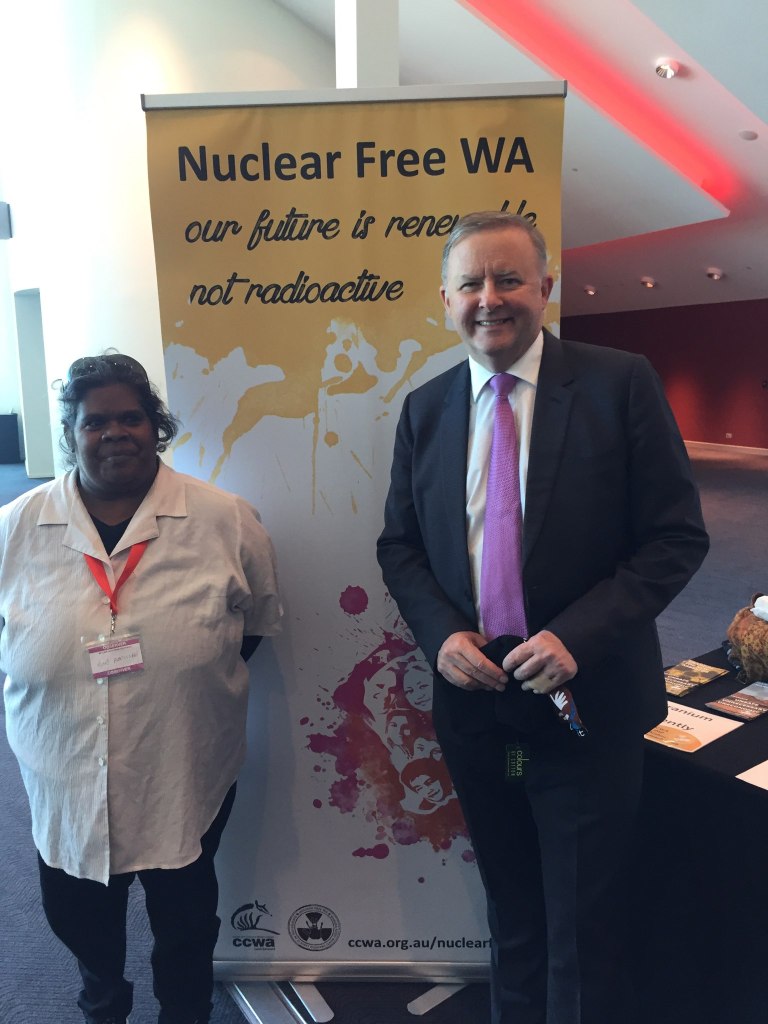 Dave Sweeney, 27 Aug 19, It was a big weekend of Labor politics with state conferences in both WA and Queensland.
In WA the following motions were adopted on Sunday 25/8:
WA Labor is committed to implementing a best process and practise approach to uranium assessment and regulation. We urge federal Labor – and the federal government – to reflect this on a national level and retain the long standing and prudent nuclear action trigger for uranium mining and the clear prohibition on nuclear power in the federal EPBC Act (1999) during the current EPBC review process.
WA Labor commits to rigorous scrutiny of any further approvals or applications by any of the four WA uranium mine proposals approved under the previous government. WA Labor will apply the highest regulatory standards to any project and will work with affected communities and key stakeholders including trade unions and workers in order to reduce risks.
WA Labor welcomes the resolution passed unanimously by the 2018 National Labor Conference committing Labor in government to sign and ratify the United Nations Treaty on the Prohibition of Nuclear Weapons and calls on the Australian Government to sign and ratify the Treaty as an urgent humanitarian imperative.
Queensland Labor reaffirmed their clear policy opposition to uranium mining and also adopted a wider nuclear free position on Sunday:
In order to protect human health and Queensland’s unique natural values, Queensland Labor affirms its commitment to ensuring that Queensland remains nuclear free.
There was a good presence and profile (WA) and support at both events – see attached pic from WA with Leader of the Opposition Albanese and Yeelirrie defender Vicky Abdullah – a massive shout out to KA, Vicki, Mia, along with Piers and the wider crew from CCWA. The WA nuke free team did a superb job of putting the issue strongly on the radar at Conference. Thanks also to our comrades and champions in Labor and the progressive trade unions.
Renewable energy booming in Australia: nuclear power irrelevant
 Nuclear power not the answer as renewables continue to boom in Australia, report finds, https://www.abc.net.au/news/2019-08-27/energy-audit-finds-nuclear-power-is-not-the-answer-for-australia/11450850Australia’s continuing renewable energy boom means the development of nuclear power is not a viable option, a new report from public policy think-tank the Australia Institute has concluded.
Key points:
- The Australia Institute’s energy emissions audit for the month July was released today
- It found SA’s renewable energy generation is setting a “real example” for other states
- It also found nuclear energy would not complement a high renewables sector
With the potential for nuclear power set to be examined by a federal parliamentary inquiry, the institute said the rapid development of wind and solar resources, particularly in South Australia, would render new “baseload” power resources like nuclear uneconomic.
The think-tank’s latest National Energy Emissions Audit found that for 44 hours during the month of July, South Australia generated enough wind and solar energy to power 100 per cent of its own demand, with some left over for export to eastern states.
The Institute’s climate and energy director, Richie Merzian, said the power grid in SA is effectively eliminating the need for so-called “baseload” supply, the type typically supplied by coal or nuclear.
What high renewables don’t need is a baseload type of energy, so a consistent supply of energy that doesn’t ramp up or ramp down to meet peak demand,” he said.
“That usually happens when you have those extremely hot days in summer that are becoming more common.
“What our audit shows is the windows where you need that peak demand are few, but that’s really where the additional support needs to come and that won’t be provided by a baseload support like nuclear.”
He said the other issue with nuclear energy was the cost and timeframe needed to build a nuclear power station.
“It takes a long time to build and it doesn’t complement high levels of renewables which is what we’re seeing in South Australia and the direction we’re going in in other states,” he said.
Earlier this month, Federal Energy Minister Angus Taylor announced the potential for nuclear energy would be examined by a parliamentary inquiry, but insisted Australia’s moratorium on nuclear energy would remain in place.
The parliamentary inquiry is expected to be finalised by the end of the year.
The Australia Institute’s audit acknowledged that South Australia’s high renewable energy output had forced the Australian Energy Market Operator (AEMO) to regularly intervene in that state’s market to maintain system security of the grid.
AEMO does so by directing gas generators to run or directing windfarms to curtail their output, or both, when the level of wind energy is deemed a risk to the stable operation of the grid.
But, according to the institute, AEMO has been gradually reducing such interventions as it gains more experience dealing with the high renewable energy mix.
SA is setting a ‘real example’
Mr Merzian said the latest audit had looked at South Australia in particular and had shown it was setting a great example for other states in terms of renewable energy.
“What we found is that for nine of the last 18 months, half of all the energy supplied in South Australia has been from renewable generation, including rooftop solar,” he said.
“That means that South Australia has been able to operate for a good chunk of the last year and a half with at least 50 per cent of its energy coming from wind and solar.
“That’s impressive and that’s the highest in the country and is a real example for where most of the states are going to go.”
He said Victoria and Queensland both had ambitious renewable energy targets and while New South Wales did not have a renewable energy target at state level, it would soon be the largest generator of renewable energy.
Renewable supply meeting demand
Mr Merzian said one prime example from the audit was that for almost 50 hours, the supply of wind and solar power in South Australia was equal with the amount of energy demand.
“Over the last month there were 44 hours in total where the state was generating enough wind and solar that is equal to what it actually required as an energy demand,” he said.
“Not only is South Australia a great example for the rest of the country, it’s also a great example globally.”
He said South Australia did not have the same energy security from coal and gas as other states and had become a “champion” for renewable energy because of it.
“South Australia has really had to charge on its own to build that internal reliability from its own energy sources and that’s really helped it champion its current make up of energy,” he said.
“It also puts a lot of pressure on that transmission link between South Australia and Victoria.
“If South Australia is going to continue to evolve, it’s important that we continue to build on these transmission links and infrastructure.”
A 2006 report on nuclear power led by Ziggy Switkowski suggested Australia could have up to 25 reactors providing over a third of the country’s electricity by 2050.
Both major parties in Queensland now oppose nuclear power
 Both major parties in Queensland now oppose nuclear. Not much of an election topic anymore then.
‘Queensland Labor immediately questioned the LNP’s nuclear power policy before Opposition Leader Deb Frecklington on Sunday afternoon issued a single line statement rejecting nuclear power. “The state LNP does not support nuclear power in Queensland,” Ms Frecklington said.’
Melbourne Event this Wednesday: Is nuclear power a solution to climate change?
When: Wednesday 28 August 2019, 6.30-8pm
Where: Yami Lester room, Friends of the Earth Office, 312 Smith St, Collingwood
https://www.facebook.com/events/2570886793009022/
The Federal Government has announced an inquiry into nuclear power, the Victorian and NSW Parliaments are conducting similar inquiries and conservative ideologues are promoting nuclear power. At this event, Prof. Tilman Ruff and Dr Jim Green will bust some of the myths around nuclear power and we’ll show some short films about Chernobyl and other less-known nuclear accidents.
Come along with your questions about nuclear power and enjoy free soup and hot drinks!
Speakers:
Prof. Tilman Ruff (International Campaign to Abolish Nuclear Weapons Australia and Medical Association for Prevention of War) will speak about the public health impacts of nuclear power.
Dr Jim Green (Friends of the Earth) will launch a new Friends of the Earth report, Nuclear Power – No Solution to Climate Change (nuclear.foe.org.au/climate)
+ short films about Chernobyl and other less-known nuclear accidents
+ Q&A
RSVP here
Contact: ace@foe.org.au, 0417 318 368
As forests disappear in the Amazon, Australia’s rainforests are being destroyed, too
|
Calls to preserve Australia’s rainforests as fires rage in the Amazon, https://www.sbs.com.au/news/calls-to-preserve-australia-s-rainforests-as-fires-rage-in-the-amazon People must fight to save the Amazon rainforest from deforestation – but it is important efforts to preserve Australia’s rainforests are also made, local environmental groups say. BY EVAN YOUNG 25 Aug 19, Environmental groups are urging people to channel raised awareness about deforestation in the Amazon into renewed efforts to preserve Australia’s own forests.
|
|
Indigenous landowner challenges Sussan Ley’s decision for coal mine
 Legal challenge over Sussan Ley’s decision to put potential mining jobs at Shenhua Mine before cultural heritage, ABC News, By Indigenous affairs correspondent Isabella Higgins and Sarah Collard 25 Aug 19, A family fighting to defend their traditional country from mining are suing Environment Minister Sussan Ley after she rejected their heritage protection bid in favour of a controversial Chinese coal project.
Key points
- Environment Minister is being sued for rejecting heritage protection in favour of a proposed coal mine
- Lawyers say it could be an important test case if the decision is found to be unlawful
- Traditional owners fear important sacred sites will be destroyed if the mine goes ahead
Last month, the Gomeroi Traditional Custodians failed in a bid to have sacred sites in north-west New South Wales preserved and protected from development due to cultural importance.
The land near Gunnedah had already been earmarked for the $1.2 billion Shenhua Watermark Coal Mine, which gained conditional federal approval in 2015 and has state development consents.
Ms Ley rejected their application on the grounds that the potential jobs generated from the mine were more important than cultural preservation.
She acknowledged the project could cause “mental health impacts … a sense of dislocation, displacement and dispossession,” among Indigenous people, but determined the social and economic value of the project took priority.
On behalf of the Gomeroi people, traditional owner Dolly Talbott has launched legal action against Ms Ley, with the case due before court for the first time on Wednesday.
She is being represented by the NSW Environmental Defender’s Office (EDO) which will argue that the minister’s decision was “unlawful” and contravenes the constitutional basis of the heritage protection act.
“If we don’t try to save these sites, then we are not fulfilling our obligations to our elders and our ancestors … and our children and grandchildren,” Ms Talbott said.
“[The national Indigenous heritage laws] are supposed to be there for the protection of Aboriginal culture and it doesn’t seem to be working.”……
Benefits of mine outweigh destruction of heritage: Minister
When deciding on the intervention request, Ms Ley acknowledged the mine would result in the “likely destruction of parts of their Indigenous cultural heritage”.
“I considered that the expected social and economic benefits of the Shenhua Watermark Coal Mine outweighed the impacts on the applicants [Gomeroi people]” she said in the rejection document seen by the ABC…….
The Minister has the final say on which applications receive protection status, under the National Aboriginal and Torres Strait Islander Heritage Protection Act. …….
Shenhua development courts controversy
This legal battle is the latest saga, in a long-running series of controversies involving the mine.
It sparked vehement protests in recent years, with farmers, environmentalists and Indigenous groups all fiercely opposed to the development.
They have raised concerns about how the mine will impact groundwater and wildlife and whether it’s economically viable.
Nationals MP Barnaby Joyce previously labelled the project “ridiculous” after his own government approved the mine, which falls in his New England electorate.
The NSW Government bought back half of the company’s mining exploration license in 2017, at a cost of $262 million, which at the time it said was to protect prime farming land.
Winning this case would mean Gomeroi people can continue to teach their children culture on country, Ms Talbott said.
“The stories of the land that we continue to tell our children today, and hopefully these sites are still there so they can tell their children.
1 This month.

Australians deserve the truth
about
AUKUS – https://aukuspublicinquiry.com/
Australians deserve the truth
about AUKUS


PETITION – To: Prime Minister Anthony Albanese and the Australian Labor Government

of the week – Australians for War Powers Reform (AWPR)
To see nuclear-related stories in greater depth and intensity
 Antinuclear