Antinuclear

Australian news, and some related international items

Barnaby Joyce’s fantasy for Australia- nuclear unicorns?

Apparently, in order to placate Barnaby Joyce and others, there will be a Parliamentary inquiry into nuclear power. I was thinking of putting a boring submission restating all the reasons why nuclear power will never happen in Australia, but that seemed pretty pointless.

Given that the entire exercise is founded in fantasy, I’m thinking it would be better to suspend disbelief and ask what we need if nuclear power is to have a chance here. The answer is in two parts:

  • Repeal the existing ban on nuclear power
  • Impose a carbon price high enough to make new nuclear power cheaper than existing coal (and, ideally gas) fired power stations

My initial estimate, based on the Hinkley C contract in the UK (price of $A160/MWh) is that the required price is at least $100/tonne of CO2. Rough aritmetic follows: Black coal emits about 1 tonne/MWh, and costs around $40/MWh to generate, so it would be slightly cheaper in the short run. Similarly for brown coal, which has higher emissions, but is cheaper to run.. But at those prices, it would be uneconomic to do the repairs necessary to keep existing coal-fired plants in operation past, say, 2030.

If such a policy were adopted, perhaps to be phased in over a decade or so, the immediate impact would be a massive expansion of renewables and big incentives for energy efficiency. But, if the arguments of nuclear fans about the need for baseload energy turn out to be right, there would be some room for nuclear to enter the mix after about 2040.

Of course, nothing remotely like this will happen. It’s rather more likely that Barnaby and the committee will discover a working technology for cold fusion, based on harnessing unicorns.

Comment: KT2 says:

In the spirit of the op…

“Barnaby and the committee will discover a working technology for cold fusion,” could be tricky as;

“The U.S. Patent and Trademark Office(USPTO) now rejects patents claiming cold fusion.[89] Esther Kepplinger, the deputy commissioner of patents in 2004, said that this was done using the same argument as with perpetual motion machines: that they do not work. ”
https://en.m.wikipedia.org/wiki/Cold_fusion   https://johnquiggin.com/2019/08/05/rethinking-nuclear/

August 6, 2019 Posted by | AUSTRALIA - NATIONAL, politics | Leave a comment

Paul Richards refutes Heiko Timmers’ push for Australia to import nuclear wastes

In an article in The Conversation, Associate Professor of Physics, UNSW, puts the case for Australia storing, presumably importing, the world’s nuclear waste.

Paul Richards While nuclear power in Australia has a somewhat shaky business case, a much stronger argument can be made for the back end of the nuclear fuel cycle: storing nuclear waste’ Heiko Timmers Associate Professor of Physics, UNSW

A case can be made, that’s true.

However, the nuclear industry never talks about the whole nuclear fuel cycle. Furthermore, no one in the nuclear estate has proved they can look after unspent nuclear fuel, and contaminated material for the time needed without an indefinite supply of sovereign wealth.

What you are proposing is that Australia enters the sales channels of waste storage, for the profit of a very limited few in the nuclear estate. An unrealistic proposal, as no other nation has been able to solve this back door nuclear waste issue that even the IAEA admits, there is no economically viable solution for.

Unlike all the other sales channels in this nuclear estate, waste storage in terms of cost is indefinite, and on that basis, the cost is then based on our sovereign wealth. In other words, an indefinite cost to our Australian taxpayer’s.

The key takeaway is;
there is no way that nuclear waste storage as a business is economically viable, as the nuclear war hawks propose, it will be a cost to Australia indefinitely.

However, introducing nuclear waste storage as a sales channel for the nuclear estate changes our Federal Legislation of nuclear non-proliferation and that is the ‘Trojan Horse’ being wheeled out yet again. In yet another amoral attempt at introducing;

• nuclear energy,
• waste, and
• weapons,

despite developed nuclear nations phasing out nuclear fuel as obsolete, because the energy system is unviable economically and environmentally.

August 6, 2019 Posted by | AUSTRALIA - NATIONAL, politics, spinbuster | Leave a comment

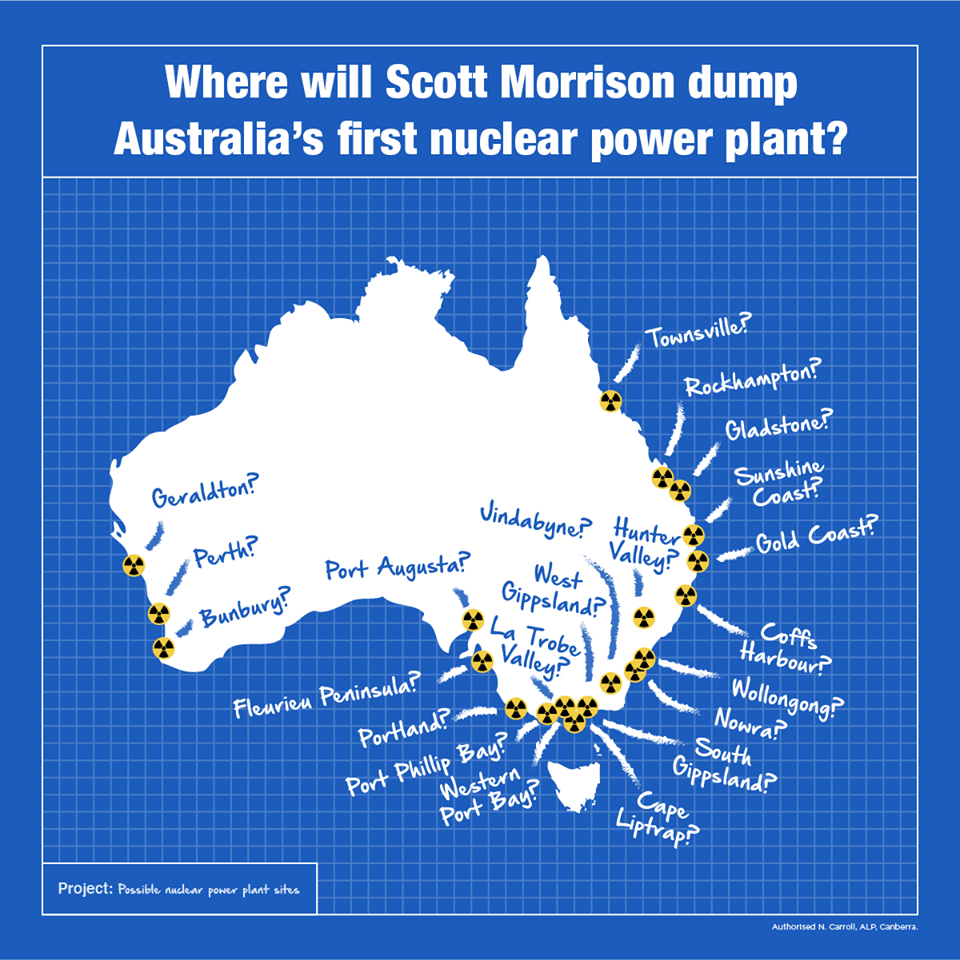
Labor demands that the federal government outline potential locations for nuclear power plants

Labor fires warning shot on nuclear power,  https://www.9news.com.au/national/labor-fires-warning-shot-on-nuclear-power/072b8a0a-e2a6-421e-a83c-a1c358424be1, By AAP

 Aug 4, 2019  Labor has demanded the federal government outline potential locations for nuclear power plants after establishing a parliamentary inquiry into an Australian industry.

Energy Minister Angus Taylor has requested the Standing Committee on the Environment and Energy to investigate nuclear as a power source for Australia.
Opposition Leader Anthony Albanese suggested the inquiry showed the government was softening its position on lifting the ban on nuclear power.
“What the government has to come up with is exactly where is it considering putting nuclear power plants around our coastlines or next to the rivers?” he told the ABC’s Insiders program on Sunday.
Conservative Liberal and Nationals MPs have been pushing for the inquiry, arguing nuclear could be a way to drive power prices down and cut emissions.
But Mr Albanese said the issue had been examined many times before, with studies showing it would be three times more expensive than wind or solar when connected to other systems.
He said construction of nuclear plants had emissions-intensive construction and used large volumes of water, meaning they had to be near rivers or the coast.
We know, of course, from incidents like Chernobyl and Fukushima that it’s very dangerous,” the Labor leader said.
Mr Albanese said the government was in its third term and still didn’t have an energy policy.
“Now they’re off on this frolick, giving a parliamentary committee the scope to run around the country and consider matters that have been considered by the experts before,” he said.

August 6, 2019 Posted by | AUSTRALIA - NATIONAL, politics | Leave a comment

No investment appetite for nuclear- says Ziggy Switkowski,  

No investment appetite for nuclear: Switkowski,   The renewed debate on nuclear power is largely one for “intellects and advocates” because the lack of political bipartisanship means there is little investment appetite, says one of the country’s foremost experts…… (subscribers only)  https://www.afr.com/politics/federal/no-investment-appetite-for-nuclear-switkowski-20190805-p52dwv

August 6, 2019 Posted by | AUSTRALIA - NATIONAL, politics | Leave a comment

Long-Term Radiation Exposure From Space Travel Harms Memory, Mood

Long-Term Radiation Exposure From Space Travel Harms Memory, Mood, D-brief, 

By Korey Haynes | August 5, 2019  There’s a major outstanding question lingering over the future of human spaceflight: Just how much radiation can the body handle? While humans have spent more than a year at a time on orbiting space stations without ill effect from radiation, almost all astronaut experience has been in low-Earth orbit. There, humans are still semi-safely enclosed within our planet’s magnetic field, which offers protection from the bulk of space radiation.

Researchers also know that short, powerful doses of radiation are deadly. But less is known about long-term, low-dose radiation — the kind that settlers on Mars or the moon would face.

Now, a team of scientists led by Charles Limoli at the University of California, Irvine, has taken a step toward a better understanding of those long-term risks. The researchers exposed mice to chronic, low-dose radiation for six months. The results are troubling for the future of spaceflight. The radiation left the mice suffering from both memory and mood problems that the scientists say would likely show up in human subjects as well. The results were published Monday in the journal eNeuro.

Radiation on the Brain

In the study, the mice showed “severe impairments in learning and memory,” according to the research paper. The mice were also generally more stressed out by their environments. That isn’t a good sign for space settlers, who will need their wits to face unforeseen struggles. Other studies have also already shown the potential ill effects of the long-term isolation and stress.

In the past, scientists hit lab mice with radiation levels some 100,000 times higher than they’d actually experience on Mars’ surface. But the researchers say their test is the first that has used these lower, more realistic doses of radiation over long periods to study space travel. Their efforts were made possible by a new facility.

The radiation included both neutrons – heavy particles from atomic nuclei – and pure energy in the form of gamma rays and other scattered photons……

Researchers found both physical and chemical changes in the brains they examined, in addition to the behavioral changes they observed in the living mice……..

more tests need to be done, and the radiation, while more realistic than past experiments, still doesn’t exactly mimic the space environment. But if their results hold up, they’re not a good sign for the future of human space settlement, at least not without a lot of bulky and expensive radiation shielding. http://blogs.discovermagazine.com/d-brief/2019/08/05/long-term-radiation-exposure-from-space-travel-harms-memory-mood/#.XUionm8zbIU

August 6, 2019 Posted by | General News | Leave a comment

Radiation Levels Higher in Marshall Islands Than in Chernobyl 

August 6, 2019 Posted by | General News | Leave a comment

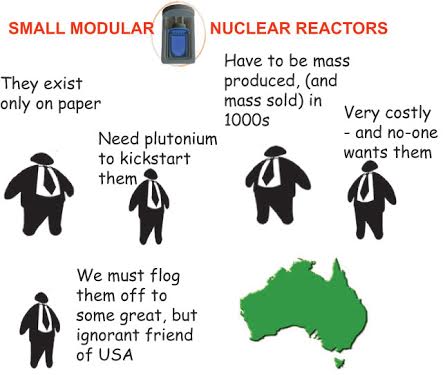
Small modular nuclear reactors for Australia?

Parliament to look at small nuclear reactors as future energy source. A parliamentary inquiry into an Australian nuclear industry will look at the fast-changing technology of small modular reactors. InDaily,  Rebecca Gredley, 5 Aug 19, A parliamentary inquiry into an Australian nuclear industry will look at the fast-changing technology of small modular reactors.Energy Minister Angus Taylor says he’s requested the Standing Committee on the Environment and Energy to investigate nuclear as a power source for Australia.

“We have a moratorium on nuclear. There is absolutely no plan to change that moratorium,” the minister told ABC Radio on Monday…….

Small modular reactors are factory produced and installed on-site.

Director of the Australian National University’s Energy Change Institute Kenneth Baldwin says wind and solar paired with battery storage will continue to be the cheapest form of power.

“These costs will decrease and who knows, in 10-15 years, it may simply be uneconomic to look at nuclear power,” he told ABC News.

Baldwin says such reviews need to be done periodically to understand the current technologies and costs.  It would take at least a decade before nuclear is realistically part of the energy mix, he added.

“You need the social licence to operate such a system, and to gain public acceptance may take many years,” he said.

“Add to that the fact that you have to then build a regulatory system – let’s say that it takes five years to do that, five years to build a public acceptance – that’s ten years.”

A federal review into nuclear energy was last conducted under the Howard government, with a report finding 25 reactors would be needed across Australia to supply one-third of the nation’s electricity supply by 2050. https://indaily.com.au/news/2019/08/05/parliament-to-look-at-small-nuclear-reactors-as-future-energy-source/

August 6, 2019 Posted by | AUSTRALIA - NATIONAL, politics, technology | Leave a comment

Australia’s one great river system – Murray-Darling Basin Plan ‘untenable’ – corrupt?

August 6, 2019 Posted by | AUSTRALIA - NATIONAL, climate change - global warming, environment, politics | Leave a comment

Belarus’ forgotten children – victims of Chernobyl’s nuclear radiation

Kevin Barry in Chernobyl: ‘Misha is an example of what happens when a country is on its knees’  Irish Examiner, August 05, 2019 

In 2000 the Irish Examiner sent Kevin Barry, now longlisted for the Booker Prize for his novel Night Boat to Tangier, to Chernobyl. Here we reproduce what he reported

Misha photographed by Eugene Kolzov at the No 1 orphanage in Minsk.Misha, aged seven, is the victim of not one but many sicknesses. His physical disorders, as can be plainly seen, are many and various.

But Misha is the victim of another ailment too, a kind of compassion deficiency.

Chernobyl isn’t fashionable these days, it’s been around so long now. April 26, 1986 seems a long time in the way-distant past. After the initial blurt of paranoia and charitable outreach, the fickle gaze of public interest quickly flicked from the incident at Reactor No 4 to fresher horrors.

Misha, then, has been shuffled way back in the compassion pack. He has fallen behind the other ravaged children who sombrely people the planet’s trouble spots, in places like Mozambique and Ethiopia.

He’s competing with Rwanda and Chechnya. And it’s beginning to tell Misha’s illness is a direct consequence of the Chernobyl explosion.

The radioactive danger in Belarus is not so much in the air now as in the food chain. Professor Yuri Bandashevsky, a dissident scientist, told the Irish Examiner this week that the mutations caused by radiation in children like Misha have by now entered the gene pool and thus the effects of the ‘86 explosion can stretch to infinity.

After criticising the state’s alleged misspending of research money for Chernobyl, Professor Bandashevsky recently found himself banged up in jail for five months, bound at the feet.

Which isn’t the sort of thing that bodes well for the likes of Misha. Some aid continues to filter through. This week, a convoy run by the Chernobyl Children’s Project has been on a drive through Belarus, dispensing almost £2 million in food and medicines.

One of the institutions the orphanage supports is Novinki, a children’s asylum on the outskirts of Minsk. Such is its Dickensian squalor, its actual existence was long denied by the state. This is where you’ll find little Misha.

Project leader Adi Roche says she has known the child since he was a baby, but has been stunned at his deterioration since she last visited in December.

After finding him emaciated and dying this week, the project has placed a Dublin nurse and a local Chernobyl nurse on 24-hour care alert with Misha, an attempt to make whatever is left of his life as painless as possible

“We don’t know how long Misha will live, or if he will live, but we are morally obliged to do everything in our power to attempt saving his life,” said Ms Roche last night.

“‘He is not the only child in Belarus suffering as horrifically as this. he’s just one of many.” she added. “‘These children are the victims of 14 years of neglect by the international community.”’

Many children in Belarus consigned to mental asylums have no mentaI handicap. “All orphaned children with any kind of disability are put into mental asylums if they live beyond the age of four,” she said.

Meanwhile, staffed by1,000 workers, the Chernobyl plant continues operate a couple of kilometres inside the Ukraine border.

The authorities say it will close this year. The concrete sarcophagus built to contain contamination from the reactor has 200 holes and counting.

Orphans of the nuclear age

Kevin Barry, in Chernobyl, finds a land and its people scarred by a disaster from which they may never recover.

Chernobyl at this time of year is beautiful, the borderlands of the Ukraine and Belarus a pastoral and idyllic place. Vast swardes of rich woodland are full of babbling brooks and twittering songbirds, every way you turn, there’s a postcard vista to please even the most jaded eyes.

The locals, however, are edgy. The President of Belarus, Alaksandr Lukashenko — aka ‘Batska’ (‘The Father’) — has decreed that the farmlands here–abouts are now safe to plant and he’s threatening to fly overhead and make sure the workers are toiling.

If not, he says, there will be trouble. Big trouble.

The notion of Batska in an airplane is enough to prompt sleepless nights for those who remain in the Purple Zone, the area most contaminated by the accident in 1986 at Smelter No 4 of the nuclear plant that lies inside the Ukranian border.

In a tragedy of happenstance, because there was a stiff northerly gusting that day, Belarus took the brunt of the damage and because radioactivity is most lethal when it attacks developing human systems, children have borne most of the pain.

But for these children, the most serious ailment is not the thyroid cancer or the leukaemia or the heart trouble or the kidney failure or the various disorders of colon and spleen prompted by Chernobyl.

The greatest danger is the compassion-fatigue. 1986 seems a long time ago now and the incident at Smelter No 4 is no longer swaddled in the necessary event-glamour or crisis-chatter.

When the evening news is an atrocity exhibition, when daily there are hellish dispatches from Mozambique, Ethiopia and Chechnya, the Belarussians fall ever further back in the line.

The foreign correspondents have long since moved on elsewhere. The story of a child developing thyroid cancer over a period of years doesn’t conform neatly with the sound-byte culture.

By this stage, the Belarussians have had enough. A condition of mass denial exists in the country and a native of the village Solchechy in the Purple Zone says that up to around 1993, everybody fretted and freaked out but then they decided, well, to hell with it.

“The mess got to be too much,” she says.

We don’t think about it now. Life is life and we try to get on with it.

This is easier said than done in Belarus. The country’s economy is shot — agriculture was its mainstay and since Chernobyl, the income from farming has been negligible. Almost 30% of the country’s annual turnover goes to the clean-up operation.

Belarus remains the most Soviet of states. There are thickly-piled layers bureaucracy and this tangle of demented protocol regulations and petty restrictions is amorphic, constantly shape-shifting.

The natives have had to develop a stoic acceptance of a hard frustrating life…….. https://www.irishexaminer.com/breakingnews/views/analysis/kevin-barry-in-chernobyl-misha-is-an-example-of-what-happens-when-a-country-is-on-its-knees-941735.html

August 6, 2019 Posted by | General News | Leave a comment

Windlab’s solar-wind-battery project finally connected to Queensland grid — RenewEconomy

Windlab’s world-leading solar, wind and battery project at the Kennedy Energy Park in north Queensland has finally been connected to the grid and energised after an eight month delay. The construction of the Kennedy hub – combining 43MW of wind, 15MW of solar and a 2MW/4MWh Tesla battery – was completed in December but has……

via Windlab’s solar-wind-battery project finally connected to Queensland grid — RenewEconomy

August 6, 2019 Posted by | Uncategorized | Leave a comment

Why solar, wind and EVs will be the death of the petroleum industry — RenewEconomy

Stunning new report from BNP Paribas signals death toll for petrol: a mix of solar, wind and electric vehicles will deliver more than 6 times the return on investment than oil. The post Why solar, wind and EVs will be the death of the petroleum industry appeared first on RenewEconomy.

via Why solar, wind and EVs will be the death of the petroleum industry — RenewEconomy

August 6, 2019 Posted by | Uncategorized | Leave a comment

August 5 Energy News — geoharvey

Opinion: ¶ “Overlapping Crisis Of Climate Change Cause Of Ecological Land Grab” • The crises of climate change, unsustainable food systems, and mass species extinction are on a course towards what might best be called an ecological land grab. Experts who once touted “win-win” scenarios for the environment now talk about “trade-offs.” [Deccan Chronicle] Science […]

via August 5 Energy News — geoharvey

August 6, 2019 Posted by | Uncategorized | Leave a comment

Angus Taylor, Australia’s Minister for Coal and Nuclear, wants to launch Inquiry into nuclear power

Taylor presses nuclear button, as energy wars enter dangerous new phase, Giles Parkinson 5 August 2019  https://reneweconomy.com.au/taylor-presses-nuclear-button-as-energy-wars-enter-dangerous-new-phase-47854/

Australia’s energy minister Angus Taylor has campaigned against renewables since before he entered parliament in 2013, appearing at anti-wind events organised by an anonymous and unpleasant website, and vowing on many occasions to scrap the renewable energy target.

He has been powerless to stop the build out of wind and solar, although he has complained about it often enough. But now Taylor and the Coalition government have taken their war against wind and solar to its next inevitable phase: They’ve pressed the nuclear button.

Taylor revealed late Friday that he had asked the Environment and Energy Standing Committee to launch a new inquiry into nuclear energy, including its costs and issues of waste etc. They’ve got four months to produce a report.

Taylor insists that there is no intention to repeal the laws that outlaw nuclear energy in Australia. But that beggars the question. Why have the inquiry in the first place?

The answer is simple. As Taylor revealed in an interview on ABC’s AM program, he simply doesn’t accept that renewables can power the electricity grid. A view that is loudly shared by many of his Coalition colleagues, the Murdoch media, and of course the coal industry.

The timing of the announcement is interesting. It comes just a couple of days after the end of the parliamentary sitting week (they won’t be back again until September) and just as the country’s far-right conservatives got ready to gather at the Australian Conservative Political Action Conference.

Tellingly, this is the first policy or initiative that Taylor has announced since the shock re-election of the coalition government in May, and comes after a major push by the far right ideologues of this conservative government to reconsider the ban on nuclear.
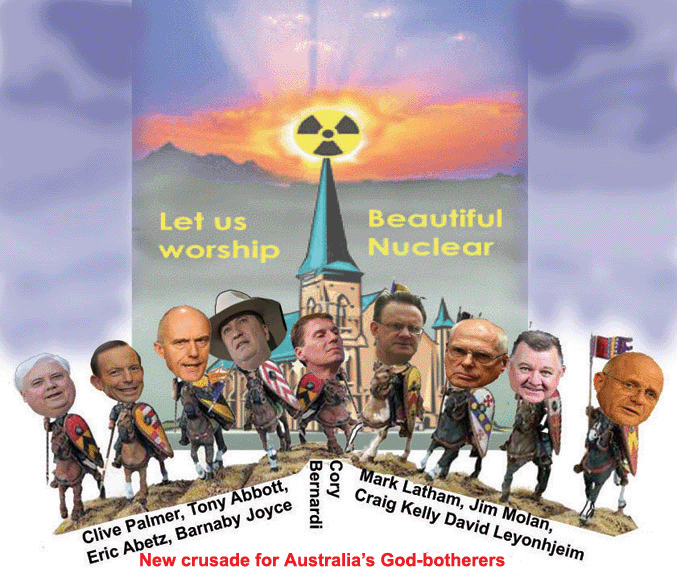
And as we have noted before, the same Coalition MPs that have been pushing for nuclear are the very same Coalition MPs pushing for new coal generation, and the very same Coalition MPs who reject the science of climate change, or make a mockery of the urgings of young people that they should take it seriously.

This is no co-incidence. This is not about carbon emissions, and it is certainly not about cheap energy. The common enemy of these people is wind and solar, and the shift from a centralised system based around “baseload” fossil fuel generators to a renewable system that is largely decentlralised (and democratised), and based around renewables, storage and demand management.

Australia is one of those regions – like Germany and California – that is at the forefront of this transition, and the fossil fuel industry view is that it cannot be allowed to succeed.

So it is no coincidence that the biggest industry supporter of nuclear is the coal lobby itself, in the guise of the Minerals Council of Australia, which is also pushing for new coal generators and urging the government to do as little as possible on climate.

The MCA is cosy with the Coalition – its former CEO and deputy CEOs are now key advisors in Prime Minister Scott Morrison’s office, and its chair is the former Coalition minister Helen Coonan. Its current CEO, Tania Constable, was appointed by the Coalition government to the board of the ABC, over-riding independent recommendations.

A new dimension is also added.

One of the noisiest opponents of renewable energy technologies is Trevor St Baker, pushing for new coal generators and whose Vales Point coal generator in NSW – currently in the queue to get federal government funding to remain open beyond its schedule closure date – is also the founder of a company SMR Nuclear that looking at new “modular” nuclear technologies that Taylor suggests could be a focus of this inquiry.

Like St Baker, the likes of Constable argue that only nuclear is able to deliver 24/7 emissions free power. They insist it is “cheap”, but that is nonsense.

The International Energy Agency desperately wants nuclear to succeed, but it concedes that costs have surged, as this graph (above) from a recent report illustrates. While the cost of solar has fallen 95 per cent over the past decade, and the cost of battery storage by some 70 per cent, the cost of nuclear has more than trebled upwards.

Even re-fitting existing stations was considered more expensive than wind and solar, although as BloombergNEF founder and now commentator Michael Liebreich has pointed out, the costs might be close enough to convince some countries to extend their life.

But there is no economic case for new nuclear. Liebreich says. Cost blowouts are occurring in the UK with Hinckley, and in France and in Finland with their versions of the latest technology, as it is in China (which has begun no new projects in the last three years), and in the US.

This graph[on original] from Le Monde in France illustrates how costs have surged in its next generation technology at its flagship project in Flamanville. It was begun in 20017 with promises it would be finished in 2012 at a cost of €3.5 billion.The latest delay and cost blowout have pushed the assumed finish date to 2022 and the new estimate of costs to €11.5 billion.

As France’s own National Infrastructure Commission said last year, a focus on renewables ‘looks like a safer bet than constructing multiple new nuclear plants’”.

Into this debate recently landed Industry Super Australia, the union fund research body with a report that is quite possibly one of the most inept analyses of the energy industry that has been produced in Australia. And that says something because it has had strong competition. The ISA, and the ISF that oversees it, should be embarrassed that it is published in its name.

To address the issue of costs, the ISA report produces a completely nonsensical “capital cost” assumption that confuses output with capacity factors, multiplies it by the cost of solar plants built more than 5 years ago.

It delivers a figure of $16 billion per gigawatt for the cost of solar. It is not a rough “back of the envelope” calculation as the authors try to claim, it is complete and utter garbage.

Among its other laughable claims are that Australia would need “one hundred” Snowy 2.0 pumped hydro schemes, or 72,000 Tesla big batteries were it to go 100 per cent renewables.

It’s a preposterous number that completely misunderstands the workings of the energy system, and the role of storage technologies, and fails to appreciate that if we do electrify everything, then we will be using less energy, not more.

Apart from now being expensive and polluting, burning fossil fuels is hugely inefficient – most of it disappears as heat, be it in a coal fired power station or in the internal combustion engine of a car – and it is two or three times more wasteful than electric motors and batteries.

But the authors of this report seek to mislead, either deliberately or through their ignorance. They make the patently false claim that fossil fuel plants “do not need back up.” Try running that past anyone who actually operates an electricity  grid, and has to deal with large plants that need regular maintenance or which may trip for any number of reasons.

The study is so poorly researched it even claims that the Invanpah solar tower facility in California does not need back-up.

If the authors bothered to spend two minutes researching that project, rather than relying on the blogs of nuclear fantasists, they would have discovered that it has no storage, and needs gas plants to help fire it up in the morning. Yes, it was costly, but it turned out to be such a bad idea that no plant like it has or will be built again. All new solar towers do and will have storage.

But the authors’ minds were set. They even dismiss the reaction to the disasters at Chernobyl, Fukushima and Three Mile Island to “behavioural bias” and compares the lot of the nuclear industry with that of a baseball pitcher in 1930s, Chad Bradford, who had an unusual throwing action.

  1. “They just judged him on the way he looked. So they demoted him to the minor leagues for a time,” they plead.
  2. For heavens sake, nuclear is not judged by the way it looks, or its throwing action, but for its costs. And the CSIRO and the Australian Energy Market Operator – like the IEA – have made it clear that nuclear – like new coal – costs a multiple more than the cheapest alternatives, wind and solar backed by dispatchable capacity, be that pumped hydro, batteries, or demand management.

You won’t see baseload mentioned in AEMO’s Integrated System Plan, the 20-year blueprint for the future. Neither will you see it championed by the grid operators in the UK, or China. The world has moved on.

AEMO says Australia has the technology and know-how to move to 100 per cent renewables, although they would differ about the time frame from the most enthusiastic renewables supporters.

The problem is that like the ISA report, the nuclear boosters in the Coalition are prone to accept garbage as gospel.

The energy industry has largely dismissed nuclear as an option in Australia, knowing that it is absurdly expensive, and that if it were built in Australia it would take so long – possibly two decades at the very least – that the country would be powered almost exclusively by much cheap wind and solar and dispatchable storage by that time (if allowed to).

But Ted O’Brien, the chair of the committee reviewing the nuclear issue (it is stacked with four out of seven members from the Coalition) has already made up his mind.

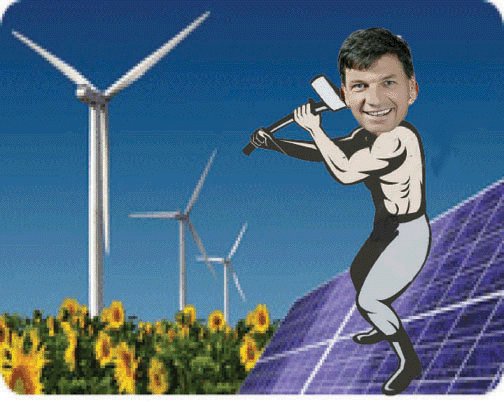
Like his Coalition colleague Craig Kelly, lampooned in the cartoon above, he’s long been a big fan of nuclear – and given his analysis of Labor’s energy policy – he said it would be a tax on Tim Tams – he might have been about as thorough in his assessment of nuclear as Homer Simpson.

Don’t laugh.These people really are that stupid. They are not interested in the advice of experts – be it on climate science, energy technologies,  or electric vehicles. But one thing they can’t admit is that the Greens – and now the rest of the energy industry – are right about wind and solar, and the focus on “dispatchable” power rather than “base-load”.

If Australia can demonstrate that a modern economy can be run on a predominantly renewables grid, it’s all over for the fossil fuel industry across the world. So expect this push to have some powerful friends, and not just in the media industry, and not just in Australia.

Giles Parkinson is founder and editor of Renew Economy, and is also the founder of One Step Off The Grid and founder/editor of The Driven. Giles has been a journalist for 35 years and is a former business and deputy editor of the Australian Financial Revie

August 5, 2019 Posted by | AUSTRALIA - NATIONAL, politics | Leave a comment

Liberal National Coalition wants to embrace nuclear power

Coalition wants to embrace nuclear power,    https://www.abc.net.au/radionational/programs/breakfast/coalition-wants-to-embrace-nuclear-power/11382616 4 Aug 19   Australia’s decade-long energy wars have taken a new twist with the Morrison Government ordering a Senate inquiry into the feasibility of nuclear power in this country.

Energy Minister Angus Taylor says the review will look at the economic, environmental and safety implications of lifting the moratorium on atomic energy as a source of baseload power.

The inquiry coincides with the United States flagging the deployment of intermediate missiles in Darwin after Donald Trump pulled the US out of a nuclear arms treaty with Russia

August 5, 2019 Posted by | AUSTRALIA - NATIONAL, politics | Leave a comment

Nuclear power in Australia to be examined by multi-party parliamentary inquiry

Nuclear power in Australia to be examined by multi-party parliamentary inquiry, By political reporter Jade Macmillan -4 Aug 19, Angus Taylor has asked for the first inquiry into nuclear power in over a decade

August 5, 2019 Posted by | General News | Leave a comment