In drive to promote 2020 Olympics, Japan’s govt urges Fukushima evacuees to return home
Expert says 2020 Tokyo Olympics unsafe due to Fukushima | 60 Minutes
|
Fukushima: Despite health threats, the Japanese government urges residents to return https://www.express.co.uk/news/world/1161500/fukushima-japanese-government-encourages-residents-returnFAMILIES who fled nuclear meltdown in Fukushima are being urged to return to their homes ahead of the Tokyo Olympics., By DAVID PILDITCH, Aug 4, 2019 Alarming levels of radiation up to 20 times higher than official safety targets have been recorded in areas where locals are being encouraged to go back. We found ghost towns eight years after three reactors went into meltdown at Daiichi power plant 140 miles north east of Tokyo in March 2011. Tokyo 2020 is being hailed as the “Reconstruction Olympics” signalling new hope following the earthquake and tsunami that triggered the disaster and left more than 18,000 people dead. Now evacuees are being urged to return as the global spotlight focuses on the recovery of the region. The government has lifted most evacuation orders and all but a handful of hot spots have been declared safe.
But parents believe their children are in danger, saying officials are downplaying the dangers and safety is compromised in a cynical attempt to convince the world the crisis is over. Families have accused the government of speeding up their return to showcase safety standards ahead of the Olympics. We found once-vibrant communities now post apocalyptic wastelands like something from a Hollywood movie after the worst nuclear accident since Chernobyl. Schools, shopping malls, supermarkets, libraries and petrol stations lie decaying along with thousands of homes. Many are set behind guarded barricades in exclusion areas known officially as “difficult to return to zones”. Others lie in areas which the government says are safe to live in but whose few residents – wild boar and monkeys – demonstrate signs of mutation. Along roadsides sit giant black bags containing contaminated soil. In Tomioka, five miles from the power plant, a school sports hall is scattered with footballs left when children fled. It’s in stark contrast to arenas being built for the £20billion Games. Fukushima is hosting the first event, a softball match on July 22, two days before the opening ceremony. The Japanese leg of the torch relay starts on March 26 at a soccer training centre 12 miles south of the crippled plant. The J Village, a base for emergency workers, only fully reopened last month. In Okuma our Geiger counter sounded furiously, recording four microsieverts an hour. The government safety target is 0.23 microsieverts per hour. It came days after evacuation orders were lifted for parts of the town which had 10,000 residents. The centre remains a no-go zone and just 367 former residents have registered to go back. Ayako Oga, 46, who suffered a miscarriage, says: “The Olympics are putting lives in danger. The government is forcing people to leave the public homes they have been in. They are putting a heavy burden on people still suffering mentally and financially.” In Namie, which had 21,000 residents, evacuation orders were lifted in 2017. It is said 800 people returned but we found desolation, only traffic lights working. The Wild Boar bar last served a drink on disaster day. Owner Sumio Konno, in a group legal action against the government, says his son, who was five, still suffers nosebleeds. “He is sick all the time,” he says. “Every month he needs to go to the doctor.” Ryohei Kataoka, of the Citizens Nuclear Information Centre, says: “The government’s insistence in lifting evacuation orders where heightened radiation-related health risks undeniably exist, is a campaign to show that Fukushima is ‘back to normal’ and to try to make Japan and the world forget the accident ever happened.” |
|
NuScale’s Small Modular Nuclear power is too risky
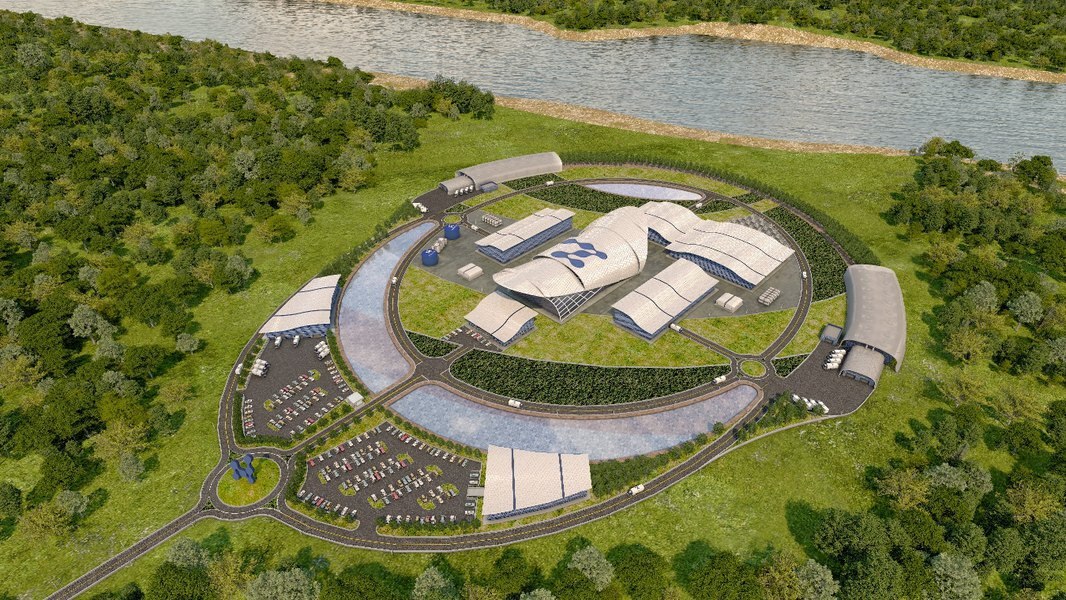
NuScale nuclear power is too risky, [artist’s model above] https://www.sltrib.com/opinion/letters/2019/08/04/letter-nuscale-nuclear/ By Robert Goodman | The Public Forum, 4 Aug 19, NuScale’s nuclear power project is too much of a financial and environmental risk when there are cleaner energy alternatives.
Not only will NuScale’s virtually untested nuclear technology be an estimated 40% more costly than renewable energy portfolios, the project in Idaho Falls, Idaho, will also likely go exceedingly over budget.
Many recent nuclear projects nationwide have resulted in extreme cost overruns and project cancellations, the burden of which has often fallen on ratepayers. For instance, ratepayers in South Carolina will end up owing more than $6,000, to be paid in monthly installments for the next four decades for a failed nuclear power plant. And just this year, the Department of Energy gave $3.7 billion in taxpayer money to the ailing Southern Co.’s nuclear power project near Waynesboro, Ga.
Yes, UAMPS has promised a rate cap in order to protect ratepayers. But if the new, first-of-a-kind project goes over budget, will that rate cap stay? Will NuScale Power, an Oregon-based LLC, step up and pay the extra expense?
City officials in UAMPS districts should look beyond NuScale Power’s promotional presentations and consider economically competitive, safer and more sustainable energy portfolios through a more transparent, independent and robust procurement process.
Water shortage now hitting France’s fleet of nuclear reactors
 Reuters 3rd Aug 2019 French utility EDF may curb power generation at its 3,000 megawatt Chooz nuclear reactor in the north of France due to the low flow rate of the
Meuse river which it uses to cool the two reactors at the plant. “Due to
flow forecasts of Meuse river, production restrictions are likely to affect
EDF’s nuclear generating fleet on Chooz production units starting
Thursday August 8,” the company said. EDF’s use of water from rivers as
coolant is regulated by law to protect plant and animal life. It is obliged
to reduce output during hot weather when water temperatures rise, or when
river levels are low.
Water shortage hitting Queensland town Stanthorpe
|
Day zero approaches for Stanthorpe as locals face prospect of levy to cover cost of trucked-in water https://www.abc.net.au/news/2019-08-05/stanthorpe-drought-bites-as-town-runs-out-of-water/11381886, ABC Southern Qld , By Elly Bradfield Locals describe it as the “worst drought in living memory” but things are about to go from bad to worse in the southern Queensland town of Stanthorpe, with the town water supply weeks away from drying up.
Key points:
If there is no rain by the end of spring, the council has estimated it will have to truck 45 loads water per day, costing up to $2 million a month, to supply the town. The Queensland Government has refused to be drawn on whether it will contribute, but the council said it would be forced charge ratepayers a levy if governments did not step in. Families strugglingBusiness has doubled at the laundromat, but owner Chris Reedy said that was a bitter pill to swallow with the community struggling.
“They struggle to put food on the table, let alone come and do washing for hygiene,” he said. “I feel depressed to see people in that state … especially families and young kids. “I’ve been helping out a bit with free loads to try to help out where I can.” He described spirits in the town as “at an all-time low” and raised concerns about people’s mental health. Without water you can’t make concreteTraditionally the winter period was concreter Lachlan Carnell’s busiest time, but with most farmers cash strapped, work has dried up and he has been forced to tell staff to “take whatever [work] they can get”. Without water you cannot mix concrete, so everyone’s a bit stressed at the moment,” he said. “The plant will have to start trucking in water, which is going to stress us the contractors and the clients because obviously the concrete is going to go up in price.
Levy threat causes fearAt the motel, owner Michael Jensen raised concerns about the impact of a water levy on the already struggling town. “I think it could have been handled a lot better because there’s a lot of people out there now that are very scared of what’s ahead of us,” he said. “We have an ageing population and a lot of those older people, including my parents for example, just have to try to find that extra money if it does come to that situation.” Mr Jensen broke down when he described the impact of the drought on his community. “If we don’t get water in the next three to six months I fear for the actual community,” he said. “It’s tough; tough for everyone especially the farmers.” ‘Not just farmers who struggle’Secretary of the Stanthorpe and Granite Belt Chamber of Commerce Amanda Harrold said the levy would be “the last straw” for many people. “It goes all the way through the town through families, the retail, the shopping centres, all the way to the school, to the hospital — what services will be kept if we have a dwindling community?” she said. “It’s not just the farmers who struggle in a drought. “This community cannot bear the cost of this, there just won’t be the money.” She said business was already down 20 to 50 per cent. “We are lucky that some tourists are coming to town, but with tourists comes the water usage, so it’s a really hard balancing act.” With the $84 million Emu Swamp Dam now fully funded, there is some hope for locals that the region can be protected from future droughts. But the Bureau of Meteorology has warned the town is unlikely to receive the soaking rain needed in the coming months. |
|
Minerals Council CEO ecstatic about parliamentary inquiry into nuclear power
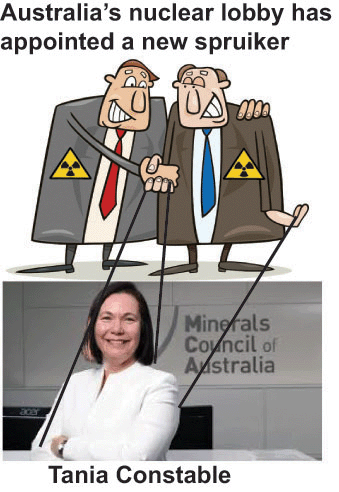 Minerals Council welcomes inquiry into nuclear power, THE AUSTRALIAN, OLIVIA CAISLEY, REPORTER, AUGUST 5, 2019 Minerals Council welcomes inquiry into nuclear power, THE AUSTRALIAN, OLIVIA CAISLEY, REPORTER, AUGUST 5, 2019
“When the rest of the world is deploying the cheapest zero-emission 24/7 energy source, Australia should readily embrace an energy future which is good for both national progress and the environment.” It comes as Energy Minister Angus Taylor wrote to the standing committee on the environment and energy on Friday and asked them to investigate nuclear as a potential power source for Australia……. : “Nuclear energy is safe, reliable and affordable. This is the inconvenient but fundamental truth ignored by those arguing against nuclear power.” Her support of the inquiry comes as Labor leader Anthony Albanese yesterday questioned why the government had requested the inquiry. Mr Albanese said the viability of nuclear energy had been examined “many times” before, with studies showing nuclear power could be up to three times more expensive than wind or solar when connected to other systems. …… https://www.theaustralian.com.au/nation/minerals-council-welcomes-inquiry-into-nuclear-power/news-story/38a0a74c1831558c35bd8a15e9712a9f
|
|

Earthquake hits Fukushima Prefecture – there could be more to come
|
M6.4 quake hits Japan’s Fukushima, no reports of major damage https://english.kyodonews.net/news/2019/08/749a3bf09b4c-breaking-news-m62-quake-hits-off-japans-fukushima-weather-agency.html
KYODO NEWS An earthquake with a magnitude of 6.4 hit Japan’s northeastern prefecture of Fukushima and its surrounding areas on Sunday, but there is no danger of a tsunami, the weather agency said. The epicenter of the quake, which occurred at around 7:23 p.m. at a depth of about 45 kilometers, was out at sea off the prefecture, the agency said. There were no immediate reports of major damage or casualties, according to authorities. No abnormalities were found at nuclear power plants in the region, including both Fukushima Daiichi and Daini, according to their operators. The quake registered lower 5 on the Japanese seismic intensity scale of 7 in Futaba in Fukushima Prefecture, and Ishinomaki and Watari, both in Miyagi Prefecture, according to the Japan Meteorological Agency. An official at the agency, speaking at a press conference, cautioned that quakes of similar intensity could hit the region over the following week or so. The agency first announced the magnitude was 6.2 and the depth of the epicenter was 50 km, but later revised them to 6.4 and 45 km. |
|
Looks as if Malaysia will let Lynas keep its radioactive wastes there, after all
Malaysian minister capitulates on Lynas waste export condition, The Age, By Colin Kruger, August 4, 2019 One of Lynas Corp’s fiercest critics in Malaysia has confirmed the country’s government will drop a requirement for the rare earths miner to export its radioactive waste from the country.
The confirmation, from Malaysian environment minister Yeo Bee Yin, all but secures Lynas licence to operate in the country beyond September 2 and could reignite a $1.5 billion bid for the business from Perth based conglomerate Wesfarmers.
Ms Yeo said the decision made by Cabinet to allow Lynas to setting up a permanent disposal facility (PDF) in Malaysia was a better outcome than earlier proposals, according to local press reports at the weekend.
A final decision from cabinet is expected later this month.
Ms Yeo had planned to visit Australia last month to discuss exporting the waste back to Australia, but the trip was cancelled after the West Australian and federal government rejected the proposal.
Lynas’ share price plunged in December when her ministry imposed a new condition on the extension of the company’s licence to operate in Malaysia beyond September this year. This included the removal of more than 450,000 of low level radioactive waste.
On Friday Lynas told the ASX it is scouting locations for a permanent disposal facility in Malaysia the day after Malaysian Prime Minister Mahathir Mohamad suggested this is the compromise that will secure its licence.
In May, the company said it would spend $500 million by 2025 on value added processing in the US and Malaysia as well as setting up a processing plant in Western Australia, near its Mt Weld mine, to extract radioactive waste from its rare earths before it is shipped to Malaysia.
On Saturday, Lynas managing director, Datuk Mashal Ahmad, issued a statement to the local media that the company is looking at disused mines as potential sites.
“There are a number of disused mines in the state of Pahang that require rehabilitation and a PDF can be designed such that it assists in the rehabilitation of this land, providing environmental benefits in a sustainable way,” he said in a statement……https://www.theage.com.au/business/companies/malaysian-minister-capitulates-on-lynas-waste-export-condition-20190804-p52dnl.html
Labor dismisses nuclear inquiry as a ‘frolic
‘Very dangerous’: Labor criticises government’s nuclear power inquiry
‘Very dangerous’: Labor criticises government’s nuclear power inquiry, https://www.sbs.com.au/news/very-dangerous-labor-criticises-government-s-nuclear-power-inquiry 4 Aug 19 Opposition Leader Anthony Albanese has criticised the federal government’s inquiry into nuclear power, saying the issue has been fully canvassed already.
Labor has demanded the federal government outline potential locations for nuclear power plants after establishing a parliamentary inquiry into an Australian industry.
Energy Minister Angus Taylor has requested the Standing Committee on the Environment and Energy to investigate nuclear as a power source for Australia.
Opposition Leader Anthony Albanese suggested the inquiry showed the government was softening its position on lifting the ban on nuclear power.
A winnable nuclear war? — Beyond Nuclear International

Trump won’t wipe Afghanistan “off the face of the Earth.” For now.
The denuclearization of the world? — Beyond Nuclear International

For us, the non-nuclear countries, our only solution is to enforce the law.
via The denuclearization of the world? — Beyond Nuclear International
Nuclear power will ‘lumber into extinction,’ ex-regulator says
|
Jaczko’s conclusions are controversial, especially in the energy industry, where he ruffled feathers as a former member and chairman of the Nuclear Regulatory Commission. But Jaczko, who holds a doctoral degree in theoretical particle physics from the University of Madison-Wisconsin, is convinced the equation is relatively simple. “The longer you operate nuclear power plants, the more accidents are going to happen,” he said. “The more power plants you upgrade, the more accidents you’re going to have.”…… Jaczko, whose rocky tenure atop the NRC is discussed in his book, “Confessions of a Rogue Nuclear Regulator,” documents his opinions carefully, and suggests that even if nuclear plants could be designed more safely to avoid catastrophic accidents, the expense wouldn’t be worth it because of the availability of cheaper, renewable alternatives such as solar power, wind farms, geothermal plants and the like. “Today, there’s not a debate anymore because you can solve the climate problem without nuclear,” he said. “So you don’t have to deal with any of these other issues anymore. And you can solve them with things that are cheaper. They do not create the same kinds of challenges.” “In hindsight, the Fukushima incident revealed what has long been the sad truth about nuclear safety: the nuclear power industry has developed too much control over the (Nuclear Regulatory Commission) and Congress,” Jaczko writes in his book. “In the aftermath of the accident, I found myself moving from my role as a scientist impressed by nuclear power to a fierce nuclear safety advocate. I now believe that nuclear power is more hazardous than it is worth.” Other countries are moving away from nuclear power: Countries such as Germany, Sweden, Switzerland and Italy have decided to phase out nuclear power, although it remains the largest source of power in France. After the Fukushima disaster, Japan shut down all of its nuclear power plants, although some have since been restarted. Jaczko also makes the point that continued use of nuclear power puts pressure on regulators and the government to find a place to dispose of spent nuclear fuel. Currently, there’s only one target, the Yucca Mountain repository in Nevada, which has seen renewed interest from Republicans during the Trump administration. But that site has long been opposed by most state officials out of concerns about safety, concerns that have been increased after recent California earthquakes. Not only that, but revelations that the government secretly shipped plutonium for temporary storage to the Nevada National Security Site, and may have mixed in reactive waste products with lower-level waste in other shipments, have stirred serious concerns among Nevada officials. “As waste piles up, we leave behind dangerous materials that later generations will eventually have to confront,” Jaczko wrote in his book. “The short-term solution — leaving it where it is — can certainly be accomplished with minimal hazard to the public. But such solutions require active maintenance and monitoring by a less-than-willing industry.” He adds: “There is only one logical answer: We must stop generating nuclear waste, and that means we must stop using nuclear power. I wish that as chairman (of the Nuclear Regulatory Commission) I’d had the courage to say this, but my courage had its limits. I knew the backlash that would come if the chairman of the NRC were to admit our country should stop producing nuclear power.” But now, like many former elected officials or political appointees, he’s freed from the shackles that responsibility imposed upon his candor. He predicts that nuclear power will “lumber into extinction” in favor of cheaper, safer, cleaner and more readily viable technologies and that “we will likely begin to think of electricity much as we do hot water; as something we make in our homes on demand.” Contact Steve Sebelius at SSebelius@reviewjournal.com or 702-383-0253. Follow @SteveSebelius on Twitter. https://www.reviewjournal.com/opinion/opinion-columns/steve-sebelius/steve-sebelius-nuclear-power-will-lumber-into-extinction-ex-regulator-says-1818297/ |
|

Trump broke US law in destroying INF Treaty — limitless life
[ICAN] INF Treaty – Trump broke US law Trump broke US law in destroying INF Treaty Dr. Timmon Wallis President Trump violated the US Constitution when he unilaterally pulled the United States out of the Intermediate Nuclear Forces (INF) Treaty on August 2, 2019. Treaties signed and ratified by the President of the […]
via Trump broke US law in destroying INF Treaty — limitless life
August 4 Energy News — geoharvey

Opinion: ¶ “Big Auto’s Existential Problem: Cannibalize Cash Cows Or Evolve Too Slowly” • Legacy automakers have a dilemma on their hands. Transitioning to electric cars is hard. A few German automakers have calmly voiced their concerns. Others have resorted to all-out whining. So what about Big Auto in America? Here is a look. [CleanTechnica] […]
NZ unveils climate plan to strengthen price on carbon, adoption of EVs — RenewEconomy

NZ unveils package of climate change policies, including a strengthened emissions trading scheme, and independent advisor for policies and targets. The post NZ unveils climate plan to strengthen price on carbon, adoption of EVs appeared first on RenewEconomy.
via NZ unveils climate plan to strengthen price on carbon, adoption of EVs — RenewEconomy
1 This month.

Australians deserve the truth
about
AUKUS – https://aukuspublicinquiry.com/
Australians deserve the truth
about AUKUS


PETITION – To: Prime Minister Anthony Albanese and the Australian Labor Government

of the week – Australians for War Powers Reform (AWPR)
To see nuclear-related stories in greater depth and intensity
 Antinuclear