Sydney Morning Herald article provokes Australian pro nuclear troll’s vicious attack on Dr Helen Caldicott.
 It was remarkable that the Sydney Morning Herald finally had the courage to run an article by globally recognised writer on matters nuclear – Dr Helen Caldicott. The Australian mainstream media generally runs pro nuclear articles, or, at best, steers clear of the nuclear topic altogether.
 This was too much for Australia’s pro nuclear propagandist, Ben Heard. He prides himself on writing information – the facts – and claims to never use ‘ad hominem’ arguments against nuclear critics. But here’s what Ben tweeted yesterday:
“Outrageous that @smh published the conspiratorial, unscientific train-of-thought that is Helen Caldicott. Next week, climatechange by Lord Christopher Moncton?
Any rational person need only spend 5 mins listening to her before feeling the need to back away slowly without making eye contact.”
France’s latest nuclear-powered ‘Barracuda’ class submarine: why did Scott Morrison send Australian Defence Minister Linda Reynolds to France, for the launch.
The French government has placed an order for six of the 5,000-tonne submarines made by Naval Group, in which defence company Thales has a 35 percent stake.
The Australian defence minister Linda Reynolds attended the ceremony unveiling the submarine. Australia recently ordered a non-nuclear attack class submarine fleet from the Naval Group……… https://www.euronews.com/2019/07/12/french-president-emmanuel-macron-to-unveil-france-s-nuclear-powered-barracuda-submarine
The unaffordable and extreme cost – if Australia opted for nuclear power
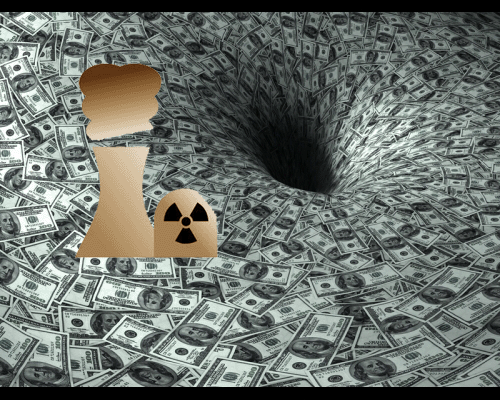 The nuclear cycle of destruction, Red Flag, James Plested, 12 July 2019 “……..Another downside to nuclear power is the cost and time involved in constructing new reactors. As Peter Farley of Engineers Australia wrote in RenewEconomy earlier this year, “The 2,200 MW Plant Vogtle [a new nuclear plant in the US] is costing US$25 billion plus financing costs, insurance and long term waste storage … For the full cost of US$30 billion, we could build 7,000 MW of wind, 7,000 MW of tracking solar, 10,000 MW of rooftop solar, 5,000 MW of pumped hydro and 5,000 MW of batteries”.
International financial advisory firm Lazard’s 2018 Levelized Cost of Energy Analysis found that nuclear power was significantly more expensive than gas, coal, or renewable energy sources like solar and wind. For new nuclear, it estimated the cost at US$112-189 per megawatt hour. The cost of power generation from coal was US$60-143. Wind and utility-scale solar were significantly cheaper, at US$29-56 and US$36-46 respectively.
The world’s 450 or so operative nuclear reactors produce only around 11 percent of the electricity supply. Any significant increase in this proportion would require a massive program of construction – on the order of 1,000 new plants over the next decade.
According to the most generous estimates, the cost of constructing a single new nuclear reactor is between US$5 and $10 billion (and the necessary decommissioning of the average reactor now costs an estimated US$500 million). So for the construction of 1,000, we would be looking at up to US$10 trillion. In addition, there is related infrastructure such as new uranium mines, enrichment and transportation facilities, waste storage facilities and so on. But if there are trillions of dollars available for nuclear, why not use that money to fund a global shift to a combination of wind, solar, tidal and other renewable sources that could much more cheaply and sustainably provide for the world’s energy needs? …… https://redflag.org.au/node/6835
July 12 Energy News — geoharvey

Opinion: ¶ “Why The Future Is Bright For 100% Clean Energy” • A city in Texas with oil derricks on its license plates. A Kansas town devastated by a tornado. An isolated Alaskan island, known for its huge bears. What do they have in common? All are in red states, yet their electricity is generated […]
Another coal unit breakdown in Victoria, with five thermal units now offline — RenewEconomy

Another coal unit trips off in Victoria, with more than 2,100MW of so-called “reliable baseload” out of action. The post Another coal unit breakdown in Victoria, with five thermal units now offline appeared first on RenewEconomy.
via Another coal unit breakdown in Victoria, with five thermal units now offline — RenewEconomy
Solar was biggest source of electricity in Germany in June — RenewEconomy

Solar was biggest supplier of electricity in month of June in Germany, as coal output plummets. The post Solar was biggest source of electricity in Germany in June appeared first on RenewEconomy.
via Solar was biggest source of electricity in Germany in June — RenewEconomy
Louisiana Hurricane Watch; Storm Surge Watch; Levees & Nuclear Power Station(s) At Risk — Mining Awareness +

Everyone should worry about this storm due to potentially weakened levees and nuclear power stations along the Mississippi river. Any levee failures will be the fault of the Trump Administration/MRC, and perhaps Trump himself, as surely as if they/he had blown up the levee, because they/he refused to open the Morganza Spillway. The final say […]
The unlikely and unwise process towards Australia getting nuclear weapons
 Nuclear weapons? Australia has no way to build them, even if we wanted to https://theconversation.com/nuclear-weapons-australia-has-no-way-to-build-them-even-if-we-wanted-to-120075 Associate Professor of Physics, UNSWJuly 10, 2019 In his latest book, strategist and defence analyst Hugh White has gone nuclear, triggering a debate about whether Australia should develop and maintain its own nuclear arsenal.But developing and sustaining modern nuclear weapons requires a certain combination of technologies and industries that Australia simply does not have. In fact, it may be safely estimated on the basis of approval and construction times for nuclear power reactors in other western countries that it would take some 20 years to establish such capabilities in the present legal and economic environment. Nuclear weapons? Australia has no way to build them, even if we wanted to https://theconversation.com/nuclear-weapons-australia-has-no-way-to-build-them-even-if-we-wanted-to-120075 Associate Professor of Physics, UNSWJuly 10, 2019 In his latest book, strategist and defence analyst Hugh White has gone nuclear, triggering a debate about whether Australia should develop and maintain its own nuclear arsenal.But developing and sustaining modern nuclear weapons requires a certain combination of technologies and industries that Australia simply does not have. In fact, it may be safely estimated on the basis of approval and construction times for nuclear power reactors in other western countries that it would take some 20 years to establish such capabilities in the present legal and economic environment.
Opting for nuclear weapons also fails to consider the global implications of Australia abandoning its almost 50-year stance against nuclear proliferation. The first step: nuclear power generationWhite argues quite rightly that China may eventually overtake the US in terms of its industrial production and military reach. Speculating that this could entail a strategic withdrawal of the US from the western Pacific, he suggests Australia might find itself without the American defence umbrella to deter Chinese influence, or worse. But Australia would struggle to replace its long and successful alliance with the US with a limited nuclear deterrence capability. Even ignoring the issues generally involved in adopting new defence capabilities – evident in the many problems hindering Australia’s efforts to replace its ageing submarine fleet – the idea is fanciful given our current stance on nuclear energy. Nuclear power reactors, uranium enrichment plants, missile technology and high-tech electronics manufacturing would all be essential to support truly independent efforts to develop a compact nuclear weapon that could be delivered by missile from a submarine and kept in a permanent state of readiness. Neither power reactors nor enrichment facilities exist in Australia today, despite some pioneering research in both areas in the past. Australia’s missile development and high-tech electronics sectors, meanwhile, are in catch-up mode or in their infancy due to years of economic reliance on mining, tourism and services. Advancing and establishing nuclear industries for the sole purpose of developing a nuclear weapons program would neither be practically nor economically viable. Political will for nuclear energy?The only way such industries could be developed realistically would be if Australia added nuclear power to its suite of power generation technologies. Of course, Australia has large uranium deposits and a well-established uranium mining and export industry. And there appears to be increasing public support for nuclear power. A recent survey found that 44% of Australians support nuclear power plants, up four points since the question was last asked in 2015. Other polls indicate support might even be higher. A well-developed nuclear power industry would eventually give Australia almost all the necessary technologies, personnel and materials to make and maintain a nuclear weapon. This includes, in particular, the ability to enrich uranium and breed plutonium. But herein lies the problem. Even if the public did eventually support a nuclear energy program, it remains unclear whether the necessary political will would be there. Legally, the Howard government banned domestic nuclear power plantsin the late 1990s – an act that would now need to be overturned by parliament. In 2006, the federal government commissioned an inquiry led by Ziggy Switkowski into the future feasibility of nuclear power generation in Australia. The final report found that nuclear energy would be 20-50% more expensive than coal without carbon pricing. It also said a nuclear power industry would take between 10 and 15 years to establish. Recently, Energy Minister Angus Taylor said the Morrison government was open to reversing the country’s nuclear energy ban, but only if there was a “clear business case” to do so. With the current widespread availability of cheaper, renewable energies in Australia, this makes the economics of nuclear power generation less convincing. Lastly, in order to ensure true self-reliance, a delivery option for a nuclear weapon would have to be developed without purchasing technologies from other countries, such as the US. This would be incredibly costly and difficult to do. When it comes to this sort of missile technology and high-tech electronics manufacturing, Australia is currently not leading in research and development. Australia’s long-time stance against nuclear weaponsEven though Australia is not in a position to contemplate nuclear weapons due to its technological and industrial limitations, there are moral arguments against pursuing such a goal that should be considered carefully. The country has been at the forefront of the international non-proliferation movement, ratifying both the UN Treaty on the Non-Proliferation of Nuclear Weapons in 1973 and the Nuclear Test Ban Treaty in 1998. A 2018 poll also showed that 78.9% of Australians supported joining the UN Treaty on the Prohibition of Nuclear Weapons, while only 7.7% were opposed. Australians should remind themselves that these treaties have greatly contributed to peace and security in the world. Abandoning such longstanding principles of its foreign policy, which are aimed at creating a better, more peaceful world, would be an implosion of Australian character of massive proportions. |
|
|
Union push to union trustees to formally exclude nuclear energy from industry super investments
ETU pushes union trustees to block nuclear AFR, 10 July 19 The Electrical Trades Union is leading a push for union trustees to formally commit to excluding nuclear energy from industry super investments in favour of bolstering renewables. ETU national secretary Allen Hicks will propose an anti-nuclear investment motion at the Australian Council of Trade Union’s national executive later this year and use the ACTU’s Super Trustees Forum to “build and leverage support among my union director colleagues on this”.
“I want to pass a motion committing union directors in the industry super sector to focus on backing investment in renewable tech,” he will tell the union’s national conference on Wednesday afternoon.
“To focus on backing that investment instead of propping up the misguided imaginings of those who long for an Australian nuclear sector.”
The motion follows the ETU’s attack last week on an energy paper released by industry fund peak body Industry Super Australia (ISA), chaired by former ACTU secretary Greg Combet…….
Mr Hicks will attack the paper as a “disgrace” in his speech and question industry funds diverting money to ISA to produce it.
“It’s a disgrace that this body – this body that unions created – could be used as part of a push to expose workers and their communities to the catastrophic dangers that nuclear power plants present,” the speech says.
He will advocate industry super funds commit to a “war-like mobilisation” to battle climate change and “become the ultimate weapon in Australia’s fight for a clean, renewable energy sector”.
“The retirement savings of Australian workers could be deployed to invest in smart, new, renewable technology – including battery tech – that could set us on the path to zero carbon emissions.”
The ETU’s anti-nuclear position is supported by the $50 billion building industry super fund Cbus, which includes the CFMEU on its board of trustees………
Mr Hicks will argue the economics around nuclear power don’t stack up due to the costs and time taken for construction.
“But even if they did, our union would oppose it,” he will say, arguing nuclear puts workers in unsafe conditions.
“No responsible Australian trade union … no organisation that claims to represent the interests of Australian workers … could possibly endorse putting Australians into that line of potential fire.”…..
Energy Super, whose board includes ETU representatives, stressed it was “focused on maximising members’ hard-earned retirement savings”.
“We have a transparent investment process which considers many factors including environmental, social and governance criteria to ensure the sustainability of the fund over the longer term,” chief executive Robyn Petrou said.
“We are increasing our investments in renewables, such as wind farms and solar energy.” https://www.afr.com/leadership/workplace/etu-pushes-union-trustees-to-block-nuclear-20190710-p525sj
A counterview to Hugh White’s book in favour of nuclear weapons for Australia
Australia, nuclear weapons and America’s umbrella business The Strategist , 9 Jul 2019, Rod Lyon Hugh White’s new book, How to defend Australia, has stirred up a hornet’s nest on the topic of potential nuclear proliferation. In one sense, that’s a surprise, since anyone who’s read the relevant chapter knows that it’s book-ended by carefully crafted paragraphs which state explicitly that White ‘neither predicts nor advocates’ Australia’s development of an indigenous nuclear arsenal.
But in between those paragraphs White explores the history of Australian interest in a national nuclear weapons program, underlines the dwindling credibility of US nuclear assurances to allies, canvasses a possible nuclear doctrine for Australia, and recommends a force structure—more submarines—suitable to what he sees as our new straitened strategic circumstances. If he’s not advocating a nuclear arsenal, why is he telling us so much about what it ought to look like?
Let’s start with the possibility of Australian nuclear proliferation up front. As I wrote recently for a chapter in After American primacy, there are five barriers to Australian proliferation: ideational, political, diplomatic, technological and strategic. Briefly, crossing the nuclear Rubicon would require:
- Australians to think differently about nuclear weapons—as direct contributors to our defence rather than as abstract contributors to global stability
- a bipartisan political consensus to support proliferation, during both development and deployment of a nuclear arsenal
- a shift in Australia’s diplomatic footprint, to build a case for our leaving the Non-Proliferation Treaty, and abrogating the Treaty of Rarotonga, while still being able to retail a coherent story of arms control and nuclear order
- serious investment in the technologies and skill-sets required to construct and deploy, safely and securely, both nuclear warheads and appropriate delivery vehicles
- and a strategy which gives meaning to our arsenal and an explanation of our thinking to our neighbours and our major ally.

New South Wales Deputy Premier John Barilaro sucked in by slick propaganda from “New Nuclear” lobby
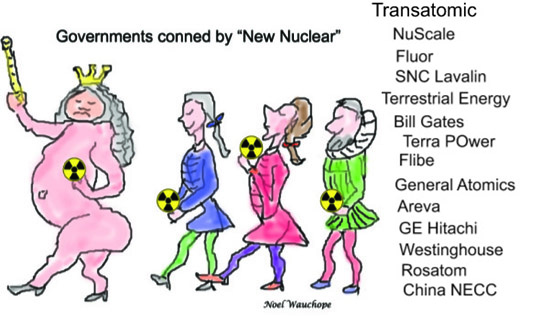
The NSW Deputy Premier has thrown his support behind the push for a Senate inquiry into the benefits of a nuclear power industry in Australia.
Nuclear energy is a controversial solution to Australia’s deepening energy crisis but it still remains illegal in Australia.
Queensland National Keith Pitt and Liberal Senator James McGrath have also backed a parliamentary inquiry into nuclear power.
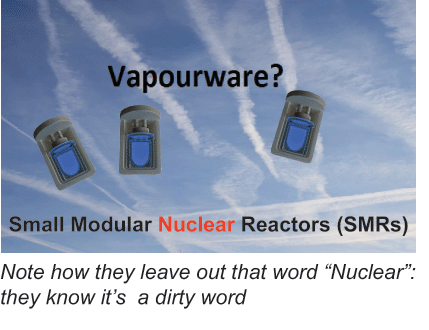 NSW Deputy Premier John Barilaro tells Merrick Watts Australia needs to welcome nuclear energy into the conversation.
“Chernobyl or Fukushima… that technology is your granddad’s technology.
“What is on the horizon, small modular reactors, gives us a chance to really look at this through a different lens.”
Nuclear recycling is expensive, dirty, and ultimately dangerous, AND STILL PRODUCES TOXIC RADIOACTIVE TRASH
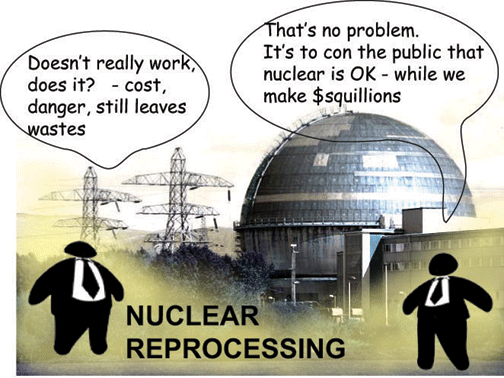 Recycle everything, America—except your nuclear
  waste https://thebulletin.org/2019/07/recycle-everything-america-except-your-nuclear-waste/ By Allison Macfarlane, Sharon Squassoni, July 8, 2019 Americans have come late to the game on responsible consumerism, but they are making up for lost time with a passionate obsession about waste. It’s no coincidence that Fox News, CNN, YouTube and USA Today have all reported that the deepest solo ocean dive found plastic waste seven miles below the surface, in the Mariana Trench.
Now that Americans are “woke” about waste in general, they may turn to the specific kind produced by the nuclear energy industry. Plans to revitalize US nuclear power, which is in dire economic straits, depend on the potential for new, “advanced” reactors to reduce and recycle the waste they produce. Unfortunately, as they “burn” some kinds of nuclear wastes, these plants will create other kinds that also require disposal. At the same time, these “advanced” reactors—many of which are actually reprises of past efforts—increase security and nuclear weapons proliferation risks and ultimately do nothing to break down the political and societal resistance to finding real solutions to nuclear waste disposal.
The current nuclear dream is really no different from previous ones of the last 70 years: the next generation of reactors, nuclear power advocates insist, will be safer, cheaper, more reliable, less prone to produce nuclear bomb-making material, and more versatile (producing electricity, heat, and perhaps hydrogen), without creating 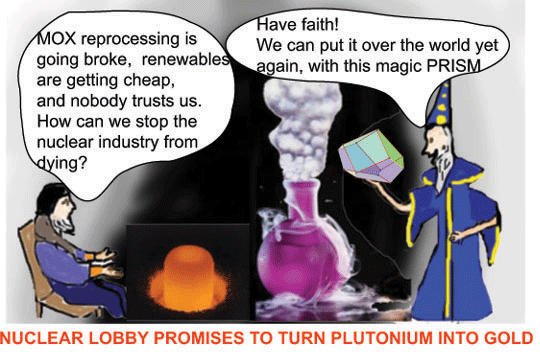 the wastes that have proved almost impossible to deal with in the United States. The Nuclear Energy Innovation and Modernization Act specifically describes the advanced reactors it seeks to support as having all those positive characteristics. This newest burst of enthusiasm for advanced reactors is, however, largely fueled by the idea that they will burn some of their long-lived radioisotopes, thereby becoming nuclear incinerators for some of their own waste.
Many of these “advanced” reactors are actually repackaged designs from 70 years ago. If the United States, France, the UK, Germany, Japan, Russia, and others could not make these reactors economically viable power producers in that time, despite spending more than $60 billion, what is different now? Moreover, all of the “advanced” designs under discussion now are simply “PowerPoint” reactors: They have not been built at scale, and, as a result, we don’t really know all the waste streams that they will produce.
It’s tempting to believe that having new nuclear power plants that serve, to some degree, as nuclear garbage disposals means there is no need for a nuclear garbage dump, but this isn’t really the case. Even in an optimistic assessment, these new plants will still produce significant amounts of high-level, long-lived waste. What’s more, new fuel forms used in some of these advanced reactors could pose waste disposal challenges not seen to date.
Some of these new reactors would use molten salt-based fuels that, when exposed to water, form highly corrosive hydrofluoric acid. Therefore, reprocessing (or some form of “conditioning”) the waste will likely be required for safety reasons before disposal. Sodium-cooled fast reactors—a “new” technology proposed to be used in some advanced reactors, including the Bill Gates-funded TerraPower reactors—face their own disposal challenges. These include dealing with the metallic uranium fuel which is pyrophoric (that is, prone to spontaneous combustion) and would need to be reprocessed into a safer form for disposal.
Unconventional reactors may reduce the level of some nuclear isotopes in the spent fuel they produce, but that won’t change what really drives requirements for our future nuclear waste repository: the heat production of spent fuel and amount of long-lived radionuclides in the waste. To put it another way, the new reactors will still need a waste repository, and it will likely need to be just as large as a repository for the waste produced by the current crop of conventional reactors.
Recycling and minimizing—even eliminating—the waste streams that many industries produce is responsible and prudent behavior. But in the context of nuclear energy, recycling is expensive, dirty, and ultimately dangerous. Reprocessing spent nuclear fuel—which some advanced reactor designs require for safety reasons—actually produces fissile material that could be used to power nuclear weapons. This is precisely why the United States has avoided the reprocessing of spent nuclear fuel for the last four decades, despite having the world’s largest number of commercial nuclear power plants.
Continuing research on how to deal with nuclear waste is a great idea. But building expensive prototypes of reactors whose fuel requires reprocessing, on the belief that such reactors will solve the nuclear waste problem in America, is misguided. At the same time, discounting the notion that a US move into reprocessing might spur other countries to develop this same technology—a technology they could secretly exploit to produce nuclear weapons—is shortsighted and damaging to US national and world security.
To 9 July Nuclear and Climate News Australia
 The TV mini-series “Chernobyl” has reminded the world of something that the insurance industry fully understands: even if the probability of a nuclear accident is very small, the consequences of a nuclear accident are very big.
Two current events highlight the risks of nuclear disaster:
14 sailors died in a heroic effort to avert a planetary catastrophe, in a fire accident on a Russian nuclear submarine in the Barents Sea.
Earthquakes in Southern California raise anxieties about the safety of Diablo Canyon Nuclear Power Station. The Quake That Could Make Los Angeles a Radioactive Dead Zone. What are the risks at closed San Onofre during a big earthquake?
AUSTRALIA
NUCLEAR.
- Australia would be wise not to mindlessly follow USA into war against Iran.
- Is Napandee, (Jeff Baldock’s property) near Kimba the govt’s chosen site for expanded nuclear waste dump? Have the Nukunu Aboriginal people been consulted about proposed Wallerberdina nuclear waste suppository?
- New South Wales National Party formally adopts pro nuclear policy, Australian unions reject Industry Super’s backing of the nuclear industry . News Corpse comes out with a weird pro nuclear ramble.
- Why Australia should absolutely not contemplate getting nuclear weapons. Not Impressed with Professor Hugh White’s pro nuclear weapons stance.
- Former Environment Minister rejected department advice and approved uranium mine day before election called,
- Uranium contamination in groundwater in an Adelaide suburb.
CLIMATE. Australia now emitting record greenhouse gases.
RENEWABLE ENERGY Victoria rooftop solar rebate in hot demand, with July quota filled in just days. Victorian wind farm to power massive new recycling plant.
The raid on journalist’s home by armed federal police.
INTERNATIONAL
Far from stopping climate change – nuclear reactors are being stopped by climate change.
Special UN meeting to discuss Iran: Russia, China, France, Britain and Germany try to keep nuclear deal.
United Nations warns that climate crisis disasters are happening at the rate of one a week and work is urgently needed to prepare developing countries for the profound impacts. Rich countries are not immune.
Renewable energy racing ahead, close to beating nuclear power.
Climate Change Authority prepares harsh assessment of Morrison’s policy failure — RenewEconomy

Climate Change Authority to issue new advice to government on climate policies, citing falling technology costs and rising emissions as reasons to do something. The post Climate Change Authority prepares harsh assessment of Morrison’s policy failure appeared first on RenewEconomy.
via Climate Change Authority prepares harsh assessment of Morrison’s policy failure — RenewEconomy
The unwisdom of Australia mindlessly following USA into a war against Iran
 We must think very carefully before committing to war in the Gulf, The Age, By Hossein Esmaeili, July 8, 2019 Conflict between the United States and Iran is deepening and the two states are marching towards war. The Persian Gulf, where a third of the world’s natural gas and a fifth of the world’s oil is sourced, may soon see another large scale and probably long-lasting international conflict………
Australia has no legal obligations under the ANZUS Treaty, or any other international agreement, to join the US in another possibly long, chaotic and devastating regional conflict. Indeed, under the Charter of the United Nations, to which both Australia and the US are parties, the use of force is prohibited unless authorised by the Security Council of the United Nations.
the European Union is backing measures, provided by France, United Kingdom and Germany, known as Instruments In Support of Trade Exchange (INSTEX), to facilitate trade between the EU and Iran to partially get around the US sanctions, in order to save the 2015 nuclear deal, to maintain dialogue with Iran and to prevent an international military crisis.
Australia would be much wiser to join the EU’s INSTEX and engage in dialogue with Iran……..
Should Morrison decide to enter into a conflict in one of the most volatile regions of the world, he will not have the decision-making power to end it. He would do well not to drive Australia into such a war, instead, given Australia’s international reputation, he should help European countries, the world community and the United Nations to avoid a useless armed conflict, which will not benefit any country.
Hossein Esmaeili is an associate professor of international law at Flinders University. https://www.theage.com.au/world/middle-east/we-must-think-very-carefully-before-committing-to-war-in-the-gulf-20190708-p52566.html
1 This month.

Australians deserve the truth
about
AUKUS – https://aukuspublicinquiry.com/
Australians deserve the truth
about AUKUS

PETITION – To: Prime Minister Anthony Albanese and the Australian Labor Government

of the week – Australians for War Powers Reform (AWPR)
To see nuclear-related stories in greater depth and intensity
 Antinuclear