Escalating collapse of global insect populations
The Great Insect Dying: How to save insects and ourselves, MONGABAY, BY JEREMY HANCE 13 JUNE 2019
- The entomologists interviewed for this Mongabay series agreed on three major causes for the ongoing and escalating collapse of global insect populations: habitat loss (especially due to agribusiness expansion), climate change and pesticide use. Some added a fourth cause: human overpopulation.
- Solutions to these problems exist, most agreed, but political commitment, major institutional funding and a large-scale vision are lacking. To combat habitat loss, researchers urge preservation of biodiversity hotspots such as primary rainforest, regeneration of damaged ecosystems, and nature-friendly agriculture.
- Combatting climate change, scientists agree, requires deep carbon emission cuts along with the establishment of secure, very large conserved areas and corridors encompassing a wide variety of temperate and tropical ecosystems, sometimes designed with preserving specific insect populations in mind.
- Pesticide use solutions include bans of some toxins and pesticide seed coatings, the education of farmers by scientists rather than by pesticide companies, and importantly, a rethinking of agribusiness practices. The Netherlands’ Delta Plan for Biodiversity Recovery includes some of these elements……….. https://news.mongabay.com/2019/06/the-great-insect-dying-how-to-save-insects-and-ourselves/
“Chernobyl” TV series gets high rating, highly viewed in Russia and Kazakhstan
BBC 12th June 2019 , Hours after the world’s worst nuclear accident, engineer Oleksiy Breus
entered the control room of the No. 4 reactor at the Chernobyl nuclear
power plant in Ukraine. A member of staff at the plant from 1982, he became
a witness to the immediate aftermath on the morning of 26 April 1986.
The story of the reactor’s catastrophic explosion, as told in an HBO/Sky
miniseries, has received the highest ever score for a TV show on the film
website IMDB. Russians and Ukrainians have watched it via the internet, and
it has had a favourable rating on Russian film site Kinopoisk. Mr Breus
worked with many of the individuals portrayed and has given his verdict of
the series. https://www.bbc.co.uk/news/world-europe-48580177
Adani mining project: Court asks Australian govt to look into public concerns
Adani mining project: Court asks Australian govt to look into public concerns https://www.nationalheraldindia.com/international/adani-mining-project-court-asks-australian-govt-to-look-into-public-concerns 14 June 19
A local court in Australia has asked Federal Govt to listen to public grievances on Adani’s North Galilee Water Scheme. It spells fresh trouble for Adanis and their billion dollar coal mining project
In what is being interpreted as fresh trouble for the Adanis in Australia, who are on way to set up USD 16 billion dollar coal mining project in the Queensland state, a local court has asked the Federal Government to listen to public grievances on Adani’s North Galilee Water Scheme.
The Australian Conservation Foundation (ACF), which had filed a case the Federal Government has said that the latter has conceded public grievances on the Adani’s water scheme were ignored.
ACF said, “This is a massive outcome for the broader community, who raised grave concerns about the effect this project would have on Australia’s precious water resources”, adding, “In conceding the case, the Federal Environment Minister has admitted the Federal Government failed to consider all of the thousands of valid public submissions about if and how Adani’s project should be assessed, in direct breach of the Environment Protection and Biodiversity Conservation Act 1999.”
According to ACF, “Those people were denied their right to a voice in this process. This win will ensure their voice is heard. Now the Government will need to go back to the drawing board and open up assessment of the project for public comment again. It’s a big moment in the Adani story, and it couldn’t have happened without the bold vision of ACF in launching the case, backed by the hard work and expertise of the legal team.”
It continued, “This win is a humiliating outcome for the Federal Government over its assessment of Adani’s North Galilee Water Scheme – the plan to pump up to 12.5 billion litres of water a year from the Suttor River to the company’s Carmichael mine site. Thousands of Australians made valid public comments on Adani’s North Galilee Water Scheme referral, many concerned about the project’s impact on our precious water resources during a time of extreme drought.”
According to ACF, “The Federal Environment Minister has now admitted her delegate did not consider these comments, as required by law. In fact, she has admitted that her Department lost an unknown number of public comments made over the controversial project. This botched process points to a worrying lack of oversight in core assessment procedures designed to protect Australia’s precious water resources.”
It insisted in a statement, “The Federal Environment Minister did not concede our client’s initial argument in the case, which was that the ‘water trigger’ should have applied to the Scheme. The ‘water trigger’ is a measure that ensures any action which has a significant impact on water resources and involves a large coal mining development requires a more rigorous assessment under the EPBC Act.”
It added, “The community is still no closer to having an answer on why the ‘water trigger’ should not have applied to the North Galilee Water Scheme – a project which will take billions of litres of water a year from Central Queensland to service a coal mine. The Australian people have a right to know the impact big projects like this have on their precious water resources.”
Pick out the anti-environment statements in Sussan Ley’s spiel!
 Sussan Ley: I’ll be an environmentalist as minister, Guardian 14 June 19,
 The new environment minister, Sussan Ley, has declared herself an “environmentalist”, saying she is prepared to fight for the environment around the cabinet table even when colleagues disagree with her.
Ley, who welcomed the Queensland government’s decision on Thursday to give the green light to the Adani coalmine, told Guardian Australia she wanted to see more action on recycling, threatened species and biodiversity protection, and a greater focus on individual action to achieve a better environment.
But in the lead-up to a 10-yearly review of the country’s Environment Protection and Biodiversity Conservation Act, Ley has also flagged that she wants approval times for major projects cut, has left the door open to lifting the country’s ban on nuclear power, and has questioned whether land clearing is responsible for species loss.
The former health minister, who was returned to cabinet by Scott Morrison after she quit over an expenses scandal in 2017, said she saw the role as an advocacy position……
Ley welcomed the review of the EPBC Act, due in the second half of this year, saying the country’s current environmental laws were “unnecessarily arduous, complex and not productive”.
….. Along with the approvals process, a clutch of Coalition MPs have indicated they will use the EPBC Act review to have Australia’s nuclear ban removed, a push that is being backed by the Minerals Council of Australia and industry groups.
Ley said the question of nuclear power in Australia was one “where you have to listen to all of the voices” but said she was open to the review considering a removal of the ban.
“To be honest, I am not strongly for or against nuclear power. I think there are good arguments for it, and there are good arguments against it.
“From the perspective of the environment it is important that it is considered, so I am not going to lead that discussion at any point of the review process. Plenty of other people will.”
Ley also made clear her views on the threat to biodiversity after a UN report warned that a million species across the world faced extinction. The minister said she was “concerned” about the problem, but questioned whether land clearing was to blame.
The Australian Conservation Foundation has estimated that there has been a loss of more than 7.4m hectares of threatened species habitat since the EPBC Act was introduced in 1999, with Australia singled out for its high rates of deforestation.
“Biodiversity and … our level of loss of species is of great concern to me,” she said.
“I really believe that the biggest threat to our threatened species is probably feral cats. Loss of habitat isn’t just land clearing, if it is land clearing at all, loss of habitat is often the wrong type of vegetation and that is often introduced weeds……
I do want my approach to the portfolio to be about what you can do, whether it be reducing plastic waste, whether it be about joining a local volunteer group, whether it be about agitating for better weeds and pest management in national parks that are near you, where you live – these are practical things that people can do and they do make a difference.”
On climate change, Ley said she was “interested” in the emissions reduction task of government which is included with the energy portfolio, under Angus Taylor, rather than environment, and said she believed the Coalition’s climate solutions fund is “where we need to be”.
“I am not going to discuss the emissions policy, that is Angus Taylor’s to discuss,”……..
Having argued during the campaign for the compliance and operational parts of the Murray-Darling Basin Authority to be split, Ley also said she would use her new role to push for changes being demanded by irrigators……..perhaps we need to work harder on that balance between environmental water and agriculture.” https://www.theguardian.com/australia-news/2019/jun/14/sussan-ley-ill-be-an-environmentalist-as-minister
Anti-Adani protests continue in Canberra
Former Australian Greens leader Bob Brown is expected to join the peaceful demonstration to “highlight the Adani company’s appalling record of environmental destruction and corruption overseas”.
June 14 Energy News — geoharvey

Science and Technology: ¶ “Why Tesla’s Solar Roof Is A Bargain, 53% Of The Price Of A Roof + Electricity” • I priced a new roof for my house, so the numbers are not hypothetical but a comparison of bids and realistic projections of two scenarios over 25 years. The Tesla Solar Roof is 52.7% […]
Why storage is key to NSW government plans, in race to clean energy — RenewEconomy

NSW government to use money collected through consumer electricity bills to help bring new, large-scale generation and storage capacity into its changing grid. The post Why storage is key to NSW government plans, in race to clean energy appeared first on RenewEconomy.
via Why storage is key to NSW government plans, in race to clean energy — RenewEconomy
An easy-breezy idea for the Minister for Emissions Reduction — RenewEconomy

If Angus Taylor wants to cut emissions, boost regional economies and build a stable electricity grid, then the answer to all three is blowing in the wind. The post An easy-breezy idea for the Minister for Emissions Reduction appeared first on RenewEconomy.
via An easy-breezy idea for the Minister for Emissions Reduction — RenewEconomy
Goodbye energy consumers, hello energy citizens — RenewEconomy

Power is literally shifting to the people, and we have only just started to conceptualise what that might mean for consumers as energy citizens. The post Goodbye energy consumers, hello energy citizens appeared first on RenewEconomy.
via Goodbye energy consumers, hello energy citizens — RenewEconomy
Record wind output in South Australia, thanks to “butterfly” effect of failed coal plant — RenewEconomy

Wind generation hits record levels in South Australia as wind farms enjoy a rare “butterfly effect” from the failure of a unit at Loy Yang A’s brown coal generator. The post Record wind output in South Australia, thanks to “butterfly” effect of failed coal plant appeared first on RenewEconomy.
Store that thought: Batteries enter the energy mainstream — RenewEconomy

Battery storage is entering the mainstream: in households and streetscapes, and with renewables and as “virtual” transmission lines. The post Store that thought: Batteries enter the energy mainstream appeared first on RenewEconomy.
via Store that thought: Batteries enter the energy mainstream — RenewEconomy
Nuclear power exits Australia’s energy debate, enters culture wars
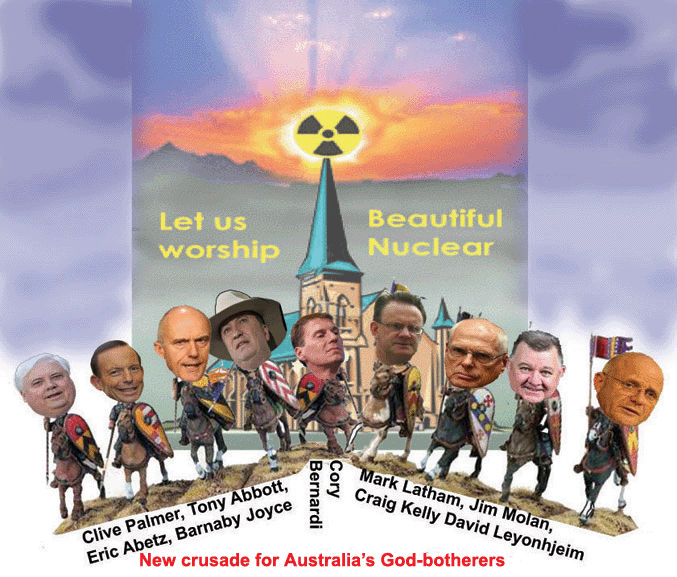
Nuclear power exits Australia’s energy debate, enters culture wars https://reneweconomy.com.au/nuclear-power-exits-australias-energy-debate-enters-culture-wars-47702/, 13 June 2019 What do these politicians and ex-politicians have in common: Clive Palmer, Tony Abbott, Cory Bernardi, Barnaby Joyce, Mark Latham, Jim Molan, Craig Kelly, Eric Abetz, and David Leyonhjelm?
Queensland clear way for Adani to begin work on Galilee basin “carbon bomb” — RenewEconomy

Queensland Government grants Adani approval for groundwater management plans, as project moves clears last major hurdle before construction commences. The post Queensland clear way for Adani to begin work on Galilee basin “carbon bomb” appeared first on RenewEconomy.
via Queensland clear way for Adani to begin work on Galilee basin “carbon bomb” — RenewEconomy
Energy Minister Angus Taylor contemplates reversing Australia’s nuclear energy ban
 Angus Taylor won’t rule out reversing nuclear energy ban if business case stacks up Angus Taylor won’t rule out reversing nuclear energy ban if business case stacks up
Energy minister dodges questions about how Australia will meet its Paris emission reduction targets, Guardian, Amy Remeikis Angus Taylor has not ruled out reversing the nuclear energy ban and remains confident Australia will meet its Paris emission reduction targetsThe energy minister, Angus Taylor, has not ruled out the Morrison government reversing the nuclear energy ban, if a “clear business case” showed the economics were sound as he dodged questions about how Australia would meet its Paris agreement targets. The first energy battle of the new parliament comes from within the party room, with a group of Queensland MPs, emboldened by that state’s strong showing for the Coalition in the May election, leading a push to have nuclear energy reconsidered as part of Australia’s power plan. While a peak lobby group representing the sector says a carbon price would be needed for nuclear to be an economically viable alternative, Australia’s law against nuclear power is another impediment. But Taylor says the government would consider nuclear power if the economic case stacked up. I think, again, the prime minister has made many questions on this in the lead up to the election … right now it is illegal to build a nuclear power station and as he has said when there is a very clear business case which shows the economics of this can work, we are more than willing to consider it,” he said. Pushed on what that business case would look like, Taylor said he would not give “a lecture on business cases”. I mean it is pretty straight forward, I mean the prime minister answered this question on a number of occasions before the election, there needs to be a clear business case,” he said, before being asked directly if the government would change the law in the event a case presented itself. “As I say, let’s not put the cart before the horse, if there is a clear business case there is a clear business case,” he said. The nuclear question is not the only quandary facing the Morrison government in the energy space, as discussions over the rules for the Paris emissions reduction target continue within the international community. The main debate centres around whether countries which exceeded their Kyoto targets can use the excess abatement as credit towards their Paris targets. In Australia, that amounts to about 367 megatonnes, which Taylor has previously described as “relatively small” in terms of the nation’s carbon budget, but “apocalyptic” to the economy if not used. Repeatedly asked what the government’s plan was in the event it was decided carryover credits could not be used, Taylor did not have an answer and instead reiterated that Australia had met its past targets…….. https://www.theguardian.com/australia-news/2019/jun/12/angus-taylor-wont-rule-out-reversing-nuclear-energy-ban-if-business-case-stacks-up |
|
Nearly a billion people facing high exposure to climate change effects, Global Peace Index finds
 Nearly a billion people facing high exposure to climate change effects, Global Peace Index finds, ABC, Nearly a billion people facing high exposure to climate change effects, Global Peace Index finds, ABC,
Nearly a billion people are facing climate change hazards globally, with the Asia-Pacific region housing twice as many people living in areas with high exposure than all other regions combined, a new report has revealed. Key points:
In the annual Global Peace Index released on Wednesday, the Institute for Economics and Peace (IEP) said an estimated 971 million people — including more than 2.4 million Australians — live in areas with high or very high exposure to climate hazards including cyclones, floods, bushfires, desertification and rising sea levels. The top nine countries facing the highest risk of climate hazards were all Asian nations with the Philippines topping the list, followed by Japan, Bangladesh, Myanmar and China. IEP founder and executive chairman Steve Killelea told the ABC that many of the countries in the Asia-Pacific region also have weaker coping capacities for natural disasters.
In Australia, the main risks come from hurricanes and cyclones in the north, rising sea levels in the south and east, as well as drought and desertification which is already affecting thousands of farmers, he said. Climate hazards exacerbate conflict and migrationThe report — which ranks 163 countries by measuring internal safety and security, militarisation and ongoing conflict — included climate change risks for the first time this year to evaluate links between climate hazards and violence. It found climate pressures can adversely impact resource availability and affect population dynamics, which can impact socioeconomic and political stability. ……. https://www.abc.net.au/news/2019-06-12/climate-change-hazards-global-peace-index-report/11198144 |
|
1 This month.

Australians deserve the truth
about
AUKUS – https://aukuspublicinquiry.com/
Australians deserve the truth
about AUKUS


PETITION – To: Prime Minister Anthony Albanese and the Australian Labor Government

of the week – Australians for War Powers Reform (AWPR)
To see nuclear-related stories in greater depth and intensity
 Antinuclear