The extreme weather events of climate change rule out nuclear power as a solution
|
Nuclear power is not the answer in a time of climate change, https://aeon.co/ideas/nuclear-power-is-not-the-answer-in-a-time-of-climate-change Heidi Hutner, Erica Cirino-November 2018, In the Woolsey Fire scorched nearly 100,000 acres of Los Angeles and Ventura counties, destroying forests, fields and more than 1,500 structures, and forcing the evacuation of nearly 300,000 people over 14 days. It burned so viciously that it seared a scar into the land that’s visible from space. Investigators determined that the Woolsey Fire began at the Santa Susana Field Laboratory, a nuclear research property contaminated by a partial meltdown in 1959 of its failed Sodium Reactor Experiment, as well as rocket tests and regular releases of radiation.
The State of California’s Department of Toxic Substances Control (DTSC) reports that its air, ash and soil tests conducted on the property after the fire show no release of radiation beyond baseline for the contaminated site. But the DTSC report lacks sufficient information, according to the Bulletin of Atomic Scientists. It includes ‘few actual measurements’ of the smoke from the fire, and the data raises alarms. Research on Chernobyl in Ukraine following wildfires in 2015 shows clear release of radiation from the old nuclear power plant, calling into question the quality of DTSC’s tests. What’s more, scientists such as Nikolaos Evangeliou, who studies radiation releases from wildfires at the Norwegian Institute for Air Research, point out that the same hot, dry and windy conditions exacerbating the Woolsey Fire (all related to human-caused global warming) are a precursor to future climate-related radioactive releases.
With our climate-impacted world now highly prone to fires, extreme storms and sea-level rise, nuclear energy is touted as a possible replacement for the burning of fossil fuels for energy – the leading cause of climate change. Nuclear power can demonstrably reduce carbon dioxide emissions. Yet scientific evidence and recent catastrophes call into question whether nuclear power could function safely in our warming world. Wild weather, fires, rising sea levels, earthquakes and warming water temperatures all increase the risk of nuclear accidents, while the lack of safe, long-term storage for radioactive waste remains a persistent danger.
 |
Chernobyl: horrifying, masterly television that sears on to your brain (on Foxtel Showcase 12 June) ne 8.30
(Foxtel Showcase 12 June 8.30 pm and 10.30 pm)
This breathtaking series throws us right into the hellish chaos of the nuclear disaster – and its terrors are unflinching and unforgettable, Guardian, Rebecca Nicholson, 29 May 2019 After three of its five episodes aired, the miniseries Chernobyl found its way to the top of IMDB’s top 250 TV shows in history list. While the fan-voted chart might seem hyperbolic, given that the drama had only just crossed the halfway point, it is not undeserving of the honour. Chernobyl is masterful television, as stunning as it is gripping, and it is relentless in its awful tension, refusing to let go even for a second. That old ‘don’t spoil the ending’ joke about Titanic will inevitably be rebooted here, but it is confident enough to withstand any familiarity with the story.
Australian companies, later, governments, may face legal action over climate issues
  Brace for impact – climate change litigation is fast approaching https://www.canberratimes.com.au/story/6184421/brace-for-impact-climate-change-litigation-is-fast-approaching/?cs=14246, Arthur Marusevich , 30 May,19 Brace for impact – climate change litigation is fast approaching https://www.canberratimes.com.au/story/6184421/brace-for-impact-climate-change-litigation-is-fast-approaching/?cs=14246, Arthur Marusevich , 30 May,19
Since the late 1990s, Australian politics on climate change has been divisive. Although Australia signed the Kyoto Protocol in 1998, it did not ratify it until 2007. Then, in 2011, the Clean Energy Act purporting to reduce greenhouse emissions was passed, only to be repealed in 2014. In 2016, Australia ratified the Paris Agreement and the Doha Amendment to the Kyoto Protocol; however, any serious action on climate change remains to be seen.
At the same time, some states and territories also have emissions reduction targets. The uncoordinated approach is a problem for at least two important reasons. Second, there is a rising wave of climate change-related litigation globally which is headed for Australia. Climate change litigation 2.0 (targeting companies) and climate change litigation 3.0 (targeting governments) will sink Australia, unless drastic measures are implemented.
Under the current legal regime, company directors may only be liable if found to be in breach of their duty of care or for failing to address a foreseeable risk. However, guidance from case law suggests that it is difficult to establish that the actions or omissions of a particular entity or director caused or contributed harm to be suffered by another. With the arrival of climate change litigation 2.0, this will all change. For one, litigation 2.0 will force companies to assess and report on the risks of climate change and potentially set out plans for mitigating those risks. The recent tide of comments from the Australian Securities and Investments Commission, the Australian Prudential Regulatory Authority and the Reserve Bank of Australia are a testament to this. Companies and their directors could soon face liability (including personal liability) if they fail to assess and address risks relating to climate change. Investors, shareholders and even communities will be able to recover losses and seek damages from companies and their directors, auditors and advisors, for failing to assess and mitigate risks. As major climate change attribution studies emerge to assist in tracing particular weather events with greenhouse gasses, causation will be easier to establish. It is likely that in the future, courts will rely on such studies to conclude that a particular entity has contributed, at least in some proportion, to a particular harm. It would be interesting to see how companies and directors brace for impact as climate change litigation 2.0 approaches. Although unprecedented and unheard of in Australia, climate change litigation 3.0 will be the next phase. It will allow Australians to bring action against the government for failing to mitigate risks. Claims of this nature around the world are already proving to be quite successful. The Urgenda litigation in the Netherlands is the leading example. In that case, a Dutch NGO argued that the Netherlands Government had breached its duty of care to the Dutch people by failing to mitigate the risks of climate change and reducing greenhouse gases. The remedy ordered by the court was that the Netherlands Government reduce emissions by at least 25 per cent by the end of 2020. Similarly, the Juliana case brought against the US government argued that current policies fail to satisfy their obligations to hold certain essential resources on trust for all US citizens. The case is currently awaiting a determination as to whether it will go to trial. We can only ignore it for so long – in the coming years, we are destined to see a rise in climate change litigation in Australia. While this may be welcome news for practitioners, it is not so much for companies and governments, who need to re-examine their approach to assessing and mitigating climate change risks now. If not, litigation 2.0 and 3.0 will do it for them.
|
|
COURT STATEMENT: WANGAN & JAGALINGOU COUNCIL – on the Adani coal project and Aboriginal rights
|
Read at WandJ source: www.facebook.com/WanganandJagalingou/posts/2744817738866719 “We are at the Federal Court again because we are driven by a need for justice. Whether our appeal against the Adani ILUA delivers that justice remains with the members of the full bench. We are using the means available to us to challenge the authority that is being exercised over our lives and country by Governments, corporations like Adani, and those who take the native title regime as the upper limit of our rights or use it to their own advantage. But there are aspects of the native title system that are not just, and not in accord with the UN Declaration on the Rights of Indigenous Peoples. We have found deep flaws in the native title regime. Ours is an important case. It is an important part of legal accountability placed upon the powerful interests in society and the economy. It is also about more than our own circumstances – it’s about all Aboriginal people who are denied the right to say no to mining, because there is no veto and we lose any compensation if we don’t agree. That element of the law is coercive. Native title is meant to protect us in line with international standards for the protection of universal human rights and fundamental freedoms. It is not about the skirmishes of majorities versus minorities of W&J people, or the wider community. Our laws and customs don’t work that way. Our land rights are not derived from voting. We are deeply concerned by our experience of misconduct, abuse of process and stacking a meeting to obtain a contract that signs away our rights in the land without our free, prior and informed consent. Much will be said about the technical and legal arguments. Our lawyers will do their best to win those points. We simply appeal for honesty and integrity. For recognition of the absolute right to free prior informed consent, which on any fair measure is not available to us. And right now, the threat to our rights and country couldn’t be higher. We are on alert as the Queensland Government buckles under political pressure to deliver approvals to Adani. That means our lands and waters, our culture and law, could be under assault within weeks. We are wary the Government will now expedite land tenure arrangements for Adani at our expense, before the conclusion of the court process. All along, the native title system has been allowed to play to sectional interests in the Aboriginal community. Only those putting their hands up for mining deals are favoured and promoted, but when we assert our right to say no to the opening up of the Galilee Basin – our traditional lands – we are obstructed at every turn. We have no option but to stand up for our rights. We will never accept anything less than full recognition. And we are compelled to defend and protect our country and heritage, and the right to practice our laws and customs. We will continue to look at all legal options available to us to gain full recognition of our rights.” Read at WandJ source: www.facebook.com/WanganandJagalingou/posts/2744817738866719 |
|
The short term and then the long term health effects of Chernobyl nuclear disaster
it is estimated that 270,000 people in the Ukraine, Russia and Belarus who wouldn’t have otherwise developed cancers did develop these illnesses.
 How Did Radiation Affect the ‘Liquidators’ of the Chernobyl Nuclear Meltdown? https://www.livescience.com/65563-chernobyl-radiation-effects-body.html How Did Radiation Affect the ‘Liquidators’ of the Chernobyl Nuclear Meltdown? https://www.livescience.com/65563-chernobyl-radiation-effects-body.html
These liquidators, who worked between 1987 and 1990, were exposed to high levels of radiation, on average around 120 millisievert (mSv), according to the World Health Organization. That’s over a thousand times more powerful than a typical chest X-ray, which delivers 0.1 mSv of radiation. And some of the very first responders were exposed to levels astronomically higher than that. So, what happens to the human body when exposed to such high levels of radiation? [5 Weird Things You Didn’t Know About Chernobyl] It’s like walking into a giant, powerful X-ray machine shooting radiation everywhere, said Dr. Lewis Nelson, chairman of emergency medicine at Rutgers New Jersey Medical School. Except, in this case, most of the radiation consisted of an even more damaging type of radiation than X-rays, called gamma-rays. This radiation, as it passes through the body, is ionizing. This means that it removes electrons from atoms in the body’s molecules, breaking chemical bonds and damaging tissues. Very high levels of ionizing radiation cause “radiation sickness.” At Chernobyl, 134 liquidators quickly developed radiation sickness, and 28 of them died from it. These people were exposed to radiation levels as high as 8,000 to 16,000 mSv, or the equivalent of 80,000 to 160,000 chest X-rays, according to the World Health Organization. Radiation sickness mostly manifests in the gastrointestinal tract and the bone marrow, Nelson said. Those areas have rapidly dividing cells, which means that instead of being tightly coiled and a little more protected, the DNA is unraveled so that it can be copied. That makes it more susceptible to the radiation (this is also why radiation therapy works to target cancer cells, which also rapidly divide). Within a couple of hours of the exposure, people with radiation sickness develop symptoms such as diarrhea and vomiting, Nelson said. When cells cannot properly divide, the mucosa or tissue lining of the GI tract also break downs, releasing cells and the bacteria that live in the gut (including in the stool) into the bloodstream. This would make even a healthy person sick, Nelson said. But because the radiation is also stopping the bone marrow from producing infection-fighting white blood cells, the body can’t fight those infections. People who have radiation sickness therefore have a weakened immune systemand frequently die of blood poisoning, or sepsis, within a couple of days, he said. High levels of radiation can also cause burns and blisters on the skin, which show up minutes to a few hours after the exposure and look just like a sunburn, Nelson said. While the GI-tract symptoms and burns happen almost immediately to a couple of hours after exposure to the radiation, the bone marrow survives for a couple of days. This means there is a latency period, when the person might even seem to improve, before showing symptoms of sepsis. The people who survived radiation sickness from Chernobyl took years to recover, and many of them developed cataracts because the radiation damaged the eye lenses, according to the World Health Organization. Lower exposuresBut much of the health focus around Chernobyl survivors has focused on the long-term consequences of the radiation exposure in these areas. The main consequence, for them, is an elevated risk of cancer. “But remember, the cancer risk is something you see 10 years down the road, so you have to live for 10 more years in order to see [that],” Nelson said. So the cancer risk is generally more of a concern for those who survived Chernobyl but were exposed to lower levels of radiation. The data on this risk is murky, with very approximate numbers, but it is estimated that 270,000 people in the Ukraine, Russia and Belarus who wouldn’t have otherwise developed cancers did develop these illnesses. This mainly manifested as thyroid cancer, directly caused by radioactive particles of iodine-131 released by the explosion. The thyroid needs iodine in order to produce hormones that regulate our metabolism. But if it doesn’t have enough of the healthy, nonradioactive iodine found in many foods, it absorbs the radioactive iodine, and this can eventually lead to thyroid cancer. This is why in the HBO series “Chernobyl,” people take iodine pills; filling those stores of iodine in the thyroid prevents it from absorbing the radioactive iodine. These radioactive particles, which also include others such as cesium-137 enter the body through contact with the skin or through the mouth and nose. In Chernobyl, these particles were thrown into the air, carried by winds and later fell back down in surrounding areas, contaminated crops and water, and the people who ate them. |
|
Resources Minister Canavan enthuses for coal, Labor leader Albanese points out coal market problems
May 29, 2019 A new coal-fired power station is back on the federal government’s agenda in the wake of its election victory, with ministers supporting a major project in Queensland despite calls from environmentalists to accelerate the shift to renewable energy.Resources Minister Matt Canavan is backing the new power station proposal and pointing to the Coalition’s strong vote in his home state of Queensland to warn off critics from southern states who want to halt the project…….
The message comes as Opposition Leader Anthony Albanese embarks on a “listening tour” of Queensland and prepares to reconsider party policy on climate change.
The move also sets up a clash with the environmental movement over the Adani coal mine in Queensland and the Narrabri gas field in northern NSW, which Senator Canavan likened to “NSW’s Adani” because its approval has taken so long……..
Emboldened by their election victory, government ministers are challenging Labor to rethink its policies on the Adani mine, coal-fired power, a 45 per cent target to reduce emissions and the mechanism to be used to meet that target.
One day after Energy Minister Angus Taylor claimed an election mandate for the government’s 26 per cent target to reduce emissions, Senator Canavan claimed a mandate for coal-fired power……..
Mr Albanese made no criticism of the Adani coal mine while visiting the Queensland electorate of Longman on Tuesday, but he disputed whether there was any need for federal support for a coal-fired power station.
“Markets make those decisions, not governments,” he said during an interview with 2GB radio host Alan Jones.
“And the truth is that no one that I’m aware of in terms of any investor, in spite of the government’s rhetoric over the last two terms, no investor has come forward saying I want to put my money into investing in a coal-fired power station.” ……..https://www.brisbanetimes.com.au/politics/federal/resources-minister-backs-new-coal-plant-as-labor-reconsiders-climate-policy-20190528-p51s31.html
Fast rising sea levels threaten Australia’s major airports
|
Rising seas threaten Australia’s major airports – and it may be happening faster than we think, The Conversation, Senior Risk Scientist, Risk Frontiers, Adjunct Fellow, Macquarie University, General Manager, Risk Frontiers, Adjunct Fellow, Macquarie University, Associate Professor, Macquarie University, Senior Geospatial Scientist, Risk Frontiers, Adjunct Fellow, Macquarie University, May 28, 2019 Most major airports in Australia are located on reclaimed swamps, sitting only a few metres above the present day sea level. And the risk of sea level rise from climate change poses a greater threat to our airports than we’re prepared for. In fact, some of the top climate scientists now believe global sea-level rise of over two metres by 2100 is likely under our current trajectory of high carbon emissions. This makes Cairns (less than 3m above sea level), Sydney and Brisbane (under 4m), and Townsville and Hobart (both around under 5m) airports among the most vulnerable. In the US, the National Oceanic and Atmospheric Administration (NOAA) has recommended that global mean sea level rise of up to 2.7 metres this century should be considered in planning for coastal infrastructure. This is two to three times greater than the upper limit of recommended sea level rise projections applied in Australia. But generally, the amount of sea level rise we can expect over the coming century is deeply uncertain. This is because ice sheet retreat rates from global warming are unpredictable…….. The Intergovernmental Panel on Climate Change (IPCC) puts sea level rise projections for Australia somewhere between 50 to 90 centimetres by 2090, relative to the average sea level measured between 1986 to 2005. But the emerging science indicates this may now be an underestimate. Some studies suggest if substantive glacial basins of the West Antarctic Ice Sheet were to collapse, it could contribute at least a further two metres to global sea levels. Most Australian airports have conducted risk assessments for the IPCC projections. In fact, there is no state-level policy that considers extreme sea level rise for the most critical infrastructure, even though it is possible sea levels could exceed those recommended by the IPCC within the coming century…….. http://theconversation.com/rising-seas-threaten-australias-major-airports-and-it-may-be-happening-faster-than-we-think-115374 |
Europe’s Greens – big winners in European elections, supported by young voters
 Guardian 28th May 2019 Europe’s Greens, big winners in Sunday’s European elections, will use
their newfound leverage in a fractured parliament to push an agenda of urgent climate action, social justice and civil liberties, the movement’s leaders say. “This was a great outcome for us – but we now also have a great responsibility, because voters have given us their trust,” Bas Eickhout, a Dutch MEP and the Greens’ co-lead candidate for commission president, told the Guardian.
concerned about the climate crisis, and they are pro-European – but they feel the EU is not delivering. They want us to change the course of Europe.”
Scotland the first country to set legally binding annual emission reduction targets
Scotsman 29th May 2019 , Scotland is leading way by being first country to set legally  binding annual emission reduction targets, writes Jamie Livingstone, head of Oxfam Scotland. Earlier this month, Environment Secretary Roseanna Cunningham reaffirmed in the Scottish Parliament the First Minister’s declaration that we are facing a “climate emergency”.
It’s a phrase that’s suddenly in vogue among political leaders from Edinburgh to Cardiff, London, Dublin and
beyond. It’s not hard to see why. Politicians are feeling the climate heat after schoolchildren went on strike and campaigners brought prominent locations, including in Edinburgh, to a standstill.
A recent poll by Stop Climate Chaos Scotland shows 70 per cent of people in Scotland support further action on climate change. It follows dire warnings by climate scientists that we have until 2030 to avert a climate catastrophe.
Political language is, it seems, catching up with reality. And not before time. When I hear the words “climate emergency”, I picture Jenipher, a young woman from the Mulanje district of southern Malawi. When I met her in 2016, Malawi was suffering from the worst drought the country had experienced in over 30 years, one made worse by climate change. Jenipher’s crops had withered; her family was starving; her life depended on the rain
coming next season.
High radiation levels found in giant clams near U.S. nuclear dump in Marshall Islands
Researchers have found high levels of radiation in giant clams near the Central Pacific site where the United States entombed waste from nuclear testing almost four decades ago, raising concerns the contamination is spreading from the dump site’s tainted groundwater into the ocean and the food chain.
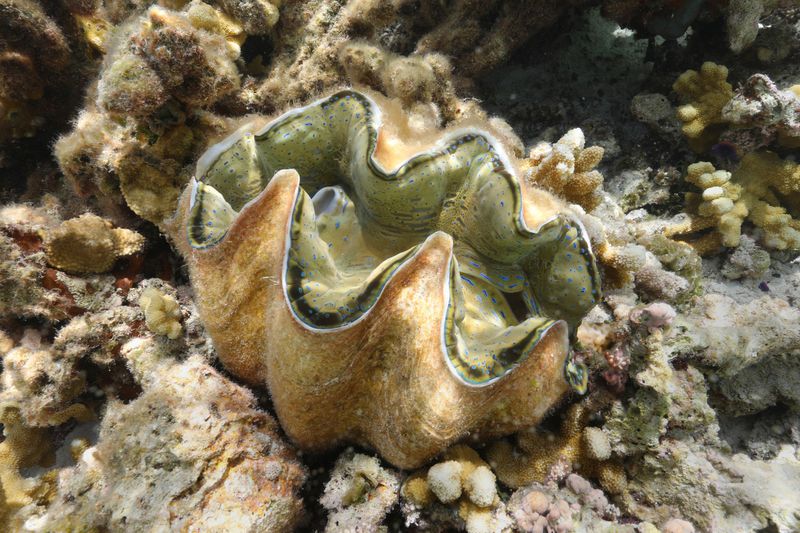
The findings from the Marshall Islands suggest that radiation is either leaking from the waste site — which U.S. officials reject — or that authorities did not adequately clean up radiation left behind from past weapons testing, as some in the Marshall Islands claim.
The radioactive shellfish were found near Runit Dome — a concrete-capped waste site known by locals as “The Tomb” — according to a presentation made by a U.S. Department of Energy scientist this month in Majuro, the island nation’s capital. The clams are a popular delicacy in the Marshall Islands and in other nations, including China, which has aggressively harvested them from vast swaths of the Pacific.
According to Terry Hamilton, a veteran nuclear physicist at the Energy Department’s Lawrence Livermore National Laboratory, Runit Dome is vulnerable to leakage by storm surge and sea level rise, and its groundwater, which is leaking into the lagoon and ocean, is severely contaminated. Continue reading
New interactive map shows France’s many nuclear waste locations
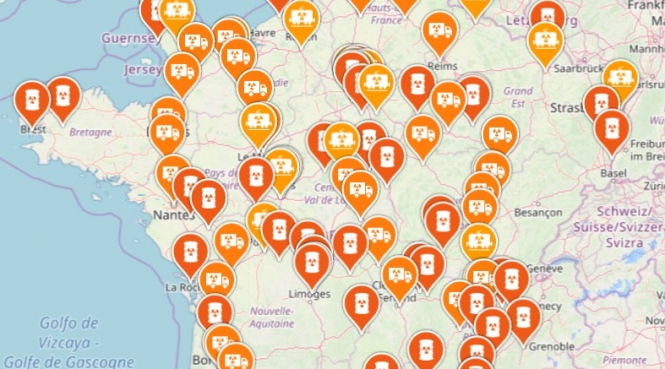 Nuclear waste map of France published by Greenpeace, https://www.connexionfrance.com/French-news/Nuclear-waste-map-of-France-published-by-environmental-activists-Greenpeace-on-issue 29 May, 19, Nuclear waste is becoming a hot topic of discussion, as Greenpeace publishes a map of waste across France
A new interactive map showing the locations of nuclear waste across France has been published by environmental group Greenpeace, as part of its forthcoming campaign on the issue.
The map was published online this week, with the NGO aiming to “compile in a single place” all of the information it has on the location of radioactive material, to let people know how close they may be living to the waste.
The map categories include storage centres (at which the waste will be stored for 300 years minimum); nuclear centres that generate all forms of nuclear waste; more than 200 old uranium mines, operational up to 2001; factories and other plants; and radioactive waste from more than 70 military sites.
The data was collected from records of radioactive waste agency l’Agence Nationale pour la Gestion des Déchets Radioactifs (Andra).
The map does not include waste from medical use or research.
The map allows you to search by post code (Greenpeace.fr / Screenshot)Greenpeace is hoping to raise awareness and prompt debate over the extent of nuclear waste, and ask questions on the potential impact it may have. This also includes the impact of transporting nuclear waste by road or rail.
The group is also seeking to gather signatures and support for its national campaign on the issue, which it will later address to French ecology minister François de Rugy.
The map features a button saying “Agir! (Act!)”, allowing members of the public to add their support.
A public debate is set to be held on September 25 on this exact question – the issue of nuclear waste in France. It will be held on a platform via which the public will be able to ask for further information and have their say.
Nuclear waste disposal is also expected to be on the agenda at the G20 summit being held in Japan next month.
Wind energy sets new records as strong investment and windy weather combine — RenewEconomy

Blustery conditions lead to record wind output in Australia’s main grid on Tuesday, as the Tesla big battery also plays heavily in the arbitrage market. The post Wind energy sets new records as strong investment and windy weather combine appeared first on RenewEconomy.
via Wind energy sets new records as strong investment and windy weather combine — RenewEconomy
Galilee Basin “carbon bomb” about to explode as coal and gas developers rush in — RenewEconomy

Rush of new fossil fuel projects, egged on by the Coalition Government, is likely to push global emissions higher while ACCC warns gas producers on prices. The post Galilee Basin “carbon bomb” about to explode as coal and gas developers rush in appeared first on RenewEconomy.
via Galilee Basin “carbon bomb” about to explode as coal and gas developers rush in — RenewEconomy
WA councils urge state to step up on clean energy — RenewEconomy

An alliance of 21 local governments have called for a renewed state government commitment to renewable energy and tackling climate change. The post WA councils urge state to step up on clean energy appeared first on RenewEconomy.
via WA councils urge state to step up on clean energy — RenewEconomy
Relief as “common sense” and Supreme Court prevail over Queensland solar rule change — RenewEconomy

Solar industry exhales as Queensland Supreme Court throws out controversial, potentially crippling solar rule change. State government has promised to appeal the decision. The post Relief as “common sense” and Supreme Court prevail over Queensland solar rule change appeared first on RenewEconomy.
via Relief as “common sense” and Supreme Court prevail over Queensland solar rule change — RenewEconomy
1 This month.

Australians deserve the truth
about
AUKUS – https://aukuspublicinquiry.com/
Australians deserve the truth
about AUKUS


PETITION – To: Prime Minister Anthony Albanese and the Australian Labor Government

of the week – Australians for War Powers Reform (AWPR)
To see nuclear-related stories in greater depth and intensity
 Antinuclear