Particles From Cold War Nuclear Bomb Tests Found in Deepest Parts of the Ocean
Crustaceans in the Mariana Trench and other underwater canyons feed on food from the surface laced with carbon-14 from Cold War bomb tests, By Christopher Crockett, smithsonian.com , May 1, 2019
Crustaceans in the Mariana Trench and other underwater canyons feed on food from the surface laced with carbon-14 from Cold War bomb tests
The first test of a thermonuclear weapon, or a hydrogen bomb, codenamed Ivy Mike and conducted by the United States in 1952 over the island of Elugelab in Enewetak Atoll in the Pacific Ocean. (Public Domain)
……… Crustaceans in the Mariana Trench and other underwater canyons feed on food from the surface laced with carbon-14 from Cold War bomb tests
No place on Earth is free from human influence—not even the bottom of the deepest trenches in the ocean.
Shrimp-like critters from three West Pacific ocean trenches were found to munch on food that sinks down from the surface, leaving a unique chemical signature from decades-old nuclear bomb tests in the bodies of the deep-sea crustaceans. The findings, published recently in Geophysical Research Letters, not only help marine scientists figure out how these bottom dwellers survive, but also underscore the depths to which humanity’s influence can penetrate………
In those dark depths, one of the most common critters is the shrimp-like amphipod, a family of crustaceans that scavenge the ocean floor for food. Where that food comes from is a matter of debate. Potential sources include morsels that percolate up from Earth’s interior, nutrient-rich sediment that slides down steep trench walls, or tasty detritus that wafts down from the surface.
A recent haul of deep-sea amphipods offered Sun and colleagues a chance to solve this marine mystery. Using baited traps, two Chinese research vessels in 2017 harvested amphipods from three trenches in the West Pacific, including the famous Mariana Trench. Sun’s team chemically analyzed the amphipods’ muscle tissue and gut contents and found elevated levels of carbon-14, a heavy variant of carbon. The levels closely matched abundances found near the surface of the ocean, where the amount of carbon-14 is higher than usual thanks to nuclear bomb tests conducted more than half a century ago.
Carbon comes in a few different varieties based on how many neutrons are stuffed into its atomic nucleus. About one out of every trillion carbon atoms on Earth has two extra neutrons. This form, known as carbon-14, occurs naturally thanks to high-speed atomic particles from deep space whacking into nitrogen atoms. But in the middle of the 20th century, humans doubled the amount of carbon-14 in the atmosphere.
According to the International Atomic Energy Agency, from 1945 to 1963 the United States and the Soviet Union (with a little help from the United Kingdom and France) detonated nearly 500 nuclear bombs, 379 of which exploded in the atmosphere. These tests dramatically increased the amount of carbon-14 on our planet. The Test Ban Treaty of 1963 put a stop to most atmospheric and underwater tests, and carbon-14 levels in the atmosphere started a slow return to normal—though they are still higher than pre-nuclear levels—as ocean waters and land-based life absorbed carbon from the air.
………While the nuclear bomb signature has been recorded a couple miles down in the West Atlantic, no one has seen it as these depths before. “This is just interesting as all get out,” says Robert Key, a Princeton oceanographer who was not involved with this study. He points out that starting about a mile below the surface of the North Pacific, carbon-14 levels closely match what the atmosphere looked like before the bomb tests. “The high carbon-14 [in the amphipods] could only come from food that’s come down from the top,” he says.
April 24, 2019 Japan’s nuclear regulator decided Wednesday not to let power companies operate reactors if they fail to install sufficient counterterrorism measures by specified deadlines. The decision by the Nuclear Regulation Authority came after three utilities that operate five nuclear plants in western and southwestern Japan requested that their deadlines be extended as they […]
Smart Energy Council report finds ALP battery rebate and finance policies could help deliver massive electricity cost savings for households – up to $1,860 a year. The post Labor battery subsidy could deliver 80% cut to household electricity bills appeared first on RenewEconomy.
Federal Labor unveils plan for a VPP of solar schools, through $1bn government loans scheme to help schools invest in PV and battery storage. The post Solar schools to create 364MW virtual power plant in Labor policy plan appeared first on RenewEconomy.
Brisbane’s Tritium opens world-leading R&D facility for EV charging and testing centre in Amsterdam. The post World’s largest Tritium EV charging R&D facility launched in Brisbane appeared first on RenewEconomy.
Leading solar manufacturer Hanwha to launch “next generation” 100% renewable electricity retailer in Australia, using software platform of UK-based Octopus Energy. The post Hanwha to launch 100% renewable “next gen” energy retailer in Australia appeared first on RenewEconomy.
Science and Technology: ¶ “The Vicious Climate-Wildfire Cycle” • While wildfire risk has increased with forest management and human development, climate change has exacerbated the trend of large fires and made the fire season longer. In some places wildfires are a year-round phenomenon. In the past 35 years, the area burned has nearly doubled. [Union […]
On nuclear issues, also, where to start? With the stalemate in nuclear weapons negotiations, in several countries, and India and Pakistan on the tightrope? Or with the nuclear financial messes in USA and UK?
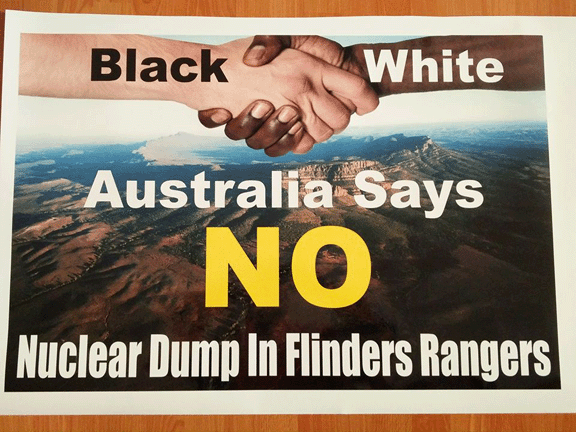
Thousands call for SA nuclear dump plans to be scrapped, as Labor remains silent on the issue, The Adelaide Advertiser , 29 Apr 19,More than 3000 people have signed a petition urging the Federal Government to scrap plans for a nuclear dump at Kimba or Hawker.
It comes as Federal Labor remains silent on whether it would push ahead with the stalled plans, if it came to power next month.
The Hawker and Kimba communities say they are in a “holding pattern” as they await progress on work to select a nuclear dump site, which has ground to a halt amid a legal battle.
No Dump Alliance’s Mara Bonacci said campaigners would tomorrow give Grey MP Rowan Ramsey a petition calling for the Government to take sites at Hawker and Kimba off the table.
Ms Bonacci said it should introduce “an independent process to look at the best place for waste in SA”.
“Australia’s waste is a national issue and putting the burden on two semirural communities isn’t fair,” she said.
“They haven’t consulted anybody properly. They’re looking for a postcode, and not the best process.”
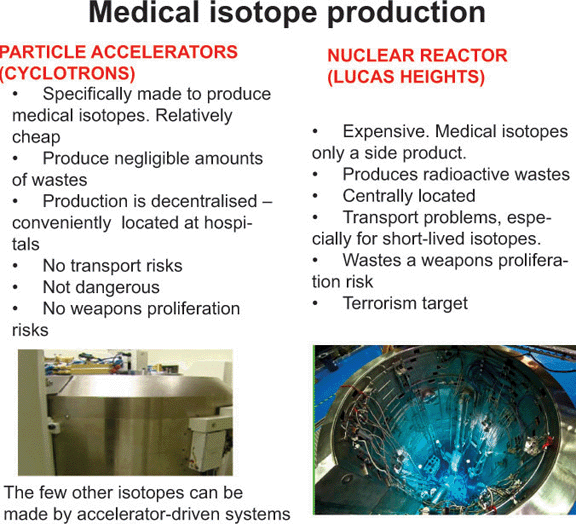
The Federal Government plans to use the new dump to store waste from the [[Lucas Heights nuclear reactor’s wastes] production of nuclear medicines.
However, it was unclear whether a potential change of government might result in an overhaul of the trouble-plagued planning process, as Labor did not respond to The Advertiser’s repeated inquiries about the issue.
Aboriginal associations in Hawker and Kimba have opposed a move to set up a radioactive waste dump in their traditional lands.
The Barngarla Determination Aboriginal Corporation complained that Kimba Council’s plan to run a community ballot about whether it supported the dump, was discriminatory.
It launched Federal Court action, taking issue with the council’s plan to exclude native-title owners from the ballot because they did not live in the district.
Kimba Council chief executive Deborah Larwood in January gave evidence in court, but since then, has heard nothing about future proceedings.
From the council’s perspective we’re basically in a holding pattern,” Ms Larwood said.
The district stands to receive a Federal Government “community development” package worth about $31 million if Kimba is selected for the dump.
In Hawker, Flinders Ranges Mayor Peter Slattery said his district, too, was “in limbo” until court action — both the Barngarla case and another flagged by the Adnyamathanha Traditional Lands Association (ATLA) — was settled.
“I think we’re looking at a pretty long hiatus,” Mr Slattery said.
The dump debate had been a “divisive” issue.
“Regardless of what happens, there’s not going to be a decision in the next six months and it could be much longer,” Mr Slattery said.
The protracted debate was generating “growing frustrations” on both sides of the fence.
“Everyone is wearying of the process and the antagonism it’s generated,” Mr Slattery said.
Maurice Blackburn senior associate Nicki Lees, representing ATLA, said the Hawker ballot would have excluded a significant number of Adnyamathanha people.
The organisation in December lodged a complaint in the Australian Human Rights Commission and was awaiting conciliation.
It also claims Commonwealth contractors carried out ground disturbing work in the area, which desecrated land sacred to Adnyamathanha women, causing them “great distress”.
Ms Lees said it made sense to await the outcome of the Kimba case before potentially launching ATLA’s own court action.
Resources Minister Matt Canavan said the Hawker and Kimba ballots were due last year.
“As this matter is before the courts, the Government cannot speculate on when any community ballot may be held,” Mr Canavan said.
A community postcard opposing the federal government’s plans to build a nuclear waste facility in Kimba or Hawker will be delivered to the Whyalla Office of Member for Grey Rowan Ramsey on Tuesday.
The postcard, which urges the federal government to ‘investigate all safe options before proceeding with this current plan’ has been put together by the No Dump Alliance, a group that represents community opposition to the nuclear waste dump.
It will urge Mr Ramsey to voice these concerns to Resources Minister Matt Canavan on behalf of the community. Copies of the postcard will also be sent to Shadow Minister Kim Carr, the Kimba District and Flinders Ranges Councils and the state government..
Flinders Rangers Adnyamathanha woman Vivianne McKenzie said ‘there are many people in the community who have opposed this nuclear waste dump since it was first announced’.
“We need Canberra to listen to us, because we will never give up,” she said. “The Government is rushing and wrong and we want a different approach.”
Monday marked three years since Wallerberdina Station in the Flinders Ranges was named as the federal government’s preferred site for a national radioactive waste facility.
Currently three sites are under federal consideration: two near Kimba on the Eyre Peninsula and one near Hawker in the Flinders Ranges.
Doctor Susi Andersson from Hawker said most people, for or against the facility, felt that three years of uncertainty was too long.
“The process of finding a site for a NRWMF is dividing and harming our community,” she said.
Kimba farmer Peter Woolford said jobs were at risk because of the government’s ‘unpopular and unnecessary’ plan.
“We will not sit quietly and allow a flawed plan to have a lasting negative impact on our way of life,” he said.
Member for Grey Rowan Ramsey said he totally agreed that three years was too long for the site selection process – however he noted that the nuclear proposal was tied up in a court case launched by the Barngarla Determination Aboriginal Corporation.
“While we’re still waiting for the judge’s decision there’s nothing we can do in that space,” he said.
“There are differing views (on nuclear) in each community, I am aware of that. From day 1 my government made a commitment that we wouldn’t be forcing this facility on a community that does not want it.
“The towns of Hawker and Kimba are without a doubt the best educated communities in Australia on this issue and should be left to have their say in a voting mechanism.”
Mr Ramsey said he would pass on the postcard from the No Dump Alliance to Minister Canavan.
The Last Time There Was This Much CO2, Trees Grew at the South Pole, Dahr Jamail, Truthout , 29 April 19, “……… Water
As usual, there continue to be ample examples of the impacts of climate disruption in the watery realms of the planet.
In oceans, most of the sea turtles now being born are female; a crisis in sea turtle sex that is borne from climate disruption. This is due to the dramatically warmer sand temperatures where the eggs are buried. At a current ratio of 116/1 female/male, clearly this trend cannot continue indefinitely if sea turtles are to survive.
An alarming study showed recently that the number of new corals on the Great Barrier Reef has crashed by 89 percent after the mass bleaching events of 2016 and 2017. With coral bleaching events happening nearly annually now across many of the world’s reefs, such as the Great Barrier, we must remember that it takes an average of a decade for them to recover from a bleaching event. This is why some scientists in Australia believe the Great Barrier Reef to be in its “terminal stage.”
The UN recently sounded the alarm that urgent action is needed if Arab states are to avoid a water emergency. Water scarcity and desertification are afflicting the Middle East and North Africa more than any other region on Earth, hence the need for countries there to improve water management. However, the per capita share of fresh water availability there is already just 10 percent of the global average, with agriculture consuming 85 percent of it.
Another recent study has linked shrinking Arctic sea ice to less rain in Central America, adding to the water woes in that region as well.
In Alaska, warming continues apace. The Nenana Ice Classic, a competition where people guess when a tripod atop the frozen Nenana River breaks through the ice each spring, has resulted in a record this year of the earliest river ice breakup. It broke the previous record by nearly one full week.
Meanwhile, the pace of warming and the ensuing change across the Bering Sea is startling scientists there. Phenomena like floods during the winter and record low sea ice are generating great concern among scientists as well as Indigenous populations living there. “The projections were saying we would’ve hit situations similar to what we saw last year, but not for another 40 or 50 years,” Seth Danielson, a physical oceanographer at the University of Alaska Fairbanks, told The Associated Press of the diminishing sea ice.
In fact, people in the northernmost community of the Canadian Yukon, the village of Old Crow, are declaring a climate disruption State of Emergency. The chief of the Vuntut Gwitchin First Nation in the Yukon, Chief Dana Tizya-Tramm, has stated that his community’s traditional way of life is at stake, including thawing permafrost and rivers and lakes that no longer freeze deeply enough to walk across in the winter, making hunting and fishing difficult and dangerous. He said that declaring the climate emergency is his community’s responsibility to the rest of the planet.
Other signs of the dramatic warming across the Arctic abound. On Denali, North America’s highest mountain (20,310 feet), more than 66 tons of frozen feces left by climbers on the mountain are expected to begin thawing out of the glaciers there as early as this coming summer.
Another study found that tall ice cliffs around Greenland and the Antarctic are beginning to “slump,” behaving like soil and rock in sediment do before they break apart from the land and slide down a slope. Scientists believe the slumping ice cliffs may well be an ominous sign that could lead to more acceleration in global sea level rise, as far more ice is now poised to melt into the seas than previously believed.
In New Zealand, following the third hottest summer on record there, glaciers have been described by scientists as “sad and dirty,” with many of them having disappeared forever. Snow on a glacier protects the ice underneath it from melting, so this is another way scientists measure how rapidly a glacier can melt — if the snow is gone and the blue ice underneath it is directly exposed to the sun, it’s highly prone to melting. “Last year, the vast majority of glaciers had snowlines that were off the top of the mountain, and this year, we had some where we could see snowlines on, but they were very high,” NIWA Environmental Science Institute climate scientist Drew Lorrey told the New Zealand Herald. “On the first day of our survey, we observed 28 of them, and only about six of them had what I would call a snowline.”
Lastly in this section, another study warned that if emissions continue to increase at their current rate, ice will have all but vanished from European Alpine valleys by 2100. The study showed that half of the ice in the Alps’ 4,000 glaciers will be gone by 2050 with only the warming that is already baked into the system from past emissions. The study warned that even if we ceased all emissions at this moment, two-thirds of the ice will still have melted by 2100……… https://truthout.org/articles/the-last-time-there-was-this-much-co2-trees-grew-at-the-south-pole/
The JEEP II research reactor at Kjeller near Oslo has been shut for scheduled maintenance since last December and corrosion was found on several important safety components during an inspection.
The institute said it would be too costly to repair the reactor.
“The board of directors has decided, based on an overall assessment, that the reactor will not be restarted. IFE will consequently initiate work to prepare the decommissioning of the reactor,” the institute said in a statement.
Nuclear fuel and heavy water have been already removed, meaning that the reactor poses no danger to the environment, it added.
The rector, some 20 kilometres away from Oslo, has been used by researchers in physics, materials, cancer medicine, renewable energy and nuclear disarmament since starting operations in 1967, the IFE said.
In June 2018, Norway’s research reactor in Halden was shut down after 60 years of operation.
“Both Norwegian nuclear reactors are now closed and Norway will enter into a new era with decommissioning of the national nuclear programme which was started in 1948,” the IFE said.
Norway has no commercial nuclear reactors, and generates more than 90 percent of its electricity at hydropower plants. (Reporting by Nerijus Adomaitis. Editing by Jane Merriman)
Japan needs thousands of foreign workers to decommission Fukushima plant, prompting backlash from anti-nuke campaigners and rights activists, SCMP Julian Ryall , 26 Apr, 2019
Activists are not convinced working at the site is safe for anyone and they fear foreign workers will feel ‘pressured’ to ignore risks if jobs are at risk
Towns and villages around the plant are still out of bounds because radiation levels are dangerously high
Anti-nuclear campaigners have teamed up with human rights activists in Japan to condemn plans by the operator of the crippled Fukushima Daiichi nuclear plant to hire foreign workers to help decommission the facility.
Tokyo Electric Power Co (TEPCO) has announced it will take advantage of the government’s new working visa scheme, which was introduced on April 1 and permits thousands of foreign workers to come to Japan to meet soaring demand for labourers. The company has informed subcontractors overseas nationals will be eligible to work cleaning up the site and providing food services.
About 4,000 people work at the plant each day as experts attempt to decommission three reactors that melted down in the aftermath of the March 2011 Great East Japan Earthquake and the huge tsunami it triggered. Towns and villages around the plant are still out of bounds because radiation levels are dangerously high.
TEPCO has stated foreign workers employed at the site must have Japanese language skills sufficient for them to understand instructions and the risks they face. Workers will also be required to carry dosimeters to monitor their exposure to radiation.
Activists are far from convinced working at the site is safe for anyone and they fear foreign workers will feel “pressured” to ignore the risks if their jobs are at risk.
“We are strongly opposed to the plan because we have already seen that workers at the plant are being exposed to high levels of radiation and there have been numerous breaches of labour standards regulations,” said Hajime Matsukubo, secretary general of the Tokyo-based Citizens’ Nuclear Information Centre. “Conditions for foreign workers at many companies across Japan are already bad but it will almost certainly be worse if they are required to work decontaminating a nuclear accident site.”
Companies are desperately short of labourers, in part because of the construction work connected to Tokyo hosting the 2020 Olympic Games, while TEPCO is further hampered because any worker who has been exposed to 50 millisieverts of radiation in a single year or 100 millisieverts over five years is not permitted to remain at the plant. Those limits mean the company must find labourers from a shrinking pool.
In February, the Tokyo branch of Human Rights Now submitted a statement to the UN Human Rights Council in Geneva demanding action be taken to help and protect people with homes near the plant and workers at the site.
“It has been reported that vulnerable people have been illegally deceived by decontamination contractors into conducting decontamination work without their informed consent, threatening their lives, including asylum seekers under false promises and homeless people working below minimum wage,” the statement said. “Much clean-up depends on inexperienced subcontractors with little scrutiny as the government rushes decontamination for the Olympic Games.”
Cade Moseley, an official of the organisation, said there are “very clear, very definite concerns”.
“There is evidence that foreign workers in Japan have already felt under pressure to do work that is unsafe and where they do not fully understand the risks involved simply because they are worried they will lose their working visas if they refuse,” he said……
Japan’s nuclear horror relived as people return to Fukushima’s ghost towns,
It is eight years since a devastating tsunami caused three reactors to meltdown at the Fukushima Daiichi nuclear power station on the north-east coast of Japan Mirror UK, Emily RetterSenior Feature Writer, Mirror UK, 29 Apr19
Wide streets still lie empty, scavenging boar and monkeys the only signs of life.
Only wild animals, and the 6ft weeds, which have rampaged through deserted homes and businesses, suffocating once-chatty barbers shops and bustling grocery stores; strangling playgrounds and their rusting rides which lie empty and eerily still.
Laundry hangs where it was pegged out to dry, clock faces are frozen in time, traffic lights flash through their colours to empty roads, meals laid out on tables in family homes, remain uneaten.
Once unextraordinary, mundane symbols of everyday lives have taken on the appearance of a horror film set in these areas closest to the Fukushima Daiichi nuclear power station on the coast of north-east Japan, eight years after the devastating tsunami which caused a meltdown at three of the plant’s reactors, forcing tens of thousands to flee.
The earthquake on March 11, 2011, claimed 19,000 lives, and triggered the world’s largest nuclear disaster since Chernobyl.
Radiation leaking in fatal quantities forced 160,000 people to evacuate immediately, and most to this day have not returned to their toxic towns and villages…….
The official mandatory evacuation order was lifted, and while reports reveal just 367 residents of Okuma’s original population of 10,341 have so far made the decision to return, and most of the town remains off-limits, the Japanese government is keen this be seen as a positive start to re-building this devastated area…….
The Japanese Prime Minister, Shinzo Abe, visited to mark the milestone.
The government is particularly keen to show progress before the 2020 Olympic Games in Tokyo.
Six Olympic softball games and a baseball game will be staged in Fukushima, the capital of this prefecture, which is free of radiation.
The torch relay will even begin at J Village, which was once the base for the crisis response team. Hearteningly, it is now back to its original function, a football training centre.
But the truth is, it is mainly older residents who have decided to return to their homes.
Seimei Sasaki, 93, explained his family have roots here stretching back 500 years.
His neighbourhood in Odaka district now only contains 23 of its original 230.
“I can’t imagine what this village’s future looks like,” he admitted.
Young families are few and far between – these areas are still a terrifying prospect for parents.
But the re-built schools are slowly filling a handful of classroom seats.
Namie Sosei primary and middle school, less then three miles from the plant, has seven pupils.
One teacher said: “The most frustrating thing for them is that they can’t play team sports.”
A sad irony as the Olympics approach.
And with so many residents still fearful, so the deadly clean-up operation continues.
Work to make the rest of Okuma safe is predicted to take until 2022. The area which was its centre is still a no-go zone.
In the years following the disaster, 70,000 workers removed topsoil, tree branches, grass and other contaminated material from areas near homes, schools and public buildings.
A staggering £21billion has been spent in order to make homes safe.
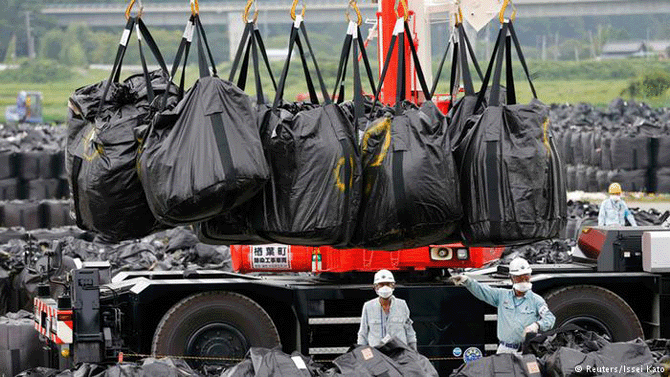
Millions of cubic metres of radioactive soil has been packed into bags.
By 2021 it is predicted 14million cubic metres will have been generated.
The mass scale operation uses thousands of workers. Drivers are making 1,600 return trips a day.
But residents understandably want it moved out of Fukushima for good.
As yet, no permanent location has agreed to take it, but the government has pledged it will be gone by 2045.
When I was reading for my Energy Studies degree at University College Swansea in the late 1970s, the consensus within the nuclear power industry was that the thorium cycle could prove of interest, but a lot of investment would be required to develop a competitive and safe reactor design.
Forty years later, the nuclear power industry appears to be still saying this.
Meanwhile, onshore wind and solar PV are the cheapest means of generating electricity, and they are available NOW.
The climate emergency is so severe, we can’t wait for the future promise of any ‘long-haul’ energy technology, and that includes fusion: when I was a student, fusion was 50 years away from commercialisation, and more than 40 years later it is still 50 years away from commercialisation!












 Antinuclear