Uranium waste in New Mexico puts lie to ‘carbon free’
The Public Service Company of New Mexico, which has made an incredible indelible scar of industrial consequence on New Mexico and the Earth, now wants to add more nuclear to its portfolio. By doing so, PNM will only amplify this consequence. Some say that nuclear-generated electricity should be allowed because it is “carbon-free.” From a life-cycle perspective, it is not carbon-free. The semantics are irrelevant; what matters is the eventual and permanent negative impact and consequence to the land, the people and our planet Earth.
(In honor of) this Earth Day, it is imperative we acknowledge the damage done to the integrity of the life of Earth. The seemingly insurmountable effect from the cause of the extractive industry demands our attention. We have a climate crisis that is ebbing the life of our planet. The delicate balance of the equilibrium of the Earth and its life systems have been dangerously upset. We cannot further aggravate this great dilemma with more uranium exploitation and continue to destroy the sanctity of our Earth Mother and all life upon and within her.https://www.abqjournal.com/1307342/uranium-waste-in-nm-puts-lie-to-carbon-free.html
The impact of high carbon emissions on the land
 The Last Time There Was This Much CO2, Trees Grew at the South Pole, Dahr Jamail, Truthout , 29 April 19,
“……… Earth
The impact of runaway emissions is already upon us. Several cities in the northern U.S., such as Buffalo, Cincinnati and Duluth, are already preparing to receive migrants from states like Florida, where residents are beset with increasing flooding, brutal heat waves, more severe and frequent hurricanes, sea level rise, and a worse allergy season. City planners in the aforementioned cities are already preparing by trying to figure out how to create jobs and housing for an influx of new residents.
Indications of the climate disruption refugee crisis are even more glaring in some other countries.
Large numbers of Guatemalan farmers already have to leave their landdue to drought, flooding, and increasingly severe extreme weather events.
In low-lying Bangladesh, hundreds of thousands of people are already in the process of being displaced from coastal homes, and are moving into poverty-stricken areas of cities that are already unprepared to receive the influx of people. Given that 80 percent of the population of the country already lives in a flood plain, the crisis can only escalate with time as sea level rise continues to accelerate.
Meanwhile, diseases spread by mosquitoes are also set to worsen in our increasingly warm world. A recently published study on the issue shows that over the next three decades, half a billion more people could be at risk of mosquito-delivered diseases.
Other migrations are occurring as well. In Canada’s Yukon, Indigenous elders told the CBC that caribou and moose are moving further north than ever before in order to escape the impacts of climate disruption like warmer summers, lakes and rivers that don’t freeze, and adjusting their migrations to find more food. This has deep impacts on the survival and culture of the area’s Indigenous residents.
In economic news, a researcher for the Federal Reserve Bank recently penned a letter urging central banks to note the financial risks, and possibly an impending financial crisis, brought about by climate disruption. “Without substantial and sustained global mitigation and regional adaptation efforts,” read the letter, “climate change is expected to cause growing losses to American infrastructure and property and impede the rate of economic growth over this century.”
Another report showed that climate disruption is already negatively impacting fruit breeders, and consumers will soon feel the pain of higher prices. “We are seeing industries that may not survive if we don’t find a solution, and we are only just seeing the consequences of climate change,” Thomas Gradziel, of the University of California at Davis, told The Washington Post.
Underscoring all of this, the Global Seed Vault in Svalbard, Norway, known as the “Doomsday Vault,” has already been altered by climate disruption impacts. The primary impacts thus far have been floodingaround the vault, given how warm temperatures have become across the Arctic. The Doomsday Vault holds nearly one million seeds from around the globe, and functions as a backup in case climate disruption, war, famine, or disease wipes out certain crops. In other words, it’s a backup plan to backup plans. A recent report showed that climate change’s impacts on the seed vault could get worse as snow season shortens, heavier and more frequent rainfalls escalate, and avalanches and mudslides near the vault become more common.
Lastly in this section, researchers recently warned that the Arctic has now entered an “unprecedented state” that is literally threatening the stability of the entire global climate system. Their paper, “Key Indicators of Arctic Climate Change: 1971–2017,” with both American and European climate scientists contributing, warned starkly that changes in the Arctic will continue to have massive and negative impacts around the globe.
“Because the Arctic atmosphere is warming faster than the rest of the world, weather patterns across Europe, North America, and Asia are becoming more persistent, leading to extreme weather conditions,” Jason Box, the lead author of the paper said. ……….. https://truthout.org/articles/the-last-time-there-was-this-much-co2-trees-grew-at-the-south-pole/
How Climate Change is Making Storms Stronger — Evaporation, Precipitation, Instability — robertscribbler

With Cyclones Idai and Kenneth generating record breaking, back-to-back landfalls in Mozambique, with new studies indicating an increase in U.S. tornado activity and a general movement of tornadoes eastward, and with many air travelers recently grounded, it’s a good time to revisit climate change’s overall effects on extreme weather. (Kenneth was the strongest storm to […]
S.A. begins search for energy provider after failure of solar tower project — RenewEconomy

South Australia signals search for new projects and competitors to supply 100% of its electricity supply, after failure of the Aurora solar thermal project. The post S.A. begins search for energy provider after failure of solar tower project appeared first on RenewEconomy.
via S.A. begins search for energy provider after failure of solar tower project — RenewEconomy
CEFC invests $30 million in world-first Woolworths green bond — RenewEconomy

The CEFC has invested $30 million in the Woolworths Group green bond, the first certified green bond issued by an Australian retailer and by a supermarket business globally. The post CEFC invests $30 million in world-first Woolworths green bond appeared first on RenewEconomy.
via CEFC invests $30 million in world-first Woolworths green bond — RenewEconomy
April 29 Energy News — geoharvey

Video: ¶ “Finland’s New Generation Of Climate Heroes” • The town of Ii in northern Finland wants to be the world’s first zero-waste community. They stopped using fossil fuels, and the community is reducing CO₂ emissions faster than any other in Finland. Their target is to reduce carbon emissions by 80% by 2020, 30 years ahead […]
The Last Time There Was This Much CO2, Trees Grew at the South Pole
Dahr Jamail, Truthout , 29 April 19, It is palpable now. Even the most ardent deniers of human-caused climate disruption can feel the convulsions wracking the planet…..
The signs of our overheated planet abound, and another collection of recent reports and studies shows things are only continuing to accelerate as human-caused climate disruption progresses.
A recently published study showed that Earth’s glaciers are now melting five times more rapidly than they were in the 1960s.“The glaciers shrinking fastest are in central Europe, the Caucasus region, western Canada, the U.S. Lower 48 states, New Zealand and near the tropics,” lead author Michael Zemp, director of the World Glacier Monitoring Service at the University of Zurich told Time Magazine. Glaciers in those places are losing an average of more than 1 percent of their mass each year, according to the study. “In these regions, at the current glacier loss rate, the glaciers will not survive the century,” added Zemp.
Meanwhile, the World Meteorological Organization announced that extreme weather events impacted 62 million people across the world last year. In 2018, 35 million people were struck by flooding, and Hurricanes Florence and Michael were just two of 14 “billion-dollar disasters” in 2018 in the U.S. More than 1,600 deaths were linked to heat waves and wildfires in Europe, Japan and the U.S. The report also noted the last four years were the warmest on record.As an example of this last statistic, another report revealed that Canada is warming at twice the global rate. “We are already seeing the effects of widespread warming in Canada,” Elizabeth Bush, a climate science adviser at Environment Canada, told The Guardian. “It’s clear, the science supports the fact that adapting to climate change is an imperative.”
Another recent report showed that the last time there was this much CO2 in the atmosphere (412 ppm), in the Pliocene Epoch 5.3 to 2.6 million years ago, sea levels were 20 meters higher than they are right now, trees were growing at the South Pole, and average global temperatures were 3 to 4 degrees Centigrade (3°-4° C) warmer, and even 10°C warmer in some areas. NASA echoed the report’s findings.
And if business as usual continues, emissions will only accelerate. The International Energy Agency announced that global carbon emissions set a record in 2018, rising 1.7 percent to a record 33.1 billion tons……….. https://truthout.org/articles/the-last-time-there-was-this-much-co2-trees-grew-at-the-south-pole/
Grey voters see red over 3 years of federal radioactive waste plan
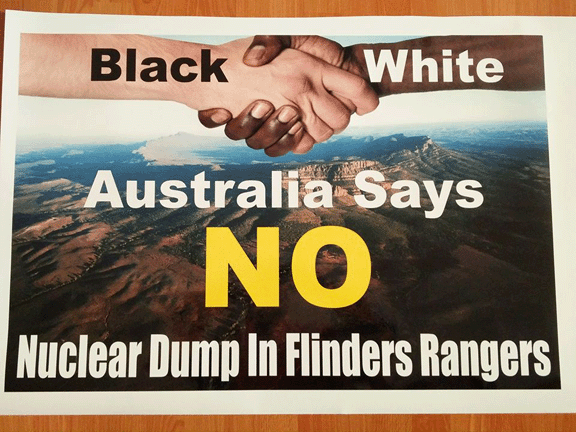 Maria Bonacci, 29 April 2019, Today marks three years since the federal government named Wallerberdina Station in the Flinders Ranges as its preferred site for a national radioactive waste facility.
Since then, Kimba on the Eyre Peninsula has also been targeted. Members of both communities have since worked consistently to prevent becoming home to Australia’s radioactive waste.
Adnyamathanha woman from the Flinders Ranges Vivianne McKenzie said “there are many people in the community who have opposed this nuclear waste dump since it was first announced. We need Canberra to listen to us, because we will never give up.”
As part of these efforts a community postcard initiative opposing the planned waste site is being delivered tomorrow to the Whyalla office of current federal member for Grey, Mr Rowan Ramsey. He is being requested to take it to Federal Resources Minister Matt Canavan on behalf of the community. Copies will also be given to Shadow Minister Kim Carr, the Kimba District and Flinders Ranges Councils and the SA state government.
One of the messages collected on the postcards was “please investigate all safe options before proceeding with this current plan”. The Government is rushing and wrong and we want a different approach.
There are three sites currently under federal consideration: two near Kimba on the Eyre Peninsula and one near Hawker in the Flinders Ranges. All three sites are actively contested and all are in Grey, the largest electorate in South Australia.
Dr Susi Andersson from Hawker said “three years of uncertainty is too long. The process of finding a site for a NRWMF is dividing and harming our community. Most people, for or against the facility, feel three years is too long. This is affecting the well-being of individuals and the community.
“The Cadence Economic Report commissioned and published by DIIS predicts an 8% increase in GRP (gross regional product) when the facility is expected to be operational in 2030. SA tourism predict a State-wide rise in tourism activity by 2030 of 32%. Tourism and primary production are the basis of our economy and our future, not a radioactive waste facility. DIIS produces lots of slick propaganda promoting their proposal but when we ask questions or for clarification, it usually takes months to get an answer” Dr Andersson concluded.
Peter Woolford, a farmer from Kimba said “Our homes – our communities – our jobs are at risk from this unpopular and unnecessary plan. We will not sit quietly and allow a flawed plan to have a lasting negative impact on our way of life.”
The No Dump Alliance – a broad grouping of SA community, Aboriginal and agricultural representatives – is calling on the current and any future federal government to scrap the current site selection process, take the three sites in SA off the table and hold an independent inquiry into the full range of ways to manage Australia’s radioactive waste.
For media comment or to arrange interviews please call Mara Bonacci: 0422 229 970
Lynas’ rare earths miner: its troubles are a reminder that even renewables technologies involve radioactive trash
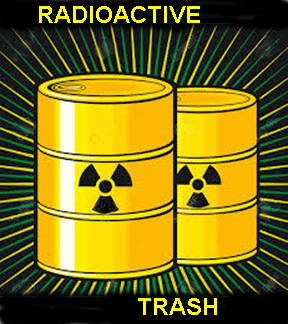 Toxic waste: Lynas Corporation and the downside of renewable energy, Independent Australia, 28 April 2019 In some cases, renewable energy can have profoundly harmful environmental effects if not managed correctly, writes Noel Wauchope.AUSTRALIA’S LYNAS CORPORATION is currently under the business and political spotlight. The current controversy over Lynas rare earth elements company is a wake-up call to an area of vulnerability in renewable technologies – the radioactive pollution produced by developing the rare earth elements essential for today’s hi-tech devices. Electric cars, batteries, energy efficient lighting, smartphones, solar panels, wind turbines and so on all need some of the 17 mineral elements classed as rare earth. The mining and processing of this produces radioactive trash. Toxic waste: Lynas Corporation and the downside of renewable energy, Independent Australia, 28 April 2019 In some cases, renewable energy can have profoundly harmful environmental effects if not managed correctly, writes Noel Wauchope.AUSTRALIA’S LYNAS CORPORATION is currently under the business and political spotlight. The current controversy over Lynas rare earth elements company is a wake-up call to an area of vulnerability in renewable technologies – the radioactive pollution produced by developing the rare earth elements essential for today’s hi-tech devices. Electric cars, batteries, energy efficient lighting, smartphones, solar panels, wind turbines and so on all need some of the 17 mineral elements classed as rare earth. The mining and processing of this produces radioactive trash.
Environmentalists, in their enthusiasm for renewable energy, seem unaware of this fact, while they rightly condemn coal and nuclear power, for their toxic by-products. Australia’s Lynas Corporation has two major rare earth facilities — mining at Mount Weld, Western Australia, and processing at Kuantan, Malaysia. For years, there’s been a smouldering controversy going on in Malaysia, over the radioactive wastes produced by the refining facility at Kuantan. Now, this has come to a head. On 17th April, the Malaysian Government insisted that Lynas Corp must remove more than 450,000 tonnes of radioactive waste from the country, for its licence to be renewed in September. Australian Government legislation and policy prohibits the import of radioactive waste. However, some categories of radioactive waste are exempt from this law, if they contain very low levels of radioactivity. Here’s where it all gets terribly complicated. Wesfarmers wants to take over Lynas. The Australian Securities and Investments Commission (ASIC) is examining this, and especially Wesfarmers’ involvement with the Malaysian government. The Age on 16 April, reported that Prime Minister Mahathir, following discussions with Wesfarmers, announced that a company interested in acquiring Lynas had promised to extract the radioactive waste before exporting the ore to Malaysia. All this raises the question of exactly what would an Australian company, such as Wesfarmers, do with that radioactive waste? This is a thorny problem. And what would Lynas do about their current problem?…… It is complicated to grasp the methods used and just what is required for the proper cleanup of the Lynas rare earth elements refining. Lynas CEO Amanda Lacaze maintains that the wastes left behind are only marginally radioactive. …… culture and history really have their impact, precisely in Malaysia’s experience of rare earth processing. Even if the Lynas waste really is only slightly radioactive, Malaysians remember the environmental and health disaster of Bukit Merah; where, early this century, rare earth processing left a toxic wasteland. China’s rare earth element processing disaster in Inner Mongolia is better known, an environmental catastrophe from the 1960s which lingers today. Modern processing has improved safety in waste management. In relation to nuclear power, there is an abundance of information on radioactive waste management, for China and for other countries. However, there’s little or no information that’s easily available to specifically discuss radioactive waste from rare earth processing. Australia does have another, smaller, rare earth elements mining and processing operation, Arafura Resources, in Central Australia. The Northern Territory Environment Protection Authority (EPA) found this acceptable….. What is clear, is that the production of the world’s hi-tech devices is not a simple matter as far as the environment goes. Climate change activists, anti-nuclear activists and environmentalists in general can keep on promoting renewable energy and electric cars. But they seem to be blind to the total picture, which includes the downside. Obviously, it is necessary to ensure safer disposal of the trash from rare earth mining and processing. A better idea is to develop the design of devices so that the minerals can be retrieved from them and recycled, thus greatly eliminating the need for mining rare earth. And this is beginning to happen. ….. Energy conservation is the biggest factor in the change that is needed. Social change, however difficult that will be, is going to be the most important answer — the transition from a consumer society to a conserver society. The Lynas radioactive trash controversy is not going to go away quickly, however much governments and corporations want to keep it under wraps. And it also could be a catalyst for discussion on that downside of renewable and hi-tech devices. This is something to think about as we throw away last year’s iPhone in favour of the latest model. https://independentaustralia.net/environment/environment-display/toxic-waste-lynas-corporation-and-the-downside-of-renewable-energy,12619#disqus_thread |
|
|
Liberal Coalition gets a poor rating on climate policy
|
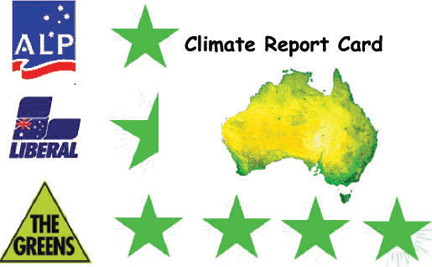
Coalition scores ‘F’ on climate policy-ACF, https://www.sbs.com.au/news/coalition-scores-f-on-climate-policy-acf 28 Apr 19,The federal coalition government has scored a ‘fail” on its climate change policy but Labor has scraped through with a “pass”, a conservation group says.
A climate change advocate has scored the climate policies of the major policies, marking down the coalition as a fail but with Labor scraping through with a pass mark. The Greens, however, scored a high distinction. “Of the two major parties, Labor is miles ahead of the coalition on climate commitments, but neither party is doing enough to make Australians safe from climate damage,” Australian Conservation Foundation chief executive Kelly O’Shanassy warned. Given the importance of the response to climate change in the 2019 election campaign, the ACF assessed the policies on 50 key tests across four broad areas before giving each a score out of 100. These areas included ramping up renewables, phasing out coal, stopping Adani’s coalmine and protecting nature. The scorecard gives the Greens’ policies 99/100 and Labor 56/100, but the coalition just 4/100. “The coalition’s signature climate policy – the emissions reduction fund – has not curbed Australia’s climate pollution,” Ms O’Shanassy said handing down the scorecard on Monday. “For the coalition to again offer this ineffective policy as its main plan to tackle climate change shows a disregard for farmers, survivors of natural disasters fuelled by global warming and the next generation of Australians.” Meanwhile, the ACF believes while Labor has put forward a credible framework for cutting climate pollution and growing the renewable energy sector, it is only halfway to full marks because of its blind spot on coal and gas. In particular, Labor hasn’t (established) plans to phase out coal-fired power and hasn’t ruled out the Adani mine,” Ms O’Shanassy. However, the policies the Greens are taking to the election reflect the urgency of action that scientific bodies like the Intergovernmental Panel on Climate Change say is needed to keep global warming at relatively safe levels, she added. |
|
2019: the climate election
Friends of the Earth, APR 24, 2019,
Uranium miner coaxed government to water down extinction safeguards
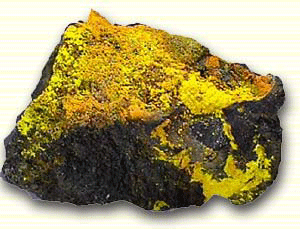 Guardian, Adam Morton@adamlmorton, 27 Apr 2019 Cameco did not have to show if WA mine would lead to extinction of tiny fauna before its approval on 10 April, A multinational uranium miner persuaded the federal government to drop a requirement forcing it to show that a mine in outback Western Australia would not make any species extinct before it could go ahead.
Canadian-based Cameco argued in November 2017 the condition proposed by the government for the Yeelirrie uranium mine, in goldfields north of Kalgoorlie, would be too difficult to meet.
The mine was approved on 10 April, the day before the federal election was called, with a different set of conditions relating to protecting species.
Environmental groups say the approval was politically timed and at odds with a 2016 recommendation by the WA Environmental Protection Authoritythat the mine be blocked due to the risk to about 140 subterranean stygofauna and troglofauna species – tiny animals that live in groundwater and air pockets above the water table.
A Cameco presentation to the department, released to the Greens through Senate estimates, shows the government proposed approving the mine with a condition the company must first demonstrate that no species would be made extinct during the works.
Cameco Australia said this did not recognise “inherent difficulties associated with sampling for and describing species”, including the inadequacy of techniques to sample microscopic species that live underground and challenges in determining whether animals were of the same species. It said the condition was “not realistic and unlikely to be achieved – ever”
The condition did not appear in the final approval signed by the environment minister, Melissa Price, which was made public after being posted on the environment department’s website on 24 April.
Instead, the government said the company should develop a groundwater management program, limit groundwater extraction in some places to 50cm and have evidence from a qualified ecologist that work in part of the area affected by the mine would not lead to extinction. All would need to be submitted to the environment minister for approval.
Mia Pepper, from the Conservation Council of WA, said the change to the conditions showed mining companies had a disproportionate influence in what was a flawed environmental approvals process.
She said a clear condition to stop extinction had been replaced with convoluted requirements that shifted the onus for stopping species loss from the company to the government.
“I think the public and government department should expect [that] companies can provide evidence that species won’t be made extinct,” she said. “The attitude in the mining industry around subterranean fauna has been pretty poor. Whether they are tiny species or cute and cuddly species, they should all be protected. Who are we to decide?”
Pepper said Yeelirrie had been subject to probably the most extensive subterranean fauna survey at an Australian mine site when it was owned by BHP Billiton. “The chances that these species exist elsewhere is almost zero to none. That is backed up by the BHP survey and the EPA,” she said……
Labor has called on Price to explain why the mine was approved in the shadow of an election campaign.
Cameco Australia general manager, Simon Williamson, welcomed the approval but said a decision to advance the Yeelirrie mine would depend on market conditions, which were currently challenging. The mine is also the subject of a legal challenge in the WA court of appeal by the conservation council and three Tjiwarl traditional owners. https://www.theguardian.com/environment/2019/apr/27/uranium-miner-coaxed-government-to-water-down-extinction-safeguards
Climate change protests across the globe: activists stage “die-ins”
 Extinction Rebellion activists stage die-in protests across globe https://www.theguardian.com/environment/2019/apr/27/extinction-rebellion-activists-stage-die-in-protests-across-globe Mattha Busby @matthabusby, 28 Apr 2019
Environmental protesters lay on the ground at transport hubs, venues and shopping centres
At the Kelvingrove art gallery and museum in Glasgow, about 300 activists lay down beneath Dippy, the famous copy of a diplodocus skeleton which is currently touring the UK, for 20 minutes on the sound of a violin.
Many held handwritten signs with the question “Are we next?”, while children held pictures they had drawn of their favourite at-risk animals as part of the event organised by Wee Rebellion, a climate-change protest group for young people in Glasgow associated with Extinction Rebellion.
Twelve-year-old Lida said: “We want to raise awareness about climate change. If we keep carrying on the way we are humans may become extinct, like Dippy.” Aoibhìn, 7, said: “Lots of animals are dying out because of climate change.”
The group said industrial agriculture, overfishing and deforestation could lead to food shortages in the UK and serious flooding in parts of Glasgow.
In Lund, a number of people took to the cobbled streets of the southern Swedish city in the rain, urging people to take greater notice of what they called a looming climate catastrophe.
Meanwhile, in Oslo, about 30 people occupied the floor of a shopping centre. Extinction Rebellion Norway tweeted: “Full stoppage at Oslo City while we campaigned against the clothing industry’s wild environmental degradation. It is the world’s second largest polluter after the oil industry.”
The actions were part of worldwide celebration at 12.05pm called by Extinction Rebellion Berlin following the protests that began in London in November 2018, which have since spawned a mass movement.
A spokesperson for the group said in a statement: “Our ecosystem is threatened by collapse, which will not only lead to mass extinction of countless species, the loss of soil fertility and more extreme weather but will also bring with it the social crises of famine, war and migration.
Australian children want Australia to take action on climate change: it’s about their future!
 We underestimate young people because it’s convenient, SMH, By Caitlin Fitzsimmons, April 28, 2019 —
Of course, they are – climate change is an existential threat for Generation Z. Did you think they wouldn’t notice?
In a recent incident that made the news, the NSW Department of Education ordered Ramsgate Public School to remove two letters from students published in an online newsletter.
The children had written letters about climate change, notionally to Prime Minister Scott Morrison though the letters weren’t sent, as part of an exercise in persuasive writing.
A department spokesman told The Sun-Herald the letters were written after a geography lesson about the Great Barrier Reef. The spokesman said there was no problem with the lesson or the letters themselves but because they were addressed to the Prime Minister and were critical of government policy, the publication of the letters breached the Controversial Issues in Schools policy.
The incident was reported in The Daily Telegraph, which quoted two right-wing think tanks and a conservative academic in a story about how teachers are ostensibly subjecting children to a political agenda in the classroom and “brainwashing young, immature and vulnerable children with their politically correct ideology”.
Last week, Swedish climate change activist Greta Thunberg, the girl who started the worldwide school strike movement, addressed the British Parliament. Predictably, people who don’t want to hear her message choose to attack her instead – they mock her appearance and stern manner, her Asperger’s, claim she is paid to protest, and dismiss her on the basis that she has only just turned 16.
If you would prefer to listen to an adult who has studied the issue then by all means do so – they will tell you the same as Thunberg. The difference is that Thunberg’s youth gives her message about the future a certain moral clout.
Climate change is a tough issue for teachers and not just because they are hamstrung by policy………
Among the surveyed teenagers, the vast majority (86 per cent) view climate change as a threat to their safety, with 73 per cent saying it affects the world “a lot” now and 84 per cent saying it will affect the world “a lot” in the future.
Three out of four want Australia to be taking action on climate change, to lead by example and play our part in stopping its worsening effects. Only 8 per cent believe we shouldn’t take action because of negative effects on the economy and only 5 per cent that we are too small a nation to make a difference. Only 4 per cent do not believe climate change is both real and caused by human activity………
Young people and all future generations are the ones who will inherit a vastly depleted natural world. The only way to counter that moral authority is to call them “pawns” in a debate they couldn’t possibly understand.
Or we could hear the message and act. As Thunberg says, we need to act like the house is on fire – because it is.
More evidence that US may seek to prosecute Julian Asssange under the Espionage Act
, 28th April 2019 More evidence has emerged that WikiLeaks founder Julian Assange could be prosecuted for offences under the US Espionage Act. Although testimony provided by a digital forensics expert raises questions about the prosecution.
1 This month.

Australians deserve the truth
about
AUKUS – https://aukuspublicinquiry.com/
Australians deserve the truth
about AUKUS

PETITION – To: Prime Minister Anthony Albanese and the Australian Labor Government

of the week – Australians for War Powers Reform (AWPR)
To see nuclear-related stories in greater depth and intensity
 Antinuclear