NFLA 18th April 2019 The Nuclear Free Local Authorities (NFLA) notes that over 70 Welsh unitary, county, city, town and community councils have passed resolutions formally opposing taking any interest in hosting a deep underground radioactive waste repository.
The figure was noted at a joint meeting in Menai Bridge organised by the NFLA Welsh Forum in conjunction with the groups PAWB, CADNO and CND Cymru. At a presentation provided by the NFLA Secretary, he noted that there had been real anger and frustration raised across Welsh and Northern Irish Councils in particular to the request made by the UK
Government for considering hosting a large deep underground repository to store over 60 years of higher activity radioactive waste, as well as possibly additional waste should new nuclear power stations ever be built.
Even in England, a number of nuclear site Councils have indicated their public opposition to hosting a repository. NFLA have noted some of these issues in its response to RWM regarding its consultation on how any proposed sites will be evaluated.
Extinction Rebellion: The People Risking Their Freedom For Climate Change | HuffPost Reports: UK
Extinction Rebellion arrests close to 1,000 as protesters ‘pause rebellion’ ITV 21 Apr 19Climate change protesters who have stopped traffic in a series of peaceful demonstrations across London will “pause” their rebellion in a bid to achieve their political aims, as the arrest total nears 1,000.Extinction Rebellion (XR) have announced they are switching disruptive tactics for political negotiations as they enter a second week of campaigning to have the Government declare a climate emergency.
The number of people arrested in connection with the protests has hit 963 and 40 people have been charged. Continue reading →
Scott Morrison warned on ‘cherry-picking’ $35 billion climate cost, SMH, 22 Apr 19The election fight on climate change has sparked warnings against “misleading” voters about the cost of cutting greenhouse gas emissions, as an independent researcher repudiates Coalition claims of a $35 billion hit from Labor policies.
Prime Minister Scott Morrison has been accused of “cherry-picking” numbers in the escalating row over the competing pledges on climate, as he prepares to release new estimates of the economic impact of the Labor carbon target…….
The head of the Department of Prime Minister and Cabinet, Dr Martin Parkinson, has responded to the climate dispute by warning against the “misleading” use of economic modelling and assuring Mr Shorten the public service has not costed the Labor policy.
The research company cited in the government’s $35 billion claim, Bloomberg New Energy Finance, has also told The Sydney Morning Herald and The Age that the figure was “not a credible estimate” of the cost of buying international carbon permits.
“To come up with this number, the government has taken the highest point in our 10 year forecast for European carbon credits and assumed 50 per cent of Australia’s abatement for the next decade is bought at this price,” said Bloomberg NEF global head of special projects Kobad Bhavnagri.
“It takes the highest instantaneous forecast price, in the most expensive market, to come up with the biggest number.
Swedish climate activist’s speech comes amid police action to clear protesters from Waterloo Bridge, Governments will no longer be able ignore the impending climate and ecological crisis, Greta Thunberg, the teenage climate activist, has told Extinction Rebellion protesters gathered at Marble Arch in London.
In a speech on Sunday night where she took aim at politicians who have for too long been able to satisfy demands for action with “beautiful words and promises”, the Swedish 16-year-old said humanity was sitting at a crossroads, but that those gathered had chosen which path they wish to take…….
Julian Assange: Within Washington’s grasp? | The Listening Post (Full)
Debunking All The Assange Smears, by Caitlin Johnstone , Robert Gore, STRAIGHT LINE LOGIC,21Apr19
This is the definitive and comprehensive source for anyone who wants to defend Julian Assange in an argument and win. From Caitlin Johnstone at theburningplatform.com:
Have you ever noticed how whenever someone inconveniences the dominant western power structure, the entire political/media class rapidly becomes very, very interested in letting us know how evil and disgusting that person is? It’s true of the leader of every nation which refuses to allow itself to be absorbed into the blob of the US-centralized power alliance, it’s true of anti-establishment political candidates, and it’s true of WikiLeaks founder Julian Assange.
Corrupt and unaccountable power uses its political and media influence to smear Assange because, as far as the interests of corrupt and unaccountable power are concerned, killing his reputation is as good as killing him. If everyone can be paced into viewing him with hatred and revulsion, they’ll be far less likely to take WikiLeaks publications seriously, and they’ll be far more likely to consent to Assange’s imprisonment, thereby establishing a precedent for the future prosecution of leak-publishing journalists around the world. Someone can be speaking 100 percent truth to you, but if you’re suspicious of him you won’t believe anything he’s saying. If they can manufacture that suspicion with total or near-total credence, then as far as our rulers are concerned it’s as good as putting a bullet in his head.
Those of us who value truth and light need to fight this smear campaign in order to keep our fellow man from signing off on a major leap in the direction of Orwellian dystopia, and a big part of that means being able to argue against those smears and disinformation wherever they appear. Unfortunately I haven’t been able to find any kind of centralized source of information which comprehensively debunks all the smears in a thorough and engaging way, so with the help of hundreds of tips from my readers and social media followers I’m going to attempt to make one here. What follows is my attempt at creating a tool kit people can use to fight against Assange smears wherever they encounter them, by refuting the disinformation with truth and solid argumentation.
This article is an ongoing project which will be updated regularly where it appears on Medium and caitlinjohnstone.com as new information comes in and new smears spring up in need of refutation.
Here’s a numbered list of each subject I’ll be covering in this article for ease of reference:
Our leaders are ignoring global warming to the point of criminal negligence. It’s unforgivable, Guardian, 20 Apr 10, Tim Winton
Humanity survived the cold war because no one pushed the button. On climate change, the button has been pushed again and again.
I’ve been asking myself a question – and even posing it makes me queasy.
Is it too late – are we beyond saving?
As a culture and a polity, when it comes to climate change, have we arrived at a point where we are now expected – even trained – to abandon hope and submit to the inevitable?
OK, I guess that’s two questions. In good faith I can still say that the answer to the first is no. But I’d be a liar and a fool to give the same response to the second.
No, it isn’t too late. But we’ve squandered decades of opportunities to mitigate and forestall impacts and we’re making a pig’s breakfast of responding to what is now a crisis. Even so, humans are not yet beyond saving themselves from the worst ravages of global warming. There’s fight in us yet, even if it’s a bit shapeless.
The problem – and it’s an existential threat both profound and perverse – is that those who lead us and have power over our shared destiny are ignoring global warming to the point of criminal negligence. Worse than that, their policies, language, patronal obligations and acts of bad faith are poisoning us, training citizens to accept the prospect of inexorable loss, unstoppable chaos, certain doom. Business as usual is robbing people of hope, white-anting the promise of change. That’s not just delinquent, it’s unforgivable.
Over the last 15 years in Australia our national governments have failed to respond effectively to the challenge of climate change, and for most of that time we actually gave ourselves the luxury of calling it a challenge. Now it’s more of a crisis. And it’s not as if our leaders are incapable of producing a timely response to a crisis. After all, in 2009 the government took bold steps to avoid an economic depression….
The message implicit in our governments’ refusal to act is that we should all just suck it up – as in “climate change is bullshit, and even if it’s not there’s nothing you can do about it”. Once internalised, this narrative is profoundly dangerous, not only for individuals, but for the entire community. ……
t’s time to make sharp demands of our representatives, time to remove those who refuse to act in our common interest, time to elect people with courage, ingenuity and discipline, people who’ll sacrifice pride, privilege and even perks for the sake of something sacred. Because there’s something bigger at stake here than culture wars and the mediocrity of so-called common-sense. It’s the soil under our feet, the water we drink, the air we breathe……https://www.theguardian.com/environment/2019/apr/20/our-leaders-are-ignoring-global-warming-to-the-point-of-criminal-negligence-its-unforgivable
Expert scientific advice on how to limit the impact of the Adani coal mine wasn’t accepted by the company, despite the environment minister saying so. SBS 18 Apr 19Indian mining company Adani didn’t accept expert scientific advice by Geoscience Australia and CSIRO on how to limit the environmental impact of its Carmichael coal mine, documents have revealed.
Earlier this month, federal environment minister Melissa Price said Adani had “accepted in full” the advice from Geoscience Australia and the CSIRO, prompting her to approve the company’s groundwater management plans.
But documents from Geoscience Australia show Adani did not accept key advice and recommendations for its groundwater plan, the ABC reported on Thursday.. The findings included that the model used to determine the Carmichael coal mine’s impact was not fit for purpose.
Adani also refused to accept that a new model could show the mine would breach environmental approvals.
The company would not commit to corrective action if a new model showed greater environmental impacts than Adani said would occur.
The revelations come from handwritten notes by Geoscience Australia’s chief James Johnson from a briefing with the Department of Environment and Energy…….
Queensland Premier Annastacia Palaszczuk wants to see Adani’s rail plan before giving the Galilee Basin coal mine the final tick of approval, which has been met with resistance from the Indian company.
Extinction Rebellion: what pushes people to drastic action on climate change?
Slow burn? The long road to a zero-emissions UK, Guardian, Robin McKie, Observer science editor, Sun 21 Apr 2019
Extinction Rebellion protesters want a carbon-free UK by 2025. But can the financial and political hurdles be overcome?
…….. Extinction Rebellion protesters want a carbon-free UK by 2025. But can the financial and political hurdles be overcome?
The crucial question is: when? Just how quickly can we eliminate our carbon emissions? Extinction Rebellion protesters are clear. They want the UK to be decarbonised by 2025. That will mean massive curtailment of travel by car or plane, major changes in food production – steaks would become culinary treats of the past – and the construction of swathes of wind and solar plants. But given that we face disastrous climatic change, only massive, widespread, rapid interventions can now save us from a fiery global fate, they say.
Many experts disagree, however. They argue that such an imminent target is completely impractical. “Yes, you could decarbonise Britain by 2025 but the cost of implementing such vast changes at that speed would be massive and hugely unpopular,” says Lord Turner, former chairman of the climate change committee.
Most expect the climate change committee will plump for 2050 as Britain’s ideal decarbonisation date. “2050 is do-able and desirable and would have an insignificant overall cost to the economy,” states Turner, who is now chairman of the Energy Transitions Commission. According to this scenario, developed nations, including Britain, would aim to achieve zero-emissions status by 2050 and then use the decarbonising technologies they have developed to achieve this goal – hydrogen plants, carbon dioxide storage vaults and advanced renewable generators – to help developing nations halt their greenhouse gas emissions by 2060.
Many experts disagree, however. They argue that such an imminent target is completely impractical. “Yes, you could decarbonise Britain by 2025 but the cost of implementing such vast changes at that speed would be massive and hugely unpopular,” says Lord Turner, former chairman of the climate change committee.
Most expect the climate change committee will plump for 2050 as Britain’s ideal decarbonisation date. “2050 is do-able and desirable and would have an insignificant overall cost to the economy,” states Turner, who is now chairman of the Energy Transitions Commission. According to this scenario, developed nations, including Britain, would aim to achieve zero-emissions status by 2050 and then use the decarbonising technologies they have developed to achieve this goal – hydrogen plants, carbon dioxide storage vaults and advanced renewable generators – to help developing nations halt their greenhouse gas emissions by 2060.
And the change has already been reflected in Britain’s power statistics. In 2013, 62.5% of UK electricity was generated by oil, coal and gas stations, while renewable provided only 14.5%. In 2018, the figure for oil, coal and gas had been reduced to 44% while renewables were generating 31.7%. It is a distinct improvement – though we have yet to be given a date when engineers expect the last UK fossil-fuelled power plant to produce its final watts of electricity and to emit its last puffs of carbon dioxide
“Decarbonising UK power production is going well,” says George Day, head of policy for the technology and innovation centre Energy Systems Catapult. “There is a clear path forward.” But as he points out, there are many other sources of carbon dioxide in the UK. “The next big challenge will be heating. Gas boilers are major carbon emitters and dealing with them is going to be very difficult.”
According to Day, about 90% of British people have gas boilers in their homes, most having been fitted relatively recently …
………In the end, it will simply not be possible to reduce Britain’s fossil-fuel emissions to zero, say scientists. To compensate, we will have to take carbon dioxide back out of the atmosphere. “That is the logical, inevitable consequence of trying to achieve zero net emissions in this country,” argues Corinne Le Quéré, of the University of East Anglia. “If you are looking for any net zero target then you have to remove carbon dioxide from the atmosphere.”
This can be done in three ways: naturally, by planting trees and shrubs that absorb carbon dioxide. Or artificially – on a larger scale – the gas can be removed as it is produced at a factory or power station that burns trees for energy.
Or it can be removed by huge numbers of man-made air filters, known as direct air capture. The carbon dioxide can be liquefied and stored underground in underground caverns, or old, depleted gas fields under the North Sea. This is known as carbon capture utilisation and underground storage (CCUS).
“In the end, your choice of replanting or of building underground storage facilities depends on how much carbon you will need to remove,” says Le Quéré. “Most calculations suggest Britain will need to take quite a lot of carbon dioxide out of the atmosphere to keep its net emissions at zero.”……….
UK carbon emissions have fallen for the sixth year running
This need for speed is shared by many other parts of the zero-emissions programme, as we have seen. It may seem odd given it is unlikely it will reach its conclusion for another three decades. Nevertheless, scientists are adamant that even if choose 2050 for our decarbonisation date, we need to act now.
This urgency of the task is emphasized by Joeri Rogelj at Imperial College London. “If the world limits emissions of carbon dioxide to no more than 420 billion tonnes this century, we will have a two in three chance of keeping global warming down to around 1.5C.
“However, if we go above to 580 billion tonnes then our chances will be reduced to 50-50. The problem is that in 2017 alone, a total of 42 billion tonnes of carbon dioxide was emitted in a single year. By that calculation, we clearly do not have a lot of time to waste.”https://www.theguardian.com/environment/2019/apr/21/long-road-to-zero-emissions-uk
Opinion: ¶ “When Airplanes Are Designed To Be Energy Agnostic, You Know Electricity Is Banging At The Door” • Lift Air subsidiary Flight Design General Aviation GmbH, based in Germany, announced new 4-seat airplane that could be certified in a year. Importantly, it is energy agnostic, so it is ready for a full electric propulsion […]
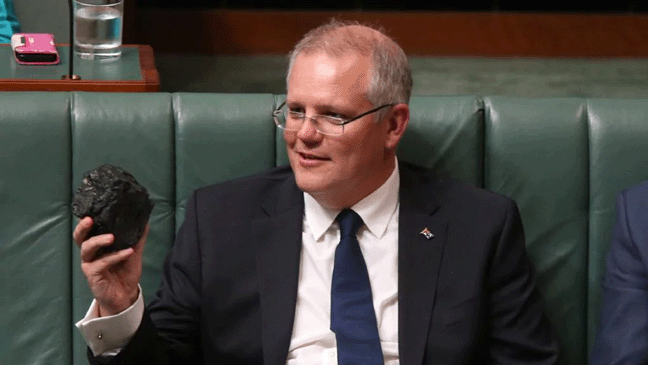
Scott Morrison has clarified comments suggesting he was open to nuclear power.
The Prime Minister earlier today said nuclear power was “not ‘not’ on the agenda” and he was “fine” with energy generation “wherever it comes from.”
But after backlash from Labor, Mr Morrison moved on Twitter to declare he had no plans to change the law to allow nuclear power stations.
“Labor are getting desperate, and we are only 8 days in. This is not our policy and we have no plans to change that,” he tweeted.
Mr Morrison’s original comments came on Tasmanian radio on Thursday morning.
When pushed on whether he would be happy to take proposals from the nuclear industry on going ahead with power projects, the Prime Minister said it would be allowed to do so.
“It’s not ‘not’ on the agenda, wherever it can come from is fine, but it has to be self-sustaining,” Mr Morrison told Launceston FM.
“If they want to put them forward they can. (Nuclear physicist) Ziggy Switkowski did a major report for the Howard Government on this issue, and it came back and it didn’t say it could support itself.”
Nuclear power has been an almost untouchable issue in Australian politics for decades and Labor was quick to leap on the Prime Minister’s comments.
Opposition environment spokesman Tony Burke said Mr Morrison would need to change the law if he were ever to accept a nuclear power station proposal.
“Nuclear power is against the law in Australia. It is extraordinary that Scott Morrison is now contemplating changing the law to allow nuclear power stations in Australia,” he said.
“Several places have been identified in the past for nuclear power stations — like Jervis Bay, Townsville, Bribie Island, Mackay.
“Where is Morrison proposing to put his nuclear power plants? Which coastal community is under threat?”
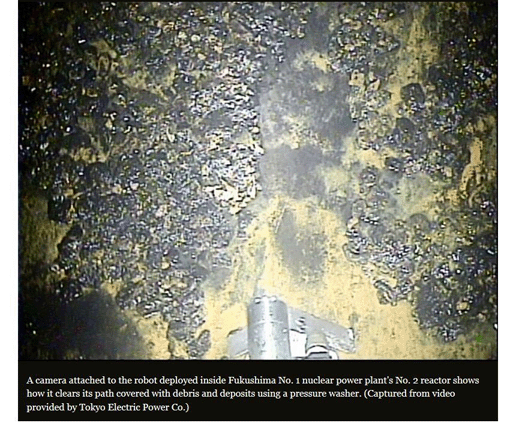
April 19, 2019 Tokyo Electric Power Co., the operator of the crippled Fukushima No. 1 nuclear power plant, has started removing radioactive fuel rods from the fuel storage pool for one of the three reactors that melted down in the 2011 nuclear disaster.
Massive amounts of melted nuclear fuel debris remain in the cores or containment vessels of the No. 1 to No. 3 reactors, which melted down. In addition, many fuel rods, batched into assemblies, are stored in storage pools within the reactor buildings.
These pools could be seriously damaged if the plant is hit by another big earthquake or tsunami. Moving spent fuel from these pools to the safe common pool within the premises is an important step to preventing accidents and ensuring steady progress in the process of decommissioning the reactors.
All the 1,535 nuclear fuel assemblies that were in the No. 4 reactor building, which did not melt down because it was shut down at the time of the accident, were removed by the end of 2014. Since workers could enter the building, the operation was conducted in a normal manner.
By contrast, areas around the fuel storage pool for the No. 3 reactor remain inaccessible due to high levels of radiation. The situation requires the removal operation to be remotely conducted from a control room about 500 meters from the No. 3 reactor building.
The work involves putting nuclear fuel assemblies into special containers under water and lifting them up with a crane and putting them down onto the ground for transportation to the common pool. This is a tricky and risky mission that has to be carried out with great care and caution by using a monitor.
Initially, the process of removing the fuel rods from the storage pool for the No. 3 reactor was scheduled to start at the end of 2014. But it has been repeatedly postponed due to technical mishaps and other reasons. It was finally started after a delay of more than four years.
The plant operator, known as TEPCO, plans to relocate all 566 nuclear fuel assemblies that have been kept in the storage pool in the No. 3 reactor building by the end of March 2021.
To reduce the risks posed to the process by possible earthquakes and tsunami, it is desirable to carry out the work quickly. But making undue haste could cause problems and accidents that disrupt the process. Meeting the schedule should not be the top priority.
Experience and expertise to be accumulated through the work with the No. 3 reactor will come in handy for the same fuel removal work with the Nos. 1 and 2 reactors, which could be initiated as early as in fiscal 2023, which starts in April 2023.
The other two reactors, however, will pose even tougher challenges. The debris situation of the No. 1 reactor building is worse, while radiation levels within the No. 2 reactor building are higher.
It is vital to obtain sufficient experience and know-how through the process of removing fuel rods from the No. 3 reactor.
TEPCO needs to ensure steady progress in the process through effective and close information sharing with related manufacturers and other actors involved.
No decision has yet been made as to what to do with the spent fuel after being transferred to the common pool. This is a complicated and knotty issue that does not lend itself to an easy, quick solution, just like the problem of a rapidly increasing amount of radiation-contaminated water the plant is generating as the reactors are being flooded to cool the melted fuel debris and underground water keeps flowing in the reactor buildings.
In 2021, the utility plans to launch the even more challenging mission of removing melted fuel debris from one of the three reactors.
Prime Minister Shinzo Abe recently visited the Fukushima No. 1 nuclear plant for the first time in five years and promised the government’s committed leadership for the efforts to decommission the reactors and deal with polluted water.
The Abe administration should provide really strong and effective leadership for the long, grueling process in line with the prime minister’s pledge.
Both the government and TEPCO have a duty to move the decommissioning process steadily forward while winning support from the local communities through sincere and serious dialogue.
Senator Cory Bernardi has backed nuclear power after the Prime Minister said he is not considering the energy alternative. Nuclear power plants are illegal in Australia but experts say [these “experts” turn out to be the Australian Nuclear Association] it could be the answer to Australia’s energy concerns.
Senator Cory Bernardi had introduced a bill last year to remove a ban on nuclear energy.
He tells Luke Grant he was hopeful when he heard Scott Morrison had been open to the idea.
“The Prime Minister got my hopes up when he said nuclear energy might be a part of the mix if it stacks up on its own two feet. But within 48 hours all the usual suspects come out and monster him into a position which is basically ‘oh no it’s not on the table’.
“Any idea that’s not driven by the left is outrageous and terrible and awful.”
Many are calling for the construction of High-Efficiency Low Emission (HELE) coal power plants, in order to avoid outages and soaring power prices.
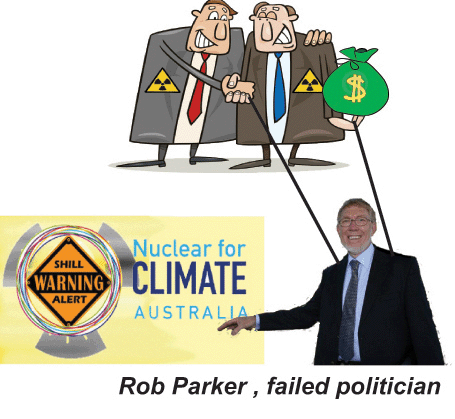
But Australian Nuclear Association Vice President Rob Parker tells Natalie Peters and Erin Molan nuclear energy is the most environmentally friendly and cost-effective option.
“When we look at nuclear energy we find that it is established as being the safest form of power generation that we have on the planet.
“It is safer than coal, safer than oil, safer than anything, including solar and wind. “We have established that we can have a clear low carbon, low-cost, future using nuclear energy.”
U.S. Nuclear Power Plants Weren’t Built for Climate Change, [excellent pictures on original] Bloomberg , By Christopher Flavelle and Jeremy C.F. Lin, April 18, 2019
In 2011, after an earthquake and tsunami caused a meltdown at Japan’s Fukushima-Daiichi power plant, Gregory Jaczko, then the chairman of the U.S. Nuclear Regulatory Commission, had to worry about two things: whether radioactive fallout would harm the U.S. and whether a similar accident could befall an American plant. The answer to the first question turned out to be no. The second question preoccupies him still.
The NRC directed the operators of the 60 or so working U.S. nuclear power plants to evaluate their current flood risk, using the latest weather modeling technology and accounting for the effects of climate change. Companies were told to compare those risks with what their plants, many almost a half-century old, were built to withstand, and, where there was a gap, to explain how they would close it.
That process has revealed a lot of gaps. But Jaczko and others say that the commission’s new leadership, appointed by President Donald Trump, hasn’t done enough to require owners of nuclear power plants to take preventative measures—and that the risks are increasing as climate change worsens.
….. After Fukushima, U.S. regulators told operators to calculate their exposure to various flood risks and compare that with what the plant was designed for. Ninety percent of plants had at least one risk exceeding their design.
According to a Bloomberg review of correspondence between the commission and plant owners, 54 of the nuclear plants operating in the U.S. weren’t designed to handle the flood risk they face. Fifty-three weren’t built to withstand their current risk from intense precipitation; 25 didn’t account for current flood projections from streams and rivers; 19 weren’t designed for their expected maximum storm surge. Nineteen face three or more threats that they weren’t designed to handle.
The industry argues that rather than redesign facilities to address increased flood risk, which Jaczko advocates, it’s enough to focus mainly on storing emergency generators, pumps, and other equipment in on-site concrete bunkers, a system they call Flex, for Flexible Mitigation Capability. Not only did the NRC agree with that view, it ruled on Jan. 24 that nuclear plants wouldn’t have to update that equipment to deal with new, higher levels of expected flooding. It also eliminated a requirement that plants run Flex drills………
The commission’s three members appointed by President Trump wrote that existing regulations were sufficient to protect the country’s nuclear reactors. Jaczko disagrees. “Any work that was done following Fukushima is for naught because the commission rejected any binding requirement to use that work,” he says. “It’s like studying the safety of seat belts and then not making automakers put them in a car.”
The commission “is carrying out the Trump deregulatory philosophy,” says Edwin Lyman, head of the Nuclear Safety Project at the Union of Concerned Scientists. “The NRC basically did everything the industry wanted.” The two Democratic appointees objected to the NRC’s ruling. “The majority of the commission has decided that licensees can ignore these reevaluated hazards,” commissioner Jeff Baran wrote in dissent. His colleague Stephen Burns called the decision “baffling.” Through a spokesman, the Republican appointees declined to comment.
“Nuclear power is weird—it exists to produce electricity, and at the same time it can’t exist without electricity,” says Allison Macfarlane, who chaired the NRC from 2012 through 2014. Plants need constant power to pump cool water into a reactor’s core; if flooding interrupts that power supply for long enough, as happened in Fukushima, the core can overheat, melting through its container and releasing deadly levels of radiation.
The true risk to U.S. nuclear facilities may be even greater than what the documents from the nuclear commission show. The commission allowed nuclear plant operators not only to perform their own estimates of current flood risk but also to decide what assumptions to make—for example, the maximum likely hurricane speed or how much rain would fall in an extreme storm. (The commission reviews that work.) The commission also rejected a recommendation by their own staff that would require nuclear power plants to update their risk assessments periodically to reflect the advancing threat of climate change.
While plant owners weren’t required to project their future storm surge risk, the Union of Concerned Scientists has done its own estimates for some of those regions. The images included here show that projected increase.
Turkey Point Nuclear Generating Station, 35 miles south of Miami, was designed to withstand a storm surge of 16 feet, according to documents submitted to regulators by its owner, Florida Power & Light Co. But the updated storm surge is expected to range from 17.4 feet to 19.1 feet at different parts of the plant. Last year, Florida Power & Light sought permission from regulators to extend Turkey Point’s operating license until 2053.
……….. The Waterford power plant, a half-hour drive up the Mississippi River from New Orleans, was designed to withstand a maximum storm surge of 23.7 feet above sea level, according to documents provided to the NRC by Entergy Corp., which owns the plant. The company told regulators that a combination of storm surge and river flooding would create a maximum surge of 31.8 feet.
……… One of the largest gaps in storm surge protection is at Dominion Energy Inc.’s Surry Power Station, whose two reactors sit on a peninsula jutting into the James River just north of Norfolk, Va. The plant’s east side, which is most exposed to a potential storm surge, was designed to withstand a wall of water as high as 28.6 feet above sea level, Dominion told regulators. The company found that under current conditions, a storm surge combined with river flooding would bring a surge of as much as 38.8 feet. “
…… Dominion asked the NRC to extend its license for Surry to 2053. The commission has yet to rule on that request.
…….. According to documents provided to the commission by Exelon Corp., which owns Peach Bottom, the plant wasn’t designed for its current flood risk from heavy precipitation, storm surge, ice-induced flooding, or a standing wave called a seiche.
The fight over regulation and climate change comes when the nuclear industry, under pressure from cheap natural gas and still viewed with suspicion by many environmentalists, can least afford it, according to Peter Bradford, a former commissioner. “Anything that increases their costs now threatens their existence,” he says.
…… Macfarlane, the former NRC chairman, says the lesson of Fukushima is that the nuclear industry, including regulators, needs to prepare for seemingly unlikely threats. “Boy, did we misjudge natural hazards,” she says. “If something happens and you don’t learn from it, woe unto you.”https://www.bloomberg.com/graphics/2019-nuclear-power-plants-climate-change/
Opinion: ¶ “The Largely Ignored Problem Of Global Peak Oil Will Seriously Hit In A Few Years” • Data from the International Energy Agency shows that with no new investment global oil production will drop by 50% by 2025. That includes oil from all unconventional sources, and new oil exploration is at the lowest level […]










 Antinuclear