NUCLEAR POWER STATIONS ARE NOT APPROPRIATE FOR AUSTRALIA
|
NUCLEAR POWER STATIONS ARE NOT APPROPRIATE FOR AUSTRALIA – AND PROBABLY NEVER WILL BE , Climate Council, Periodically, as with the changing of the seasons, various individuals appear in the media extolling the virtues of nuclear energy, promising a panacea of clean and reliable electricity to solve Australia’s energy crisis. But the truth is far less rosy. …. nuclear energy is not “renewable”. Uranium is a finite resource just like coal or gas. Nuclear energy doesn’t make sense in Australia
……….there are a number of reasons why nuclear power is not appropriate for Australia.
Nuclear power stations are expensiveNuclear power stations are extremely expensive to build. For example, the Hinkley nuclear power station under construction in the UK will cost 20 billion pounds (AU$36 billion). Nuclear cannot compete on a cost basis with wind and solar, which are the cheapest forms of new generation. The cost of energy from the Hinkley Power station is significantly higher than large-scale solar, windand offshore wind energy in the UK. On average, nuclear power stations take a decade to buildThe Hinkley power station will take nine years to build. The global average is 9.4 years. This would be even longer in Australia given there is currently no nuclear industry here. It is not unusual for nuclear power stations to take over a decade between the start of approvals and coming online. For comparison, wind and solar farms take just one to three years. Australia cannot wait this long to replace our ageing fleet of coal power stations, which are already struggling to cope with extreme heat. Nuclear power stations are inflexible and ill-suited to a modern gridNuclear power stations are inflexible – that is, they cannot quickly increase or decrease the amount of electricity they produce. Nuclear power generation is not well suited to modern, fast and flexible electricity grids with large amounts of wind and solar generation. Unlike inflexible nuclear, fast response technologies such as batteries, pumped hydro and solar thermal can be turned on and off, or ramped up and down to balance electricity supply and demand. In California, where wind and solar provides more than 30% of the state’s power needs, the last nuclear power plant will shut by 2026. Nuclear power stations need a lot of waterNuclear power stations require massive quantities of water to operate. In a dry continent like Australia, prone to hot summers and drought conditions which are only likely to get more severe as climate change worsens, it would be reckless to rely on a water-hungry power source like nuclear. The bottom line is this: it makes no sense to build nuclear power stations in Australia. For more information on what Australia needs to build a modern electricity grid, read the Climate Council’s report ‘Powering a 21st Century Economy: Secure, Clean, Affordable Electricity’. https://www.climatecouncil.org.au/nuclear-power-stations-are-not-appropriate-for-australia-and-probably-never-will-be/ |
|
|
Public will never know truth behind Three Mile Island
Chaos at Three Mile Island
|
Public will never know truth behind Three Mile Island, anti-nuclear energy advocates say https://www.witf.org/news/2019/03/public-will-never-know-truth-behind-three-mile-island-anti-nuclear-energy-advocates-say.phpWritten by Ivey DeJesus/PennLive | Mar 26, 2019 he public will never know the truth behind some of the most basic facts about the nation’s worst nuclear disaster nor the actual amount of radiation that was released.Those were some of the messages underscored on Monday by the head of Three Mile Island Alert, an anti-nuclear advocacy group, and other advocates at a press conference in the Main Rotunda of the state Capitol. Just days shy of the 40th anniversary of the partial meltdown at the Three Mile Island nuclear plant in Londonderry Township, TMI Alert’s Eric Epstein excoriated the nuclear industry for misrepresenting the facts of the accident, and in the process misleading and misinforming the public. “Three Mile Island is an accident without an ending,” Epstein said. “There’s no bookends to it. If you look at the holy trinity of nuclear accidents, Three Mile Island, Chernobyl and Fukushima, we can probably pretty much tell you when they started. The reality is there is no ending. This is a funeral where the pallbearers need to stand in place for 500 years. That’s tough for a society that has the memory of a fruitfly.” Epstein was joined by Tim Judson, executive director of Nuclear Information and Resource Service, and Arnie Gundersen, a nuclear engineer, who over the years converted from a proponent to an ardent critic. Judson and Gundersen outlined the chain of events that took place on March 28, 1979, the start of the partial meltdown, as well as the levels of radiation released and subsequent impact on the health of the region. Judson said the Three Mile Island story amounted to a “mistelling of history” of what could have been a preventable accident. He said that as a result of inconsistencies provided by the nuclear industry, the public was not given – nor will never have – a clear picture of the facts and the risks surrounding the meltdown. Gundersen explained that because inadequate radiation monitors were in place at the time, officials were never able to get an accurate reading of radiation levels. All analysis of radiation releases were based on mathematical corrections to estimates derived from off-site dose readings, he said. “How much radiation was released? Nobody knows,” said Gundersen, who began a change of heart on nuclear energy in the 1990s when he served as an expert witness for plaintiffs in a lawsuit against Three Mile Island. He is today chief engineer of Fairewinds Associates, an advocacy group for clean, renewable energy. The Nuclear Regulatory Commission has long stood by its 40-year-old estimate that 10 million Curies of radiation were released. The NRC has also long held that the radiation released during the accident was well within levels deemed safe. The industry has reiterated that no one died or was harmed as a result of the accident. Gundersen said that according to his own analysis of raw data, he calculated that 10 times that amount was released. Epstein further excoriated legislative efforts to “bail out” Pennsylvania’s nuclear power plants, including Exelon Corp., current owner of TMI-1. He said proposals to bail out the nuclear industry in Pennsylvania – to the tune of nearly $3 billion – were “fundamentally and manifestly unfair,” adding that Three Mile Island Alert categorically opposed any bailout.Proposed legislation would lead to the reclassification of Pennsylvania’s nuclear plants as “zero emission energy” and create new requirements on how electric companies purchase power. Among the members of the audience, were several visitors from Fukushima, Japan, site of the 2011 post-tsunami nuclear disaster that led to the evacuation of a quarter of million people. “The same (tactics) used to minimize the damage and risk of health is the same between Fukushima and TMI,” said Hiroko Aihara, a journalist from Fukushima. She said citizen engagement has been pivotal in the case of Three Mile Island and continues to be so in the Fukushima aftermath. “It’s very important to work together. To know we are not alone,” she said. Aihara said the Japanese people – like residents of central Pennsylvania 40 years ago – were not provided with the truth. “Many people are still suffering… about evacuation, radiation, contamination and economic situation,” she said. “We are still suffering or fighting the situation.” |
|
More stunning falls in solar and battery storage costs put fossil fuels on notice — RenewEconomy

BNEF says stunning cost falls mean clean technologies are beating coal and threatening to steal the grid balancing role from gas-fired plant operators. The post More stunning falls in solar and battery storage costs put fossil fuels on notice appeared first on RenewEconomy.
via More stunning falls in solar and battery storage costs put fossil fuels on notice — RenewEconomy
Morrison government says no electric vehicle policy until mid-2020 — RenewEconomy

Federal Coalition government says it does not plan to release an EV strategy before mid-2020. The post Morrison government says no electric vehicle policy until mid-2020 appeared first on RenewEconomy.
via Morrison government says no electric vehicle policy until mid-2020 — RenewEconomy
March 26 Energy News — geoharvey

Science and Technology: ¶ “NASA Is Using Lasers In Space To Measure The Size Of Trees On Earth” • A laser imaging system on the International Space Station provides highly refined measurements to calculate the size and shape of individual trees from 250 miles above the Earth. It will help scientists gauge how much carbon […]
No new coal in Coalition generation shortlist, just an upgrade, gas and storage — RenewEconomy

No new coal plant made the Coalition’s shortlist for new generation, although Morrison has bowed to the far right and agreed to a feasibility study for Queensland coal plant. The post No new coal in Coalition generation shortlist, just an upgrade, gas and storage appeared first on RenewEconomy.
via No new coal in Coalition generation shortlist, just an upgrade, gas and storage — RenewEconomy
Coalition climate scare campaign continues, in desperate pitch to farmers — RenewEconomy

Federal agriculture minister claims 1% emissions reduction could slash national herd and flock by 10% – “more than 2.5m cattle and six million sheep.” Says Labor being “tricky.” The post Coalition climate scare campaign continues, in desperate pitch to farmers appeared first on RenewEconomy.
via Coalition climate scare campaign continues, in desperate pitch to farmers — RenewEconomy
The lies being told by coal lobby to push for Queensland coal plant — RenewEconomy

The campaign for a new coal generator in Queensland has been underpinned by lies and misinformation. A feasibility study should confirm the stupidity of the idea. The post The lies being told by coal lobby to push for Queensland coal plant appeared first on RenewEconomy.
via The lies being told by coal lobby to push for Queensland coal plant — RenewEconomy
Australia gets bottom of class on energy transition, as government clings to coal — RenewEconomy

Australia singled out as one of least prepared of world’s advanced economies to transition to low-carbon energy, according to a new report from the World Economic Forum. The post Australia gets bottom of class on energy transition, as government clings to coal appeared first on RenewEconomy.
via Australia gets bottom of class on energy transition, as government clings to coal — RenewEconomy
It’s cheaper to replace most US coal plants with renewables than keep them open — RenewEconomy

New research finds that replacing 74 per cent of existing coal plants with renewables would immediately reduce costs. The post It’s cheaper to replace most US coal plants with renewables than keep them open appeared first on RenewEconomy.
via It’s cheaper to replace most US coal plants with renewables than keep them open — RenewEconomy
Nuclear waste, and court actions
01/06/2017 Senate Estimates…
“Senator LUDLAM: “That is all right—I have a couple of others I want to run through, and the hour is late. Could you please advise on the cost, the extent of the process and the status of works to recontainerise and secure low-level radioactive waste at the Woomera site? While we are on the subject of how safe this stuff is, how much are we having to spend on recontaining the decaying packaging of the radioactive waste up at Woomera? Is that still kind of your bailiwick, or … ?”
Mr B Wilson : “Not technically; it is actually CSIRO’s waste, so they own that waste and they are responsible for managing it.””
Soooo…..according to documentation in December 1989 the CSIRO COMMISSIONED the Australian Nuclear Science and
Technology Organisation (ANSTO) to remove radioactively contaminated materials from the CSIRO’s Fishermans Bend site in Melbourne. This waste was THEN COMPLETELY ON SITE at ANSTO Lucas Heights in 1990. (Remember that date)
HOWEVER IN THE END IT REMAINED ON SITE at Lucas Heights NSW for FOUR YEARS!
It was only as the result of the Sutherland Shire Council against ANSTO in the New South Wales Land and Environment Court 1991 that the CSIRO waste from Fishermans Bend VICTORIA, and the St Mary’s Waste from the Defence Department was moved to Commonwealth Defence Land in Woomera in South Australia, as ANSTO, under that Environmental Planning and Assessment Act 1979 (NSW), could not accept nuclear waste from OTHER entities.
This court case was in reaction to ANSTO entering into a contract with Australian Defence Industries (ADI) to condition and store radioactive waste from the ADI site at St Marys NSW, 1991. (Remember this date too – not 1990 nor 1989 -when CSIRO waste from Fishermans Bend was on ANSTO Lucas Heights land, nor 1989 when it was contracted!)
Of course after this ruling, ANSTO hurriedly amended the ANSTO Act so this could never happen again!
So….according to Bruce Wilson, CSIRO own the Fishermans Bend waste, and then that means that the Department of Defence in NSW own the St Mary’s waste!
And since the siting of the waste in Woomera was only ever agreed to be TEMPORARY AS IN SPECIFICALLY ” A FEW YEARS” – NOW TWENTY FOUR YEARS AND COUNTING…..then Victoria and NSW are quite welcome to take it back any time NOW!!
The Stop the Adani Convoy: An Interview With Bob Brown
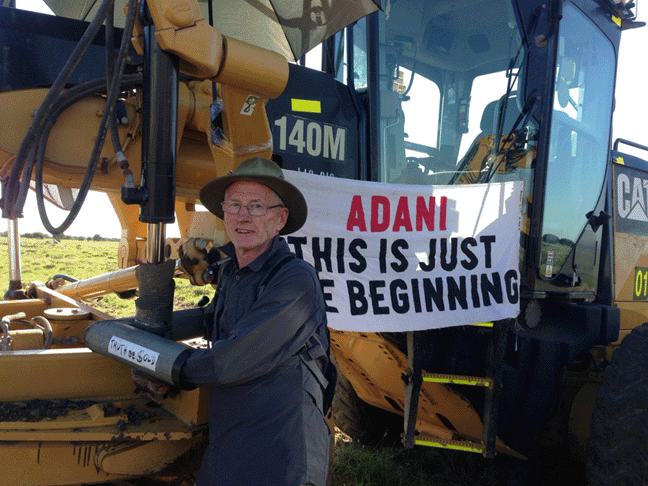
Scroll down the page to Read PaulGregoire‘s interview with BobBrown: www.sydneycriminallawyers.com.au/blog/the-stop-the-adani-convoy-an-interview-with-bob-brown/
By Paul Gregoire 22/03/2019
“Adani announced last November that it plans to go ahead with a self-funded and scaled-down version of the overwhelmingly opposed Carmichael thermal coal mine in the central Queensland Galilee Basin.
This is following the Indian mining giant’s inability to secure any private sector investment both here and overseas, after environmentalists successfully pressured financial institutions into boycotting the Adani project.
At present, the terminally-delayed mine still needs to receive two environmental clearances. One relating to the endangered black-throated finch from the state government. And the other is from the federal government in regard to the groundwater impact the mine would have.
There’s the challenge from the Wangan and Jagalingou Traditional Owners that’s set to go before the full bench of the Federal Court in May. They claim that the Indigenous land use agreement (ILUA) that’s essential for the mine to go ahead is void.
And now, the Bob Brown Foundation is about to launch the Stop the Adani Convoy, which will depart from Hobart on 17 April and make its way through Melbourne, Sydney and Brisbane, before it arrives in the Galilee area.
History repeats
… Mr Brown expects many Australians will join the Stop the Adani Convoy as it makes its way across the country. And the founder and former leader of the Australian Greens and his fellow protesters will hold a rally, after the convoy rolls into Canberra in early May, right before the federal election. … ”
Scroll down the page to Read More and to Read PaulGregoire‘s interview with BobBrown: www.sydneycriminallawyers.com.au/blog/the-stop-the-adani-convoy-an-interview-with-bob-brown/
Bob Brown
The Stop Adani Convoy
“The Stop Adani Convoy will travel the length of Australia, holding public meetings and rallies en route to the Galilee Basin, west of Mackay. We will be there in solidarity with the traditional owners of the land who oppose the mine.”
www.thesaturdaypaper.com.au/opinion/topic/2019/02/09/the-stop-adani-convoy/15496308007421
‘Bigger than Franklin’: Bob Brown to lead anti-Adani road convoy
“His foundation’s “Stop Adani Convoy” plans to travel from Hobart to the coal port of Bowen on the Queensland coast over a fortnight starting from April 17, Mr Brown told the Herald.”
www.smh.com.au/environment/climate-change/bigger-than-franklin-bob-brown-to-lead-anti-adani-road-convoy-20190206-p50w1o.html
Yes, Virginia, Australia’s carbon emissions DO MATTER!
 Yes, Australia’s carbon emissions do have an impact, Independent Australia, By Nicholas Bugeja | 24 March 2019, Don’t listen to the climate sceptics that say Australia’s emissions are irrelevant to tackling climate change. Our contribution does matter — and it has real consequences for fighting this most urgent threat.
For about the last decade, the vast majorityof Australians have believed in the prevailing climate science. Yet the issue was hardly closed, with conservatives and so-called “climate sceptics” constantly trying to impugn what 97% of scientists accept: that climate change is occurring, is human-induced, and will radically alter weather conditions, the natural environment and the world itself.
Over the past year, however, a seemingly widespread, unassailable consensus has emerged in Australia. Finally. That climate change is a matter of the utmost moral and political urgency. Although this conclusion was reached by scientists roughly 30 years ago, the increase of public consciousness around climate change has proven promising and heartening……..
For Sky News’ Chris Kenny , those committed to lowering Australia’s emissions – “the kids, and the Greens, and the Labor politicians” – are “just kidding themselves. They know they will hurt us for no environmental gain.”
This kind of rhetoric is deft and manipulative, meant to lull the public into a sense of disempowerment and ineffectuality about Australia’s role in combating the greatest modern threat to humanity and the planet.
What proponents of this view don’t acknowledge is the need for global unity on this issue. Climate change cannot conceivably be stopped if states, like Australia, throw their hands up in defeat. Imagine if every country of a comparable size to Australia remained passive: the Netherlands, Taiwan, Canada. We’d be condemned, most certainly, to a perilous future of climate instability and disaster. Every bit of carbon reduction matters.
To put it another way, there are 24 countries, Australia included, that contribute between 0.5-1.5% of carbon emission in the atmosphere, an aggregate of 21% of all emissions. This is comparable to China’s total emissions, an admittedly big player in the battle to tackle the problem of climate change. As one cooperative unit, these countries can make a real difference in reducing carbon emission. Australia – one of the world’s richest countries – must be part of the solution, not part of the problem.
It is true climate change cannot be solved by one individual country. But it certainly won’t be if countries fail to make substantial and swift emission cuts in line with their international obligations. Indeed, it’s the cumulative effect of carbon emissions, that extends across borders and nations, that must be focused and acted upon. Australia’s inertia will only further guarantee that the IPCC’s worrying predictions – of widespread flooding, droughts, heat-related deaths, smaller crop harvests, greater amounts of poverty – come true.
Should Australia continue along its current path, its moral authority on the climate change issue will be utterly diminished. The old adage “practice what you preach” has enormous application here. Those states with the highest carbon footprint – the U.S., China, India, Germany – would hardly accept any appeal Australia might make about emissions cuts. And who could blame them? It’s imperative that Australia takes action – for it to have any moral or diplomatic agency in urging other states to mitigate their emissions.
For its size, Australia’s emissions are staggeringly high. In 2015, we ranked 13th in the world for total carbon emission, ahead of much larger countries: UK, Italy and France, as well as most of Africa. Our emissions per capita were the highest in the OECD, at 16 tonnes for each person. ….. https://independentaustralia.net/environment/environment-display/yes-australias-carbon-emissions-do-have-an-impact,12499
Cyclone Idai Lays Bare Deadly Reality of Climate Change in Africa
 https://allafrica.com/view/group/main/main/id/00066940.html Although experts have said it was too early to draw specific conclusions from Idai, for a continent already wracked by the effects of climate change, the Tropical Cyclone has been another chilling reminder of the destructive power of the kind of storms that will become more common in the future. It has been described as the worst weather-related disaster to hit the southern hemisphere, and the UN says more than 2 million people have been affected.
VERDADE By Adérito Caldeira 24 Mar 19,
A week after Tropical Cyclone IDAI “massacred” the center of Mozambique, there are still people under siege in the trees and on the roofs of houses in the provinces of Sofala and Manica.
“The affected area is much larger than we thought, there are almost 125 kilometers of flood areas” said Saviano Abreu of the United Nations Office for the Coordination of Humanitarian Affairs (OCHA). The location of 92 more corpses raised the number of fatalities to 294.
In Nhamatanda in Sofala province 47 bodies were found. Government official Toze Joseph said that there are other communities under water with which communication is impossible
The remaining 45 bodies were located and removed at Dombes administrative post in Sussundenga, Manica province.
In the neighboring province of Manica other 45 bodies were removed from the water at the Administrative office of Dombe in Sussendenga district, said the governor Manuel Rodrigues.
Since Tuesday, March 19, the Government has not publicly updated the number of affected people or fatalities.
“We are still updating the numbers. When the flood waters subside, more bodies will be discovered. When I addressed the nation and world, I said the numbers of dead will increase and that is what is happening,” said President Philip Nyusi in Tete.
Nyusi had earlier said that the number of deaths could rise to a thousand.
Cost estimates for Small and Medium Nuclear Reactors (SMRs) and costs of SMRs under construction
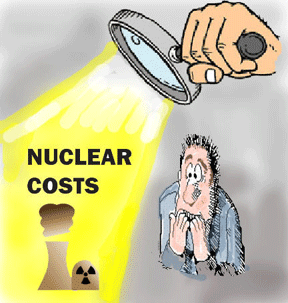 SMR cost estimates, and costs of SMRs under construction, Nuclear Monitor Issue: #872-873 4777 07/03/2019Jim Green ‒ Nuclear Monitor editor
Little credible information is available on the cost of China’s demonstration 2×250 MW high-temperature gas-cooled reactor (HTGR). If the demonstration reactor is completed and successfully operated, China reportedly plans to upscale the design to 655 MW (three modules feeding one turbine, total 655 MW) and to build these reactors in pairs with a total capacity of about 1,200 MW (so much for the small-is-beautiful SMR rhetoric). According to the World Nuclear Association, China’s Institute of Nuclear and New Energy Technology at Tsinghua University expects the cost of a 655 MWe HTGR to be 15-20% more than the cost of a conventional 600 MWe PWR.3
A 2016 report said that the estimated construction cost of China’s demonstration HTGR is about US$5,000/kW ‒ about twice the initial cost estimates.4 Cost increases have arisen from higher material and component costs, increases in labor costs, and increased costs associated with project delays.4 The World Nuclear Association states that the cost of the demonstration HTGR is US$6,000/kW.5
The CAREM (Central Argentina de Elementos Modulares) SMR under construction in Argentina illustrates the gap between SMR rhetoric and reality. Argentina’s Undersecretary of Nuclear Energy, Julián Gadano, said in 2016 that the world market for SMRs is in the tens of billions of dollars and that Argentina could capture 20% of the market with its CAREM technology.6 But cost estimates have ballooned: Continue reading
1 This month.

Australians deserve the truth
about
AUKUS – https://aukuspublicinquiry.com/


PETITION – To: Prime Minister Anthony Albanese and the Australian Labor Government

of the week – Australians for War Powers Reform (AWPR)
To see nuclear-related stories in greater depth and intensity
 Antinuclear