Despite £1 million just to listen, UK councillors reject plan for nuclear waste dumping
 Daily Post 22nd March 2019 , Any plans to find a site to store nuclear waste in Denbighshire will be strongly resisted despite an offer of £1 million just to listen to a government pitch for the plans. The UK government is searching for sites that will allow nuclear waste to be buried.
As part of the process county councils have been offered £1 million to listen to the government sales pitch for the scheme. If a council agrees to the start of work on taking in the waste they will be then given £2.5 million if authorities take part in
the planning stage. Denbighshire councillors will be presented with details of the scheme when they meet next week but already opposition councillors have said there is no way they would support such a move.
https://www.dailypost.co.uk/news/north-wales-news/1m-sweetener-store-nuclear-waste-16015159
UK Council strongly rejects hosting a nuclear waste dump
Leader Live 22nd March 2019 , HOLYWELL councillors were quick to back a bid to reject nuclear waste being dumped in the town. Earlier this year, North Wales residents were consulted in the search for a site to dump 60 years’ worth of the UK’s most dangerous radioactive waste.
At their monthly meeting, town council members were quick to support the motion that Holywell would not become the host of a nuclear waste dump. Plaid Cymru’s Jill Evans MEP sent the town council an email on the subject that was read out at the meeting. “We are writing to you to urge your council to pass a motion stating that your community
will not volunteer to host an underground waste dump.
CND Cymru will keep a record of every community, town and county council that passes such a motion, and submit a list to the government’s consultation as part of our submission to the consultation.” From the end of March, this list of
councils who support this motion will be available on the Campaign for Nuclear Disarmament’s website
Court rejects bid to block South Australia wind and ‘biggest’ battery project — RenewEconomy

Legal bid to block 180MW Twin Creek wind farm, with provisions for an energy storage facility more than twice the size of the Tesla big battery, has been rejected. The post Court rejects bid to block South Australia wind and ‘biggest’ battery project appeared first on RenewEconomy.
via Court rejects bid to block South Australia wind and ‘biggest’ battery project — RenewEconomy
Coalition’s Canavan launches the sausage sizzle climate scare campaign — RenewEconomy

Canavan says Labor’s climate plan will mean the end of the sausage sizzle and $100 meat trays. The scare campaign is on! The post Coalition’s Canavan launches the sausage sizzle climate scare campaign appeared first on RenewEconomy.
via Coalition’s Canavan launches the sausage sizzle climate scare campaign — RenewEconomy
Residents around TMI exposed to far more radiation than officials claimed — Beyond Nuclear International

Research was gagged and radiation monitors weren’t functioning
Too cheap to meter now needs a bailout? — Beyond Nuclear International

Time for Three Mile Island nuclear plant to close
via Too cheap to meter now needs a bailout? — Beyond Nuclear International
March 24 Energy News — geoharvey

Opinion: ¶ “Propaganda, Politics, And The Environment” • Democratic systems can fail when those in the position of making and maintaining laws, the politicians, put their personal ends before the society that the system was originally built to benefit. They use propaganda to achieve their ends. Democracy in America is failing because of it. [CleanTechnica] […]
Coal became a dirty word in NSW poll, but wind and solar face uncertainty — RenewEconomy

The likely biggest losers from the NSW poll result were the coal loving Nationals, and the large scale wind and solar industry. The post Coal became a dirty word in NSW poll, but wind and solar face uncertainty appeared first on RenewEconomy.
via Coal became a dirty word in NSW poll, but wind and solar face uncertainty — RenewEconomy
Wind generation hits peak output of more than 4,000MW in Australia — RenewEconomy

Australia’s wind output reaches a record peak of more than 4,000MW. The post Wind generation hits peak output of more than 4,000MW in Australia appeared first on RenewEconomy.
via Wind generation hits peak output of more than 4,000MW in Australia — RenewEconomy
CEFC tips $10m into home solar and battery-focused green bond — RenewEconomy

CEFC invests $10m in latest green bond from FlexiGroup – a $90.9 million issuance, with a large portion of rooftop solar, and a smaller portion of small-scale battery storage. The post CEFC tips $10m into home solar and battery-focused green bond appeared first on RenewEconomy.
via CEFC tips $10m into home solar and battery-focused green bond — RenewEconomy
Australia and the uneconomic “new nuclear” push – theme for April 19,

The global nuclear lobby has Australia in its sights. And they have a faithful servant in Dr Adi Paterson and his Australian Nuclear Science and Technology Organisation. Never mind that Australia has laws against developing nuclear power. Never mind that as a political ally of USA, Australia shouldn’t be partnering with China to develop nuclear reactors. Adi’s just signed us up to do that, anyway.
Apart from the dodgy politics of this, the big problem is the DISECONOMICS of new nukes – “Generation IV ” nuclear reactors.
The global nuclear lobby, getting desperate about the increasing financial quagmire of nuclear power, is obsessed with selling nuclear reactors overseas. Russia and China, with government owned nuclear firms, offer other countries huge loans, to buy their product. The West can’t do this, as the industry is owned by commercial firms, not by the government.
Now the push is on, to develop “new nukes” – “Generation IV nuclear reactors, – and sell them to overseas countries. AS there’s no market for these reactors, because they’re simply not economic, then the buyer, and the funding developer, must be the government.
The Australian Nuclear Science and Technology Organisation (ANSTO) , (? fortunately) is funded by the tax-payer, (much as they pretend to have a huge future in selling medical isotopes) . Dr Paterson and ANSTO seem to be a law unto themselves. Is the Australian government asleep at the wheel?
I mean – let’s pretend for a moment that ethical issues, health, safety, environment nuclear weapons proliferation, – all those things just don’t matter. BUT – WHAT ABOUT COSTS? What about Australian tax-payers money being chucked out at a commercially unviable industry? Omigawd!
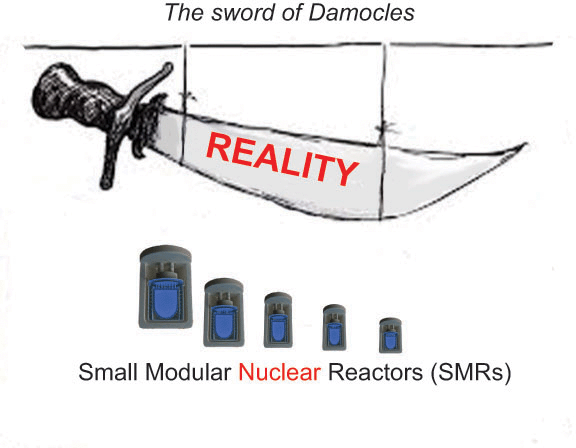
Poor outlook for small nuclear reactors – they have a dismal history of failure
 Many of the expenses associated with constructing and operating a reactor do not change in linear proportion to the power generated. For instance, a 400 MW reactor requires less than twice the quantity of concrete and steel to construct as a 200 MW reactor, and it can be operated with fewer than twice as many people.
In the face of this prevailing wisdom, proponents of small reactors pinned their hopes on yet another popular commercial principle: “economies of mass production.”
In 1968, the same year Elk River shut down, the last of the AEC’s small reactors was connected to the grid: the 50 MW La Crosse boiling water reactor.19 That plant operated for 18 years; by the end, its electricity cost three times as much as that from the coal plant next door, according to a 2012 news account about the disposal of the plant’s spent fuel. Dealing with the irradiated uranium-thorium fuel proved difficult too. Eventually, the spent fuel was shipped to a reprocessing plant in southern Italy.
Since then, not a single small reactor has been commissioned in the United States.
Without exception, small reactors cost too much for the little electricity they produced, the result of both their low output and their poor performance.
The forgotten history of small nuclear reactors Nuclear Monitor Issue: #872-873 4775 07/03/2019 M.V. Ramana ‒ Simons Chair in Disarmament, Global and Human Security at the School of Public Policy and Global Affairs at the University of British Columbia
the technology remains in stasis or decline throughout the Americas and Europe. …..
A fundamental reason for this decline is indeed economic. Compared with other types of electricity generation, nuclear power is expensive. Continue reading
The bugocalypse – study after study shows the dramatic declines in insect populations
 Why are insects dying in such numbers? https://www.smh.com.au/environment/conservation/why-are-insects-dying-in-such-numbers-20190319-p515hb.html By Greg Callaghan March 23, 2019 It’s been dubbed the bugocalypse – study after study rolling in from countries across the globe pointing to dramatic declines in insect populations. In Germany, an 82 per cent fall in midsummer invertebrate populations across 63 nature reserves between 1990 and 2017; in the Puerto Rico rainforest, a 75 per cent reduction in the volume of insects between 1976 and 2013; in the UK, a one-third fall in the honeybee population over the past 10 years. Across the US, monarch butterfly and ladybird beetle numbers are at record lows.
In alpine NSW, there’s been a collapse in bogong moth populations, resulting in starving pygmy possums, who feed on them. Most worrying, a research review of 73 existing surveys, released last month by the University of Sydney’s Institute of Agriculture, discovered that 40 per cent of insect species will likely be in catastrophic decline within a century.
So what’s going on? Just more scary headlines, or a real indicator of an eco-crisis ahead? A bit of both. While certain “beneficial” insect populations (butterflies, grasshoppers, mayflies, dragonflies, ground beetles, fireflies) appear to be in unprecedented retreat, others considered pests and a risk to human health (tsetse flies, ticks, mosquitoes) are on the offensive again.
We’re all sure a decline is happening,” explains Dr David Yeates, director of the Australian National Insect Collection in Canberra. “But to obtain a useful measure, we need to compare insect numbers today with those of 30, 40 or 50 years ago – but invertebrate counts weren’t being done then.”
So what’s causing the bug die-off? The top culprit is likely to be wilderness loss – many insects feed off native plants, and the relentless spread of single-crop farmland and insecticides has shrivelled their range, says Yeates. Another culprit: global warming, which favours some insects over others. Cut out insects and you lose all the creatures that feed on them, including frogs, lizards and birds. Of course, a large proportion of the food we eat comes from plants pollinated by insects, and they also clean up the environment, notes Yeates. “Waking up in a world without insects would be like waking up in a garbage dump.”
The spectacularly rising costs of cleaning up the Fukushima nuclear catastrophe
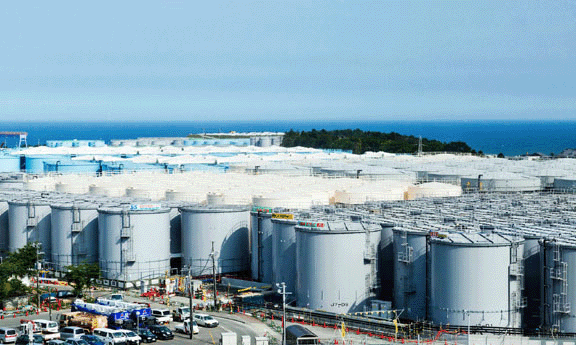
Think tank puts cost to address nuke disaster up to 81 trillion yen http://www.asahi.com/ajw/articles/AJ201903100044.html By ATSUSHI KOMORI/ Staff Writer, 23 Mar 19
March 10, 2019 In a startling disparity, a private think tank puts the cost of addressing the 2011 Fukushima nuclear disaster between 35 trillion yen and 81 trillion yen ($315 billion and $728 billion), compared with the government estimate of 22 trillion yen.
The calculation, by the Tokyo-based Japan Center for Economic Research, showed that the total could soar to at least 60 percent more and up to 3.7 times more than the 2016 estimate by the Ministry of Economy, Trade and Industry.
In releasing the latest estimates on March 7, the center said it is time for serious debate over the role nuclear energy should play in the nation’s mid- and long-term energy policy.
Of the highest price tag of 81 trillion yen, 51 trillion yen would go toward decommissioning the crippled Fukushima No. 1 nuclear power plant and treating and disposing of radioactive water. The ministry put the cost for these tasks at 8 trillion yen.
The center calculated the compensation to victims at 10 trillion yen, while the comparable estimate by the ministry was 8 trillion yen.
Although the center’s estimate for the decontamination operation was 20 trillion yen, the ministry’s projection was 6 trillion yen.
The biggest disparity in the estimates between the think tank and the ministry is that the former put the treatment and disposal of contaminated water at 40 trillion yen and included the cost for disposing of polluted soil produced during cleanup operations in the overall costs.
If contaminated water is released in the sea after it is diluted with water, the overall costs could be 41 trillion yen, including 11 trillion yen estimated for decommissioning and disposal for tainted water.
The least expensive way of coping with the accident–35 trillion yen–would be to encase the plant in a concrete sarcophagus, rather than undertaking the formidable challenge of retrieving melted nuclear fuel from the reactors, and releasing contaminated water into the sea. In this case, it would cost 4.3 trillion yen to close down the plant and dispose of the radioactive water.
But this scenario drew fire from residents in the affected municipalities as they view covering nuclear fuel debris with a massive structure would be tantamount to asking them to give up hope of eventually returning to their hometowns.
The center’s latest projections followed its estimates two years ago, in which the number varied from 50 trillion yen to 70 trillion yen.
It updated its projections based on the findings about treatment and disposal of radioactive water and progress in cleanup operations over the past years.
Independent report found ANSTO’s health staff lacking in knowledge about radiation exposure
 Kazzi Jai Fight To Stop Nuclear Waste Dump In Flinders Ranges SA
“In addition, based on interviews with ANSTO Health staff working in high hazard areas, the majority of staff did not understand the various health effects of radiation exposures, this being appropriate to individual duties with respect to the hazardous areas in which they work. This is believed by the reviewers to put at risk the ability to verify all persons
performing high risk activities are fully competent to do so. More importantly, this puts the individual at risk.”
– (excerpt from page 7) “INDEPENDENT SAFETY REVIEW OF THE ANSTO HEALTH APPROACH TO OCCUPATIONAL RADIATION SAFETY AND OPERATIONAL PROCEDURES”
OCTOBER 2018
On 5 October 2018, following a direction from ARPANSA’s CEO Dr Carl-Magnus Larsson, the Australian Nuclear Science and Technology Organisation (ANSTO) provided ARPANSA with a report produced by an independent expert review team outlining 85 recommendations to improve ANSTO’s occupational radiation safety processes and operational procedures.
Dr Larsson issued the direction to initiate an independent review on 29 June 2018 under section 41(1A) of the Australian Radiation Protection and Nuclear Safety Act 1998 (the Act) following four separate events with safety implications at ANSTO Health in less than 10 months.

Seems this report was somewhat “buried” in ANSTO’s bright new webpages..….but I got mine from ARPANSA’s webpage instead, since they are the regulator. https://www.facebook.com/groups/344452605899556/
1 This month.

Australians deserve the truth
about
AUKUS – https://aukuspublicinquiry.com/


PETITION – To: Prime Minister Anthony Albanese and the Australian Labor Government

of the week – Australians for War Powers Reform (AWPR)
To see nuclear-related stories in greater depth and intensity
 Antinuclear