The protest comes a month after about 10,000 youngsters staged a nationwide school strike across 60 cities in Britain, showing how a grass roots movement inspired by a Swedish girl last summer had taken off…….
Who should hold “hot potato” of connection costs for wind and solar farms? — RenewEconomy

Developers and contractors want more clarity, and fewer last minute changes, to connections for wind and solar projects. The post Who should hold “hot potato” of connection costs for wind and solar farms? appeared first on RenewEconomy.
via Who should hold “hot potato” of connection costs for wind and solar farms? — RenewEconomy
March 13 Energy News — geoharvey

Opinion: ¶ “Wyoming’s Coal Plants Are So Unprofitable Republicans Turned To A ‘Socialist Program’ To Save Them” • Wyoming recently enacted a law that forces utilities seeking to shut down unprofitable coal plants to try to sell them first, and then to buy back the power from the new owner, even if cheaper power is […]
NSW approves new 165MW solar farm near Gunnedah — RenewEconomy

NSW commission approves 165MW solar farm to be built near Gunnedah. The post NSW approves new 165MW solar farm near Gunnedah appeared first on RenewEconomy.
via NSW approves new 165MW solar farm near Gunnedah — RenewEconomy
Queensland approves new 240MW wind farm for Western Downs region — RenewEconomy

A $450m wind project by UK-based developer RES Group has won Queensland state planning approval and may add solar. The post Queensland approves new 240MW wind farm for Western Downs region appeared first on RenewEconomy.
via Queensland approves new 240MW wind farm for Western Downs region — RenewEconomy
RBA turns Dorothea Mackellar’s “My Country” right back on climate deniers — RenewEconomy

RBA deputy governor uses “My Country” – a favourite poem of climate deniers – to highlight climate threat to Australia’s financial stability, and opportunities in wind, solar, battery technologies. The post RBA turns Dorothea Mackellar’s “My Country” right back on climate deniers appeared first on RenewEconomy.
via RBA turns Dorothea Mackellar’s “My Country” right back on climate deniers — RenewEconomy
Students strike to spur adults into climate action
Kids across the globe are protesting a failure of governments to cut greenhouse-gas emissions Science News for Students, KATHIANN KOWALSKI, MAR 11, 2019 “…… As of March 6, there were 596 planned events across 64 countries, according to a list kept by the group Fridays For Future.
Milou Albrecht, 14, of Castlemaine, Australia, is a co-leader of strikes in her country. What motivates her, she says, is worry about wildfires. When she was little, a fire quickly approached the bush country where she was playing at a friend’s house.,,,,,,
A worldwide movement Many young protesters have drawn inspiration from Greta Thunberg. The 16-year old Swedish teen……..
began regularly protesting outside Sweden’s Parliament last summer. She also has encouraged kids to strike in other countries. She even spoke to delegates at the 2018 United Nations Climate Change Conference (UNCCC). It was held in December in Katowice, Poland.
“You say you love your children above all else, and yet you are stealing their future in front of their very eyes,” Greta told attendees at the UNCCC. There is still time to limit the worst impacts, she noted — but only if governments act now. “Until you start focusing on what needs to be done rather than what is politically possible,” she said, “there is no hope.”…..
“Climate denialism is like suicide,” Nakate Vanessa of Uganda, says of the people who argue climate change is not happening. “We cannot let ourselves perish as we look on without doing anything,” she says. “Not taking climate action is like locking yourself up in a house on fire.” …….
As Greta Thunberg told the United Nations meeting, “We have run out of excuses, and we are running out of time.” https://www.sciencenewsforstudents.org/article/students-climate-strike-march-spur-adults-climate-action
School students’ climate action strike, across Australia, on 15 March -and this is having its impact!
Students strike for climate change, defying calls to stay in school | ABC News
Australia’s young climate activists to strike again – and people are listening Students around the world have been holding protests over climate change in recent months, and they’re happening again in Australia this week. SBS, BY NICK BAKER 11 Mar 19, Australian students are once again planning to walk out of schools to protest climate change inaction.
Dismissing Aboriginal objections, Leonora Shire Council, (Western Australia) wants an underground nuclear waste dump!
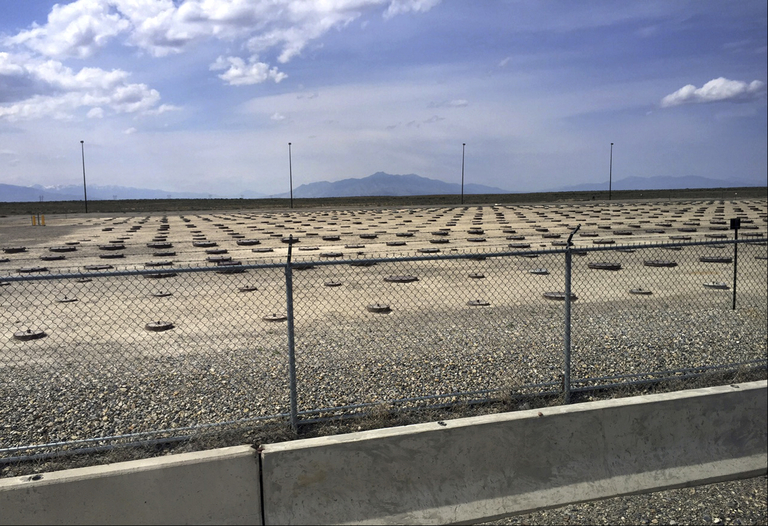
Outback WA council keeps hand raised for nuclear waste facility, as legal action halts progress on SA sites ABC North and West ,By Gary-Jon Lysaght , 12 Mar 19, While the search for a place to store Australia’s nuclear waste remains on hold pending a decision by the Federal Court, a small council in outback Western Australia still has its hand raised as a potential site.
Key points:
- Kimba and Hawker in South Australia are being considered as sites for storing nuclear waste
- A company called the Azark Project has a proposal to store waste in a “seismically stable” location near Leonora in the WA Goldfields
- The Federal Government says it is currently not considering Leonora as a potential location
Leonora, a WA Goldfields town about 200 kilometres north of Kalgoorlie, is being touted as a potential location for an underground nuclear waste disposal facility.
The Federal Government is considering sites at Kimba and Hawker in South Australia for an above-ground facility capable of permanently storing low-level waste and temporarily storing intermediate-level waste.
Nuclear waste being stored at Australia’s Nuclear Science and Technology Organisation (ANSTO) would be sent to the nuclear waste disposal facility…….
He said the Azark proposal was to store low-level and intermediate-level waste underground on a permanent basis. ……
Leonora not being considered
The Department of Industry, Innovation and Science said it was currently not considering Leonora as a potential location and that detailed studies were continuing at the three nominated sites in South Australia.
Lyndhurt and Napandee are the properties near Kimba being considered and the site near Hawker is called Wallerberdina Station.
A proposed community ballot on support for the facility in Kimba and Hawker has been on hold pending legal action.
The Leonora Shire Council remains in favour of a nuclear waste facility near the town, saying it could provide jobs and much-needed infrastructure for the small town.However, Leonora Shire President Peter Craig said that support could wane because of what he described as a lack of consultation from Azark.
“Azark did have a community meeting back in April 2018, which was pretty positive, there were some questions that still needed to be answered,” he said.
“To this day, in our view, as a council, Azark have failed in consultation work with the community…….
Mr Craig said Azark had consulted people one-on-one but not in a wider group since the 2018 meeting. ……
Cultural and environmental concerns
Throughout the site selection process at both Kimba and Hawker there has been opposition from local Aboriginal groups, who say a facility would impinge on sacred land.
Dave Sweeney from the Australian Conservation Foundation said local Aboriginal groups at Leonora remained strongly opposed to the facility.
“[Azark] says there’s no chance of any impact on water — there’s no evidential basis for that,” he said.
“They say there is no cultural or heritage issues — that is contested by local Aboriginal people.
“When this was first flagged, Aboriginal people who have deep concerns about this proposal got a petition together that rapidly got, in a number of days, around 500 signatures.
“In a remote region, that’s a quick and significant expression of concern.”……
Mr Sweeney said the Federal Government should stop the site selection process.
“We desperately need, right now, for the brakes to go on the federal process at Kimba and at Hawker and an independent assessment of the best ways we can manage radioactive waste.” https://www.abc.net.au/news/2019-03-12/goldfields-council-continues-support-for-nuclear-waste-facility/10887644?pfmredir=sm&fbclid=IwAR1mUzAfXLzOl5CeF41xkST82NALrwTf4xs8pVRnfW5v5U1FS9KxJZoLX04
From Australia to Japan to India, USA also, youths will skip school on March 15 to protest against climate change
Striking for the future: From Australia to Japan to India, youths will skip school on March 15 to protest against climate change
Students from at least six Asian countries will take part in Global Strike for Future
But authorities in some countries have warned students not to disrupt classes South China Morning Post Zoe Low 10 Mar, 2019 On March 15, students from at least six countries in the Asia-Pacific will be part of a global school strike to demand concrete action from governments to tackle climate change.
Even more Australian students will strike for climate action, this Friday
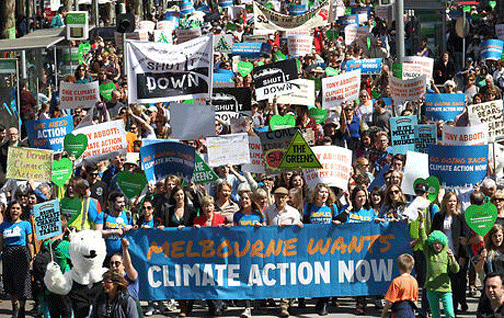
We’ve been forced into this’: Australia’s school climate strikes to go global Guardian, Naaman Zhou@naamanzhou, 11 Mar 2019 In November, Scott Morrison told the striking students to ‘go to school’ – this time even more of them will strike Four months on, 17-year-old Doha Khan says the school climate strikers have learned a lot.
On Friday, thousands of primary and high school students are again planning to walk out of class across the country, protesting against the government’s inaction on climate change, and what they see as the destruction of their future.
Up to 50 rallies, in scores of regional towns, are planned for 15 March. This time, the students will be joined by others in America and Europe, in what has become a global movement.
At the November protests, thousands took to the streets. In Canberra, they met Greens senators, Labor MPs and the independent MP Rebehka Sharkie. They were told by the prime minister, Scott Morrison, to “go to school”, and by the resources minister, Matt Canavan, that they were “learning to join the dole queue”.
More recently, the New South Wales education minister, Rob Stokes, told students to stay in class because “you can’t strike if you don’t have a job”.
But the leaders of Friday’s strike say the movement has only grown, gained momentum, and become smarter.
“We really did take into account a lot of the criticism that came out of last year,” says Khan, who goes to the Glenunga International high school in Adelaide.
“There were claims that the kids were just striking and didn’t have any demands. So this time around we’ve made our demands a lot clearer.
“We have them set out on all banners: stopping the Adani coalmine. No new fossil fuel projects, 100% renewables by 2030.”
This year, the number of rally points has grown, mostly in regional areas. There are 18 in New South Wales alone – from Bowral to Byron Bay – and Khan feels enthusiasm has risen, rather than quietened down.
“This time our response rate has doubled,” she says. “Last time, a week before the strike, we had 1,000 responses on Facebook. This week we are over 2,300. We are now getting a hundred responses a day. That’s pretty cool – and this is just the Adelaide strike.”……..https://www.theguardian.com/environment/2019/mar/11/weve-been-forced-into-this-australias-school-climate-strikes-to-go-global
After Fukushima: Nuclear power’s deepening crisis -it’s never appropriate for Australia
Independent Australia By Dave Sweeney | 12 March 2019 Eight years ago the world held its breath as the Fukushima nuclear crisis unfolded in Japan. Today the lands are littered and the seas awash with the consequences of radioactive waste responses and the economic, human and environmental costs are severe and continuing.
Fukushima was directly fuelled by Australian uranium and in its aftermath, this contested trade remains hard hit, as is the wider global nuclear power sector. Globally, reactors are in recession and the promises of the promoters look increasingly hollow.
The nuclear industry is in crisis everywhere.
In contrast, worldwide renewable power generation has doubled over the past decade and costs continue to fall dramatically.
A record amount of new renewable power capacity has been installed worldwide every year over the past decade. Renewables accounted for over 26 per cent of global electricity generation in 2017, while the nuclear contribution languishes at ten per cent. Around our shared planet, over ten million people are employed in renewable energy industries and the trajectory is only going one way.
In January, Australia’s Climate Council, comprising leading climate scientists and policy experts, issued a policy statement concluding that:
‘Nuclear power stations are not appropriate for Australia — and probably never will be.
According to the Climate Council:
‘Nuclear power stations are highly controversial, can’t be built under existing law in any Australian state or territory, are a more expensive source of power than renewable energy, and present significant challenges in terms of the storage and transport of nuclear waste, and use of water.’
This view was reinforced by Federal Labor, at its national conference in December, when it committed to
“prohibit the establishment of nuclear power plants and all other stages of the nuclear fuel cycle in Australia.”
At this time, Shadow Energy Minister Mark Butler was scathing of nuclear advocates, telling ABC Radio:
“This is not a technology that has any opportunity for Australia, it is extraordinarily expensive power as well… we want to focus on renewable energy which is going to bring down emissions, bring down power prices, and power thousands and thousands of jobs.”
China ‒ long seen as the saviour for the industry ‒ has not approved a new reactor construction site for more than two years and is instead prioritising renewable energy. The number of countries phasing out nuclear power now includes Germany, Switzerland, Spain, Belgium, Taiwan and South Korea.
The British nuclear power industry is in free-fall …….
Nuclear lobbyists used to claim nuclear power would be too cheap to meter. Now, it’s too expensive to matter……. https://independentaustralia.net/business/business-display/after-fukushima-nuclear-powers-deepening-crisis,12459
The startling and continuing costs of the Fukushima nuclear accident
Asahi Shimbun 10th March 2019 In a startling disparity, a private think tank puts the cost of addressing the 2011 Fukushima nuclear disaster between 35 trillion yen and 81 trillion yen ($315 billion and $728 billion), compared with the government estimate of 22 trillion yen.
The calculation, by the Tokyo-based Japan Center for Economic Research, showed that the total could soar to at least 60 percent more and up to 3.7 times more than the 2016 estimate by the Ministry of Economy, Trade and Industry. In releasing the latest estimates on March 7, the center said it is time for serious debate over the role nuclear energy
should play in the nation’s mid- and long-term energy policy.
Of the highest price tag of 81 trillion yen, 51 trillion yen would go toward decommissioning the crippled Fukushima No. 1 nuclear power plant and treating and disposing of radioactive water. The ministry put the cost for these tasks at 8 trillion yen. The center calculated the compensation to victims at 10 trillion yen, while the comparable estimate by the ministry
was 8 trillion yen.
Encouragement to the kids, who no doubt will be ridiculed for standing up about climate change
Striking schoolkids should wear storm of criticism as a badge of honour https://www.brisbanetimes.com.au/environment/climate-change/striking-schoolkids-should-wear-storm-of-criticism-as-a-badge-of-honour-20190311-p513ec.html By John Birmingham March 11, 2019
I hope a lot of school kids join this global children’s strike on Friday and I hope they’re mocked and traduced by their elders in politics and the media, because those elders aren’t really their betters on this issue; they’re mostly either dangerous fools or mendacious swine.
The hammer of the coming climate catastrophe will fall most heavily on these kids and eventually upon their children and grandchildren, 20, 30, 40 years from now, and it will do them no harm to take a few rhetorical knocks from a bunch of bloviating, overpaid idiots simply because they chose to step up and take action now. It’ll be good practice.
They’re going to be doing this for the rest of their lives, unless they’re cool with those lives ending in famine, superstorms and wars over diminishing water supplies, and shrinking remnants of arable land.
Protest won’t directly change that of course. Only radically revised policy settings, massive expenditure on clean energy R&D, and the accelerated deployment of paradigm shifting new technologies can change that. But that change will come only when political actors feel a real sense of terror for their futures. Not the future of the planet and its inhabitants, mind you. Just for their own immediate futures. Their pay cheques.
When they feel that existential terror creeping up on them, you’ll start to see things like Tony ‘climate change is BS’ Abbott, perform the sort of tortured interpretive dance routine the electors of Warringah have enjoyed this week.
Abbott is tying himself into Yogi Master knots as he tries to fend off the challenge of Zali Steggall, a highly accomplished and impeccably conservative independent candidate for his seat, who somehow manages to believe in the free market, the primacy of the individual, franking credits for everyone and how awesome it would be if our lives didn’t end in famine, superstorms and war over diminishing water supplies etc, etc.
The only reason Abbott and his fellow travellers on the dirty great coal train to oblivion feel any need to move away from their previous embrace of pro-apocalypse energy policy is because they can see that public opinion has moved on. Year after year of worsening climate and extreme weather events will eventually do that to people.
All those kids who strike on Friday are helping to move that opinion. Yeah, they’ll be derided and ridiculed, their motives questioned and belittled. But they just need to remind themselves that those who caused this problem will soon enough all be dead, leaving them to clean up the mess.
Best they get started now.
Endless clean-up work at Fukushima nuclear wreck
TV5 Monde 8th March 2019, Japan: 8 years after the tsunami, the Fukushima power station remains a huge construction site. The immediate risk seems to be averted, but where arduous tasks and unforeseen events continue.
Here are the three main issues:
Nuclear fuel Four of the six reactors at the plant were damaged. The cores of units 1 to 3 have melted at the time of the accident and it is now known that the fuel has almost completely fallen to the bottom of the primary containment of each unit, which it even partially started.
Contaminated water, waste. The site is teeming with contaminated water, “although the various measures taken have mitigated” the problem, according to Mr. Ono. The water is initially that of the tsunami that ravaged the facilities, water that had to pump, sanitize and store. It is then the one
used to cool the reactors and finally the one that falls from the sky and down the mountain upstream and contaminates the way. However, an underground barrier wall and pumps make it possible to limit the amount of water contaminated by the installations.
used to cool the reactors and finally the one that falls from the sky and down the mountain upstream and contaminates the way. However, an underground barrier wall and pumps make it possible to limit the amount of water contaminated by the installations.
About 4 / 5,000 people work on the site every day, almost half as many as four years ago, “because large construction sites have been completed (wall of ice, laying a coating on the ground, construction of various buildings), “says Ono. On average, the exposure of workers to radiation is now less than 5 mSV per year, but this single figure masks the large disparities between individuals according to their tasks.
https://information.tv5monde.com/info/japon-8-ans-apres-le-tsunami-la-centrale-de-fukushima-reste-un-enorme-chantier-289025
https://information.tv5monde.com/info/japon-8-ans-apres-le-tsunami-la-centrale-de-fukushima-reste-un-enorme-chantier-289025
Small modular nuclear reactors headed for the graveyard
An obituary for small modular reactors Jim Green, The Ecologist, 11 March 2019, https://theecologist.org/2019/mar/11/obituary-small-modular-reactors
The nuclear industry is heavily promoting the idea of building small modular reactors (SMRs), with near-zero prospects for new large power reactors in many countries. These reactors would have a capacity of under 300 megawatts (MW), whereas large reactors typically have a capacity of 1,000 MW.
Construction at reactor sites would be replaced with standardised factory production of reactor components then installation at the reactor site, thereby driving down costs and improving quality control.
The emphasis in this article is on the questionable economics of SMRs, but a couple of striking features of the SMR universe should be mentioned (for details see the latest issue of Nuclear Monitor).
First, the enthusiasm for SMRs has little to do with climate-friendly environmentalism. About half of the SMRs under construction (Russia’s floating power plant, Russia’s RITM-200 icebreaker ships, and China’s ACPR50S demonstration reactor) are designed to facilitate access to fossil fuel resources in the Arctic, the South China Sea and elsewhere. Another example comes from Canada, where one application of SMRs under consideration is providing power and heat for the extraction of hydrocarbons from oil sands.
A second striking feature of the SMR universe is that it is deeply interconnected with militarism:
- Argentina’s experience and expertise with small reactors derives from its historic weapons program, and its interest in SMRs is interconnected with its interest in small reactors for naval propulsion.
- China’s interest in SMRs extends beyond fossil fuel mining and includes powering the construction and operation of artificial islands in its attempt to secure claim to a vast area of the South China Sea.
- Saudi Arabia’s interest in SMRs is likely connected to its interest in developing nuclear weapons or a latent weapons capability.
- A subsidiary of Holtec International has actively sought a military role, inviting the US National Nuclear Security Administration to consider the feasibility of using a proposed SMR to produce tritium, used to boost the explosive yield of nuclear weapons.
- Proposals are under consideration in the US to build SMRs at military bases and perhaps even to use them to power forward operating bases.
- In the UK, Rolls-Royce is promoting SMRs on the grounds that “a civil nuclear UK SMR programme would relieve the Ministry of Defence of the burden of developing and retaining skills and capability”.
Independent economic assessments
SMRs will almost certainly be more expensive than large reactors (more precisely, construction costs will be lower but the electricity produced by SMRs will be more expensive). Continue reading
1 This month.

Australians deserve the truth
about
AUKUS – https://aukuspublicinquiry.com/

PETITION – To: Prime Minister Anthony Albanese and the Australian Labor Government

of the week – Australians for War Powers Reform (AWPR)
To see nuclear-related stories in greater depth and intensity
 Antinuclear