Sydney to host international climate conference for women in 2020
 Sydney wins bid to host major climate conference for women in 2020, Brisbane Times, https://www.brisbanetimes.com.au/environment/climate-change/sydney-wins-bid-to-host-major-climate-conference-for-women-in-2020-20190203-p50vd2.html, By Peter Hannam 3 February 2019 Hundreds of climate leaders are expected to flock to Sydney next year after the City of Sydney won its bid to host a global conference for women.
The C40 group, representing 94 cities home to more than 700 million people, has selected Sydney to host its Women4Climate Conference in April 2020.
Lord Mayor Clover Moore said cities are responsible for a “staggering 75 to 80
per cent” of the world’s greenhouse gas emissions, making action in cities to cut carbon pollution crucial.
“Many of the world’s biggest cities are setting ambitious targets and policies to reduce
greenhouse gas emissions, proving effective action on climate change and strong
economic growth are compatible,” Cr Moore said.
“Shamefully, our own national government has a history of wilful negligence and Australian
politicians, both state and federal, are presiding over a climate disaster.”
Polling, including by the Lowy Institute, suggest concern about climate change is at the highest level since the end of the Millennium Drought.
Those numbers may well rise after a summer of extremes, from mass fish kills on the Darling River, raging fires in Tasmania, extensive flooding in Queensland and record heat for Australia in December and January.
The Women4Climate aims to empower young female leaders to take action to protect the environment, with a focus on mentoring, research and technology.
Sydney Council is expected to endorse the proposal to host next year’s conference when it votes on the city’s budget on February 11, with Cr Moore’s Independent Team set to use its majority to support the plan.
Nuclear Company SNC-Lavalin should be barred from federal contracts

Is this company an advisor to ANSTO and Australia’s nuclear lobby?
SNC-Lavalin should be barred from federal contracts: Angus, Call comes after two former executives pleaded
 guilty to breaking laws · CBC News Feb 03, 2019 The Canadian government should suspend engineering giant SNC-Lavalin from competing for future federal government contracts after two former top executives pleaded guilty to charges in recent weeks, says NDP MP Charlie Angus.
Americal Republican politicians get big money from coal companies, – wonder how many Australian Liberals do?

150 Congressional Republicans Represent Fossil Fuel Companies Instead of Their Communities https://www.desmogblog.com/2019/01/30/150-congressional-republicans-climate-deniers-fossil-fuel-companies?utm_source=dsb%20newsletter , January 30, 2019 by ClimateDenierRoundup.
Last week, we mocked the fossil fuel industry’s use of an outlet it owns to brag about perverting democracy — but we didn’t actually call out the politicians in the industry’s pocket.
Lucky for us, the Center for American Progress Action Fund did just that this week. A new analysis from CAP tallies up the climate deniers in the 116th Congress. As it turns out, there are a lot: 150.
But that’s actually an improvement from last year, when there were 180. Of those 180, 47 are no longer serving: 22 were defeated in 2018, 16 retired, five resigned, and four went to other positions.
United States 150 out of 335 United States Members of Congress are climate deniers, collecting $68,359,582 in dirty money.
Top recipients
Mitch McConnell (R) – $3,018,793
Jim Inhofe (R) – $2,111,110
John Cornyn (R) – $3,444,515
Ted Cruz (R) – $3,372,000
Kevin Brady (R) – $1,753,762
The number of climate deniers receiving fossil fuel funding elected to the 116th Congress. Credit: Center for American Progress Action Fund Continue reading
Japan using Fukushima ‘recovery’ in a propaganda campaign for Olympic Games, despite radiation levels
The returning residents of Fukushima’s nuclear disaster
Near site of Fukushima nuclear disaster, a shattered town and scattered lives, WP, By Simon Denyer, February 3 NAMIE, Japan — Noboru Honda lost 12 members of his extended family when a tsunami struck the Fukushima prefecture in northern Japan nearly eight years ago. Last year, he was diagnosed with cancer and initially given a few months to live.
Today, he is facing a third sorrow: Watching what may be the last gasps of his hometown.
For six years, Namie was deemed unsafe after a multiple-reactor meltdown at the Fukushima Daiichi Nuclear Power Plant following a 2011 earthquake and tsunami.
In March 2017, the government lifted its evacuation order for the center of Namie. But so far, hardly anyone has ventured back.
Its people are scattered and divided. Families are split. The sense of community is coming apart.
“It has been eight years; we were hoping things would be settled now,” the 66-year-old Honda said. “This is the worst time, the most painful period.”
For the people of Namie and other towns near the Fukushima plant, the pain is sharpened by the way the Japanese government is trying to move beyond the tragedy, to use the 2020 Tokyo Olympics as a symbol of hope and recovery, a sign that life can return to normal after a disaster of this magnitude.
Its charm offensive is also tied up with efforts to restart the country’s nuclear-power industry, one of the world’s most extensive networks of atomic power generation.
Six Olympic softball games and a baseball game will be staged in Fukushima, the prefecture’s bustling and radiation-free capital city, and the Olympic torch relay will start from here.
But in Namie, much closer to the ill-fated nuclear plant, that celebration rings hollow, residents say.
This was a close-knit community of farmers, fishermen and potters — of orchards, rice paddies and cattle sandwiched between the mountains and the sea. It was a place where people celebrated and mourned as a community, and families lived together across generations.
That’s all gone. On the main street, a small new shopping arcade has opened. But a short walk away, a barber shop stands abandoned, its empty chairs gathering years of dust. A sign telling customers to make themselves at home is still displayed in a bar, but inside debris litters the floor. A karaoke parlor is boarded up. Wild boars, monkeys and palm civets still roam the streets, residents say.
Just 873 people, or under 5 percent, of an original population of 17,613 have returned. Many are scared — with some obvious justification — that their homes and surroundings are still unsafe. Most of the returnees are elderly. Only six children are enrolled at the gleaming new elementary school. This is not a place for young families.
Four-fifths of Namie’s geographical area is mountain and forest, impossible to decontaminate, still deemed unsafe to return. When it rains, the radioactive cesium in the mountains flows into rivers and underground water sources close to the town.
Greenpeace has been taking thousands of radiation readings for years in the towns around the Fukushima nuclear plant. It says radiation levels in parts of Namie where evacuation orders have been lifted will remain well above international maximum safety recommendations for many decades, raising the risks of leukemia and other cancers to “unjustifiable levels,” especially for children.
In the rural areas around the town, radiation levels are much higher and could remain unsafe for people to live beyond the end of this century, Greenpeace concluded in a 2018 report.
“The scale of the problem is clearly not something the government wants to communicate to the Japanese people, and that’s driving the whole issue of the return of evacuees,” said Shaun Burnie, senior nuclear specialist with Greenpeace. “The idea that an industrial accident closes off an area of Japan, with its limited habitable land, for generations and longer — that would just remind the public why they are right to be opposed to nuclear power.”
Today, Namie’s former residents are scattered across all but one of Japan’s 47 prefectures. Many live in the nearby town of Nihonmatsu, in comfortable but isolating apartment blocks where communal space and interaction are limited. With young people moving away, the elderly, who already feel the loss of Namie most acutely, find themselves even more alone.
………. many residents say the central government is being heavy handed in its attempts to convince people to return, failing to support residents’ efforts to build new communities in places like Nihonmatsu, and then ending compensation payments within a year of evacuation orders being lifted. ……. https://www.washingtonpost.com/world/asia_pacific/near-site-of-fukushima-nuclear-disaster-a-shattered-town-and-scattere
Is Australia still on the Solar-coaster? — RenewEconomy

Is Australia on the rollercoaster ride particularly for large-scale renewables or are we now on-board the good-ship renewables? The post Is Australia still on the Solar-coaster? appeared first on RenewEconomy.
RMIT says new solar technology could transform chemical manufacturing — RenewEconomy

RMIT designs new nano-enhanced material that can convert light to power chemical reactions, a discovery which could help deliver a more sustainable chemical manufacturing industry. The post RMIT says new solar technology could transform chemical manufacturing appeared first on RenewEconomy.
via RMIT says new solar technology could transform chemical manufacturing — RenewEconomy
Gupta challenges coalers with $1 billion plus solar and storage plan — RenewEconomy

Sanjeev Gupta’s plans to combine solar, batteries and pumped hydro emerge as the biggest challenge to the coal industry’s hopes in the government tender for 24/7 power. The post Gupta challenges coalers with $1 billion plus solar and storage plan appeared first on RenewEconomy.
via Gupta challenges coalers with $1 billion plus solar and storage plan — RenewEconomy
A planet worth saving — Beyond Nuclear International

Immersive Bella Gaia experience reminds us why Earth matters
Darth Trump: From Space Force to Star Wars — Beyond Nuclear International

Peace in space again under threat from current White House
via Darth Trump: From Space Force to Star Wars — Beyond Nuclear International
Radioactive cesium above legal limit detected in fish caught off Fukushima — Fukushima 311 Watchdogs

Feb 2, 2019 FUKUSHIMA – Radioactive cesium exceeding the state limit has been detected in fish caught off Fukushima Prefecture for the first time in about four years, the prefecture’s fisheries cooperatives association has said. The cesium level of 161 becquerels per kilogram, exceeding the limit of 100, was detected in a skate, a type […]
via Radioactive cesium above legal limit detected in fish caught off Fukushima — Fukushima 311 Watchdogs
Nuclear reactors routinely release radioactive gases into the environment — Fukushima 311 Watchdogs

Special thanks to Charles Bigelow This graphic best explains issues with venting and filtering of nuclear reactor cores under normal operations. The venting is done approximately once every three months at the beginning of fuel cycle and once a month or more at the end of fuel cycle. Noble gases like Krypton 85 are chemically […]
via Nuclear reactors routinely release radioactive gases into the environment — Fukushima 311 Watchdogs
Governor Promotes Fukushima Foods in Hong Kong — Fukushima 311 Watchdogs

Jan 26, 2019 Hong Kong, Jan. 26 (Jiji Press)–Masao Uchibori, governor of Fukushima Prefecture, has promoted the safety of foods from the northeastern Japan prefecture, home to a heavily damaged nuclear plant, during his visit to Hong Kong that started on Thursday. Hong Kong introduced restrictions on food imports from the prefecture after a triple […]
via Governor Promotes Fukushima Foods in Hong Kong — Fukushima 311 Watchdogs
Rooftop solar takes another big bite out of Origin electricity sales — RenewEconomy

Origin says ongoing deployment of rooftop solar takes big bite out of electricity sales to households in latest quarter. The post Rooftop solar takes another big bite out of Origin electricity sales appeared first on RenewEconomy.
via Rooftop solar takes another big bite out of Origin electricity sales — RenewEconomy
Renewable power costs less than nuclear
 PAT CONROY: Renewable power costs less than nuclear https://www.theherald.com.au/story/5880610/renewable-power-costs-less-than-nuclear/?fbclid=IwAR0-Upp9z0ZN2kv9P_fItO6uDJEf89pKvl2t0fXLK14roYCbNq69EWwtSlo Nuclear power is the fool’s gold of energy policy. On the surface, beautiful, but when tested it proves to be a mirage.
But even if we could build a nuclear power industry from close to scratch, and even if we could persuade a community to accept a station in their neighbourhood, it would actually increase electricity prices.
The UK government is paying the owners of the Hinkley Nuclear Power Station about $200 per megawatt hour (MWh) for nuclear power, indexed for inflation for the next 35 years. By contrast the current NSW wholesale electricity price is about $80/MWh. When you compare cost of alternatives, nuclear loses. The levelised cost of energy is the best way to compare technologies. It accounts for the fact that solar produces electricity about 30 per cent of the time, wind 40 per cent and coal 85 per cent.
The levelised cost of energy of a solar farm is $60MWh and wind is $50/MWh. The cost of nuclear in nations with established industries is between $160/MWh and $270/MWh. To make solar and wind completely reliable, you need to firm it up with back-up sources, usually a combination of gas plants, pumped hydro storage and batteries.
Power companies and government estimates put this cost at $15/MWh.
Wind power made completely reliable will cost Australians about $75/MWh. That is less than the current cost of producing electricity and a third of the cost of nuclear.
The Australian Energy Market Operator has found that the cheapest new energy for Australia is renewable energy backed up by pumped hydro storage and gas.
As the cost of generating electricity makes up 35 per cent of a consumer’s bill, by arguing for electricity produced at three times the cost, Senator Burston is arguing for a consumer’s electricity bill to be 70 per cent higher. Labor’s policy of supporting a national energy guarantee has been overwhelmingly supported by the energy industry, unions and environment groups. It will deliver 50 per cent renewable energy in a planned way that ensures electricity is as cheap as possible and reliable.
Independent modelling predicts that the 50 per cent renewable plan will lead to wholesale energy prices being 25 per cent lower and the creation of 71,000 jobs from construction through to maintenance.
Climate change is here, in Australia, as temperatures rise faster than predicted
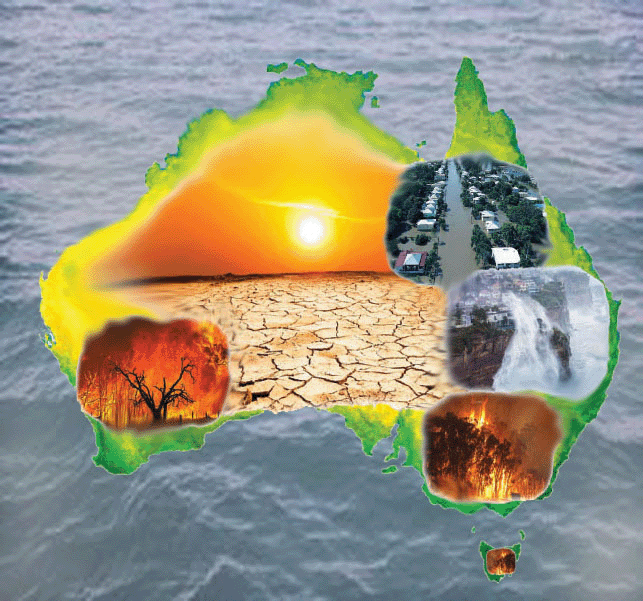
Australia’s extreme heat is sign of things to come, scientists warn https://www.theguardian.com/australia-news/2019/feb/01/australia-extreme-heat-sign-of-things-to-come-scientists-warn-climate
Hottest month ever shows temperatures rising faster than predicted, say climate experts Australia sweltered through the hottest month in its history in January, spurring mass deaths of fish, fire warnings and concerns among climate scientists that extreme heat is hitting faster and harder than anticipated.
For the first time since records began, the country’s mean temperature in January exceeded 30C (86F), according to the Bureau of Meteorology (BoM), which said daily extremes – in some places just short of 50C – were unprecedented.
“There’s been so many records it’s really hard to count,” said Andrew Watkins, a senior climatologist at BoM, after January registered Australia’s warmest month for mean, maximum and minimum temperatures.
This followed the country’s warmest December on record, with heatwaves in every Australian state and territory. With colour-coded heat maps of the country resembling blazing red furnaces for much of the month, the authorities have recently issued a special report on the extraordinary heat.
A persistent high-pressure system in the Tasman Sea that blocked cold fronts and cooler air from reaching the country’s south, and a delayed monsoon in the north, contributed to the heatwave.
Climate change is the long-term driver. “The warming trend which has seen Australian temperatures increase by more than 1C in the last 100 years also contributed to the unusually warm conditions,” Watkins said.
The bureau’s monthly report said the heatwaves were unprecedented in their scale and duration. The highest temperatures of the month were recorded in Augusta on the south-west coast, where thermometers registered 49.5C , but the most relentless heat was in Birdsville, Queensland, which endured 10 consecutive days above 45C.
This was compounded by drought. Large parts of Australia received only 20% of their normal rainfall, particularly throughout the south-east in Victoria and parts of NSW and South Australia.
Menindee in far-west NSW had four days in a row of temperatures above 47C. This was the site of December and January’s mass fish kills on the Darling River. Hundreds of thousands of native fish, including Murray cod, golden perch and bony bream, died around the Menindee weir. The authorities blamed “thermal stratification” as sudden shifts in temperature – first hot, then cold – caused algae blooms and choked the water of oxygen.
After the most recent fish die-off on 27 January, the Labor leader, Bill Shorten, said the Murray-Darling was “facing the makings of an ecological disaster”. He said: “This is not standard, this is not normal. This is a disaster.”
In parts of western Queensland and western NSW, there have been long strings of more than 40 days of temperatures above 40C.
Cloncurry had 43 days in a row that exceeded 40C. Birdsville had 16 days in January of temperatures higher than 45C including 10 days in a row.
NSW, the Australian Capital Territory, Victoria and the Northern Territory all had their warmest January on record.
The meteorological agency has warned that temperatures are set to rise further in the years ahead as a result of climate change. In its report last month, it said warming was contributing to a long-term increase in the frequency of extreme heat, fire weather and drought.
“Australia is already experiencing climate change now and there are impacts being experienced or felt across many communities and across many sectors,” said Helen Cleugh, the director of the Commonwealth Scientific and Industrial Research Organisation, which collaborated on the report.
The study, which is updated every two years, found that Australia’s fire seasons have lengthened – in places by months – and become more severe. From April to October, there has been a broad shift to more arid conditions in south-eastern and south-western Australia. Sea levels have already risen by 20cm and ocean temperatures are up by 1C, which is causing acidification – 10 times faster than at any time in 300m years – which has damaged the corals of the Great Barrier Reef.
1 This month.

Australians deserve the truth
about
AUKUS – https://aukuspublicinquiry.com/


PETITION – To: Prime Minister Anthony Albanese and the Australian Labor Government

of the week – Australians for War Powers Reform (AWPR)
To see nuclear-related stories in greater depth and intensity
 Antinuclear