Former fire chief lashes out at government inaction over climate change
‘Astounded’: former fire chief unloads on politicians over climate change inaction, The Age, By Nicole Hasham, 4 February 2019, Decorated Australian firefighter Greg Mullins says climate change is contributing to bushfires so 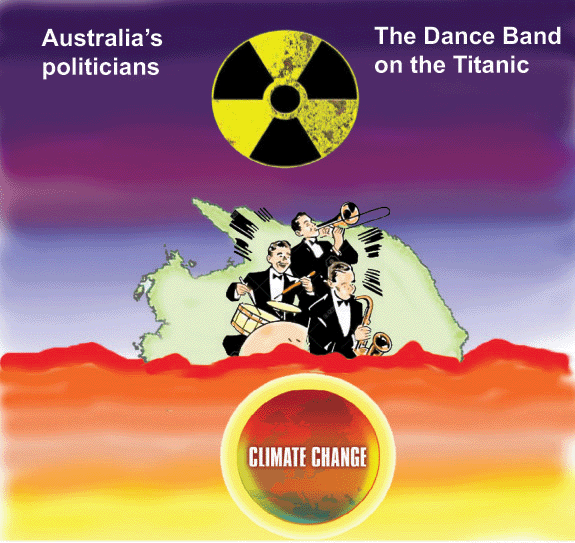 horrendous that homes and lives cannot be protected, and the federal government will not acknowledge the link because it has failed on emissions reduction policy.
The extraordinary comments by Mr Mullins, a former NSW Fire and Rescue Commissioner, coincides with the Tuesday launch of the group Bushfire Survivors for Climate Action, which will lobby the major parties to drastically reduce fossil fuel use and cut greenhouse gas emissions.
Prime Minister Scott Morrison and Opposition Leader Bill Shorten both visited Tasmania on Monday, where catastrophic bushfires had reportedly destroyed eight homes and burnt 190,000 hectares of land as of Monday afternoon. Their visit came on the 10th anniversary of the Victorian Black Saturday bushfires.
The major parties’ pledges on climate change are expected to be a frontline issue at the upcoming federal election, as the public reels from record-high summer temperatures, extreme weather and a long, unforgiving bushfire season.
Fires are a natural phenomenon in the Australian bush, but experts say climate change effects such as heatwaves and changed rainfall patterns mean bushfires are becoming more frequent and extreme.
Mr Mullins said fire seasons “are longer, more severe, and we are getting fires that are much harder to put out”.
“What that means … is there is simply not enough firefighters and fire trucks to do the job, to protect every structure and protect people’s lives,” he said.
“It’s extremely inconvenient for any government that does not have a cogent answer for what they’ll do about climate change, to see the effects of climate change putting more and more people and homes at risk.”
Mr Mullins has 50 years of fire fighting experience, including 39 years with Fire and Rescue NSW and as a volunteer in his youth and in retirement. He has been awarded the prestigious Australian Fire Service Medal and is an officer of the Order of Australia. He is a member of the Climate Council and welcomed the formation of Bushfire Survivors for Climate Action.
Mr Mullins sought to raise the climate change alarm in public comments in 2006 following fires in the Blue Mountains, but says the then-NSW Labor government told him to “pull your head in”.
“They didn’t want public servants coming out saying [the climate change driver] was pretty obvious to us,” he said.
“I feel quite passionately that the word needs to get out about how much the bushfire threat has worsened. I’ve watched it change, and I’ve watched our politicians sit on their hands, from both major parties. I don’t think either of them really have answers or are doing enough.”
NSW Labor has been contacted for comment.
……….A Labor government would reduce carbon emissions by 45 per cent by 2030, based on 2005 levels. The government has pledged to reduce emissions by 26 per cent over the same period, however, the OECD says Australia will miss that target under current policy settings.
GetUp! and the Climate Media Centre are supporting the Bushfire Survivors for Climate Actiongroup.
Black Saturday survivor Ali Griffin lost her home near Yarra Glen during the tragedy, and said: “I don’t want this to happen to anyone else”.
“We know the threat of devastating bushfires is getting worse every year we keep burning coal and heating our planet,” she said.
“Enough is enough, we are sick of the lack of progress on this issue – any politician without a serious plan to tackle climate damage is not fit to hold office.” https://www.theage.com.au/politics/federal/astounded-former-fire-chief-unloads-on-politicians-over-climate-change-inaction-20190204-p50vl0.html
One third of Asia’s ice fields doomed, endangering 2 billion people
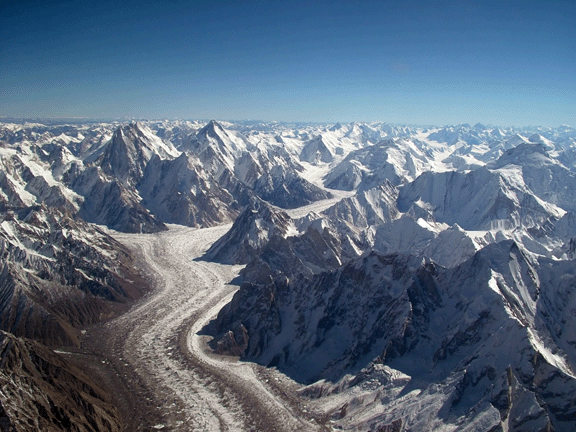
A third of Himalayan ice cap doomed, finds report, Guardian, Guardian, Damian Carrington, Environment editor@dpcarrington 4 Feb 2019
Even radical climate change action won’t save glaciers, endangering 2 billion people At least a third of the huge ice fields in Asia’s towering mountain chain are doomed to melt due to climate change, according to a landmark report, with serious consequences for almost 2 billion people.
Even if carbon emissions are dramatically and rapidly cut and succeed in limiting global warming to 1.5C, 36% of the glaciers along in the Hindu Kush and Himalaya range will have gone by 2100. If emissions are not cut, the loss soars to two-thirds, the report found.
The glaciers are a critical water store for the 250 million people who live in the Hindu Kush-Himalaya (HKH) region, and 1.65 billion people rely on the great rivers that flow from the peaks into India, Pakistan, China and other nations.
“This is the climate crisis you haven’t heard of,” said Philippus Wester of the International Centre for Integrated Mountain Development (Icimod), who led the report. “In the best of possible worlds, if we get really ambitious [in tackling climate change], even then we will lose one-third of the glaciers and be in trouble. That for us was the shocking finding.”
Wester said that, despite being far more populous, the HKH region had received less attention than other places, such as low-lying island states and the Arctic, that are also highly vulnerable to global warming.
Prof Jemma Wadham, at the University of Bristol, said: “This is a landmark piece of work focused on a region that is a hotspot for climate change impacts.”
The new report, requested by the eight nations the mountains span, is intended to change that. More than 200 scientists worked on the report over five years, with another 125 experts peer reviewing their work. Until recently the impact of climate change on the ice in the HKH region was uncertain, said Wester. “But we really do know enough now to take action, and action is urgently needed,” he added.
The HKH region runs from Afghanistan to Myanmar and is the planet’s “third pole”, harbouring more ice than anywhere outside Arctic and Antarctica. Limiting the global temperature rise to 1.5C above pre-industrial levels requires cutting emissions to zero by 2050. This is felt to be extremely optimistic by many but still sees a third of the ice lost, according to the report. If the global rise is 2C, half of the glaciers are projected to melt away by 2100.
Since the 1970s, about 15% of the ice in the HKH region has disappeared as temperatures have risen. But the HKH range is 3,500km long and the impact of warming is variable. Some glaciers in Afghanistan and Pakistan are stable and a few are even gaining ice, most probably due to increased cloud cover that shields the sun and changed winds that bring more snow. But even these will start melting with future warming, Wester said…….https://www.theguardian.com/environment/2019/feb/04/a-third-of-himalayan-ice-cap-doomed-finds-shocking-report
Murray-Darling report shows public authorities must take climate change risk seriously
The Conversation, Graduate Fellow, Steyer-Taylor Center for Energy Policy and Finance, Stanford University, February 4, 2019 The tragic recent events on the Darling River, and the political and policy furore around them, have again highlighted the severe financial and environmental consequences of mismanaging climate risks. The Murray-Darling Royal Commission demonstrates how closely boards of public sector corporate bodies can be scrutinised for their management of these risks.
Public authorities must follow private companies and factor climate risk into their board decision-making. Royal Commissioner Brett Walker has delivered a damning indictment of the Murray Darling Basin Authority’s management of climate-related risks. His report argues that the authority’s senior management and board were “negligent” and fell short of acting with “reasonable care, skill and diligence”. For its part, the authority “rejects the assertion” that it “acted improperly or unlawfully in any way”.
The Royal Commission has also drawn attention to the potentially significant legal and reputational consequences for directors and organisations whose climate risk management is deemed to have fallen short of a rising bar.
It’s the public sector’s turn
Until recently, scrutiny of how effectively large and influential organisations are responding to climate risks has focused mostly on the private sector.
In Australia it is widely acknowledged among legal experts that private company directors’ duty of “due care and diligence” requires them to consider foreseeable climate risks that intersect with the interests of the company. Indeed, Australia’s companies regulator, ASIC, has called for directors to take a “probative and proactive” approach to these risks.
The recent focus on management of the Murray-Darling Basin again highlights the crucial role public sector corporations (or “public authorities” as we call them) also play in our overall responses to climate change – and the consequences when things go wrong……….https://theconversation.com/murray-darling-report-shows-public-authorities-must-take-climate-change-risk-seriously-110990
The Constitutional Reform Package – Explained
Jessica Savage vimeo.com/user91910335
The following is a summary of points in the video at https://vimeo.com/314319026
The original video is a powerpoint style presentation with voice-over.
This video is the final part of a 5 part series. Here are some brief notes instead of a full transcript, because the video is long.
The Constitutional Reform Package – Explained
- I think the goal of these reforms is to herd us all together into a single treaty with universal terms. A treaty that gives Australia as much power as possible.
- These reforms are being presented as coming from First Nations people. This is a deliberate tactic to bypass free prior and informed consent, and to make getting out of the treaty for reasons of misrepresentation difficult or impossible.
- An important prerequisite to treaty was met in the Yulara statement. First Nations stated that their sovereignty “co-exists with the sovereignty of the Crown.” This is needed because under INTERNATIONAL law, Australia’s claim of sovereignty is still based on the Crown’s claim of terra nullius. This makes it logically inconsistent for Australia, acting in the right of the Crown, to treaty under international law with people who – according to their own claim to sovereignty – do not exist. Australia is not able to enter into an treaty without first having it’s own sovereignty recognised by First Nations as being co-existent. This acknowledgement was in the Yulara Statement, hidden in plain sight.
- The “First Nations Voice to Parliament” is more precisly – a First Nations State. To join the First Nations State, is to become a signatory to an international sovereign treaty. (Video 1 in this series explains this more)
- To join the First Nations State, First Nation mobs must sign a contract, under the name of their own nation. Categorising and labelling nations has already begun. Note also, by signing up, sovereign mobs are also affirming that they were party to the offer made at Yulara. They are signing up to the reform package, and they are affirming that Australia’s sovereignty co-exists with their own sovereignty.
- The First Nations State is a democratic state, this may adversly affect traditional governence structures. Putting all nations into a single, democratic body is fundamentally contrary to our law “no mob speaks for another mob”.
- Victoria is not an international actor, so Victoria cannot make treaties at all, the Victorian constitution does not have the power.
- Victorian treaties are not treaties with Victoria. They are domestic agreements with Victoria, wrapped up in a sovereign international treaty with Australia.
- The terms of this international treaty with Australia are already set, it is a one-sized-fits-all deal.
- There are no, and will be no constitutionally enshrined rights.
- Signing up closes doors to international pathways to self-determination and independence.
- There are other pathways to a treaty or to independence. The Yulara reforms are not the only option. Don’t be fooled if they tell you otherwise.
- Consider asserting your sovereignty as firmly as you possibly can as a matter of urgency, even if you prefer a treaty over independence. Asserting sovereignty, and declaring independence does not rule out Treaty. The reason this is urgent, is because of the proposed modifications of the constitutional preamble. Watch the Recognition video, part 3 for more detail on this. This is very dangerous, and it’s flying almost completely under the radar. This is a danger even if the Voice referendum fails.
- They would not have made such an elaborate, expensive scheme if we were not sovereign. It took me months to figure out what they are doing, and a few more months more figuring out how the hell to explain it! It’s very elaborate, and it takes a while to get your head around. Once you do though, you can’t unsee it.
If you have any questions, visit my blog decolonisethemind.wordpress.com, there is a contact form where you can write to me. That concludes this video series, I hope you enjoyed it, I hope it got you thinking, but above all – I hope that it gets people talking about the reforms, because there hasn’t been enough critical discussion or debate. I hope to make some more videos about sovereignty related topics in the future.
Solar powered batteries on wheels will change the grid forever — RenewEconomy

Tritium co-founder says the mobile battery storage in electric vehicles will have a major impact on the way consumers use electricity, and the grid. The post Solar powered batteries on wheels will change the grid forever appeared first on RenewEconomy.
via Solar powered batteries on wheels will change the grid forever — RenewEconomy
Energy efficient homes could save households $1,000-plus a year on bills — RenewEconomy

Government mandated energy efficiency standards could deliver more than $1000 a year in electricity bill savings for average Australian households, a new report has found. The post Energy efficient homes could save households $1,000-plus a year on bills appeared first on RenewEconomy.
via Energy efficient homes could save households $1,000-plus a year on bills — RenewEconomy
State by state – solar records fell across Australia in 2018 — RenewEconomy

There has never been a sustained boom of this magnitude occurring concurrently in every major state. The post State by state – solar records fell across Australia in 2018 appeared first on RenewEconomy.
via State by state – solar records fell across Australia in 2018 — RenewEconomy
W.A. unveils plan to lead global lithium-ion battery boom — RenewEconomy

Western Australia government launches plan to unlock lithium-ion battery value chain, including vast reserves of lithium and other high value metals. The post W.A. unveils plan to lead global lithium-ion battery boom appeared first on RenewEconomy.
via W.A. unveils plan to lead global lithium-ion battery boom — RenewEconomy
Know your NEM: Gas and hydro creamed the market as brown coal failed — RenewEconomy

Gas and hydro plants were the big beneficiaries as the unreliability of brown coal generation hit home in the January heatwave. The post Know your NEM: Gas and hydro creamed the market as brown coal failed appeared first on RenewEconomy.
via Know your NEM: Gas and hydro creamed the market as brown coal failed — RenewEconomy
February 4 Energy News — geoharvey

World: ¶ “Energy Storage: Next Game Changer” • Everybody agrees that storage is turning into big business, and soon, but exactly how big and how soon? According to a report from Bloomberg New Energy Finance the global energy-storage market will surge to a cumulative 942 GW by 2040 requiring a hefty investment of $620 billion. […]
Mark Butler ALP Shadow Minister rules out nuclear power
MARK BUTLER MP
SHADOW MINISTER FOR CLIMATE CHANGE AND ENERGY
MEMBER FOR PORT ADELAIDE
E&OE TRANSCRIPT
RADIO INTERVIEW
RN BREAKFAST
TUESDAY, 22 JANUARY 2019
SUBJECT/S: Labor’s $1 billion National Hydrogen Plan, climate change, nuclear power, Liberals plan for new coal.
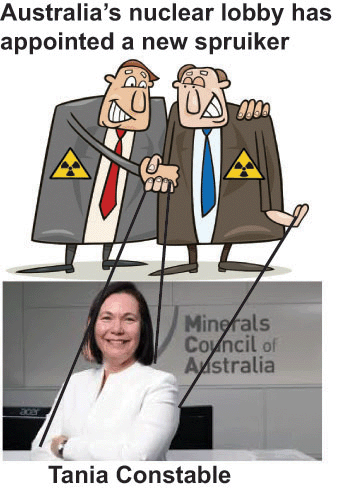 KELLY: You’re listening to RN Breakfast; our guest is the Shadow Climate and Energy Minister, Mark Butler. Mark Butler, Tanya Constable who is the Chief Executive of the Minerals Council of Australia is today proposing in news.compapers that nuclear energy be allowed to be developed as a zero emissions fuel. She says Australia will only be catching up with the rest of the world, there are new technologies in this area ready to be deployable, they produce zero emissions and thirty other countries around the world use them. Is Labor prepared to exercise or even consider that option?
BUTLER: No, this is not a technology that has any opportunity for Australia. There are legal barriers to it, which we  reindorsed at our National Conference just before Christmas as Labor Party policy. Where nuclear power is being explored, new nuclear power plants around the developed world in particular, for example the UK, it is extraordinarily expensive power as well. Rather than focus on these sorts of technologies that really are of no practical use to Australia, we want to focus on renewable energy which is going to bring down emissions, bring down power prices, and power thousands and thousands of jobs.
We’ve always had floods and bushfires, but climate change is making them worse
Queensland floods: Townsville reels under record water levels as more rain arrives, There are several more days to go in this 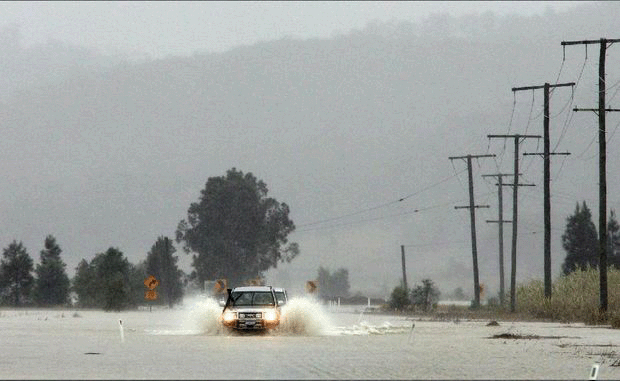 flood event, Bureau of Meteorology warns, Guardian, 2 Feb 2019,
Queensland authorities have said the state’s north was entering “unprecedented territory” as monsoon rains battered the city of Townsville, setting record flood levels and destroying homes.
Homes and businesses have been destroyed as flash floods washed through streets, sweeping away cars, equipment and livestock……..https://www.theguardian.com/australia-news/2019/feb/02/queensland-floods-townsville-reels-under-record-water-levels-as-more-rain-arrives
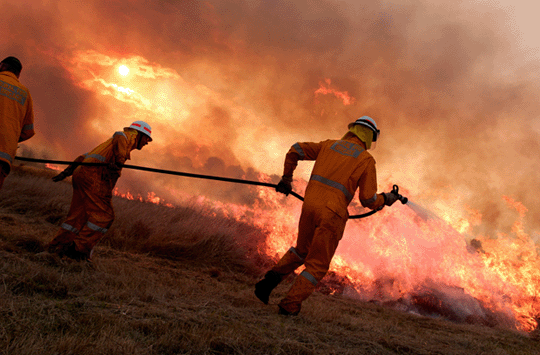
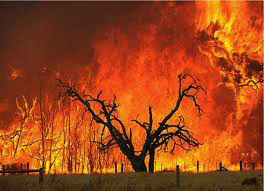 Bushfires threaten homes across Victoria , The Age, By Nicole Precel, 3 February 2019,Out-of-control bushfires threatened homes and lives on Sunday as more than 1000 firefighters battled major blazes across Victoria.Firefighters were stretched to the limit, fighting several large fires throughout the state.
A fire in Hepburn, in central Victoria was the major focus for the day with residents warned at daybreak to evacuate the town.
Two firefighters who were fighting the Hepburn fires were treated for heat exhaustion and over-exertion and were taken to hospital as a precaution.
Elsewhere, as almost 50 new fires sparked, emergency warnings were issued at various times for fires including days-old blazes in Timbarra in Gippsland and Grantville on the Bass Coast……..
As of Sunday afternoon, there were 69 aircraft working “very, very hard” and “effectively”.
The fires were fanned by soaring temperatures, hitting 43.3 degrees in the Mallee, 43.1 degrees in Hopetoun, 42.2 in Mildura, 41.1 at Melbourne Airport and 38.2 in Melbourne’s CBD.
The Bureau of Meteorology’s Richard Russell said high winds and thunderstorms were expected throughout the night……….. https://www.theage.com.au/national/victoria/bushfires-threaten-homes-across-victoria-20190203-p50vf8.html
 Tasmania’s fire disaster revealed in satellite images showing the extent of the damage
It’s easy to get warning fatigue, and, with only a handful or properties impacted so far, dismiss the fires as all bark and no bite.
But satellite images reveal the scale of the destruction so far.
The Gell River blaze, in the state’s south-west, was the first to start, ignited by a dry lightning strike in late December.
“It seems really like ancient history,” professor of pyrogeography and fire service at the University of Tasmania David Bowman said.
“It started at the end of last year and escalated in early January, so we’re looking at a fire situation that’s now gone for a full calendar month.”
Images taken by the European Space Agency’s Sentinel-2 satellite on January 3 show what seems, relative to the lakes around it, like a small blackened patch of wilderness……..
“There are multiple major fire events occurring simultaneously, which is extremely challenging for firefighters and fire managers because of the requirement to spread resources and make very difficult prioritising decisions.” …….
“This is definitely a historic event, it’s unprecedented,” Professor Bowman said.
“The area burnt is very substantial, I can barely keep up with the numbers.”
This week the fire service did put a number on it — 187,000 hectares.
At the same time as the Central Plateau fire ramped up, the Tahune fire was also burning out of control.
Of all the fires burning across Tasmania, this one has caused the most displacement, forcing hundreds of people to evacuate from communities in the Huon Valley south of Hobart.
Since last week, firefighters have issued almost daily warnings to residents, cautioning that only those prepared to defend their properties should stay behind.
A satellite image taken on January 30 shows how the fire, having burnt through more than 56,000 hectares, was still sending smoke over towns to its east. …..https://www.abc.net.au/news/2019-02-02/tasmanian-bushfires-from-the-air-satellite-images/10771528
Climate Change Faster than Expected — GarryRogers Nature Conservation

Climate change is occurring faster than expected.
via Climate Change Faster than Expected — GarryRogers Nature Conservation
February 2 Energy News — geoharvey

Opinion: ¶ “PA Needs Clean Energy. Why Are Legislators Stuck On Nuclear?” • Reports say Pennsylvania state legislators will soon introduce bills to provide financial support to the state’s nuclear power plants. The NRDC urges the General Assembly to adopt a real clean energy transition policy and reject nuclear plant subsidizes. [Natural Resources Defense Council] […]
Climate change is back as a big issue in Australian federal politics
Climate change is a burning issue (again) in voters’ minds, Guardian, Katharine Murphy @murpharoo, 2 Feb 19, The Coalition has no choice but to try and fix the self-created disaster that is its climate policy. his piece of backroom intelligence shouldn’t come as a surprise, given the summer we are all still enduring. Record high temperatures, the hottest January on record; storms; floods in some places, droughts in others; mass fish kills in ailing rivers.Climate change is back as a vote-changing issue – top of mind for many Australian voters. Private polling conducted for the environment movement and for the major parties suggests community concern about climate change is currently sitting at levels not seen since the federal election cycle in 2007.
If you can remember the events of 2007, you’ll recall that John Howard was forced into a significant about-face on the issue. Within sight of the election that swept Kevin Rudd into power, Howard signed the Liberal party up to emissions trading, a “world’s best-practice” cap and trade scheme, and declared Australia must prepare for a “low-carbon future”.
he research doing the rounds as the major parties bed down their war rooms for the May contest puts climate change in the top-two issues of concern nationally. Women, particularly, are alarmed by the ongoing policy inaction, and that’s bad for the Liberals because the party’s standing among women is already depressed courtesy of the unhinged shenanigans of the past 12 months.
But there’s some nuance in the research. In marginal seats in outer suburban areas – the seats that often determine the outcome of federal elections – cost of living pressures still rank higher than climate change. But people insist that climate is registering in the top-three concerns in several outer suburban seats, where the issue is normally dormant.
The political consequence of all this is pretty obvious. The strength of community concern about climate change leaves the Morrison government vulnerable. The Coalition’s policy record on climate change is appalling. There is no other word for it. Absolutely, indefensibly, appalling…….
Independents such as Zali Steggall and Oliver Yates are thumping the government on climate change, both as a thing in itself and as a proxy for dysfunction within the Liberal party which is imposing costs on the citizenry……… https://www.theguardian.com/australia-news/2019/feb/02/climate-change-a-burning-issue-again-in-voters-minds
1 This month.

Australians deserve the truth
about
AUKUS – https://aukuspublicinquiry.com/

PETITION – To: Prime Minister Anthony Albanese and the Australian Labor Government

of the week – Australians for War Powers Reform (AWPR)
To see nuclear-related stories in greater depth and intensity
 Antinuclear