An employee of Tokyo Electric Power Co. works at Japan’s Fukushima Dai-ichi nuclear power plant to decontaminate the area after the 2011 nuclear meltdown. A Vietnamese laborer in Japan on a training program says he was also put to work cleaning up the site, but with inadequate gear. January 15, 2019 The wind howls and […]
Students tasked with developing dishes using Fukushima produce to promote prefecture’s recovery Students sample local farm products with the aim of creating their own dishes as part of a campaign to highlight recovery efforts in the prefecture of Fukushima and its capital, on Dec. 16. January 13, 2019 A group of elementary, junior high […]
Consumers buy rice at a supermarket in Taiyuan, North China’s Shanxi Province in March, 2018 January 10, 2019 Chinese residents expressed concerns over the safety of Japanese rice produced nearby the Fukushima disaster area, after the Chinese government lifted an eight-year ban on the import of the rice. Japan’s National Federation of Agricultural Cooperative […]
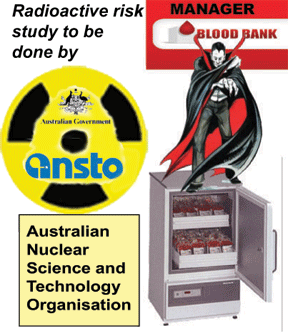
For public education about the nuclear industry, Australia relies on – well – the nuclear industry. The Australian Nuclear Science and Technology Organisation (ANSTO) is a government statutory body, which in 1987 grew out of The Australian Atomic Energy Commission (AEC). The AEC’s original mission was to plan for nuclear weapons for Australia, or, if that failed, at least for nuclear power. This goal of promoting nuclear power remains ANSTO’s core role
ANSTO does the nuclear education for Australians. It’s just like putting British Tobacco in charge of education about healthy lungs.
Just how does ANSTO do its “nuclear education” for Australia?, Well, broadly, by silence. Minimal information, especially about nuclear reactor dangers, transport of wastes, and about how much tax-payer funding it guzzles up. The Australian media conveniently complies with this silence.
However, when it comes to rural communities in one region of South Australia, then ANSTO is busily flooding them with “education”, because ANSTO has this dream of expanding nuclear power, and becoming a global hub for nuclear, but to do that, it has to dump the radioactive wastes somewhere, – Hawker, Kimba .. anywhere – ‘away from civilisation’.
The nuclear lobby now ‘partners’ with academia, wherever possible, and some universities are very grateful for their funding grants. The International Atomic Energy Agency (IAEA) partners with The University of Tasmania. South Australian top university big-wigs are nuclear industry promoters.
Then there’s the space travel hype. The great “colonise Mars” dream and all the rest of the space fever rarely mentions that the space travel rockets will be nuclear-powered – indeed, powered by plutonium, that man-made substance that is the most carcinogenic substance known. Too bad if there’s a crash.
Underlying all this is the glorification of STEM education – Science, Technology, Engineering, Mathematics. These ARE important studies, – but the subtext of this message is the downgrading of the arts and humanities subjects.
Technology can do things and go places. Humanities can guide us on what things we should do, and what places we should go to.
Climate and nuclear activists have lots to do in 2019. The IPCC report emphasises the need for a complete transition to clean energy, the need for people to put real pressure on governments. This video (partially an ad for an optical company) gives a good rundown on the report and its recommendations
Why the IPCC Report is so Scary
It’s astonishing, that with the global horror of nuclear radioactive trash piling up in USA, UK, Russia, Japan…. with no solution in sight, governments still promote the nuclear industry. And with the “Doomsday Clock” at 2 minutes to 12, it is an urgent need to stop the nuclear industry.
It’s harder for people in totalitarian countries, Russia, China, – to learn the truth about nuclear power – its diseconomics as well as its dangers. It’s still hard for people in democratic countries to grasp the facts, as mainstream media, and even much of the alternative media, blindly swallow the propaganda lies about nuclear power being “clean” and “the solution to climate change”.
The intrinsic connection between “peaceful” nuclear power and nuclear weapons manufacture has been clearly recognised. So this now remains the main reason for governments to promote nuclear power at home, while they scramble to try to sell the uneconomic technology overseas.
As with climate change, the challenge is for people to pressure governments, and to elect candidates who are not in the pocket of the nuclear industry.
Our nuclear free moment
As with climate change, many groups and individuals around the world are spreading the word on how to counteract industry propaganda, how to resist polluting developments. They are supporting indigenous land rights, social justice issues, and networking globally to close down polluting industries, and develop clean energy and energy conservation. The U.N Nuclear Weapons Ban Treaty, with 69 nations already signed up now shows that nuclear weapons are morally unacceptable, and shows the way to a nuclear weapons-free world.
Susan Craig Fight To Stop Nuclear Waste Dump In Flinders Ranges SA, 18 Jan 19,
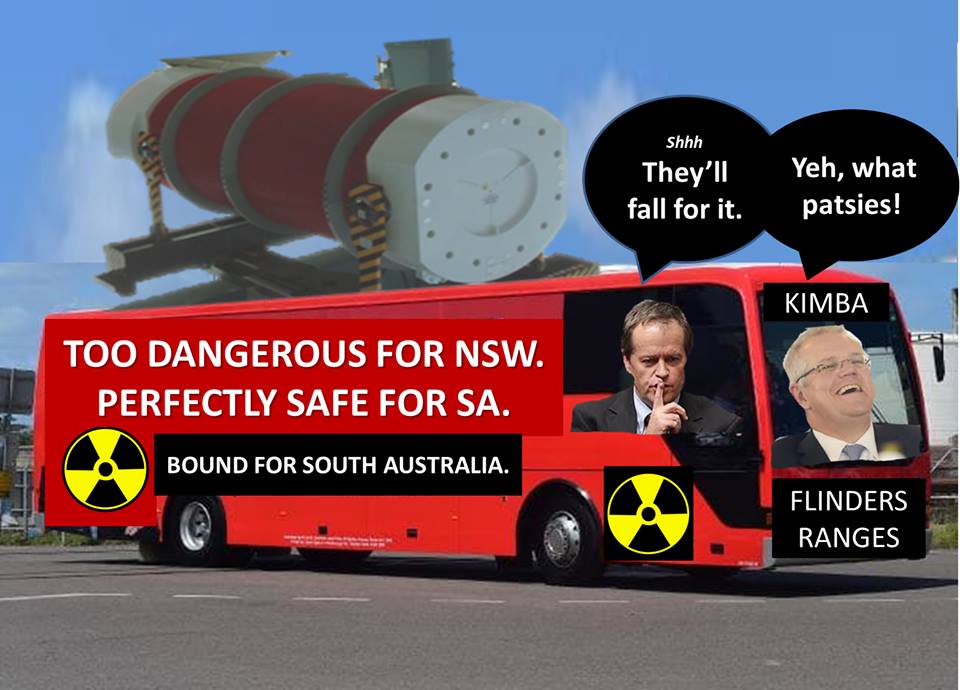
Federal Labor tell us the nuclear waste is TOO DANGEROUS for Lucas Heights, NSW, “we’ve got to get it out of there because it’s too dangerous to have it in densely populated metropolitan Sydney.
Federal Liberal tell us it’s PERFECTLY SAFE. It’s confounding that a post code can change the risk level of nuclear waste!
Both Scott and Bill are on the same bus. They refuse to make this an election issue. South Australians need to get on our own bus and demand that this issue be brought out into the open.
The current plan for a nuclear waste dump for South Australia is dangerous. Intermediate level nuclear waste is 100% fatal, after exposure life expectancy is around 4 – 6 weeks, it’s radioactive for 10,000 years and it will be stored above ground in a tin shed. It’s time for a cohesive, intelligent worlds best practice plan be developed to keep all Australian’s and our environment safe, now and into the future.
Roads melt as temperatures break records across NSW, SMH, By Jenny Noyes, 17 January 2019As temperature records continue to be broken across NSW, residents from Sydney to Menindee are warned the heatwave melting the state is yet to hit its peak, and in some parts is forecast to continue into next week without respite.
On Wednesday and Thursday, new maximum temperature records were set at 27 sites across NSW and the ACT, while some of the hottest overnight temperatures on record worsened the impact of the ongoing hot spell.
The conditions were so extreme that the bitumen on the Oxley Highway near Wauchope, just west of Port Macquarie, began melting about midday.
Walcha Council is using water from a nearby river to cool the pavement.
“Roads and Maritime Services acknowledge water is a scarce resource at this time, however it is required to ensure the safety of motorists and keep the road open,” a spokeswoman said in a statement.
Meanwhile, the NSW Rural Fire Service was battling more than 50 fires across the state – 20 of them are uncontained.
Deputy Commissioner Rob Rogers said 61 new fires were ignited on Wednesday alone, 31 of them started by lightning.
“We’re still trying to capture some of these fires and get them contained,” he told 2GB radio.
Total fire bans were in place across much of central NSW, stretching from the Victorian border up to Queensland……….
Ranger mine closure costs to hit more than $800mNT News, 18 Jan 19, The Northern Territory’s Ranger mine is counting the millions — more than $800 million to be exact — to move the mine, which is surrounded by Kakadu National Park, towards full closure…. (subscribers only)
Australian coal is killing the Pacific, Fiji PM tells Scott Morrison, Fiji has firmly told Australia to shift away from coal and fossil fuels because climate change is hurting Pacific island nations. SBS 18 Jan 19 Australia must not put the interests of a single industry above the lives of Pacific nations battling climate change, Scott Morrison has been firmly told.At an official dinner in Fiji to mark a newly announced partnership between the two nations, Fijian Prime Minister Frank Bainimarama explicitly told Australia to do better.
He said the only way to guarantee the survival of Pacific island countries was for Australia to shift away from fossil fuels.
“I urged your predecessor repeatedly to honour his commitment to clean energy,” Mr Bainimarama said on Thursday night in Suva.
“From where we are sitting, we cannot imagine how the interests of any single industry can be placed above the welfare of Pacific peoples and vulnerable people in the world over.
“Rising seas threaten whole communities, forcing them to endure the trauma of relocating from land they’ve endured for generations.
“Fijian farmers are watching their crops perish in soil that has been spoiled by the heightened salinity that is associated with sea level rise.”
Mr Bainimarama said the evidence of climate change was clear in the disappearing coastlines in Bangladesh and worsening flooding in the United States.
“And in Australia as well, where soaring temperatures have reached record highs in several major cities just this week,” he said.
“This cannot be written off as a difference of opinion.
“Consensus from the scientific community is clear and the existential threat posed to Pacific island countries is certain.”
US to begin nuclear treaty pullout next month after Russia missile talks fail, Guardian, Julian Borger in Washington, 17 Jan 2019
Officials reject Russian offer to inspect new missile
US says it will suspend observance of INF treaty on 2 February
The US has rejected Moscow’s offer to inspect a new Russian missile suspected of violating a key cold war-era nuclear weapons treaty, and warned that it would suspend observance of the agreement on 2 February, giving six-months’ notice of a complete withdrawal. The under secretary of state for arms control and international security, Andrea Thompson, confirmed the US intention to withdraw from the treaty after a meeting with a Russian delegation in Geneva, which both sides described as a failure.
Donald Trump took US allies by surprise when he announced his intention to leave the 1987 Intermediate-range Nuclear Forces (INF) treaty in October. The agreement led to the destruction of thousands of US and Soviet weapons, and has kept nuclear missiles out of Europe for three decades.
The Russian foreign minister, Sergei Lavrov, accused the US of intransigence, saying Moscow had offered to allow US experts to inspect the suspect missile, which it insists does not infringe the limits laid down in the treaty.
“However, US representatives arrived with a prepared position that was based on an ultimatum and centred on a demand for us to destroy this rocket, its launchers and all related equipment under US supervision,” Lavrov said.
Thompson noted that the US had been demanding Russian transparency over the missile for more than five years. She confirmed that the offer of inspections was not enough and that the US was demanding the destruction of the missile system, known as the 9M729……..
She said that there were currently no plans for follow-up talks on the INF before the 2 February deadline laid down by the Trump administration, though US and Russian diplomats would be meeting, including at a summit of the Nato-Russian council next week.
Thompson said that if Russia did not show willingness to comply with the treaty by the deadline, the US would suspend its own obligations, meaning that the US defense department could start research and development on missiles with ranges currently banned by the INF, from 500 to 5,500km.
At the same time, she told reporters, the US would formally give notice of its withdrawal from the treaty, which could come into effect on 2 August.
After that, there would be no restrictions on deployment of medium-range missiles in Europe or the Pacific………..
The Trump administration was criticised by former officials and arms control advocates for not pursuing the Russian offer of inspections.
“We’ve spent years trying to get something – anything – out of the Russians on INF. The Russian offer of an exhibition of the 9M729 is not enough, but it is something,” Alexandra Bell, a former senior state department official who is now senior policy director at the Centre for Arms Control and Non-Proliferation.
“Perhaps it is a foundation on which to build. Not trying to take advantage of this opportunity is to leave diplomatic options on the table and that’s just foolish.”
Daryl Kimball, the head of the Arms Control Association said: “If the INF is terminated on 2 August, there will be nothing to prevent Russia from deploying nuclear missiles that threaten Europe and the Trump administration will have no hesitation in pursuing the deployment of INF-prohibited weapons in Europe.” https://www.theguardian.com/world/2019/jan/16/us-russia-inf-treaty-nuclear-missile
Ground Zero Nagasaki: Living the nuclear past – and future, Asia Times, By SUSAN SOUTHARDJANUARY 18, 2019 “………. Much of Nagasaki and the world have, of course, moved on from that terrible morning when a 5-ton plutonium bomb plunged at a thousand kilometers an hour toward the city of 240,000 people. Forty-three seconds later, it detonated half a kilometer above Nagasaki’s Urakami Valley. A super-brilliant blue-white flash lit the sky, followed by a thunderous explosion equal to the power of 21,000 tons of TNT. The entire city convulsed
Based on my book Nagasaki: Life after Nuclear War, I often give talks in the US about that unforgettable (or now often-too-forgettable) day when, for only the second time in history, human beings deemed it right to assault their own species with apocalyptic power. At these book talks, I’ve learned to be prepared for someone in the audience to say that the Japanese deserved what they got. It’s still hard to hear.
At its “burst point,” the Nagasaki blast reached temperatures higher than at the center of the sun, and the velocity of its shock wave exceeded the speed of sound. Within three seconds, the ground below had reached an estimated 3,000 to 4,000 degrees Celsius. Directly beneath the bomb, infrared heat rays instantly carbonized human and animal flesh and vaporized internal organs. Did the men, women, and children of Nagasaki really deserve that?
As the mushroom cloud rapidlyascended 3km over the city and eclipsed the sun, the bomb’s vertical blast pressure crushed much of the Urakami Valley. Horizontal blast winds tore through the region at two and a half times the speed of a Category 5 hurricane, pulverizing buildings, trees, animals, and thousands of people.
The blazing heat twisted iron, disintegrated vegetation, ignited clothing, and melted human skin. Fires broke out across the city, burning thousands of civilians alive.
And though no one knew it yet, larger doses of radiation than any human had ever received penetrated deeply into the bodies of people and animals.
…………. the United States bombed and incinerated all or parts of 66 Japanese cities, killing, maiming or irradiating more than 668,000 civilians. In Nagasaki alone, by the end of 1945 when a first count was possible, 74,000 men, women and children were dead. Of those, only 150 were military personnel. Seventy-five thousand more civilians were injured or irradiated.
Today, this kind of indiscriminate killing and harm to civilians would be called “terrorism.”
Despite the history most Americans have learned – that the atomic bombings of Hiroshima and Nagasaki were military necessities that ended World War II and saved a million American lives by obviating the need for an invasion of Japan’s home islands – there is no historical evidence that the Nagasaki bombing had any impact on Japan’s decision to surrender.
What we aren’t taught are the political and military complexities of the last few months of the war or how, in the postwar years, the US government crafted this end-of-war narrative to silence public opposition to the atomic bombings and build support for America’s fast-expanding nuclear-weapons program.
What many don’t realize is that this misleading version of history allows us to turn away from what happened in Hiroshima and Nagasaki and continue to support the development and proliferation of nuclear weapons without ever having to think about what those weapons do.
Still, so many decades later, in a world in which the Trump administration is preparing to withdraw from a key Cold War nuclear agreement with Russia and the US nuclear arsenal is being modernized to the tune of up to $1.6 trillion, it’s worth recalling the other side of the story, the kind of suffering the Hiroshima and Nagasaki bombings caused in August 1945 and long after.
Within weeks, people in both cities began experiencing mysterious symptoms: vomiting, fever, dizziness, bleeding gums, and hair loss from what doctors would later understand as radiation-related sickness. Purple spots appeared all over their bodies. Many died in excruciating pain within a week of the first appearance of such symptoms. Fear gripped Nagasaki. From one day to the next, no one knew when his or her time might come.
In those first nine months, pregnant women suffered spontaneous abortions, stillbirths, or the deaths of their newborn infants. Many of the babies who survived would later develop physical and mental disabilities.
Five years after the bombings, thousands more began dying from leukemia and other illnesses caused by high-dose radiation exposure, initiating cycles of higher than normal cancer rates that would last for decades. The bombs had, from the survivors’ perspective, burned their bodies from the inside out. Parents exposed to radiation feared possible genetic defects in their children and hovered over them year after year, terrified that what looked like a simple cold or stomach ache would lead to severe illness or death.
Climate change preparation key as Canberra beats heatwave record, Canberra Times, By Jasper Lindell, 18 January 2019Canberra has experienced its longest run of days above 40 degrees, with the temperature hitting 40.1 at 3.41pm on Friday afternoon, while experts say the city needs to quickly adapt to more extreme heat driven by climate change.A cool change is expected to bring closer to average temperatures on Friday night or early on Saturday morning – but the capital still sweltered through four days at 40 degrees or above, the worst heatwave since January 1939.
Bureau of Meteorology Senior Climatologist Blair Trewin said the current heatwave was striking to people of his generation who grew up in Canberra and never experienced a day above 40 degrees……..
The director of the Climate Change Institute at the Australian National University, Mark Howden, said a particular heatwave wasn’t a direct result of climate change, but climate change was embedded into all extreme weather events.
Professor Howden said a small increase in the average temperature meant a higher likelihood of hotter temperatures.
There was only a five degree average temperature difference between present climate conditions and the Ice Age, he said.
Canberra could expect extreme hot weather more frequently and in longer spells, along with a reduction in autumn, winter and spring rainfall, Prof Howden said.
We’d also expect to see a lot more fires and fire frequency, and the fire season and the intensity of those fires going up.”
“Canberra is probably one of the more climate change aware and climate change active cities and that’s particularly because the current government has been leaders in terms of climate change,” Professor Howden said.
The ACT government’s 2016 Climate Change Adaptation Strategyrequires the impacts of climate change to “mainstreamed” and incorporated into government, household and business practice.
Dr Peter Tait, an Australian National University lecturer and general practitioner who spent 32 years in Alice Springs, said many of his Canberra patients didn’t have heatwave contingency plans and that needed to change as the city experienced more periods of extreme heat.
But Dr Tait said the emphasis needed to be on building heat resilience into the “fabric of society”, including enforcing heat appropriate building codes.
Can a growing city cut carbon emissions to zero? https://www.canberratimes.com.au/politics/act/can-a-growing-city-cut-carbon-emissions-to-zero-20190118-p50s9m.html,By Penny Sackett, Frank Jotzo & Will Steffen,19 January 2019 How can Canberrans keep cutting their greenhouse-gas emissions as their city grows quickly and spreads out? And how will the ACT benefit from going low-carbon? Having adopted stringent emissions targets for 2025 onwards, these questions are becoming front of mind for the ACT government.
The new targets include net zero emissions on or before 2045, with interim targets of 50 to 60 per cent emissions reduction by 2025; 65 to 75 per cent by 2030; and 90 to 95 per cent by 2040, all compared to the ACT’s emissions in 1990. The 2020 target, which has been in place for several years, is a 40 per cent reduction.
Meeting an emissions trajectory like this would mean the ACT does its fair share to cut greenhouse-gas emissions in line with the Paris agreement of holding global warming below 2 degrees. The ACT would help lead the way in Australia by respecting the boundaries set by its “carbon budget”, and demonstrating how to make deep reductions in an urban economy.
The idea behind setting a clear trajectory to zero emissions is that business, government and the ACT community can invest in modern, low-emissions technology with confidence about the overall goal, knowing that policy will support the shift. Climate action is part of creating a healthier, better-connected, more resilient and prosperous city. Positive change can occur in nearly every aspect of life in Canberra.
As one of Australia’s richest communities, we should find it easier than elsewhere to invest in the necessary change. And taking a lead in climate-friendly modernisation helps attract highly skilled people to Canberra, which is what is needed for continued economic success in the ACT. Canberra has a national, and growing international, reputation for innovation in the low-carbon economy, and ACT energy and climate policy programs have already attracted global renewable-energy companies.
The targeted reductions are steep, but they can be achieved if government, businesses and the community all make a sustained effort.
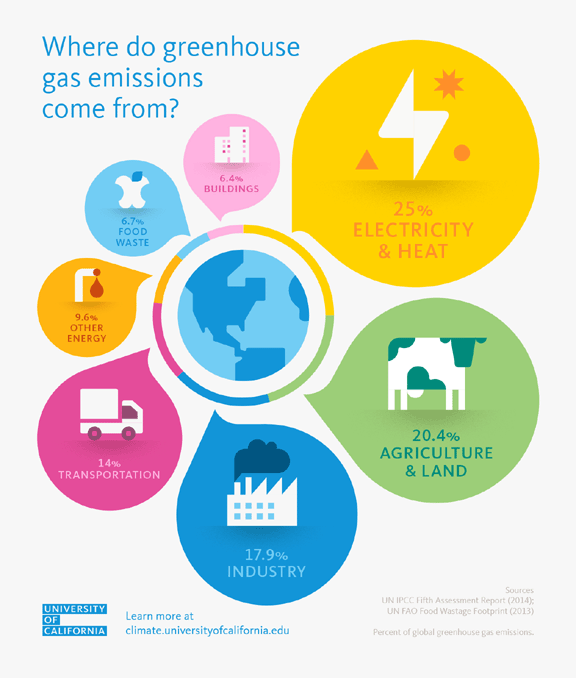
The ACT is on track to have 100 per cent of its electricity sourced from renewables by about 2020. This will make possible the targeted 40 per cent reduction in emissions (as they are accounted in the ACT). Carbon-free power supply gives us emission-free options for other sectors, notably transport – electric cars and buses, as well as light rail – and the use of electricity instead of gas for heating, cooking and in industry. This is critical because transport and natural gas use account for the lion’s share of Canberra’s direct emissions outside of electricity generation, at about 65 per cent and 20 per cent respectively.
The vision is clear: a transport system where public transport, as well as biking and walking, play a bigger role; where almost all cars, buses and trucks run on electricity or hydrogen; and where almost no gas is used. Quite aside from climate change, this means even cleaner air in Canberra and much less noise. The shift to higher-density living and the rapid progress with electric cars will help make it possible. Electric bicycles are already an alternative.
The first step is to stop investment that locks in carbon use into the future. We need electric cars and buses rather than petrol and diesel, and electric heating systems, not gas. Extra investment to improve energy efficiency in houses, apartments and public buildings is needed, too.
In all of this, the ACT government can and should lead by example. And climate policy must go hand-in-hand with social policy, ensuring that the shift to a truly clean city does not put some groups at a disadvantage. That means a keen eye on energy costs and the needs of commuters in the suburbs, and increased engagement by all of us during the transition.
Penny Sackett, an honorary professor at the ANU, is a former Australian chief scientist; Frank Jotzo is a professor at the ANU’s Crawford school of public policy; and Will Steffen, an emeritus professor at the ANU, is on the Climate Council of Australia. The authors are on the ACT Climate Change Council, an independent statutory body that advises the ACT government on emissions targets. This is the first of several articles exploring how Canberra can transition to carbon neutrality.
Adani cleared of wrong doing by Federal Government over bores but Qld investigation continues, ABC News By Josh Robertson , 18 Jan 19, Adani remains under investigation by the Queensland Government for alleged illegal works on its Carmichael mine site, despite federal authorities ruling out any wrongdoing.
State officials have confirmed the ongoing probe into whether the company breached its environmental authority by sinking six dewatering bores last year.
The ABC revealed in September the department had launched an investigation into whether Adani sunk the groundwater bores in breach of its approval under the state Environmental Protection Act. …….
Queensland Greens senator Larissa Waters said she had reviewed documents relating to the Federal Environment Department’s inquiries and “unfortunately it seems that there wasn’t a thorough investigation”.
Ms Waters is a former lawyer at Queensland’s Environmental Defenders Office (EDO), which has provided the State Government evidence of the alleged breach, including drone footage of the bores.
State Government investigation still underway
A spokesman for the Queensland Department of Environment and Science (DES) said the Government was aware of the Commonwealth findings.
“DES is undertaking a more comprehensive investigation under separate state legislation, and has made several information requests to Adani, and has also carried out site inspections,” he said.
“If non-compliances are identified during the course of the investigation, DES can move to enforcement action.”
Adani still needs approval for its groundwater dependent ecosystem management plan to carry out mining operations.
NITV is inviting all Australians to hear stories of our nation’s shared history from an Indigenous perspective.
Come and explore what 26 January means to Indigenous people, through a curated slate of distinctive programming.
Collectively housed under our #AlwaysWillBe special programming, stories of strength, resilience and survival, from across the country are coming to Channel 34.
Songlines (Season 2) – Daily, 7pm
Songlines Season Two brings a collection of six documentaries from some of Australia’s greatest and oldest storytellers. Each documentary presents an Indigenous Songline story.
Community and elders share their rich accounts of dreaming, serving as a reminder of the ancient roots of our country and the enduring power of its original people.
Songlines presents a chance to understand and celebrate our rare and precious heritage.
Songlines airs 7pm, daily from Sunday, 20 January until Friday, 25 January on NITV (Ch. 34). And will be repeated throughout the day, Saturday, 26 January…………
Connection to Country – Monday 21 January 11.35pm
Connection to Country follows the Indigenous people of the Western Australian Pilbara’s battle to preserve Australia’s 50,000-year-old cultural heritage from the ravages of a booming mining industry.
The Pilbara region sits in the Burrup Peninsula (or Murujuga) and is host to the largest concentration of rock art in the world, dating back over 50,000 years.
Connection to Country will repeat on Saturday 26 January at 10am on NITV (Ch.34)
Wik Vs Queensland – Tuesday 22 January, 8.30pm
In 1996 The High Court of Australia granted native title co-existence rights to the Wik Peoples of Cape York. The “Wik Decision” should have been a catalyst for positive change, but instead sparked a national, cultural and political fallout.
With unique access to never-before screened footage of a young Noel Pearson and Marcia Langton, this uncompromising feature documentary forensically explores the racism, fearmongering and political maneuvering that occurred in the lead up to the case, and its aftermath.
Told from the very personal Wik Peoples’ perspective, Wik vs Queensland causes us to question who we are as a nation today.
Another Country – Tuesday 22 January, 10pm
Narrated by David Gulpilil, Another Country is about his home Ramingining, a remote Indigenous community in North-East Arnhem Land.
But, in many ways, as the title suggests, it is ‘another country’. This award-winning 2006 film looks at Indigenous life before the arrival of white settlers.
This groundbreaking piece of cinema was the first film shot only in an Indigenous Australian language.
Occupation: Native – Thursday 24 January, 7.30pm
Filmmaker Trisha Morton-Thomas dishes up a fresh look at our colonial past. Exploring everything they never taught you at school, but should have.
It’s Australian history, but not like you have you ever seen or heard before. Trisha decides it’s time to go looking for answers, and along with actor Steven Oliver and several historians the film is a satirical recount of our untold
history. Occupation: Native will repeat on Saturday 26 January, 8.30pm on NITV (Ch. 34).












 Antinuclear