The radiation risk posed when you undergo CT scans
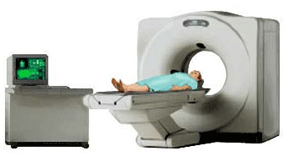 Scannell: The radiation risk posed when you undergo CT scans. The Mercury News, 18 Jan 19
Researchers estimate that nearly 2 percent of future cancers could be related to computerized tomography, It’s often said, “What you don’t know won’t hurt you.” But I’ve never understood the rationale behind that. In fact, as a doctor, I’d argue otherwise — that what you don’t know can harm you a great deal.
I’m thinking of this in light of recent studies concerning radiation exposure from medical imaging tests like computerized tomography (CT) scans. Many of us don’t know that we’re exposed to ionizing radiation when we undergo a CT scan, that ionizing radiation is a carcinogen or that data links an increased risk of cancer to low-level doses that are commonly used in CT imaging.
And while that increased risk may be small, it’s also cumulative over time — a concern for patients who receive multiple scans.
The benefits of CT scans in diagnosing disease and saving lives are indisputable. But, like any medical test or treatment, CT scans entail potential risks that should be balanced against expected benefits. Unfortunately, we’ve paid little attention to the radiation risks.
Putting the risk in perspective is difficult, considering the various yardsticks by which meaningful radiation exposure and cancer risks are measured. But, in broad terms, we can consider the constant background radiation from natural sources that we’re exposed to every day. While a chest X-ray exposes us to a 10-day dose of background radiation, a chest CT scan delivers about 2 years’ worth. And the average 3-year dose we get from a CT of the abdomen and pelvis more than doubles when the scan is repeated with and without contrast.
It’s important to remember that the increased cancer risk from a single CT scan remains low for most individuals. Still, the risk accumulates with additional scanning, and it constitutes an unnecessary risk if the scan isn’t medically necessary.
That latter point deserves underscoring because about 30 percent of CT scans performed in the U.S. are unnecessary, according to estimates. And, given that we perform over 80 million CT scans annually, it’s gob-smacking to consider the extraordinary unnecessary risk we’re assuming as a population. In fact, taking this population perspective, researchers have estimated that nearly 2 percent of future cancers could be related to CT scans.
Given the risks, our causal attitude toward CT scans is surprising. But they’ve become the Big Mac staple of modern medical fare. As a matter of perceived need or convenience, too many doctors order them and too many patients demand them when they aren’t medically needed.
Radiation risk reduction could be pursued through various strategies, beyond the obvious one of reducing unnecessary scans. Another obvious tactic involves minimizing the amount of radiation per scan without sacrificing image quality………..https://www.mercurynews.com/2019/01/18/opinion-the-radiation-risk-posed-when-you-undergo-ct-scans/
Hibakusha stories

Ground Zero Nagasaki: Living the nuclear past – and future, Asia Times, By SUSAN SOUTHARD JANUARY 18, 2019 “…………….Hibakusha stories
It’s essential for us to remember such grim details, not just for the sake of history, but for our future, because nuclear weapons far more powerful and devastating than the Nagasaki bomb are now commonplace.
In a small area of Nagasaki that includes Hypocenter Park, the Nagasaki Atomic Bomb Museum, and Peace Park, dedicated teams of Japanese men and women still work tirelessly to counter the world’s inclination to forget what happened. For the past 35 years, one organization, the Nagasaki Foundation for the Promotion of Peace, has assembled cadres of hibakusha speakers – typically about 40 at any time – willing to tell their stories. They are now aging women and men with unique memories of the day of that bombing and the weeks, months and years that followed.
Sixteen-year-old Taniguchi Sumiteru was delivering mail on his bicycle about a kilometer and a half from the hypocenter when, a split-second after the bomb detonated, its tremendous force and searing heat blew him off his bicycle and slammed him face-down on to the road. His entire back was burned off. By all rights, he should never have survived. Three months later, he finally received medical treatment. Still in constant pain 10 years after the bombing, he became one of Nagasaki’s earliest anti-nuclear activists.
Wada Koichi, an 18-year-old streetcar driver at the time of the bombing, decided to speak out when he held his first grandchild and flashed back to the charred corpse of a baby he’d stepped over as he searched for his missing colleagues.
Do-oh Mineko, then 15, suffered critical injuries to her head and lingered near death for months. Though those injuries eventually healed, radiation exposure had caused all her hair to fall out. For nearly a decade, she hid in her house until her hair finally grew back. As an adult, she kept her identity as a hibakusha secret until, in her late 60s, she found new meaning for her life by telling her story to schoolchildren.
Yoshida Katsuji, only 13, was looking up in the direction of the bomb at the moment it exploded. His entire face was scorched. Years later, as friends and colleagues told their stories publicly, he remained silent, afraid of looks of disgust from audiences due to his disfigurement. He finally began speaking out in his late 60s after deciding that being shy was not a good reason to keep silent when it came to the terrorizing impact of nuclear weapons.
These four and many others dared to cross boundaries in Japanese culture to tell their personal stories of suffering and help others grasp what nuclear war would mean for the world. Unfortunately, most hibakusha – at least those who were old enough to have vivid memories of the bombing and its aftermath – have died or are reaching the end of their lives. They are the only people capable of telling us first-hand about the experience of nuclear war, and each year their numbers diminish. ………….. http://www.atimes.com/ground-zero-nagasaki-living-the-nuclear-past-and-future/
Hitachi stops work on $19.3 billion, nuclear power project in North Wales, ending a long, expensive, saga
“The decision was made from the viewpoint of Hitachi’s economic rationality as a private enterprise,” the company, based in Japan, said.
Ben Russell, a spokesman for Hitachi’s British venture, Horizon Nuclear Power, said that discussions with the governments would continue but that its staff, currently around 300 people, would be cut to “a minimal handful.”
Hitachi will also stop planning work on a second project, in Oldbury, England. The company said it planned to take a write-off of 300 billion yen, or $2.75 billion, on the projects.
The decision by Hitachi is a blow to the British government, which is betting heavily on nuclear installations to help meet the country’s electric power needs in the coming decades.
The big question is whether Hitachi’s move will be a death knell for Britain’s campaign to build nuclear plants, which so far has resulted in only one project under construction.
While there are signs that the government is rethinking its energy policy, it was willing to go a long way toward trying to keep Hitachi on board.
In a statement to Parliament on Thursday, Greg Clark, the secretary of state for business and energy, said the government had been willing to consider providing one-third of the equity financing for the project and to take on all of the construction debt. When Hitachi continued to balk, Mr. Clark said, “I was not prepared to ask the taxpayer to take on a larger share.”
…….For Hitachi, though, the announcement could mark the end of a long and expensive saga. The company acquired the Horizon sites from two German utilities in 2012 for £697 million, or about $900 million, and wound up spending around £2 billion in total on design approvals, staff and other matters. It has been hiring apprentices, who have been training at a technical college on the island and going to Spain and Japan for work experience. At times in recent months more than 100 archaeologists were on the site, excavating and recording ancient structures that the construction would have destroyed.
Hitachi hoped Britain would prove to be an international showcase for its reactor designs. Ultimately, the company lost patience with the high level of spending required to land such a project there.
Hitachi had sought to arrive at a financial arrangement that would attract long-term investors like pension funds to the project and reduce its own exposure. But the offers of support from both the British and the Japanese sides were not enough………https://www.nytimes.com/2019/01/17/business/energy-environment/hitachi-horizon-wales-nuclear-plant.html
January 18 Energy News — geoharvey

Opinion: ¶ “EPA: New Air Pollution Plan Worse Than Doing Nothing” • Andrew Wheeler, former coal industry lobbyist, will soon be the official head of the EPA, the agency charged with protecting the environment. A study by the Harvard School of Public Health suggests the plans Wheeler has proposed will be only make things worse. […]
Construction begins on 336MW Dundonnell wind farm – one of biggest in Victoria — RenewEconomy

A 336MW Victoria wind farm inspired by local landowners, and then selected by the state government’s renewable energy auction scheme, has begun construction. The post Construction begins on 336MW Dundonnell wind farm – one of biggest in Victoria appeared first on RenewEconomy.
via Construction begins on 336MW Dundonnell wind farm – one of biggest in Victoria — RenewEconomy
Feedback sought for electricity regulation review — RenewEconomy

The AEMC is seeking stakeholder feedback on the proposed approach to the 2019 review of economic regulation of electricity networks. The post Feedback sought for electricity regulation review appeared first on RenewEconomy.
via Feedback sought for electricity regulation review — RenewEconomy
China lays out plans for subsidy-free wind and solar — RenewEconomy

China has laid out plans to drive the development of subsidy-free wind and solar projects across the country in an effort to push the technologies to grid parity. The post China lays out plans for subsidy-free wind and solar appeared first on RenewEconomy.
via China lays out plans for subsidy-free wind and solar — RenewEconomy
State of the climate: How the world warmed in 2018 — RenewEconomy

Why last year proved to be so remarkable across the oceans, atmosphere, cryosphere and surface temperature of the planet. The post State of the climate: How the world warmed in 2018 appeared first on RenewEconomy.
via State of the climate: How the world warmed in 2018 — RenewEconomy
Windscale/Sellefield Pt. 6. Research for a book length study — Nuclear Exhaust
I am now searching for the full text of Comare report number 1 of 1986. Two years after the Black report and the TV program which highlighted the leukemia cluster around Sellafield (1984). These occurred prior to Chernobyl. In my search I found the following archive record of the government response to the first comare […]
via Windscale/Sellefield Pt. 6. Research for a book length study — Nuclear Exhaust
NT on track for 10% renewables by 2020, with two new solar farms announced — RenewEconomy

Northern Territory government to build construction two new solar farms, totalling 20MW of capacity – a move it says will “catapult” its renewables share to 10% by year’s end. The post NT on track for 10% renewables by 2020, with two new solar farms announced appeared first on RenewEconomy.
via NT on track for 10% renewables by 2020, with two new solar farms announced — RenewEconomy
Australia leads the world in global warming – with the 15 hottest sites

The world’s 15 hottest sites on Tuesday were all in Australia, Brisbane Times, By Peter Hannam16 January 2019 Australia was home to all 15 of the world’s hottest temperatures on Tuesday, a feat it may well repeat on Wednesday and beyond as a huge swath of the nation bakes in 45-degree-plus heat.A slew of records have already fallen during the current heatwave and more are likely to be broken before a cool change breaks up the furnace later this week.
According to the El Dorado Weather site, the warmest 15 places on the planet in the past 24 hours were all in Australia. These ranged from Tarcoola in inland South Australia, which reached 49.1 degrees, to Yulara in the Northern Territory at 46.1 degrees in 15th slot.
The Bureau of Meteorology said the 49.1 degrees at Tarcoola was a record reading for that site.
Australia often dominates heat temperatures in summer, given that rival southern hemisphere sites are mostly in South America and South Africa where readings above 40 degrees are not so common.
The world’s hottest places in the 24 hours to 11am (AEDT) on January 16:
- Tarcoola (Australia) 49.1°C
- Port Augusta Aws (Australia) 49°C
- Woomera Aerodrome (Australia) 48°C
- Olympic Dam Aerodrome (Australia) 47.9°C
- Hay Airport Aws (Australia) 47.8°C
- Oodnadatta Airport (Australia) 47.7°C
- Marree Aero (Australia) 47.6°C
- Coober Pedy Aws (Australia) 47.5°C
- Warburton Airfield (Australia) 47.3°C
- Ivanhoe Aerodrome Aws (Australia) 46.9°C
- Wilcannia Aerodrome Aws (Australia) 46.6°C
- Leigh Creek Airport (Australia) 46.3°C
- Wulungurru (Australia) 46.2°C
- Moomba Airport (Australia) 46.1°C
- Yulara Aws (Australia) 46.1°C
50 degrees?
Jacob Cronje, a senior meteorologist with Weatherzone, said he “wouldn’t be shocked” by a 50-degree reading during the current spell, given the scale and intensity of the heat.
Certainly the duration of this event and the spatial extent of the heatwave across the southern half of Australia seems to be quite significant,” he said.
“By the end of the week, we should see many records broken across NSW,” Mr Cronje said, adding that northern Victoria might have to rewrite the records too…….
For Canberra, temperatures may reach 40 degrees for four days in a row, a series not recorded before for the nation’s capital. No days of 40 degrees were recorded in Canberra between 1973 and 1998, the bureau said. The city reached 41.6 degrees on Wednesday…….
Hot years
The Bureau of Meteorology and the CSIRO’s State of the Climate report identified rising temperatures as among the clearest indications of climate change in Australia.
Globally, last year was the world’s fourth-hottest year, according to the Japan Meteorological Agency. All of the five warmest years on record have happened since 2014, the agency reported this week. https://www.brisbanetimes.com.au/environment/weather/the-world-s-15-hottest-sites-were-all-in-australia-amid-significant-heatwave-20190116-p50rmr.html
ANSTO nuclear waste will compromise safety and security in South Australia
ANSTO nuclear waste to compromise safety and security in SA, https://www.foe.org.au/ansto_nuclear_waste_to_compromise_safety_and_security_in_s a David Noonan, 17 Jan 19 The federal government intends shipments of irradiated nuclear fuel waste to be imposed through Whyalla or Port Pirie to go onto indefinite above-ground storage at a nuclear dump site at either Kimba or Hawker ‒ all of which is illegal under state law in South Australia.
Two shipments of reprocessed nuclear waste ‒ arising from the  reprocessing of fuel irradiated in research reactors operated by the Australian Nuclear Science and Technology Organisation (ANSTO) ‒ are intended in the first two years of nuclear store operations in SA. A shipment is due from Sellafield in UK in the early 2020s, and ANSTO plans a shipment of nuclear waste that was reprocessed in France then shipped to ANSTO’s Lucas Heights site (south of Sydney) in 2015.
 Some 100 B-Double truckloads of federal government Intermediate Level Wastes (ILW) ‒ predominantly ANSTO waste from Lucas Heights ‒ are also to be trucked into SA in the first four years of nuclear store operations in SA.
SA communities face decades of potential accident and terrorist risks and impacts from ongoing ANSTO nuclear waste transports, with all of the next 40 years of ANSTO reactor waste also to be shipped and trucked to SA for indefinite above-ground storage.
 The federal nuclear regulator, the Australian Radiation Protection and Nuclear Safety Agency (ARPANSA), states that nuclear fuel wastes and other ILW require radiation shielding and require isolation from the environment for over 10,000 years. Yet the current plan is to store this waste in SA in a fancy shed for indefinite storage described as “interim” and as “long term above-ground storage (approximately 100 years)”.
After 60 years, ANSTO still has no nuclear waste disposal capacity, while ANSTO’s nuclear waste production is set to increase to more than double waste stockpiles over the next 40 years.

The government’s April 2018 ‘Australian Radioactive Waste Management Framework’1 reports total ILW at 1,770 cubic metres (m3), with 95% by volume arising as federal government wastes.
 The federal government plans to produce a further 1,960 m3 of ILW over next 40 years, with 95% (1,850 m3) arising from ANSTO’s reactor operations – all to be trucked into SA for indefinite above-ground storage at either Kimba or Hawker.
All of these federal government nuclear waste plans face serious obstacles and community opposition. They are illegal under state law in SA; are in breach of formal advice of the Nuclear Safety Committee to the federal regulator ARPANSA2; and do not represent International Best Practice.
The import, transport, storage and disposal of ANSTO nuclear fuel wastes were prohibited by the SA Liberal government in 2000; then in 2002‒03 the incoming SA Labor government extended the legislation to cover other radioactive wastes. Yet the federal Coalition government intends to override state law to impose nuclear wastes onto SA.
Advice provided to the CEO of ARPANSA by ARPANSA’s ‘Nuclear Safety Committee’ in Nov. 2013 states that:
“International best practice points to the need to have in place a policy and infrastructure for final management and ultimate disposal of waste before activities generating waste commence.”
“[T]he dual handling and transport process associated with interim storage does not represent international best practice”
“Dual handling also has implications for security.”
More recently, in Nov. 2016, the Nuclear Safety Committee advised the CEO of ARPANSA on the “ongoing requirement to clearly and effectively engage all stakeholders, including those along transport routes” and the Committee said that such engagement is “essential”.3
However, in an arrogant, flawed process, the federal government named port cities in SA as required ports to take shipments of nuclear waste in a report4 posted on the internet but failed to even inform the targeted communities and their local councils.
The story broke on Southern Cross TV on Aug. 6. The next day the ABC quoted Port Pirie’s Mayor saying Council was “blind-sided” by the federal government position to potentially require Port Pirie as a nuclear waste port. On Aug. 9 the story ran on p.1 of the Whyalla News, with the Whyalla Mayor saying Council won’t accept this.
Communities in Whyalla or Port Pirie ‒ and in Port Augusta which was named on a number of potential required nuclear waste transport routes ‒ face “complete shutdown” in transport of nuclear wastes through their cities but have been excluded from having a say by this federal government.
The federal Coalition government must stop this untenable nuclear waste threat to compromise safety and security in SA and accept extended storage of ANSTO nuclear fuel waste and ILW at Lucas Heights.
As the alternate federal government, the ALP is yet to say what they may do if elected in 2019.
More information: www.nuclear.foe.org.au/noonan
References:….
- www.radioactivewaste.gov.au/sites/prod.radioactivewaste/files/files/Australian%20Radioactive%20Waste%20Management%20Framework.pdf
- www.arpansa.gov.au/sites/default/files/legacy/pubs/nsc/nsc_iwsadvice.pdf
- www.arpansa.gov.au/sites/default/files/legacy/pubs/nsc/nrwmf-stakeholder-engagement.rtf
- https://prod-radioactivewaste.industry.slicedtech.com.au/sites/prod.radioactivewaste/files/60565376_NRWMF%20Site%20Characterisation%20Technical%20Report_Wallerberdina_20.07.2018_FINAL_Optimized.pdf
Published in Chain Reaction #134, December 2018. National magazine of Friends of the Earth Australia. www.foe.org.au/chain_reaction
Heat records smashed across Australia
 SBS News 16 Jan 19, Scorching summer temperatures have seen some regions reaching close to 50C with records crumbling as the week long heatwave continues. Summer heat records have been smashed with South Australia’s Port Augusta hitting a scorching 48.9C, as the rest of the country sweltered though a heatwave.
The Bureau of Meteorology forecast daytime temperatures of up to 12C above average and 10C higher than usual at night from Monday to Friday…….https://www.sbs.com.au/news/heat-records-smashed-across-australia
Crisis in Australia’s one great river system: climate change a factor
Drought, climate change and mismanagement’: What experts think caused the death of a million Menindee fish, ABC Science, By environment reporter Nick Kilvert, – 16 Jan 19
Britain’s nuclear energy future in jeopardy.
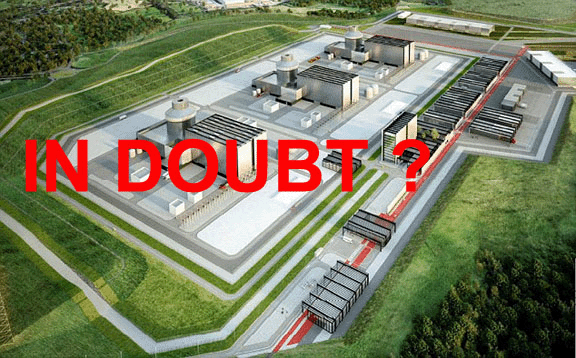 The Week, Jan 15, 2019
The company has already ploughed nearly £2 billion into the project, yet has struggled to attract investors, “even though (the) UK government may have promised as much as two thirds of the build cost” says Unearthed, a “generous largesse on behalf of UK taxpayers, not offered to any other energy projects”.
1 This month.

Australians deserve the truth
about
AUKUS – https://aukuspublicinquiry.com/

PETITION – To: Prime Minister Anthony Albanese and the Australian Labor Government

of the week – Australians for War Powers Reform (AWPR)
To see nuclear-related stories in greater depth and intensity
 Antinuclear