Disease – after-effects for uranium miners decades later
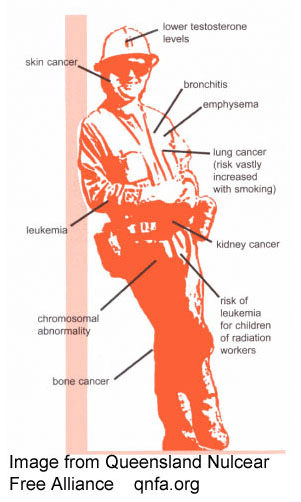 Uranium workers can face illnesses decades
  later. Many workers don’t know that help is available.Star Tribune, Heather Richards 307-266-0592, Heather.Richards@trib.com, Jan 14, 2019
Japan faces huge costs as nuclear reactors are scrapped
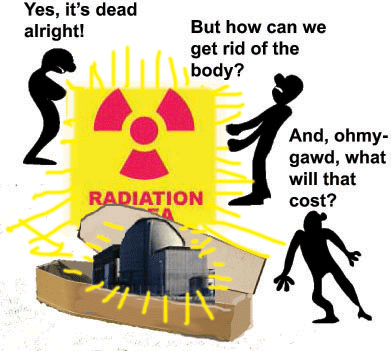 Japan News 14th Jan 2019 The total cost for scrapping the nation’s nuclear power facilities —
excluding Fukushima No. 1 nuclear power plants and other facilities under construction — is estimated to be about ¥6.72 trillion, according to a tally by The Yomiuri Shimbun.
The assessment only includes dismantlements of nuclear power facilities for which the cost can currently be estimated. Among these estimates, the cost for closing a spent nuclear fuel reprocessing plant now being built by Japan Nuclear Fuel Ltd. (JNFL) in Rokkasho, Aomori Prefecture, accounts for the largest amount at ¥1.6 trillion.
The cost for decommissioning 53 commercial nuclear reactors is estimated to total about ¥3.58 trillion, for an average at ¥57.7 billion per reactor. Of the 53 reactors, 19 reactors are scheduled or are likely to be scrapped.
http://the-japan-news.com/news/article/0005476533
UK’s “nuclear renaissance” now collapsing as Hitachi looks like dumping Moorside nuclear project
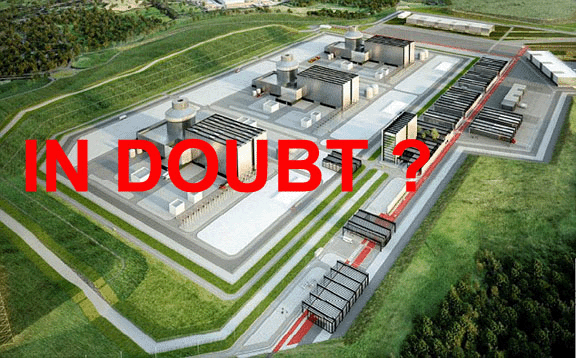
 FT 13th Jan 2019 Nick Butler: Who could blame the board of the Japanese company Hitachi if
its members decide at their meeting this week to scrap plans for a new nuclear power station at Wylfa on the North Wales island of Anglesey?
Hitachi has invested more than £840m in the project over the past six years. The technology has passed all the tests set by the UK’s nuclear regulator. But the company has been unable to get the government to put in place the clear and credible financial structure necessary to underpin the investment.
That failure has already led other investors to abandon the new plant planned at Moorside in Cumbria. Talk of scrapping the Wylfa project could be a bargaining tactic on the part of Hitachi but the reality is probably much simpler. Hitachi’s doubts have been well signalled during the
past few months and the company’s purchase of ABB’s power grid business at the end of last year gives it a range of investment choices.
Given Whitehall’s chronic indecision, the company is ready to use its capital elsewhere. Hitachi’s withdrawal would mark the collapse of the energy policy adopted in 2013 by the UK’s coalition government. Facing what were believed to be ever-rising energy prices the policy plumped for new nuclear, promising that 35 gigawatts of new capacity would be on stream by the mid 2030s – more than replacing the first generation of nuclear plants, which would by then have reached the end of their useful lives.
Because the price of gas seemed doomed to keep rising, new nuclear would come to look highly competitive over time as well as reducing dependence on imports. Since then much has changed, and the assumptions which underpinned the old policy now look laughably wrong.
The costs of all forms of energy (apart from nuclear) have fallen dramatically and there is no shortage of supply. Electricity demand is down thanks to efficiency gains and new technology.
The contract for the first new nuclear station being built at Hinkley Point in Somerset, which enjoys a guaranteed index-linked price for 35 years from the moment the plant is commissioned, looks exorbitant. The demise of Wylfa forces the need for a comprehensive review of energy policy.
Since the UK government is too busy preparing for Brexit to focus seriously on any other issue, the review should be conducted independently. Advances in energy technology offer more
possibilities each year. But those options will never be taken up unless the old outdated policy is scrapped and a more realistic approach put in place.
https://www.ft.com/content/7b33e9fa-1648-11e9-9e64-d150b3105d21
Desalination pours more toxic brine into the ocean than previously thought
|
https://www.sciencenews.org/article/desalination-pours-more-toxic-brine-ocean-previously-thought The supersalty water is a byproduct in producing potable water Technology meant to help solve the world’s growing water shortage is producing a salty environmental dilemma. Desalination facilities, which extract drinkable water from the ocean, discharge around 142 billion liters of extremely salty water called brine back into the environment every day, a study finds. That waste product of the desalination process can kill marine life and detrimentally alter the planet’s oceans, researchers report January 14 in Science of the Total Environment. “On the one hand, we are trying to provide populations — particularly in dry areas — with the needed amount of good quality water. But at the same time, we are also adding an environmental concern to the process,” says study coauthor Manzoor Qadir, an environmental scientist at the United Nations University Institute for Water, Environment and Health in Hamilton, Canada. Between human population growth and climate change, water is becoming increasingly scarce (SN: 8/18/18, p. 14). Desalination technology has become a viable solution to this problem and has grown exponentially in popularity since the 1980s. Almost 16,000 plants now operate worldwide. Desalination relies on evaporation or specialized membranes to either chemically or electrically separate pure water from a stream of saltwater. But two streams always flow out of the system: one that becomes water that people can use, and another with the leftover, extra-salty brine, which is released back into the environment. Previous evaluations didn’t assess how much brine these facilities produced, Qadir says. Scientists assumed that desalination facilities on average equally produced brine and pure water — one liter of brine for every liter of pure water. That turned out to be wrong. Using data on the water sources and technology used at desalination facilities around the globe, Qadir and his colleagues estimated for the first time how much brine is discharged daily. For every liter of pure water made, they found that on average 1.5 liters of highly concentrated brine is released back into the environment. Per day, that value translates to more than half the daily volume of water pouring over Niagara Falls, with 70 percent of it originating from desalination plants in arid North Africa and the Middle East. As brine re-enters the ocean, “it creates a kind of local environment,” Qadir says. The highly concentrated discharge, which can also contain metals and antifouling chemicals, is denser than seawater, so it flows as a salty plume to the seafloor and can poison marine organisms living nearby. Some brine can also still be hot from evaporative processes during desalination. Because hot water doesn’t hold oxygen as well as cold water, ocean areas where brine enters can become depleted of oxygen. An international standard requiring wastewater treatment and the use of environmentally friendly chemicals in desalination discharge does exist, says Yoram Cohen, a chemical engineer at UCLA. “But whether all people follow it, I don’t know.” Save for some scientific studies, not much is being done to resolve the issue, Qadir says. “At the government level, I don’t see that there is a serious attempt that has been made.” Suggestions have been proposed for repurposing the brine, including for watering salt-tolerant agricultural fields, extracting metals such as magnesium or uranium, or harvesting salt versus mining for it. In terms of technology, you can take the brine “and evaporate it to recover the salt,” Cohen says. “But the price is huge.” Depending on location and type of technology, desalination alone can cost between $0.50 and over $2 to produce 1,000 liters of drinkable water — about what two people in the United States use in a day. Further evaporating the brine waste only increases the cost. Modern desalination technologies, such as graphene oxides, are becoming more cost effective and releasing less brine discharge (SN: 8/20/16, p. 22). But they are not universally distributed and are uncommon in the Middle East where desalination is most used. “We need to make sure that with our efforts, we are able to use more of those types of technology which produce more desalinated water than brine,” Qadir says. |
|
Know your NEM: Looking forward, after looking back — RenewEconomy

The worm is starting to turn, as wind and solar power become widely acknowledged as the forthcoming mainstream suppliers of energy into the NEM. But can governments and regulators keep pace? The post Know your NEM: Looking forward, after looking back appeared first on RenewEconomy.
via Know your NEM: Looking forward, after looking back — RenewEconomy
Windscale/Sellefield Pt. 3 Research for a book length study — Nuclear Exhaust
Sources relating to the Black Report of 1984. 1. http://news.bbc.co.uk/onthisday/hi/dates/stories/july/23/newsid_4521000/4521673.stm BBC on this day 23 July 1984 A government report into cancer levels near the controversial nuclear plant at Sellafield in Cumbria has confirmed suspicions of higher-than-normal levels of leukaemia in the area. However, it says, too little research has been done to definitely link […]
via Windscale/Sellefield Pt. 3 Research for a book length study — Nuclear Exhaust
NSW waves through 900MW solar farm for construction in Riverina — RenewEconomy

Reach Solar’s 900MW Yarrabee Solar Farm, approved for construction in NSW Riverina, will have capacity to power a city nearly twice the size of Newcastle. The post NSW waves through 900MW solar farm for construction in Riverina appeared first on RenewEconomy.
via NSW waves through 900MW solar farm for construction in Riverina — RenewEconomy
National Electricity Market year in review: Wholesale electricity prices — RenewEconomy

First instalment of three-part series looking back at what the past year of energy policy turmoil has meant for the National Electricity Market (NEM). The post National Electricity Market year in review: Wholesale electricity prices appeared first on RenewEconomy.
via National Electricity Market year in review: Wholesale electricity prices — RenewEconomy
January 14 Energy News — geoharvey

Opinion: ¶ “ScottishPower: the Journey to Renewables” • ScottishPower, one of the UK’s biggest utilities, announced it will switch to 100% renewable energy. The move is hailed as touchstone moment and a good example for any big utility seeking to shed its fossil fuel legacy, but does the move make economic sense, and if so […]
Proposed nuclear waste dump in Flinders Ranges – an urgent issue for South Australians, and all Australians
“We do not have a position on the sites in South Australia for a NATIONAL NUCLEAR WASTE facility. However, we do have a position on LUCAS HEIGHTS, (NSW). We need to get the nuclear waste out of there because it’s TOO DANGEROUS to keep the nuclear waste in densely populated metropolitan Sydney.”
Extract from “Economic Priorities Document”. South Australian Government.
“South Australian food, wine and beverages are world class and our unique regions, products and the CLEAN, GREEN ENVIRONMENT that they come from provides the COMPETITIVE EDGE required to secure and maintain PREMIUM status in our markets of choice.”
 I have endeavoured to engage our State politicians on both sides for over a year now, to publicly speak to the people of South Australia on this issue, yet their silence is confounding and shameful. The nuclear waste proposed for South Australia is for both low level and intermediate level. Exposure to intermediate level nuclear waste, is 100% fatal with life expectancy of 4 -6 weeks. It will remain radioactive for 10,000 years. The Federal Government are targeting KIMBA in our farming land and The Flinders Ranges in the heart of tourism. The Flinders Ranges site will be just 10kms from Wilpena Pound! The waste will be stored for up to 100 years, above ground in a tin shed in one of the most seismic areas in Australia and prone to regular severe flooding. The floods waters in 1989 entered Spencer Gulf.
All South Australian’s need to be involved and told the truth about the Federal Government’s proposal for our state, as it will go beyond tarnishing our reputation that so many South Australian’s have worked hard for, but more so this proposal is both immediately and transcendingly dangerous for all Australians.
This decision is so catastrophically wrong it demands to be challenged by all of us, including our politicians. https://www.facebook.com/groups/344452605899556/
Every State and Territory in Australia to be hit with record heat (nothing to do with climate change?)

Record-breaking heatwave to hit every state and territory, https://www.sbs.com.au/news/record-breaking-heatwave-to-hit-every-state-and-territory Every state and territory in Australia will experience heatwave conditions on Monday, forecasters say. A cyclone is brewing off Western Australia’s Kimberley coast while much of the country is set to swelter in heatwave conditions.
Every state and territory will cop the heat on Monday when temperatures soar with some regions to experience severe and extreme hot weather.
The Bureau of Meteorology forecasts low intensity heatwave conditions in parts of central WA to southern parts of the Northern Territory, southwestern Queensland and across NSW, Victoria, Tasmania and South Australia.
It will be worst in South Australia where multiple days of temperatures above 40C, an unusual event even for summer, meteorologist Dean Narramore said on Sunday.
Particularly northern South Australia, they’re looking at maybe five days in a row above 45 and normally they might only get five or 10 a year,” he said.
Melbourne can expect to see a few days in the mid to high 30s, while temperatures in Sydney’s west will peak above 40C for four or five days.
ALERT: Adani Contractor Locked Up and Blockaded
 New Adani contractor Eastern Tree Services found themselves locked out of five premises in three states this morning, with citizens blocking work trucks at another two premises.
ETS, a large privately-owned company, operates tree clearing services from 20 sites across the country. They start tree clearing work at Abbott Point Coal Terminal this week and sources confirm ETS have accepted a contract to clear the rail corridor from Adani’s controversial Carmichael Coal Mine to link in with the existing railway travelling to Abbott Point. Jai, a spokesperson for Frontline Action on Coal said:
“ETS must listen to the majority of Australians who do not want Adani’s coal mine to go ahead and completely rule out destroying precious bushland for the proposed Adani rail corridor.”
This is not the first Adani contractor to be the target of long-running protests, with prior campaigns leading to banks, insurers and contractors ruling out supporting the mine. Emma from the Brisbane blockade protest said:
“Big businesses need to understand that if they work with Adani they will be held accountable for the damage to the reef, land, culture and climate that will ensue if Adani’s dirty coal mine goes ahead. Adani contractors like ETS will find themselves targets of ongoing protests until they rule out working with Adani.”
“Adani fail to get approvals and keep their promised work deadlines time and time again. They cannot be trusted and should not be allowed to build a climate wrecking coal mine that Australia doesn’t want, and the world doesn’t need.” SourceDoc Frontline Action on Coal: mailchi.mp/frontlineaction.org/adani-contractor-locked-out-as-warning-to-cut-ties-with-the-unpopular-carmichael-coal-mine
The problem of hazardous waste from discarded old solar panels
 I have long been worried that environmentalists are seen to be enthusiastic about renewable energy, seeing it as the panacea for the world’s climate woes. Solar power is a great technology for replacing polluting fossil fuel power, but it’s only a part of what needs to be done – in the urgently needed transition from our wasteful CONSUMER SOCIETY to a CONSERVER SOCIETY. It must not become a contributor to the waste disaster.
 Australia’s enthusiastic embrace of rooftop solar has brought clear environmental and economic benefits, but critics say governments have dragged their feet in addressing the looming waste crisis.
As of December more than 2 million Australian households had rooftop solar installed. The uptake continues to grow due to the technology’s falling cost and rising electricity bills.
Photovoltaic panels last about 30 years, and those installed at the turn of the millennium are nearing the end of their lives. Many have already been retired due to faults or damage during transport and installation.
The nation’s environment ministers in April last year agreed to fast-track the development of new product stewardship schemes for photovoltaic solar panels and associated batteries. Such schemes make producers and retailers take responsibility for an item across its life cycle.
However, Total Environment Centre director Jeff Angel, a former federal government adviser on product stewardship, said action was long overdue and the delay reveals a “fundamental weakness” in Australia’s waste policies.
“We’ve had a solar panel industry for years which is an important environmental initiative, and it should have been incumbent on government to act in concert with the growth of the industry so we have an environmentally responsible end-of-life strategy,” he said.
Mr Angel said photovoltaic panels contain hazardous substances and “when we are sending hundreds of thousands of e-waste items to landfill we are also creating a pollution problem”.
“It’s a systemic problem that [applies to] a whole range of products”, he said, saying schemes were badly needed for paint, batteries, floor coverings, commercial furniture and many types of electronic waste.
Photovoltaic panels are predominantly made from glass, polymer and aluminium, but may also contain potentially hazardous materials such as lead, copper and zinc.
 Australian Council of Recycling chief executive Peter Schmigel attributed delays in product stewardship schemes to both “bureaucratic malaise” and unfounded concern about cost.
The national television and computer recycling scheme, which since 2011 has required manufacturers and importers to participate in industry-funded collection and recycling, showed that regulatory measures can work, he said.
“Recovery rates have been out of sight since the beginning of the scheme, nobody has said anything at all about there being an inbuilt recycling cost. It generates jobs, it generates environmental outcomes and yet for some reason we have policymakers who are hesitant about [establishing similar schemes] for solar PVs and batteries,” he said.
Victoria will ban electronic waste in landfill from July 2019, including all parts of a photovoltaic system, mirroring schemes imposed in Europe.
Sustainability Victoria is also leading a project examining end-of-life management options for photovoltaic systems, which may progress to a national program. The issue is particularly pertinent in Victoria where a new $1.3 billion program is expected to install solar power on 700,000 homes.
Sustainability Victoria resource recovery director Matt Genever said there was strong support from industry, government and consumers for a national approach to photovoltaic product stewardship. Final options are due to be presented to environment ministers in mid-2019.
He rejected suggestions that plans were progressing too slowly.
“The analysis we’ve done in Victoria … shows that it’s in 2025 that we see a real ramp up in the waste being generated out of photovoltaic panels. I certainly don’t think we’ve missed the boat,” he said.
A report by the International Energy Agency and the International Renewable Energy Agency in 2016 found that recoverable materials from photovoltaic panel waste had a potential value of nearly $US15 billion by 2050.
Reclaim PV director Clive Fleming, whose business is believed to be the only dedicated photovoltaic recycler in Australia, said it recycles 90 per cent of materials in a panel. The company has been lobbying for state bans on solar panels entering landfill.
The NSW Environment Protection Authority said it has commissioned research to better understand how e-waste, including solar panels, was managed. The panels can be dumped in NSW landfill, however given their life span they were “not a common item in the waste stream”, it said.
The Queensland government is developing an end-of-life scheme for batteries used in solar systems and other appliances.
Mr Genever hoped the review would result in a broader range of products being subject to stewardship programs and take steps to ensure voluntary schemes were effective.
Both the Smart Energy Council and the Clean Energy Council, which represent solar industry operators, said a well-designed product stewardship scheme was important and should be developed through cooperation between industry, governments and recyclers.
Doubt about what happens to spent nuclear fuel rods within casks
 Derek Abbott Nuclear Fuel Cycle Watch South Australia, 13 Jan 19, Something that is never discussed about dry cask storage (before it is transferred into a repository canister) is that the fuel rods have been emitting alpha particles for 40 years in the dry cask.
 The nuke enthusiasts who don’t understand physics naively think those alpha particles are impotent. They say “a piece of paper can block an alpha particle.” True but misleading.What actually happens is that alpha particles do indeed get blocked and don’t go far within a fuel rod, but they get converted to back to helium. [Remember an alpha particle is a helium nucleus anyway].So you get helium bubbles building up inside the fuel rod. Over 40 years this can fracture the fuel rod into pieces. So transferring the rods into a repository canister may not be possible. Because no one has actually opened up a bunch of old dry casks to get the rods into a repository yet, there isn’t much experience on exactly how much alpha particle damage affects the rods. I’m not sure there has even been a proper study of this. I am searching and will post it here if I find a study. https://www.facebook.com/groups/1021186047913052/
Australia’s environment – a winner at National Labor Party Conference
Labor will strengthen the law to protect Australia’s Environment and Heritage – TONY BURKE
Environmental wins at the National Labor Conference, Independent Australia By Stephen Williams | 13 January 2019 Stephen Williams questions national co-convenor Felicity Wade of the Labor Environment Action Network (LEAN) about new Labor policy.
“………Our goal was to ensure climate action was no longer an issue to be used tactically, becoming instead an article of faith. We believe a deep-rooted response to the environmental challenges of the 21st Century is essential to the long-term survival of a modern social-democratic party.
At the 2015 Labor National Conference, LEAN won the commitments to 50% renewable energy and 45% emission reductions by 2030. But it was just a few days ago, at the 2018 National Conference, that our real goal was won. Watching the debate on the floor, there was confidence and enthusiasm. Labor not only believes climate change is real, but that it is core business.
Party heavyweights lined up to affirm their commitment to turning around the “climate emergency”, as one of the motions described it. The continued challenge of the proposed Adani coal mine in Queensland is still outstanding. LEAN believes that while Labor will continue to support existing coal operations for some time, allowing a new, huge coal basin to be opened up is both risky and undermines perceptions of our commitment to climate change.
LEAN’s next task is to rebuild commitment to the natural environment in the same way. On issues of the natural environment, it is more about remembering something lost, rather than embracing something new. Visionary environmental policy has a Labor history and this week’s commitment to a new environment Act and an independent Environment Protection Authority are the first steps in reclaiming this.
The current environmental legislation, the Environment Protection and Biodiversity Conservation Act 1999 (Cth) (EPBC), is from the Howard era. It is primarily a tool to facilitate development, not to protect the environment. What’s more, it annoys business, and costs money by creating delays and confusion, little of which translates into good environmental outcomes. The only proactive aspects of the Act create lists of environmental threats with no power to protect anything or make a difference to real-world outcomes.
Since the EPBC Act was legislated in 1999, the number of threatened species and ecosystems has increased by 30%, with three animals going extinct. About 7.4 million hectares of threatened-species habitat (more than the size of Tasmania) has been cleared. Only 0.3% (21 of 6,100 developments assessed by the Act) have been rejected for unacceptable risks to the environment.
Australia has the highest rate of mammal extinctions in the world and is the only developed nation in the world’s top ten land-clearers. About 3,000 Australians die each year due to air pollution, plastics clog our waterways, while the community’s efforts to recycle are not matched by government-led national responses to ensure the waste is re-used.
We need more power at the federal level to stem these losses. ……..
When asked by our campaigners how they felt about climate change policy, the message they sent back to the party was unequivocal: 370 local ALP branches endorsed our call for 50% renewables by 2030 and credible emission-reduction targets.
Having achieved the policy outcome at the 2015 National Conference, we applied the same methodology to our call for a complete overhaul of Australia’s environmental laws and institutions. And thanks to Bill Shorten, who personally advocated for the reforms, Labor committed to these outcomes at the 2018 National Conference………https://independentaustralia.net/environment/environment-display/environmental-wins-at-the-national-labor-conference,12270
1 This month.

Australians deserve the truth
about
AUKUS – https://aukuspublicinquiry.com/



PETITION – To: Prime Minister Anthony Albanese and the Australian Labor Government

of the week – Australians for War Powers Reform (AWPR)
To see nuclear-related stories in greater depth and intensity
 Antinuclear