Bushfire in Adelaide Hills is still a threat
Just after 4pm on Sunday, the Country Fire Service issued an alert to residents around the Mt Lofty Ranges after a fire started on Montacute Rd, Montacute.
The fire, started from a discarded cigarette butt, was burning steep terrain, making it difficult for crews to access. The spread of the fire has been contained, however the hot and dry conditions forecast this week mean it could pick up again, the CFS say……….A severe fire danger warning, as well as a total fire ban, has been issued today for the Mt Lofty Ranges due to very hot and dry conditions. https://www.adelaidenow.com.au/news/south-australia/sas-breaking-news-blog-the-pulse-fire-crews-battle-uncontained-fire-in-mt-lofty-ranges/live-coverage/dc7bcd73c3c461533c4d8f911319fd20
Air conditioners make a massive contribution to global warming (Why not promote SOLAR air-conditioning?)

Why does this article not mention that solar-powered air conditioners are the most successful way to overcome this problem ?
Treaty on HFCs aims to curb global warming from greenhouse gases in air conditioning, refrigeration https://www.abc.net.au/news/2019-01-12/rising-demand-for-air-conditioning-alarms-climate-change-experts/10710956, ABC Weather By Ben Deacon In many parts of Australia, air conditioners have gone from being a luxury to what many consider a necessity.
It’s a trend that’s being echoed around the world as billions of people in hot counties lift themselves out of poverty.
But the explosion in demand for the energy-intensive appliance is alarming climate change experts, who say we’re heating the world up by cooling it down.
Victoria MacLean, who runs the Bureau of Meteorology’s weather station in Alice Springs, said the start of 2019 was unbearable, even by local standards.
“We had 11 days in a row recently of 40-degree-plus days. We had a 45.6 day. In fact we had another one like this as well and that did break the record for the Alice Springs airport,” said the meteorologist.
During the heatwave, Alice Springs had more days over 45 degrees Celsius in a single week than the town has recorded in the past 76 years.
Like most people in the desert community, Ms MacLean coped by running her air conditioner flat out.
“We closed off the downstairs side of the house and we actually stayed down there, we slept down there a few times, just to stay cool.
“We’ve got two dogs; we had to keep them inside because they just couldn’t handle it.”
But she does worry about the environmental impact of air conditioning.
“It’s kind of ironic that you’d been using the air conditioning, and we’ve got climate change going on, so we’re trying to conserve energy, but then you have to use more of it.”
Air conditioners’ environmental impact
Air conditioners are a double whammy in terms of climate change.
They’re the most energy-hungry appliance in the average home, which in Australia is mostly powered by fossil fuels, and the refrigerants inside air conditioners are potent greenhouse gases
Experts say demand for air conditioning is increasing so fast internationally that it will have a real impact on the earth’s climate. Continue reading
Washington State opposes Trump administration’s plan to reclassify large amount of Hanford nuclear waste as ‘low level’

 Trump administration wants to reclassify leaking nuclear waste to avoid cleaning it up, say officials
‘This is unacceptable, and we will not stand by while this administration plans to abandon its responsibility to clean up their mess’, Independent UK Josh GabbatissScience Correspondent
UK’s plans for a nuclear powered future are collapsing
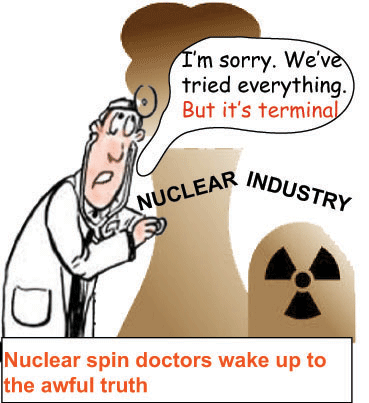
 U.K’s Nuclear Future Fades as Hitachi Exit Follows Toshiba, Bloomberg, By Lars Paulsson and Mathew Carr January 11, 2019,
EDF’s atomic plants need to be replaced by new generation
Offshore wind could be the winner from withdrawal, RBC says
…….Japanese conglomerate Hitachi Ltd. will halt work on the Wylfa project and take a one-time charge as negotiations with the British government over funding stalled, the Nikkei newspaper reported. After Toshiba Corp.’s withdrawal from its Moorside plant in November, it leaves the nation with just Electricite de France SA’s Hinkley Point project underway and that’s been mired in controversy because of delays and the cost to the U.K. consumer.
……..The Nikkei report said the company’s board will make a decision next week and cited an unidentified executive saying the project isn’t being abandoned entirely and could be restarted in the future.
Toshiba said in November it planned to liquidate NuGeneration Ltd., its U.K. nuclear power developer, after failing to find a partner or a buyer for the Moorside project. In September, China General Nuclear said it may give upthe chance to operate a nuclear plant at Bradwell amid political sensitivities over Chinese investments, the Financial Times reported.
As the U.K. is running out of nuclear options, other technologies stand to benefit.
“We see offshore wind as increasingly viable,” said John Musk, utilities analyst at RBC Europe Ltd. Natural gas power will probably provide a significant amount of the baseload power not met by renewables……..https://www.bloomberg.com/news/articles/2019-01-11/u-k-s-nuclear-future-fades-as-hitachi-exit-follows-toshiba
Australian Julian Assange in new danger as Ecuador caves in to USA pressure (and Australian govt does nothing)
 More troubles for Julian Assange as ecuador bows to pressure to extradite him following this letter, http://thewikidaily.com/more-troubles-for-julian-asange-as-ecuador-bows-to-pressure-to-extradite-him-following-this-letter/ We have been monitoring Julian asange’s asylum in Ecuadorian embassy in britain to outline the dangers the computer proggrammer and wikileaks founder face in coming future and it seems alot have been happening lately than the mainstream media’s are reporting.
Ecuador has begun a “Special Examination” of Julian Assange’s asylum and citizenship as it looks to the IMF for a bailout, the whistleblowing site reports, with conditions including handing over the WikiLeaks founder.
Former Ecuadorian President Rafael Correa tweeted an image of the letter he received from the State Comptroller General on December 19, which outlines the upcoming examination by the Direction National de Auditoria.
The audit will “determine whether the procedures for granting asylum and naturalization to Julian Assange were carried out in accordance with national and international law,” and will cover the period between January 1, 2012 and September 20, 2018.
Assange has been in the Ecuadorian Embassy in London since he sought asylum there in 2012. He was granted Ecuadorian citizenship last December in a bid to protect him from being extradited to the US where he fears he faces secret charges for publishing US government cables and documents.
WikiLeaks tweeted the news on Wednesday, joining the dots between the audit and Ecuador’s consideration of an International Monetary Fund bailout. The country owes China more than $6.5 billion in debt and falling oil prices have affected its repayment abilities.
According to WikiLeaks, Ecuador is considering a $10 billion bailout which would allegedly come with conditions such as “the US government demanded handing over Assange and dropping environmental claims against Chevron,” for its role in polluting the Amazon rainforest.
Assange’s position has increasingly been under threat under Correa’s successor, President Lenin Moreno, with Ecuadorian authorities restricting his internet access and visitors.“I believe they are going to turn over Assange to the US government,
Broad support in USA for a Green New Deal
However, the poll, conducted by the Yale Program on Climate Change Communication (YCCC), also found that very few voters were aware of the Green New Deal: 82 percent said they “knew nothing” of the proposal. Notably, the poll’s language focused on renewable electricity and job creation, but made no mention of the full decarbonization and social overhaul of the American economy that also are central tenets of the full Green New Deal.
In reporting the results, the YCCC noted the likelihood that once Republican voters became aware that the Green New Deal is being championed by Democrats, their support for the idea will decrease. This survey asked respondents about support for some of the basic concepts of the Green New Deal without associating it with either major political party.
Even though polls have shown that the majority of Republicans believe in climate change, research shows that if a proposal is made by the Democrats, Republican voters are less likely to support it. The same was true of Democratic voters and proposals made by Republicans.
Naturally, climate deniers and right-wing media like Fox News and The New York Post already are attacking the concept and its most visible champion, Rep. Alexandria Ocasio-Cortez (D-NY), foreshadowing the GND‘s slide into the partisan.
What Exactly Is the Green New Deal?
Many in the climate and energy media sphere already have attempted to pin down what exactly the Green New Deal is and how it came to be, with David Roberts at Vox going deep and long, and Tim Dickinson at Rolling Stone diving in this week because “The Green New Deal is suddenly on everyone’s lips.”
In the Yale survey, however, respondents were told that members of Congress say the Green New Deal “will produce jobs and strengthen America’s economy by accelerating the transition from fossil fuels to clean, renewable energy.”
Survey respondents were given some specifics for how this would be accomplished, which included generating 100 percent of America’s electricity from renewable sources within 10 years, upgrading the nation’s energy grid, focusing on energy efficiency, and training for jobs in the new green economy.
While this is a good general description of the GND, there is much more detail in a draft bill from Rep. Ocasio-Cortez, which even has an FAQ section………… https://www.desmogblog.com/2019/01/09/green-new-deal-bipartisan-support-yale-survey?utm_source=dsb%20newsletter
Climate denial’s successful tactic – demanding “balance” in media coverage
 By demanding “balance,” the industry transformed climate change into a partisan issue. We know that was a deliberate strategy because various internal documents from ExxonMobil, Shell, the American Petroleum Institute and a handful of now-defunct fossil fuel industry groups reveal not only the industry’s strategy to target media with this message and these experts, but also its own preemptive debunking of the very theories it went on to support.
many took the industry’s bait, routinely inserting denialist claims into stories about climate science in the interest of providing balance:
How the fossil fuel industry got the media to think climate change was debatable, WP, By Amy Westervelt, Amy Westervelt is an audio and print reporter who covers climate and gender, and sometimes the intersection of the two. Her podcast Drilled is about the creation and spread of climate denial and her first book “Forget ‘Having It All'” was published by Seal Press in November 2018., January 10 2019
Late last year, the Trump administration released the latest national climate assessment on Black Friday in what many assumed was an attempt to bury the document. If that was the plan, it backfired, and the assessment wound up earning more coverage than it probably would have otherwise. But much of that coverage perpetuated a decades-old practice, one that has been weaponized by the fossil fuel industry: false equivalence.
Although various business interests began pushing back against environmental action in general in the early 1970s as part of the conservative “war of ideas” launched in response to the social movements of the 1960s, when global warming first broke into the public sphere, it was a bipartisan issue and remained so for years. On the campaign trail in 1988, George H.W. Bush identified as an environmentalist and called for action on global warming, framing it as a technological challenge that American innovation could address. But fossil fuel interests were shifting as the industry and its allies began to push back against empirical evidence of climate change, taking many conservatives along with them.
Documents uncovered by journalists and activists over the past decade lay out a clear strategy: First, target media outlets to get them to report more on the “uncertainties” in climate science, and position industry-backed contrarian scientists as expert sources for media. Second, target conservatives with the message that climate change is a liberal hoax, and paint anyone who takes the issue seriously as “out of touch with reality.” In the 1990s, oil companies, fossil fuel industry trade groups and their respective PR firms began positioning contrarian scientists such as Willie Soon, William Happer and David Legates as experts whose opinions on climate change should be considered equal and opposite to that of climate scientists. The Heartland Institute, which hosts an annual International Conference on Climate Change known as the leading climate skeptics conference, for example, routinely calls out media outlets (including The Washington Post) for showing “bias” in covering climate change when they either decline to quote a skeptic or question a skeptic’s credibility. Continue reading
From uranium mining to nature conservation – Kakadu National Park to get $216 million boost,
Kakadu National Park to get $216 million boost, SBS News, 13 Jan 19, The federal government will invest $216 million in the Northern Territory’s Kakadu National Park to improve road access and tourist facilities. The World Heritage-listed Kakadu National Park will receive at least $216 million in funding to improve to improve roads and tourist facilities no matter who wins this year’s federal election.
Labor has pledged $220 million for Kakadu if it wins government.
Prime Minister Scott Morrison on Sunday announced the coalition’s $216 million package for the Northern Territory site during a visit to the town of Jabiru in Kakadu……https://www.sbs.com.au/news/kakadu-national-park-to-get-216-million-boost
Decentralising the energy supply system – renewables are creating a new world order

 Rise of renewables creating a ‘new world’: report, A new report by the International Renewable Energy Agency (IRENA) is predicting a new world order as a consequence of the renewables boom. SBS News 13 Jan 19, The rapid growth of renewable energy sources and the demise of fossil fuels are causing major changes in global politics, a special commission has said in a report.
The shift “will alter the global distribution of power, relations between states, the risk of conflict, and the social, economic and environmental drivers of geopolitical instability,” said the commission set up by the International Renewable Energy Agency (IRENA).
Solar, wind and other renewables, which currently make up around a fifth of global energy production, are growing faster than any other source, the report said.
Commission chairman and former president of Iceland, Olafur Ragnar, said the shift will likely cause China to eclipse the United States, place oil-dependent Gulf states at risk and help impoverished African nations achieve energy independence.
“It is difficult to predict when, but this change is happening comprehensively and fast,” Ragnar told AFP.
The report, entitled “A New World”, was launched at IRENA’s ninth general assembly in Abu Dhabi…….
Renewables will be a powerful vehicle of democratisation because they make it possible to decentralise the energy supply. https://www.sbs.com.au/news/rise-of-renewables-creating-a-new-world-report
Australia’s “largest” wind farm wins planning approval for Victoria — RenewEconomy

WestWind Energy’s plans to build an 800MW wind farm in Victoria – potentially the largest in the Southern Hemisphere – win state government planning approval. The post Australia’s “largest” wind farm wins planning approval for Victoria appeared first on RenewEconomy.
via Australia’s “largest” wind farm wins planning approval for Victoria — RenewEconomy
Black Mist, Burnt Country — Beyond Nuclear International

“Bring me the bones of Australian babies”
via Black Mist, Burnt Country — Beyond Nuclear International
We need a green planet at peace — Beyond Nuclear International

It’s time to repudiate endless war and the threat of nuclear war
via We need a green planet at peace — Beyond Nuclear International
January 13 Energy News — geoharvey

Opinion: ¶ “Climate Change Is an Existential Crisis – It Should Be the Top Political Issue, Too” • Global warming is not a partisan issue – or it should not be. The many experts issuing dire warnings about climate disruption including those of the US Department of Defense, the World Bank, the International Monetary Fund, […]
New Energy Efficiency Scheme to address climate change and reduce energy bills — RenewEconomy

The ACT’s highly successful Energy Efficiency Improvement Scheme will be expanded to include several new programs and will be extended to 2030, Minister for Climate Change and Sustainability Shane Rattenbury announced today. The post New Energy Efficiency Scheme to address climate change and reduce energy bills appeared first on RenewEconomy.
via New Energy Efficiency Scheme to address climate change and reduce energy bills — RenewEconomy
UK “reviewing” files on nuclear bomb tests in Australia- this smacks of a cover-up
 “To now withdraw previously available documents is extremely unfortunate and hints at an attempted cover-up.”
“worrying that properly released records can suddenly be removed from public access without notice or explanation.”
Review or ‘cover up’? Mystery as Australia nuclear weapons tests files withdrawn https://edition.cnn.com/2019/01/11/australia/uk-australia-nuclear-archives-intl/index.html, By James Griffiths, CNN
More than 65 years since the UK began conducting secret nuclear weapons testing in the Australian Outback, scores of files about the program have been withdrawn from the country’s National Archives without explanation.
The unannounced move came as a shock to many researchers and historians who rely on the files and have been campaigning to unseal the small number which remain classified.
“Many relevant UK documents have remained secret since the time of the tests, well past the conventional 30 years that government documents are normally withheld,” said expert Elizabeth Tynan, author of “Atomic Thunder: The Maralinga Story”.
“To now withdraw previously available documents is extremely unfortunate and hints at an attempted cover-up.”
Withdrawal of the files was first noted in late December. Access to them has remained closed in the new year.
Dark legacy The UK conducted 12 nuclear weapons tests in Australia in the 1950s and 1960s, mostly in the sparsely populated Outback of South Australia.
Information about the tests remained a tightly held secret for decades. It wasn’t until a Royal Commission was formed in 1984 — in the wake of several damning press reports — that the damage done to indigenous people and the Australian servicemen and women who worked on the testing grounds became widely known.
Indigenous people living nearby had long complained of the effects they suffered, including after a “black mist” settled over one camp near Maralinga in the wake of the Totem I test in October 1953. The mist caused stinging eyes and skin rashes. Others vomited and suffered from diarrhea.
These claims were dismissed and ridiculed by officials for decades — until, in the wake of the Royal Commission report, the UK agreed to pay the Australian government and the traditional owners of the Maralinga lands about AU$46 million ($30 million). The Australian authorities also paid indigenous Maralinga communities a settlement of AU$13.5 million ($9 million).
While the damage done to indigenous communities was acknowledged, much about the Totem I test — and other tests at Maralinga and later at Emu Field — remained secret, even before the recent withdrawal of archive documents.
“The British atomic tests in Australia did considerable harm to indigenous populations, to military and other personnel and to large parts of the country’s territory. This country has every right to know exactly what the tests entailed,” Tynan said. “Mysteries remain about the British nuclear tests in Australia, and these mysteries have become harder to bring to light with the closure of files by the British government.”
Alan Owen, chairman of the British Nuclear Test Veterans Association, which campaigns on behalf of former servicemen, said “the removal of these documents affects not only our campaign, but affects the many academic organizations that rely on this material.”
“We are very concerned that the documents will not be republished and the (Ministry of Defense) will again deny any responsibility for the effects the tests have had on our membership,” Owen told CNN.
Unclear motives Responding to a request for comment from CNN, a spokeswoman for the National Archives said the withdrawal of the Australian nuclear test files was done at the request of the Nuclear Decommissioning Authority (NDA), which has ultimate responsibility over them.
The NDA said that “a collection of records has been temporarily withdrawn from general access via The National Archive at Kew as part of a review process.”
“It is unclear, at this time, how long the review will take, however NDA anticipates that many of the documents will be restored to the public archive in due course,” a spokeswoman said.
Jon Agar, a professor of science and technology at University College London, said the withdrawal “is not just several records but two whole classes of files, many of which had previously been open to researchers at the National Archives.”
“These files are essential to any historian of the UK nuclear projects — which of course included tests in Australia. They have been closed without proper communication or consultation,” he added.
Agar shared correspondence he had with the NDA in which a spokeswoman said some files would be moved to a new archive — Nucleus — in the far north of Scotland. However the Nucleus archives focus on the British civil nuclear industry, and it is unclear why files on military testing would be moved there, or why those files would need to be withdrawn to do so.
Nucleus also does not offer the type of online access to its records as the National Archives does.
“Why not just copy the files if the nuclear industry needs them at Nucleus for administrative reasons? Why take them all out of public view?” Agar wrote on Twitter.
Information freedom In correspondence with both CNN and Agar, the NDA suggested those interested in the files could file freedom of information (FOI) requests for them.
Under the 2000 Freedom of Information Act, British citizens and concerned parties are granted the “right to access recorded information held by public sector organizations.”
FOI requests can be turned down if the government deems the information too sensitive or the request too expensive to process. Under a separate rule, the UK government should also declassify documents between 20 and 30 years after they were created.
According to the BBC, multiple UK government departments — including the Home Office and Cabinet Office — have been repeatedly condemned by auditors for their “poor,” “disappointing” and “unacceptable” treatment of FOI applications.
Commenting on the nuclear documents, Maurice Frankel, director of the Campaign for Freedom of Information, a UK-based NGO, said it was “worrying that properly released records can suddenly be removed from public access without notice or explanation.”
“It suggests that the historical record is fragile and transient and liable to be snatched away at any time, with or without good reason,” he added.
1 This month.

Australians deserve the truth
about
AUKUS – https://aukuspublicinquiry.com/



PETITION – To: Prime Minister Anthony Albanese and the Australian Labor Government

of the week – Australians for War Powers Reform (AWPR)
To see nuclear-related stories in greater depth and intensity
 Antinuclear