Bureau of Meteorology’ reveals Australia’s record-breaking month of climate change
 The stunning chart revealing Australia’s record-breaking run of rising temperatures https://www.brisbanetimes.com.au/politics/federal/the-stunning-chart-revealing-australia-s-record-breaking-run-of-rising-temperatures-20190110-p50qk1.html By Nicole Hasham10 January 2019
If there was any question Australians are enduring a more extreme, topsy-turvy climate, look only to the month just gone.
In early December, Cyclone Owen unloaded 678 millimetres of rain in one day on the tiny North Queensland town of Halifax. It was a new December daily rainfall
By mid-December, a month’s worth of rain fell in parts of Victoria in 24 hours. On December 20 it was Sydney’s turn when a monster thunderstorm dropped giant hail stones – some the size of cricket balls. The insurance bill is nearing $675 million.
Then, the sun came out. By month’s end, much of Australia was baking under torrid temperatures. Marble Bar in Western Australia reached 49.3 degrees – the third-highest December temperature recorded anywhere in the country.
Advertisement
The record-breaking events are outlined in the Bureau of Meteorology’s 2018 climate statement released on Thursday, which confirmed the nation experienced its third-warmest year on record in 2018. The bureau attributed the year of meteorological extremes to both climate change and natural variability.
The national mean temperature in 2018 was 1.14 degrees above average. Nine of the 10 warmest years on record have occurred since 2005.
The bureau’s senior climatologist Lynette Bettio said every state and territory experienced above-average day and night temperatures last year.
“The average maximum temperature for the country as a whole was particularly warm, sitting 1.55 degrees above the 1961-1990 average, making 2018 Australia’s second warmest year on record for daily high temperatures,” Dr Bettio said.
Australia’s September rainfall was the lowest on record. Nationally, rainfall in 2018 was the lowest since 2005 and 11 per cent below average, while rainfall in some areas was significantly further below normal.
“Large areas of southeastern Australia experienced rainfall totals in the lowest 10 per cent on record, which exacerbated the severe drought conditions,” Dr Bettio said.
“NSW had its sixth driest year on record, while the Murray-Darling Basin saw its seventh-driest year on record.
“We did see some respite in the final three months of the year with decent rainfall in the east of the country.”
In other significant weather events last year, Broome broke its annual rainfall record just two months into the year and Tropical Cyclone Marcus was the strongest to affect Darwin since Tracy in 1974.
In August and September, up to 100 bushfires were active across NSW, Queensland and Victoria when warm, dry conditions brought an early start to the bushfire season
The Morrison government has been riven with internal tensions over climate change policy. Under the Paris climate accord, Australia has vowed to reduce greenhouse emissions, based on 2005 levels, by 26 per cent before 2030.
The government says Australia will meet that target “in a canter” however this claim has been contradicted by international bodies and the government’s own data.
Most recently, figures released by the Department of Environment and Energy last month showed that on current trends Australia will reduce emissions by just 7 per cent on 2005 levels by 2030, a massive 19 percentage points or two-thirds of the way short of the Paris agreement.
A major report prepared by the United Nations body for climate change, the Intergovernmental Panel on Climate Change, in October said coal-generated electricity must be phased out globally by 2050 if the world is to avoid the most catastrophic impacts of global warming, including the total destruction of the Great Barrier Reef.
The bureau said Australia was strongly influenced by both natural variability and climate change in 2018. Natural drivers included sea surface temperatures in the southern Tasman Sea which rose to “exceptionally high levels” in late 2017 and early 2018, contributing to warm overland conditions.
The report said Australia’s climate “is increasingly influenced by global warming” and the nation has warmed by just over one degree since 1910. Most warming has occurred since 1950.
Australia could use a little-known loophole to help meet up to half its Paris climate commitments in a move that analysts warn could undermine the global accord.
It said radical, swift efforts must be taken to curb greenhouse gas pollution and keep the global temperature increase below the critical 1.5 degree threshold.
“The background warming trend can only be explained by human influence on the global climate,” the bureau said.
Climate change: Victoria’s iconic Great Ocean Road at risk from sea level rise
Great Ocean Road at risk from surging sea , Canberra Times, By Royce Millar, 10 January 2019 Key sections of the Great Ocean Road are at risk of being washed away, raising safety fears and calls for the Andrews government to reroute parts of the world-recognised tourist road.
New studies of dramatic beach erosion around Apollo Bay over the last two years highlight the mounting problem of erosion, flooding and sea level rise along Victoria’s coast.
In a report to the State government released exclusively to The Age, leading coastal geomorphologist Neville Rosengren and engineer Tony Miner recommend urgent action to protect the foreshore of Mounts Bay next to Apollo Bay, after major erosion there in 2017.
They warn the national heritage-listed road could be “compromised” within five years.
A second report on erosion at Apollo Bay by engineers GHD also recommends the eventual “realignment” of the road outside township areas at Apollo Bay. It notes that five metres of erosion at Apollo Bay beach during a June 2018 storm put the road “at risk”.
The studies point to erosion at critical levels at the very time the state’s south-west is hosting ever greater numbers of visitors, now more than five million a year.
Similar problems are being faced along the wider coast, from Port Fairy in the south-west to Inverloch and the Ninety Mile Beach and Lakes Entrance in the south-east and east……..
findings raise the prospect that rising seas due to climate change are now proving a real problem for vulnerable coastal locations.
Mr Rosengren said rising sea levels contributed to the erosion at Mounts Bay.
“You’re witnessing the effects of a complex of processes of which sea level is one,” he said.
The Intergovernmental Panel on Climate Change’s (IPCC’s) current projection for sea level rise, based on high emissions, ‘business-as-usual’ scenario, is almost 90 centimetres by the year 2100, relative to an average sea level for the period 1986-2005.
That projection will be updated, most likely upwards, in the IPCC’s special oceans report due for release this year.
Other peer-reviewed studies have forecast a much steeper rise in sea level by 2100.
……… While possible, realignment of the road would be difficult and expensive at Mounts Bay because the Barham River runs along the landward side of the road, making the area also susceptible to flooding.
…….. A quandary for all concerned is that sea walls of any form will alter the character of a coastline renowned for its rugged, natural beauty. Sea walls also interfere with the coast’s ecology and its ability to naturally replenish itself.
Bankrolled by public donations, the 243-kilometre Great Ocean Road was built by World War I veterans between 1919 and 1932 as a memorial to soldiers killed in the war, and to open the south-west coast to tourists and daytrippers. It was built as close to the ocean as possible.
……… A Victorian Department of Environment Land Water and Planning spokesperson said accounting for sea level rise was now “embedded” in the Victorian planning system.
The Age has sought an interview and comments from federal Environment Minister Melissa Price about the Morrison government’s policies on, and plans for, sea level rise. https://www.canberratimes.com.au/national/victoria/great-ocean-road-at-risk-from-surging-sea-20190110-p50qjb.html
Japan backing away from nuclear power build in UK: this could derail UK’s nuclear ambitions
Japan’s nuclear rethink could derail UK energy plans, https://unearthed.greenpeace.org/2019/01/09/japan-uk-nuclear-plans-go-awry/, Doug Parr, 11 Jan 19, Reports in the Japanese press claim Hitachi is set to suspend all work on Wylfa, its nuclear power project in Wales.
Japan’s prime minister Shinzo Abe is in London this week, and it seems likely in his meeting with Theresa May that the Japanese-backed nuclear power plant in Wales will come up.
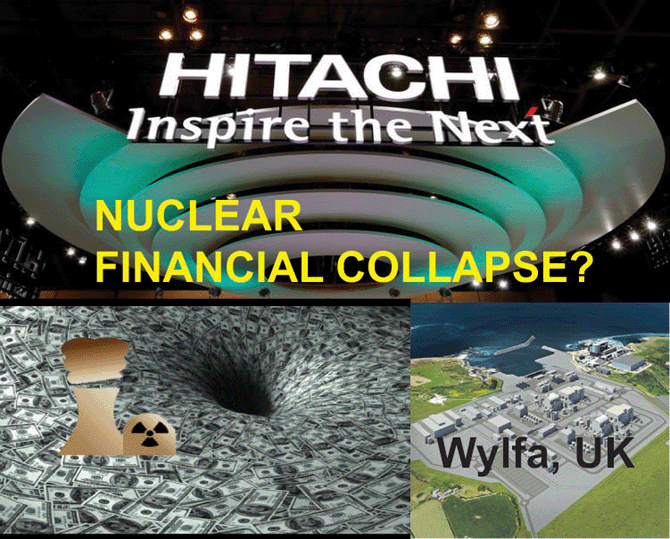 The Wylfa project, to be built by Hitachi and its subsidiary Horizon, is one of a clutch of planned nuclear power stations which the UK government has heavily prioritised for security of power supply, and meeting the country’s climate obligations.
Late last year another of the 6 major projects, the proposed Moorside plant in Cumbria, was effectively abandoned after Toshiba pulled out. And another has come under fire as questions are raised about security issues flowing from the Chinese builders.
These developments effectively illustrate that UK nuclear power policy is heavily dependent on overseas developers. What is less understood is that there are significant shifts underway in Japan which strongly suggest Hitachi’s projects may too be at risk.
‘Nuclear export superpower’ The most advanced of Horizon’s nuclear plans is a large power station to be built at Wylfa on Anglesey, North Wales.
In fact, with the collapse of Moorside, the Wylfa plant is the only nuclear project that could realistically be built before 2030, in addition to the plant already under construction at Hinkley Point in Somerset.
Japan, however, is reconsidering its nuclear export strategy. Because it keeps going wrong.
Until recently it had 3 companies interested in building nuclear power stations abroad: Toshiba, Mitsubishi and Hitachi.
These companies have experience building nuclear stations at home but since the Fukushima disaster in 2011, they have had to look elsewhere. Seeking to help these giants of Japanese industry to maintain their businesses, Prime Minister Abe reportedly wanted to turn Japan into a “nuclear export superpower”.
Misfires Toshiba pulled out of Moorside last year because it had run up huge losses in building 2 nuclear plants in USA. One, the Summer project in South Carolina, was abandoned altogether despite it being nearly half-built. Toshiba has pulled out not just of Moorside, but of building new nuclear power stations altogether.
Meanwhile, another of Japan’s nuclear groups, Mitsubishi Heavy Industries (MHI), has also been struggling to get its international project off-the-ground. It had one nuclear power station in the offing, at Sinop in Turkey, following an agreement years ago between the two countries’ prime ministers. However it seems clear that MHI is preparing to leave the project amid its “ballooning costs”. This is the only nuclear power station project MHI had an interest in.
The last of the companies involved in Japan’s nuclear export push is Hitachi. It has one active overseas nuclear project in UK at Wylfa, North Wales, and one more speculatively planned at Oldbury in Gloucestershire.
Hitachi, however, are reportedly be thinking of scrapping the project as its costs and risks become unmanageable. Hitachi could be looking at Toshiba’s near-bankruptcy and thinking ‘let’s not go there’. According to their chairman the project was in “an extremely severe situation” as it struggled to attract investors, even though UK government may have promised as much as two thirds of the build cost.
Despite this already generous largesse (on behalf of UK taxpayers, not offered to any other energy projects) Hitachi are intending to come back to UK government and ask for more. It looks like no assessment of the risks by a private funder come back looking good, and the only way nuclear plants can be built is with government stepping into very risky projects that require taxpayers to shoulder the risk.
The aversion from private investors may not only be because of the rising costs, but also that the operating performance of the proposed reactor is pretty poor (albeit partly due to earthquakes). Notably Hitachi continues to be happy to spend many billions of pounds on power grid investments, but not its own nuclear reactor, which it wants UK taxpayers to fund.
Second thoughts Unsurprisingly this tale is making many in Japan have second thoughts.
Major Japanese newspapers have opposed their own taxpayers lending supportto the Wylfa project, even though a home-grown company would be getting the benefits. And during the Xmas break, Japan’s third largest newspaper called for the nuclear export strategy to be abandoned. Another paper attacks the ‘bottomless swamp’ of nuclear funding in UK and remarks upon how few countries seem to be following the UK-style nuclear-focused policy.
Reportedly Japanese government has asked its development banks to fund the ‘nuclear export strategy’, and Wylfa in particular, but they don’t want to. It is quite difficult to see how Hitachi can manage the risks of this project without some home support, and support in Japan is ebbing away.
Few other countries will be stepping into the UK’s nuclear hole. The South Korean company KEPCO – that once might have taken over the Moorside project – is also finding exporting nuclear power tough to export, as ‘shoddy’ construction in a nuclear plant in United Arab Emirates, with attendant delays and extra costs, is showing.
For the UK, which has made a heavy bet on new nuclear to cover for retiring plants and make up a significant share of its decarbonisation targets, news from the other side of the world makes that bet look a dodgy one.
Over 600 Environmental Groups support Green New Deal, in USA Congress
More Than 600 Environmental Groups Just Backed Ocasio-Cortez’s Green New Deal, Gizmodo, Brian Kahn , 11 Jan 19, Pressure continues to mount on Congress to get its act together on climate change. The latest salvo came on Thursday, as 626 groups delivered a letter to every member of Congress laying out their support for a Green New Deal and their demands.
Dr Gordon Edwards explains the background to former NRC chairman’s opposition to nuclear power
 Nuclear Regulatory Commission ex-Chairman Gregory Jaczko is adamantly opposed to the idea of keeping existing nuclear reactors running as a way to offset climate change, because each reactor is like a time bomb ready to explode if the cooling is cut off by a total station blackout, by equipment failure, by major pipe breaks, or by acts of warfare, sabotage, or terrorism. The societal dislocation caused by the spread of radioactive material over wide areas, affecting drinking water, food and habitation for decades or centuries, is as bad as the ravages of climate change for the communities so affected.
Australian govt manages Kakadu National Park, and must upgrade it, and the town of Jabiru
 Show Kakadu the money, insists Moss,https://www.news.com.au/national/northern-territory/show-kakadu-the-money-insists-moss/news-story/d3494eb0e5093466e2becebe1b1ad9bf– 11 Jan 19
IT is time the Federal Government made clear what its funding plans are for Kakadu National Park and the town of Jabiru, Tourism Minister Lauren Moss said yesterday
IT is time the Federal Government made clear what its funding plans are for Kakadu National Park and the town of Jabiru, Tourism Minister Lauren Moss said WEDNESDAY.
Ms Moss said she is regularly quizzed about the Federal Government’s intentions.
“We have been advocating for a really long time and we have a blueprint that we presented to the Federal Government that has been done in conjunction with Aboriginal traditional owners and we want to make that we see the tired infrastructure upgraded and the complete transformation of Jabiru,” Ms Moss said. “The township is transitioning out of being a mining town into a really pumping tourist town that supports the surrounding communities.
“In line with this we continue to encourage the Federal Government to put the badly needed investment into Kakadu.
“It is a park that is managed by the Federal Government and more needs to be done in Kakadu.
“We love our parks and that’s why we are making investments in Litchfield, Nitmiluk and a whole range of other park estates.
“Kakadu National Park is important to Australia and to our Top End tourism operators. It’s an incredibly important cultural and natural asset for the Territory. This is recognised by its heritage listing.”
Prime Minister Scott Morrison has committed to working with the Territory Government and Traditional Owners “to ensure the future of Jabiru is settled as soon as possible”, but has not committed to a timeline
Pope Francis’ strong statement condemning nuclear wesapons
Pope Francis Rejects Existence of Nuclear weapons, https://www.plenglish.com/index.php?o=rn&id=37433&SEO=pope-francis-rejects-existence-of-nuclear-weapons Vatican City, Jan 7 (Prensa Latina) Pope Francis said on Monday that the existence of nuclear weapons is functional to a logic of fear that has to do not only with parties in conflict, but with the entire human race.
In this regard, he pointed out that it is sad to see how the arms market not only does not stop, but there is an increasingly widespread tendency for individuals and states to arm themselves.
Francis pointed out that ‘it is especially worrying that nuclear disarmament, so desired and pursued in part in the past decades, is now giving way to new, increasingly sophisticated and destructive weapons.
The Pope referred, on the other hand, to the floods, floods, fires, earthquakes and droughts suffered in 2018 by regions of the Latin American continent and South-East Asia, for which he considered urgent an agreement of the international community on environmental issues and climate change.
He also stressed that in the light of the consensus reached at the recent International Climate Conference (COP-24) in Katowice, he expected a more decisive commitment from states to strengthen collaboration to urgently address the worrying phenomenon of global warming.
Why sea levels aren’t rising at the same rate globally
Explainer: Why sea levels aren’t rising at the same rate globally, A spinning planet, melting ice sheets and warmer waters all contribute to sea level rise, Science news for Students, KATY DAIGLE, CAROLYN GRAMLING, JAN 10, 2019 The sea is coming for the land. In the 20th century, ocean levels rose by a global average of about 14 centimeters (some 5.5 inches). Most of that came from warming water and melting ice. But the water didn’t rise the same amount everywhere. Some coastal areas saw more sea level rise than others. Here’s why:
Swelling seawater As water heats up, its molecules spread out. That means warmer water takes up slightly more space. It’s just a tiny bit per water molecule. But over an ocean, it’s enough to bump up global sea levels……..
Land a-rising Heavy ice sheets — glaciers — covered much of the Northern Hemisphere about 20,000 years ago. The weight of all that ice compressed the land beneath it in areas such as the northeastern United States. Now that this ice is gone, the land has been slowly rebounding to its former height. So in those areas, because the land is rising, sea levels appear to be rising more slowly.
But regions that once lay at the edges of the ice sheets are sinking. ……..
Land a-falling, Earthquakes can make land levels rise and fall…….
Glaciers begone Melting glaciers also can add water to the oceans. But these huge ice slabs affect sea levels in other ways, too.
Huge glaciers can exert a gravitational tug on nearby coastal waters. ……. https://www.sciencenewsforstudents.org/article/explainer-why-sea-level-rise-rate-varies-globally
2019 As coal and nuclear power stations retire, 2019 U.S. renewable generation additions expected to far outpace gas
 2019 US renewable generation additions expected to far outpace gas: EIA https://www.utilitydive.com/news/2019-us-renewable-generation-additions-expected-to-far-outpace-gas-eia/545836/ AUTHOR, Iulia Gheorghiu @IMGheorghiu

Dive Brief:
- 23.7 GW of new U.S. electric generating capacity, mostly from wind, natural gas and solar, are expected in 2019, according to the U.S. Energy Information Administration (EIA) inventory of electric generators.
- In addition, EIA data shows 8 GW of primarily coal, nuclear and natural gas generation are expected to retire this year, though that number could increase as utilities continue to evaluate their generating portfolios.
- The expected retirements include Arizona’s 2.3 GW Navajo coal-burning power plant, Exelon’s 819 MW Three Mile Island nuclear power plant in Pennsylvania and Entergy’s 677 MW Pilgrim nuclear power station in Massachusetts.
Dive Insight:
Cheaper prices of natural gas and renewable energy have impacted the competitiveness of more traditional generation fuels.
Renewable additions are projected to more than double gas in 2019. Last year, natural gas capacity additions outpaced renewable energy additions for the first time since 2013. 2018 was also a landmark year for new capacity additions, as EIA expected nearly 32 GW of new capacity — the most in a decade.
The estimates, based on EIA data, do not include additions in the residential and commercial solar sectors, which are expected to be an additional 3.9 GW by the end of 2019.
In 2019, EIA is tracking about 6.1 GW of combined-cycle gas plants and 1.4 GW of combustion-turbine gas plants, expected to be mostly online by June, in order to meet high energy demand during the summer peak. The rest of the expected additions include wind, solar and about 2% of other renewable and battery storage capacity.
Renewable capacity typically comes online at the end of the year, according to the EIA. This matches the upcoming changes in renewable energy tax credits. The wind production tax credit will phase out completely at the end of the year from its current status at 40% of 2015 levels. On the solar side, this is the last year for a full 30% investment tax credit for developing solar energy systems, which will begin to phase down in 2020.
Utility integrated resource plans (IRPs) are beginning to show that renewables can beat out older coal plants, as the Northern Indiana Public Service Company demonstrated through its 2018 IRP analysis last fall, assessing a scenario to eliminate the resource by 2028.
Half of the 4.5 GW of coal-fired capacity expected to retire in 2019 comes from the Navajo Generation Station (NGS), which has not found enough customers for its power generation despite support from a number of groups and the Trump administration to keep it open. Last September, private equity firm Middle River Power dropped its bid to purchase the plant.
In addition, the Pilgrim nuclear plant, set to retire in May, and Three Mile Island, scheduled to retire in September, follow announcements from the plant operators of “severe economic challenges.” Exelon’s Three Mile Island failed to clear the PJM Interconnection capacity market auction in 2017 and Entergy based the decision for Pilgrim on a range of financial factors, including low current and forecast wholesale energy prices.
While the Trump administration has worked to support existing coal and nuclear power plants and to create economic conditions to add new coal and nuclear capacity, trends are pointing away from nuclear and coal additions.
“I don’t think there are any trends in the current electricity market that favor the idea of building new coal or nuclear power plants,” Tim Fox, vice president of ClearView Energy Partners, told Utility Dive.
The natural gas plants set for retirement largely consist of steam turbine plants, mostly located in California. They are older units that came online more than 50 years ago. Other capacity retirements for the year include a hydroelectric plant in Washington state and smaller renewable and petroleum capacity.
Follow Iulia Gheorghiu on Twitter
January 11 Energy News — geoharvey

Opinion: ¶ “California Set a Goal of 100% Clean Energy, and Now Other States May Follow Its Lead” • At least nine governors taking their oaths of office this month, from Nevada to Michigan to New York, campaigned on 100% clean energy, or have endorsed the target in the four months since it was enshrined […]
Australia 2019 – it’s time to Act on Climate Change, and for a Nuclear-Free Nation – theme for January 2019
It could be the weather – heat, bushfires, floods- or the degraded state of our one big river system – or the ever more obvious stupidity of our masters in Canberra – but something has to wake up Australians to our climate peril.
Australia, with its relatively small population, is the “canary in the mine” for developed countries experiencing climate change. We need to:
(a) Show the world that we are part of the global co-operative effort to slow down climate change, and to adapt to its impacts. Australia must reverse its disgraceful history of subverting international action on climate change. Australia must help Pacific island nations to address sea level rise impacts, including accepting climate refugees.
(b) Quit coal, push for energy conservation, re-afforestation, and renewable energy, with a properly developed grid, and promote electric vehicles.

As for the nuclear threat to Australia – it’s not on the public radar, thanks to the corporate-influenced media, as well as to the ignorance and subservience of Australia’s Liberal and Labor politicians. What needs to happen – an independent inquiry and plan for managing radioactive trash, the closing of the Lucas Heights nuclear reactor, (in conjunction with development of a cyclotron-based development of medical radioisotopes.) Expose and turf out those politicians who remain in the grip of the nuclear lobby – with their dream of $billions from turning Australia into the world’s nuclear garbage dump.
Labor has made a start, with its in-principle decision to join the U.N. Nuclear Weapons Ban Treaty. Unfortunately, Australia is locked into the USA nuclear weapons system, with Pine Gap and other American military bases (targets) in this country.
The risk of nuclear war is now greater than ever, since World War 2. In international relations, Australia treads a difficult path between its ties to both USA and China. Blind subservience to Donald Trump is a dangerous option.
However, the prospect of a Labor election victory quite soon means that Australia can now look forward to some intelligent and better-informed national leadership on both climate and nuclear matters.
And we have very dedicated organisations working on both of these issues. We need all Australians to join us in an allout effort for a clean energy Australia, helping the global effort to slow the pace of climate change, and intelligently addressing its effects.
ANSTO’s duplicity on what is or is not “High Level” nuclear waste

Anthony Clark Isn’t High Grade reclassified to Intermediate radiation, in order to calm the multitude?
After this stuff is sent overseas for ‘processing’ it returns as ‘waste’.
So either they have to be honest about high level waste being generated in Australia or accept that Australia is accepting waste that is generated overseas.
If it isn’t called waste when it leaves Australia and is called waste when it returns, it’s hard to argue that it isn’t ‘waste generated overseas’.
Jillian Marsh to lull the uneducated into thinking ‘its just hospital grade waste and quite harmless’ and to justify government endorsement of a plan to turn our country into the world’s dumping ground …. Happy New Year? i think not if that’s what the people of this nation are supporting. absolutely crazy https://www.facebook.com/groups/344452605899556/
Climate change denier Peta Credlin for Liberal preselection? That would finally blow up the Liberal Party!
The Liberal party is suffering an existential crisis. And no other issue defines this crisis like the looming threat to our safety and security caused by inaction on climate change. Credlin understands this and has used her position as a climate change-denying, hard-right mouthpiece of the Murdoch empire to advance her own political interests, and the interests of the coal industry.
She’s consistently claimed climate change is a political hoax, and used her position in the media to undermine a sitting prime ministerand any energy policy supported by the Coalition party room that does not involve more coal and the end of renewables.
She doesn’t represent real liberal views, and if she appeals to what’s left of the “base”, then many people who used to vote Liberal will keep moving for the exits.
Inspired by Donald Trump, Credlin has argued Australia should tear up the Paris agreement, tear up any sensible national energy guarantee. Credlin has demanded taxpayers’ money go to the Adani coalmine and be used to build new coal-fired power stations. It’s madness.
Australians don’t want this. We would prefer a Great Barrier Reef, renewable energy and a future we can survive and thrive in.
These views are so ignorant – their political manifestation through Tony Abbott, Craig Kelly and their ilk – that it presents a grave economic and security threat to Australia’s future. And it could be the final death knell to the Liberal party.
Credlin’s demonstrated lack of understanding of the serious climate emergency we face, or even the basic economics of power production costs are breathtaking. She promotes the view that climate change is some leftwing conspiracy and that the science is rubbish.
These views need to be called for what they are: dangerous.
In her media roles, Credlin has even attacked the scientific foundation for energy and climate policy. From the desk at Sky, she announced her displeasure that former prime minister Malcolm Turnbull asked chief scientist Alan Finkel for real consideration of the climate change transition and energy policy. Instead she demanded a manufactured report devoid of reality………
Australians know it’s getting hotter every summer and see the increases in extreme weather. Report after report, overflowing with scientific evidence, traditionally a solid foundation for investment and public policy making, has been abandoned by the federal Liberal party. We understand how this will threaten our families, economy and security, and we must act to provide people with a real liberal alternative.
Credlin, Abbott and the rest of the hard-right’s “commitment to coal” is entirely political. The calculation they’ve made is that their short-term political interests, and the interests of the coal industry, are more important than the future of our country, our people and holistically the environment we all share.
It is essential now that real liberals stand against this reckless game of Russian roulette the hard right are playing with our future. If not, they too will adorn the walls as climate change deniers, who, despite all the evidence, refused to act.
• Oliver Yates is a member of the Liberal party and former chief executive of the Clean Energy Finance Corporation https://www.theguardian.com/commentisfree/2019/jan/09/peta-credlins-preselection-could-be-the-spark-that-blows-up-the-liberal-party
Book by former chairman of Nuclear Regulatory Commission opposes nuclear energy
How Dangerous is Nuclear Power and How Bad is It’s Regulation? (2019)
Former NRC chairman remains clearly opposed to nuclear energy, Las Vegas Sun, 9 Jan 19, “……… former Nuclear Regulatory Commission Chairman Gregory Jaczko is going on the offensive to explain why nuclear energy is nowhere near a perfect solution to the climate crisis.
In a new book, Jaczko reiterates his longstanding criticism of the nuclear industry and his opposition to development of traditional nuclear power plants, which he says are unsafe despite technological improvements designed to make them safer.
Exhibit No. 1 in Jaczko’s argument is the Fukushima disaster. …, he contends that the catastrophe at Fukushima wiped out environmental gains that Japan made by burning less fossil fuels
…….Meanwhile, he says, the cost of generating electricity through natural gas and renewables is lower in most parts of the country than nuclear generation
……“So to me, the idea that somehow we’re going to preserve these reactors and that’s a climate solution is just wrong,” he said.
Then, of course, there’s the issue with nuclear waste ………
Jaczko’s bottom-line assessment is that despite decades of development, nuclear energy remains too hazardous and costly to be a viable source of power.
“There’s going to be an accident,” he said. “The only question is when and where.”
It’s a compelling argument, and anyone who may be warming to nuclear energy in the fight to reverse climate change should examine it. The book, “
,” is available now at Amazon, Barnes & Noble and other outlets. https://lasvegassun.com/news/2019/jan/09/former-nrc-chairman-remains-clearly-opposed-to-nuc/
Trump administration and Bill Gates hope to further Gates’ nuclear project, with taxpayer funding, and weaker safety regulation.
 TRUMP ADMINISTRATION WANTS BILL GATES TO DITCH CHINA AND BUILD HIS NUCLEAR PROJECT IN THE US, Daily Caller, Jason Hopkins | Energy Investigator 01/08/2019 | Members of the Trump administration are actively working to convince Bill Gates to relocate his now-scrapped nuclear reactor project in China over to the U.S.
“We hope we can work with them and bring them back,” said Deputy Energy Secretary Dan Brouillette in an exchange with reporters Monday. Brouillette revealed the Energy Department has held “several conversations” with Gates, adding that he was optimistic the U.S. government could streamline the permitting process and entice the billionaire to bring his project stateside…….
“Unfortunately, America is no longer the global leader on nuclear energy that it was 50 years ago. To regain this position, it will need to commit new funding, update regulations, and show investors that it’s serious,” Gates wrote in a year-end blog post, first revealing his botched nuclear plans. ……
In the waning days of December, Congress passed the The Nuclear Energy Innovation and Modernization Act by wide margins in both chambers. The legislation aims to streamline the regulatory process for commercial nuclear plants, with an end game of making the development and commercialization of nuclear technology more affordable.
If signed by President Donald Trump, the bill could make nuclear projects, like the one Gates is spearheading, easier to accomplish. https://dailycaller.com/2019/01/08/bill-gates-nuclear-project/
1 This month.

Australians deserve the truth
about
AUKUS – https://aukuspublicinquiry.com/



PETITION – To: Prime Minister Anthony Albanese and the Australian Labor Government

of the week – Australians for War Powers Reform (AWPR)
To see nuclear-related stories in greater depth and intensity
 Antinuclear