Antinuclear

Australian news, and some related international items

Adani tries to bankrupt Wangan and Jagalingou man, Adrian Burragubba, I

It’s the multi-billion dollar mega-mine set for Queensland. But one man is trying to stop it going ahead. And he isn’t going away. news.com.au  Charis Chang@CharisChang2 7 Jan 19Adrian Burragubba has been a thorn in Adani’s side for years and now the mining giant has had enough.  

Last month Adani filed an order seeking to bankrupt the Wangan and Jagalingou man by demanding payment of more than $600,000 in legal costs.

The extreme action follows numerous failed court actions that Mr Burragubba has been party to since 2015 to stop Adani’s coal mine in Queensland’s Galilee Basin from going ahead.

Mr Burragubba is part of the W&J People, who have a native title claim over about 30,000sq km of land in central Queensland, west of Rockhampton, including the townships of Clermont, Alpha, Rubyvale and Capella.

He’s a vocal member of the W&J Family Council disputing the validity of the indigenous land use agreement (ILUA) which Adani has secured from the traditional owners of the land.

The W&J had been negotiating with Adani since 2011 but were unable to reach an agreement so the company applied to the National Native Title Tribunal to grant them two mining leases.

The tribunal can order that mining leases be granted even if an agreement with traditional owners has not been reached.

In October 2013, the Queensland Government gave notice it intended to grant the leases and a six-month negotiation process started between the mining company and native title holders.

Australia’s first Indigenous silk Tony McAvoy has previously criticised the native title system because the tribunal rarely rejects applications for mining leases.

Mr McAvoy is a W&J traditional owner and he said Aboriginal people were being coerced into agreements with mining companies because if an agreement was not reached, they lost their opportunity to negotiate compensation or royalties.

If we don’t agree, the native title tribunal will let it go through, and we will lose our land and won’t be compensated either. That’s the position we’re in,” Mr McAvoy told The Guardian.

….At the meeting, which Mr Burragubba has claimed is not valid, there were 294 votes to approve the agreement and only one against.

But Mr Burragubba said the company failed to explain that once native title is relinquished it cannot be reclaimed.

Our position has always been the same — that there has never been any free or informed consent with any agreement with Adani,” Mr Burragubba said in August.

However, legal action challenging the registration of the land use agreement was dismissed on August 17, 2018.

The decision was delivered after the Federal Government passed legislation to override a separate Federal Court ruling that all members of a native title group had to approve of an agreement for it to be valid.


The law change was important for Adani because its agreement did not get approval from all 12 families represented.

At that point, state and federal governments had already granted Adani all necessary state and federal approvals, although it still needs to submit groundwater and other plans.

But Mr Burragubba has refused to give up.

Another appeal was filed on September 7 and is due to be heard in May.

Adani tried to stop the most recent action, which was originally scheduled for February, by asking the court to force W&J representatives to pay $160,000 in security costs or have their appeal dismissed.

Adani’s lawyers said it had tried to recoup payment of $637,000 in legal fees from previous cases and had been unsuccessful. While the court agreed to the payment, it reduced the amount to $50,000 that must be paid by the end of January.

The decision was a blow to Adani, partly because its move also saw the court case delayed further and it will be heard in May instead.

After weathering years of legal actions from the W&J Family Council and other environmental activist groups, Adani appears to have had enough and is playing hardball. https://www.news.com.au/finance/business/mining/adani-tries-to-bankrupt-wangan-and-jagalingou-man-adrian-burragubba/news-story/46aefeeca5f02c61f73b3840cfdddad1?fbclid=IwAR1NuyfNRGivxa72zmUl0lBVb91I074dPmTeHqGzIfA6If0_ukjHTkVqepQ

January 8, 2019 Posted by | aboriginal issues, AUSTRALIA - NATIONAL, climate change - global warming | Leave a comment

Caloundra, South East Queensland an ionising radiation hotspot

Australia records 6,543,223 c.p.m. radiation counts 1-5-2019 

Paul WaldonFight To Stop Nuclear Waste Dump In Flinders Ranges SA    7 Jan 19 Caloundra, a hot spot. 

This is no less than three times that I know of, where this town of more than 42,000 people have been hit with a radioactive cloud, however this time its at a whopping 6,543,223 cpm.

ARPANSA failed to give me an explanation with the previous contamination. Did the media report on it, I don’t know.
I don’t know the cause, but when they can’t control nuclear, they try their best to control the media.Fight To Stop Nuclear Waste Dump In Flinders Ranges SA https://www.facebook.com/groups/373984659617522/

January 6, 2019 Posted by | AUSTRALIA - NATIONAL, environment | Leave a comment

Nuclear arms race danger is increasing – Australia endorses it

Nuclear arms race risk grows, amid US and Russia tensions, Newcastle Herald , Damon Cronshaw , JANUARY 7 2019,  The risk of a new nuclear arms race appears to have significantly increased through “fractured relations between the US and Russia”, a University of Newcastle academic says.

January 6, 2019 Posted by | AUSTRALIA - NATIONAL, weapons and war | Leave a comment

Despite Tony Abbott, renewable energy investment has been promoted by Labor and the crossbench

Senate crossbench gave renewables $23bn boost by thwarting Abbott’s plan https://www.theguardian.com/environment/2019/jan/06/senate-crossbench-gave-renewables-23bn-boost-by-thwarting-abbotts-plan, Paul Karp @Paul_Karp Sun 6 Jan 2019 

 Decisions by Labor and crossbench to save clean energy agencies encouraged investment, report says The Senate’s decisions to stop Tony Abbott abolishing clean energy agencies helped create renewable energy projects worth $23.4bn, a new report says.

The Australia Institute says decisions taken by Labor and the crossbench between 2013 and 2015 to save the Clean Energy Finance Corporation and Australian Renewable Energy Agency (Arena) have now secured $7.8bn in public funding and investment for clean energy.

Together with the renewable energy target – which was retained but reduced to 33,000GWh by 2020 – these measures will cut greenhouse gases by 334m tonnes over their lifetime, compared with 192m tonnes through the Coalition’s emissions reduction fund.

The Australia Institute released the Saved by the Bench report alongside polling that showed Australians supported the Senate’s role as a check on government power but were split on whether it blocked government legislation too often. Continue reading

January 6, 2019 Posted by | AUSTRALIA - NATIONAL, climate change - global warming, energy, uranium | Leave a comment

Horror health effects of uranium mining in India

 By 2050 the government intends to meet 25% of its electricity needs from nuclear power JADUGUDA, JHARKHAND: Nestled in the mountainous district of East Singhbhum, this tiny dot on India’s vast map has become a virtual cancer ward for its residents, following years of dangerous radiation being emitted from uranium mines and tailing ponds in the area.

Jaduguda (or Jadugora) made its tryst with the hazardous byproducts of ‘clean’ nuclear power just 20 years after independence, when the country launched its nuclear programme.

Meeting 25 percent of India’s uranium needs, the town is in the news again as the Uranium Corporation of India Limited (UCIL) recently announced that it would soon resume its excavation operations here, following the renewal of its land lease for another 50 years.

Will Jaduguda’s residents still be able to live there 50 years from now?

As part of its indigenous nuclear power programme, India aims to generate 14.6 GWe (gigawatts electrical) of power through nuclear reactors in the next seven years – and 63 GWe by 2032.

By 2050 the Indian government intends to meet 25% of its electricity needs from uranium-based nuclear power, as against 5% at present.

This ambition, however, may annihilate a large number of Adivasi citizens resident in Jaduguda – from the Ho, Birhore, Santhal, Kora, Beiga, Munda, Malpahari and Mahali communities – who already are paying very dearly for uranium mining.

Due to the dangerous fallout of radiation, they are suffering from a plethora of clinical problems which were unheard of in the area before the public sector UCIL began excavating uranium ores in 1967.

People in the area suffer disproportionately from congenital deformities, sterility, spontaneous abortions, cancers and a plethora of other serious diseases known to be caused by radiation and industrial pollution.

Despite the low risk and damage done by wind and solar renewable energy generation, large, destructive hydel projects and nuclear reactors with highly toxic byproducts continue to be a part of India’s energy generation plans – not to mention the use of fossil fuels which continues unabated.

Jaduguda’s residents inhale toxic air. They drink poisoned water. They consume vegetables and cereals laced with radioactive iodine. They are exposed to radiation 24×7.

As you enter the hamlets located around UCIL’s mines and tailing ponds, where radioactive elements are dumped, the gory sight of deformed children playing innocently with their homemade toys meets your eyes.

The culprit is uranium, the highly radioactive mineral used in making nuclear warheads and for generating electricity.

Uranium is a sleeping monster. An estimated 99.28% of mined uranium ore is effectively waste – referred as tailings. These wastes are very highly radioactive with a centuries’ long half life.

In India the process of neutralising the toxicity of tailings is still done in a rudimentary manner, with simple lime, with the wastes carried through pipes to tailing ponds.

Of course, nowhere in the world is there a safe way to permanently dispose of nuclear waste, or render it harmless. In Jaduguda, though the tailings are treated at an effluent treatment plant for the removal of radium and manganese, solid radioactive matter settles in the ponds, allowing toxic iodine to vitiate the entire atmosphere.

Radioactive elements also leak out of the tailing ponds and enter the earth and water during floods, affecting people, livestock, rivers, forests and agricultural produce in and around Jaduguda.

Yellowcake or urania, processed from uranium, is the lifeblood of any nuclear programme. Jaduguda uranium ore can be enriched to 0.065-grade, making it highly valuable for nuclear power generation. The yellowcake produced Jaduguda is sent to nine nuclear reactors in India.

To obtain about 65 grams of usable uranium, UCIL needs to mine, grind and process 1000 tonnes of uranium ore. The waste is thrown into the tailing ponds.

As mentioned these tailings undergo radioactive decay to produce other radioactive substances, such as radium-226 which in turn produces radon-222 gas, a highly toxic cancer-causing gas, which emits high-energy alpha and gamma particles that can shred genetic material in our cells, leading to cancer and other illnesses.

For instance, radon-222 gas damages the air passages in our lungs. It remains radioactive for 1,600 years.

Some 36,000 to 40,000 citizens – mostly Adivasis – live within 5 kilometres of Jaduguda’s tailing ponds. So you can imagine what the extent of this “radiation trap” would be, given that uranium has been excavated and enriched here almost without a break since 1967.

The ores go through several process of purification. At each and every process, the ores emit radiation and other carcinogens.

Since the mining is carried out at depths as great as 880 metres, the miners also endanger their lives.

As long as uranium remains buried deep inside the earth, it does not pose any danger to living beings. But the moment it is brought out to the surface of the earth and ground, levels of radioactivity become hazardous in the ways described above.

Inside the Cancer Ward

On visits to villages in the Jaduguda uranium mine area, whether Chatikocha or Dungridih or others, several times this writer came across unusually large numbers of deformed children. They were born deformed.

According to an official estimate by the Union Ministry of Social Justice and Empowerment, nearly 3 percent of Indians suffer from physical disabilities, with congenital deformity being one of them.

In Jaduguda the rate is 50 percent higher, at 4.49 percent.

Cases of impotency, frequent abortions, infant mortality, Down’s syndrome, cancers, thalassemia and other serious diseases have made Jaduguda their home.

Some 9,000 people here – almost a quarter of the population – are suffering from congenital deformities, leukemia, and various forms of cancer. Cancer deaths are commonplace here, and do not surprise locals at all now.

Now uranium mining is set to resume here, despite this public health catastrophe. Jaduguda’s citizens are slowly being choked to death before our eyes.


January 6, 2019 Posted by | General News | Leave a comment

A review of 2018 and developments in nuclear weapons policies

The Nuclear Ban Treaty was adopted by two-thirds of U.N. members in July 2017. By year’s end, 69 states had signed and 19 had ratified it. It will come into effect after 50 ratifications. There are reasonable prospects of this happening in 2019,

There are signs of discomfort in some umbrella states at having been exposed as lip-service adherents of the cause of nuclear disarmament. The Norwegian sovereign wealth fund and the largest Dutch pension fund have decided not to invest in nuclear-weapon-producing companies. The Australian Labor Party conference in December unanimously approved a resolution committing a future Labor government to sign and ratify the ban treaty.

Because this will violate many existing bilateral security arrangements with the U.S., Labor is unlikely to give it high priority if the government changes after elections due by May. But it sets down an important marker for majority sentiment among Labor Party members and parliamentarians. Importantly, Australian accession to the Ban Treaty would be compatible with a minimalist reading of the ANZUS Treaty but would have significant impact on present security ties.

January 6, 2019 Posted by | General News | Leave a comment

Victoria’s bushfires could burn for weeks

Bushfires across Victoria could burn for weeks, The Age, By Rachael Dexter, Liam Mannix, Rachel Wells & Simone Fox Koob, 5 January 2019,  Firefighters will use a brief reprieve from the hot weather to try to get on top of a major bushfire in Gippsland – before temperatures start to rise again.

The bushfire at Rosedale, suspected to be deliberately lit, ripped through more than 10,000 hectares of scrub and forest before it was brought under control about 2.30am Saturday.

After a cool change following one of the hottest days in years on Friday, the mercury is forecast to rise to 31 degrees on Tuesday. Another cool front will bring relief Wednesday and Thursday with temperatures of 23 and 25 degrees.

But the fire, which is burning through a state park and pine plantation, could take weeks to extinguish. Gippsland will get a week of cool weather, before the temperature starts to get into the 30s next weekend. Firefighters hope to have it well under control by then. ……..

The Rosedale fire was the largest of more than 200 that burnt across Victoria on Friday, as high temperatures and fast winds combined to apply a blowtorch to the state. Melbourne recorded its hottest day in five years with a top temperature of 42.6 degrees…….. https://www.theage.com.au/national/victoria/bushfires-across-victoria-could-burn-for-weeks-20190105-p50prw.html

January 6, 2019 Posted by | climate change - global warming, Victoria | Leave a comment

Paul Langley scrutinises academic whitewash of leukaemia incidence near Sellafield nuclear site

there is, or was, an excess of childhood leukemia close in to Sellafield.
There is no doubt that Pu contamination in children close in to Sellafield is higher than Pu contamination in children more distant from Sellafield. (O’Donnell et al) and that the Sellafield leukemia cluster adjacent to Sellafield exists or existed

On what basis does the British and World nuclear industry claim that Sellafield’s emissions have not caused and do not cause disease?

That is the claim and I cannot believe that claim. There is no rational path for me to attain such a level of blind faith.

Variations in the concentration of Pu, Sr-90 and total alpha-emitters in human teeth collected within the British Isles https://nuclearexhaust.wordpress.com/2019/01/05/variations-in-the-concentration-of-pu-sr-90-and-total-alpha-emitters-in-human-teeth-collected-within-the-british-isles/
Variations in the concentration of plutonium, strontium-90 and total alpha-emitters in human teeth collected within the British Isles

R.G.O’Donnell P.I.Mitchell N.D.Priest L.Strange A.Fox.L.Henshaw S.C.Long

Science of The Total Environment

Volume 201, Issue 3, 18 August 1997, Pages 235-243

https://www.sciencedirect.com/science/article/pii/S0048969797840600  quote “Abstract

quote “Abstract

Concentrations of plutonium-239, plutonium-240, strontium-90 and total α-emitters have been measured in children’s teeth collected throughout Great Britain and Ireland. The concentrations of plutonium and strontium-90 were measured in batched samples, each containing approximately 50 teeth, using low-background radiochemical methods. The concentrations of total α-emitters were determined in single teeth using α-sensitive plastic track detectors. The results showed that the average concentrations of total α-emitters and strontium-90 were approximately one to three orders of magnitude greater than the equivalent concentrations of plutonium-239, 240. Regression analyses indicated that the concentrations of plutonium, but not strontium-90 or total α-emitters, decreased with increasing distance from the Sellafield nuclear fuel reprocessing plant — suggesting that this plant is a source of plutonium contamination in the wider population of the British Isles. Nevertheless, the measured absolute concentrations of plutonium (mean = 5 ± 4 mBq kg−1 ash wt.) were so low that they are considered to present an insignificant radiological hazard.” end quote. emphasis added.

For the organism, it is the total dose which counts as far as biological effects and induction of diseases are concerned. Total dose is the sum of all dose contributors.

Further, comparison involves a subtraction of one thing from one or more other things in order to highlight proportion.

The bio-medical language in the abstract quoted above is laden with legal defensiveness which is totally inappropriate when considering the fate of an exposed cell, tissue and organism. Continue reading

January 6, 2019 Posted by | General News | Leave a comment

Climate change brings a boom in jellyfish, causing many problems

Is climate change beating nuclear reactors, even while the nuclear lobby claims it’s the other way around? There are many records of nuclear reactors being shut down due to jelly fish.
Jellyfish are causing mayhem as pollution, climate change see numbers boom, ABC, RN  By Hong Jiang and Sasha Fegan for Late Night Live 6 Jan 19 Jellyfish have been around for at least 500 million years — they’re older than dinosaurs and even trees.Science writer Juli Berwald calls them “ghosts from the true garden of Eden”.

“An intelligence of a sort has allowed them to make it through the millennia,” she says.

And they’re not going anywhere.

In fact, the brainless, spineless, eyeless, bloodless creatures are booming in numbers — and causing mayhem around the world. Their propensity to breed fast and prolifically means jellyfish can disrupt ocean ecosystems in a flash.

And their effects aren’t contained to the sea.

In places like Sweden, Israel, the US and the Philippines, power plants have been affected by blooms of jellyfish.

“So many jellyfish were swept into the power system … that it shut down the power system through much of this one island in the Philippines,” Ms Berwald says. People thought that perhaps there was a coup going on, but there wasn’t, it was just the jellyfish.”

Jellyfish have also caused plants to shut down in Japan.

“One jellyfish scientist from Japan told me that the first threat to the electric system in Japan is earthquakes, but the second is jellyfish,” Berwald says.

“We are dealing with a ubiquitous creature.”

A human cause

Some scientists think jellyfish numbers are increasing as the climate changes — the creatures reproduce well in warmer waters.

Jellyfish also fare better than many other sea creatures in polluted waters, as they don’t need much oxygen.

Berwald says that can give them the upper hand over predators.

“They can sort of slip into polluted waters, into low oxygen waters, and hide from predation there better than a fish that has a higher oxygen demand,” she says…….. https://www.abc.net.au/news/2019-01-06/the-magic-and-mayhem-of-jellyfish/10377112

January 6, 2019 Posted by | General News | Leave a comment

January 6 Energy News — geoharvey

Opinion: ¶ “Meet Clean Energy Pioneers Hoping to Change the World” • Empowering rural women in the field of clean energy and providing electricity to more than 675,000 underprivileged people are just some of the feats achieved finalists for the Zayed Sustainability Prize. Winners will be announced during the Abu Dhabi Sustainability Week. [gulfnews.com] ¶ […]

via January 6 Energy News — geoharvey

January 6, 2019 Posted by | Uncategorized | Leave a comment

With heatwaves like this, what sort of future do we have in store? 

https://www.brisbanetimes.com.au/national/with-heatwaves-like-this-what-sort-of-future-do-we-have-in-store-20190103-p50pim.html, By Louise Freckelton
4 January 2019 I don’t really want to spoil your New Year with this article, but the changing of the year is a time to reflect on the past and to make plans for the year to come. So what are your plans for our future? What action will you take?Christmas Day in my part of the world – near Gundagai – was hot. It was the start of an intense heatwave where every day for 12 days in a row was 35 degrees or more. And our nights have been in the mid 20s making sleep fitful and uneasy.

It’s this kind of weather that also makes farming very difficult. After this kind of solar radiation onslaught, we won’t have any pasture left, we won’t be able to feed our sheep. Careful management with grazing rotations, maintenance of native grass pastures and planning to hold water in the landscape can only do so much. Our dams are nearly dry.

Now we spend much of the day keeping our pasture roaming hens cool (that is, preventing their death by overheating). There are frozen bricks in their water, we make ice pecking treats for them and hose down their pen. Your pasture-raised eggs will be hard to find this summer, and more expensive too.

Before you kindly offer bales of hay and make suggestions for sprinkling systems, before you placate me by saying how much we value our farmers and their work, how lovely our pictures on Instagram are, before you metaphorically pat me on the shoulder and say, “the rain will come, don’t worry”, I want you to know I don’t want bales or advice, or praise or cheering up.

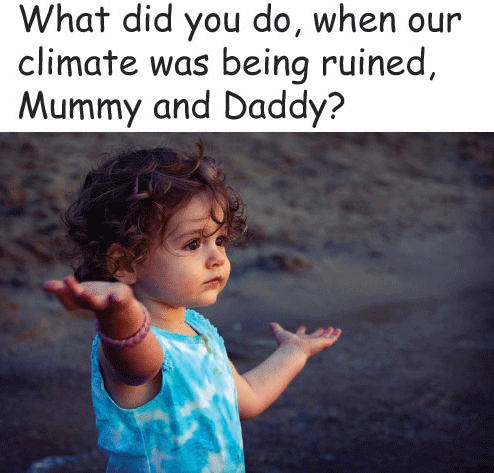
When we have fewer eggs and no lamb, I want you to get angry. I want you to be angry with me at the lack of action on global warming.

I’m angry because being anything other than angry feels like being complicit. I want us all to be so noisy and so outraged that we get heard. I want our governments to take real action on climate change.

I’m not religious but I am deeply interested in symbols and in the underlying meaning of the stories we tell ourselves. Ultimately, Christmas is a story of hope – innocent hope that comes with the birth of a new baby; the hope that the baby will have a fruitful, happy life.

But what kind of life will a baby born today have? One without the Great Barrier Reef, magnificent forests, without koalas or polar bears? A future where bird diversity means sparrows, pigeons and starlings. A future of water scarcity, longer, hotter heatwaves and firestorms.

Our children, with their global friends are marching. But Prime Minister Scott Morrison told them to go back to school – that they needed “more learning in schools and less activism”. Well, soon they’ll be voting.

We are doing all the hard work: we’re reducing, reusing, recycling, renewing, repurposing, installing solar, minimising water use, changing farming practices, eliminating plastics, thinking about food miles, buying from ethical sources. We’re riding bikes, walking, taking public transport, eating locally, composting, sewing, fixing. Meanwhile, our politicians are obfuscating.

In 2019 we will have an election. It will be our opportunity to interrogate our politicians about action on climate change. To my despair it feels none of the available parties have policies strong enough for effective action. But let’s push them. What meaningful action will they take?

Make sure they know you are angry and that you will change your vote depending on that issue. Don’t let them distract you with fears about free-trade or immigration or terrorism – there is nothing more terrifying than an increasingly hostile climate.

So as we start the new year, hold your children tight and vote with their future in mind. Be an accountable adult.

In the meantime, if you’ll excuse me, I’m going out to put more ice bricks in the chickens’ water tank.

Louise Freckelton is a grazier at Highfield Farm and Woodland, Adelong NSW, and a member of Farmers for Climate Action.

January 5, 2019 Posted by | General News | Leave a comment

Facebook commentators not impressed with nuclear toady Australia’s Department of Industry Innovation and Science (DIIS)

Steve Dale Woomera is “an “incompatible land use”? Farming/tourism/fishing are incompatible land uses as well. This whole thing stinks of corruption and Machiavellian planning.
Robert Webb Yea well they can say what they want but the pressure needs to be put on them, there is a massive land space thee they control and this is the obvious position they would start with

January 5, 2019 Posted by | General News | Leave a comment

Dept of Industry (DIIS) “rules out” Woomera as nuclear waste storage site, despite much waste already there

Woomera not in contention for nuclear storage facility, The Transcontinental, Marco Balsamo, 3 Jan 19

January 5, 2019 Posted by | AUSTRALIA - NATIONAL, Federal nuclear waste dump, politics | Leave a comment

Australia’s wide swathe of mid-40 degree heat breaks records, and there’s more to come

National records melt in ‘prolonged spell of heat’ with more to come, Brisbane Times  Peter Hannam, 4 January 2019 A huge swathe of Australia baked in mid-40 degree heat on Friday, with more records likely to be broken at the tail-end of a heatwave that set a slew of national highs last month.

The mercury was tipped to reach at least 45 degrees over a region stretching from northern Western Australia into Victoria and the NSW Riverina.

Melbourne exceeded its predicted top of 42 degrees, reaching 42.6 degrees. Avalon, to the city’s west, reached 45.8 degrees before a cool change knocked that down to under 25 degrees in less than an hour.

Walpeup in the state’s north touched 46.6 degrees – not far shy of Victoria’s January record of 47.2 degrees set in 1939 – while across the border in South Australia, Marree got to 47.2 degrees…….

Mean temperatures for 2018 were the third-warmest on record, with the bureau due to release its year-end report in coming days.

All but one of the country’s top 10 hottest years have occurred since 2005, a result “in line with long-term trends resulting from anthropogenic climate change”, the bureau said in a preliminary summary on 2018’s national weatherhttps://www.brisbanetimes.com.au/environment/weather/national-records-melt-in-prolonged-spell-of-heat-with-more-to-come-20190104-p50pkf.html

January 5, 2019 Posted by | AUSTRALIA - NATIONAL, climate change - global warming | Leave a comment

The nuclear industry now controls safety regulation in Russia’s Arctic shipping!

It’s a law – Russian Arctic shipping to be regulated by Rosatom https://thebarentsobserver.com/en/arctic/2019/01/its-law-russian-arctic-shipping-be-regulated-rosatom

President Putin signs the bill that makes the country’s state nuclear power company top regulator of the Northern Sea Route.By Atle Staalesen, January 02, 2019

Rosatom has officially been granted the leading role in the development of the vast Russian Arctic. The company that employs more than 250,000 people and engages in a multitude of activities related to nuclear power development and production is now formally Russia’s management authority for the Northern Sea Route.

The law was adopted by the State Duma on the 11th December and on the 28th signed by Vladimir Putin.

The new legislation comes as Russian Arctic shipping is on rapid increase. In 2018, about 18 million tons of goods was transported on the sea route, an increase of almost 70 percent from 2017. And more is to come. According to Vladimir Putin so-called May Decrees, the top national priorities, shipping on the Northern Sea Route is to reach 80 million tons already by year 2024.

Rosatom’s new powers in the Arctic include development and operational responsibilities for shipping, as well as infrastructure and sea ports along the northern Russian coast.

The responsibilities of the Northern Sea Route Administration, that until now has operated under the Ministry of Transport, will now be transferred to Rosatom.

It was Putin himself who in early 2017 made clear that a coordinating government agency for the Northern Sea Route was needed. A battle between Rosatom and the Ministry of Transport followed. In December 2017, it became clear that the nuclear power company had won that fight.

A central person in the new structure will be Vyacheslav Ruksha, the former leader of nuclear icebreaker base Atomflot.

The nuclear power company has since 2008 operated the fleet of nuclear-power icebreakers. Currently, five icebreakers are based in Atomflot, Murmansk, and several more ships are under construction, including four powerful LK-60 vessels.

Rosatom is also in the planning process of the «Lider», the 120 MW capacity super-powerful ship that can break through two meter thick ice at an unprecedented 10-12 knot speed.

January 5, 2019 Posted by | General News | Leave a comment