The nuclear industry now controls safety regulation in Russia’s Arctic shipping!

It’s a law – Russian Arctic shipping to be regulated by Rosatom https://thebarentsobserver.com/en/arctic/2019/01/its-law-russian-arctic-shipping-be-regulated-rosatom
President Putin signs the bill that makes the country’s state nuclear power company top regulator of the Northern Sea Route.By Atle Staalesen, January 02, 2019
Rosatom has officially been granted the leading role in the development of the vast Russian Arctic. The company that employs more than 250,000 people and engages in a multitude of activities related to nuclear power development and production is now formally Russia’s management authority for the Northern Sea Route.
The law was adopted by the State Duma on the 11th December and on the 28th signed by Vladimir Putin.
The new legislation comes as Russian Arctic shipping is on rapid increase. In 2018, about 18 million tons of goods was transported on the sea route, an increase of almost 70 percent from 2017. And more is to come. According to Vladimir Putin so-called May Decrees, the top national priorities, shipping on the Northern Sea Route is to reach 80 million tons already by year 2024.
Rosatom’s new powers in the Arctic include development and operational responsibilities for shipping, as well as infrastructure and sea ports along the northern Russian coast.
The responsibilities of the Northern Sea Route Administration, that until now has operated under the Ministry of Transport, will now be transferred to Rosatom.
It was Putin himself who in early 2017 made clear that a coordinating government agency for the Northern Sea Route was needed. A battle between Rosatom and the Ministry of Transport followed. In December 2017, it became clear that the nuclear power company had won that fight.
A central person in the new structure will be Vyacheslav Ruksha, the former leader of nuclear icebreaker base Atomflot.
The nuclear power company has since 2008 operated the fleet of nuclear-power icebreakers. Currently, five icebreakers are based in Atomflot, Murmansk, and several more ships are under construction, including four powerful LK-60 vessels.
Rosatom is also in the planning process of the «Lider», the 120 MW capacity super-powerful ship that can break through two meter thick ice at an unprecedented 10-12 knot speed.
Nuclear diplomacy: Donald Trump and Kim Jong-un back to Square 1
 Kim and Trump Back at Square 1: If U.S. Keeps Sanctions, North Will Keep Nuclear Program, NYT, By David E. Sanger, Jan. 1, 2019
Nearly two years into his presidency and more than six months after his historic summit meeting with Kim Jong-un of North Korea, President Trump finds himself essentially back where he was at the beginning in achieving the ambitious goal of getting Mr. Kim to relinquish his nuclear arsenal.
That was the essential message of Mr. Kim’s annual New Year’s televised speech, where he reiterated that international sanctions must be lifted before North Korea will give up a single weapon, dismantle a single missile site or stop producing nuclear material.
The list of recent North Korean demands was a clear indicator of how the summit meeting in Singapore last June altered the optics of the relationship more than the reality. Those demands were very familiar from past confrontations: that all joint military training between the United States and South Korea be stopped, that American nuclear and military capability within easy reach of the North be withdrawn, and that a peace treaty ending the Korean War be completed.
“It’s fair to say that not much has changed, although we now have more clarity regarding North Korea’s bottom line,’’ Evans J.R. Revere, a veteran American diplomat and former president of the Korea Society, wrote in an email.
“Pyongyang refused to accept the United States’ definition of ‘denuclearization’ in Singapore,’’ he wrote. To the United States, that means the North gives up its entire nuclear arsenal; in the North’s view, it includes a reciprocal pullback of any American ability to threaten it with nuclear weapons. “The two competing visions of denuclearization have not changed since then.”
o Mr. Trump and Mike Pompeo, the secretary of state, who is supposed to turn Mr. Trump’s enthusiasms into diplomatic achievements, dispute such conclusions. They note that the tone of one of the world’s fiercest armed standoffs has improved. It has, and both leaders say they want to meet again.
……….By some measures there has been modest progress. It has been 13 months since the North tested a nuclear weapon or a long-range missile, a change that Mr. Trump and Mr. Pompeo cite as the first fruits of what some officials now concede will be a long diplomatic push.
Relations between the two Koreas are warming, though there is considerable evidence that Mr. Kim sees his outreach to President Moon Jae-in of South Korea as a way to split the United States from its longtime ally.
But Mr. Trump’s strategic goal, from the moment he vowed to “solve” the North Korea problem rather than repeat the mistakes of past presidents, has been to end the North Korean nuclear and missile threat, not suspend it in place.
Mr. Trump dispatched his first secretary of state, Rex W. Tillerson, to Seoul in March 2017 to declare that a mere nuclear freeze would not be enough. Back then, Mr. Tillerson declared there would be no negotiations, and certainly no lifting of sanctions, until the North’s dismantling had begun. A nuclear freeze would essentially enshrine “a comprehensive set of capabilities,” he argued.
The decision Mr. Trump must make now is whether to backtrack on the objective of zero North Korean nuclear weapons even if that means accepting the North as a nuclear-armed state, as the United States has done with Pakistan, India and Israel. https://www.nytimes.com/2019/01/01/world/asia/kim-trump-nuclear.html
New Zealand’s 2018 – hottest year on record
 2018 NZ’s hottest year on record – climate scientist https://www.nzherald.co.nz/nz/news/article.cfm?c_id=1&objectid=12184584 3 Jan, 2019 A veteran climate scientist has called 2018 our hottest year on record.
Niwa isn’t due to release its official summary for the year until early next week, but Professor Jim Salinger has already picked it the warmest on records stretching back to 1867.
His calculations put 2018’s mean annual land surface temperatures at 13.5C – or 0.85C above the 1981-2010 average.
His figure also surpassed the scorching years of 1998 and 2016, which were 0.80C and 0.84C above normal respectively.
Niwa meteorologist Chris Brandolino said people would have to wait until next week to see the climate agency’s final numbers – but added Niwa’s preliminary figures showed 2018 tracking extremely close to 2016’s record.
Last year got off to an unusually warm start with the hottest summer – and the hottest recorded month ever, January – on the books.
“January, March, July and December were all at least 1C above normal, with January being massive 3.2C above average – the hottest month ever,” Salinger said.
The record warmth of 2018 was accompanied by warm seas around the country.
“For all months of the year sea surface temperatures around New Zealand were well above average, with preliminary estimates for 2018 being 0.8C above average.”
Even as 2018 began, it was in the grip of a marine heatwave caused by a freak combination of factors and which turned the Tasman Sea into a warm bath, fired the record summer, and lured swarms of jellyfish to our shores.
“The heat of 2018 was also demonstrated by the record loss of ice on the Southern Alps,” he said.
“We measured a nine per cent drop in just one year. That says it all. We’ve never had anything like that in the glacier record.”
Globally, 2018 was likely to be the fourth-warmest year ever recorded, with an average temperature sitting 0.6C above the 1970-2000 baseline, and only behind the years 2015, 2016 and 2017.
“And more heating is predicted for 2019, by the UK Met Office,” Salinger said.
“Their 2019 forecast indicates that the year 2019 will be close to a record due to global heating and the added effect of the El Niño in the tropical Pacific.”
Salinger said that with six of our warmest years falling in the last two decades, the hand of climate change was unequivocal.
New Zealand’s average temperature had grown 1.3C warmer over 151 years of records.
“It’s roaring away,” he said. He highlighted the UN’s recent report warning that the world had little over a decade to limit global warming to 1.5C above pre-industrial levels – and only around two decades to hold the Paris Agreement’s symbolic 2C line.
“We have to get going now and make significant inroads in the next years – there’s now a global movement of youth calling for that.”
Niwa’s latest seasonal outlook, covering summer, predicted temperatures were equally likely to be near or above average until the end of February, with near-normal rainfall likely for most regions.
Adani’s attack on Aboriginal leader morally reprehensible
Traditional Owners support leader, Adrian Burragubba
Adani’s bankruptcy petition is corporate bullying, abuse of process
W&J call on Qld Government to investigate Adani’s sham dealings
Adani are out to punish the Traditional Owner leading the fight against their Carmichael Mine and the opening up of the Galilee Basin. In a show of abject moral failure and corporate bullying, Adani has instituted bankruptcy proceedings against W&J leader and spokesperson Adrian Burragubba, simply for retribution, said W&J Traditional Owners Family Council chairperson Linda Bobongie.
“Our people will stand with Mr Burragubba at this trying time. He is a courageous leader who has put our people, country and cultural heritage before his own and his families personal needs. He speaks for many of the rightful Traditional Owners of Wangan and Jagalingou Country and we will not be frightened by Adani’s latest abuse of power.
We have enormous support for our Federal Court appeal against Adani’s rent-a-crowd ILUA. Over 128,000 people have signed our petition and millions of Australians who oppose the Carmichael Mine continue to back our campaign because they also care about Aboriginal rights in this country.
We will prosecute Adani to the limit and make sure they wear their illegitimate claims as a burden upon their brief corporate history in Australia. But we cannot rely on the legal system alone for justice.
We call on the Queensland Government to urgently inquire into the corruption of process that led to the disputed land deal. We demand that the Queensland Government refrain from any action to support Adani and from extinguishing our native title while investigating this grave injustice.
Queensland Labor has said they recognise that the registration of the Adani ILUA is contested and they acknowledge and respect our right to have our complaints considered and determined by a court. They should underwrite this process to ensure that Adani cannot bankrupt any of the appellants before the matter is heard, and they make proper inquiries of their own.
Adani are trying to prevent justice and hide behind a veil of supposed charity. Nothing could be more sickening than to have this corporate bully lecture us about our own people. They never have the courage to front up. It’s always done through anonymous media spokespeople or high priced lawyers.
We demand to know the Adani bosses who initiated this action. Was it Lucas Dow, the new CEO of Adani Mining, or was it Jeyakumar Janakaraj, CEO & Country Head Australia, or was it Gautam Adani himself who authorised this shameless attack on our people?
We are seeking the assistance of the UN Special Rapporteurs for Indigenous Peoples Rights and for Human Rights Defenders. The heads of corporations like Adani have a responsibility to respect human rights that are protected under international law. These responsibilities exist independently of a country’s abilities or willingness to fulfil its own obligations with respect to the rights of Indigenous peoples. We expect Adani’s bosses to answer for their actions.
Adani has no moral claim over us, and no legitimate claim for money. Their deceit is practiced. From the hollow protest about a vote of 294 – 1, as though this is believable, and Traditional Owners property rights and human rights can be wiped out forever by a one-off stacked meeting; to employing or contracting with people who oversaw the collapse of our $1m trust fund, such as Ms Irene Simpson and Mr Patrick Malone, directors of Cato Galilee, which entered into an unauthorised Memorandum of Understanding with Adani; to the PR exercises on jobs and partnership with ‘fake W&J people’. (Tony Johnson who appears in this Adani video is from the Gooreng Gooreng Nation on the Port Curtis Coast).
Adani claims to have a valid ILUA with the W&J people yet have failed to engage the authorised native title party at any time in more than two years, and have not paid $1.3m they are obligated to under the terms of their own contract.
Adani would bankrupt our people, prop up those who would breach our trust, and withhold what they owe just to score a cheap political point.
Our people will continue to seek justice in the face of this profound inequity. We will call on all First Nations people, and members of the Australian and international communities for support. And we will challenge the decision of Justice Reeves because we know the Adani ILUA is a gross distortion of the will of the W&J People”, Ms Bobongie concluded.
| Source Document: wanganjagalingou.com.au/adanis-attack-on-aboriginal-leader-morally-reprehensible/ |
Bill Gates’ “Travelling Wave” nuclear reactor project with Chinese shuts down
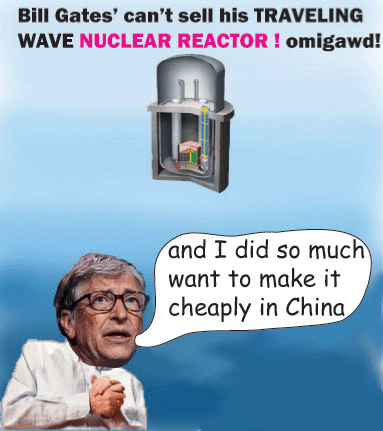 Bill Gates’s Experimental Nuclear Power Plant Halts Construction in China, Gates cites the Trump Administration’s aggressive stance for having to pull out. Popular Mechanics , By David Grossman, Jan 3, 2019 “……..Gates invested in TerraPower in 2011 with the hope of helping to prove the company’s core concept: a so-called traveling-wave reactor (TWR) which would run on depleted uranium, as opposed to the enriched uranium commonly used in nuclear plants……… In 2015, the company signed a deal with the Chinese government to be a small demonstration plant to be constructed by 2022. Since then, it has remained relatively low-profile. ……
In October 2018, U.S. Secretary of Energy Rick Perry said that the United States “cannot ignore the national security implications of China’s efforts to obtain nuclear technology outside of established processes of U.S.–China civil nuclear cooperation.”
The Department of Energy then announced it would deny any new licenses from U.S. companies wishing to work with the Chinese government, and current licenses would not be given extensions. The department cited the indictment of the Chinese state-owned nuclear corporation in 2017 alongside Taiwanese-American Allen Ho, who was eventually jailed for assisting the Chinese state on nuclear issues.
January 4 Energy News — geoharvey

Opinion: ¶ “Can Trump’s New Science Adviser Convince Him that Climate Change Is Real?” • As one of its last acts of the term, the Senate confirmed meteorologist Kelvin Droegemeier, to be director of the Office of Science and Technology Policy, “science adviser” to the president. Trump, however, has a history of ignoring his own […]
Police officer stays on duty in empty town near Fukushima plant — Fukushima 311 Watchdogs

Satoru Saeki, a resident police officer at the Okuma police substation, goes on patrol in the difficult-to-return zone in Okuma, Fukushima Prefecture. January 1, 2019 OKUMA, Fukushima Prefecture–On his rather lonely rounds, Satoru Saeki looks for anything out of place in an empty town center marred by broken windows, uncollected litter and […]
via Police officer stays on duty in empty town near Fukushima plant — Fukushima 311 Watchdogs
2020 Olympic torches to be made of recycled aluminum from Fukushima temporary housing — Fukushima 311 Watchdogs

This file photo shows the Tokyo Summer Olympics torch relay held in September 1964. Olympics: 2020 torches to be made of recycled aluminum from Fukushima Jan 1, 2019 TOKYO (Kyodo) — Recycled aluminum from temporary housing in Fukushima Prefecture, which was devastated by the 2011 earthquake, tsunami and nuclear disaster, is planned to be […]
Over 20 years of Australian governments failure to act on climate change
 Climate warnings ignored
Twenty years on, only the names have changed, The Age 1 January 2019 The annual release of the federal Cabinet papers is usually a chance to reflect on issues long since settled. … the release today by the National Archives of Australia of the papers from John Howard’s cabinet deliberations of 1996 and 1997.
The most obvious is climate change and finding a way to reduce Australia’s greenhouse gas emissions.
The Cabinet papers reveal how the Howard government clearly rejected the advice of its most senior ministries that the most effective and efficient method to deal with the issue was via a price signal with an emissions trading scheme.
Howard government started the hypocrisy on climate change
Howard government told without a carbon price, emissions would rise, The Age, By Shane Wright, 1 January 2019 The Howard government was urged more than 20 years ago to consider an emissions trading scheme, while its signature plans to deal with Australia’s greenhouse gas emissions were considered by its own departments to be merely aimed at deflecting global criticism.
As the Morrison government continues to fight a debilitating internal battle over how to deal with climate change, previously secret papers from the 1990s reveal a suite of major government departments said the most effective and efficient way to deal with greenhouse gases was to impose a carbon price.
Cabinet papers from 1996 and 1997 released on Tuesday by the National Archives reveal the beginnings of the Howard government’s drawn-out response to the threat posed by rising greenhouse gas emissions and the way some of those issues are still playing out in the Morrison government.
Ahead of the expected adoption of the Kyoto Protocol in December 1997, there were deep concerns within the government about how it may affect Australia with its large coal exports, heavy dependence on coal-fired power stations and increasing LNG production.
Government departments headed by Prime Minister and Cabinet, Treasury and Foreign Affairs fleshed out the details of a series of proposals backed by the government in September 1997 in a bid to deal with Australia’s emissions.
The co-ordinating document produced by the departments, which were aiming to finalise a package discussed at cabinet earlier in the month, made clear the bureaucracy did not believe the government’s plans would go nearly far enough in cutting emissions but may be sufficient to deflect international criticism.
“None of the packages presented here would achieve the stabilisation of emissions at 1990 levels,” they said.
“Rather, they are aimed at deflecting criticism that Australia is not fully committed to reducing its emissions.”
The departments costed a series of proposals which would ultimately become part of the government’s official response to climate change…….
But the departments, which acknowledged the government’s opposition to a price signal, said these would ultimately be expensive initiatives which would not deliver a real impact on the nation’s overall emissions profile.
“The most effective way to reduce emissions would be to combine significant price signals (either general or sectoral increases in taxes on greenhouse producing activities), information so firms and individuals can reduce greenhouse production, opportunities to invest in carbon sinks and some degree of compulsion to address areas where markets cannot be made to work effectively,” they said…….
While a small number of Coalition MPs have backed subsidies for new coal-fired power stations, the cabinet documents from 1997 canvassed ways to use emission standards to effectively end brown coal-fired stations and encourage more gas into the system.
Last month, official figures showed Australia’s greenhouse gas emissions increasing to their highest level since 2011. Projections suggest Australia will fall well short of its stated aim of reducing emissions by between 26 and 28 per cent by 2030. https://www.theage.com.au/politics/federal/howard-government-told-without-a-carbon-price-emissions-would-rise-20181227-p50og9.html
The Weather may just WAKE THE PUBLIC UP TO urgency of CLIMATE CHANGE ACTION

And yet the weather still has one big advantage over every other argument about the urgency of climate change: We experience the weather. We see it and feel it.
It is not a complex data series in an academic study or government report. It’s not a measurement of sea level or ice depth in a place you’ve never been. It’s right in front of you. And although weather patterns do have a lot of randomness, they are indeed changing. That’s the thing about climate change: it changes the climate.
I wanted to write my last column of 2018 about the climate as a kind of plea: amid everything else going on, don’t lose sight of the most important story of the year.
I know there was a lot of competition for that title, including some more obvious contenders, like President Donald Trump and Robert Mueller. But nothing else measures up to the rising toll and enormous dangers of climate change. I worry that our children and grandchildren will one day ask us, bitterly, why we spent so much time distracted by lesser matters.
The story of climate change in 2018 was complicated — overwhelmingly bad, yet with two reasons for hope. The bad and the good were connected, too: Thanks to the changing weather, more Americans seem to be waking up to the problem.
I’ll start with the alarming parts of the story. The past year is on pace to be the earth’s fourth warmest on record, and the five warmest years have all occurred since 2010. This warming is now starting to cause a lot of damage.
In 2018, heat waves killed people in Montreal, Karachi, Tokyo and elsewhere. Extreme rain battered North Carolina and the Indian state of Kerala. The Horn of Africa suffered from drought. Large swaths of the American West burned.
Amid all of this destruction, US President Donald Trump’s climate agenda consists of making the problem worse. His administration is filled with former corporate lobbyists, and they have been changing federal policy to make it easier for companies to pollute. These officials like to talk about free enterprise and scientific uncertainty, but their real motive is usually money. Sometimes, they don’t even wait to return to industry jobs.
I often want to ask these officials: deep down, do you really believe that future generations of your own family will be immune from climate change’s damage? Or have you chosen not to think very much about them?
As for the two main reasons for hope: the first is that the Trump administration is an outlier. Most major governments are trying to slow climate change.
The second reason for hope is public opinion. No, it isn’t changing nearly as rapidly as I wish. Yet it is changing, and the weather seems to be a factor. The growing number of extreme events — wildfires, storms, floods and so on — are hard to ignore.
Only 40 percent of Americans called the quality of environment “good” or “excellent” in a Gallup Poll this year, the lowest level in almost a decade. And 61 percent said the environment was getting worse. In an NBC News/Wall Street Journal poll, 66 percent of Americans said they wanted to see action to combat climate change. Some polls even suggest that Republican voters are becoming anxious about the situation.
The politics of climate change remains devilishly hard, especially because so many people around the world feel frustrated about their living standards. France’s “gilet jaune” protests, after all, were sparked by a proposed energy tax. Compared with day-to-day life, the effects of climate change have long felt distant, almost theoretical.
But now those effects are becoming real, and they are terrifying. To anyone who worries about making a case for climate action based on the weather, I would simply ask: do you have a better idea?
Knighted for Services Rendered: Don’t Worry about the Nukiller Plant on your doorstop – Just Let Them Drink Yoghurt! —

The New Years Honours List Does its Thing…..‘For 30 years I’ve been obsessed by why children get leukaemia. Now we have an answer’ Let Them Drink Yoghurt! Newly knighted cancer scientist Mel Greaves explains why a cocktail of microbes could give protection against disease The national press trumpet the clarion cry that could have […]
December 31 Energy News — geoharvey

Opinion: ¶ “The US Department of Energy Roots for Floating Solar Panels. Do You?” • Floating solar PVs on water seems to make sense, right? Well, maybe. Floating PVs on water add another wrinkle to maintaining them. So does finding suitable bodies of water. But as other countries move on floating PVs, the US DOE […]
Dave Sweeney reflects on the achievements of Australia’s nuclear-free movement in 2018
 The days roll on and 2018 is about to be in the past tense.
As ever the year saw highs, lows and flatlines. It also saw sustained and successful resistance to the nuclear industry in Australia.
This note is a snapshot, not a definitive list, but I wanted to capture some of our collective efforts and achievements so in a quiet moment we can reflect and recharge – and know that we are making a real difference.
Thanks and solidarity to all – and best wishes for a good break and time with people and in places that freshen the spirit. I look forward to working with you all in season 2019.
Uranium: Less is being ripped and shipped
- Kakadu: the clean-up of the Ranger site is underway – Mirarr native title of the region was formally recognised – Rio Tinto have accepted their responsibility to clean up – there was a calendar and a series of events around the country to mark twenty years since the Jabiluka blockade
- uranium remains stalled and actively contested in WA: 2018 saw a decade since then Premier Barnett announced a fast tracked uranium sector that would be “iron ore on steroids” – there are no mines but there is a major legal challenge to the Yeelirrie project, procedural challenge to Mulga Rock and community resistance to the four proposed projects with actions at AgMs, project critiques, Walkatjurra Walkabout and more
- Qld Labor reaffirmed its opposition to uranium mining at its state conference
Radioactive waste: Under pressure and delayed
the federal plan for a national waste facility in regional SA is highly contested, behind schedule and increasingly uncertain
- the issue was pushed ahead of the state election and SA Labor has subsequently adopted a good policy position
- there is growing civil society awareness and engagement with the issue – especially through our trade union partners
- the Barngarla people were formally awarded native title over the Kimba sites in June and have taken legal action over deficiencies in the Feds consultation processes
- Adnyamathanha resistance to the proposed Flinders Ranges site is strong and they have lodged a complaint on the plan with the Australian Human Rights Commission
- community resistance at both sites is sustained and strong with high levels of engagement and regular actions, events and media profile
- Federal Labor policy has a long way to go but at its national conference in December Labor moved from a policy position dominated by sites and place to one of standards and process
- Standing Strong – the story of the successful community fight against the earlier plan for an international radioactive waste dump in SA was launched and learned from
- there was early and strong opposition to chatter around other potential radioactive waste sites – especially at Brewarrina (NSW) and Leonora (WA)
Nuclear weapons: the cold war is reheating and support for a weapons ban grows
ICAN – the International Campaign to Abolish Nuclear Weapons – has continued to build on its 2017 Nobel Peace Prize profile
- there was sustained outreach and awareness initiatives, including a bike ride from Melbourne to Canberra
- there is growing international support for the Treaty on the Prohibition of Nuclear Weapons with more nations signing and ratifying the ban
- federal Labor committed to sign and ratify the ban treaty at its national conference in Adelaide in December – a major step forward
- the Peace Boat visited Australian waters and cities in January/February and the Black Mist, Burnt Country Maralinga exhibition continued touring
Broader nuclear free efforts
ANFA – the Australian Nuclear Free Alliance – had a good gathering in the Adelaide Hills in October and there was clear recognition of the role of First Nation people in the atomic resistance with awards to crew in WA, Aunty Sue in SA and Jeffrey Lee gaining the German based Nuclear Free Future award in the global Resistance category
- anniversaries were marked with actions, events and reflection – including Fukushima, Chernobyl, Hiroshima and Maralinga
- people engaged in state and federal processes including Senate Estimates, Senate Inquiries into radioactive waste siting and mine rehabilitation, ARPANSA Codes of Practice and more
- folks engaged with ALP state and federal conferences, the ACTU Congress, many union forums, SoS, the Sustainable Living Festival and more
- we remained connected and updated via the efforts of Christina Macpherson, Maelor at ACF, Jim Green at WISE, KA at CCWA and Walkatjurra, WGAR news, 3CR’s Radioactive Show, Understory and more
Looking ahead to 2019 – Another big year ahead folks – and one where we consolidate, defend and grow
- Challenges include:
- the forever struggle of resourcing and capacity
- pro-nuke voices pushing small modular reactors (SMRs) and seeking to overturn the ban on domestic nuclear power
- Mineral Council of Australia and others seeking the removal of uranium mining as a ‘trigger’ action in the federal EPBC Act
- We need to:
- better braid the uranium story and struggle into the wider dirty energy-fracking- fossil fuel narrative
- keep Rio Tinto and the regulators focussed and genuine re the best possible rehab outcomes at Ranger and keep the door shut to the uranium sector in WA
- support affected communities facing radioactive waste dump plans and push federal Labor to adopt a different approach
- pressure and support federal Labor to follow through on its commitment to sign and ratify the nuclear weapons ban
- make Australian uranium companies operating overseas – often in jurisdictions with low governance – accountable for their impacts
Climate danger: take heart and fight on
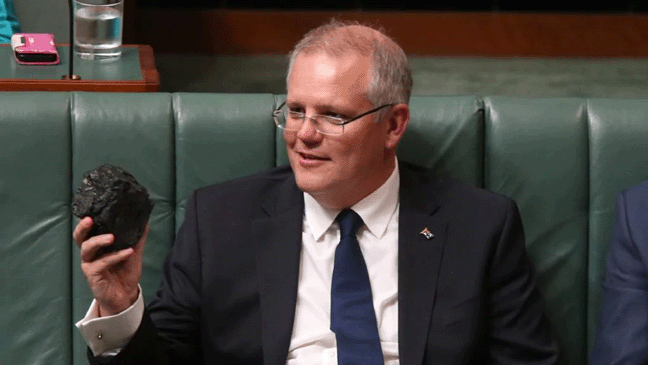 Listening to those who govern us, it sometimes seems as if despair is the only logical response. We have a Prime Minister who, as treasurer, gleefully wielded a lump of coal in Parliament, saying it was nothing to be afraid of. Scott Morrison has made restraining power costs, not fixing emissions, the focus of his bid for re-election in May. He says Australia is meeting its Paris pledge of a 26 per cent cut in emissions by 2030, based on 2005 levels, “in a canter”, but experts say this target is no longer enough to help the planet stave off dangerous warming.
But despair, so damaging to mental health, is not the answer. When despair leads to apathy, it becomes a self-fulfilling prophecy. We can’t escape climate change entirely but any action that leads to a better future is worth taking.
The antidote is action and activism. Criticism, led by the Prime Minister, of the school students’ protest against climate inaction in November was misguided.
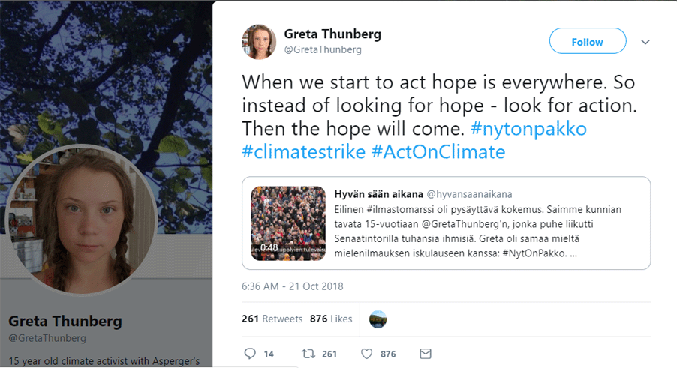
Today’s young people face a full 21st century of dangerous rising temperatures. As one parent pointed out in a letter to The Sydney Morning Herald: “Our daughter, aged 15, participated in the rally with our consent as we believe she deserves to have a voice on important issues that affect her future. We support and encourage our children to take an interest in the world around them so that they might become engaged citizens willing to make a difference to the communities in which they work and live.”
Young or old, we are not waiting for directions from the political class. This is perhaps wise when the Coalition is torn over by climate policy, Labor is fudging its attitude to the Adani coal mine project in north Queensland, and the Greens are eating themselves alive.
Look instead to the one-fifth of Australian homes that now have solar panels. As The Sydney Morning Herald reported this month, surging power bills and the falling price of solar panels have pushed the number of households with photovoltaics on their roofs past the 2 million mark. We now think nothing of cutting water use and reusing shopping bags.
Lower levels of government are taking encouraging action. Energy Minister Don Harwin committed the NSW government to getting to zero emissions by 2050. The City of Sydney draft renewable energy master plan foresees having all the council area’s electricity, heating and cooling supplied from renewable sources by 2030.
Decarbonising the economy has benefits beyond reducing emissions. Coal mining is destructive to the land and water, and the jobs it provides can cause ill-health. The renewable industry can create new 21st-century jobs and become an export industry.
Action trumps despair. As the classic advertising slogan says: we’re worth it.
1 This month.

Australians deserve the truth
about
AUKUS – https://aukuspublicinquiry.com/



PETITION – To: Prime Minister Anthony Albanese and the Australian Labor Government

of the week – Australians for War Powers Reform (AWPR)
To see nuclear-related stories in greater depth and intensity
 Antinuclear