Scientists refute the nuclear lobby’s paper “Burden of Proof”

Christina’s note: “Burden of Proof”comes from a very small, but very vocal, Australian pro nuclear shill.
 Response to ‘Burden of proof: A comprehensive review of the feasibility of
  100% renewable-electricity systems’ Science Direct Volume 92, September 2018, Pages 834-847 lT.W.BrownabT.Bischof-NiemzcK.BlokdC.BreyereH.LundfB.V.Mathieseng 847 lT.W.BrownabT.Bischof-NiemzcK.BlokdC.BreyereH.LundfB.V.Mathieseng https://doi.org/10.1016/j.rser.2018.04.113
Highlights
- •We respond to a recent article that is critical of the feasibility of 100% renewable-electricity systems.
- •Based on a literature review we show that none of the issues raised in the article are critical for feasibility or viability.
- •Each issue can be addressed at low economic cost, while not affecting the main conclusions of the reviewed studies.
- •We highlight methodological problems with the choice and evaluation of the feasibility criteria.
- •We provide further evidence for the feasibility and viability of renewables-based systems.
-
Abstract
A recent article ‘Burden of proof: A comprehensive review of the feasibility of 100% renewable-electricity systems’ claims that many studies of 100% renewable electricity systems do not demonstrate sufficient technical feasibility, according to the criteria of the article’s authors (henceforth ‘the authors’). Here we analyse the authors’ methodology and find it problematic. The feasibility criteria chosen by the authors are important, but are also easily addressed at low economic cost, while not affecting the main conclusions of the reviewed studies and certainly not affecting their technical feasibility. A more thorough review reveals that all of the issues have already been addressed in the engineering and modelling literature. Nuclear power, which the authors have evaluated positively elsewhere, faces other, genuine feasibility problems, such as the finiteness of uranium resources and a reliance on unproven technologies in the medium- to long-term. Energy systems based on renewables, on the other hand, are not only feasible, but already economically viable and decreasing in cost every year…………..
-
5. Conclusions
In ‘Burden of proof: A comprehensive review of the feasibility of 100% renewable-electricity systems’ [73] the authors called into question the feasibility of highly renewable scenarios. To assess a selection of relevant studies, they chose feasibility criteria that are important, but not critical for either the feasibility or viability of the studies. We have shown here that all the issues can be addressed at low economic cost. Worst-case, conservative technology choices (such as dispatchable capacity for the peak load, grid expansion and synchronous compensators for ancillary services) are not only technically feasible, but also have costs which are a magnitude smaller than the total system costs. More cost-effective solutions that use variable renewable generators intelligently are also available. The viability of these solutions justifies the focus of many studies on reducing the main costs of bulk energy generation.
As a result, we conclude that the 100% renewable energy scenarios proposed in the literature are not just feasible, but also viable. As we demonstrated in Section 4.4, 100% renewable systems that meet the energy needs of all citizens at all times are cost-competitive with fossil-fuel-based systems, even before externalities such as global warming, water usage and environmental pollution are taken into account.
The authors claim that a 100% renewable world will require a ‘re-invention’ of the power system; we have shown here that this claim is exaggerated: only a directed evolution of the current system is required to guarantee affordability, reliability and sustainability. https://www.sciencedirect.com/science/article/pii/S1364032118303307
ANSTO’s worrying history of covering up releases of radioactive gases from Lucas heights nuclear reactor

 New nuclear reactor spark cover up claims, PUBLIC not told about potentially dangerous gases spread over hundreds of kilometres for fear of causing alarm. https://www.news.com.au/technology/environment/poison-gas-leak-from-sydney-nuclear-reactor-spark-cover-up-claims/news-story/7a2bea7f047cf87f997ad7aff5646213?fbclid=IwAR3YTUCw81aekayba61OSWLYkemq6Eb0u9rlPYnej5B3EUHc9iE0n50_B7I#.s3vdk By Linda Silmalis, The Sunday Telegraph, AUGUST 29, 2010 POTENTIALLY dangerous radioactive gases have been secretly pumped into the atmosphere from Lucas Heights and have spread hundreds of kilometres from the nuclear reactor – but the public have never been told.
The release of the highly volatile radioxenon over several months last year was so concentrated that the plumes were detected in Melbourne up to two days later.
Other plumes were dragged out to sea by winds before drifting back over Sydney.
The Sunday Telegraph understands the Australian Nuclear Science and Technology Organisation (ANSTO) decided against releasing a public statement at the time to avoid causing alarm.
Scientists at a nuclear testing station in Melbourne traced the source of the radioactive gases to Sydney after they picked up 10 specific events between November, 2008 and February last year.
The Comprehensive Test Ban Treaty Organisation International Monitoring System site in Melbourne contacted Lucas Heights after detecting the radioxenon isotope Xe-133.
They were told that 36 hours earlier the first “hot commissioning trials” at ANSTO’s Lucas Heights radioisotope facility for Molybdenum-99 had taken place.
Molybdenum-99 is produced by the fission technique – the intense neutron-bombardment of a highly purified uranium-235 – and is used in nuclear medicine.
While the nuclear reactor – and the government body that oversees it – insists the release of the radioxenon by-product were no threat to public safety, no one, including neighbours of the suburban Sydney plant, were informed.
“Xenon gases are highly volatile and, being inert, they are not susceptible to wet or dry atmospheric removal mechanisms,” a scientific report obtained by The Sunday Telegraph says.
“Consequently, once released to the atmosphere they are simply transported down-wind while radioactively decaying away.”
Significant amounts of the main gas detected – Xenon-133 – can be released during a nuclear reaction or a nuclear explosion.
While it is used in medical procedures, specialists are urged not to administer it to pregnant women and children.
Side effects of its use in medical procedures can include allergic reactions such as itching or hives, swelling of the face or hands, swelling or tingling in the mouth or throat, chest tightness, and trouble breathing.
The report into the release from Lucas Heights says the doses were “well below the annual limit for public exposure”.
Officials from the Australian Radiation Protection and Nuclear Safety Agency said it was notified at the time and that the emissions were within public safety guidelines.
In 2006, ANSTO was forced to allay public fears after a leaked memo revealed xenon and krypton were released into the atmosphere following the rupture of a pipe.
Poisoned water and deadly dust — Beyond Nuclear International

Cleanup and health studies needed in uranium disaster community
via Poisoned water and deadly dust — Beyond Nuclear International
“We do not accept anything that harms our mother Earth” — Beyond Nuclear International

Brazil gas plant and pipelines stopped by community action but nuclear disaster remains a threat
via “We do not accept anything that harms our mother Earth” — Beyond Nuclear International
North Korea’s Kim Yong Un wants more nuclear summits with South Korea’s President Moon Jae-in
Kim Wants More Summits With Moon to Tackle Nuclear Issue ,Bloomberg, By Sam Kim and Youkyung Lee. December 30, 2018,
Kim intent on resolving nuclear impasse, Blue House says North Korean leader sent personal letter to South Korea’s Moon
Kim Jong Un is intent on resolving the nuclear impasse that has stalled negotiations with the U.S. and wants to hold more meetings with South Korean President Moon Jae-in, Moon’s office said.
The North Korean leader sent Moon a personal letter of well wishes on Sunday, expressing a willingness to meet often in 2019 to advance peace talks and achieve “denuclearization on the Korean peninsula,” Moon spokesman Kim Eui-keum said. Moon thanked him for the letter, tweeting that the North Korean leader “again made clear” that he would act on his agreement with the U.S. and South Korea.
The missive came amid increased skepticism over Kim’s willingness to dismantle his arsenal of nuclear weapons, months after a historic summit with President Donald Trump in which the two leaders agreed to work toward denuclearization. Kim’s letter made no mention of Trump or the U.S.
…….Earlier this month, North Korea told the U.S. that sanctions and pressure won’t work to force Pyongyang into action on its nuclear program. North Korean state media said the removal of the U.S.’s nuclear weapons from the region was a condition of its own disarmament, raising the stakes for Trump’s efforts to hold a second summit with Kim………https://www.bloomberg.com/news/articles/2018-12-30/kim-wants-more-summits-with-moon-to-tackle-nuclear-issue
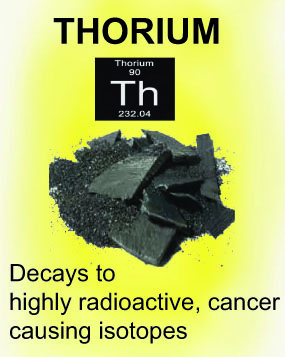
What’s the radioactivity level of Lynas’ refinery thorium wastes?
https://m.malaysiakini.com/letters/458037, Citizens’ Health Initiative. Chan Chee Khoon, 29 Dec 2018, Lynas has repeatedly stated that the specific (radio)activity of their water leach purification (WLP) residues is low (but still above Malaysia’s regulatory limit of 1 becquerel per gm of material [the becquerel (Bq) is a measure of radioactivity, equal to the number of nuclear decays per second]:
“The WLP residue, although classified as radioactive material, has the same radioactivity level as the feedstock material (rare earth ore concentrates) used in the Lamp process (about 6 Bq/g of Th)”.
(More accurately, this should read 6Bq/g of WLP – pure Th232 has a specific activity of 4070 Bq/gm of thorium, so 1655ppm of Th232 in WLP residues would contribute 6.7 Bq/gm of WLP).
But saying that each gram of WLP contributes 6Bq of radioactivity amounts to saying that Th232 decays in a single step to a stable element which is not radioactive. Clearly, this is not the case as is evident from the decay chain for Th232 below: [on original]
In a stable equilibrium, the number of nuclear decays for each of the subsequent radioactive progenies in the Th232 decay series is equal to the number of nuclear decays of Th232.
Hence the specific activity of WLP would be 10x the Bq counts contributed solely by Th232 nuclear decays (followed by nine other nuclear decays in the decay chain of progenies in the figure above).
In line with this, p.38 of the Radiological Impact Assessment (Nuklear Malaysia, June 2010) stated that Lynas’ refinery would produce “32,000 tons per year of water leach purification residue (WLP) with radioactivity concentration of 61 Bq/g containing 1,655ppm (6.62 Bq/g) thorium-232 and 22.5ppm (0.28 Bq/g) of uranium-238”.
It is noteworthy that the RIA arrived at this estimate despite this qualification:
 “All but one of the daughter products of thorium-232 is a solid. The one exception is radon-220, an isotope of radon, but commonly referred to as thoron [half-life 55 seconds]. There is a possibility of thoron being able to emanate from the concentrate, the residue or thorium bearing contaminated materials so that the entire radioactive series may not be in secular equilibrium. When in secular equilibrium the thorium-232 radioactive series has an activity ten times the activity of thorium-232”) (p.41)
Likewise, the Preliminary Environmental Impact Assessment includes a table on page 5-55 which states that the WLP contains 1655ppm of Thorium Oxide and 22.5ppm of Uranium Oxide, for a total specific (radio)activity of 62.0 Bq/g of WLP, i.e. 10 times the specific activity announced.
Lynas should explain why it is taking the boundary case (equivalent to a one-step decay of Th232 to a non-radioactive progeny), rather than in a decay chain including nine other radioactive progenies, occurring in a low-permeability clayey mass of WLP residues, which would retain much of the short-lived Thoron 220 and its decay progenies, and thus approximate a closed system tending towards secular equilibrium.
Climate change: six positive news stories you probably missed this year.
 The Conversation 28th Dec 2018 Renewable energy is being set up faster than ever; Chernobyl fights against
climate change; A new mobilising force for climate action; Global economic
growth may have peaked; Glimmer of hope in emissions reduction; Local
community energy is doing well.
https://theconversation.com/climate-change-six-positive-news-stories-you-probably-missed-this-year-108785
Nuclear power will exacerbate climate change, not solve it
Fairwinds 29th Dec 2018 Relicensing old nuclear power plants and building new nukes will not
resolve any climate change issues. View our well-researched film,
Smokescreen, created with data from university analyses and independent
international economic reports. Also, check out Arnie’s speech at McGill
University where he discusses how building new nuclear power plants will
actually exacerbate climate change as well as his Truthout article
https://www.fairewinds.org/demystify//climate-change-is-real-nuclear-is-not-the-answer
Regulators File Complaint Against Holtec about its nuclear waste casks
 Regulators File Complaint Against Maker Of Nuclear Fuel Cask https://www.wamc.org/post/regulators-file-complaint-against-maker-nuclear-fuel-cask By PAT BRADLEY • DEC 29, 2018 The Nuclear Regulatory Commission has filed a complaint against the manufacturer of casks used at the closed Vermont Yankee nuclear power plant.
NRC spokesman Neil Sheehan tells the Brattleboro Reformer that Holtec International adopted a new design for its steel and concrete casks without a written evaluation, violating federal safety regulations. Officials say the company made changes after it discovered a loose bolt at San Onofre nuclear power plant in California.
Holtec said Friday that the NRC has confirmed the safety of the canisters. It says it doesn’t agree with the severity level of the apparent violation.
The casks are used at other nuclear plants to store spent fuel.
Last month, regulators approved the sale of Vermont Yankee to NorthStar. The company plans to start decommissioning the plant no later than 2021.
The biggest porky pies: How fake news has shaped our history
Read more at the Source: www.theage.com.au/national/the-biggest-porky-pies-how-fake-news-has-shaped-our-history-20181227-p50ohq.html By Julia Baird host of The Drum on ABCTV & a journalist and author 29 December 2018
“We can fact check lies – but who will tell the stories of those who have been ignored, stereotypes and scrubbed out of history? First Nations people have been fed fake news and lies about their history and their present for centuries. As have we all. And the impact of this endures.
Myths like: there is only one Aboriginal culture, voice, or viewpoint.. That Aboriginal people are inherently violent, lazy, drunk. That the impact of colonisation has long passed. That the first inhabitants of this land were simply hunter-gatherers. That Australia was just a wilderness before Europeans arrived.
The truth is starkly different. In his brilliant book Dark Emu, Indigenous historian Bruce Pascoe documented how Aboriginal peoples lived here for millennia before Cook arrived, establishing a sophisticated, cultivated form of land management, carefully tended irrigation and extensive farming and fish-trapping practices – with villages with wells, dams, permanent buildings made of clay-coated wood and elaborate cemeteries – operating as a cluster of distinct but connected democracies. A land carefully tilled, a land built upon, a land that sustained an economy, a land that was theirs. … ”
Read much much much more at the Source: www.theage.com.au/national/the-biggest-porky-pies-how-fake-news-has-shaped-our-history-20181227-p50ohq.html
Review of ‘DarkEmu by BrucePascoe’
‘Required re-education readings’ BookReview by BenCourtice
groups.google.com/forum/#!msg/wgar-news/WH0DXuU9ntk/8XeB5QOuAAAJ;context-place=forum/wgar-news
astherivergoesby.wordpress.com/2017/12/27/required-re-education-readings-dark-emu/
Spain’s chain of 97 top grand hotels goes solar
Observer 30th Dec 2018 Spain’s state-owned chain of paradores, the grand hotels often housed in ancient castles and monasteries, has announced that all 97 of its establishments will use only electricity from renewable sources from the start of the new year.
The 90-year-old chain said the decision to switch to green electricity had been made for both environmental and symbolic
reasons. “Paradores is a company that supports sustainable tourism in every sense of the word,” said its chair, Óscar López Águeda. “What’s more, as a public company, we also want to set an example when it comes to investments that encourage energy saving and responsible consumption.”
https://www.theguardian.com/world/2018/dec/30/spain-paradores-solar-power-pledge
December 30 Energy News — geoharvey

Opinion: ¶ “More Republicans Than You Think Support Action on Climate Change” • New polls suggest that Republicans’ views on global warming may be at a tipping point. While the media have been focusing on splits between Democrats and Republicans, the more important gap may now be between Republican voters and the leaders they elected. […]
2019 – For a clean nuclear-free climate – theme for January
 It would be nice to just wish everyone a happy New Year. We can do that. And for the Earth, we can wish that the human species would stop polluting it. We can say, along with Dr Pangloss – “Everything for the best, in the best of all possible worlds”.
But, I’m afraid that we’re kidding ourselves, if we think that we can do any more than to slow the onset of climate change. “Disruptive impacts from climate change are now inevitable”. Jem Bendell, A British Professor of Sustainability now says that nothing in our civilization is sustainable. The emphasis must now also be on adaptation to climate change. Elizabeth May, Leader of Canada’s Green Party, has recently stressed, on Radio Ecoshock, that not only grandchildren, and later generations will be affected, but today’s children will experience the social, and health disruptions of climate change.
The Power of One Green – Elizabeth May in 2018
As for the nuclear threat – it’s no wonder that the Bulletin of the Atomic Scientists’ Doomsday Clock stays now at 2 minutes to midnight, with aggressive leaders like Trump and Putin, with weapons’ companies and military brass salivating about new, advanced weapons, even space warfare.
Still, nations continue to sign up to the U.N. Nuclear Weapons Ban Treaty. It’s a start.
For the “peaceful” nuclear industry – the good news is that it’s becoming a failing economic disaster. It would die a faster death, if it were not so valuable to the nuclear weapons industry. Colossal waste problems in USA, Japan, UK, are stalling plans for new reactors . Russia and China are not publicly divulging information on their wastes, but both are keen to export nuclear technology, rather than develop it at home.
The nuclear industry continues its lies about nuclear solving climate change -lies that are mindlessly regurgitated by the mainstream media. Media also faithfully parrot the promises of “new nukes” – the “Generation IV” nuclear designs that do not yet exist, and would be prohibitively expensive, requiring huge tax-payer subsidies..
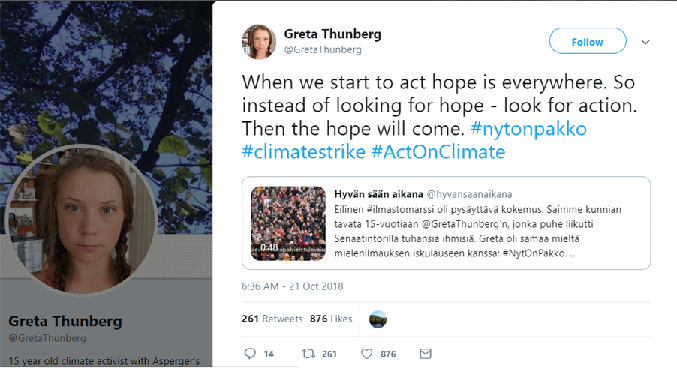
Anyway, I promise to include some good news, some positive stories, in 2019, because, after all, good people continue to do good things. And, we just can’t afford to give up hope – as Greta Thunberg tells us “Look for action – then the hope will come”
Why Labor is taking the right course on nuclear disarmament

|
Labor sets the right course on nuclear disarmament, https://www.smh.com.au/politics/federal/labor-sets-the-right-course-on-nuclear-disarmament-20181224-p50o22.html, By Gem Romuld, 27 December 2018 On the final afternoon of the recent 48th Labor national conference, Anthony Albanese took to the podium to announce that a future Labor government will sign and ratify the UN Treaty on the Prohibition of Nuclear Weapons. He declared that “people who change the world are ones that are ambitious”, after three days of intense negotiations on nuclear policy among senior Labor parliamentarians.The Coalition government has not only refused to join the treaty, but boycotted the negotiating conference and opposed the process leading up to it. While claiming to wholeheartedly seek a world free of nuclear weapons, foreign affairs ministers Julie Bishop and Marise Payne have failed to act. Their preferred path is one that doesn’t challenge the nuclear-armed states, especially our powerful ally, and protects the status quo.
After words of caution from Senator Penny Wong and MP Richard Marles in October, supporters of the nuclear ban treaty within Labor had to move a mountain to get the leadership on side. Even with former foreign minister Gareth Evans warning against the treaty, out of deference to the United States, on the eve of the resolution the supportive majority won out. With 78 per cent of the federal caucus signed up to support the ban, 83 per cent of Labor voters on side, and two dozen unions adding their voice, Labor has a clear mandate. Soon after the resolution passed unanimously, commentators rushed to dismiss the resolution as aspirational, ineffective and conditional upon whether nuclear-armed states join the treaty. This is not true; there are no binding caveats to the resolution. Labor must only “take account of” various factors ahead of signing and ratifying. Conservatives within Labor tried to attach binding preconditions, but their attempts failed. As for whether the resolution is aspirational, in fact it is binding. Therefore, it is no longer a matter of whether a Labor government will join the TPNW – only when. A recently published paper by Harvard Law School’s International Human Rights Clinic is clear that Australia joining the ban treaty would advance its stated goal of supporting nuclear disarmament without creating insurmountable legal obstacles to ongoing military relations with the United States. Australia signed up to the landmines and cluster munitions treaties when the United States did not, and still has not, signed on. The alliance relationship doesn’t bind us to include weapons of mass destruction in our defence policies. Further, the ANZUS Treaty contains no obligation to accept the policy of nuclear deterrence. The threat posed by nuclear weapons is real and urgent. More than ever, our security depends on an effective rules-based international order and strong multilateral institutions. No nuclear-armed states have yet joined the treaty, but this will change. No treaty, whether on disarmament or human rights or climate change, has ever enjoyed universal support at the outset. Support is always built up over time. Monumental strides forward in human history rarely begin with all parties coming together to agree on a common course of action. The majority of the world’s nations negotiated the TPNW based on their firm belief that it would have a profound impact on the behaviour of nuclear-armed states and their allies, even if its provisions would not, at the outset, be binding on those states. Treaties prohibiting other inhumane, indiscriminate weapons demonstrate this process; for example, the landmine ban treaty is widely regarded as a success, with massive reductions in use and production worldwide. Within the nuclear weapon ban treaty’s first year of existence, money is moving. The Norwegian sovereign wealth fund and the largest Dutch pension fund have decided to exclude nuclear-weapon-producing companies from their investment portfolios, citing the treaty as their reason. The Australian Medical Association and the Australian Red Cross have urged the Australian government to sign and ratify the treaty as a humanitarian imperative. Cities within countries opposed to the treaty are also joining the call for national action, including Los Angeles, Toronto, Manchester, Melbourne and Sydney. The ban treaty is a powerful new tool for advocacy, and nuclear disarmament is back on the political agenda. Since the treaty opened for signature in September 2017, 69 states have signed on and 19 have ratified. The 50th nation to deposit its instrument of ratification will enable the treaty to enter into force and become permanent international law. With dozens of nations currently undergoing domestic processes to sign and ratify, entry- into-force is expected by 2020. It is beyond time for Australia to quit our role as nuclear enabler for the United States. The nuclear weapon ban treaty presents us with a persistent question; will we join the global majority and contribute to the consensus against these WMDs, or remain implicated in the nuclear threat? Labor’s commitment clears a pathway forward for the next Government. Gem Romuld is the Australian director of the International Campaign to Abolish Nuclear |
|
The Story of Sustainability in 2018: “We Have About 12 Years Left”

Harvard Business Review 27th Dec 2018 Andrew Winston, – We have about 12 years left. That’s the clear message from a monumental
study from the Intergovernmental Panel on Climate Change (IPCC).
To avoid some of the most devastating impacts of climate change, the world must slash carbon emissions by 45% by 2030, and completely decarbonize by 2050 (while, in the meantime, emissions are still rising).
The IPCC looked at the difference between the world “only” warming two degrees Celsius (3.8°F) — the agreed upon goal at global climate summits in Copenhagen and Paris — or holding warming to just 1.5 degrees. Even the latter, they say, will require a monumental effort “unprecedented in terms of scale.”
We face serious problems either way, but every half degree matters a great deal in human, planetary, and economic losses.
It wasn’t just the IPCC that told a stark story. Thirteen U.S. government agencies issued the U.S. National Climate Assessment, which concluded that climate change could knock at least 10% off of GDP. Other studies tell us that sea
level rise is going to be worse than we thought, Antarctica is melting three times faster than a decade ago, and Greenland is losing ice quickly as well. If both those ice sheets go, sea level rise could reach 200-plus feet, resulting in utter devastation, including the loss of the entire Atlantic seaboard (Boston, New York, D.C., etc.), all of Florida, London,
Stockholm, Denmark, Paraguay, and land now inhabited by more than 1 billion Asians). https://hbr.org/2018/12/the-story-of-sustainability-in-2018-we-have-about-12-years-left
1 This month.

Australians deserve the truth
about
AUKUS – https://aukuspublicinquiry.com/

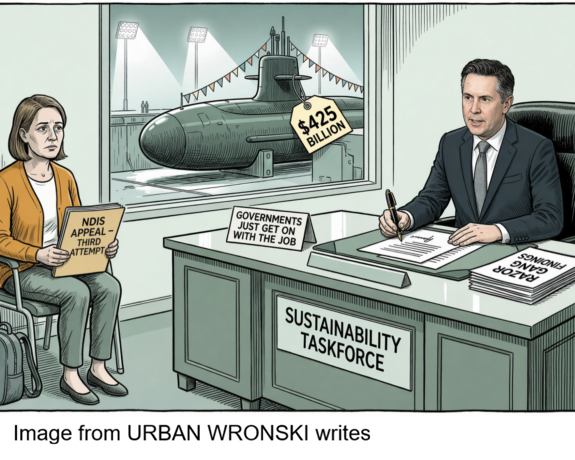

PETITION – To: Prime Minister Anthony Albanese and the Australian Labor Government

of the week – Australians for War Powers Reform (AWPR)
To see nuclear-related stories in greater depth and intensity
 Antinuclear