Antinuclear

Australian news, and some related international items

Comments on the drums of radioactive waste at Woomera, South Australia

Kazzi Jai  No Nuclear Waste Dump Anywhere in South Australia This is the radioactive waste that should never have even been transported over to South Australia in the first place! It was only because it was on Department of Defence land which is Commonwealth land. The Eastern states from where it was made in the first place are welcome to have it back!
 It’s amazing when the documentation comes out, how much is actually left out!
Again, down play of the actual contents of ALL the drums – just as was the case when those drums where transported over all those years ago, from ANSTO’s holding!   https://www.facebook.com/groups/1314655315214929/

December 27, 2018 Posted by | AUSTRALIA - NATIONAL, Federal nuclear waste dump | Leave a comment

2018 Likely to be 4th Hottest; But 2019 Might Break All Records — robertscribbler

According to NASA’s global monitoring division, the period of December 2017 through November 2018 was the fourth hottest such time ever measured in the global climate record. Starting in 1880, the measure now spans 138 years. And it marks a period of unprecedented rapid change in the Earth’s climate system — driven primarily by fossil […]

via 2018 Likely to be 4th Hottest; But 2019 Might Break All Records — robertscribbler

December 27, 2018 Posted by | Uncategorized | Leave a comment

December 26 Energy News — geoharvey

Opinion: ¶ “Ho Hum. Air Pollution Is Harming Your Children. So What Else Is New?” • Thanks to the billions of dollars spent by fossil fuel companies, a significant portion of the population believes Al Gore is a raving lunatic, climate scientists are just hired guns with big salaries, and climate change is a Chinese […]

via December 26 Energy News — geoharvey

December 27, 2018 Posted by | Uncategorized | Leave a comment

DEFENCE TO BE CHALLENGED ON WOOMERA RADIOACTIVE WASTE FACILITY ‘NIMBY’ CLAIM

Senator Rex Patrick, December 21 

Last month I asked the CSIRO to release its most recent report into the state of its radioactive waste stored in Hanger 5 at Evetts Field inside the Woomera Prohibited Area. That caused them to publish the document on their website yesterday.

The report shows that extensive radiological surveys/monitoring has been conducted around the Hanger 5 and there is no significant radiological contamination outside the storage facility. Radioactivity levels are at or below average background radiation levels in Australia. Inside the hanger, robots are being used to measure radiation levels and inspect the condition of the 10,000 drums of contaminated material – including low level and intermediate level radioactive waste – stored in the facility. This work is ongoing and will not be completed for another one to two years.

None the less, the report concludes that the current storage arrangement for low and intermediate level waste at the Woomera Test Range poses no health or environmental threat.

The report findings make a mockery of Defence’s recent claims that there’s no way a National Radioactive Waste Management Facility could be located anywhere in the enormous expanse of the Woomera Prohibited Area. The reality is that radioactive waste has been safety stored at Woomera for a quarter of century.

Government Ministers and Defence can expect to come under intense questioning from me over Defence’s bureaucratic obfuscation and deception on this issue.

The CSIRO report can be found here.
https://www.csiro.au/…/Land-manag…/Radioactive-waste-Woomera

Kazzi Jai Got to love this bit “Inside the hanger, robots are being used to measure radiation levels and inspect the condition of the 10,000 drums of contaminated material – including low level and intermediate level radioactive waste – stored in the facility. This work is ongoing and will not be completed for another one to two years.”

ONE TO TWO YEARS! How often has ARPANSA been inspecting this site PRIOR to the 2016 inspection which found that some of the barrels were leaking, and the AMNESIA that they had no idea what they actually held, set in??

This is EVIDENCE ENOUGH to show how much we should DEFINITELY NOT TRUST THE SYSTEM!

Kazzi Jai What about the contents of Control Bunker Launcher 5? Or has the Federal Government had another “amnesia” moment about that too?

December 24, 2018 Posted by | Uncategorized | Leave a comment

Fighting Adani: An Interview With Wangan and Jagalingou Council’s Adrian Burragubba By Paul Gregoire | 21/12/2018

“Indian mining giant Adani filed an application with the Federal Court last week asking that a legal challenge to its proposed Carmichael coalmine be thrown out, unless the Wangan and Jagalingou Traditional Owners fronted up with $160,000 in potential court fees within two weeks.

On Tuesday, Federal Court Justice Alan Robertson said that Adani’s demand was “disproportionate and unpersuasive”. He ordered that the traditional ownerspay $50,000 in security costs by the end of January or their legal challenge could not go ahead.

Adani’s attempt to have the Wangan and Jagalingou Traditional Owners’ case thrown out has caused the mining company further setbacks with its terminally delayed mine, as the case will now take place in May, when it was initially scheduled for next month.

The traditional owners are appealing an earlier ruling by the Federal Court. They assert that the Indigenous land use agreement (ILUA) that is essential for the Adani mine to go ahead is void. In August, Justice John Reeves found that this claim had “no merit”.

However, on Tuesday, Justice Robertson also upheld that the appeal will be going before the full bench of the Federal Court, as there’s an “arguable case of error” in the decision of the primary judge. …

Sydney Criminal Lawyers spoke with Wangan and Jagalingou spokesperson Adrian Burragubba about his thoughts on Adani’s latest tactic to try and thwart their ongoing opposition, why the Adani ILUA is a sham and how the system of native title needs a complete overhaul. … ”

Read the interview at the source document: www.sydneycriminallawyers.com.au/blog/fighting-adani-an-interview-with-wangan-and-jagalingou-councils-adrian-burragubba/

December 24, 2018 Posted by | aboriginal issues, climate change - global warming, Queensland | Leave a comment

December 23 Energy News — geoharvey

Opinion: ¶ “An Indian Perspective on the Poland Climate Meeting: Not Much Help for the World’s Poor and Vulnerable” • COP 24 ended with a deal that was vital, though limited. From my perspective as a social scientist focusing on conservation and development, however, the meeting failed to match the urgency of needed climate action. [PBS […]

via December 23 Energy News — geoharvey

December 24, 2018 Posted by | Uncategorized | Leave a comment

Australian Labor Party’s very limited support for the United Nations nuclear ban treaty

Bill Shorten wins cautious agreement on foreign aid, recognising Palestine and nuclear ban treaty, SMH, By Michael Koziol
18 December 2018 A federal Labor government will pursue the recognition of Palestine, a treaty banning nuclear weapons and an increase to foreign aid – but final decisions will be left for cabinet under an agreement struck between the party’s factions.Three controversial issues in the foreign relations portfolio were settled in backroom deals on Tuesday morning to ensure there were no contentious votes and Labor leader Bill Shorten ended the party’s national conference on a united note.The changes to Labor’s platform urge the next Labor government to recognise Palestine as a sovereign state as an “important priority”, but leaves the final decision to cabinet acting on expert advice.Labor has also given in-principle agreement to the United Nations nuclear ban treaty – but only after taking account of whether nuclear-armed states had signed up (so far none have) and whether they were abiding by the treaty’s terms…….

Senator Wong and defence spokesman Richard Marles led the negotiations, while the Left’s Anthony Albanese was heavily involved in the nuclear talks  ……..

The controversial nuclear treaty bans states from using, producing or stockpiling nuclear weapons, and prohibits them from assisting any other state to engage in such activities.

Mr Marles – who has criticised the treaty as “the non-nuclear world thumbing its nose at the nuclear world” – said it was “no secret” some in Labor were sceptical about the treaty and its impact on Australia’s alliance with the US.

A Labor government would need to be “certain” the treaty would not endanger that alliance, Mr Marles told the conference, and it was essential there was a realistic pathway for nuclear powers to sign up.

According to the International Campaign to Abolish Nuclear Weapons, 69 states have signed the treaty, and 19 have ratified it into law. However, none of the nuclear weapons powers or nuclear-armed states have signed or ratified the treaty.

As recently as October, Senator Wong said there was “no realistic prospect” of any nuclear states signing the treaty, let alone ratifying it, and it would have “no effect” without their endorsement……https://www.smh.com.au/politics/federal/bill-shorten-wins-cautious-agreement-on-foreign-aid-recognising-palestine-and-nuclear-ban-treaty-20181218-p50mw8.html

December 22, 2018 Posted by | AUSTRALIA - NATIONAL, politics, politics international | Leave a comment

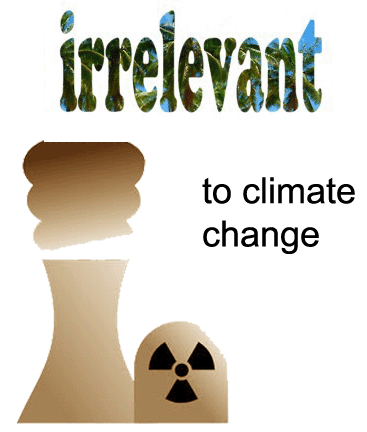
New report concludes nuclear “will play no meaningful role” in climate change abatement

 NUCLEAR MONITOR  Author: Nuclear and Information and Resource Service NM870.4766

Nuclear power is frequently promoted as a necessary msolution to global warming, and a key means to achieve emissions goals. This is a major mistake, according to a new report published by the Rosa Luxemburg Stiftung‒ New York City. The report ‒ “Nuclear Power and Climate Action: An Assessment for the Future” ‒ presents an industrial analysis of nuclear energy to assess its viability as a climate solution. From real and practical evidence, the report concludes that nuclear power is not a viable tool in the climate solutions toolbox, and that nuclear- free paths to phasing out greenhouse gas emissions are necessary, feasible, and cost-effective.

The report evaluates the technology from all sides: the potential for building new reactors, the prospects for continuing to operate existing reactors, and the commercialization of so-called “advanced reactor designs” in the mid-century timeframe. Analysis shows that nuclear power may not be available in any meaningful capacity by 2050. Existing reactor fleets in most of the world are already reaching the end of their mechanical lives and will mostly phase out within the critical climate timeframe, and strategies to reduce gas reduction must take this into account.

“Those who argue that nuclear power is necessary to reduce GHG emissions are gravely mistaken,” said author of the report Tim Judson, Executive Director of the Nuclear and Information and Resource Service (NIRS). “The practical realities about nuclear energy show that it is a failed technology, which is on its way out. We have many more effective and promising tools in the climate action toolbox,” continued Judson. “We must not waste time and money on trying to preserve a role for nuclear power, and align energy policies and investments with rapidly transitioning to renewables, efficiency, and carbon-free, nuclear-free climate solutions.”

With the immense threats of climate change, it is tempting to overlook other environmental hazards in the effort to address it. That is a mistake with nuclear power especially, because its environmental impacts are so severe and long-lasting and so many of them intersect with and compound impacts of global warming as well as issues of climate justice. At every stage of its production ‒ from uranium mining to the production of radioactive wastes ‒ nuclear power pollutes the environment with some of the most dangerous, long-lived contaminants in the world and places undue stress on water resources.

Because fossil fuels make up 86% of global energy, decarbonization will require a total transformation of energy systems in most parts of the world. Renewable energies have proven to be the most promising option ‒ complemented by investments in energy efficiency, development of complementary technologies, and integrated reliably and resiliently. Evidence from places like Germany and California shows that nuclear power does not integrate well with renewables and phasing it out is likely to create greater opportunities to accelerate the phaseout of fossil fuels and the transformation of the energy system.

The report includes case studies showing that promotion of nuclear power entails significant climate opportunity costs, wasting time and financial investments that could reduce greenhouse gas emissions and decarbonize energy systems much more rapidly and cost-effectively.

For instance, in the United States, the Summer 2 and 3 reactors were cancelled after major cost overruns and construction delays bankrupted their manufacturer, after US$9 billion had already been spent. Had utilities invested in energy efficiency and renewables, the report finds, the utilities would have made substantial reductions in emissions and reduced electricity costs for their consumers.

Similarly, the state of New York in the US decided in 2016 to subsidize four aging, uneconomical reactors, at a projected cost of $7.6 billion by 2029 ‒ three times as much as will be spent to achieve 50% renewable energy standard in 2030. Had New York invested in energy efficiency instead of nuclear, it could achieve greater emissions reductions in 2030, at a cost reduction of $10.6 billion.

“The pursuit of nuclear power in South Africa would have permanently locked us into complicity in putting our country as a radioactive waste zone for centuries,” said Makoma Lekalakala, Director, Earthlife Africa Johannesburg, and 2018 awardee of the Goldman Environmental Prize for Africa. “By challenging the secret $76 billion agreement between South Africa and Rosatom, we exposed the role of corruption at the highest level of our government. The agreement would have forced South Africans to pay all the costs of a nuclear disaster, contaminated our environment and water with radioactive waste, and made electricity unaffordable for generations,” continued Lekalakala. “We have all of the clean, affordable wind and solar energy we need in South Africa, and overturning the nuclear agreement has put us back on track for a healthy, sustainable future, free of fossil fuels.”

“The imperatives of rapidly eliminating greenhouse gas emissions demand greater ambition in the implementation of the Paris Agreement,” said Kerstin Rudek of Bürgerinitiative Umweltschutz Lüchow-Dannenberg of Germany, on behalf of the international Don’t Nuke the Climate Coalition (a global network working to keep nuclear out of the climate agreements ‒ http://www.dont- nuke-the-climate.org). “Nuclear power has proved too expensive, too slow, and too unreliable to rapidly reduce emissions, and the vast majority of reactors around the world are likely to retire before 2050. A carbon-free, nuclear-free world is possible, but we can’t get there by wasting time, money, and political will on failed technologies and false solutions like nuclear power.”

The report concludes that the primary obstacles to rapidly phasing out fossil fuels and greenhouse gas emissions are political, not technological or economic. In particular, deceptive interventions by corporations invested in fossil fuels and nuclear energy have engendered inertia and confused the debate by, alternately, denying the reality of global warming and by presenting false solutions.

Mitigating the economic and social impacts of climate action by ensuring a just transition for workers and impacted communities is key to charting a clear vision and building and sustaining the political will to accelerate emissions reductions and the phase-out of greenhouse gas emissions.

The report is online: Tim Judson, Nov 2018, ‘NuclearPower and Climate Action: An Assessment for the Future’, Rosa Luxemburg Stiftung: New York, http://www.rosalux-nyc. org/wp-content/files_mf/judson_eng.pdf

December 22, 2018 Posted by | General News | Leave a comment

Radioactive waste at the Woomera Test Range

 CSIRO 19 Dec 18 “……..Where did the waste come from?Almost 10,000 210-litre drums of waste now stored at the Woomera Test Range came from the clean-up of a former research site at Fishermans Bend, Melbourne, in the early 1990s and comprises of mainly soil and building materials…..

What is CSIRO doing about it?

CSIRO is using robotic equipment to better understand the physical condition and contents. This work will take 12–24 months and will inform future activities to characterise, separate and repackage waste and reduce its volume for transfer to the NRWMF. The robots are able to travel between the tightly packed drums which cannot be reached by people.

The robotic work will also help us better understand the physical integrity of the drums before further testing. The painted or galvanised drums are just over half way through their expected useful life of around 40 years……

Some material will be low level radioactive waste (LLW) and a very small amount may be intermediate level waste (ILW). Measures will be taken to ensure the material is safely stored to meet ARPANSA regulations until a final disposal pathway has been identified.

What does this mean for a National Radioactive Waste Management Facility (NRWMF)?

Further analysis and separation of material is needed to clarify how much of the material currently at the Woomera Range will require future disposal (LLW) or storage (ILW) at the proposed NRWMF.

The waste could not be transferred to a NRWMF until its contents are known and it is packaged to comply with the strict Waste Acceptance Criteria for the Facility. The current storage arrangement at the Woomera Test Range poses no health or environmental threat……. https://www.csiro.au/en/Research/Environment/Land-management/Radioactive-waste-Woomera?fbclid=IwAR2WeaBCrmpzBS5rZEqa-wH3IMh_sG7_L3Me5C3Ur5V6XhZo7WmiLCw7kEs

December 22, 2018 Posted by | South Australia, wastes | Leave a comment

Scorching weather predicted for Queensland

Heatwave set to blaze across Queensland for next few days, ABC News, By Aneeta Bhole and staff, 21 Dec 18,  Scorching weather has been predicted over the next four days in Queensland, with temperatures set to soar over 40 degrees Celsius in the state’s western interior.

December 22, 2018 Posted by | climate change - global warming, Queensland | Leave a comment

Scientists warn that climate “tipping points” are a greater risk than previously thought

Risks of ‘domino effect’ of tipping points greater than thought, study says,   https://www.theguardian.com/environment/2018/dec/20/risks-of-domino-effect-of-tipping-points-greater-than-thought-study-says   Jonathan Watts

The authors said their paper, published in the journal Science, highlights how overstressed and overlapping natural systems are combining to throw up a growing number of unwelcome surprises.

“The risks are greater than assumed because the interactions are more dynamic,” said Juan Rocha of the Stockholm Resilience Centre. “The important message is to recognise the wickedness of the problem that humanity faces.”

The study collated existing research on ecosystem transitions that can irreversibly tip to another state, such as coral reefs bleaching and being overrun by algae, forests becoming savannahs and ice sheets melting into oceans. It then cross-referenced the 30 types of shift to examine the impacts they might have on one another and human society.

Only 19% were entirely isolated. Another 36% shared a common cause, but were not likely to interact. The remaining 45% had the potential to create either a one-way domino effect or mutually reinforcing feedbacks.

Among the latter pairings were Arctic ice sheets and boreal forests. When the former melt, there is less ice to reflect the sun’s heat so the temperature of the planet rises. This increases the risks of forest fires, which discharge carbon into the air that adds to the greenhouse effect, which melts more ice. Although geographically distant, each amplifies the other.

By contrast, a one-way domino-type impact is that between coral reefs and mangrove forests. When the former are destroyed, it weakens coastal defences and exposes mangroves to storms and ocean surges.

The deforestation of the Amazon is responsible for multiple “cascading effects” – weakening rain systems, forests becoming savannah, and reduced water supplies for cities like São Paulo and crops in the foothills of the Andes. This, in turn, increases the pressure for more land clearance.

Until recently, the study of tipping points was controversial, but it is increasingly accepted as an explanation for climate changes that are happening with more speed and ferocity than earlier computer models predicted. The loss of coral reefs and Arctic sea ice may already be past the point of no return. There are signs the Antarctic is heading the same way faster than thought.

Co-author Garry Peterson said the tipping of the west Antarctic ice shelf was not on the radar of many scientists 10 years ago, but now there was overwhelming evidence of the risks – including losses of chunks of ice the size of New York – and some studies now suggest the tipping point may have already been passed by the southern ice sheet, which may now be releasing carbon into the atmosphere.

“We’re surprised at the rate of change in the Earth system. So much is happening at the same time and at a faster speed than we would have thought 20 years ago. That’s a real concern,” said Peterson. “We’re heading ever faster towards the edge of a cliff.”

The fourth most downloaded academic research of 2018 was the Hothouse Earth paper, which considered how tipping points could combine to push the global climate into an uninhabitable state.

The authors of the new paper say their work goes beyond climate studies by mapping a wider range of ecological stress points, such as biodiversity loss, agricultural expansion, urbanisation and soil erosion. It also focuses more on what is happening at the local level now, rather than projecting geo-planetary trends into the future.

“We’re looking at things that affect people in their daily lives. They’re things that are happening today,” said Peterson. “There is a positive message as it expands the range of options for action. It is not just at an international level. Mayors can also make a difference by addressing soil erosion, or putting in place social policies that place less stress on the environment, or building up natural coastal defences.”

Rocha has spent 10 years building a database of tipping points, or “regime shifts” as he calls them. He urges policymakers to adopt a similar interdisciplinary approach so they can better grasp what is happening.

“We’re trying to connect the dots between different research communities,” said Rocha. “Governments also need to look more at interactions. They should stop compartmentalising ministries like agriculture, fisheries and international relations and try to manage environmental problems by embracing the diversity of causes and mechanisms underlying them. Policies need to match the scale of the problem.

“It’s a little depressing knowing we are not on a trajectory to keep our ecosystem in a functional state, but these connections are also a reason for hope; good management in one place can prevent severe environmental degradation elsewhere. Every action counts.”


December 22, 2018 Posted by | General News | Leave a comment

W&J UPDATE: Our Federal Court appeal against Adani is on track

www.facebook.com/notes/wangan-and-jagalingou-traditional-owners-council/our-federal-court-appeal-against-adani-is-on-track/2478213712193791/

Friends, we did it!

With your backing, we fought off Adani’s effort to knock us out of the courtroom.

Our court case against Adani will proceed. Our fight goes on. Thank you so much!

In the Federal Court on Tuesday, we beat back Adani and their high-priced legal team.

The judge ruled that Adani’s demand for $160,000 was “disproportionate and unpersuasive”. Instead, we have to put forward $50,000, a figure we can cover thanks to the incredible solidarity of our many supporters, who responded generously in the face of this serious threat.

We have held our ground, and together we thwarted Adani’s bid for a “guillotine order” to get us out of the way. This means our court case to throw out Adani’s ‘rent-a-crowd ILUA’ goes on. Our campaign to protect our ancestral lands and waters is as strong as ever.

Adani’s determination to knock us out has backfired: we are still in the fight – strengthened with even more public support – and their maneuver has put off the case until May next year, causing them even further delays.

And even better, the judge upheld our appeal to the full bench of the Federal Court, saying there is an “arguable case of error” in the decision of the primary judge. It’s what we had hoped to hear.

Our legal challenges are exacting and we have faced an uphill battle for four years, made more difficult by Adani’s relentless bullying, and the piling on of legal costs designed to make us fold. It’s not working.

We are still in the way of Adani building its catastrophic mine. We are confident in our arguments, and sure of the rightness of our cause. We know Adani does not have our consent and never will. 

Thank you again for standing in solidarity with us, as we stand for the rights of our people to keep our country intact and to protect our culture and law.

Adrian Burragubba, Murrawah Johnson & Linda Bobongie

for the Wangan and Jagalingou Traditional Owners Family Council

December 22, 2018 Posted by | aboriginal issues, AUSTRALIA - NATIONAL, legal | Leave a comment

With more Democrats in U.S. it is doubtful that there will be more pro nuclear legislation

the broad infrastructure legislation that Democrats put forward last year makes no mention of nuclear.

Nuclear Industry Hopes for More Legislation in 2019, but Path Uncertain, Incoming Congress’ climate focus seen as beneficial to industry, but lawmakers noncommittal , Morning Consult BY December 21, 2018

Nuclear advocates hope 2019 will bring the passage of new legislation to support the industry in the United States as Democrats turn their focus toward addressing climate change.

But experts say it’s not a certainty that Congress will enact or fund nuclear technology and research and development to the extent necessary to get new concepts to market. And spokespeople for key lawmakers are close-lipped when it comes to specific energy policies they will back next year. Continue reading

December 22, 2018 Posted by | General News | Leave a comment

Adani ordered to pay almost $12m for work on scrapped Carmichael rail line

 https://www.theguardian.com/environment/2018/dec/20/adani-ordered-to-pay-almost-12m-for-work-on-scrapped-carmichael-rail-line, Ben Smee


Judgment details how ‘payment difficulties’ emerged in contract between AECOM and Adani subsidiary Adani has been ordered to pay almost $12m owed to engineering firm AECOM for work on a scrapped rail line to the Carmichael coalmine.A judgment in the Queensland Building and Construction commission details how “payment difficulties” emerged in a contract between AECOM and an Adani subsidiary company. The 1,862-point commission adjudicationsays Adani had “anticipated” receiving government support that did not materialise, including a $1b federal loan to build the rail link between Carmichael and the Abbot Point port.

The loan was vetoed by the Queensland government in November last year. The contract to design the rail line was suspended about six months later.

Soon after AECOM lodged a claim with the QBCC alleging it was owed $20m for the work. Adani countered by offering $325,000.

The QBCC this week issued a detailed mixed ruling that Adani owes AECOM about $12m, plus interest. The ruling also reveals how the rail line, which has since been abandoned, suffered a series of setbacks.

These included Adani being unable to provide AECOM with access to properties to undertake design work, “expected government relaxations that did not materialise” and the veto of a loan from the Northern Australia infrastructure facility.

“[AECOM] argued that these difficulties resulted in delays … [and] a substantial change to [Adani’s] project delivery strategy, resulting in the suspension of the claimant’s services,” adjudicator Chris Lenz said.

Adani had previously said the Naif loan was “not critical” to its project. As the rail project struck “difficulties”, Adani was unsuccessfully attempting to find outside finance for the Carmichael project. Eventually the company changed tack, downscaling port, rail and mine plans and cutting costs to an extent it can self-finance Carmichael.

It announced last month Carmichael would go ahead without external finance, and that works at the site in the Galilee Basin are imminent. But several key approvals and processes remain outstanding; including some which will not be finalised by the federal election. Adani has sought to frame those approvals as formalities, and can undertake some works before those approvals being granted.

A recent federal court decision means a full-bench appeal by traditional owners, members of the Wangan and Jagalingou family council, will likely be heard in May next year. The Queensland government is understood to be waiting until the outcome of that case before extinguishing native title at the Carmichael site.

Guardian Australia has previously reported that access discussions with rail network operator Aurizon will likely take until September, and that those negotiations will need to settle who pays for line upgrades worth at least $100m.

Management plans for groundwater have not been approved. A recent government report said cumulative water impacts in the Galilee had been understated, and the ABC reported this week the CSIRO had flagged concerns about Adani’s groundwater dependent ecosystems management plan, which the Queensland government must approve, and for which there is no statutory timeframe.

No significant ground disturbance can occur until the groundwater plan is approved.

Adani said in a statement it had invested $3.3bn in its Australian businesses, “a clear demonstration of our capacity to deliver a financing solution for the mine and rail project, as well as meeting all financial obligations”.

“In September we announced a new narrow-gauge railway design solution for the Carmichael project to accelerate the delivery and reduce capital costs. We have already secured the necessary approvals and land-access agreements with landholders needed to build the line.

“We are working through [the] regulatory process with the network owner and once it is complete we will commence construction of the rail line.”

December 22, 2018 Posted by | climate change - global warming, Queensland | Leave a comment

Climate change and the risk to civilisation: the doctors’ prescription

Climate change and the risk to civilisation: the doctors’ prescriptionCanberra Times , By Colin Butler, 21 December 2018 The 2018 State of the Climate report, released yesterday, again highlights the risk to human wellbeing from our love affair with fossil fuels. Coal, oil and gas have underpinned the incredible advances in affluence, population size, and health since development of the steam engine. But fossil fuel use has an optimum dose, which is now well past.

We are metaphorically drowning in carbon dioxide, the invisible, odourless waste product of burning fossil fuel. As the report notes, this is increasing heatwaves, acidifying the oceans and raising the sea level. It is also lowering the micronutrient concentrations of food.

The report cites growing effects on human and animal health, including from increased fires and flooding, and says extreme heat days are rising alarmingly. This month, dozens of Australians were rescued from the Hume Highway, stranded by intense rainfall. Record heat and fire ravaged north Queensland. A third of the spectacled flying fox population died from heat, possibly exposing animal rescuers to viral diseases.

In November, San Francisco air was worse than Delhi, due to fires that ruined the Californian city of Paradise, recently home for 30,000 people.

Earlier this month, at the Katowice conference, held in the heartland of Polish coal seams, David Attenborough called climate change the greatest threat to humanity in thousands of years. He warned that, without action, “the collapse of our civilisations, and the extinction of much of the natural world, is on the horizon”.

Attenborough’s warnings have a distinguished pedigree. In 2010, Frank Fenner, the great Australian scientist who helped eradicate smallpox, warned that humans risked total extinction due to overpopulation, resource over-consumption, environmental destruction and climate change. Martin Rees, a past president of the world’s oldest scientific organisation, the Royal Society, has warned this century might be our last. ……

The physical climate is changing, so fast that more and more people, including many children, can now recognise it. If we can harness the internet, new technology, and the common sense of ordinary people then we will we at least have a reasonable chance. Recognising the validity of these warnings is a vital step if we are to survive.

Colin Butler is an epidemiologist and member of the scientific advisory committee of Doctors for the Environment, Australia. He is an honorary professor in public health at the Australian National University. https://www.canberratimes.com.au/environment/climate-change/climate-change-and-the-risk-to-civilisation-the-doctors-prescription-20181220-p50nfl.html

December 22, 2018 Posted by | General News | Leave a comment