Antinuclear

Australian news, and some related international items

  • Home
  • 1 This month.
  • Disclaimer
  • Kimba waste dump Submissions

The economic cost of climate troglodytes 

 Crispin Hull,  DECEMBER 21, 2018  As Hyundai demonstrated its latest pollution-reversing hydrogen car in London this week, it is worth looking at how the policy impasse on climate-change – caused by the actions of the troglodyte right of the Coalition – threatens Australia’s economic well-being. We first have to understand the troglodytes’ beliefs by following the money trail.

It is wrong to assume that they believe that the climate is not changing or if it is that humans are not causing it and therefore coal is okay to use. Rather it is the other way around. Their financial backers in the coal industry want to be able to continue to profit from coal, therefore the troglodytes must either deny climate change is happening or that coal has anything to do with it.

Of course, proselytising and propaganda have caused a lot of people to believe that there is no human-made climate change, in the same way that people have been convinced of a religious belief that, say, God made the earth in a week a few thousand years ago. But it is not science.

It is difficult to shift belief. It is also difficult to change the selfish view that Australia can do little on its own. We should therefore look at economics and how much these beliefs will cost Australia in the near future.

The Coalition troglodytes should contemplate over this yet-again record-breaking hot summer how their dogged determination to stick with coal and other fossil fuels is denying Australia a leading role in new industries and billions in savings by using new technology.

Climate change aside, we should be embracing renewable energy from solar and wind with battery and hydro storage because they will make our lives materially better.

Hyundai’s hydrogen car is a good example. It splits hydrogen into two positively charged protons and two negatively charged electrons. The electrons are drawn off to run the car’s electric motor. Then they and the protons are combined with oxygen from the air to form harmless water.

The oxygen has to be free of pollutants, so the incoming air is filtered. The net result is that the hydrogen car removes as much pollutant from the air per kilometre as petrol and diesel cars emit.

Hydrogen-powered cars are driven by electric engines, just like ordinary electric cars, but their energy source is stored in hydrogen fuel cells. Other electric cars use batteries, usually lithium. Both need electric power, usually from the grid, to charge them.

These cars are already here, but in the next few years, sales will boom. We do not make any cars in Australia so we will be forced to follow international trends as petrol and diesel cars are phased out. They will go the way of the film camera with the onslaught of vastly cheaper and instantly satisfying digital cameras. It took about eight years for almost the whole of the world’s camera inventory to be replaced.

Electric cars have very few moving parts, not even a gearbox. They do not emit poisonous gases into the atmosphere. And even with Australia’s inexplicably high electricity prices are far cheaper to run than petrol or diesel cars.

A battery car uses about 18kWh of electricity for 100km, say $4. A hydrogen car uses about double that, and, incidentally, unless that improves it may mean that hydrogen cars do not take off, though hydrogen trucks and buses will still make sense. A petrol or diesel car, on the other hand, costs about $10 per 100km and requires much more servicing and lubricants than electric cars do.

But if the federal government is so scared of the coal lobby that it will not develop an innovative energy and transport policy Australians will not get these benefits, or get them later and at a greater cost.

Our national government should not be contemplating subsiding or owning new coal power plants but be leading the charge. It should not be passively waiting for industry, the states and individuals to take up the technology in a haphazard way. Our government should be promoting nationwide charging stations for electric cars.

At present Australia imports about 90 per cent of its liquid fuel for transport, at a cost of about $50 billion a year.

If the Coalition is really interested in jobs and growth and running the economy it would be helping Australian industry innovate with more renewables and better battery and other storage technologies.

We should be replacing the $50 billion worth of polluting fuel with electricity from our abundant sun and wind…….At present Australia imports about 90 per cent of its liquid fuel for transport, at a cost of about $50 billion a year.

If the Coalition is really interested in jobs and growth and running the economy it would be helping Australian industry innovate with more renewables and better battery and other storage technologies.

We should be replacing the $50 billion worth of polluting fuel with electricity from our abundant sun and wind.  clarionledger.com   http://www.crispinhull.com.au/

December 22, 2018 Posted by Christina Macpherson | AUSTRALIA - NATIONAL, climate change - global warming | Leave a comment

December 21 Energy News — geoharvey

Opinion: ¶ “The Farm Bureau: Big Oil’s Unnoticed Ally Fighting Climate Science and Policy” • While big oil and gas companies provided the cash for anti-regulation campaigns, the farm lobby offered up a sympathetic face: the American farmer. For more than three decades, the Farm Bureau has aligned agriculture closely with the fossil fuel agenda. […]

via December 21 Energy News — geoharvey

December 22, 2018 Posted by Christina Macpherson | Uncategorized | Leave a comment

Greens accuse Coalition of “cooking books” – and planet – on emissions — RenewEconomy

Greens call out federal Coalition’s “dodgy accounting” efforts to minimise emissions targets, as government says heatwaves and droughts will reduce abatement because it is killing crops. The post Greens accuse Coalition of “cooking books” – and planet – on emissions appeared first on RenewEconomy.

via Greens accuse Coalition of “cooking books” – and planet – on emissions — RenewEconomy

December 22, 2018 Posted by Christina Macpherson | Uncategorized | Leave a comment

CSIRO/AEMO study says wind, solar and storage clearly cheaper than coal — RenewEconomy

Major study from CSIRO and AEMO shows cost of new wind and solar – even with hours of storage – is “unequivocally” cheaper than coal. The post CSIRO/AEMO study says wind, solar and storage clearly cheaper than coal appeared first on RenewEconomy.

via CSIRO/AEMO study says wind, solar and storage clearly cheaper than coal — RenewEconomy

December 22, 2018 Posted by Christina Macpherson | Uncategorized | Leave a comment

World’s governments indulge in symbolism, not action, at COP24 — Systemic Disorder

The good news from the annual climate summit just concluded in Katowice, Poland, is that the world’s governments agreed on a “rulebook” intended to implement the Paris Accord, the 2015 agreement to reduce greenhouse-gas emissions. The bad news is that the world is no closer to actually tackling global warming than before and the rulebook […]

via World’s governments indulge in symbolism, not action, at COP24 — Systemic Disorder

December 22, 2018 Posted by Christina Macpherson | Uncategorized | Leave a comment

Nine reasons to celebrate solar PV in 2018 — RenewEconomy

What a year 2018 has been for solar PV in Australia! Here are nine reasons to celebrate solar as we head into what may well be another record-braking year for photovoltaics. The post Nine reasons to celebrate solar PV in 2018 appeared first on RenewEconomy.

via Nine reasons to celebrate solar PV in 2018 — RenewEconomy

December 22, 2018 Posted by Christina Macpherson | Uncategorized | Leave a comment

Tesla activates Tesla Powerwall “storm watch” in Queensland – first time outside US — RenewEconomy

Tesla activated its “storm watch” mode for household batteries ahead of last week’s cyclone in north Queensland – the first time it has done so outside the US. The post Tesla activates Tesla Powerwall “storm watch” in Queensland – first time outside US appeared first on RenewEconomy.

via Tesla activates Tesla Powerwall “storm watch” in Queensland – first time outside US — RenewEconomy

December 22, 2018 Posted by Christina Macpherson | Uncategorized | Leave a comment

Six developments that changed the world of energy in 2018 — RenewEconomy

The performance of the Tesla big battery helped redefine the debate around the clean energy transition in Australia last year. But it wasn’t the only big thing that happened. The post Six developments that changed the world of energy in 2018 appeared first on RenewEconomy.

via Six developments that changed the world of energy in 2018 — RenewEconomy

December 22, 2018 Posted by Christina Macpherson | Uncategorized | Leave a comment

Australia: new State of the Climate Report – extreme heat events, fire weather and drought

Australia experiencing more heat, longer fire seasons and rising oceans

State of the climate report points to a long-term increase in the frequency of extreme heat events, fire weather and drought, Guardian  Lisa Cox

Thu 20 Dec 2018 0
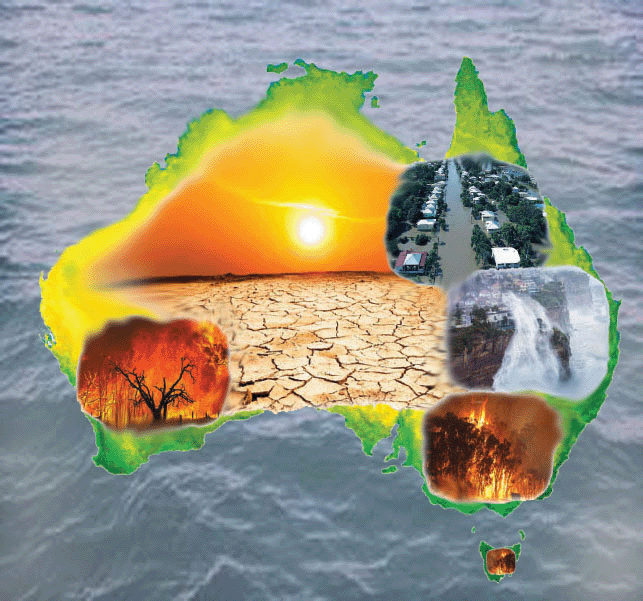
Australia’s fire seasons are longer and more severe, the Bureau of Meteorology and CSIRO’s state of the climate. Australia is experiencing more extreme heat, longer fire seasons, rising oceans and more marine heatwaves consistent with a changing climate, according to the Bureau of Meteorology and CSIRO’s state of the climate report.

The report, published every two years, measures the long-term variability and trends observed in Australia’s climate.

The 2018 report shows that Australia’s long-term warming trend is continuing, with the climate warming by just over 1C since 1910 when records began.

That warming is contributing to a long-term increase in the frequency of extreme heat events, fire weather and drought.

“Australia is already experiencing climate change now and there are impacts being experienced or felt across many communities and across many sectors,” said Helen Cleugh, the director of the CSIRO’s climate science centre.

The report’s key findings include:

  • Australia’s fire seasons have lengthened and become more severe. In some parts of the country, the season has been extended by months.
  • The number of extreme heat days continues to trend upward.
  • There has been a shift to drier conditions in south-eastern and south-western Australia in the months from April to October.
  • Rainfall across northern Australia has increased since the 1970s, particularly during the tropical wet season in north-western Australia.
  • Oceans around Australia have warmed by about 1C since 1910, which is leading to longer and more frequent marine heatwaves that affect marine life such as corals.
  • Sea levels around Australia have risen by more than 20cm since records began and the rate of sea level rise is accelerating.
  • There has been a 30% increase in the acidity of Australian oceans since the 1800s and the current rate of change “is ten times faster than at any time in the past 300 million years”.
  • Karl Braganza, the bureau of meteorology’s manager of climate monitoring, said the increase in average temperature was having an impact on the frequency or amount of extremes Australia experienced in any given year.

    “In general there’s been around a five-fold increase in extreme heat and that is consistent whether you look at monthly temperatures, day time temperatures or night time temperatures,” he said.

  • The report also highlights an increase in the number of extreme fire danger days in many parts of Australia, particularly in southern and eastern Australia. …….https://www.theguardian.com/environment/2018/dec/20/australia-experiencing-more-heat-longer-fire-seasons-and-rising-oceans

December 20, 2018 Posted by Christina Macpherson | AUSTRALIA - NATIONAL, climate change - global warming | 1 Comment

Aboriginal landowners say that radioactive waste contractors ‘damaged’ cultural sites

Radioactive waste contractors ‘damaged’ cultural sites, allege traditional owners, SBS News, 19 Dec 18 Traditional owners in South Australia have launched a complaint to the Australian Human Rights Commission over the federal government’s plans for a nuclear waste facility.

Traditional owners in South Australia’s Flinders Ranges have launched a complaint to the Australian Human Rights Commission, alleging contractors damaged a precious cultural site while assessing land for a new nuclear waste facility.

Maurice Blackburn lawyer Nicki Lees, acting for the Adnyamathanha Traditional Lands Association (ATLA), said Adnyamathanha traditional owners were concerned about the alleged actions of contractors on their lands.

“Earlier this year, contractors of the Commonwealth caused significant harm and damage to an area that is particularly significant to traditional owners, and in particular female Adnyamathanha women,” she said.

“What we’re doing today is saying that the Commonwealth failed to deal with that damage, and they failed to take seriously the complaint that ATLA made to the Commonwealth regarding that damage.”

The complaint also alleges that a vote to determine support for a nuclear waste site excluded a large number of traditional owners.

“The complaint alleges that because a large number of traditional owners are not included in the vote, it is therefore discriminatory and unlawful,” Ms Lees said.

Earlier this year, Barngarla traditional owners launched a similar complaint alleging a community vote was discriminatory because it failed to include native title holders who didn’t reside in the community.

Vince Coulthard, Chief Executive of ATLA, said his people deeply opposed the nuclear waste proposal.

“The Adnyamathanha people have voted against the waste dump. We don’t want the waste dump on our country,” he said.

“The department on this consultation has gone and spoken with other people in the region, other interest groups, they’ve never come out and spoken directly with us.”……..

Three South Australian sites have been short-listed to house Australia’s low and medium level nuclear waste. Two are near Kimba, on the Eyre Peninsula. The third is near Hawker in the Flinders Ranges.

A planned community vote to determine support for the facility had to be postponed earlier this year after Barngarla traditional owners were granted an injunction by the South Australian Supreme Court.

This Barngarla matter will return to court in January. Three South Australian sites have been short-listed to house Australia’s low and medium level nuclear waste. Two are near Kimba, on the Eyre Peninsula. The third is near Hawker in the Flinders Ranges.

A planned community vote to determine support for the facility had to be postponed earlier this year after Barngarla traditional owners were granted an injunction by the South Australian Supreme Court.

This Barngarla matter will return to court in January.https://www.sbs.com.au/news/radioactive-waste-contractors-damaged-cultural-sites-allege-traditional-owners?fbclid=IwAR1IMP4yisi_kHZ30Bslg2ftYw75j6IjMAcsKLOmFvboX9d1G1EbMJ1iQJE

December 20, 2018 Posted by Christina Macpherson | aboriginal issues, AUSTRALIA - NATIONAL, legal | Leave a comment

Coalition energy and climate policies hit rock bottom at year’s end — RenewEconomy

Coalition ends 2018 with its position on climate and energy policies even further to the right than when the year started. The post Coalition energy and climate policies hit rock bottom at year’s end appeared first on RenewEconomy.

via Coalition energy and climate policies hit rock bottom at year’s end — RenewEconomy

December 20, 2018 Posted by Christina Macpherson | Uncategorized | Leave a comment

Division within the Liberal Coalition over climate change

Coalition’s divide exposed at COAG energy meeting in Adelaide, ABC, By Casey Briggs 19 Dec 18, A meeting of Australia’s energy ministers had ended bitterly divided, with the country’s biggest Liberal-run state accusing the Commonwealth of blocking discussion on climate change.

New South Wales Energy Minister Don Harwin led a revolt over carbon emissions at today’s energy COAG meeting in Adelaide.

Mr Harwin had been pushing to revive the emissions obligation, which would impose rules on power companies to reduce carbon emissions.

It was a key component of the National Energy Guarantee which was dumped in August, days before Malcolm Turnbull was overthrown as prime minister.

As a sign of how out of touch they are, they wouldn’t let us have the discussion,” Mr Harwin said after the meeting.

“It is absolutely imperative that we end the Canberra climate wars.

“NSW is going to work with both Labor and Liberal state and territory governments around the country to make that happen.”……..

Business calls for end to ‘policy chaos’

NSW’s tough-talking stance won support from the nation’s biggest business lobby, with the Business Council of Australia commending the state’s leadership on emission reduction……..https://www.abc.net.au/news/2018-12-19/states-split-at-coag-energy-meeting/10636230

December 20, 2018 Posted by Christina Macpherson | AUSTRALIA - NATIONAL, climate change - global warming, politics | 1 Comment

Tuvalu island nation actually growing, not sinking – Fact Check

Is the Pacific island nation of Tuvalu growing, and not sinking, as Craig Kelly says?  RMIT ABC Fact Check  , 19 Dec 18

The claim

Liberal MP and climate sceptic Craig Kelly made headlines in November when he was caught on tape mocking “lefties” for exaggerating the effects of climate change.

Speaking at a local party event, audio of which was leaked to the Guardian, Mr Kelly set out to debunk several justifications for climate change action, including the argument that Tuvalu, the Pacific island nation, was slipping beneath the sea.

“The science tells us that Tuvalu, which I often hear about, is actually growing not sinking,” he told colleagues.

Is Tuvalu growing? RMIT ABC Fact Check investigates.

The verdict

Mr Kelly’s claim checks out.

In the four decades to 2014, Tuvalu’s total land area grew by 73 hectares, or 2.9 per cent.

The expert behind this research told Fact Check the nation’s islands were continually adjusting, and that the new land was habitable.

But that’s not to say Pacific nations are not at risk from rising seas.

One expert told Fact Check that among the Solomon Islands, for example, reef and volcanic islands had disappeared or been eroded, in some cases displacing indigenous communities.

Smaller islands in Tuvalu, though uninhabited, have also shrunk.

The research cited by Mr Kelly suggests certain islands — specifically, larger atolls and reef platforms — can adapt to the current pace of sea level rise.

However, the United Nations Intergovernmental Panel on Climate Change (IPCC) sets out four scenarios for future rises, three of them more severe than what Tuvalu has so far faced.

Why is Tuvalu important?

Halfway between Australia and Hawaii lies the tiny Pacific nation of Tuvalu………

Why is Tuvalu growing?

The study looked at Tuvalu’s two island types, atolls and reef platforms.

Though both are formed from coral reefs, atolls are ring-shaped formations of islets or islands surrounding a lagoon, whereas reef platform islands are solid, single structures.

Their expansion, the study suggests, is the result of sediment, corals and other debris being washed ashore by storms and waves.

Coastal geomorphologist Paul Kench, who led the research team, told Fact Check that Tuvalu’s islands had “always been changeable” and that they “adjust their position on the reef surface” as waves, currents and sea levels change.

“This is a continual adjustment process,” he added.

Notably, Tuvalu Prime Minister Enele Sopoaga criticised the research, claiming it had not considered the habitability of the new land area.

But Professor Kench told Fact Check this was not the case:

“These islands are essentially deposits of gravel and sand,” he said.

“The accreted material is no different to the older material.”

His previous research demonstrated similar growth in the atoll islands of Kiribati……

University of NSW Professor John Church, who is an IPCC lead contributor on rising seas, told Fact Check that sea levels did not rise uniformly but varied depending on factors such as ocean currents, surface winds and water temperature.

“There is a tendency for sea level rise to be less than the global average near regions of mass loss,” Professor Church said, explaining that rises were greater in places further from melting glaciers and ice sheets……..

What about other Pacific islands?

In his speech, Mr Kelly went on to say “sinking Pacific islands” were getting bigger.

Simon Albert, an expert in marine ecology and climate change at the University of Queensland, told Fact Check that the threat to low-lying Pacific islands was not the possibility of sinking but of erosion.

He said that although Tuvalu’s experience was largely true of the Pacific, the Solomon Islands offered a bleaker window into the future. There, sea levels had risen much faster than the global average.

Between 1994 and 2014, according to Dr Albert’s research, the Solomons experienced sea level rises averaging 7-10mm per year.

Meanwhile, between 1993 and 2018, the global average was 3.2mm per year.

While Tuvalu recorded a total rise of 15cm over four decades, the Solomons managed that in just two.

Dr Albert said that in parts of the Solomons, rising seas had combined with wave exposure to cause “dramatic coastal erosion leading to recession of coastlines and in some cases the loss of entire islands”.

His research has shown that some of the Solomons’ uninhabited reef islands, similar in structure to those in Tuvalu, had completely disappeared due to erosion.

The country’s volcanic islands, generally larger and steeper than atoll or reef islands, had also experienced coastal erosion. As a result, local indigenous communities — some of which had inhabited the islands for over  100 years — had been destroyed or displaced.

n the Tuvalu study, referring to the Pacific more generally, Professor Kench noted:

“Commonly, the densest populations are located in the economic and political centres, situated on smaller and less stable islands, which represent less than 1 per cent of the land available in the archipelagos.”

Principal researchers: David Campbell, Billy Phillips

factcheck@rmit.edu.au   https://www.abc.net.au/news/2018-12-19/fact-check-is-the-island-nation-tuvalu-growing/10627318

December 20, 2018 Posted by Christina Macpherson | General News | Leave a comment

Australia’s oceans absorbing most of the climate heating, but for how much longer

State of the Climate: Thank goodness for ocean sinks currently holding more warming extremes at bay

ABC Weather By Kate Doyle   20 Dec 18 The Bureau of Meteorology (BOM) and CSIRO’s joint biennial State of the Climate report has just been released and it is not the kind of report card you would want to take home to your parents just before Christmas.

Key points:

  • Australia’s climate has now warmed by over 1 degree Celsius since 1910
  • Oceans have now warmed by around 1C since 1910
  • For the first time, the report draws attention to “compound extreme events” when multiple variables coincide

An extra two years has firmed-up the data to demonstrate that climate change is happening now.

Dr Helen Cleugh, the director of the climate science centre at CSIRO, said the last time the planet saw levels of CO2 this high was at least 800,000 years ago.

She said atmospheric CO2 is up 46 per cent since before the industrial era began in the 1750s.

“We know from our analysis that the cause of the increases in CO2 concentration is human activities, through burning of fossil fuels and through land use change,” Dr Cleugh said.

Ocean sinks

That CO2 is not just staying in the atmosphere.

“As a result of the increased greenhouse gases in the atmosphere we’ve actually got more energy in the Earth’s climate system, and it turns out that over 90 per cent of that extra energy has actually been taken up by the ocean,” Dr Cleugh said.

“Our oceans and land are performing an enormous ecosystem service at the moment because they’re taking up a lot of the anthropocentric [human-generated] CO2 emissions.”

The oceans take up the CO2 directly, removing it from the atmosphere, as well as absorbing heat from the atmosphere. The land also acts as a sink but to a lesser extent.

“That has two really important implications. The first is that it means that the oceans play a really important role in modulating the rate and pace of our changing climate. But the other is it leads to warming,” Dr Cleugh said.

A very live research question right now is will those oceans and land continue to take up CO2 into the future.

“At the moment we’re not seeing any evidence of the weakening of that sink.”

But Dr Cleugh said that models of our future climate suggest that the extra CO2 and heat would not be able to be taken up by the ocean forever.

A bit like sweeping dust under a rug, eventually only so much can fit.

“There are feedbacks that could lead to a weakening of those sinks, either on the land or in the ocean, and that would mean that warming in the atmosphere would proceed at a greater rate,” she said.

Dr Cleugh said it is a very important scientific question to understand the way that the oceans are behaving.

“It turns out the Southern Hemisphere oceans are particularly important in taking out heat and CO2. So it’s really important that we do that research in our own patch,” she said.

Oceans already feeling the heat

Ocean temperatures, already up by around 1 degree Celsius since 1910, has contributed to more and longer marine heatwaves.

The back-to-back bleaching of the Great Barrier Reef in 2016 and 2017 have been well canvased, but the changing ocean is meddling with other ecosystems.

The report states that the Eastern Australian Current — of Finding Nemo fame — is extending further south, encouraging warming in the Tasman Sea and extending the habitat of other species south.

As the ocean warms it is expanding, which is coupling with ice melts to raise sea levels.

The increased CO2 in the water has also lead to a 30 per cent increase in ocean acidity since the late 1800s.

“This has significant implications for our marine ecosystem and the ability of corals to regrow, so it actually is linked back to the coral bleaching,” Dr Cleugh said.

These changes are not happening evenly. Luckily for the Great Barrier Reef, so far it looks like the worst of the ocean warming acidification has happened to the south of Australia……..https://www.abc.net.au/news/2018-12-20/bom-csiro-biennial-state-of-the-climate/10631122

December 20, 2018 Posted by Christina Macpherson | AUSTRALIA - NATIONAL, climate change - global warming | 1 Comment

A third of Australia’s spectacled flying fox population wiped out by extreme heat waves

Extreme heat wipes out almost one third of Australia’s spectacled flying fox population, ABC Far North , 20 Dec 18, By Sharnie Kim and Adam Stephen An extreme heatwave in far north Queensland last month is estimated to have killed more than 23,000 spectacled flying foxes, equating to almost one third of the species in Australia.

The deaths were from colonies in the Cairns area where the mercury soared above 42 degrees Celsius two days in a row, breaking the city’s previous record temperature for November by five degrees.

Ecologist, Dr Justin Welbergen from the Hawkesbury Institute for the Environment (Western Sydney University) is collating the numbers of bat deaths and said it was the second-largest mass die-off of flying foxes recorded in Australia and the first time it had happened to this species.

“These are certainly very serious wildlife die-off events and they occur at almost biblical scales,” he said……..https://www.abc.net.au/news/2018-12-19/heat-wipes-out-one-third-of-flying-fox-species/10632940

December 20, 2018 Posted by Christina Macpherson | AUSTRALIA - NATIONAL, climate change - global warming, environment | Leave a comment

« Previous Entries     Next Entries »

1 This month.

Australians deserve the truth
about

AUKUS – https://aukuspublicinquiry.com/

PETITION – To: Prime Minister Anthony Albanese and the Australian Labor Government

No Nuclear Weapons in Australia

of the week – Australians for War Powers Reform (AWPR)

​To see nuclear-related stories in greater depth and intensity

– go to https://nuclearinformation.wordpress.com/

  • Pages

    • 1 This month.
    • Disclaimer
    • Kimba waste dump Submissions
      • NUCLEAR ROYAL COMMISSION
      • Submissions on Radioactive Waste Code 2018
      • SUBMISSIONS TO SENATE INQUIRY 18
    • – Alternative media
    • – marketing nuclear power
    • business and costs
    • – Spinbuster 2011
    • Nuclear and Uranium Spinbuster – theme for June 2013
    • economics
    • health
    • radiation – ionising
    • safety
    • Aborigines
    • Audiovisual
    • Autralia’s Anti Nuclear Movement – Successes
    • climate change – global warming
    • energy
    • environment
    • Fukushima Facts
    • future Australia
    • HEALTH and ENVIRONMENT – post Fukushma
    • media Australia
    • Peace movement
    • politics
    • religion – Australia
    • religion and ethics
    • Religion and Ethics
    • secrets and lies
    • Spinbuster
    • spinbuster
    • wastes
    • ethics and nuclear power – Australia
    • nuclear medicine
    • politics – election 2010
    • secrecy – Australia
    • SUBMISSIONS to 2019 INQUIRIES
    • weapons and war
  • Follow Antinuclear on WordPress.com
  • Follow Antinuclear on WordPress.com
  • Blogroll

    • Anti-Nuclear and Clean Energy Campaign
    • Beyond Nuclear
    • Exposing the truth about thorium nuclear propaganda
    • NUCLEAR INFORMATION
    • nuclear news Australia
    • nuclear-news
  • Categories

    • 1
    • ACTION
    • Audiovisual
    • AUSTRALIA – NATIONAL
      • ACT
      • INTERNATIONAL
      • New South Wales
      • Northern Territory
      • Queensland
      • South Australia
        • NUCLEAR ROYAL COMMISSION 2016
          • Nuclear Citizens Jury
          • Submissions to Royal Commission S.A.
            • significant submissions to 6 May
      • Tasmania
      • Victoria
      • Western Australia
    • Christina reviews
    • Christina themes
    • Fukushima
    • Fukushima 2022
    • General News
    • Japan
    • Olympic Dam
    • Opposition to nuclear
    • reference
    • religion and ethics
    • Resources
    • TOPICS
      • aboriginal issues
      • art and culture
      • business
        • employment
        • marketing for nuclear
      • civil liberties
      • climate change – global warming
      • culture
      • energy
        • efficiency
        • solar
        • storage
        • wind
      • environment
      • health
      • history
      • legal
      • media
      • opposition to nuclear
      • people
      • personal stories
      • politics
        • election 2013
        • election 2016
        • election 2019
        • Submissions Federal 19
      • politics international
      • religion and ethics
      • safety
        • – incidents
      • secrets and lies
      • spinbuster
        • Education
      • technology
        • rare earths
        • thorium
      • uranium
      • wastes
        • Federal nuclear waste dump
      • weapons and war
    • water
    • Weekly Newsletter
    • Wikileaks
    • women

Site info

Antinuclear
Blog at WordPress.com.
Privacy & Cookies: This site uses cookies. By continuing to use this website, you agree to their use.
To find out more, including how to control cookies, see here: Cookie Policy
  • Subscribe Subscribed
    • Antinuclear
    • Join 865 other subscribers
    • Already have a WordPress.com account? Log in now.
    • Antinuclear
    • Subscribe Subscribed
    • Sign up
    • Log in
    • Report this content
    • View site in Reader
    • Manage subscriptions
    • Collapse this bar

Loading Comments...