An elephant whiter than Hinkley looms on the horizon — daryanenergyblog

Much has been said over the last few years about the Hinkley C project, very little of it positive. It was ill-conceived from the start, the CfD system used to fund it isn’t going to work and by all accounts its likely to become the whitest of white elephants. However, there is another nuclear energy project […]
via An elephant whiter than Hinkley looms on the horizon — daryanenergyblog
As Americans Wake up to Climate Threat, Deniers Dig In — Climate Denial Crock of the Week

Above, climate deniers as always with their finger on the pulse of reality, have decided to double down on coal burning. Denialist clown and tobacco shill Steven Milloy is leading a “Burn more Coal” campaign, as America wakes up to the depths of the climate catastrophe. On the other hand, when we run out of […]
via As Americans Wake up to Climate Threat, Deniers Dig In — Climate Denial Crock of the Week
Grid connection biggest concern for wind, solar, and storage projects — RenewEconomy

Concern about pace and cost of grid connections, and lack of clarity about the rules for connection, cited as biggest concern for wind and solar industry. The post Grid connection biggest concern for wind, solar, and storage projects appeared first on RenewEconomy.
via Grid connection biggest concern for wind, solar, and storage projects — RenewEconomy
10 million and more reasons to be cheerful: RenewEconomy page views surge in 2018 — RenewEconomy

Huge interest in clean energy transition – and technologies and policies that go with it – helped deliver more than 10m page views to RenewEconomy this year. The post 10 million and more reasons to be cheerful: RenewEconomy page views surge in 2018 appeared first on RenewEconomy.
via 10 million and more reasons to be cheerful: RenewEconomy page views surge in 2018 — RenewEconomy
Australia lies low in Katowice as UN scrapes together rules for climate deal — RenewEconomy

Environment minister Melissa Price kept as low a profile as possible in Poland climate talks, as Australia’s only noticeable contribution to public debate was its declared support of fossil fuels. The post Australia lies low in Katowice as UN scrapes together rules for climate deal appeared first on RenewEconomy.
via Australia lies low in Katowice as UN scrapes together rules for climate deal — RenewEconomy
Far from perfect, but still, nearly 200 nations reached an agreement on climate action rules
 Countries breathe life into the Paris climate agreement http://www.climatechangenews.com/2018/12/15/countries-breathe-life-paris-climate-agreement/ 15/12/2018, Countries breathe life into the Paris climate agreement http://www.climatechangenews.com/2018/12/15/countries-breathe-life-paris-climate-agreement/ 15/12/2018,
At a summit in Katowice, Poland, nearly 200 governments agreed rules to put the historic pact into action, but failed to make strong push for faster emissions cuts. By Karl Mathiesen, Megan Darby and Sara Stefanini At a moment of deep global division, governments have made a deal on climate rules that was immediately hailed as a victory for multilateralism. The rules will define nations’ responsibilities for tackling climate change, reporting their progress and upping their efforts for decades to come. They will put the 2015 Paris Agreement into action. Whereas past UN climate talks have been dominated by global heavyweights – mainly the US and China – this one struck a delicate balance between the concerns of the smallest, poorest and most vulnerable countries, the developed nations most responsible for global warming and the emerging economies wary of being saddled with a bigger burden to act. Success here also means success for the rules-based global order at a time when multilateralism is so fiercely challenged. Climate change has a global impact so it requires a global response,” Miguel Arias Cañete, the EU’s climate action and energy commissioner, told Climate Home News. “Katowice has shown once more the resilience of the Paris Agreement, our solid roadmap for climate action,” said UN chief Antonio Guterres, in a statement read out in the plenary were the deal was adopted. “From now on my five priorities will be ambition, ambition, ambition, ambition and ambition.” Experienced negotiators told Climate Home News they had expected the result of this meeting to be far, far weaker: just a few dozen pages of rules and many issues left until later to resolve. Laurence Tubiana, a former French diplomat who helped craft the Paris Agreement said the 133 pages of completed rules agreed by every country was “really striking”. “Probably today this process, this agreement, is certainly more complete, ambitious and engaging than any other [global deal],” said Tubiana. “This is a very important achievement that shows a strong willingness from the international community, even in a context where there are leaders that challenge multilateralism,” said Teresa Ribera, Spain’s energy and environment minister. The build-up to the conference was dominated by major public concern after a UN science report found warming even 0.5C beyond today’s global temperature would cause widespread damage and human suffering. The first week of the meeting saw a bitter fight over the language used to adopt the report. Eventually, it welcomed its “timely completion”, but not the findings. The US, Saudis, Kuwaitis and Russians resisted a full acclamation of the science. Diplomats believe that the rulebook is a strong enough tool that, if it is coupled with political leadership, can prevent the worst impacts. That leadership is lacking, said Amjad Abdulla, the chair of the Alliance of Small Island States. He said the group was “not entirely happy”, but the deal was something they “can work with”. “It’s not a bible we are drafting,” said Gebru Jember Endalew, the chair of the least developed countries group. “It’s something that we can revise.” National climate pledges to date put the world on track for 3-4C of warming, double the target agreed in Paris. Many hoped for a political statement in Katowice urging governments to commit to increased ambition before 2020, which did not materialise. The next stop on the climate roadshow is a summit in New York in September hosted by Guterres. He flew into the Katowice conference three times to draw a commitment from the parties to arrive at that conference with new, tougher climate pledges. Their response, in the main, was non-committal. While the most vulnerable countries were dissatisfied with the level of ambition on show, they won a few concessions, including more predictability of financial aid and a toehold for recognising the damages caused by climate change in the process. Countries could not agree on everything, however. A package of rules on trading carbon credits across borders was deferred to 2019, after a standoff between Brazil and a coalition of European and climate-vulnerable countries. Brazil was lobbying for looser rules to benefit its carbon offset industry, which the latter group said undermined the environmental integrity of the Paris Agreement. That disagreement led the end of the meeting to be delayed by more than 24 hours, with the Polish presidency trying to broker agreement on how to take the negotiation forward. “We all worked very hard to find compromises, but the wise decision is to defer,” a Brazilian negotiator told CHN. Observers do not see much prospect of those tensions easing next year. Jair Bolsonaro, incoming president of Brazil, tends to favour business interests over environmental protection. Concerns that US indifference could turn into hostility proved mostly unfounded. Multiple sources said the state department was a constructive force in the talks. White House advisor Wells Griffith oversaw a pro-fossil fuel event, that was supported by the Australian delegation. But that happened on the sidelines of the conference. Within the talks, the White House chose collaboration over confrontation. Beside China, the US oversaw the drafting of the rules governing transparency, a central aspect of the rulebook. A compromise reached through diplomacy between the two major powers saw further blurring of a two-tier system that has governed climate politics since the early 1990s. The split between developed and developing countries was shifted to a common set of rules that can be flexed for those who need it. |
|
|
UK’s nuclear reprocessing plant – now a nightmare
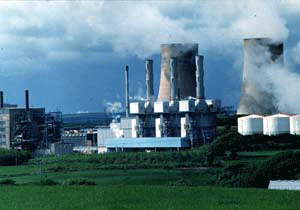 UK’s dream is now its nuclear nightmare https://climatenewsnetwork.net/uks-dream-is-now-its-nuclear-nightmare/?fbclid=IwAR3CEunSXXOxdK_-N8Ka9kwpCMzvHFXNkZf23VGjd6oFuDecember 14, 2018, by Paul Brown
Nobody knows what to do with a vast uranium and plutonium stockpile built up in the UK by reprocessing spent fuel. It is now a nuclear nightmare.
LONDON, 14 December, 2018 − Thirty years ago it seemed like a dream: now it is a nuclear nightmare. A project presented to the world in the 1990s by the UK government as a £2.85 billion triumph of British engineering, capable of recycling thousands of tons of spent nuclear fuel into reusable uranium and plutonium is shutting down – with its role still controversial.
Launched amid fears of future uranium shortages and plans to use the plutonium produced from the plant to feed a generation of fast breeder reactors, the Thermal Oxide Reprocessing Plant, known as THORP, was thought to herald a rapid expansion of the industry.
In the event there were no uranium shortages, fast breeder reactors could not be made to work, and nuclear new build of all kinds stalled. Despite this THORP continued as if nothing had happened, recycling thousands of tons of uranium and producing 56 tons of plutonium that no one wants. The plutonium, once the world’s most valuable commodity, is now classed in Britain as “an asset of zero value.” Continue reading
Australia’s credibility on the line at UN climate talks.
COP24 sees Australia walk climate tightrope amid ‘Paris Rulebook’ deadlock, ABC Weather , By Ben Deacon 15 Dec 18 The COP24 Climate talks in Poland have been extended through the weekend, as nations remain deadlocked over how to implement the Paris agreement.
The aim of the annual United Nations conference is to determine what collective action the world takes on climate change. AUDIO: Australia walks climate talks tightrope (AM)
More than 100 ministers and more than 1,000 negotiators from around the globe have been hammering out the so-called ‘Paris Rulebook’ with an eye to defining how pledges will be put into action.
In the thick of it all has been the Australian delegation, which has been walking a tightrope between the Paris obligations and support for fossil fuels.
In a defining moment at COP24, protesters disrupted a pro-fossil fuel event on Monday that had been organised by the Trump administration.
On stage, the only non-American panellist at the event was Australia’s Ambassador for the Environment, Patrick Suckling.
“Fossil fuels are projected to be a source of energy for a significant time to come,” Mr Suckling said.
Fossil fuel event ‘damaged’ Australia’s credibility
The Director of the Climate & Energy Program at the Australia Institute, Richie Merzian, believes Australia jeopardised its influence in the COP process by appearing at the US event.
“Everyone picked up on the fact that Australia was on the panel with the Trump appointees,” Mr Merzian said.
“I think it even made the New York Times and the Washington Post.
“It really damaged, I think, Australia’s credibility here.”……. https://www.abc.net.au/news/2018-12-15/australia-walks-climate-tightrope-at-cop24/10623558
Rudolph the radioactive reindeer
https://beyondnuclearinternational.org/2018/12/16/rudolph-the-radioactive-reindeer/ Dosed by Chernobyl and atomic tests, reindeer and their herders are carrying a heavy nuclear burden, By Linda Pentz Gunter, December 16, 2018
Fallout from Soviet atomic bomb tests over the Arctic Ocean, compounded by the 1986 Chernobyl nuclear power plant explosion, have left reindeer too radioactive to eat, even today. That may be good news for the reindeer, sort of. But it’s bad news for the indigenous Laplanders in Finland and Sami herders in Norway, who carry high levels of radiation in their own bodies as well as in the reindeer on which they depend for sustenance and sales.
Reindeer carry heavy radioactive doses, mainly of cesium-137, because they devour lichen, moss and fungi, which bioaccumulate radioactive deposits from fallout. Norway’s radioactive contamination is primarily from Chernobyl, made worse because it was snowing heavily at the time of the April 26 accident.
The Sami story is beautifully explained in this stunning photo essay by Amos Chapple and Wojtek Grojec for Radio Free Europe/Radio Liberty.
As the essay describes it, despite the length of time since the Chernobyl disaster, the fallout is a nasty gift that keeps on giving. “In 2014, there was a huge spike in radiation levels that scientists put down to a bumper season for mushrooms. Hundreds of Norwegian reindeer intended for slaughter had to be released back into the wild.” Levels apparently shot from 1,500 becquerels per kilogram to 8,200.
A video of Chapple and Grojec’s work, on Tech Insider, also explains the impact of cesium-137 fallout on reindeer and their herders. [0n originall]
Unfortunately, Norway’s “allowable” radiation standards are far higher than in other parts of Europe, at 3,000 becquerels per kilogram of food compared to the EU standard of 600 becquerels. When Chapple and Grojec were compiling their story, the herd they visited was testing at 2,100 becquerels, passing the Norwegian test for “safe”. The authors say that the higher levels were established by the Norwegian government in “response to radiation levels in reindeer that threatened the very existence of the Sami herders.”
This practice of simply moving the radiation goalposts to make dangerous levels safe still goes on today, of course, most notably in Japan. As was pointed out in an earlier story on our site, the Japanese government, eager to show the world that the Fukushima region could quickly be made safe for habitation, simply raised the “allowable” annual exposure rate from 1 millisievert to 20, an entirely unacceptable dose for most people, especially women and children.
In Finland, most of the persistent radiation levels are due to atomic testing during the Cold War. Measurements continue to be taken among the Lapland reindeer herders where cesium levels are ten times higher than in the rest of Finland. Although cesium levels in humans were a shocking 45,000 becquerels per kilo in the 1960s according to one report, they still hover at over 1,000 today.
The reduction in slaughter of reindeer comes with other side effects as well. As far back as 1997, it was already being observed that the increase in reindeer population, leading to “Over-grazing and trampling, is causing more damage to the fragile tundra than some of the world’s most seriously polluting factories,” wrote Geoffrey Lean in The Independent.
Now, as Russia begins using floating nuclear reactors to plunder the Arctic Ocean for oil, the region has been placed under threat of a radioactive catastrophe again. From both an economic and health perspective, neither the reindeer nor their indigenous herders can afford a second assault.
World has enough uranium for the foreseeable future
 Global uranium supply sufficient to meet future demand – NEA14th December 2018 Mining Weekly
CREAMER MEDIA ONLINE WRITER Intergovernmental agency, the Nuclear Energy Association (NEA), says the world’s supply of uranium is more than adequate to meet projected requirements for the foreseeable future, regardless of the role that nuclear energy will play in meeting future electricity demand …..http://m.miningweekly.com/article/global-uranium-supply-sufficient-to-meet-future-demand-nea-2018-12-14/rep_id:3861
The mad plan to store nuclear waste on the beach — Beyond Nuclear International

Flimsy casks, sea level rise, and safety mismanagement spell disaster
via The mad plan to store nuclear waste on the beach — Beyond Nuclear International
Solar farms getting smaller, cheaper and smarter to overcome grid hurdles — RenewEconomy

Kanowna solar farm near Moree believed to be first to use both DC optimisers and centralised DC-coupled inverters to cater for battery storage and get around network connection hurdles. The post Solar farms getting smaller, cheaper and smarter to overcome grid hurdles appeared first on RenewEconomy.
via Solar farms getting smaller, cheaper and smarter to overcome grid hurdles — RenewEconomy
WA names new energy minister, primes grid for 900MW renewables rush — RenewEconomy

WA opens up grid for nearly 1GW of new large-scale renewable projects. And it has appointed a new energy minister to shepherd the process. The post WA names new energy minister, primes grid for 900MW renewables rush appeared first on RenewEconomy.
via WA names new energy minister, primes grid for 900MW renewables rush — RenewEconomy
10 million and more reasons to be cheerful: RenewEconomy page views surge in 2018 — RenewEconomy
Huge interest in clean energy transition – and technologies and policies that go with it – helped deliver more than 10m page views to RenewEconomy this year. The post 10 million and more reasons to be cheerful: RenewEconomy page views surge in 2018 appeared first on RenewEconomy.
via 10 million and more reasons to be cheerful: RenewEconomy page views surge in 2018 — RenewEconomy
Privatising warfare: Amazon’s bid to become the Pentagon’s “brain”
To understand the implications of JEDI, we must realize that the information being gathered and sorted will inevitably be used for the targeting and killing of not only opposing government-based military forces, but also nongovernmental individuals and groups who are viewed as political or potential military threats by the US.
The transfer of a massive amount of military information into a privately owned and built cloud, as will happen with the creation of JEDI, raises the possibility that the owner or owners of that cloud will — because of their knowledge of the cloud structure, capabilities and content — become more powerful than military and elected officials.
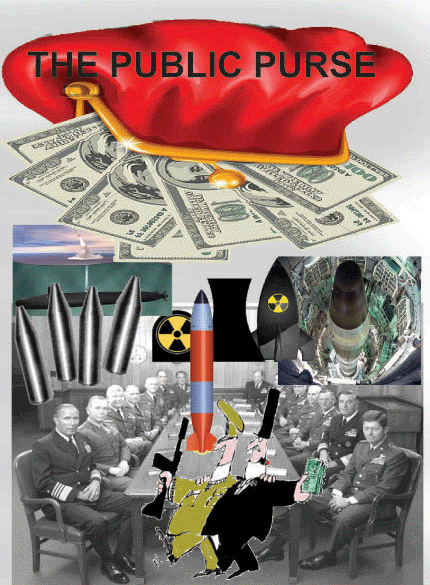 “Alexa, Drop a Bomb”: Amazon Wants in on US Warfare, Nick Mottern, Truthout https://truthout.org/articles/alexa-drop-a-bomb-amazon-wants-in-on-us-warfare/December 16, 2018
Amazon is seeking to build a global “brain” for the Pentagon called JEDI, a weapon of unprecedented surveillance and killing power, a profoundly aggressive weapon that should not be allowed to be created.
Founded in 1994 as an online book seller, Amazon is now the world’s largest online retailer, with more than 300 million customers worldwide, and net sales of $178 billion in 2017.
Amazon has built a vast, globally distributed data storage capacity and sophisticated artificial intelligence programs to propel its retail business that it hopes to use to win a $10 billion Pentagon contract to create the aforementioned “brain” that goes by the project name Joint Enterprise Defense Infrastructure, a moniker obviously concocted to yield the Star Wars acronym — JEDI.
As of the October 12, 2018, deadline for submitting proposals for JEDI, Amazon is the betting favorite for the contract, which will go to just one bidder, in spite of protests by competitors, chief among them Microsoft and IBM. The Pentagon appears likely to select a winner for the contract in 2019.
Jedi Powers? Continue reading
1 This month.

Australians deserve the truth
about
AUKUS – https://aukuspublicinquiry.com/



PETITION – To: Prime Minister Anthony Albanese and the Australian Labor Government

of the week – Australians for War Powers Reform (AWPR)
To see nuclear-related stories in greater depth and intensity
 Antinuclear