Hidden costs? Cheaper energy? ‘Farcical’ locations? Debunking the hype around nuclear
29 June 2024 , By Charis Chang, SBS News

Seven nuclear power plants could be built in Australia if the Coalition wins the next election, but will they live up to the hype?
Australians are being promised a brighter future with nuclear as the answer to rising energy costs.
As concerns grow over the cost of living and rollout of renewables, the Coalition has announced an alternative vision, promising to build seven nuclear power plants across the country if elected.
Last week, it confirmed it would push for nuclear power plants to be built at Tarong and Callide in Queensland, Liddell and Mount Piper in NSW, Port Augusta in South Australia, Loy Yang in Victoria and Muja in Western Australia.
“We have a vision for our country: to deliver cleaner electricity, cheaper electricity and consistent electricity,” Opposition leader Peter Dutton said on 19 June.
But can nuclear in Australia live up to the hype?
Can nuclear bring down electricity prices?
One of the biggest claims the Coalition makes is that
nuclear energy could bring down the price of electricity
in Australia.
Dutton told the Today show on 21 June: “In Ontario, for example — they have 60 per cent nuclear in the mix there, their electricity prices are a quarter of what it is here in Australia”.
But Tim Buckley, director of think tank Climate Energy Finance, questioned how a form of energy that would produce “zero” electricity for the next 15 to 20 years, could bring down power prices.
In the meantime, the Coalition’s plan would undermine investor confidence so Australia didn’t get as much electricity supply from other sources, Buckley said.
“Less supply means higher prices — that’s economics 101.”
He believes the Coalition’s nuclear strategy could increase electricity prices by 20-50 per cent over the next decade because of the need for more government intervention and funding to extend the life of coal plants.
Buckley said the GenCost report — produced by Australia’s national science agency, the CSIRO — found power from nuclear could also be double the price of firmed renewables.
“Therefore power prices go up, not down,” he said.
GenCost looked at the levelised cost of electricity, which is the estimated price that would need to be charged so the generator could cover its costs including a return on investment.
It found electricity generated by large-scale nuclear would be $155/MWh (per megawatt hour) to $252/MWh.
Integrating renewables such as solar photovoltaic (PV) and wind into the grid, including the cost of storage and transmission lines, was estimated to be much cheaper, costing between $90/MWh and $100/MWh.
The GenCost report noted overseas electricity costs may not reflect the prices that could be charged in Australia because of differences in installation, maintenance and fuel costs.
Other countries may also be benefiting from older projects where the costs to build the power plant had already been recovered by investors or governments.
“Such prices are not available to countries that do not have existing nuclear generation such as Australia,” the report said.
Batteries will need to be ‘ripped down’ for nuclear
The Coalition plans to locate its nuclear power plants in the locations of old and retiring coal-fired power plants to “avoid much of the new spending needed for Labor’s ‘renewables-only’ system”.
An electricity grid with a large proportion of intermittent renewables requires many new transmission poles and wires, “all of which will be passed on in the form of higher bills”, Opposition energy spokesperson Ted O’Brien has said.
But Buckley points out that most retired coal-fired power sites are already being used for new battery plants. This includes a 500-megawatt battery plant announced last year on the site of the old Liddell plant in NSW’s Hunter Valley.
Ted O’Brien and Peter Dutton are proposing nationalisation of private assets, and then they’re going to have to rip down the batteries that have just been built at billions of dollars in cost … in order to then wait for 20 years while they build their nuclear power plants,” he said.
“It’s a little bit farcical to me.”
An ambitious 13-year timeline
In a press release announcing its policy, O’Brien said large-scale nuclear would be built by 2037, in 13 years.
But the CSIRO has estimated a nuclear power plant in Australia would take at least 15 years to build.
Australia’s federal nuclear ban would have to be overturned and the government may also have to override several state-level bans
Site selection and acquisition, design, impact studies and environmental permits would then need to be completed before construction could even begin.
Buckley said getting the relevant planning approvals was a time-consuming hurdle for any energy project, let alone one that had never been done in Australia before.
Nuclear ‘will need to be refurbished after 30 years’
Dutton has said nuclear is “an investment for 80 years” and this longevity makes the technology superior to renewable sources of power such as wind energy.
“These nuclear plants can produce and provide 24/7 power for 80 to 100 years … wind turbines last 19 years, so you’ve got to cycle them in and out three or four times,” he told the Today show on 21 June.
Buckley said Coalition statements underestimated the life of renewable projects, noting that nuclear power plants needed to be refurbished after around 30 years.
Warranties on new solar modules now covered them for more than 20 years, he said. And those on batteries had doubled from 10 to 20 years.
“Most solar projects have a design life of 25 years, wind projects have a design life of 30,” he said.
Buckley said the price of refurbishment should also be included in the capital costs for nuclear, and so should decommissioning expenses, which can cost about $10 billion once the plant reaches the end of its life.
‘Who’s going to pay for other costs?’
Eventually, funding will also have to be found to store the nuclear waste generated, which has to be securely stored for tens of thousands of years.
“Who’s going to pay for 10,000 years of nuclear waste disposal?” Buckley said.
Even based purely on the initial construction cost, nuclear does not come out ahead.
Who’s going to pay for 10,000 years of nuclear waste disposal? Tim Buckley, Climate Energy Finance director
The GenCost report estimated the cost of a large-scale nuclear plant in Australia would be $8.6 billion for a 1,000kW plant built in 2023, although the first one would likely be much more expensive.
A small modular reactor (SMR) was estimated to be even more expensive, at $28.6 billion.
In comparison, onshore wind is estimated to cost $3 billion for 1000kW of generation, while large-scale solar PV is even cheaper, at $1.5 billion.
Costs for offshore wind rise to between $5.5 billion and $7.7 billion.
The capital cost for firming technologies such as batteries is separate, but — as mentioned above — the levelised cost of renewables is estimated to be $90-$100/MWh, even including the cost of storage and transmission lines.
Meanwhile, the levelised cost of nuclear is between $155-$252/MWh.
The Coalition hasn’t yet released costings for its nuclear plan, only saying they would come “very soon”.
Analysis from the Smart Energy Council suggests it could cost between $116-$600 billion to build seven nuclear reactors, and they would only supply 3.7 per cent of Australia’s energy mix in 2050.
Michael Preuss, director of research infrastructure at Monash University’s faculty of engineering, has previously told SBS News that while the initial investment in nuclear is expensive, those upfront costs could be recovered.
“There’s a huge upfront investment and once they’re built and they start operating, they’re relatively inexpensive to operate and then you recoup the investment. But it takes a long time,” he said.
There will also be ongoing costs to buy the fuel required to run the nuclear power plant, something renewables can source for free.
Australian communities facing an un-insurable risk?
The Coalition has dismissed concerns about government funding of the plants, saying local communities would welcome the investment.
“You can imagine what this means to local communities, to mums and dads and their kids as they look to the future,” O’Brien told reporters on 19 June.
But Buckley said government funding was required because nuclear power plants were not commercially viable without taxpayer subsidies. He said no private company could afford the insurance risk of a nuclear catastrophe………………………..
Is the world embracing nuclear?
Dutton told Today on 21 June: “I think if you look at the top 20 economies of the world, Australia is the only one that hasn’t embraced or hasn’t signed up to nuclear.”
But Buckley believes this statement is misleading.
“America has closed more nuclear units in the last two decades than they’ve opened so how is that embracing nuclear?”……………………………………………………….
He said other countries that had embraced nuclear did not have the wind and solar resources that Australia did.
“Why would Australia go and choose the most expensive source of electricity with massive water consumption issues, with massive site rehabilitation and massive waste disposal risks, when we don’t need to?
“When there’s a lower cost, commercially proven technology today?” https://www.sbs.com.au/news/article/hidden-costs-cheaper-energy-farcical-locations-debunking-the-hype-around-nuclear/7rd5ewmbr
EDF extends heat-related warning cuts at 3 nuclear plants

This warning from France is a warning to Australia, too. France, the poster boy for nuclear power, is being affected by global heating – making its nuclear reactors less effective and more expensive with rising temperatures.
Australia, a water-short continent, will be even more vulnerable to climate change affecting a nuclear industry
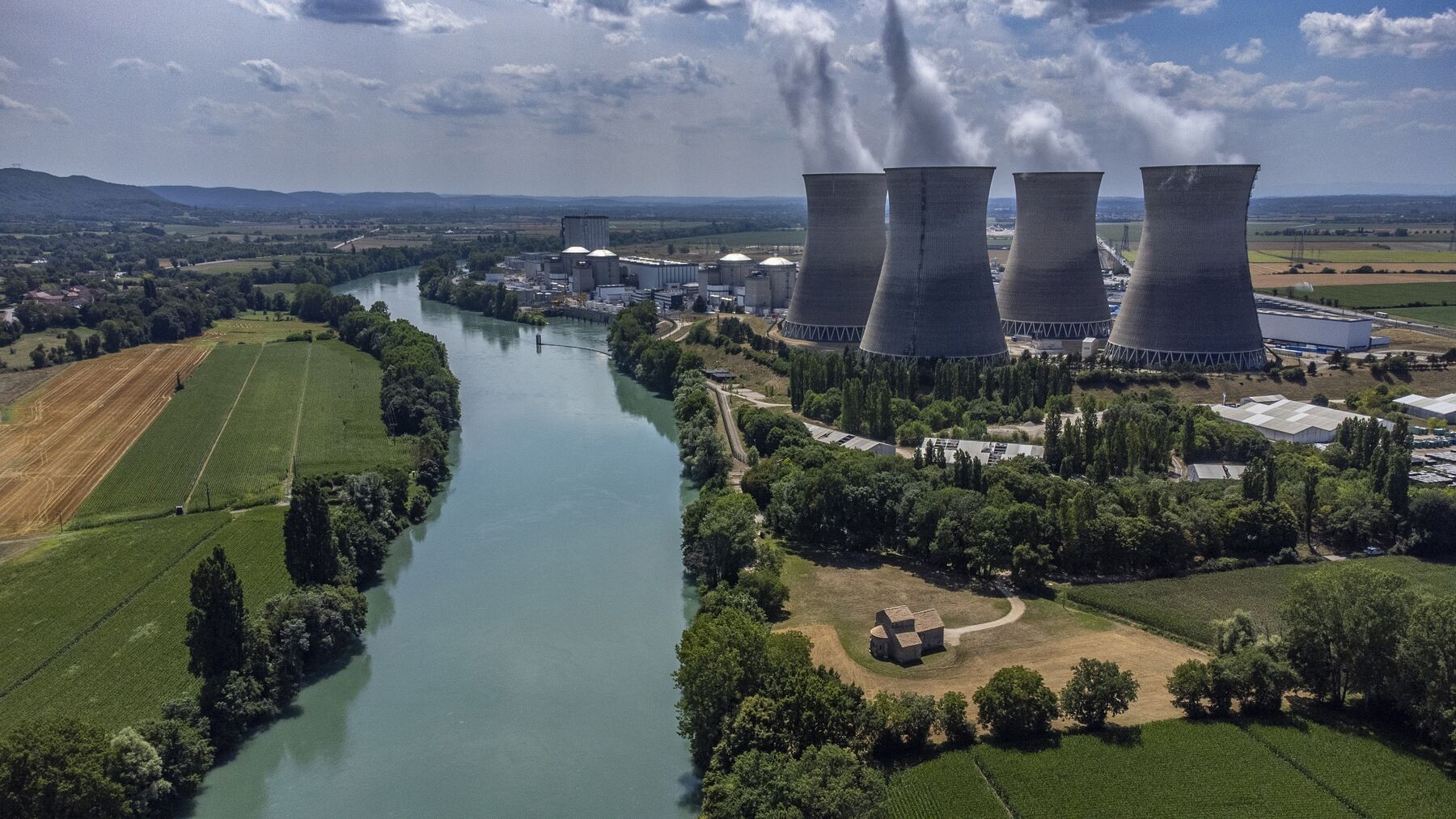
(Montel) French utility EDF has extended by two days a warning of power output curbs at three nuclear power plants – totalling 10 GW – along the river Rhone in southeastern France from tomorrow until Friday next week due to high temperatures.
Reporting by: Muriel Boselli, 08 Aug 2024, https://montelnews.com/news/f1e0a4b4-61b8-4d45-8027-d549192b910e/edf-warns-of-heat-related-cuts-at-3-nuclear-plants-10-gw
EDF could curb output at 3.6 GW Tricastin, 3.6 GW Bugey and 2.6 GW St Alban, the state-owned utility said on Thursday.
Weather service Meteo France has forecast temperatures to intensify in southeast France over the next few days, with peaks reaching 35C.
At some power plants, EDF uses river water to cool reactors. However, it could reduce output if river water temperatures or levels are too warm or too low.
Separately, EDF has extended a capacity cut warning at its 2.6 GW Golfech nuclear power plant in southwest France by three days to 17 August, due to warm temperatures.
We published an analysis from a leading economist on soaring nuclear costs. Facebook removed it
Facebook pages all still full of articles and videos making outrageous claims about renewables and nuclear. But that, it seems, is OK for the social media giant.
Giles Parkinson, Jul 22, 2024 https://reneweconomy.com.au/we-published-an-analysis-from-a-leading-economist-on-soaring-nuclear-costs-facebook-removed-it/—
On Sunday, Renew Economy published an analysis on the soaring cost of nuclear power by leading economist John Quiggin. On Monday we attempted to post it in our feed on social media.
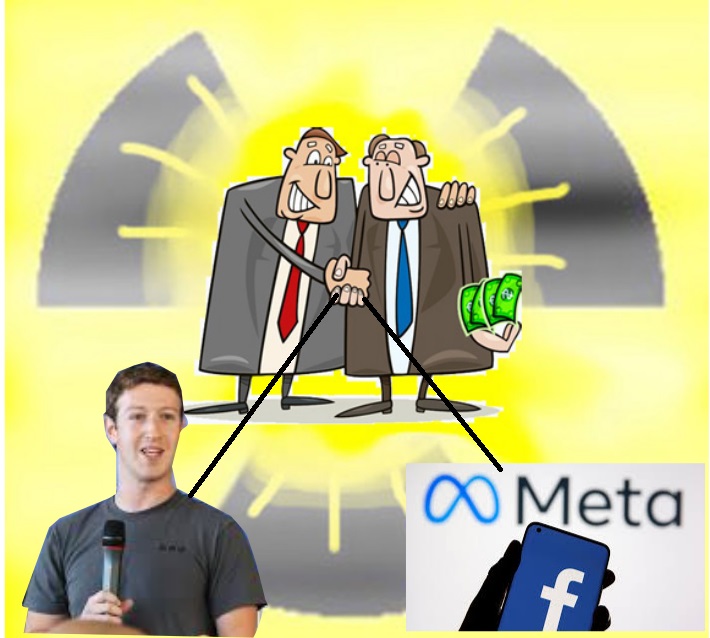
Facebook removed the item, saying it was an attempt to generate clicks by providing misleading information. We’d like to know on what basis this decision was made, but Facebook has yet to provide an answer.
It’s a concerning development, and not the first time one of our posts has been removed by Facebook.
Social media platforms including Facebook, X, YouTube, TikTok, and Instagram – are full of unchecked and misleading information about climate change and energy technologies. Much of it is complete nonsense creating FUD – fear, uncertainty and doubt – about new technologies.
It appears to be part of a well-funded and orchestrated plan by vested interests, and the fossil fuel industry in particular, to demonise renewables, electric vehicles, battery storage and other emerging competitors.
Much of this is amplified in mainstream media, where outrageous claims against renewables – and claims of blackouts, economic collapse and environmental failure – are repeatedly given voice.
Social media platforms including Facebook, X, YouTube, TikTok, and Instagram – are full of unchecked and misleading information about climate change and energy technologies. Much of it is complete nonsense creating FUD – fear, uncertainty and doubt – about new technologies.
It appears to be part of a well-funded and orchestrated plan by vested interests, and the fossil fuel industry in particular, to demonise renewables, electric vehicles, battery storage and other emerging competitors.
Much of this is amplified in mainstream media, where outrageous claims against renewables – and claims of blackouts, economic collapse and environmental failure – are repeatedly given voice.
Quiggin notes that the Czechia deal suggests the opposite is true, and confirms the widely held view in the energy industry itself that GenCost underestimates rather than overestimates the costs of nuclear. Nuclear, he says, is really really expensive.
But Facebook has now ruled that such analysis is misleading, and it won’t allow its users to view such information. Over the last few months, this has happened on several occasions to Renew Economy and its sister site The Driven.
Just last week, another article on the certification of green hydrogen technologies in Australia was pulled down. Last month, it was a story on how households will be a driving force of the energy transition. A few months earlier, an analysis on nuclear costs by Jeremy Cooper, the former deputy chair of ASIC and chair of the 2009/10 Super System Review, was also removed.
Over on The Driven, a story on how EVs are actually suitable for farmers in regional communities, was also pulled down. No explanation was provided. Despite protests, the posts were not reinstated.
Yet Facebook allows media groups such as Sky News Australia to post misleading information about renewables and climate without a check.
It’s a shocking development, and one that points to the manipulation of information by naysayers and vested interests. Some attribute it to the work of the Atlas Network, a shadowy group with strong Australian fossil fuel links that has campaigned against renewables, the Voice referendum, climate action, and climate protests.
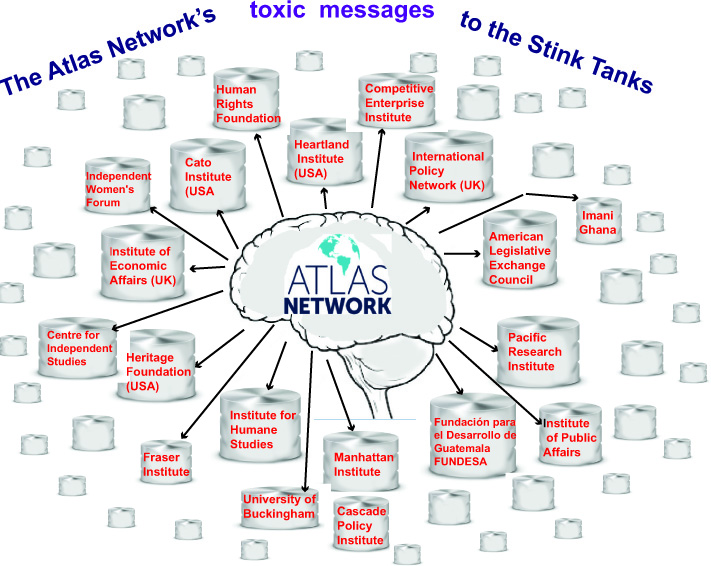
Researchers say that the whole point of the Atlas network of organisations and so called “institutes” and think tanks – which this article in New Republic says includes Australia’s Centre for Independent Studies, which has launched loud attacks against institutions such as the CSIRO, AEMO, and renewables in general – is to drown out actual academic expertise.
The Atlas Network does this, researchers say, to reduce the capacity for public and government influence with its own corporate propaganda that is dressed up as “research.”
George Monbiot, a columnist for the Guardian, calls many of the 500 institutions linked with the Atlas Network “junk tanks.” Jeremy Walker, from the University of Technology in Sydney, wrote in a paper that the network in Australia includes the CIS and the Institute for Public Affairs, both strongly anti renewable, and pro nuclear.
Their Facebook pages all still full of articles and videos making outrageous claims about renewables and nuclear. But that, it seems, is OK for the social media giant.
DUTTON’S RISKY NUCLEAR REACTOR PLAN THREATENS 12,000 FARMS
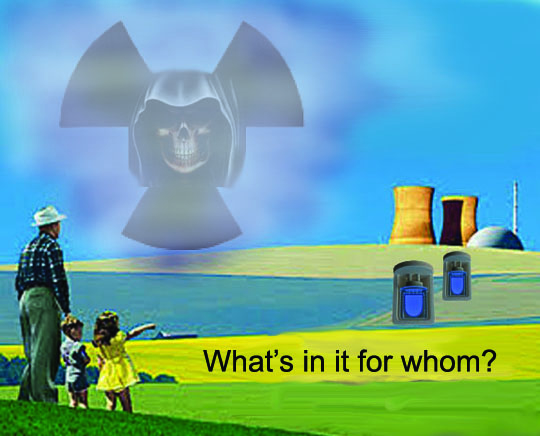
FOOD PRODUCTION ACROSS THE COUNTRY ON HIGH ALERT FROM DUTTON’S RISKY REACTOR PLAN
Agriculture Minister Murray Watt, 18 July 24
The fallout from Peter Dutton’s expensive and risky nuclear reactor announcement continues with new revelations that nearly 12,000 farms across Australia could be impacted.
The LNP’s announcement that nuclear reactors would be built at seven sites across the country could have serious implications for the agricultural sector.
The regions selected by Mr Dutton are major contributors to Australia’s food supply with significant cattle, milk, lamb, grain and vegetable production nearby.
Various states in the United States of America, including Illinois, California, Indiana, Maryland, Missouri and Florida set out detailed guidelines to be followed by farmers, processors and distributors within an 80-kilometere radius of nuclear reactors (known as the “ingestion zone”) to protect their food supply, in the event of a nuclear accident.
Analysis of ABS and local government data by the Parliamentary Library has found approximately 11,955 farms are located within an 80-kilometre radius of the Coalition’s selected sites.
Mr Dutton must urgently explain whether Australian farmers, processors and distributors within a similar ingestion zone will be forced to replicate the expensive actions recommended by American counterparts.
On top of this, leaks have occurred in recent years at nuclear reactors in the United States, Japan, India and Europe, in some cases contaminating agricultural land, crops and water sources.
Eating contaminated foods and drinking contaminated milk and water could have a harmful, long-term effect on the health of the wider community.
Mr Dutton needs to explain his plan to prevent such leaks, how he will manage them if they occur and how he would compensate affected farmers.
Agriculture Minister Murray Watt: –
“Peter Dutton’s risky nuclear plan is not only expensive, slow and unreliable, it also poses a threat to the agricultural industry.
“Based on international practice, farmers would need to take expensive steps during a nuclear leak and would need to inform their customers that they operate within the fallout zone.
“It’s bizarre that the Nationals and Liberals are putting at risk our prime agricultural land like this, especially without the decency to explain it to farmers and consumers how they’d mitigate all the potential impacts.”
BACKGROUND:
Parliamentary library analysis of farm businesses within the 80km ingestion zone of each proposed reactor.
- Collie (WA): Approximately 1,150 agricultural establishments. Major agricultural products include beef cattle, milk, lamb, barley, and carrots.
- Callide (Qld): Approximately 1,040 agricultural establishments. Major agricultural products include beef cattle, cotton, vegetables, wheat, and herbs.
- Hunter (NSW): Approximately 1,650 agricultural establishments. Major agricultural products include beef cattle, milk, chicken (meat), eggs, and hay.
- Latrobe Valley (VIC): Approximately 4,175 agricultural establishments. Major agricultural products include milk, beef cattle, vegetables, applies, and strawberries.
- Mt Piper (NSW): Approximately 1,280 agricultural establishments. Major agricultural products include beef cattle, cultivated turf, lamb, mushrooms, and other vegetables.
- Port Augusta (SA): Approximately 260 agricultural establishments. Major agricultural products include wheat, barley, lamb, wool, hay, and eggs.
- South Burnett/Darling Downs (Qld): Approximately 2,400 agricultural establishments. Major agricultural products include beef cattle, pork, sorghum, cotton, and milk
South Australia locks in federal funds to become first grid in world to reach 100 per cent net wind and solar
And to underline the difference in federal politics, the announcement was made at Port Augusta, the site of a former coal fired power station that the federal Coalition wants to turn nuclear, but which has already become a hub for green energy and green industry.
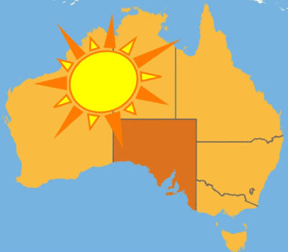
And to underline the difference in federal politics, the announcement was made at Port Augusta, the site of a former coal fired power station that the federal Coalition wants to turn nuclear, but which has already become a hub for green energy and green industry.
Giles Parkinson, Jul 10, 2024, https://reneweconomy.com.au/south-australia-locks-in-federal-funds-to-become-first-grid-in-world-to-reach-100-per-cent-net-wind-and-solar/
South Australia has locked in federal funding to ensure that it becomes the first non-hydro grid in the world to reach 100 per cent net renewables.
The funding deal – through what’s known as a Renewable Energy Transformation Agreement – means that the federal government will underwrite a minimum one gigawatt of new wind and solar generation capacity and another 400 MW (1,600 MWh) of storage – to ensure it meets its target of 100 per cent net renewables by 2027.
South Australia already leads Australia – and the world – with a wind and solar share of around 70 per cent over the last 12 months. The addition of the new capacity, along with the new Project Energy Connect transmission link from NSW, will enable it to become the first in the world to reach 1`00 per cent net renewables based around wind and solar.
That does not mean it will be powered at all times by wind and solar. But the amount of wind and solar generated and stored each year will be equivalent to what it consume each year. The state will export power at times and import at other times, and can fall pack on existing peaking gas plants to fill in the gaps.
Reaching that milestone will be a landmark for the state, and for advocates of the renewable energy transition, particularly as conservative and legacy fossil fuel interests continue to push back on the idea that a modern economy can be powered by renewables and storage.
The irony about South Australia is that the target of 100 per cent net renewables was originally committed by the state Liberal government. The state Labor government merely accelerated it from 2030 to 2027.
And to underline the difference in federal politics, the announcement was made at Port Augusta, the site of a former coal fired power station that the federal Coalition wants to turn nuclear, but which has already become a hub for green energy and green industry.
“South Australia has been a renewable energy pioneer – so much so that we recently brought forward our renewable energy target by three years, committing to ensure electricity generation can be sourced from net 100 per cent renewables by 2027,” state energy minister Tom Koutsantonis said in a statement.
“So we warmly welcome this agreement to accelerate the roll out of renewables while ensuring the reliability of the energy system.
“Our government is committed to working with the Commonwealth to establish a secured grid, supporting the power needs of South Australian households and businesses.”
South Australia has not added a new wind or solar project to the grid for around two years, although the biggest wind project in the state – the 412 MW Goyder South wind farm – is about to connect and send its first power to the grid.
Several new battery projects are also under construction – at Blyth, Hallett, Clements Gap and Templers and another, Tailem Bend, still waiting to be commissioned.
These projects will help propel the state towards 80 per cent renewables over the coming year, while the additional capacity of 1,000 MW of wind and solar, 400 MW of battery capacity (plus the minimum 200 MW included in the current CIS auction) will take it towards 100 per cent net renewables by 2027.
South Australia is also building the world’s first green hydrogen power plant at Whyalla, which will be accompanied by a 250 MW green hydrogen electrolyser and storage facilities, which will also be the world’s biggest when complete.
The state is also fielding huge number of inquiries from industry keen to source zero emissions and low cost green energy – with the local transmission company ElectraNet reporting that more than 2 gigawatts of load inquiries have been made.
Federal energy and climate minister Chris Bowen says the signing of the Renewable Energy Transformation Agreement means that South Australia is the first state to lock in the funding required to meet its targets under the federal government’s Capacity Investment Scheme.
The CIS aims to contract an additional 32GW of renewable generation and storage across the country to help it deliver most of the capacity needed to meet its 82 per cent renewable energy target by 2032.
The first tender of 6 gigawatts of new wind and solar capacity has been flooded with interest, with more than 40 GW of projects showing interest, while the first storage tender – for 600 MW, 2,400 MWh in Victoria and South Australia – was also heavily oversubscribed with some 19 GW of proposals.
Bowen says the bilateral agreements have been designed specifically to address the barriers developers, communities, and governments face in delivering renewable projects, and to replace ageing infrastructure that was built half a century ago.
“The Albanese Government is delivering the certainty and confidence the market spent a decade asking for,” Bowen said in a statement.
“The more renewable energy we have in our grid, the more downward pressure it puts on energy bills because it is the cheapest form of energy to power households and industry.
“Giving the market the confidence to build new projects is good; signing an agreement to collaborate with South Australia on practical steps to get the best out of this energy transformation for South Australian workers, communities and industry, is great.
“The Albanese Government’s Reliable Renewables Plan is the only plan supported by experts to deliver the clean, cheap, reliable and resilient energy system that Australians deserve. This is in sharp contrast to Peter Dutton’s anti-renewables nuclear plan – which remains uncosted and unexplained.”
As part of the deal, South Australia, will establish its own specific grid reliability mechanism and benchmark to be used in place of the national framework, and to be responsible for identifying and delivering new projects and technologies that will maintain reliability to that standard.
Renew Economy is seeking more information to understand what that means in practice.
“The Sun has won”: exponentially growing solar destroys nuclear, fossil fuels on price

Given Dutton’s claims about solar power costing more than nuclear are made ridiculous by the fact that solar’s break-even price has fallen by a factor of more than 1000 and the trend is continuing.
Meanwhile cost overruns in nuclear are endemic and SMR’s only exist in Dutton’s imagination.
By Noel Turnbull, Jul 11, 2024, https://johnmenadue.com/the-sun-has-won-exponentially-growing-solar-destroys-nuclear-fossil-fuels-on-price/—
It’s not known if Peter Dutton reads The Economist but if he does, he must probably think from time to time that it is sometimes dangerously left wing.
In the 22 June issue, it had a special essay on solar power – headlined ‘The Sun Machine’. The sub-head was “An energy source which gets cheaper the more you use it marks a turning-point in industrial history’.
The essay is a total contradiction of almost everything Dutton is claiming about nuclear and renewable energy.
“What makes solar energy revolutionary is the rate of growth which brought it to this just-beyond the marginal state”, the essay says.
They cite a veteran energy analyst, Michael Liebreich, who shows that in 2004 it took a year to install a gigawatt of solar power capacity; in 2010 it took a month; in 2016 a week; and in single days in 2023 there were a gigawatt of installation worldwide.
Current projections are that solar will generate more electricity than all the world’s nuclear plants in 2026; than wind turbines in 2027; dams in 2028; gas-fired plants in 2026; and coal-fired ones in 2032.
All that well before Dutton’s nuclear plants – if at all – start generating power. Moreover, unlike nuclear power which notoriously always takes longer to build than predicted, predictions about the rate of solar power roll-out are consistently under-estimates.
The Economist points out that in in 2009 The International Energy Agency (IEA) predicted solar would increase from 23GW to 244GW by 2030. It hit that milestone in 2016 – less than a third of the predicted time. The world capacity was 1419GW by 2023.
Ironically, one of the few organisations which got their predictions roughly right was Greenpeace – yet even their prediction was an under-estimate.
Given Dutton’s claims about solar power costing more than nuclear are made ridiculous by the fact that solar’s break-even price has fallen by a factor of more than 1000 and the trend is continuing. Meanwhile cost overruns in nuclear are endemic and SMR’s only exist in Dutton’s imagination.
Dutton is stronger on ideology and outrageous claims than economics, but the manufacture of photovoltaics is a classic example of the benefits of mass production – benefits which have always eluded the nuclear power industry.
As The Economist points out solar cells are standardised products all made in basically the same way and “they have no moving parts at all, let alone the fiendish complexity of a modern turbine.”
“Manufacturers compete on cost, by either making cells that make fractionally more electricity, by either making cells that make fractionally out of a given amount of sunshine or which cost less.”
Economics 101 teaches us that a commoditised product does not lead to more and more aggressive competition on the supply side – simply in this case by getting more electricity out of any given amount of sunshine or by costing less.
Rob Carlson, a technology investor, told The Economist: “There is no other energy-generation tech where you can install one million or one of the same thing depending on your application.”
“The Sun has won” he says.
The Economist said: “From the mid-1970 to the early 2020s cumulative shipments of photovoltaics increased by a factor of a million which is 20 doublings. At the same time prices dropped by a factor of 500. That is a 27% decrease in cost of doubling of installed capacity, which means a halving of costs every time installed capacity increases by 360%.
Adair Turner, an eminent economist and financial services executive, was Chair of Britian’s Climate Change Committee which was set up to help transition to zero emissions.
He told The Economist: “We totally failed to see that solar would come down so much.”
BloombergNEF estimated, in 2015, that the cost for solar on a global basis was $122 per MWH – higher than on shore wind and coal. Today both solar and onshore wind are almost half the cost of coal.
Meanwhile, Dutton has welcomed Keir Starmer’s election win by pointing to his support for nuclear power. Which, given that the UK has already installed nuclear power, the cautious Starmer is unlikely to announce that he is closing it down.
Moreover, Starmer’s major problem with nuclear is managing the spiralling delays in, and cost of, nuclear plants being constructed following typical Tory blunders.
The question which Dutton needs to answer is why he knows more about nuclear and solar power than The Economist reporters, Bloomberg, Adair Turner, Rob Carlson, many major investment funds and the overwhelming majority of Australian scientists?
He might ponder all that while the Murdoch media is becoming a tad critical of him – criticising his policy on supermarket divestment and speculating on who might be the Liberal Party leader if Dutton loses the next election.
Meanwhile, notwithstanding their doubts about Dutton’s chances and policies (other than nuclear) The Australian never totally loses its manic opposition to anything progressive. The inimitable Greg Sheridan opined on The Australian front page (6/7) that Labour had not won but the Tories had lost. Partly true obviously, but his piece was enough to prompt the subs to headline the piece with “Self-described socialist is set to drag Britain far to the left”.
Sheridan also rehearsed his regular hates and speculated how it would all come undone.
Jeremy Corbyn would love that to be the case but Starmer not so.
Perhaps the funniest lines in Sheridan’s’ piece were: “Starmer is brainy and works hard. Too deep immersion in the law has rendered it impossible for Starmer to write felicitous prose or create memorable images.”
From a journalist who year after year simply reproduces the same old opinions on the same old subjects that is, to say the least, a bit much.
The nuclear and renewable myths that mainstream media can’t be bothered challenging

Mark Diesendorf, Jul 4, 2024, https://reneweconomy.com.au/the-nuclear-and-renewable-myths-that-mainstream-media-cant-be-bothered-challenging/
Nuclear energy proponents are attempting to discredit renewable energy and promote nuclear energy and fossil gas in its place. This article refutes several myths they are disseminating that are receiving little or no challenge in the mainstream media.
Myth: Renewables cannot supply 100% electricity
Denmark, South Australia and Scotland already obtain 88, 74 and 62 per cent of their respective annual electricity generations from renewables, mostly wind. Scotland actually supplies 113 per cent of its electricity consumption from renewables; the difference between its generation and consumption is exported by transmission line.
All three jurisdictions have achieved this with relatively small amounts of hydroelectricity, zero in South Australia. Given the political will, all three could reach 100% net renewables generation by 2030, as indeed two northern states of Germany have already done. The ‘net’ means that they trade some electricity with neighbours but on average will be at 100% renewables.
Computer simulations by several research groups – using real hourly wind, solar and demand data spanning several years – show that the Australian electricity system could be run entirely on renewable energy, with the main contributions coming from solar and wind. System reliability for 100% renewables will be maintained by a combination of storage, building excess generating capacity for wind and solar (which is cheap), key transmission links, and demand management encouraged by transparent pricing.
Storage to fill infrequent troughs in generation from the variable renewable sources will comprise existing hydro, pumped hydro (mostly small-scale and off-river), and batteries. Geographic dispersion of renewables will also assist managing the variability of wind and solar. For the possibility of rare, extended periods of Dunkelflaute (literally ‘dark doldrums’), gas turbines with stores of biofuels or green hydrogen could be kept in reserve as insurance.
Myth: Gas can fill the gap until nuclear is constructed
As a fuel for electricity generation, fossil gas in eastern Australia is many times more expensive per kilowatt-hour than coal. It is only used for fuelling gas turbines for meeting the peaks in demand and helping to fill troughs. For this purpose, it contributes about 5% of Australia’s annual electricity generation. But, as storage expands, fossil gas will become redundant in the electricity system.
The fact that baseload gas-fired electricity continues temporarily in Western Australia and South Australia is the result of peculiar histories that will not be repeated. Unlike the eastern states, WA has a Domestic Gas Reservation Policy that insulates customers from the high export prices of gas.
However, most new gas supplies would have to come from high-cost unconventional sources. South Australia’s ancient, struggling, baseload, gas-fired power station, Torrens Island, produces expensive electricity. It will be closed in 2026 and replaced with renewables and batteries.
Myth: Nuclear energy can co-exist with large contributions from renewables
This myth has two refutations:
- Nuclear is too inflexible in operation to be a good partner for variable wind and solar. Its very high capital cost necessitates running it constantly, not just during periods of low sun or wind. Its output can only be ramped up and down slowly, and it’s expensive to do that.
- On current growth trends of renewables, there will be no room for nuclear energy in South Australia, Victoria or NSW. The 2022 shares of renewables in total electricity generation in each of these states were 74%, 37% and 33% respectively.
Rapid growth from these levels is likely. It’s already too late for nuclear in SA. Provided the growth of renewables is not deliberately suppressed in NSW and Victoria, these states too could reach 100% renewables before the first nuclear power station comes online.
As transportation and combustion heating will be electrified, demand for electricity could double by 2050. This might offer generating space for nuclear in the 2040s in Queensland (23% renewables in 2022) and Western Australia (20% renewables in 2022). However, the cost barrier would remain.
Myth: There is insufficient land for wind and solar
The claim by nuclear proponents that wind and solar have “vast land footprints” is misleading. Although a wind farm can span a large area, its turbines, access road and substation occupy a tiny fraction of that area, typically about 2%.
Most wind farms are built on land that was previously cleared for agriculture and are compatible with all forms of agriculture. Off-shore wind occupies no land.
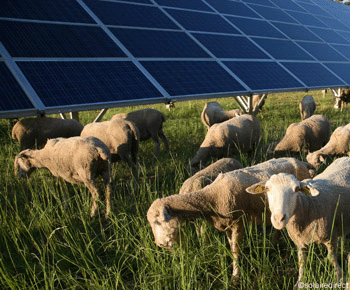
Solar farms are increasingly being built sufficiently high off the ground to allow sheep to graze beneath them, providing welcome shade. This practice, known as agrivoltaics, provides additional farm revenue, which is especially valuable during droughts. Rooftop solar occupies no land.
Myth: The longer lifetime of nuclear reactors hasn’t been taken into account
The levelised cost of energy method – used by CSIRO, AEMO, Lazard and others – is the standard way of comparing electricity generation technologies that perform similar functions.
It permits the comparison of coal, nuclear and firmed renewables. It takes account automatically of the different lifetimes of different technologies.
Myth: We need baseload power stations
The recent claim that nuclear energy is not very expensive “when we consider value” is just a variant of the old, discredited claim that we need baseload power stations, i.e. those that operate 24/7 at maximum power output for most of the time.
The renewable system, including storage, delivers the same reliability, and hence the same value, as the traditional system based on a mix of baseload and peak-load power stations.
When a nuclear power reactor breaks down, it can be useless for weeks or months. For a conventional large reactor rated at 1000 to 1600 megawatts, the impact of breakdown on electricity supply can be disastrous.
Big nuclear needs big back-up, which is expensive. Small modular reactors do not exist––not one is commercially available or likely to be in the foreseeable future.
Concluding remarks
We do not need expensive, dangerous nuclear power, or expensive, polluting fossil gas. A nuclear scenario would inevitably involve the irrational suppression of renewables.
The ban on nuclear power should be maintained because nuclear never competes in a so-called ‘free market’. Renewables – solar, wind and existing hydro – together with energy efficiency, can supply all Australia’s electricity.
Mark Diesendorf is Honorary Associate Professor at the Environment & Society Group in the School of Humanities & Languages and Faculty of Arts, Design & Architecture at UNSW. First published in Pearls and Irritations. Republished with permission of the author.
Nuclear more costly and could ‘sound the death knell’ for Australia’s decarbonisation efforts, report says
Peter Hannam Economics correspondent, Guardian, Fri 28 Jun 2024
A nuclear-powered Australian economy would result in higher-cost electricity and would “sound the death knell” for decarbonisation efforts if it distracts from renewables investment, a report by Bloomberg New Energy Finance (BNEF) argues.
The report comes as ANZ forecast September quarter power prices will dive as much as 30% once government rebates kick in. A separate review by the market watchdog has found household energy bills were 14% lower because of last year’s rebates.
BNEF said the federal opposition’s plan to build nuclear power stations on seven sites required “a slow and challenging” effort to overturn existing bans in at least three states, for starters.
Even if they succeeded, the levelised cost of electricity – a standard industry measure – would be far higher for nuclear power than renewables. Taking existing nuclear industries in western nations into account, their cost would still be “at least four times greater than the average” for Australian wind and solar plants firmed up with storage today, Bloomberg said.
“Nuclear could play a valuable, if expensive, role in Australia’s future power mix,” the report said. “However, if the debate serves as a distraction from scaling-up policy support for renewable energy investment, it will sound the death knell for its decarbonisation ambitions – the only reason for Australia to consider going nuclear in the first place.”
Bloomberg’s analysis complements CSIRO’s GenCost report that also found nuclear energy to be far more costly than zero-carbon alternatives. Australia’s lack of experience with the industry would result in a learning “premium” that would double the price of the first nuclear plant, according to the CSIRO.
Bloomberg also found that assuming the opposition’s seven plants had a generation capacity of 14 gigawatts, they would supply only a fraction of the total market.
If governments tried to rely on inflexible generators – whether coal-fired or nuclear – as renewables increased, they would have to resort to subsidies and other market interventions at a cost to taxpayers, Bloomberg said.
“This report speaks for itself,” the energy minister, Chris Bowen, said. “It’s another example of experts confirming that nuclear energy is too slow, too expensive and too risky for Australia.
“The Albanese government’s plan is the only plan backed by experts to deliver clean, cheap, renewable power available 24/7, and get us to net zero by 2050.”
Guardian Australia sought comment from the opposition energy spokesperson, Ted O’Brien.
ANZ, meanwhile, expects residential electricity prices to begin to see big falls starting from next month as federal and state rebates take effect.
@ANZ_Research predicts electricity prices in the September quarter could fall by 30% as fresh rebates kick in. That would lop a large 0.7 percentage points off the inflation rate (to be recovered later unless the rebates continue). pic.twitter.com/fjHWP8duEn— @phannam@mastodon.green (@p_hannam) June 27, 2024
From 1 July, all households in Queensland get a $1,000 rebate, those in Western Australia the first of two $200 rebates and nationally the first of four $75 rebates from the federal government will arrive.
In the September quarter, ANZ estimates consumer prices will fall 0.7 percentage points, temporarily dampening overall inflation – assuming those rebates aren’t extended again.
The Australian Competition and Consumer Commission will also release its annual market inquiry report on Friday. It showed that without the federal government’s energy rebates in the May 2023 budget the median residential energy bill would have been 14%, or $46.64, higher across all regions…………………………………….more https://www.theguardian.com/australia-news/article/2024/jun/28/nuclear-energy-report-australia-expensive-decarbonisation-renewables
Peter Dutton’s nuclear power plans are an ironic backflip to nationalisation for the Liberal Party
With a mantra of small government and minimal interference in the economy, the Liberal Party has long stood for the rights of the individual and free enterprise.
Until last week.
If Dutton’s nuclear ambitions come to fruition, control of Australia’s energy market, will end up in the hands of the federal government.
https://www.abc.net.au/news/2024-06-25/dutton-nuclear-power-renewable-energy-liberal-party/104016288
By chief business correspondent Ian Verrender 25 June 24
Ben Chifley is considered one of the giants of Labor politics.
As treasurer, he guided the nation through the arduous task of financing World War II and later, after John Curtin’s death, went on to lead the country in the immediate post-war era.
But, in August 1947, concerned that rival banks would undermine the roles of the Commonwealth Bank and the federal government in operating monetary policy, he announced a plan to nationalise Australia’s banking system.
Politically, it was a disaster after the High Court ruled against it. From wartime hero, Labor was swept from power in the 1949 elections by the Robert Menzies-led Liberal Party and spent the next 23 years in the political wilderness.
With a mantra of small government and minimal interference in the economy, the Liberal Party has long stood for the rights of the individual and free enterprise.
Until last week. Rather than allowing market forces to dictate how Australia should respond to the global challenge of reducing greenhouse emissions, the Coalition under Peter Dutton has turned that ethos on its head with a plan to embark upon one of the biggest government-funded investment programs in history.
It is a radical plan that not only throws future private investment in the energy sector into a state of uncertainty, it threatens to undermine the value of privately owned renewable energy investment made during the past 15 years.
On some estimates, depending upon how big the nuclear rollout will be, a capital expenditure program of more than half a trillion dollars will be required to fund this sudden shift in energy policy.
To operate efficiently and to minimise cost, nuclear power plants need to be permanently going full pelt, leaving little room for any other source of power generation.
If Dutton’s nuclear ambitions come to fruition, control of Australia’s energy market, having been privatised largely under Coalition-run state governments since Jeff Kennett made the first move in Victoria, will end up in the hands of the federal government.
Who cares about cost?
It is not the first time the Coalition has up-ended its free-market ethos when it comes to energy policy.
Under Tony Abbott, Australia abandoned the carbon tax established under the Gillard government which put a price on carbon emissions. Instead, it was replaced by a direct subsidy program, the Emissions Reduction Fund, which allocated billions of taxpayer dollars to private enterprise.
Australia’s energy and climate policies have been a mess, the battleground of a bitter raging war between both sides of politics for most of the past 20 years. It has resulted in an underinvestment in new electricity generation as the industry has watched policy lurch between the two extremes.
While many senior Coalition members have openly questioned whether climate change exists with Abbott labelling climate science as “crap”, both sides of politics finally appeared to be on a unity ticket in November 2021 when then-prime minister Scott Morrison signed up to the Paris agreement on emissions reductions.
Since then, gas shortages, Russia’s invasion of Ukraine and the shutdown of our aging coal-fired generators have sent retail electricity prices soaring.
While Dutton claims the first nuclear station could be operational by midway through the next decade, realistically, they are likely to take far longer.
By that stage, however, almost all our coal-fired plants would have been retired, creating massive energy shortfalls in the meantime. Those supporting the opposition and its nuclear policy argue the coal generators’ life should be extended.
That means either building new ones or refurbishing the existing ones at enormous expense which would then detract from the economics of replacing them with nuclear. And our emissions reduction targets would be blown.
The French experience
Whenever any kind of debate on nuclear power plants erupts, France enters the conversation.
More than 70 per cent of France’s electricity is generated from nuclear power plants. And as the proponents will highlight, the French enjoy much lower power prices than most of their European neighbours who now rely on imported fossil fuels.
That’s because the vast bulk of them were built decades ago, they are all government-owned and their costs largely have been sunk.
France has more than 55 nuclear plants dotted around the country that are run by a government entity EDF.
They were built in reaction to the 1973 energy crisis under a plan put forth by then prime minister Pierre Messmer given the country had little if any fossil fuel resources.
Economists Steven Hamilton and Luke Heeney argue that France has made its nuclear system work largely because the technology dominates the power generation system and because it has neighbours that can absorb the excess.
“Countries like France can only make nuclear work by exporting large amounts of energy when it’s surplus to demand,” they wrote recently.
Almost half the plants are more than 40 years old and many are in need of upgrades, a process that has been delayed by debate about whether they should be decommissioned or their life extended.
In September 2022, more than 30 plants were shut because of technical or maintenance problems while the extended European drought created havoc with plant cooling facilities.
Water is essential for nuclear plants, a challenge the opposition appears to have overlooked in its plan to roll them out on the world’s driest continent.
Instead, it has opted to place them on the sites of retired coal-fired generators. But those sites were selected because they were close to coal fields.
Nuclear not compatible with renewables
For all the talk about the cost of building nuclear stations, the cost involved in running them has taken a back seat.
They are horrendously expensive to build. But, even if you don’t take the build cost into account, they are hugely expensive to run.
Even when they are running flat out, the cost of electricity generation is much higher than for renewables, according to the CSIRO and most reputable economists and analysts.
To maximise their efficiency, they need to be running full-time at maximum capacity. But the opposition has hinted nuclear power would somehow complement renewables, that they could switch on to fill the breach when renewables fall short.
As investment banker David Leitch argues, renewables flood the system during daylight hours, sending wholesale power prices to zero and even lower on many days, which would cripple the economics of nuclear power.
“Generation technology choices do not live in isolation from the system in which they operate,” he says.
“For those not already tired of the debate around small, modular reactors, the fact is they are not a technology designed to deal with the reality of a system that has lots of renewables and specifically lots of solar.”
That means much higher generation prices on top of an extraordinarily expensive and long build time that will come into effect long after our coal-fired generators have bitten the dust.
Chifley’s experience still looms large over Labor. So, for the next few years, prepare to be entertained by a Labor Party preaching market forces butting heads with a Coalition hell-bent on nationalising a key segment of the economy.
The irony.
Matt Kean to helm Climate Change Authority, says no to nuclear

Rachel Williamson, Jun 24, 2024, ReNewEconomy
The architect of New South Wales’ (NSW) renewable energy transition is set to be the next Climate Change Authority (CCA) chair, with Matt Kean stepping up to take on the job of advising on the options and pace of the national shift to decarbonisation.
The former NSW Liberal MP and state energy minister – who only stepped down from politics late last week – will combine decarbonisation with economic policy in his new role, a job whose importance is taking on an outsized importance in advance of an election set to be fought on how to get to net zero.
The CCA advises the government on climate change policy.
He then handled the NSW emissions reductions target of 70 per cent by 2035.
Today, Kean rejected nuclear as a solution the CCA will support, saying that his department looked into the energy source for NSW and advice was that it would take too long and be too expensive.
He says the advice was from professor Hugh Durrant-Whyte, who was responsible for the British government’s nuclear defence program and is one of the few people in Australia to have actually run a nuclear program.
Retiring chair Grant King restored the agency to “its proper role” supporting the government’s climate goals, says energy and climate change minister Chris Bowen.
“Good climate and energy policy is good economic policy – the Albanese government gets that and so does Matt Kean,” he said in a statement.
“Our ambitious but achievable policies are ensuring our approach is credible and delivers benefits for all Australians. The Climate Change Authority is critical to this agenda.
“Matt Kean’s time in public office was marked by reform and the ability to bring people from across the political spectrum with him for the good of the community.”…………………………………………………………………. more https://reneweconomy.com.au/matt-kean-to-helm-climate-change-authority-says-no-to-nuclear/
Peter Dutton says nuclear power plants “burn energy.” No they don’t

Giles Parkinson, Jun 25, 2024 https://reneweconomy.com.au/peter-dutton-says-nuclear-power-plants-burn-fuel-no-they-dont/
Opposition leader Peter Dutton has betrayed his complete ignorance about the nuclear technology he threatens to impose on the Australian population by a making a fundamental error: He thinks they burn fuel, or energy.
The comments were made in a heated Question Time in parliament house on the first day of the winter session which promises to be focused on energy and climate.
Opposition energy spokesman Ted O’Brien was ejected from the house by speaker Milton Dick, and Dutton ran close, earning the ire of the speaker on several occasions when he interjected as Labor ministers spoke.
At one point Dutton – trying to tie Labor up in knots over waste from a nuclear submarine, said this, according to Hansard:
Mr Dutton: It’s on relevance. And, perhaps, to be of assistance to the minister, the propulsion system burns energy—that’s how the system is working—and it’s stored in the—
The SPEAKER: Resume your seat.
Actually, they don’t burn fuel. That’s the point of them. If they did, they would likely create emissions, as defence minister Richard Marles explained.
Mr MARLES: Actually, it doesn’t burn any fuel, because burning is oxidisation, which is what happens in an internal combustion engine, which is exactly what happens when you use hydrocarbons. What this is is a nuclear reaction which gives rise to power. That is what happens inside the sealed nuclear reactor. The point is that the waste that will need to be disposed of …
And if he doesn’t accept Labor’s word on it, the Opposition leader could also read up on the website of the Nuclear Energy Institute:
“Nuclear plants are different because they do not burn anything to create steam. Instead, they split uranium atoms in a process called fission. As a result, unlike other energy sources, nuclear power plants do not release carbon or pollutants like nitrogen and sulfur oxides into the air.”
It reminds me of an encounter I had when I first started driving an EV. It was rubbished by a passer-by who suggested the car would be better off powered by nuclear. He seemed to think you could just shovel uranium into a boiler and off you go. Just top it up at the local refuelling station.
It could be that the aspiring prime minister thinks along the same lines. After all, we are constantly told we should mine Australia’s vast uranium reserves – heck, why not burn them like we do with coal.
It’s not the only major misunderstanding of nuclear by Dutton. He has suggested that what he defines as a small nuclear reactor, around 400 MW, would produce just a single can of coke as waste. It will need to be a very big can.
Emeritus Professor Ian Lowe, of Griffith University’s school of environment and science, told the SMH it was safe to say an SMR would generate many tonnes of waste per year, and it was likely that waste would be more radioactive than the waste from a large-scale reactor.
“For a 400-megawatt SMR, you’d expect that to produce about six tonnes of waste a year. It could be more or less, depending on the actual technology but certainly multiple tonnes a year,” he said. “They run on highly enriched uranium and produce a much nastier and a much more intractable set of radioactive waste elements that have to be treated.”
The Coalition’s entire nuclear push is based on lies and misconceptions, from their claim that wind, solar and storage can’t power a modern economy, that their plan needs no additional transmission, that its cheaper than renewables, and that it’s consistent with climate targets.
As virtually all experts have pointed out, with the exception of an heroic rear guard action on Sky News, the policy makes no sense economically, environmentally, or from an engineering point of view.
Perhaps Dutton needs to watch a few more episodes of The Simpsons. Or perhaps not.
Is rooftop solar a fatal flaw in the Coalition’s grand nuclear plans?

Unlike nuclear, solar is also extraordinarily cheap, at least up-front, and large-scale projects can be delivered for comparative peanuts — and with blinding speed.
There are now almost 4 million homes spread across the country with solar installations, and the electricity they generate accounted for about 12 per cent of Australia’s needs last year.
It’s a constituency that politicians would tackle at their peril.
By energy reporter Daniel Mercer, https://www.abc.net.au/news/2024-06-24/rooftop-solar-potentially-lethal-flaw-in-coalition-nuclear-plans/104008864—
Earlier this year, the Coalition made a curious, significant move.
David Littleproud, the leader of the National Party, broke cover and wholeheartedly threw his support behind rooftop solar and household batteries.
The Nationals, he said, were not against renewable energy, only large-scale projects such as wind farms and transmission lines that were “tearing up the environment”.
Quite the opposite — the National Party wanted as many Australian households to get solar and batteries as would have them.
The pitch, which was quickly backed by opposition leader Peter Dutton, evidently had a few purposes.
For starters, it clearly distinguished the opposition from the Labor government, whose plan to decarbonise the power system rests largely on big-ticket renewable energy and transmission items.
In one fell swoop, the Coalition was able to say it was pro-renewable energy while being able to attack the government’s own green plans as environmentally and economically dangerous.
What’s more, the shift was a clear nod — or a sop, depending on who you ask — to the enormous and growing political clout of Australia’s solar-owning class.
Lastly, as both Mr Littleproud and Mr Dutton have repeatedly since pointed out, rooftop solar was an ideal complement for the central plank of the Coalition’s energy plans — nuclear.
Dangers in the detail?
The thinking behind that pivot has been on full display in recent days after the Coalition finally unveiled the major details of its energy policy for the upcoming federal election.
Under the plans, Australia would get seven nuclear power plants by the middle of the century — five large-scale ones across New South Wales, Queensland and Victoria and two small ones across South Australia and Western Australia.
No longer would the renewable emphasis be on scores of new wind and solar farms in regional areas and the high-voltage power lines needed to plug them into the grid.
It would instead be directed towards people’s rooftops, “an environment that you can’t destroy”, according to Mr Littleproud.
But hiding behind this veil of logic from the Coalition, energy experts reckon, is a potentially fatal flaw.
Solar power and nuclear power don’t play nicely together.
“That’s another untested and questionable part of this whole strategy,” said Dylan McConnell, a senior researcher and energy analyst at the University of NSW.
“What happens if we look into a system that is largely dominated by … a significant proportion of … behind-the-meter solar?
“People are going to continue to install rooftop solar and, in fact, the Coalition is supportive of that.
At the heart of this tension are the differing — and some argue incompatible — characteristics of nuclear and solar power.
On the one hand, nuclear reactors are the quintessential base-load generators that can — and want to — run at or near full capacity all the time.
Not only are they well-suited to the task technically, nuclear plants also have an economic imperative to operate flat-out given their monumental development costs.
These development costs are typically exacerbated by very long lead times — lead times subject to significant blowouts — in which debts are incurred and eye-watering amounts of interest can accrue.
The hare and the tortoise
Paying off those debts is paramount for the owner of a nuclear plant.
Failure to do so can be financially ruinous.
And the way to do that is to produce and sell as much electricity as is technically possible.
By contrast, solar power — specifically from photovoltaic cells typical of suburban rooftops — are the archetypal source of variable renewable energy.
They produce the most power when the sun is shining during the day, none when it’s not, and their output can be highly variable depending on the conditions.
Unlike nuclear, solar is also extraordinarily cheap, at least up-front, and large-scale projects can be delivered for comparative peanuts — and with blinding speed.
For a household, the cost of a 10-kilowatt system — an installation capable of meeting much of an average customer’s needs — can be done for a few thousand dollars.
In other words, if nuclear power is the proverbial tortoise, solar is the hare.
None of which is to dismiss the technical and economic challenges that solar presents, namely, how to back it up when it’s not producing — a very big task indeed.
But there is another crucial way in which solar and nuclear — or any base-load power such as coal, for that matter — clash.
Solar generation, by its very nature, peaks in the middle of the day.
As ever-more Australians install seemingly ever-more solar panels on their roofs, that peak in solar output is becoming truly epic in its proportions.
Rooftop solar is a beast
or example, there are times in South Australia when rooftop solar alone can account for more than the entire demand for electricity in the state.
To ensure South Australia’s electricity system doesn’t blow up, virtually all other generators have to pare back their output to a bare minimum or switch off entirely.
And even then, South Australia’s surplus rooftop solar generation has to be exported to other states or wasted.
Rooftop solar can do this because it’s largely uncontrolled and flows simply by dint of the sun shining.
It was partly for this reason that South Australia’s only base-load coal plant retired in 2016.
Of course, there are many more times when rooftop solar provides precisely 0 per cent of South Australia’s power needs.
But it all goes to illustrate the very real challenges that base-load nuclear would face, and the very real trends that are unlikely to grind to a halt between now and 2035, by when the Coalition hopes to have the first of its nuclear reactors up and running.
A quick glance at the numbers will tell you all you need to know about the popularity — and power — of rooftop solar in Australia.
There are now almost 4 million homes spread across the country with solar installations, and the electricity they generate accounted for about 12 per cent of Australia’s needs last year.
Bruce Mountain, the director of the Victoria Energy Policy Centre, summed it up this way: “Rooftop solar has few opponents.”
“It’s the one thing that keeps on growing despite the impasse at a national level,” Professor Mountain said.
“And I think there’s much more to go to realise the potential for that, most notably on factory roofs.”
Something has to give
Professor Mountain said “I’m kind of open to the idea of nuclear”, noting that it was being taken seriously by many other developed countries seeking to decarbonise their electricity supply.
He also pointed out that Australia’s development of large-scale renewable energy projects and, particularly, the transmission lines needed to support them, had hardly been a glowing success to date.
In any case, Professor Mountain suggested the fact the Coalition was proposing to own and operate any nuclear power stations was an acknowledgement that there was no commercial case for the technology in Australia.
On that point, Dr McConnell from the University of NSW agreed.
Dr McConnell said the economic obstacles in front of nuclear in Australia were enormous, and a big one was rooftop solar.
He said that in the almost inevitable event that nuclear and solar power clashed, something would have to give.
“The way you might achieve that in a system with lots of rooftop solar is by curtailing [switching off] rooftop solar,” Dr McConnell said.
“And that may not be politically popular either.”
Robert Barr, a power industry veteran and a member of the lobby group Nuclear for Climate, did not shy away from the potential for future tensions, noting that coal was already getting squeezed out of the system by solar.
But Dr Barr said any clash could be easily managed through a combination of price signals that encouraged householders to use more of their solar power and export less, and new reactor technology that could ramp up and down more effectively.
You could probably drop down from 100 per cent down comfortably to like 60 per cent output and on a daily basis,” Dr Barr said of new nuclear technology.
Ultimately, however, Dr Barr argued it may need to be households with solar panels that gave way to nuclear energy for the greater benefit of the electricity system.
Don’t mention the solar wars
Right now, he said, renewable energy was benefiting from taxpayer-funded subsidies that allowed wind and solar projects to make money even when the price of power was below $0.
These subsidies applied to both utility-scale projects and rooftop solar panels, through the large- and small-scale green energy targets introduced by the Rudd Labor government.
They effectively allow such projects to sell their electricity for less than zero — up to a point — and still be in the money.
In the future, Dr Barr said, those subsidies would no longer exist and renewable energy projects would start to be penalised each time the price of electricity went negative.
“I think what will happen is that nuclear will just tend to push out solar,” he said.
“There’ll be an incentive for customers to back off.
“And I think it wouldn’t be that difficult to build control systems to stop export of power at the domestic level.
“It’d be difficult for all the existing ones but for new ones, it just might require a little bit of smarts in them to achieve that particular end — it can be managed.”
Much like the Coalition’s grand policy pitch, those comments might be considered bold given the political heft wielded by millions of solar households.
Last decade, politicians of all stripes got into all manner of trouble when they tried to wind back subsidies known as feed-in-tariffs, which paid customers for their surplus solar power generation.
Solar households, egged on by the industry, mobilised, went on the attack and in many cases forced governments to bend to their will.
And that was at a time when the number of households with solar was a fraction of what it is now.
It’s a constituency that politicians would tackle at their peril.
Peter Dutton’s flimsy charade is first and foremost a gas plan not a nuclear power plan
Dutton’s nuclear castle is made of cardboard. Close questioning over the many months until election day will show that behind the costly facade, it’s not so much a nuclear plan, as a plan to give up on our climate targets, turn our back on a clean energy future and burn a lot more gas (and money).
Simon Holmes à Court, 21 June 24, https://www.theguardian.com/commentisfree/article/2024/jun/21/peter-dutton-nuclear-power-plan-gas-energy
Straight from the Donald Trump playbook the opposition leader left Australia with more questions than answers.
Finally, on Wednesday morning Peter Dutton announced his nuclear plan … well, it’s more a vibe than a plan – a flimsy announcement leaving us with more questions than answers.
If there’s any doubt that Dutton has internalised the Trump playbook, here’s an example of how he’s deployed the infamous Steve Bannon technique: “flood the zone with shit”.
The media conference was a stream of falsehoods, empty rhetoric and veiled swipes, deftly delivered with unwavering confidence.
As an energy nerd, there’s a lot I like about nuclear technology, and my long-held interest has led me to visit reactors in three countries. Last year I took a nuclear course at MIT and met nuclear developers, potential customers, innovators and investors, tracing many footsteps of the shadow energy minister, Ted O’Brien.
I strongly believe nuclear power is an important technology – but it has to make sense where it’s used and that requires close questioning. Here are some important questions, and what we know so far.
How to remove the current bans?
Nuclear is banned in Australia by two acts of parliament. Naturally, to repeal the ban the Coalition would need to win back control of the house – a daunting task when they are 21 seats shy of a majority – and control of the Senate, power it hasn’t held since the end of the Howard era.
Once the federal ban is lifted, Dutton needs a plan for lifting state bans in Victoria, New South Wales and Queensland.
The leaders of the Labor governments and their Coalition oppositions in each of these key states have expressed their clear opposition. Dutton rehashed the old quip that you wouldn’t want to stand between a state premier and a bucket of money, indicating that he thinks dangling commonwealth carrots will solve the issue.
They will not be cheap carrots!
Where will the reactors go?
The Coalition has named seven specific locations, two in Queensland, two in New South Wales and one each in Victoria, South Australia and Western Australia, all on sites of retired or soon-to-be-retired coal power stations.
One big problem – the commonwealth doesn’t own any of these sites, and in many cases the owners of the sites have plans to redevelop the sites, such as a $750m battery on the site of the old Liddell power station being built by AGL.
On Wednesday Dutton hinted that if the owners wouldn’t sell the sites, he had legal advice that the commonwealth could compulsorily acquire them. That’ll go down well.
How do we keep the lights on?
Australia’s 19 coal power stations generated 125 TWh of electricity last year. The Australian Energy Market Operator expects all will be retired by 2037. On top of that, our energy demand is expected to increase by more than 230 TWh by 2050. Over the next 25 years we need to build facilities that generate at least 355 TWh every year.
Dutton announced that the Coalition would build five large reactors and two small modular reactors by 2050. This would be about 6.5 GW of new capacity, which at best could be expected to generate 50 TWh a year – less than 15% of the new generation needed.
The Coalition has been quite clear that it wants to see renewable energy development slowed to a crawl. This would leave a massive hole in our energy supply, which could only be filled by extending the life of coal and a massive increase in gas power generation.
This is first and foremost a gas plan, not a nuclear plan.
What will it cost?
Gas is the most expensive form of bulk energy supply in the electricity market … at least until nuclear is available.
Replacing the cheapest form of energy – wind and solar, even including integration costs – with the two most expensive forms can only send energy prices higher.
The Coalition’s announcement is too vague to cost precisely and nobody really knows what SMRs will cost, but a reasonable estimate using assumptions from CSIRO’s GenCost would be in the order of $120bn, or to coin a new unit of money, one-third of an Aukus.
What does this mean for emissions?
An analysis by Solutions for Climate Australia, released before Wednesday’s announcement and which assumes a much more aggressive nuclear build, shows an aggregate increase in emissions by 3.2bn tonnes of carbon dioxide by 2050 – the emissions equivalent of extending the life of our entire coal fleet by 25 years.
While the Coalition has turned its back on Australia’s legislated 2030 target, their talking points say they’re still committed to net zero emissions by 2050. This does not compute. Dutton’s proposal would see high emissions in the electricity sector all the way to 2050 and beyond, blowing our carbon budget and every emissions target along the way.
What if locals object?
For years Coalition members have been running around the country fomenting then amplifying community concern around wind and solar farms. Genuine community consultation, which has sometimes been lacking, is the best antidote to opposition.
Yet the Coalition has made a massive blunder in telling communities exactly where they’ll go before any consultation. Worse, it has adopted a strong-man posture that communities will have to accept that the reactors are in the national interest. It will be fascinating to watch how the Coalition handles local opposition over the coming months.
How will they be built?
With a combination of astronomical costs and zero interest by energy companies, there only ever was one possible owner of a nuclear power station in Australia: the commonwealth government.
One of the biggest challenges will be locking in major contractors. With the high likelihood that a future Labor government would cancel any contracts, no contractor would proceed without very expensive cancellation protection.
When will the reactors come online?
We often hear that a nuclear reactor can be built in eight years. In reality it takes three to four years from signing the contract to completing the civil works to begin ‘construction’, and it would very optimistically take four years to complete site selection, planning, licensing, vendor selection and contracting. Add in the inevitable legal challenges and it’s highly unlikely a reactor could be delivered by 2035 – as Dutton claimed – let alone before the early 2040s.
The newest reactors in the United States took 18 years from announcement to commercial operation, while in the UAE, it took 13 years under an authoritarian regime … and I’m being kind by not mentioning contemporary projects in France, the UK, Finland and Argentina.
Dutton has said he favours the Rolls-Royce SMR, tweeting an artist’s rendering on Wednesday.
These SMRs exist only on paper, yet Dutton wants us to believe he can provide one by 2035. Remember, this is the mob that brought us the NBN and the Snowy 2.0 disaster. This is the team that couldn’t even build commuter car parks.
What about the water and the waste?
I think we can relax a little about water and waste. Yes, nuclear power stations generally require large volumes of water for cooling, but so do coal power stations. By choosing sites with existing access to cooling water, the Coalition has sidestepped this concern.
Public concern around nuclear waste is high, but ultimately the problem is manageable. The waste will be kept on site, likely in dry casks and eventually moved to wherever Australia decides to store its waste from the Aukus program. Nobody has ever been harmed by spent nuclear fuel.
Who will provide disaster insurance?
While serious nuclear accidents are very rare, their costs can be astronomical. The Japan Centre for Economic Research has estimated that total costs related to the 2011 Fukushima Daiichi nuclear accident may reach $350 to 750bn. The only viable solution is for the commonwealth to accept liability.
For a long time the Coalition’s nuclear plan sat beyond the horizon, to be unveiled before the election. But now Dutton’s built a castle and he has to defend it.
Dutton is still learning about nuclear. On Wednesday he said that an SMR would emit only a “coke can” of nuclear waste a year. In reality it would probably produce more than 2,000 times that.
Nuclear energy is complex. He and his team will keep making mistakes. Keith Pitt, a Nationals backbencher told RN Breakfast on the same day that the grid couldn’t handle more than 10% wind and solar power combined. Over the past year the grid has averaged 31% wind and solar.
Some people want to believe there are simple solutions to the complex solutions behind the cost of living crisis, and like his political forebear Tony Abbott, Dutton has a knack for delivering simple messages with cold competence.
But Dutton’s nuclear castle is made of cardboard. Close questioning over the many months until election day will show that behind the costly facade, it’s not so much a nuclear plan, as a plan to give up on our climate targets, turn our back on a clean energy future and burn a lot more gas (and money).
- Simon Holmes à Court is a Director of The Superpower Institute, the Smart Energy Council and convener of Climate 200. Contrary to Coalition belief, he is not a large investor in renewable energy.
Dutton’s plan to build nuclear plants on former coal sites not as easy as it seems
Dr Katherine Woodthorpe said it would be impractical for nuclear facilities to use existing poles and wires. CREDIT:LOUIE DOUVIS
By Bianca Hall, June 21, 2024, https://www.theage.com.au/environment/climate-change/dutton-s-plan-to-build-nuclear-plants-on-former-coal-sites-not-as-easy-as-it-seems-20240620-p5jnbo.html
Experts have cast doubt on the central pillar of Peter Dutton’s nuclear pitch to voters, saying it would take decades to fill in coal mine voids and make contaminated power station sites safe, during which time fragile and valuable transmission lines would be left to deteriorate.
Operators at several of the seven sites identified by the Coalition for nuclear plants already have well-advanced plans to transform their sites into renewable energy hubs with grid-scale batteries, hydrogen and solar once the coal runs out.
Announcing a future Coalition government would build seven nuclear power stations on the sites of existing coal-fired power stations, Dutton said nuclear facilities could be built on the sites of retired coal power plants using existing transmission poles and wires.
“Each of these locations offer important technical attributes needed for a zero-emissions nuclear plant, including cooling water capacity and transmission infrastructure,” he said.
“That is, we can use the existing poles and wires.”
Dr Katherine Woodthorpe, president of the Australian Academy of Technological Sciences and Engineering, said overseas examples like the United Kingdom’s Hinkley Point C showed it could take decades to approve and build new nuclear facilities – leaving aside the time needed to remediate dirty and geologically unstable former mine sites.
Woodthorpe said even if it only took 25 years to get a new nuclear facility up and running, that meant the existing transmission potential could lie dormant for 25 years after a coal plant closed.
“In theory it could be done, but when you look at the actual practicality of doing it they’d pretty well have to replace it all,” she said.
University of Sydney professor Glenn Platt, who specialises in energy policy, markets and grids, said there was already high demand for dormant transmission networks among renewables operators.
“The unknown bit [about the Coalition policy] is what happens to those poles and wires between now and when somebody wants to build the nuclear plant, because everybody else is trying to use those poles and wires today for wind and solar and battery projects,” he said.
“The landowners many of these sites are already deploying wind and solar or batteries on those sites. They would use up the available poles and wire infrastructure.”
AGL, which owns the Liddell Power Plant in the Hunter Valley, and Loy Yang A in the Latrobe Valley, said it was well-advanced in plans to transform the sites into industrial energy hubs with renewables, batteries and associated industries.
A spokesman referred this masthead to a statement made by chief executive Damien Nicks in March.
“AGL is already developing our coal and gas power station sites into low-emissions industrial energy hubs,” he said.
“As the owner of these sites, nuclear energy is not a part of these plans. There is no viable schedule for the regulation or development of nuclear energy in Australia, and the cost, build time and public opinion are all prohibitive.”
Many observers are looking to now-closed mine sites for clues about how Dutton’s policy could work on a practical level.
French energy giant Engie, which is rehabilitating Victoria’s closed coal mine Hazelwood, has estimated it could take up to 35 years under a worst-case scenario to finish filling the enormous mine void to a maximum depth of 116m and surface area of 1145 hectares.
Engie Australia and New Zealand manager of environment and planning Adam Moran, who has led the rehabilitation, said a nuclear facility could in theory be put on the site of a former coal power station.
“Could it be done? Yes, but if you had to choose a location, would you choose next to a mine void that’s been rehabilitated and full of water, or would you put it some distance further away?” he said.
“You would probably err on the side of caution, and move it well outside of the geological buffer zone that would exist around a rehabilitated coal mine.”
At Hazelwood, which had a 1600-megawatt transmission capacity when the coal mine operated, operators have installed a 150-megawatt-hour battery, which is now plugged into the mine’s existing transmission network.
In November, Yancoal announced plans to transform the coal mine at Stratford in the Hunter Valley, slated for closure this year, into a major 330-megawatt solar farm and pumped hydro facility capable of producing 300 megawatts in a 12-hour period.
A spokesman for EnergyAustralia, which operates the Mt Piper mine in Lithgow, said the company spoke regularly with governments and regulators.
“To date, we have not discussed the use of any EnergyAustralia sites in the context of nuclear,” he said
With its Mt Piper plant due to close in 2040, and Yallourn this decade, EnergyAustralia is increasingly looking to diversify, he said.
“We are focused on continuing to roll out existing, readily available technologies,” he said, which included gas and batteries.
“We are developing more batteries in multiple states, pumped hydro at Lake Lyell in Lithgow and working with partners to underpin further renewable energy.”
The Australian Manufacturing Workers’ Union and Climate Action Network Australia commissioned a report identifying industry and workforce opportunities presented by the renewable energy shift.
National secretary Steve Murphy said with government backing, coal workers could retrain and reap the benefits of renewable technologies.
“This is coming, so let’s get involved and get the best results for our members,” he said.
“We’re in a global race for the jobs of the future, and we spent 10 years standing still, [but] we can catch up very quickly with the natural advantages that we’ve got, provided that there is government support.”
Ziggy Switkowski and another big nuclear back-flip
Ziggy 1.0 said in 2009 that the construction cost of a one gigawatt (GW) power reactor in Australia would be A$4-6 billion.
Ziggy 1.0 wasn’t wrong by 4-5 percent, or 40-50 percent. He was out by 400-500 percent. And yet he still gets trotted out in the mainstream media as a credible commentator on nuclear issues. Go figure.
Jim Green, Jun 21, 2024, https://reneweconomy.com.au/ziggy-switkowski-and-another-big-nuclear-back-flip/
Dr Ziggy Switkowski, best known as a former Telstra CEO, less well known as a former oil and gas company director, is a nuclear physicist by training. Wearing his nuclear hat, he was appointed by then prime minister John Howard to lead the 2006 Uranium Mining, Processing and Nuclear Power Review (UMPNER) inquiry.
The UMPNER inquiry didn’t inquire. The panel was comprised entirely of “people who want nuclear power by Tuesday” according to the late comedian John Clarke. Its report was predictably biased and misleading.
Howard evidently decided that he was pushing too hard and too fast. The UMPNER panel was required to finish its report in great haste in late 2006 and the Coalition tried to run dead on the nuclear issue in the lead up to the November 2007 federal election.
However, the Coalition’s political opponents – including Anthony Albanese – were more than happy to draw voters’ attention to the Coalition’s unpopular nuclear power plans. During the election campaign at least 22 Coalition candidates publicly distanced themselves from the government’s policy. Howard lost his seat and the Coalition was defeated. The nuclear power policy was ditched immediately after the election. Past as prologue, perhaps.
Ziggy 2.0
In recent years we’ve had Ziggy 2.0. To his credit, he reassessed his views in light of the cost blowouts with reactor projects and the large reductions in the cost of renewable energy sources.
He said in 2018 that “the window for gigawatt-scale nuclear has closed” and he noted that nuclear power is no longer cheaper than renewables, with costs rapidly shifting in favour of renewables.
Ziggy 2.0 noted in his evidence to the 2019 federal nuclear inquiry that “nuclear power has got more expensive, rather than less expensive,” and that there is “no coherent business case to finance an Australian nuclear industry.”
He added that no-one knows how a network of small modular reactors (SMRs) might work in Australia because no such network exists “anywhere in the world at the moment.”
Ziggy 2.0 noted the “non-negligible” risk of a “catastrophic failing within a nuclear system”. He acknowledged the difficulty of managing high-level nuclear waste from nuclear power plants, particularly in light of the failure of successive Australian governments to resolve the long-term management of low- and intermediate-level waste.
Ziggy 3.0
Now we have Ziggy 3.0, who sounds a lot like Ziggy 1.0. Peter Dutton and shadow energy minister Ted O’Brien “are as well informed on things nuclear as any group I’ve talked to in the last 20 years in Australia,” Ziggy 3.0 says.
Just about everything Dutton and O’Brien say about nuclear power is demonstrably false. Only the ill-informed could possibly claim they are well informed.
Ziggy 3.0 is spruiking the next generation of nuclear plants. Perhaps he’s talking about non-existent SMRs, or failed fast breeder technology, or a variety of other failed technologies now being dressed up as ‘advanced’ or ‘Generation IV’ concepts.
Who knows what he has in mind, and there’s no reason anyone should care expect that he has, once again, assumed the role of a prominent nuclear cheerleader.
“I think it’s unreasonable for anybody to expect the opposition leader to come out with a fully documented and costed plan at this stage,” Switkowski says.
But why is that so hard? O’Brien chaired a 2019 parliamentary inquiry into nuclear power. Coalition MPs initiated and participated in a 2022/23 parliamentary inquiry. And they have a mountain of other research to draw from.
Baseload
According to the Sydney Morning Herald, Switkowski now says “the cost curve for solar and wind has moved aggressively down” and he praises CSIRO for its work on the higher relative cost of nuclear power compared to renewables.
But Ziggy 3.0 goes on to say that “you need to have nuclear as well for baseload power”. Seriously? Nuclear power as a complement to renewables as we head to, or towards, 82 per cent renewable supply to the National Electricity Market by 2030? That’s nuts.
Perhaps he thinks non-existent SMRs can integrate well with renewables? Does he support the Coalition’s plan to expand and prolong reliance on fossil fuels until such time as SMRs i) exist anywhere in the world and ii) are operating in Australia?
Apart from the practical constraints (not least the fact that they don’t exist), the economics of SMRs would go from bad to worse if using them to complement renewables. According to the Institute for Energy Economics and Financial Analysis, power from an SMR with a utilisation factor of 25% would cost around A$600 per megawatt-hour (MWh).
Likewise, a recent article co-authored by Steven Hamilton – assistant professor of economics at George Washington University and visiting fellow at the Tax and Transfer Policy Institute at the ANU – states:
“Opposition Leader Peter Dutton said: “Labor sees nuclear power as a competitor to renewables. The Coalition sees nuclear power as a companion to renewables”.
“The trouble is that nuclear is a terrible companion to renewables. The defining characteristic of being “compatible” with renewables is the ability to scale up and down as needed to “firm” renewables.
“Even if we don’t build a single new wind farm, in order to replace coal in firming renewables, nuclear would need to operate at around 60 per cent average utilisation (like coal today) to keep capacity in reserve for peak demand. This alone would push the cost of nuclear beyond $225/MWh. To replace gas as well, the cost skyrockets beyond $340/MWh.”
Making sense of Ziggy 3.0
Ziggy 1.0 said in 2009 that the construction cost of a one gigawatt (GW) power reactor in Australia would be A$4-6 billion. Compare that to the real-world experience in the US (A$23.4 billion / GW), the UK (A$27.2 billion / GW) or France (A$19.4 billion / GW).
Ziggy 1.0 wasn’t wrong by 4-5 percent, or 40-50 percent. He was out by 400-500 percent. And yet he still gets trotted out in the mainstream media as a credible commentator on nuclear issues. Go figure.
Dr. Jim Green is the national nuclear campaigner with Friends of the Earth Australia and co-author of the ACF’s new report, ‘Power Games: Assessing coal to nuclear proposals in Australia’.
1 This month

of the week – Australians for War Powers Reform (AWPR)
To see nuclear-related stories in greater depth and intensity
 Antinuclear