Nuclear power’s financial problems exposed in new report

Greenpeace European Unit, 19/06/2024, https://www.greenpeace.org/eu-unit/issues/climate-energy/47124/nuclear-powers-financial-problems-exposed-in-new-report/
Brussels, 19 June 2024 – Nuclear power is a risky gamble with taxpayers’ cash, according to a comprehensive review of financing models published as the European Investment Bank prepares to discuss new support for nuclear energy at a meeting on 21 June.
The report, Fission for Funds: The Financing of Nuclear Power Plants, gives an overview of financing models and reveals how the profitability of nuclear power plants heavily relies on government involvement in de-risking investments. The report was commissioned by Greenpeace Germany and carried out by Jens Weibezahn from the Copenhagen School of Energy Infrastructure, and Björn Steigerwald from the Technische Universität Berlin.
Greenpeace EU political campaigner Lorelei Limousin said: “Nuclear power is a black hole for taxpayers and consumers. High upfront costs, long construction times, and government bailouts make nuclear projects a burden on public coffers and a threat to credible climate action. Wind and solar energy are already much cheaper, and their cost is declining. Not a single euro of EU public money should go to nuclear power – it’s time to put people’s needs ahead of nuclear greed, and invest in a safer, cheaper future.”
The report shows that nuclear power plant projects are unreliable due to budget overruns, construction delays, and reliability problems in the operational phase, and therefore often lose investor interest. Hidden costs are also often not included in initial calculations, such as liability insurance, decommissioning and waste management. These become a burden for taxpayers in the future. The report highlights that the cost of solar and wind energy are already much lower than new nuclear projects.
Jens Weibezahn, Assistant professor Ph.D., Copenhagen Business School, co-author of the report, said: “In our review of current nuclear power plant projects, we found that almost all financing models rely – either directly or indirectly – on government support to make them viable. This places an unreasonable burden on either taxpayers or electricity ratepayers, as they, ultimately, bear a large part of the associated financial risks.”
Although most global economies are focusing on renewables to reach net-zero targets, some EU countries, such as France, the Netherlands, Poland, Sweden, Slovakia, Slovenia and the Czech Republic, are betting on nuclear power, despite major issues in securing funding for new projects and maintaining their existing ageing fleets. This report highlights that government support for these costly, long-term, and high-risk nuclear projects is becoming harder to justify, particularly at a time of high inflation and rising cost of living.
In the past two decades, the European Investment Bank (EIB) has invested €845 million in nuclear power activities. For the first time, the EIB intends to support research and development in so-called small modular reactors (SMRs), according to a draft strategic roadmap, which will be adopted on 21 June. Many uncertainties persist regarding the overall economic viability of SMRs, not to mention safety risks and the radioactive waste problem. Greenpeace calls on EU finance ministers, who govern the EIB, to oppose any funding for nuclear energy, including small modular reactors.
Please find more information about the various financing models used in European countries in this briefing and read more in the full report.
Coalition’s climate and energy policy in disarray as opposition splits over nuclear and renewables

Simon Birmingham contradicts Nationals’ leader, saying renewables are ‘an important part of the mix’ while Queensland LNP leader rules out nuclear.
Paul Karp and Andrew Messenger, Tue 18 Jun 2024
The federal Coalition’s climate and energy policy is in disarray, with a senior Liberal contradicting the Nationals’ anti-renewables push and the Queensland LNP leader ruling out allowing nuclear energy in that state.
After the Nationals further undermined the push for net zero by 2050 by claiming the Coalition would “cap” investment in large-scale renewable energy, the Liberal leader in the Senate, Simon Birmingham, declared on Tuesday it is an “important part of the mix”.
On Monday the Nationals leader, David Littleproud, said Australia did not need “large-scale industrial windfarms” such as those proposed for an offshore zone south of Sydney. That position was backed by Nationals senator, Matt Canavan, a longstanding opponent of net zero who nevertheless revealed the position had not been to their party room
On Tuesday Birmingham contradicted the junior Coalition partner’s stance. The leading member of the Liberals’ moderate faction told Sky News that there is “absolutely a place for large-scale renewables, as part of a technology-neutral approach” and they are an “important part of the mix”.
Birmingham said that renewables and other sources of power should be judged on reliability – “which is why nuclear is important” – price, including the cost of transmission, and the “social licence” aspects about whether local communities support them.
“There will be difficult discussions on that journey [to net zero by 2050]. We’ve been having them in relation to nuclear energy. The Albanese government has stuck its head in the sand.”…….
As the federal Coalition attempts to ramp up pressure on Labor for refusing to lift the ban on nuclear energy, it also faces opposition at the state level from its own side of politics, as Guardian Australia revealed in March.
In Queensland the Nuclear Facilities Prohibition Act 2007 bans “the construction and operation of particular nuclear reactors and other facilities in the nuclear fuel cycle”.
On Tuesday, the Queensland Liberal National party leader, David Crisafulli, was asked whether he would consider repealing the legislation if his federal colleagues proposed a nuclear plan that stacked up.
“The answer is no, and I’ve made my view very clear on that … contrary to some of the most childish memes that I’ve seen getting around social media from the Labor party,” he said.
Crisafulli said nuclear is a “matter for Canberra” and it is “not on our plan, not on our agenda”. “The things that we are offering are real and they are tangible, I understand there is that debate in Canberra, fair enough, but I can’t be distracted by it”…………..
CSIRO’s Gencost report found that electricity from large-scale nuclear reactors would cost between $141 a megawatt hour and $233 a MW/h compared with combining solar and wind at a cost of between $73 and $128 a MW/h – figures that include building transmission lines and energy storage.
The Albanese government on Saturday gave the green light to a 1,022 sq km area, 20km off the Illawarra coast, in the first stage of a process for it to become the country’s fourth dedicated windfarm zone.
Littleproud declared the Coalition was opposed to it and promised to “send the investment signals that there is a cap on where [the Coalition] will go with renewables and where we will put them”.
The energy and climate change minister, Chris Bowen, seized on the remarks which he said showed “while the world races to cleaner cheaper reliable renewables, the Nationals wants to stop new investment”.
“Peter Dutton would be worse on climate than Abbott or Morrison and David Littleproud would be worse than Barnaby Joyce,” he posted on X…………………………………………………………..
Scrutiny of the Coalition’s climate policy is increasing after Dutton announced a plan to oppose the 43% emissions reduction target by 2030, in contradiction of the Paris agreement.
On Tuesday Forrest warned that the proposal would hit Australian exports with penalty carbon taxes, and also cautioned against new limits on large-scale renewables.
“If we flip-flop between policies, if we go back to the past of uncertainty then it of course makes employing people and investing very difficult to impossible,” he told Radio National. “So that would be Australia kicking an own goal.”
With Graham Readfern https://www.theguardian.com/australia-news/article/2024/jun/18/coalition-climate-energy-policy-opposition-split-nuclear-renewables
Nuclear plan is fiscal irresponsibility on an epic scale and rank political opportunism

The LNP wants to burn untold tens of billions of public money in a nuclear debt bin fire because nuclear is 100% uncommercial – no private investor will touch it with a ten foot pole short of massive multi-decade subsidies.
The LNP wants to burn untold tens of billions of public money in a nuclear debt bin fire because nuclear is 100% uncommercial – no private investor will touch it with a ten foot pole short of massive multi-decade subsidies.
Tim Buckley & AM Jonson, ReNeweconomy, Jun 19, 2024
While the Coalition has failed to release any detail or costings, today we have confirmation that if it gets into office, Australians will be paying a mult-billion dollar “nukebuilder” tax for generations to come for a national build out of government-owned nuclear reactors across seven locations, including on the sites of former coal-fired power stations.
It beggars belief that opposition leader Peter Dutton proposes nationalising a nuclear public debt bomb and detonating it at the heart of energy policy in this country.
This exacerbates the problem that electricity generated from nuclear is two to four times as expensive as power from firmed renewables – as the CSIRO has confirmed – and would permanently lock in higher energy prices for consumers already crushed by cost of living pressures.
The medium term energy price implications are horrendous. Electricity prices would skyrocket as private investment in new replacement capacity is crowded out, resulting in undersupply for the next 15-25 years while we wait for the LNP’s nuclear white elephants to arrive.
We know that firmed renewables – utility scale solar and wind, backed by big batteries, and orchestrated with accelerated deployments of distributed consumer energy resources such as rooftop solar, storage and EVs in a modernised grid – can and will keep the lights on, delivering consistent, secure, reliable and affordable supply at a fraction of the cost. This transition is already underway and accelerating.
Critically, the Coalition’s announcement puts at serious and imminent risk planned private capital investments in clean energy as policy uncertainty and chaos make proposals uninvestable – especially in light of public statements by Nationals Leader David Littleproud that the LNP would, bizarrely, “cap” renewables investment here.
The thought bubble released this week threatens to undermine our energy and economic security and our future prosperity as it creates sovereign risk.
By destroying investor confidence, it deters the private clean energy capital we need to attract at speed and scale – capital for which we are competing with the rest of the world.
The LNP wants to burn untold tens of billions of public money in a nuclear debt bin fire because nuclear is 100% uncommercial – no private investor will touch it with a ten foot pole short of massive multi-decade subsidies.
As the Investor Group on Climate Change, representing energy investors with $35tn in assets, said, there is “no interest” among investors in nuclear, when nuclear has time blowouts up 15+ years and cost blowouts in the tens of billions, and lowest-cost technologies – renewables, batteries and so on – are available to deploy now.
Further, to model our energy transition on the great government-owned public infrastructure debacles of the last quarter century – Snowy 2.0 and the NBN – is an egregious blunder with dire consequences now and for future generations.
The LNP’s Snowy 2.0 was due to be operational in 2021 at a cost of $2bn. After a rolling series of crises, it’s now expected to come online around 2028 and is likely to cost Australians $15bn, a budget blowout of 700%. And we have been lumped with one of the world’s worst, slowest (64th fastest in the world) and most expensive NBNs after a litany of LNP mismanagement.
The idea that nuclear could be up and running in 2035-37 is fanciful. Community opposition, inevitable protracted state and federal legal challenges, technological hurdles and the requirement that nationwide legislative bans on nuclear be overturned make a 2035 timeline impossible.
There is zero mention of how Australia plans to deal with nuclear waste for many centuries to come, or provide for the $10bn per nuclear plant end of life closure costs, another two LNP debt burdens dumped on future generations. The people of Japan are funding the US$200bn cleanup of the Fukushima disaster for the next century.
The international experience shows that the western nuclear industry is plagued with massive delays and cost blowouts. There is zero reason to expect Australia would be any different when the risks for us are higher, as we have no history of deployment of nuclear energy generation here.
The Vogtle nuclear power plant expansion debacle in Georgia, US, is a case point, massively delayed and the most expensive public works project in US history at $35bn, with consumers left to carry the can for the runaway costs.
And the £33bn Hinkley Point C nuclear plant in England – with completion now delayed to 2031 – is a millstone around UK citizens’ necks for the next 60 years or so, even as owner EDF of France took a €12bn writedown on this white elephant after China General Nuclear (CGN) walked away.
Dutton now centres Australian energy and climate policy on nuclear against the explicit and unequivocal advice of our flagship national scientific agency, the CSIRO, which warned that nuclear would take until at least 2040 to stand up in Australia, if legislative bans and other barriers could be overcome, and the energy generated would cost at least twice that of firmed renewables. …………………………………………………………………………… more https://reneweconomy.com.au/nuclear-plan-is-fiscal-irresponsibility-on-an-epic-scale-and-rank-political-opportunism/
Coalition set to announce long-awaited nuclear details

Jacob Shteyman June 19, 2024, https://www.aap.com.au/news/coalition-set-to-announce-long-awaited-nuclear-details/
Opposition Leader Peter Dutton is poised to announce his nuclear energy policy, including multiple proposed sites for power plants.
The Liberal leader plans to reveal the location of up to three sites for nuclear energy plants should the coalition win the next federal election, according to media reports.
Mr Dutton is set to hold a press conference on Wednesday alongside Nationals leader David Littleproud and deputy Liberal leader Sussan Ley.
His party’s MPs are expected to be briefed on the plans that morning.
Mr Dutton has said he will oppose Australia’s legally binding 2030 climate target, a 43 per cent emissions reduction on 2005 levels, if he is elected.
The coalition remains committed to reaching net-zero emissions by 2050, senior party members have said.
A report by the CSIRO found nuclear power plants wouldn’t be built at the earliest until 2040.
The latest report on the technology’s feasibility has found nuclear power is a “dangerous distraction” to Australia’s renewable energy transition because it would take too long and cost too much to build.
Even if nuclear restrictions were lifted tomorrow, it would still be at least 20 years before a reactor could be operational, the paper released by the Australian Conservation Foundation says.
By that time, all or nearly all Australia’s remaining coal-fired power plants will be closed, meaning carbon emissions-intensive fossil fuels will likely have to be prolonged.
Even ignoring the lead time required to establish a nuclear industry, it would be unable to compete financially with renewables and require taxpayer subsidies worth tens or hundreds of billions of dollars.
Another hurdle is convincing Australians nuclear poses no safety risk.
Major insurers, including AAMI, Allianz and NRMA, specifically exclude coverage to homes, cars or possessions from nuclear accidents.
“Proposals to introduce nuclear power to Australia make no sense,” concludes the report, which was led by anti-nuclear campaigner Jim Green and released on Wednesday.
The paper was written in response to a federal coalition plan to replace coal-fired power stations with nuclear, rather than relying on increased investment in renewable energy and storage to reach net zero.
Mr Dutton argues baseload nuclear is necessary to achieve the energy transition without sacrificing affordability or reliability.
“I want to make sure that we’ve got renewables in the system,” he told reporters on Tuesday.
“I’m happy for batteries, but we can’t pretend that batteries can provide the storage.
“We need to make sure that as we decarbonise and as the economy transitions, that we do it in a sensible way.”
The latest edition of the benchmark GenCost report, released by the CSIRO and Australian Energy Market Operator in May, found the cost of building a large-scale nuclear power plant would be at least $8.5 billion.
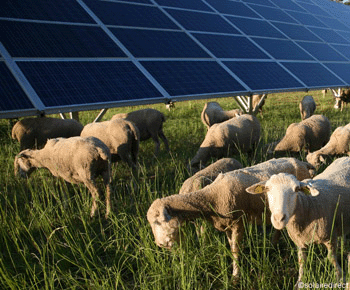
Farmers who graze sheep under solar panels say it improves productivity. So why don’t we do it more?
Guardian, by Aston Brown, 14 June 24
Allowing livestock to graze under renewable developments gives farmers a separate income stream, but solar developers have been slow to catch on.As a flock of about 2,000 sheep graze between rows of solar panels, grazier Tony Inder wonders what all the fuss is about. “I’m not going to suggest it’s everyone’s cup of tea,” he says. “But as far as sheep grazing goes, solar is really good.”
Inder is talking about concerns over the encroachment of prime agricultural land by ever-expanding solar and windfarms, a well-trodden talking point for the loudest opponents to Australia’s energy transition.
But on Inder’s New South Wales property, a solar farm has increased wool production. It is a symbiotic relationship that the director of the National Renewables in Agriculture Conference, Karin Stark, wants to see replicated across as many solar farms as possible as Australia’s energy grid transitions away from fossil fuels.
“It’s all about farm diversification,” Stark says. “At the moment a lot of us farmers are reliant on when it’s going to rain, having solar and wind provides this secondary income.”
In exchange, the panels provide shelter for the sheep, encourage healthier pasture growth under the shade of the panels and create “drip lines” from condensation rolling off the face of the panels.
“We had strips of green grass right through the drought,” Dubbo sheep grazier Tom Warren says. Warren has seen a 15% rise in wool production due to a solar farm installed on his property more than seven years ago.
Despite these success stories, a 2023 Agrivoltaic Resource Centre report authored by Stark found that solar grazing is under utilised in Australia because developers, despite saying they intend to host livestock, make few planning adjustments to ensure that happens……………………………………………………………………………….
According to an analysis by the Clean Energy Council, less than 0.027% of land used for agriculture production would be needed to power the east coast states with solar projects – far less than the one-third of all prime agricultural land that the rightwing thinktank the Institute of Public Affairs has claimed will be “taken over” by renewables. That argument, which has been heavily refuted by experts, has been taken up by the National party, whose leader, David Littleproud, said regional Australia had reached saturation point with renewable energy developments.
Queensland grazier and the chair of the Future Farmers Network, Caitlin McConnel, has sold electricity to the grid from a dozen custom-built solar arrays on her farm’s cattle pastures for more than a decade.
“Trial and error” and years of modifications have made them structurally sound around cattle and financially viable in the long-term, she says.
“As far as I know, we are the only farm to do solar with cattle,” McConnel says. “It’s good land, so why would we just lock it up just for solar panels?” https://www.theguardian.com/australia-news/article/2024/jun/13/farmers-who-graze-sheep-under-solar-panels-say-it-improves-productivity-so-why-dont-we-do-it-more
Experts unite to condemn Coalition nuclear policy meltdown.
Climate Media Centre
Energy and health experts as well as affected regional and global communities have condemned reports today of the Coalition’s energy policy which includes large nuclear reactors to be sited on mothballed coal-fired power stations across regional Australia, as well as a plan to rip up Australia’s commitments to the Paris Agreement.
The CSIRO’s recent GenCost report showed that renewable energy remains the fastest, safest and lowest-cost energy option is what we’re already building. Clean energy like solar and wind already makes up 40% of our national electricity grid, and one in three households have installed solar panels. Staying this course is the most responsible path toward slashing emissions this decade to avoid the worst impacts of climate change.
Andrew Bray, National Director, RE-Alliance – “The Federal Coalition’s energy policy is a false solution to Australia’s emission reduction commitments – the shift to a clean energy supply is already under way, with the latest data showing almost 40% of Australia’s electricity generation came from renewable energy sources in 2023.
“Policies relying on non-existent small modular reactor (SMR) nuclear technologies and large-scale nuclear plants that take decades to build would commit Australia to a polluting and unreliable fossil fuel powered system for the next 20 years. Our current trajectory will see these ageing plants close progressively over the next ten years.
“Renewable energy is here right now. Australians are increasingly using a cleaner and cheaper electricity supply, which we need to minimise the increasing impacts of climate change. Regional communities can greatly benefit from the rollout of renewable energy infrastructure – provided governments and industry are committed to sustained and significant investment in community engagement.
“We need to stick to the plan but shift our focus to ensure regional communities get the benefits they deserve from the roll-out.”
IEEFA Australia CEO, Amandine Denis Ryan, said: “The research by IEEFA’s nuclear experts calls into question whether nuclear makes financial sense for Australia, for a multitude of reasons – timing, cost, compatibility with renewables and liability issues to cite just a few.”
“Our research shows that nuclear reactors – both small modular reactors (SMRs) and gigawatt-scale reactors – in comparable countries have consistently taken longer and have been more expensive to build than expected. With over 50 years experience in this space, our analysts have researched nuclear projects around the world. For a country like Australia, starting from scratch, we expect that nuclear power reactors would not reach commercial operation before the 2040s, would come at a high cost, and require substantial government support.
“Nuclear plants in Australia cannot be built in time to replace Australia’s fleet of coal power stations, more than 90% of which are expected to retire in the next 10 years. Our research aligns with CSIRO and the regulators’ assessment that it would take at least 15 years to first production. The few existing SMRs in operation took over 12 years to build, despite original construction schedules of three to four years. Large reactors have a history of long delays, with most recent projects taking nine years or more from the first concrete pour, which in turn can only take place after years of planning, contracting and pre-construction works. This is in addition to the time required to develop the regulatory regime.
 Experts unite to condemn Coalition nuclear policy meltdownClimate Media CentreEnergy and health experts as well as affected regional and global communities have condemned reports today of the Coalition’s energy policy which includes large nuclear reactors to be sited on mothballed coal-fired power stations across regional Australia, as well as a plan to rip up Australia’s commitments to the Paris Agreement. Experts unite to condemn Coalition nuclear policy meltdownClimate Media CentreEnergy and health experts as well as affected regional and global communities have condemned reports today of the Coalition’s energy policy which includes large nuclear reactors to be sited on mothballed coal-fired power stations across regional Australia, as well as a plan to rip up Australia’s commitments to the Paris Agreement.The CSIRO’s recent GenCost report showed that renewable energy remains the fastest, safest and lowest-cost energy option is what we’re already building. Clean energy like solar and wind already makes up 40% of our national electricity grid, and one in three households have installed solar panels. Staying this course is the most responsible path toward slashing emissions this decade to avoid the worst impacts of climate change. To arrange interviews, please contact:Danielle Veldre +61 408972997 dan.veldre@climatemediacentre.org.auEmily Watkins +61 420622408 emily.watkins@climatemediacentre.org.au Andrew Bray, National Director, RE-AllianceAndrew has been working with regional communities hosting large scale renewable and transmission infrastructure for more than a decade. He can discuss the policy solutions that are needed to support regional communities to harness the benefits available in the shift to renewable energy.Location: Bungendore, NSW (near Canberra) “The Federal Coalition’s energy policy is a false solution to Australia’s emission reduction commitments – the shift to a clean energy supply is already under way, with the latest data showing almost 40% of Australia’s electricity generation came from renewable energy sources in 2023. “Policies relying on non-existent small modular reactor (SMR) nuclear technologies and large-scale nuclear plants that take decades to build would commit Australia to a polluting and unreliable fossil fuel powered system for the next 20 years. Our current trajectory will see these ageing plants close progressively over the next ten years. “Renewable energy is here right now. Australians are increasingly using a cleaner and cheaper electricity supply, which we need to minimise the increasing impacts of climate change. Regional communities can greatly benefit from the rollout of renewable energy infrastructure – provided governments and industry are committed to sustained and significant investment in community engagement. “We need to stick to the plan but shift our focus to ensure regional communities get the benefits they deserve from the roll-out.” IEEFA Australia CEO, Amandine Denis Ryan, said: “The research by IEEFA’s nuclear experts calls into question whether nuclear makes financial sense for Australia, for a multitude of reasons – timing, cost, compatibility with renewables and liability issues to cite just a few.” “Our research shows that nuclear reactors – both small modular reactors (SMRs) and gigawatt-scale reactors – in comparable countries have consistently taken longer and have been more expensive to build than expected. With over 50 years experience in this space, our analysts have researched nuclear projects around the world. For a country like Australia, starting from scratch, we expect that nuclear power reactors would not reach commercial operation before the 2040s, would come at a high cost, and require substantial government support. “Nuclear plants in Australia cannot be built in time to replace Australia’s fleet of coal power stations, more than 90% of which are expected to retire in the next 10 years. Our research aligns with CSIRO and the regulators’ assessment that it would take at least 15 years to first production. The few existing SMRs in operation took over 12 years to build, despite original construction schedules of three to four years. Large reactors have a history of long delays, with most recent projects taking nine years or more from the first concrete pour, which in turn can only take place after years of planning, contracting and pre-construction works. This is in addition to the time required to develop the regulatory regime. “Nuclear plants are notorious for cost overruns. Our analysts found that SMRs in operation or under construction cost three to seven times more than originally planned. Proposed SMRs in the US have also already seen cost estimates blow out by between two and four times in recent years. Large-scale reactors often face cost overruns as well. The Flamanville EPR in France is an extreme example of this, with costs having more than quadrupled despite France’s deep expertise on nuclear. |
“Nuclear plants are not a good complement for renewable generation. They can be flexible within a range, however the economics rely upon being operated in ‘baseload’ mode. In the 2040s, when the first nuclear plants could begin operating, the Australian Energy Market Operator expects that over 90% of generation will be supplied by variable renewables (wind and solar), and that the average annual utilisation factor of gas generation assets will be between 3% and 15% to complement them. Our analysts estimate that at a utilisation factor below 25%, the cost for electricity supplied by an American SMR would increase to more than AUD 600/MWh, if it was even possible to achieve such a low utilisation operationally.
| Experts unite to condemn Coalition nuclear policy meltdownClimate Media CentreEnergy and health experts as well as affected regional and global communities have condemned reports today of the Coalition’s energy policy which includes large nuclear reactors to be sited on mothballed coal-fired power stations across regional Australia, as well as a plan to rip up Australia’s commitments to the Paris Agreement. The CSIRO’s recent GenCost report showed that renewable energy remains the fastest, safest and lowest-cost energy option is what we’re already building. Clean energy like solar and wind already makes up 40% of our national electricity grid, and one in three households have installed solar panels. Staying this course is the most responsible path toward slashing emissions this decade to avoid the worst impacts of climate change. To arrange interviews, please contact:Danielle Veldre +61 408972997 dan.veldre@climatemediacentre.org.auEmily Watkins +61 420622408 emily.watkins@climatemediacentre.org.au Andrew Bray, National Director, RE-AllianceAndrew has been working with regional communities hosting large scale renewable and transmission infrastructure for more than a decade. He can discuss the policy solutions that are needed to support regional communities to harness the benefits available in the shift to renewable energy.Location: Bungendore, NSW (near Canberra) “The Federal Coalition’s energy policy is a false solution to Australia’s emission reduction commitments – the shift to a clean energy supply is already under way, with the latest data showing almost 40% of Australia’s electricity generation came from renewable energy sources in 2023. “Policies relying on non-existent small modular reactor (SMR) nuclear technologies and large-scale nuclear plants that take decades to build would commit Australia to a polluting and unreliable fossil fuel powered system for the next 20 years. Our current trajectory will see these ageing plants close progressively over the next ten years. “Renewable energy is here right now. Australians are increasingly using a cleaner and cheaper electricity supply, which we need to minimise the increasing impacts of climate change. Regional communities can greatly benefit from the rollout of renewable energy infrastructure – provided governments and industry are committed to sustained and significant investment in community engagement. “We need to stick to the plan but shift our focus to ensure regional communities get the benefits they deserve from the roll-out.” IEEFA Australia CEO, Amandine Denis Ryan, said: “The research by IEEFA’s nuclear experts calls into question whether nuclear makes financial sense for Australia, for a multitude of reasons – timing, cost, compatibility with renewables and liability issues to cite just a few.” “Our research shows that nuclear reactors – both small modular reactors (SMRs) and gigawatt-scale reactors – in comparable countries have consistently taken longer and have been more expensive to build than expected. With over 50 years experience in this space, our analysts have researched nuclear projects around the world. For a country like Australia, starting from scratch, we expect that nuclear power reactors would not reach commercial operation before the 2040s, would come at a high cost, and require substantial government support. “Nuclear plants in Australia cannot be built in time to replace Australia’s fleet of coal power stations, more than 90% of which are expected to retire in the next 10 years. Our research aligns with CSIRO and the regulators’ assessment that it would take at least 15 years to first production. The few existing SMRs in operation took over 12 years to build, despite original construction schedules of three to four years. Large reactors have a history of long delays, with most recent projects taking nine years or more from the first concrete pour, which in turn can only take place after years of planning, contracting and pre-construction works. This is in addition to the time required to develop the regulatory regime. “Nuclear plants are notorious for cost overruns. Our analysts found that SMRs in operation or under construction cost three to seven times more than originally planned. Proposed SMRs in the US have also already seen cost estimates blow out by between two and four times in recent years. Large-scale reactors often face cost overruns as well. The Flamanville EPR in France is an extreme example of this, with costs having more than quadrupled despite France’s deep expertise on nuclear. “Nuclear plants are not a good complement for renewable generation. They can be flexible within a range, however the economics rely upon being operated in ‘baseload’ mode. In the 2040s, when the first nuclear plants could begin operating, the Australian Energy Market Operator expects that over 90% of generation will be supplied by variable renewables (wind and solar), and that the average annual utilisation factor of gas generation assets will be between 3% and 15% to complement them. Our analysts estimate that at a utilisation factor below 25%, the cost for electricity supplied by an American SMR would increase to more than AUD 600/MWh, if it was even possible to achieve such a low utilisation operationally. “One of the major risks for investors in nuclear assets is the size and allocation of liability in case of an accident, with international conventions stating that operators of nuclear installations are liable should an incident occur. Such liabilities are very challenging for a company to carry by itself. In the United States, this issue was addressed with the Price–Anderson Nuclear Industries Indemnity Act (1957) by creating a shared insurance pool, now totalling AUD 22.5 billion across the almost 100 reactors covered. The US Government is exposed to costs beyond the insurance pool. Full costs associated with the 2011 Fukushima disaster could be as high as AUD 770 billion. It is unclear how Australia would be able to manage these liabilities without very material government underwriting of risk.” |
Mia Pepper, Campaign Director at the Conservation Council of WA said: “The Coalition’s nuclear power plans reported today are a clear plan to distract and delay from real action on climate change.
“Nuclear power is expensive, slow and dangerous and simply cannot deliver the energy needed in the time frame we have to decarbonise.
“WA is currently exiting coal and well advanced on the transition to cheaper, safer, cleaner alternatives like renewables. It makes no economic, environmental or energy sense to change direction now.
“The WA Liberals have already ruled out nuclear power for WA, saying it is too expensive and doesn’t make sense for WAs grid. Peter Dutton’s irresponsible reactor plan has failed to convince his own party – and it certainly hasn’t and won’t convince the wider WA community. The Liberal party energy policy is nothing more than a dangerous distraction and delay from the much needed transition out of fossil fuels.”
“Nuclear is thirsty, requiring huge volumes of water for cooling, in an uncertain climate future nuclear also becomes one of the most dangerous and unreliable forms of energy we have seen these issues emerge in nuclear powered countries like France.
There remain significant and unresolved issues with the management of High-Level nuclear waste, insurmountable issues with security, and deep connections to the production of weapons grade materials. The risks of things going wrong are catastrophic.”
Masayoshi Iyoda – 350.org Japan Campaigner, said: “You cannot call nuclear clean energy, and completely ignore the voices of the victims of nuclear disasters and the burden on future generations. Nuclear is simply too costly, too risky, too undemocratic, and too time-consuming. We already have cheaper, safer, democratic, and faster solutions to the climate crisis, and they are renewable energy and energy efficiency.”
Joseph Sikulu – 350.org Pacific Managing Director said: “The legacy of nuclear power in the Asia Pacific region is a harmful one, as is the legacy of climate-destroying fossil fuels. The possibility of Australia venturing into nuclear is dangerous and concerning, and a distraction from what we should really be focused on – the just transition to renewable energy.”
Do young people support nuclear power?

Jim Green 31 May 24
Earlier this year the Murdoch-Coalition echo-chamber was excited about younger poll respondents in a February Newspoll survey ‒ 65 percent support and 32 percent opposition among 18 to 34-year-olds to this survey question: ‘There is a proposal to build several small modular nuclear reactors around Australia to produce zero-emissions energy on the sites of existing coal-fired power stations once they are retired. Do you approve or disapprove of this proposal?’
However the Newspoll survey was a crude example of push-polling as discussed by polling experts Kevin Bonham and Murray Goot and by economist Professor John Quiggin. The question was loaded, the response options were mischievous (excluding a “neither approve nor disapprove” option, without which majority support (across all age groups) almost certainly would not have been achieved), and the Murdoch/Sky reporting on the poll was biased and dishonest.
Moreover, as Murray Goot notes, other polls reach different conclusions:
“But eighteen- to thirty-four-year-olds as the age group most favourably disposed to nuclear power is not what Essential shows, not what Savanta shows, and not what RedBridge shows.
“In October’s Essential poll, no more than 46 per cent of respondents aged eighteen to thirty-four supported “nuclear power plants” — the same proportion as those aged thirty-six to fifty-four but a smaller proportion than those aged fifty-five-plus (56 per cent); the proportion of “strong” supporters was actually lower among those aged eighteen to thirty-four than in either of the other age-groups.
“In the Savanta survey, those aged eighteen to thirty-four were the least likely to favour nuclear energy; only about 36 per cent were in favour, strongly or otherwise, not much more than half the number that Newspoll reported.
“And according to a report of the polling conducted in February by RedBridge, sourced to Tony Barry, a partner and former deputy state director of the Victorian Liberal Party, “[w]here there is support” for nuclear power “it is among only those who already vote Liberal or who are older than 65”.”
“Truly the stuff of nightmares”: unprecedented low in Antarctic sea ice recorded

By Jeremy Smith, May 31, 2024, https://johnmenadue.com/truly-the-stuff-of-nightmares-unprecedented-low-in-antarctic-sea-ice-recorded/?fbclid=IwZXh0bgNhZW0CMTEAAR0LBw8Xpve2S05Os1FH_y7RYvvv8tqj0qhXrhsM-Z3e49hH1Uu2E44lQr4_aem_AbLMAUeHwooBl6H86wLEqHTtPllDKldX5fzB5e2_5LYTTkXQuf4y_brUHNORL5PsxpdKGuD227S1VVLTWCOjJj7N
Each winter the surface of the sea freezes around Antarctica, over a vast area, mostly to a depth of about one metre. But this is starting to change. Last year, the sea ice reached an unprecedentedly low maximum extent of only 17 million square kilometres.
Why aren’t we talking about sea ice? Perhaps it’s because most people haven’t even heard of it, which is a shame because it’s important.
Each winter the surface of the sea freezes around Antarctica, over a vast area, mostly to a depth of about one metre. The continent effectively doubles in size, with 18-20 million square kilometres being covered by floating ice. That’s an area 2.5 times that of Australia; 4% of Earth’s surface.
But this is starting to change. Last year, the sea ice reached an unprecedentedly low maximum extent of only 17 million square kilometres. Although this year looks like being a little less extreme, a clear and concerning trend appears to be under way. This is emphasised in the ice minimum values in late summer. By February each year the sea ice extent shrinks typically to about three million square kilometres (mostly in two large embayments, the Weddell Sea and the Ross Sea), but through most of the present decade it has dwindled to below two million.
Why does this matter? Well for a start, it is the underside of this huge area of sea ice where algae live and multiply, which feed the shrimp-like krill that in turn sustains an entire ecosystem: fish, seals, penguins, whales, the lot. The upper surface of sea ice is also crucially important. Its albedo, or reflectivity, means that 80-90% of the incoming summer sunshine is bounced back into space. Replace the ice with dark ocean and only about 9% is reflected, the rest going to warm the water. So the loss of sea ice is not only a symptom of climate change, it also contributes to it, in a feedback loop that might accelerate.
There’s more. When sea water freezes, the developing ice crystals comprise nearly pure water. Most of the salt is extruded as a heavy brine, and this cold, dense water sinks, becoming the Antarctic Bottom Current. This circulates around the Southern Ocean before spinning off into the other major ocean basins. As this deep cold flow moves north it displaces warmer water which then up-wells and forms the main surface currents. Without the annual ‘push’ of the Antarctic Bottom Current, these warmer currents might slow and cease.
The global ocean is so vast that it changes very slowly. We are only now beginning to see the results of the ocean’s absorbance of a century of industrial environmental heating, in the form of anomalously warm seas particularly this year. Any pronounced weakening of the ocean circulation due to sea ice loss will be slow – but inexorable.
The results, which are probably not going to happen in our own lifetimes but could well become part of our legacy to future generations, are likely to be dire. It could eventually mean goodbye to the Gulf Stream and the other currents which maintain benign climates on the European Atlantic coast, around Japan, and elsewhere in the northern hemisphere.
The possible consequences of such climate change for human societies are truly the stuff of nightmares.
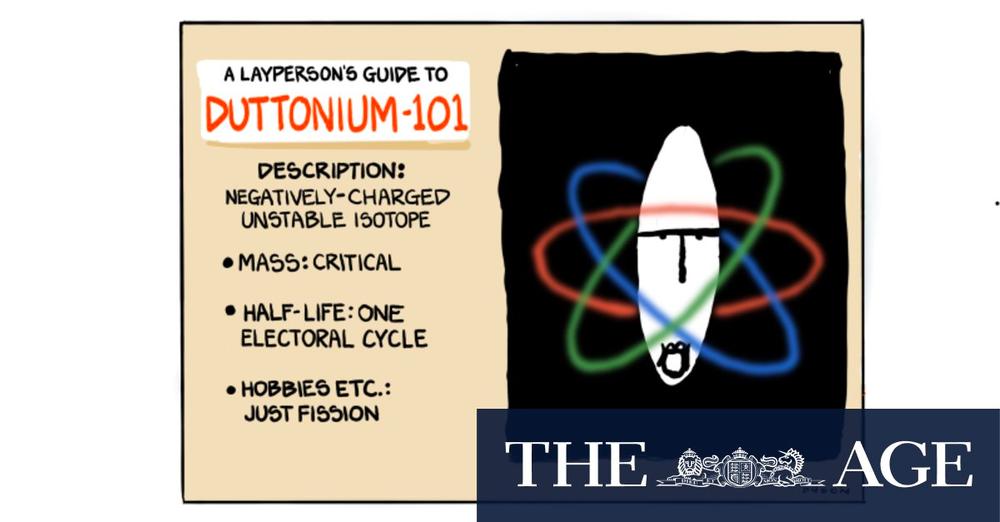
Among opposition leaders, Peter Dutton is a miracle survival story. But is he about to nuke himself with women voters?
ABC, By Annabel Crabb 29 May 24
Peter Dutton is a freak of nature. Politically, that is…………………………………
Two years in, Dutton is not only still in office, but nobody inside his own party — or even in the National Party — is trying to blow him out of it. It is a truly extraordinary achievement.
His public popularity remains firmly in negative territory, according to Newspoll. So why isn’t this translating into the customary seasonal orgy of backstabbing?
Two reasons.
The first is that there really isn’t, ahem, any alternative……………………………………………………………………………….
Dutton much a much more dangerous opponent for Anthony Albanese than is commonly assumed.
But there is one risk associated with this unseasonably warm bath of internal approbation……………………..his decision to pursue nuclear energy as a principal policy decision is a high-risk call, as a new piece of research — supplied to the ABC — makes clear……………………
When it comes to nuclear, public opinion divides along gender lines
Over recent weeks, the RedBridge Group conducted a survey of around 2,000 Australian voters, seeking their views on various issues including nuclear energy. Respondents were asked whether they would support or oppose an Australian government lifting the ban on nuclear power so private investors could build nuclear power plants here.
The responses, across all voters, were kind of evenly divided. Strong supporters constituted 17 per cent, another 17 said they were supportive, 19 per cent were “neither”, 15 per cent were opposed, 20 per cent strongly opposed, and 12 per cent were unsure. This shakes out to an extremely slender net negative of-1
But the truly fascinating detail in the survey comes when you dig down into who especially loves the idea of nuclear, and who hates it.
And the biggest difference of opinion on nuclear, it turns out, breaks along gender lines……………….
Women disapproved of nuclear power strongly – just 7 per cent strongly agreed a ban should be lifted, compared with 24 per cent of male respondents. That’s a net negative of -29 for women, and net positive of 26 for men.
The only demographics showing real enthusiasm for nuclear power were Coalition voters, those aged over 65, those who earn more than $3,000 a week, and those who own their own home. In each of these instances, every other group was majority opposed.
In other words, every other party’s voters apart from the Coalition’s registered a net negative, as well as every other age bracket apart from the most elderly, and all other income brackets apart from the top one.
Renters and mortgage holders alike disapproved on the whole. Among those who described themselves as under “a great deal of financial stress”, the feeling on nuclear ran at negative 15. Among those under “no stress at all”, however, the reception was much warmer – positive 19…………………………………………………………………………….
And in the two years that have elapsed since female voters demonstrated their annoyance at being ignored and talked down to, the Liberal Party has failed to do anything about its structural under-representation of women in parliament, …………………………………………………………..
There always seems to be an abundance of reasons to get rid of women; almost as many reasons as traditionally abound for holding on to and even promoting male duds. Women do notice this stuff.
And “Never mind ladies, have a nuclear power plant” may not be a very compelling change of subject. https://www.abc.net.au/news/2024-05-29/peter-dutton-nuclear-power-policy-may-risk-alienating-women/103870338
Coalition’s brave nuke world a much harder sell after new CSIRO report
Graham Readfearn, https://www.theguardian.com/australia-news/article/2024/may/26/coalitions-brave-nuke-world-a-much-harder-sell-after-new-csiro-report?CMP=soc_568
The agency’s GenCost analysis says a first nuclear plant for Australia would deliver power ‘no sooner than 2040’ and could cost more than $17bn
The Coalition’s pitch on nuclear energy for Australia has had two recurring themes: the electricity will be cheap and it could be deployed within a decade.
CSIRO’s latest GenCost report – a document that analyses the costs of a range of electricity generation technologies – contradicts both of these points. It makes the Coalition’s job of selling nuclear power plants to Australians ever more challenging.
For the first time, the national science agency has calculated the potential costs of large-scale nuclear electricity in a country that banned the generation technology more than a quarter of a century ago.
Even using a set of generous assumptions, the CSIRO says a first nuclear plant would deliver power “no sooner than 2040” and could cost more than $17bn.
It is likely to spark an attack on the credibility of the report from nuclear advocates and those opposed to the rollout of renewable energy. Opposition leader, Peter Dutton, has already attacked the report.
In the meantime, Australia waits for the Coalition to say what kind of reactors it would deploy, where it would put them and how much it thinks they would cost.
Now that CSIRO has released its report, here’s what we know about the viability of a nuclear industry in Australia.
What’s new on nuclear costs?
CSIRO’s GenCost report says a 1,000 megawatt nuclear plant would cost about $8.6bn to build, but that comes with some large caveats. The main one is that this was the theoretical cost of a reactor in an Australia that already had an established and continuous program of building reactors.
The $8.6bn is based on costs in South Korea, which does have a continuous reactor building program and is one country the least beset by cost blowouts.
To make the cost more relevant, CSIRO compared the Australian and South Korean costs of building modern coal plants. Costs were more than double in Australia.
But CSIRO warns the first nuclear plants in Australia would be subject to a “first of a kind” premium that could easily double the $8.6bn build cost.
In the UK, a country that has been building reactors intermittently, costs for its under-construction Hinkley C reactor (more than three times the size of a theoretical 1,000MW reactor in Australia) started at $34bn and could now be as high as $89bn.
In the United States, the country’s largest nuclear plant has just turned on its final unit seven years behind schedule and at double the initial cost. There are no more nuclear plants under construction in the country.
What about the cost of the electricity?
CSIRO also offers cost estimates for the electricity produced by large-scale reactors, but those too assume a continuous nuclear building program in Australia.
Electricity from large-scale reactors would cost between $141 per megawatt hour and $233/MWh if they were running in 2030, according to GenCost.
Combining solar and wind would provide power at between $73 and $128/MWh – figures that include the costs of integrating renewables, such as building transmission lines and energy storage.
What about those small modular reactors?
The Coalition has also advocated for so-called “small modular reactors” which are not commercially available and, CSIRO says, are unlikely to be available to build in Australia until 2040.
One United States SMR project lauded by the Coalition collapsed in late 2023 because the cost of the power was too high.
That project, CSIRO says, was significant because its design had nuclear commission approval and was “the only recent estimate from a real project that was preparing to raise finance for the construction stage. As such, its costs are considered more reliable than theoretical projects.”
GenCost reports that power from a theoretical SMR in 2030 would cost between $230 and $382/MWh – much higher than solar and wind or large-scale nuclear.
How quickly could Australia build a nuclear plant?
Nuclear advocates tend to point to low nuclear power costs in countries that have long-established nuclear industries.
Australia has no expertise in building nuclear power, no infrastructure, no regulatory agency, no nuclear workforce and a public that is yet to have a serious proposition put in front of it.
Australia’s electricity grid is fast evolving from one dominated by large coal-fired power plants to one engineered for and dominated by solar, wind, batteries and pumped hydro with gas-fired power working as a rarely used backup.
This creates a major problem for the Coalition, because CSIRO estimates “if a decision to pursue nuclear in Australia were made in 2025, with political support for the required legislative changes, then the first full operation would be no sooner than 2040.”
Tony Wood, head of the Grattan Institute’s energy program, says: “By 2040, the coal-fired power stations will be in their graves. What do you do in the meantime?”
“You could keep the coal running, but that would become very expensive,” he says, pointing to the ageing coal fleet that is increasingly beset by outages.
Wood says the GenCost report is only a part of the story when it comes to understanding nuclear.
The Coalition, he says, would need to explain how much it would cost to build an electricity system to accommodate nuclear.
Could you just drop nuclear into the grid?
The biggest piece of generation kit on Australia’s electricity grid is a single 750 megawatt coal-fired unit at Kogan Creek in Queensland. Other power stations are larger but they are made up of a series of smaller units.
But the smallest of the “large-scale” nuclear reactors are about 1,000MW and most are 1,400MW.
Electricity system engineers have to build-in contingency plans if large units either trip or have to be pulled offline for maintenance. That contingency costs money.
In Australia’s current electricity system, the GenCost report says larger nuclear plants would probably “require the deployment of more generation units in reserve than the existing system consisting of units of 750MW or less.”
But by the time a theoretical nuclear plant could be deployed, most if not all the larger coal-fired units will be gone.
Who might build Australian nukes?
Some energy experts have questioned whether any company would be willing to take up a contract to build a reactor in Australia when there are existing nuclear nations looking to expand their fleets.
Right now, nuclear reactors are banned federally and in several states.
The GenCost report also points to another potential cost-raiser for nuclear – a lack of political bipartisanship.
The report says: “Without bipartisan support, given the historical context of nuclear power in Australia, investors may have to consider the risk that development expenses become stranded by future governments.”
Renewables and storage still cheapest option, nuclear too slow and costly in Australia – CSIRO

Giles Parkinson, May 22, 2024, https://reneweconomy.com.au/renewables-and-storage-still-cheapest-option-nuclear-too-slow-and-costly-in-australia-csiro/
Australia’s main scientific body, the CSIRO, has reaffirmed its assessment that integrated renewable energy is by far the cheapest option for Australia, and that nuclear – be it large scale or small modular reactors – is too slow and too costly.
The CSIRO’s findings have been consistent since the first of its now annual GenCost reports was released under the then Coalition government in 2018. In fact the gap between renewables and nuclear has widened, despite the addition of integration and transmission costs to wind and solar, even with up to a 90 per cent renewable share.
Its draft report released late last year re-affirmed that nuclear – the chosen technology of new Coalition leader Peter Dutton and his energy spokesman Ted O’Brien, remained by far the costliest energy choice for Australia.
Dutton is digging in on nuclear, and amid furious attacks from right wing media and so-called think tanks, the Coalition has tried to discredit the CSIRO GenCost report, which is produced in conjunction with energy experts at the Australian Energy Market Operator.
The nuclear boosters were particularly frustrated by the CSIRO’s costings on SMR (small modular reactors), which was based on the NuScale project in the US, the only SMR in the western world to get close to construction, but which was abandoned because of soaring costs that caused its customers to withdraw their support.
The nuclear boosters, and the federal Coalition, want the CSIRO and AEMO to accept the cost forecasts from salesmen for SMR technologies that remain largely on the drawing board and which – unlike the failed NuScale project – have no real world verification.
The CSIRO has now released its final GenCost report, prepared in conjunction with AEMO, and which it describes as the most comprehensive assessment of generation costs ever produced in this country.
The CSIRO has bent over backwards to respond to the criticism from the nuclear lobby, and added an estimated cost in Australia for large scale nuclear. It says is not as pricy as SMR technology, but is still at least double the cost of integrated renewables, and wouldn’t be possible before 2040 even if a commitment was made now.
That’s important, because Australia is the midst of a renewable energy transition that aims for an 82 per cent renewable energy share by 2030. Climate science dictates that speed of emissions cuts is now critically important, and by 2040 the country should be at or close to 100 per cent renewables.
The addition of large scale nuclear was one of a number of changes to the GenCost report from its 2023 edition, including a return to calculations for solar thermal, a technology hoping for its own renaissance, the inclusion of spilled energy from wind and solar, and – in response to more feedback – including integration costs incurred before 2030.
It doesn’t change the picture that much. Wind and solar are still by far the cheapest, in 2023 and in 2030, even though an expected cost reduction for wind energy – whose prices spiked after the Covid pandemic and energy crisis – is now not expected to take much longer until the mid 2030s.
Solar costs, however, are still falling, and it’s important to note that renewable integration costs for 80 per cent renewables in 2030 are less than $100/MWh. Even assuming the money is spent now, before expected cost reductions, the cost for an 80 per cent wind and solar grid in 2023 is put at $120/MWh.
Compare that to the estimated costs for nuclear, which in terms of the political and public debate, are the most revealing, and just a little inconvenient for the Coalition, whose attacks on the CSIRO and AEMO ignore the fact that the same conclusions were reached under its own governance.
The final GenCost report highlights how the favoured technologies of the conservatives – be they nuclear, gas, gas with CCS and coal with CCS – are so much higher than solar and wind with firming. SMRs are four to six times the cost of integrated renewables, and the first projects are likely to be significantly higher.
Large scale nuclear is twice as expensive, again without considering the first of its kind costs which would be necessary in Australia, and without considering the considerable costs of added reserve capacity needed because the plants are so big.
It also does not take into account how nuclear, with its “always on” business model could fit into a future grid already dominated by renewables and needing flexible capacity to support it, not redundant baseload.
Even with the full integrated costs itemised for both the 2023 and the 2030 assessments, the difference is clear.
CSIRO says that its draft GenCost received more submissions than any previous edition, with most of the 45 submissions coming from individuals who support nuclear.
This is not surprising given that no one in the Australian energy industry is the slightest bit interested in the technology, because of its costs and the timelines. As US energy expert Amory Lovins wrote for Renew Economy this week, nuclear “has no place in Australia’s energy future. No one who understands energy markets would claim otherwise.”
Indeed, two of the most prominent public faces of the pro-nuclear campaign in Australia have been a school student and an emergency doctor from Ontario, who have both received remarkable amounts of publicity in mainstream media despite their lack of industry knowledge.
The CSIRO points out that the large scale nuclear costs are at best estimates, because there is no nuclear industry in Australia, and no regulatory framework. First of its kind developments are likely to be exorbitant, but even basing its estimates on the South Korea experience puts the costs of large scale nuclear at a multiple of renewables.
The nuclear lobby has been insistent that wind and solar costs need to factor in the integration costs of the technologies in the grid, including storage and transmission, so no doubt they will insist that the CSIRO now does the same with large scale nuclear.
It is not likely to be cheap. As CSIRO notes, large scale nuclear units normally ranges in size from 1 GW to 1.4 GW or more, far bigger than the biggest coal unit in Australia, which is 750 MW. That will require added reserve capacity of equivalent size in case of an unexpected outage or unplanned maintenance.
In the UK, the regulator estimated that the additional reserve capacity of the Hinkley C nuclear plant would be in the order of $12 billion, on top of the now blown out costs of up to $92 billion for that reactor.
The project that had promised to be “cooking turkeys” by 2017, looks to be a cooked turkey itself by the time it gets switched on in 2031.
Federal energy minister Chris Bowen said the GenCost report validated the Labor government’s focus on renewables, and underlined the risky nature of the Coalition’s “half-baked” goal of keeping ageing coal fired power plants operating until nuclear can be delivered in the 2040s.
“Were small modular nuclear reactors able to be up and running in Australia by 2030, which they aren’t, the ‘first of a kind’ scenario is a cost of between $294/MWh and $764/MWh,” Bowen said. “Meaning small modular nuclear reactors would be up to more than nine times more expensive than firmed large-scale wind and solar.
“We know that Australia has the best solar resources in the world, and today’s report shows large-scale solar alone is 8 per cent cheaper to build than a year ago,” he said.
“We know Australia doesn’t have that time (to wait for nuclear) – 24 coal plants announced their closure dates under the previous government, and 90% of Australia’s coal-fired power is forecast to close by 2035.”
Giles Parkinson is founder and editor of Renew Economy, and is also the founder of One Step Off The Grid and founder/editor of the EV-focused The Driven. He is the co-host of the weekly Energy Insiders Podcast. Giles has been a journalist for more than 40 years and is a former business and deputy editor of the Australian Financial Review. You can find him on LinkedIn and on Twitter.
Isle of Wight-size iceberg breaks from Antarctica

BBC News, Jonathan Amos, Science correspondent, 20 May 24
Another big iceberg has broken away from an area of the Antarctic that hosts the UK’s Halley research station.
It is the third such block to calve near the base in the past three years.
This new one is not quite as large, but still measures some 380 sq km (145 sq miles) – roughly the size of the Isle of Wight.
The British Antarctic Survey (BAS) took the precaution of moving Halley in 2017 because of concerns over the way the local ice was behaving.
Its buildings were shifted on skis to take them away from immediate trouble.
The station is also now routinely vacated during the long dark months of the southern winter. The last personnel were flown out in February.
Halley sits on top of the Brunt Ice Shelf, which is the floating protrusion of glaciers that have flowed off the continent into the Weddell Sea.
This shelf will periodically shed icebergs at its forward edge and it is currently going through an extremely dynamic phase.
In 2021, the shelf produced a berg the size of Greater Paris (1,300 sq km/810 sq miles) called A74, followed in 2023 by an even bigger block (1,500 sq km/930 sq miles) the size of Greater London, known as A81.
The origin of the new berg goes back to a major crack that was discovered in the shelf on 31 October, 2016. Predictably, it was nicknamed the “Halloween Crack”.
A further fracture perpendicular to Halloween has now cut a free-floating segment of ice that has already begun to drift out into the Weddell Sea………………..
Satellite imagery confirms the GPS data. The berg is surrounded by seawater on all sides.
The loss of so much ice from the Brunt structure these past three years has triggered a rapid acceleration in the shelf’s seaward movement.
Historically, it has flowed forward at a rate of 400-800m (1,300-2,600ft) per year. It is now moving at about 1,300m (4,300ft) a year………………………….
“This latest calving reduces the Brunt Ice Shelf to its smallest observed size,” commented remote sensing specialist Prof Adrian Luckman, from Swansea University…………………………………………… more https://www.bbc.com/news/articles/c033wr32ewno
Nuclear more than 6 times the cost of renewables – report

20 May 2024, https://www.aumanufacturing.com.au/nuclear-more-than-6-times-the-cost-of-renewables-report
An independent report by consulting and engineering firm Egis and commissioned by the Clean Energy Council has confirmed that nuclear is the most expensive form of new energy in Australia.
The review analysed the CSIRO and Australian Energy Market Operator (AEMO)’s GenCost report against the Lazard Review and the Mineral Council of Australia (MCA)’s research into Small Modular Nuclear Reactors.
The report found that nuclear energy is up to six times more expensive than renewable energy and even on the most favourable reading for nuclear, and that renewables remained the cheapest form of new-build electricity.
Nuclear may be even higher cost than forecast as waste management and decommissioning of nuclear plants had been omitted in cost calculations.
The report also found:
- The safe operation of nuclear power requires strong nuclear safety regulations and enforcement agencies, none of which exist in Australia
- And the economic viability of nuclear energy will further diminish as more wind, solar and battery storage enters the grid.
“Put simply, nuclear plants are too heavy and too slow to compete with renewables and can’t survive on their own in Australian energy markets.”
Clean Energy Council Chief Executive Kane Thornton, said households would need to pay a hefty price to subsidise nuclear reactors.
Thornton said: “Taxpayers also need to understand the costs that will be borne if they are forced to foot the bill for building a nuclear industry from scratch over a period of decades.
“Nuclear power is also a poor fit with our increasingly renewable power system.
“Nuclear power stations are expensive and have to run constantly in order to break even – but that doesn’t work in a world with an abundance of cheap renewables.”
The Egis report also found the MCA’s research on Small Modular Reactors (SMRs) did not anticipate the current long delay in SMR projects around the world.
Is There Life Beyond Nuclear Armageddon?

Bruce Dorminey, Senior Contributor, Forbes, 30 Apr 24
Earth is a very rare jewel of a planet. A completely serendipitous chance encounter with a Mars-sized impactor some 4.5 billion years ago created our anomalously large moon which to this day gives our planet its stable axial tilt. All of which enabled our planet to evolve its current life-rich biosphere.
Yet only in the last 300,000 years or so have we been around long enough to watch Earth’s civilizations come and go. And only within the last hundred years have we created weapons of mass destruction so powerful that if used in anger, they could wipe out billions of years of biological evolution.
Given recent geopolitics, however, in fifty years’ time I wouldn’t bet on there being anybody here to ponder such philosophical musings.
Thus, could life survive a full-scale nuclear war?
A nuclear Armageddon might be broadly similar to the K/Pg impact (the “dinosaur killer”) some 66 million years ago, Ariel Anbar, a geochemist and President’s Professor at Arizona State University in Tempe, told me via email. But in terms of the energy released the impact was thousands of times larger than even an all-out nuclear war would release, he says. Nuclear war also brings with it radiation that can drive mutations, which is a special kind of “nasty” but both scenarios are more than enough to bring down human civilization, says Anbar.
Most if not all of humanity would simply disappear.
My suspicion is that something like 99.9% of all humans would die, and our civilization would never rebound, Bruce Lieberman, a paleontologist and evolutionary biologist at the University of Kansas in Lawrence, told me via email. Either we wouldn’t survive, or it would be so bad for those few that lived that they would be better off if they didn’t survive, says Lieberman.
But Would Our Biosphere Survive?
Earth’s biosphere would survive even though it would take a big hit, says Anbar. Leaving aside the consequences of radioactive fallout, a nuclear war would be less severe than the K/Pg impact some 66 million years ago, he says. The consequences of nuclear fallout from a global exchange are hard to gauge since there’s a lot we do not know, says Anbar. But plenty of animals would likely survive so evolution is not likely to be “reset” back to microbes, he says.
How would nuclear Armageddon compare to natural planet killers that have befallen planet Earth, such as giant asteroids, comets as well as nearby gamma ray bursts or supernova explosions?
Life eventually rebounded after each of these mass extinctions, though it took at least 10-20 million years for diversity to reach former levels and for ecosystems to return to their pre-extinction levels of complexity, says Lieberman.
Even so, Lieberman says a global nuclear holocaust would cause a tremendous initial loss in biodiversity, perhaps on the order of 70% to 95% of all animal and plant species on land and 25% to 50% in the oceans.
The lesson here is that our planet’s fate can turn on a dime…………………………………………………………………………. more https://www.forbes.com/sites/brucedorminey/2024/04/30/is-there-life-beyond-nuclear-armageddon/?sh=30cdf0a04eb0
Copernicus online portal offers terrifying view of climate emergency

Looking at the mass of information, there is only one conclusion: we are running out of time
Paul Brown, 29 Mar 24, https://www.theguardian.com/news/2024/mar/29/copernicus-online-portal-offers-terrifying-view-climate-emergency
here is so much information on the newly launched Copernicus Climate Change Service atlas that my laptop started to overheat trying to process it all. As well as all the past data, it predicts where the climate is going and how soon we will breach the 1.5C “limit”, and then 2C. You can call up the region where you live, so it is specific to what is happening to you and your family – and all the more disturbing for that.
A separate part called Climate Pulse intended particularly for journalists is easier to operate. The refreshing bit is that the maps, charts and timelines from 1850 to the present day on the main atlas are entirely factual measurements, so there can be no argument on the trends. It then follows those trends into the likely scenarios for the next few years. Examining current temperature increases, it seemed to this observer that scientists have been underestimating for some time how quickly the situation is deteriorating.
Looking at the mass of information all pointing one way makes the current political arguments about how soon the UK should reach net zero seem trivial. We are clearly running out of time. Still, the idea is that people can use the atlas to make up their own minds.
1 This month

of the week – Australians for War Powers Reform (AWPR)
To see nuclear-related stories in greater depth and intensity
 Antinuclear