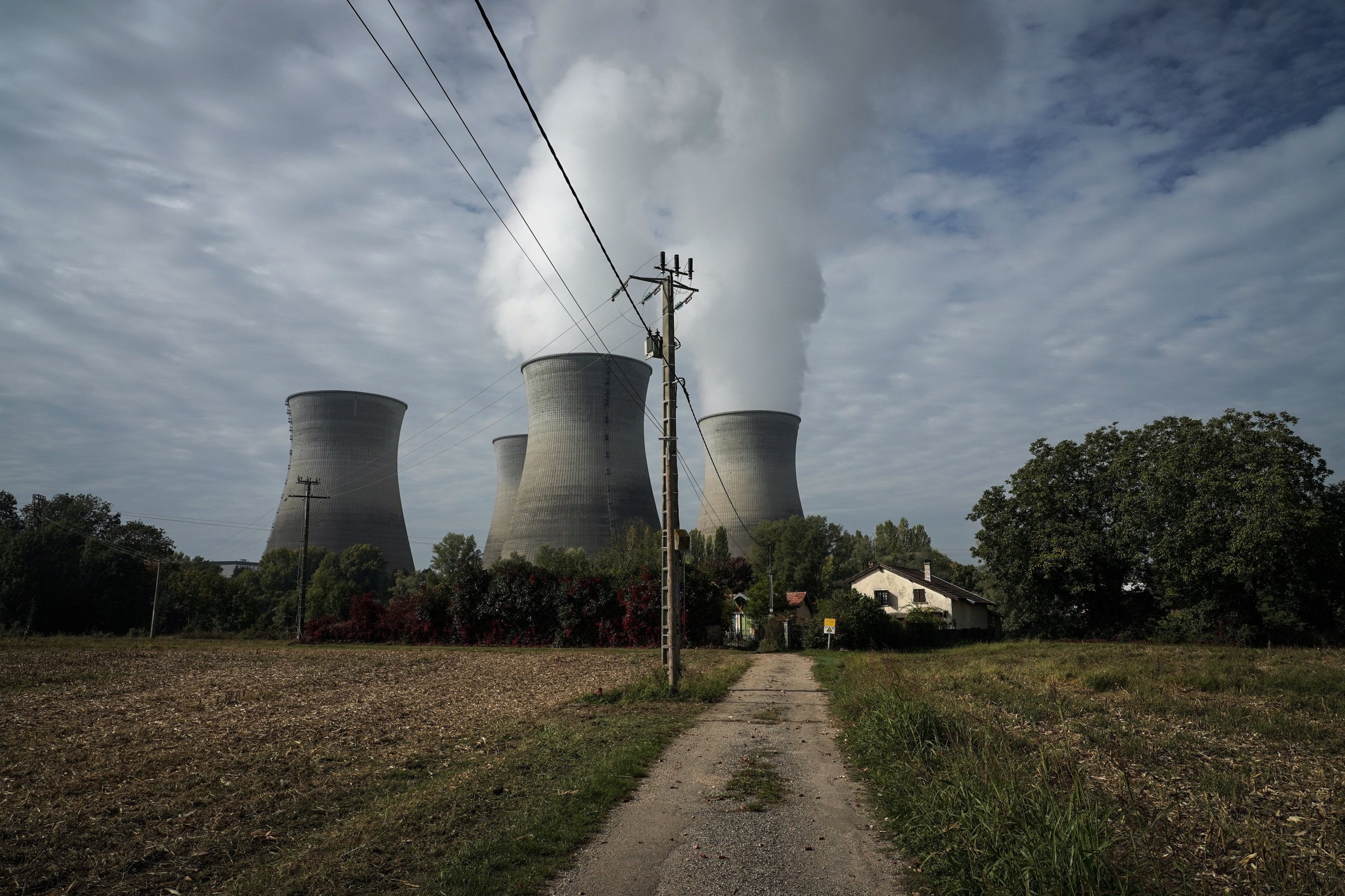
Big costs sink flagship nuclear project and they’ll sink future small modular reactor projects too

By Susan O’Donnell and M.V. Ramana, 024, https://beyondnuclearinternational.org/2024/01/21/big-costs-sink-flagship-nuclear-project/
The major news in the world of nuclear energy last November was the collapse of the Carbon Free Power Project in the United States. The project was to build six NuScale small modular nuclear reactors (SMRs). Given NuScale’s status as the flagship SMR design not just in the U.S. but even globally, the project’s cancellation should ring alarm bells in Canada. Yet SMRs are touted as a climate action strategy although it is becoming clearer by the day that they will delay a possible transition to net-zero energy and render it more expensive.
The NuScale project failed because there were not enough customers for its expensive electricity. Construction cost estimates for the project had been steadily rising—from USD 4.2 billion for 600 megawatts in 2018 to a staggering USD 9.3 billion (CAD 12.8 billion) for 462 megawatts. Using a combination of government subsidies, potentially up to USD 4.2 billion, and an opaque calculation method, NuScale claimed that it would produce electricity at USD 89 per megawatt-hour. When standard U.S. government subsidies are included, electricity from wind and solar energy projects, including battery storage, could be as cheap as USD 12 to USD 31 per megawatt-hour.
A precursor to the failed NuScale project was mPower, which also received massive funding from the U.S. Department of Energy. Described by The New York Times as the leader in the SMR race, mPower could not find investors or customers. By 2017, the project was essentially dead. Likewise, a small reactor in South Korea proved to be “not practical or economic”.
Ignoring this dire economic reality, provincial governments planning for SMRs – Ontario, New Brunswick, Saskatchewan and Alberta – published a “strategic plan” seemingly designed to convince the federal government to open its funding floodgates. Offering no evidence about the costs of these technologies, the report asserts: “The power companies assessed that SMRs have the potential to be an economically competitive source of energy.”
For its part, the federal government has coughed up grants totalling more than $175 million to five different SMR projects in Ontario, New Brunswick, and Saskatchewan. The Canada Infrastructure Bank loaned $970 million to Ontario Power Generation to develop its Darlington New Nuclear project. And the Canada Energy Regulator’s 2023 Canada’s Energy Future report envisioned a big expansion of nuclear energy based on wishful thinking and unrealistic assumptions about SMRs.
Canada’s support is puzzling when considering other official statements about nuclear energy. In 2021, Environment Minister Steven Guilbeault said that nuclear power must compete with renewable energy in the market. The previous year, then Environment Minister and current Energy and Natural Resources Minister Jonathan Wilkinson also emphasized competition with other sources of energy, concluding “the winner will be the one that can provide electrical energy at the lowest cost.” Given the evidence about high costs, nuclear power cannot compete with renewable energy, let alone provide electricity at the lowest cost.
Investing huge amounts of taxpayer money in technologies that are uncompetitive is bad enough, but an equally serious problem is wasting time. The primary justification for this government largesse is dealing with climate change. But the urgency of that crisis requires action now, not in two decades.
All the SMR designs planned in Canada’s provinces are still on the drawing board. The design furthest along in the regulatory process – the BWRX-300 slated for Ontario’s Darlington site – does not yet have a licence to begin construction. New Brunswick’s choices – a sodium cooled fast reactor and a molten salt reactor – are demonstrably problematic and will take longer to build.
Recently built nuclear plants have taken, on average, 9.8 years from start of construction to producing electricity. The requisite planning, regulatory evaluations of new designs, raising the necessary finances, and finding customers who want to pay higher electricity bills might add another decade.
SMR vendors have to raise not only the billions needed to build the reactor but also the funding to complete their designs. NuScale spent around USD 1.8 billion (CAD 2.5 billion), and the reactor was still left with many unresolved safety problems. ARC-100 and Moltex proponents in New Brunswick have each asked for at least $500 million to further develop their designs. Moltex has been unable to obtain the required funding to match the $50.5 million federal grant it received in 2021.
Adverse economics killed the flagship NuScale SMR project. There is no reason to believe the costs of SMR designs proposed in Canada will be any lower. Are government officials attentive enough to hear the clanging alarm bells?
Susan O’Donnell is adjunct research professor and primary investigator of the CEDAR project at St. Thomas University in Fredericton. M.V. Ramana is the Simons Chair in Disarmament, Global and Human Security and professor at the School of Public Policy and Global Affairs, University of British Columbia.
Nuclear power: molten salt reactors and sodium-cooled fast reactors make the radioactive waste problem WORSE


 reactors https://www.tandfonline.com/doi/full/10.1080/00963402.2018.1507791, Lindsay Krall &Allison Macfarlane, 31 Aug 18
ABSTRACT
Nuclear energy-producing nations are almost universally experiencing delays in the commissioning of the geologic repositories needed for the long-term isolation of spent fuel and other high-level wastes from the human environment. Despite these problems, expert panels have repeatedly determined that geologic disposal is necessary, regardless of whether advanced reactors to support a “closed” nuclear fuel cycle become available. Still, advanced reactor developers are receiving substantial funding on the pretense that extraordinary waste management benefits can be reaped through adoption of these technologies.
Here, the authors describe why molten salt reactors and sodium-cooled fast reactors – due to the unusual chemical compositions of their fuels – will actually exacerbate spent fuel storage and disposal issues. Before these reactors are licensed, policymakers must determine the implications of metal- and salt-based fuels vis a vis the Nuclear Waste Policy Act and the Continued Storage Rule.
UK’s nuclear obsessions kill off its net zero strategy

The new Roadmap reads like an outing to a massive nuclear sweet shop. On top of Hinkley Point C and Sizewell C, we’ll have one more big one. And then we’ll have lots of Small Modular Reactors, all over the country. And we’ll have a new fuel processing plant. And a new Geological Disposal Facility – at some much more distance point. And so on and on. 24 fantastical Gigawatts to be designed and delivered by 2050.
Jonathon Porritt, 18 Jan 24
After 14 years of Tory mismanagement, the UK finds itself bereft of an energy strategy.
This was finally confirmed in the release last week of the Government’s new Nuclear Roadmap. At one level, it’s just the same old, same old, the latest in a very long line of PR-driven, more or less fantastical wishlists for new nuclear in the UK. But at another, it’s a total revelation.
For years, a small group of dedicated academics and campaigners have suggested that the UK Government’s Nuclear Energy Strategy is being driven more by the UK’s continuing commitment to an “independent” nuclear weapons capability than by any authoritative energy analysis. For an equal number of years, this was aggressively rebutted by one Energy Minister after another, both Tory and Labour.
The new Nuclear Roadmap dramatically changes all that. It sets to one side any pretence that the links between our civil nuclear programme and our military defence needs were anything other than small-scale – and of no material strategic significance. With quite startling transparency and clarity, the Roadmap not only reveals the full extent of those links, but positively celebrates that co-dependency as a massive plus in our ambition to achieve a Net Zero economy by 2050.
“Startling” is actually an understatement. Such a comprehensive volte-face is rare in policy-making circles. Every effort is usually made by Ministers to obscure the scale (let along the significance) of any such screeching handbrake turns. That is so not the case with the new Roadmap.
Courtesy of the latest forensic work done by Professors Andy Stirling and Phil Johnstone at Sussex University (who have been absolutely at the forefront of seeking to bring these links into the public domain over many years – often with mighty little support from mainstream environmental organisations, let alone “independent” commentators), chapter and verse of this volte-face can be laid bare. Just three o examples from the Roadmap:
- “Not only does this Roadmap set a clear path for the growth of nuclear fission…it acknowledges the crucial importance of the nuclear industry to our national security, both in terms of energy supply and the defence nuclear enterprise.”
- “Government will proactively look for opportunities to align delivery of the civil and nuclear defence enterprises, whilst maintaining the highest standards of non-proliferation.”
- “To address the commonalities across the civil and defence supply chains, and the potential risk to our respective nuclear programmes due to competing demand for the supply chain, the Department of Energy Security and Net Zero (DESNZ) is working closely with the Ministry of Defence and the Defence Nuclear Sector.”
And there’s a whole lot more than that! As Andy Stirling has said: “Without any reflection on what this says about previous efforts to suppress discussion of this issue, the Government is now openly emphasising its significance.”
Indeed!
As usual, the UK’s ill-informed and unbelievably gullible mainstream media would appear to have missed the significance of this gobsmacking inflection point. So one can hardly expect them to have grasped its even more significant implications for UK energy strategy as a whole. In every single particular.
Let me briefly unpack some of those particulars:
- Nuclear
The new Roadmap reads like an outing to a massive nuclear sweet shop. On top of Hinkley Point C and Sizewell C, we’ll have one more big one. And then we’ll have lots of Small Modular Reactors, all over the country. And we’ll have a new fuel processing plant. And a new Geological Disposal Facility – at some much more distance point. And so on and on. 24 fantastical Gigawatts to be designed and delivered by 2050.
The reality couldn’t be more different:
- We will indeed end up with Hinkley Point C – at a staggering of cost of somewhere between £26 billion and £30 billion, with consumers paying twice as much for its electricity as they will for offshore wind. And it will almost certainly not come online until the end of the decade, 15 years on from the time it was meant to be up and running.
- We may possibly get Sizewell C, though the Government cannot currently guarantee the required level of investment. So a Final Investment Decision is unlikely before the next Election. At which point, Starmer may come to his senses and kill off this absurd white elephant.
- We will never get a third big reactor. The economics are literally impossible to justify.
- We are unlikely to get more than a couple of hugely expensive Small Modular Reactors, at some indeterminate point in the future, even with a new “flexible approach” to planning and financial inducements. Even that may prove to be an illusion. As Professor Steve Thomas has written: “Advocates of Small Nuclear Reactors claim they are cheaper and easier to build, safer, generate less waste, and will create many jobs compared to existing large reactor designs. These claims are unproven, misleading, or just plain wrong. Worldwide, no commercial design of SMR has even received a firm order yet.”
- And we may or may not get life extensions for the last five power stations in the “legacy fleet” – subject to regulatory approval, which may not be all that easy given extensive cracking in their reactor cores.
In short, the Roadmap is just a massive diversion from reality. Entailing incalculable opportunity costs. And putting at risk our entire Net Zero by 2050 strategy.

Ministers know all that. But they don’t really care. Our nuclear weapons programme (including upgrading Trident) will be protected as a consequence of this, via an unceasing flow of public money into the civil nuclear cul-de-sac, at a time when our defence budget is already massively overstretched. So who cares about the missing 24GW?
- Renewables
We’ll continue to see new investment into renewables here in the UK, despite (not because of) government policy, which has seriously messed up our offshore wind industry, maintained a de facto ban on onshore wind, couldn’t care less about solar, witters on vapidly about tidal without doing anything etc etc.
Meanwhile, on a global basis, renewables continue to boom. Here are a few facts – in contrast to over-excited sightings of nuclear unicorns:…………………………………………………………………………………………………………………………………………………………
Why don’t people see this?
Why don’t our mainstream media offer any serious critique of what’s going on here?
Why don’t our opposition parties rip to shreds this tissue of preposterous illusions?
The reasons for this almost complete silence can be traced back to successive governments’ grim intent to hang onto our so-called “independent nuclear deterrent”. At literally any costs…………………………………………………………………….more https://www.jonathonporritt.com/uks-nuclear-obsessions-kill-off-its-net-zero-strategy/
Work officially ‘started’ at Sizewell C Nuclear on Monday – but it was really only political theatre.

Ipswich Star, By Paul Geater 18 Jan 24
This week we had big fanfares and a major ceremony to “mark the start” of construction at Sizewell C.
But what did it all mean?
In one sense construction has already started. Land has been dug up, mature trees have been cut down, and one of the new entrances to the site is being cleared.
However, the Final Investment Decision (FID), the point at which the various parties are committed to building the station is still, apparently, several months away – so Monday’s ceremony really does look like nothing but a piece of political theatre.
What is clear, though, is that there is clear political will for this project to go ahead. The Government and the official opposition are both committed to it whatever the cost they may be exposed to.
I can understand that. I still don’t think it makes a great deal of economic sense – but given the uncertainties across the globe and the need to move to carbon zero energy I can see why they want to proceed with nuclear whatever the cost.
Personally I don’t have any concerns about the potential safety of the plant – while there are potential dangers with nuclear generation the experience over the last 60 years in this country suggests it can be operated safely.
And given that there are already two nuclear plants at Sizewell that need to be protected from the sea, it doesn’t seem unreasonable to put the new plant next to them so the protection can be shared.
I still have serious concerns with EDF and the government – who must be seen as equal partners in the project – over the way it is going to be built and the devastating impact it will have on local communities.
By adopting a “bull in a china shop” attitude towards its construction, EDF and the government are planning to cause substantial environmental damage to some of the most precious parts of the Heritage Coast that are closely linked in with Minsmere and Dunwich Heath……………………………………
Creating a new nature reserve two miles inland is great – but it can’t replace a massive area that’s directly linked to the coast.
But I fear that battle is lost now. With both the current government and the likely future government keen on the project, the best we can hope for is that some new habitats will make up for the lost treasures………………….
There’s also been a failure to really engage with local people. There have now been local community forums set up but they are being treated with suspicion by many. https://www.ipswichstar.co.uk/news/24054795.opinion-sizewell-c-still-doesnt-engage-residents/
IEA: Global renewable capacity grows over 50% YoY in 2023

George Heynes, Current News, 12 Jan 24
The International Energy Agency (IEA) has released a new report revealing that 50% more renewable capacity was added globally in 2023 than in 2022, but financing remains an issue.
As the globe hurtles towards impending net zero targets – and with the recently signed pledge by 118 countries to triple renewables by 2030 at the recent COP28 summit in Dubai – the recent release of the IEA’s Renewables 2023 report will be welcome. But the publication does include some key challenges that must be addressed to bolster net zero efforts.
Crucially, the standout figure from this year’s document is that global annual renewable capacity additions increased to 510GW in 2023. This represents the fastest growth rate that has been witnessed in the past two decades.
Now this should serve as huge praise to all throughout the global renewable value chain who have worked tirelessly to bolster the energy transition and maintain the Paris Agreement’s legislation to keep global warming increase well below 2°C with a target to limit it to 1.5°C.
Turning our attention to GB, the nation has seen its renewable capacity bolstered significantly over the past year and saw various wind generation records broken. The result saw low-carbon energy sources contribute 51% of the electricity used by Britain with fossil fuels having made up 33% of GBs electricity mix across 2023. Carbon Brief attributed the decline of fossil fuels to two factors: renewables increasing sixfold (by 113TWh) from 2008, and reduced electricity demand, which decreased by 21% (83TWh) since 2008.
Of the renewable energy sources added, solar PV accounted for three-quarters of additions worldwide with China being where the largest growth occurred. For readers wanting to learn more about solar across 2023, our sister site PV-Tech provided its own analysis to the IEA report.
China also saw huge growth in its wind sector with additions having risen by 66% year-on-year. This staggering total has seen the nation become the largest developer of wind in the world, something that could come as a blow to the UK with its offshore wind pipeline having dropped below China over the course of 2023……………………………………..
The need to support emerging and developing economies
Another crucial aspect of the IEA report is its view into the global race to net zero. As referenced by the organisation, G20 countries account for almost 90% of global renewable power capacity today meaning that much must be done to support emerging and developing economies and countries as they transition away fossil fuels……………………..
An eye to the future
The IEA referenced various major milestones that could be achieved by 2028. Firstly, should the current trajectory continue at its rate, the globe could well bring online more renewable capacity between 2023 and 2028 than has been installed since the first commercial renewable power plant was built more than 100 years ago.
Indeed, this showcases the opportunity and collective movement to ensure net zero targets are met. However, this may not be enough. As mentioned previously, more time and resources must be allocated to support developing countries in their own net zero journeys to ensure that the Paris Agreement targets are met and maintained.
Other key milestones include:
- In 2024, wind and solar PV together generate more electricity than hydropower.
- In 2025, renewables surpass coal to become the largest source of electricity generation.
- Wind and solar PV each surpass nuclear electricity generation in 2025 and 2026 respectively.
- In 2028, renewable energy sources account for over 42% of global electricity generation, with the share of wind and solar PV doubling to 25%.
With the push to bolster renewable generation capacity expected to ramp up further into the decade, it will be interesting to see how the UK government manages its expectations and is able to take a global leadership role in the fight for net zero. https://www.current-news.co.uk/iea-global-renewable-capacity-grows-over-50-yoy-in-2023/
Dissension in the nuclear lobby – it had to happen – Small Nuclear versus Big Nuclear.

Comment. As the UK fumbles its way through its “Civil Nuclear Roadmap” folly, the Rolls Royce lobby paints Hinkley and Sizewell projects as obsolete trash, and touts Rolls Royce’s non existent small reactors as Britain’s energy salvation .
Jeremy Warner: Outsourcing Britain’s nuclear renewal is insanity.
Rolls-Royce’s modular reactors are an obvious way to break free of EDF’s
grip.
Here we go again. Einstein’s definition of insanity is to keep doing
the same thing and expecting different outcomes. You would think that the
Government had learned its lesson on nuclear renewal after the debacle of
Hinkley Point C. Clearly not.
Having already made the same mistake once, by
pledging a replica of the ruinously costly Hinkley at Sizewell on the
Suffolk coast, ministers are doubling down and promising a third such
monstrosity somewhere else.
According to the Government’s “Nuclear
Roadmap”, published last week, another of these leviathans in an as yet
unspecified location is to be given the go-ahead later this year. On the
most recent estimates, Hinkley Point C is expected to cost at least 80pc
more than its original budget and is years behind schedule. Some fear that
it won’t be until the early 2030s before the reactors are fully
operational, such have been the technical and safety complications
encountered in the construction phase.
Ministers have also had to agree to
punishingly expensive output prices to persuade the main developer,
France’s state-controlled EDF, to build in the first place, committing
consumers to high electricity costs for decades to come. So much for the
promise once made by the ever courteous Vincent de Rivaz, the one-time boss
of EDF in Britain, that Hinkley Point would be cooking our Christmas
lunches by 2017.
Even allowing for the learning process – theoretically,
later projects to the same design should cost less, with past mistakes
taken on board – it beggars belief that the Government should attempt to
repeat such a tried and demonstrably poor value for money technology.
Given the experience of Hinkley Point C, why are we still pursuing the hugely
costly, largely obsolete technology of EDF’s gigawatt stations when there
are perfectly viable, but smaller, homegrown alternatives just waiting for
the opportunity to fill the gap? If we are to spend £28bn a year of
taxpayers’ money on going green, as promised by Labour, we should at
least be confident that a large part of the wider economic benefit is
reserved for UK supply chains, and is not instead squandered on supporting
jobs abroad in France, China, Denmark and the US.
Telegraph 13th Jan 2024
https://www.telegraph.co.uk/business/2024/01/13/uk-go-full-nuclear-ensure-solutions-british/
This week’s nuclear news

TOP STORIES.
Israel Is Terrified the World Court Will Decide It’s Committing Genocide.
The ‘Ghost Budget’: How America Pays for Endless War. US prepares for nuclear war at foreign bases – with “Steadfast Noon”.
‘PR Fairy Dust’ Has Canada Tripling Nuclear Capacity by 2050. Cancelled
NuScale contract weighs heavy on new nuclear.
Nuclear Continues To Lag Far Behind Renewables In China Deployments.
****************************Covid. Yes, it’s still there – it’s NOT over yet.
Climate. Analysis: Record opposition to climate action by UK’s right-leaning newspapers in 2023. 2023 confirmed as world’s hottest year on record. Human ‘behavioural crisis’ at root of climate breakdown, say scientists.
Nuclear. It’s all over the UK media – enthusiasm for Civil Nuclear Roadmap – methinks the ladies and gentlemen do protest too much. Meanwhile – back at the Israel-Palestine-Lebanon-USA-Iran ranch – it’s all getting perilous – while I try to keep that stuff out of this newsletter
Noel’s notes. Aw gee! Did ya know that Australia is partnering USA in making multiple strikes on Yemen?. Who can be believed? New heights of folly as UK government releases its Civil Nuclear Roadmap.
*************************************
AUSTRALIA.
- ‘Do or die’: MPs launch urgent bid to spare Assange from US extradition.
- Defence Minister Marles announces Australia has joined in U.S. attacks on Yemen.
- The Coalition is hoodwinking Australia about nuclear energy. Coalition, pro-nuclear lobbyists, argue Australia needs nuclear energy; oppose renewables.
- Peace Pod: an aural adventure in anti-militarist activism. With teacher resources.
*********************************
CLIMATE. “The defense of nuclear power as a low-carbon energy weakens the European Union’s action against climate change”.
ECONOMICS. Nuclear power and net zero: Too little, too late, too expensive. Sizewell C: UK and France-owned EDF look to raise £20bn for Suffolk nuclear site. Housing unaffordability – implications for Somerset with huge increase in nuclear workers for Hinkley Point C.
EMPLOYMENT. Nuclear defence workers to strike over pay. Hotel near Bridgwater could be repurposed to house Hinkley Point C workers.
ENERGY. Reducing energy demand- technologies are available, scalable and affordable today. ’The potential is extraordinary’: Business action on energy efficiency could save $2tr a year, new research claims. Unplanned nuclear power outages are reducing UK’s electricity output.
ENVIRONMENT.
- Coldwater Creek to finally have warning signs after decades of nuclear contamination.
- Ayrshire radiation highlighted as Labour’s nuclear support attacked.
- Nuclear Power: The Thousand Year-Plus Albatross Around Humanity’s Neck.
- Nuclear: Plan to relax UK planning rules for small reactors draws mixed response. Inside Bradwell’s Dark Secrets.
- Utility scale solar farms contribute to bird diversity.
ETHICS and RELIGION. ‘The Evidence of Genocide Is Not Only Chilling, It Is Also Overwhelming and Incontrovertible’: Quotes from International Court of Justice.
HEALTH. The mystery of a Truchas woman who died with extraordinary amounts of plutonium in her body.
HISTORY. The Spectacular Failure of the Zionist Project
INDIGENOUS ISSUES. Commission decision a ‘gut-punch’, so years-long battle over radioactive waste mound will continue.
LEGAL. An international law expert explains why South Africa’s case at the ICJ is so important. Craig Murray: Observations on Israel’s defense in the International Court of Justice.
MEDIA. Nuclear technology: the shady beginnings and the uncertain future. Book (fiction): The Secret of the Three Bullets- How New Nuclear Weapons Are Back on Battlefields
OPPOSITION to NUCLEAR . No to nuclear power: stop the expansion. Will Sizewell nuclear project go ahead? Campaigners question the timetable and the funding.
POLITICS. Energy Transition Minister Agnes Pannier-Runacher enthuses over “the rebirth of France’s nuclear industry”. Mr President, saying that nuclear power will save the climate is a lie. France Moves Away from Renewable Targets in Favor of Nuclear Power.
UK Government unveils biggest nuclear expansion in 70 years. Mini nuclear plants to be built almost anywhere in UK. On the road to nowhere… UK Ministers launch nuclear ‘Roadmap’ in election year. UK’s Nuclear Roadmap is Pure Fantasy. UK Government’s nuclear power expansion plans branded hot air. Bradwell Nuclear – Falling Off the (Road)Map. Allan Dorans: Scottish Labour’s support for nuclear fuel poses a risk. Government remains committed to Sizewell C timetable before a general election. Ministers told to say how Sizewell C will be funded as new nuclear plan launched.
Setback for Japan’s Nuclear Revival as Reactor Restart Delayed. NZ’s anti-nuclear stance is at risk of compromise but must be upheld.
POLITICS INTERNATIONAL and DIPLOMACY. What Does ‘Rules-Based International Order’ Mean When US Can Bomb Yemen at Will? Peace from River to Sea.– (pages 21-25). Net-Zero and Nonproliferation: Assessing Nuclear Power and Its Alternatives.
SAFETY. UK’s dwindling nuclear fleet – four ageing reactors to be kept going beyond their planned closure date. Sellafield nuclear safety and security director to leave. Nuclear convoys: Blacked-out lorries carry ‘deadly cargo’ through the village. Fresh Trident safety fears as submarines’ ‘life expectancy’ extended repeatedly.
Japan’s Hokuriku Elec reports second oil leak from Shika nuclear plant. Japan’s NRA orders probe on quake damage at Shika nuclear power plant. Japan quake stressed nuclear plant beyond design limit: panel. Japanese nuclear plant admits 20,000 litres of oil leaked when it was hit by 10ft tsunami sparked by New Year’s Day earthquake – as officials call for drones to monitor radiation levels.
SECRETS and LIES. Dutch engineer spread Stuxnet in Iran nuclear plant in 2008: report. New Revelations Shed More Light On Sabotage Of Iran Nuclear Program.
Outrage as Government admits it kept medical results on nuke test veterans a ‘state secret’ in a move Tory grandee Sir John Hayes said ‘beggars belief’. Nuclear Free Local Authorities question the Chief Constable on alleged misconduct among Civil Nuclear Constabulary.
SPINBUSTER. In the name of ‘fake news,’ NewsGuard extorts sites to follow the government narrative.
TECHNOLOGY. Killer Robots: UN Vote Should Spur Action on Treaty. Dissension in the nuclear lobby – it had to happen – Small Nuclear versus Big Nuclear. Touting a ‘new age of nuclear fusion‘. Nuclear, CCS & LNG Are Distractions As Shipping Goes Low Carbon.
WASTES. Carlsbad depositary- 79% of waste came from nuclear wastes from Idaho National Laboratory. Kebaowek First Nation strongly opposes nuclear waste storage facility in Chalk River. Behind the (somewhat dirty) scenes of nuclear waste processing.
WAR and CONFLICT. Could Israel’s War in Gaza Spiral Into a Regional War?
WEAPONS and WEAPONS SALES. Israel’s nuclear arsenal: what we know. Nuclear Arms Buildup Isn’t Just about War. It Also Harms People and Communities. IG report finds Pentagon failed to account for more than $1B in weapons sent to Ukraine. Biden’s $582 Million Arms Sale to Saudi Arabia. Can It Be Blocked?.
France has more grandiose plans for building nuclear reactors, but has no renewable energy targets.

France outstrips plans, to build additional nuclear plants beyond six
DAILY SABAH, BY AGENCE FRANCE-PRESSE – PARIS JAN 07, 2024
France is set to build eight new nuclear plants on top of six already announced, the energy minister has said, arguing more reactors are needed to hit carbon reduction targets.
A draft law set to be presented soon recognizes that “we will need nuclear power beyond the six first European Pressurized Reactors” (EPRs) announced by President Emmanuel Macron in early 2022, Agnes Pannier-Runacher told Sunday’s edition of the weekly newspaper Tribune Dimanche.
The bill will include a further eight plants that had until now been discussed as an “option” by the government, Pannier-Runacher said.
By contrast, the text would not include any targets for renewable energy generation by 2030, remaining “technologically neutral,” she added………………………………………………..
Pannier-Runacher suggested that the construction of even more than 14 nuclear reactors could be raised in talks with lawmakers once the energy bill reaches Parliament.
State energy firm EDF’s next-generation EPR has had a rocky start.
Three are online, one in Finland and two in China, after suffering massive construction delays and cost overruns that have also beset projects in Britain and France.
The first EPR in France, at Flamanville in Normandy, is set to come online for testing in mid-2024, EDF said last month – 17 years after construction started and at a cost of 12.7 billion euros ($13.9 billion), around four times the initial budget of 3.3 billion. more https://www.dailysabah.com/business/energy/france-outstrips-plans-to-build-additional-nuclear-plants-beyond-six
The real reason why the USA pushed for the world to “triple nuclear power” at COP 28.

While China dominates the wind- and solar-power sectors, nuclear energy is one area where officials believe the U.S. could compete with its long menu of newer reactor types and fuels.
U.S. puts diplomatic clout behind sales of cutting-edge reactors that have yet to show commercial success
Washington Heats Up Nuclear Energy Competition With Russia, China
By William Mauldin and Jennifer Hiller, Jan. 6, 2024 https://www.wsj.com/politics/national-security/washington-heats-up-nuclear-energy-competition-with-russia-china-f2f18e75
WASHINGTON—To compete with its biggest geopolitical rivals, the U.S. government is looking toward small nuclear reactors.
Not a single so-called small modular reactor has been sold or even built in the U.S., but American officials are trying to persuade partner countries to acquire the cutting-edge nuclear reactors still under development by U.S. firms. The goal: to wrest nuclear market share from Russia—the global industry giant—and defend against China’s fast-growing nuclear-technology industry.
The U.S. hopes that putting its clout behind a new technology can cement future commercial and diplomatic relationships and chip away at China’s and Russia’s ability to dominate their neighbors’ energy supply.
The Biden administration also sees nuclear energy as a way to export reliable green (?) energy, since nuclear-power plants split atoms and don’t burn carbon-based fuels that contribute most to climate change. With Russia’s broad 2022 invasion of Ukraine sending Poland and other European countries looking for new energy partners, U.S. officials and industry leaders see a potential opening in the market for U.S. exports to compete with China’s growing nuclear ambitions.
While China dominates the wind- and solar-power sectors, nuclear energy is one area where officials believe the U.S. could compete with its long menu of newer reactor types and fuels. The U.S. aims to sign agreements for partnerships lasting 50 years or longer to provide U.S. technology to Moscow’s former energy partners and to fast-growing countries in Southeast Asia worried about overreliance on Chinese and Russian energy.
“If we’re the supplier, we support the energy security of our allies and partners,” said Ted Jones, head of national security and international programs at the Nuclear Energy Institute, a U.S. industry group. “We help prevent them from finding themselves in the situation of Europe with respect to Russian gas and nuclear.”
At the core of the U.S. campaign is a technology, yet-unproven in the U.S., called a small modular reactor, or SMR. SMRs generate about one-third the energy of a conventional nuclear reactor and can be prefabricated and shipped to the site. Among other potential advantages, they are intended to be cheaper than larger reactors, which often have to be custom designed, and they can be installed to meet growing demand for energy, according to the International Atomic Energy Agency.
‘Very, very long-term strategic partnership’
U.S. officials say they are working with developers of SMRs, and the government-run Export-Import Bank and the U.S. International Development Finance Corp., to win overseas orders that will bring down costs and build an order book for the new technology, all while linking the countries’ energy systems to the U.S. and its allies. By 2035, the U.S. Nuclear Energy Agency estimates that the global SMR market could reach 21 gigawatts of power, enough to power two billion LED lightbulbs.
“It’s important that the United States maintains that leadership in the transition from the laboratory to the grid and deployment and commerciality,” said Geoffrey Pyatt, the State Department’s assistant secretary of energy resources. “It’s about building a very, very long term strategic partnership.”
To make nuclear-energy exports a viable tool of foreign policy, U.S. companies will have to prove they can deliver smaller reactors for export on time and budget, a goal that has eluded larger nuclear-power plants in the West.
The U.S. has yet to build an SMR, and none is yet under construction in the U.S. The concept’s economics remain unproven, as does the timeline for building such a reactor. One company, Kairos Power, recently received construction approval for a demonstration project in Tennessee. It plans to focus on the domestic market. NuScale Power, one of the major U.S. players, recently canceled an SMR project in Idaho when a group of utilities in the Mountain West couldn’t get enough members to commit.
To make the concept work, most SMRs’ developers would need a pipeline of orders so they could move into factory-style production, lowering unit costs.
Among the potential customers U.S. industry and government officials are looking at are Polish energy company Orlen, which wants to build SMRs designed by GE Hitachi Nuclear Energy.
The U.S. Export-Import Bank and U.S. International Development Finance Corp. have offered to arrange up to $4 billion in financing for a plant planned by NuScale in Romania, with an aim of going online in 2029 or 2030. U.S. officials also say they are in discussions with Bulgaria, Ghana, Indonesia, Kazakhstan and the Philippines on new nuclear projects.
China is leading the world in reactor construction and recently started commercial operations of a plant with two SMRs. The country is now building 22 of the 58 reactors under construction around the world, according to the International Atomic Energy Agency. China has built reactors in Pakistan and aims to join Russia as a major exporter of nuclear technology.
Last year, China and the U.S. were jockeying to provide civilian nuclear technology to Saudi Arabia. Washington appeared close to a deal, part of a regional pact with Israel, but it was derailed by Hamas’s attack on Israelis in October and the subsequent war in Gaza.
U.S. sales pitch: We’re less risky than Russia and China
Russia’s state-owned Rosatom, meanwhile, is a major exporter of both reactors and nuclear fuel.
According to the latest World Nuclear Industry Status Report, it was building 24 reactors: 19 large reactors in countries from Turkey to Bangladesh, a barge to be equipped with two small reactors under construction in China but intended for use in Russia, and three reactors at home. Of the reactors under construction in Russia, two are large; the third is an SMR that would use liquid metal for cooling. Rosatom started commercial operations of two SMRs on a floating barge in 2020, though that project took longer and cost more than expected.
Washington is counting on partner countries’ interest in working with U.S. firms and what officials are selling as a less risky tie-up than working with Moscow and Beijing on projects that have a lifespan of 50 years or more.
“It’s never good if our allies are dependent on a potential adversarial country for energy,” said Bret Kugelmass, chief executive of nuclear-power startup Last Energy, which plans to build microreactors that would generate 20 megawatts of electricity and be sited near factories.
The process for hammering out a network of government and commercial deals can take years, with U.S. officials working alongside foreign counterparts, export credit agencies, nuclear-energy firms and utilities, not to mention the U.S. Congress. Russia and China have the advantage of state-led financial sectors to fund projects that can span a decade until power flows.
U.S. industry executives and government officials say they are now working on shortcuts to marketing reactors, including setting up a single government-to-government deal that includes corporate contracts and public and private financing assistance.
The new deals are designed to appeal to partner countries that want a simpler path to getting a reactor, without the heavy dose of Chinese financing that U.S. officials say might have strings attached.
Mass layoffs at small nuclear reactor companies

Pioneering Nuclear Startup Lays Off Nearly Half Its Workforce. NuScale is the second major U.S. reactor company to cut jobs in recent months.

Huff Post, By Alexander C. Kaufman, Jan 5, 2024,
Almost exactly one year ago, NuScale Power made history as the first of a new generation of nuclear energy startups to win regulatory approval of its reactor design ― just in time for the Biden administration to begin pumping billions of federal dollars into turning around the nation’s atomic energy industry.
But as mounting costs and the cancellation of its landmark first power plant have burned through shrinking cash reserves, the Oregon-based company is laying off as much 40% of its workforce, HuffPost has learned.
At a virtual all-hands meeting Friday afternoon, the company announced the job cuts to remaining employees. HuffPost reviewed the audio of the meeting. Two sources with direct knowledge of NuScale’s plans confirmed the details of the layoffs.
NuScale did not respond to a call, an email or a text message seeking comment.
Surging construction costs are imperiling clean energy across the country. In just the past two months, developers have pulled the plug on major offshore wind farms in New Jersey and New York after state officials refused to let companies rebid for contracts at a higher rate.
But the financial headwinds are taking an especially acute toll on nuclear power. It takes more than a decade to build a reactor, and the only new ones under construction in the U.S. and Europe went billions of dollars over budget in the past two decades. Many in the atomic energy industry are betting that small modular reactors ― shrunken down, lower-power units with a uniform design ― can make it cheaper and easier to build new nuclear plants through assembly-line repetition.
The U.S. government is banking on that strategy to meet its climate goals. The Biden administration spearheaded a pledge to triple atomic energy production worldwide in the next three decades at the United Nations’ climate summit in Dubai last month, enlisting dozens of partner nations in Europe, Asia and Africa.
The two infrastructure-spending laws that President Joe Biden signed in recent years earmark billions in spending to develop new reactors and keep existing plants open. And new bills in Congress to speed up U.S. nuclear deployments and sell more American reactors abroad are virtually all bipartisan, with progressives and right-wing Republicans alike expressing support for atomic energy…………
Until November, NuScale appeared on track to debut the nation’s first atomic energy station powered with small modular reactors. But the project to build a dozen reactors in the Idaho desert, and sell the electricity to ratepayers across the Western U.S. through a Utah state-owned utility, was abandoned as rising interest rates made it harder for NuScale to woo investors willing to bet on something as risky a first-of-its-kind nuclear plant.
In 2022, NuScale went public via a SPAC deal, a type of merger that became a popular way for debt-laden startups to pay back venture capitalists with a swifter-than-usual initial public offering on the stock market.
In its latest quarterly earnings, NuScale reported just under $200 million in cash reserves, nearly 40% of which was tied up in restricted accounts……………………………………..
NuScale, which has four other projects proposed in the U.S. and tentative deals in at least eight other countries, isn’t the only nuclear startup navigating choppy waters.
In October, Maryland-based X-energy, which is working with the federal government to develop a next-generation reactor using gas instead of water for cooling, cut part of its workforce and scrapped plans to go public.
In September, California-based Oklo appeared to lose a $100 million contract to build its its salt-cooled “micro-reactors” at an Air Force base in Alaska, as the independent Northern Journal newsletter first reported. ………. https://www.huffpost.com/entry/nuscale-layoffs-nuclear-power_n_65985ac5e4b075f4cfd24dba
Nuclear disasters–in–waiting

RICHARD STONE, Science 4 Jan 24
Having taken a heavy toll on Ukraine’s ecosystems and water resources, the war with Russia threatens to create a another environmental disaster: damage to the region’s extensive nuclear infrastructure—including 15 power reactors and three research reactors.
“There continues to be a highly precarious nuclear safety and security situation across Ukraine,” International Atomic Energy Agency (IAEA) Director General Rafael Mariano Grossi said in a statement after explosions were heard near the Khmelnitsky Nuclear Power Plant and its two Soviet-era reactors on 28 November 2023—the second near-miss in a single month at the site. “All of Ukraine’s nuclear facilities remain vulnerable, either directly if hit by a missile or indirectly if their off-site power supplies are disrupted.”
Russia’s assault on Ukrainian nuclear sites began on the very first day of the full-scale invasion. On 24 February 2022, troops overran the Chornobyl Nuclear Power Plant, infamous for the explosion and fire there in 1986 that sent a plume of radioactive smoke into Western Europe. During 5 weeks of occupation, Russian soldiers ransacked labs and kicked up radioactive soil and dust as they dug trenches and slogged through contaminated forests in the exclusion zone around the defunct plant. To the east that spring, Russian troops frequently shelled the Kharkiv Institute of Physics and Technology, damaging a hall containing a subcritical nuclear reactor.
Shelling has also flared up repeatedly around the Zaporizhzhia Nuclear Power Station, a complex of six reactors that constitutes Europe’s largest nuclear power plant. Russia captured the plant in March 2022 and the reactors were shut down 6 months later, eliminating the risk of a core meltdown. Still, a prodigious amount of nuclear material remains there: The reactor halls hold 1380 tons of fresh and spent uranium oxide fuel, and two repositories store an additional 2100 tons of spent fuel laced with nasty long-lived radionuclides—the ingredients, many Ukrainians fear, of a “dirty bomb” that would use conventional explosives to spread radioactive isotopes……………………………………….
The presence of IAEA observers at the Zaporizhzhia station since September 2022 has deterred the theft of dirty-bomb ingredients. But a major missile strike on one of its spent fuel repositories could turn the plant itself into a dirty bomb, spreading radioactive contamination in a radius of up to 30 kilometers, says Volodymyr Borysenko, a nuclear engineer with the National Academy of Sciences of Ukraine’s Institute for Safety Problems of Nuclear Power Plants (ISPNPP).
Even a smaller strike could contaminate the reactor complex. And the spent fuel is also at risk from repeated electricity blackouts that have struck the plant, the latest in early December 2023. Diesel-fueled generators can supply power for up to 10 days, but a prolonged outage could be dangerous, as power is needed to pump cooling water into the plant’s uranium reactor cores and pools holding spent fuel.
A lesser known radioactive risk is situated about 150 kilometers upstream from the Zaporizhzhia plant on the Dnipro River. During the Cold War, the Prydniprovsky Chemical Plant was one of Europe’s largest uranium ore processing facilities. The complex accumulated some 40 million tons of tailings—leftovers of milling uranium—and other foul residues before it closed in 1992. By early 2022, Ukraine, with help from the European Union, had fenced off highly contaminated areas. But a missile or artillery strike on a tainted building or dump could disperse radioactive dust over the nearby city of Kamianske.
One relative bright spot is Chornobyl, where Ukrainian scientists are restoring labs damaged early in the war. But large parts of the exclusion zone remain off limits because of the threat of mines and unexploded ordinance, says ISPNPP Director Anatolii Nosovskiy. Complicating matters for radiation monitoring, he says, the Ukrainian army has built defensive fortifications in the zone, near the border with Belarus…………………. https://www.science.org/doi/10.1126/science.adn7987
TODAY. Nuclear Industry’s New Year Resolution – “Let’s get sloppier about safety

yeah, well - it’s a new day, it’s a beautiful new year - let’s look on the bright side. The global nuclear lobby is certainly doing that with its glowing plans for tripling of nuclear energy by 2050

Safety is now a downgraded priority. A couple of today’s examples – Japanese nuclear safety regulators lifted an operational ban on a nuclear plant owned by Tokyo Electric Power Company Holdings, deciding that it’s now safe after all. In the USA, the NRC (federal nuclear safety agency) decides that cracks in a backup emergency fuel line at a South Carolina nuclear plant are not so serious any more.
Let’s forget the nuclear industry’s history of major (and continuing) disasters, “minor” mishaps and near-misses. And let’s forget the dangers of crumbling old reactors, untested new gee-whiz ones, cracking and corroding copper pipes and waste containers, terrorism risks, drone dangers, cyber-security hazards, transport risks, extreme weather events, weapons proliferation, mishaps in space, and crookedness and corruption in the industry.
Yey! let’s waltz away into 2024 with the jolly prospect of nuclear power solving the climate crisis, energy crisis and so on. We can brush up the old big reactors (saves us the cost of scrapping them – leave that job to our grandchildren ), build myriad little tiny reactors in every country, (sell them especially developing places that have no expertise in nuclear technology) , and bring happiness and wealth to that small but highly organised phalanx of global nuclear ‘Influencers” – while the rest of us party on, and our bought politicians smile benignly.
After all, there are the various nationall safety and radiation protection agencies to save us . Right?
Trouble is – safety reporting procedures are designed to protect the nuclear industry, not the public.
Agencies like USA’s Nuclear Regulatory Commission rely on the International Atomic Energy Agency – whose brief is to promote the nuclear industry - a brief beautifully expressed by its slimy Director General, Rafael Grossi.

Let’s consider- the “safety” of ionising radiation:
- The established health ministeries rely on the Commission on Radiological Protection, which relies on The Radiation Protection Commission which relies on the international Commission on Radiological Protection, which relies on the IAEA / RERF (Reference Materials)
- The IAEA / RERF relies on the military industrial nuclear complex of five veto-wielding Security Council members
They pass the nuclear safety handball back and forth between each other - as the nuclear-industrial-military complex rolls on towards armageddon.

The failed Nuscale project lets Utah down — again

Every time we gamble on a nuclear project like Nuscale to deliver carbon-free power, we are hampering our ability to meet critical climate goals by 2030.
By Lexi Tuddenham | For The Salt Lake Tribune, Dec. 29, 2023 https://www.sltrib.com/opinion/commentary/2023/12/29/opinion-failed-nuscale-project/
Early last month, Nuscale made headlines by canceling its 462 MW proposal for a small modular nuclear reactor (SMNR) at the Idaho National Laboratory. Here in Utah, the news was met with little surprise.
For the past six years, we’ve been raising crucial questions about the viability of the so-called “Carbon Free Power Project” (CFPP). Was it a project that could deliver power on time and at a reasonable cost to ratepayers? How much would taxpayers and ratepayers ultimately pay, and who would bear the environmental, public health and financial risks? Could it meet our energy needs at a time when electrification is more critical than ever?
In 2015, the Nuscale project was eight years out. In 2022, it was still eight years out. As we watched other nuclear power projects be abandoned or blunder online years late and billions of dollars over cost, there was a sense of inevitability about who would suffer when this project failed: the communities who had placed their faith in its fantastical promises of affordable, reliable and “clean” power.
We were told that these SMNRs would be revolutionary — smaller, more cost-effective and with cutting-edge technology, but as we watched the costs swell from $55/MWh to $89/MWh and well beyond, even with huge federal subsidies, it was clear the financial risks were only mounting. With the collapse of the hypothetical project, Utah Associated Municipal Power Systems (UAMPS) member communities in rapidly growing areas like Hurricane and Washington City are now left with the reality of scrambling for alternatives to meet their future energy needs.
As we see nuclear projects around the country experience delay after delay, the Nuscale experience is one reason why we continue to watch the developments of the Terrapower Natrium reactor in Kemmerer, Wyoming, with a mix of skepticism and concern. The other reason is that the Terrapower project has promised not just electricity to Pacificorp customers, but also jobs in a community that desperately needs them. This is irresponsible at best.
The projected timeline for the Terrapower reactor to come online has already been pushed to 2030, which Terrapower external affairs director Jeff Navin admits is “cutting it close.” In addition, the community faces an economic abyss between the projected closure of the coal plant and the startup of the nuclear facility, and federal officials recently noted that with no permanent waste repository existent in the U.S., spent nuclear fuel will be stored “temporarily” on-site. Similar concerns can and should be raised about the proposed nuclear plants at Hunter and Huntington in Utah. At the end of the day, it is workers who are being let down, and it is communities who have to deal with the long term consequences.
We know that the next few years are of critical importance in our ability to combat the worst effects of climate change before we kick off even more warming feedback loops. Every time we gamble on a nuclear project like Nuscale to deliver carbon-free power, we are hampering our ability to meet critical climate goals by 2030. As timelines for such projects are inevitably dragged out, in the interim we continue to burn fossil fuels that choke the air that people breathe and force the climate ever closer to its tipping point.
The hard truth is that there is no silver bullet for climate change. Relying on nuclear power maintains dependence on a flawed energy system that primarily benefits industries that have historically profited from past harms. Now they promise to seamlessly plug in nuclear power and conduct business as usual.
According to the latest estimates, about a billion dollars was sunk into the now-abandoned Nuscale CFPP. This is a drop in the bucket compared to some other nuclear projects this country has seen over the last 30 years. But imagine that $1 billion spent elsewhere on legacy cleanups of the nuclear and uranium mining industry, aiding Downwinders or boosting renewable energy capacity that we know can work. There is an opportunity cost for investing in nuclear when we have faster, lower-risk options that we can prioritize now. Instead, we can take on climate change with what has been called “rational hope,” by investing in wind, solar, geothermal power, storage, grid improvements and efficiency technologies that offer cost-effective climate solutions. And Utah’s potential in these areas is immense.
But this energy future requires a reimagining. It requires permitting and energy-sourcing processes that put the health and vitality of communities front and center. It means changing course to avoid mistakes of the past.
Here at HEAL Utah, we collaborate with communities to shape an energy future crafted by the people it serves. This future prioritizes clean air, a healthy environment and family-sustaining jobs, all powered by accessible, sustainable and affordable renewable energy sources. In short, this is rational hope in practice. Together, we can make it a reality.
Lexi Tuddenham is the executive director of the Healthy Environment Alliance of Utah (HEAL Utah).
Climate summit in an oil state: can COP28 change anything?

You are going to be hearing a lot about COP28 over the next two weeks. The
world’s most important climate meeting, beginning on Thursday, is being
hosted in Dubai by the United Arab Emirates (UAE) – one of the world’s top
ten oil producers. COP28 will be the biggest gathering of world leaders of
the year. King Charles III and Rishi Sunak will be there, along with dozens
of other world leaders and some 70,000 other attendees.
Hosting a climate
conference in a petrostate was already controversial – but the BBC’s
evidence that the UAE team planned to use climate talks ahead of COP28 to
do oil and gas deals has heightened concerns. So, can a summit in one of
the world’s richest oil states deliver meaningful action on climate change?
Campaigner Greta Thunberg has said these UN climate summits are just “blah,
blah, blah” – meaning all talk and no action. But if the COP process did
not exist, we would certainly want something like it.
BBC 30th Nov 2023
https://www.bbc.co.uk/news/science-environment-67557533
Special Report: Managing Climate Change. As world leaders meet in Dubai for
the COP28 climate summit, success will depend on whether there is an
agreement to dump fossil fuels. Plus: China under pressure; African nations
unite; EU rewilding plans; cleantech advances; rising sea levels.
FT 30th Nov 2023
Australia’s Previous Chief Scientist spells it out on global warming
Repeating this item. What a pity that the excellent full article has been removed from the Australian government website!
Why we must act now to reduce greenhouse gas emissions
Australian Government 8 Dec 09 Despite world attention, humans emit more greenhouse gases every year than they did the year before. It’s a situation that Australia needs to help turn around if we don’t want to bear the brunt of climate change, says Chief Scientist Professor Penny Sackett……
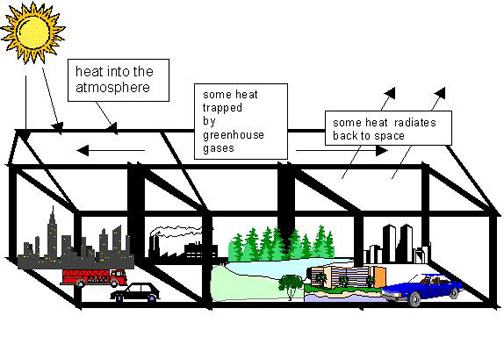
…..The Greenhouse Effect
The sun continuously bathes the Earth with energy in the form of sunlight. Much of this energy is absorbed by the Earth, and then emitted as infrared radiation, or heat. Greenhouse gases prevent the Earth from discarding as much of this heat as it otherwise would back into space.Without naturally occurring greenhouse gases, the Earth would be a much colder place, inhospitable to modern human existence. But by the same token, the additional greenhouse gases added to this store by humans is slowly increasing the average temperature of the Earth system.
Due to the quantity in which it is emitted by humans, its longevity in the atmosphere, and its effects in trapping heat, carbon dioxide is the most important of the greenhouse gases currently causing changes in the Earth’s climate……
In Australia, extreme fire danger days are already becoming more numerous in many parts of the country, and floods and cyclones more intense.
Research by the CSIRO indicates that the frequency of days with very high and extreme Forest Fire Danger Index ratings is likely to increase by 15 to 70 per cent by 2050 in southeast Australia…..
Why we must act now to reduce greenhouse gas emissions | Chief Scientist of Australia
1 This month
To see nuclear-related stories in greater depth and intensity
– go to https://nuclearinformation.wordpress.com/


 Antinuclear