TODAY. The cover-up of the danger of nuclear radiation and health, but who is speaking for our grandchildren?
From the earliest days of Marie and Pierre Curie, the harm from ionising radiation was observed, but not fully acknowledged. And before long, it was enthusiastically used in medicine, as x-rays, and in the general world, in various forms, as an aid to health and beauty. When the “radium girls” who painted watch dials with the glow-in-the-dark, radium-based paint, became ill, they were diagnosed by company doctors as having poor diet, neuroses or even syphilis.
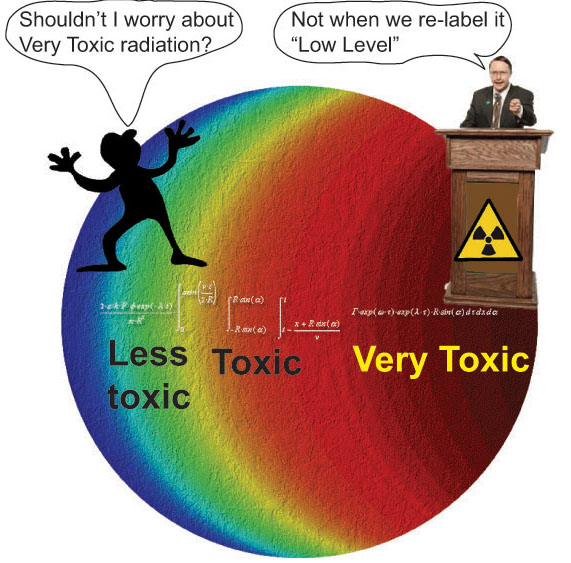
Accidents during the Manhattan Project showed the horror effects of high doses of radiation, – but with some military propaganda sleight-of-hand this seemed to be taken to show that “low level” radiation is fine.
Doctors and scientists of integrity, who researched the harm of nuclear radiation were harassed, ridiculed, and sidelined. Integrity was a career killer for DrJohn Gofman, Arthur Tamblin, Harold Knapp, Linus Pauling, Alice Stewart, Ernest Sternglass and Hermann Muller.
Despite the scientific report in 2007 – Biological Effects of Ionizing Radiation (BEIR) stating the danger, the nuclear lobby has been successful in obscuring the truth, and putting across a general acceptance that low dose radiation is well, OK, really.
Dr. Alice Stewart and , Dr. Rosalie Bertell showed the link between x-rays in the mothers and leukemia in their children – their results were similarly rubbished, (but medical authorities quietly curtailed the widespread use of x-rays)
Epidemiology and Statistics are boring stuff, I know. But population statistics of infant deaths and child cancers have shown the increased danger to embryos, infants and children living near nuclear facilities.
Sadly, health authorities have colluded in this cover-up. Public anxiety about ionising radiation is a threat to the thriving nuclear medicine industry. How much of nuclear medicine is absolutely necessary? How many CT scans and other radiological examinations are not really called for? It’s easier for medical professionals to just go along with the view that low level radiation is OK.
After all, amongst many thousands, if only a few thousand children die as a result of exposure to low level radiation – from nuclear reactors and other nuclear facilities, that’s OK isn’t it?
As world leaders enthuse over more nuclear power, and more nuclear “deterrents” , Dr. Gordon Edwards asks the question “Who is speaking for our grandchildren?”
(My inspiration for this short article came from Dr Dale Dewar’s Ionizing Radiation and Human Health .)
Matt Kean to helm Climate Change Authority, says no to nuclear

Rachel Williamson, Jun 24, 2024, ReNewEconomy
The architect of New South Wales’ (NSW) renewable energy transition is set to be the next Climate Change Authority (CCA) chair, with Matt Kean stepping up to take on the job of advising on the options and pace of the national shift to decarbonisation.
The former NSW Liberal MP and state energy minister – who only stepped down from politics late last week – will combine decarbonisation with economic policy in his new role, a job whose importance is taking on an outsized importance in advance of an election set to be fought on how to get to net zero.
The CCA advises the government on climate change policy.
He then handled the NSW emissions reductions target of 70 per cent by 2035.
Today, Kean rejected nuclear as a solution the CCA will support, saying that his department looked into the energy source for NSW and advice was that it would take too long and be too expensive.
He says the advice was from professor Hugh Durrant-Whyte, who was responsible for the British government’s nuclear defence program and is one of the few people in Australia to have actually run a nuclear program.
Retiring chair Grant King restored the agency to “its proper role” supporting the government’s climate goals, says energy and climate change minister Chris Bowen.
“Good climate and energy policy is good economic policy – the Albanese government gets that and so does Matt Kean,” he said in a statement.
“Our ambitious but achievable policies are ensuring our approach is credible and delivers benefits for all Australians. The Climate Change Authority is critical to this agenda.
“Matt Kean’s time in public office was marked by reform and the ability to bring people from across the political spectrum with him for the good of the community.”…………………………………………………………………. more https://reneweconomy.com.au/matt-kean-to-helm-climate-change-authority-says-no-to-nuclear/
Nuclear industry workers face significant, inevitable and unavoidable radiation health risks
By Tony Webb, 24 June 24, https://johnmenadue.com/nuclear-industry-workers-face-significant-inevitable-and-unavoidable-radiation-health-risks/
Nuclear industry workers face significant, inevitable and largely unavoidable radiation health risks which have so far not been addressed in the debate about Australia possibly buying into this industry.
In addition to the important arguments against the coalition policy that currently proposes building seven nuclear power plants to replace closing coal fired generators, notably that such:
will be likely cost about twice that of firmed renewable generation and take at least 15 years to build – and this in the context where most nuclear plant construction worldwide appears to routinely involve a doubling of both cost and time to build
– and so are dangerously irrelevant to meeting the existential challenge to reduce carbon and methane emissions that are driving climate change;
will require legislative changes at state and federal levels that are to say the least unlikely to be achieved;ignores the challenge of developing workforce skills to manage this technology;
ignores the as yet intractable if not insoluble problem of managing long lived nuclear wastes;
and poses significant risks to the public in the event of nuclear accidents as witnessed in the USA, Ukraine/former USSR, and Japan;
There is also an inevitable and unavoidable risk to workers in the industry and public ‘downwind’ from such reactors from routine exposure to ionising radiation.
This last has to date received little attention and whenever raised results in dismissive but misleading arguments from the nuclear industry advocates, notably that any such exposures to individuals are small and pose little, indeed ‘acceptable’ health risks compared to other risks faced in day to day living and working. Tackling this misinformation as part of the campaign has much to offer in convincing the nuclear target communities and the workers in these that might be seduced by prospects of employment in these facilities that the risks they face are far from insignificant – that, as a community they will face an increase in the incidence of fatal and ‘treatable / curable’ cancers, an increase in other, notably cardio vascular diseases and increased risk of genetic damage affecting children and future generations.
Allow me to introduce myself. I have been an active campaigner on the health effects of ionising radiation since the late 1970s. With two colleagues in 1978 I founded the UK based Radiation and Health Information Service that highlighted the evidence showing the risk estimates from radiation exposure, on which the national and international occupational and public exposure limits were based, grossly under-represented the actual risk.
This radiation-health argument was developed as part of a national campaign that resulted in a significant change of the, until then, pro-nuclear policies of UK unions with members in the industry and a review of Trade Union Congress policy in 1979. It was also an integral part of the union-led national Anti-Nuclear Campaign opposing the Thatcher government’s nuclear expansion – revealed in leaked cabinet minutes as part of the government strategy for undermining the power of the unions, particularly the National Union of Mineworkers (NUM), the Transport and General Workers Union, (T&GWU) and the General and Municipal, Boilermakers’ and Allied Trades union (GMBATU). In late 1980 I took this work on Occupational Radiation risks to the USA establishing the US Radiation and Health Labor Project, auspiced by the Foundation for National Progress / Mother Jones Magazine, that built union support across the country for AFL-CIO policy calling for a reduction in the occupational exposure limit.
Subsequently I worked as a consultant to the Canadian union (CPSU – local 2000) representing workers in the nuclear power industry and built a Canadian coalition of five Unions representing workers exposed to radiation on the job. Linking these North American union demands with those of UK and European unions (also similar concerns from unions in Australia following a 1988 organising tour) reinforced pressures from within the scientific community – notably the US Biological Effects of Ionising Radiation (BEIR) committee.
These sustained pressures led eventually to the International Commission on Radiological Protection (ICRP) reducing the recommended limits for permissible occupational (and public) exposures in 1991. Despite evidence that would have justified a ten-fold reduction (from the 50 mSv annual occupational limit to a limit of 5 mSv) the ICRP limit was only reduced by 40% (to 20 mSv a year but with individual exposures still permitted to 50 mSv in any year so long as the average over 5 years was no higher than 20 mSv).
Since then, a large-scale study of UK, EU, and US nuclear industry workers has shown radiation-induced cancer risks to be on average 2.6 times higher than the estimates used to set the ICRP limits. To put it in simple if statistical terms, the lifetime cancer risk for a worker exposed to the permissible annual dose of radiation over say a 25-year career would be of the order of 6.5% higher than normal. To this should be added the significant health effects of non-fatal cancers, an approximate doubling of the normal rate of cardio-vascular disease and a not insignificant increase in genetic damage to workers children and future generations. Nuclear industry workers face significant, inevitable and largely unavoidable radiation health risks which have so far not been addressed in the debate about Australia possibly buying into this industry.
What needs to be more clearly understood however is that the concern is not just in relation to risks faced by individuals exposed on the job, or from relatively small amounts of radiation released from routine operations of nuclear plants. What is of far greater public concern is the impact of the collective exposure. What is not fully appreciated is that there is simply no safe level of exposure – any dose however small may be the one that causes damage at cellular level in the human body that may show up years later as cancer, genetic damage or some other health effect. it is the total/collective dose that will determine the number of such health effects. Spreading the dose over a larger population will reduce the risk to any individual but not the total health effects. Indeed, it may increase it. An individual affected by cancer can only die once.
These arguments carry weight. They formed a significant part if the discussions within the 2016 South Australian government’s ‘Citizens Jury’ convened to consider proposals to import and store around a third of the world’s nuclear wastes. The concern about radiation and health received special note in the report of this jury to the SA Premier that a two-thirds majority said ‘no – under any circumstances’ to the radioactive waste proposal. The issues can also form the basis for increased collaboration between the trade union, environment, medical reform and public health movements as was the case in the mid 1990s when UK, Labour MP Frank Cook convened a Radiation Roundtable that brought together representatives of these constituencies.
So, within the current debate about a possible Australian Nuclear Power program – alongside the arguments already made about its excessive cost, extended construction time frame, ill-fit within an essential decentralised renewable energy program, risks of major accidents, and the intractable problems of multi-generation waste management, can we please add this concern over health effects that will inevitably result from occupational and public exposures to radiation. Can we particularly focus the attention of trade unions and their members in the seven former coal-fired generation-dependent communities on the effect of these exposures on health of workers who might seek to be employed in operating these facilities and on the health of their families, neighbours, and future generations.
A key demand from unions should be that the occupational limit for annual radiation exposures cbe reduced from the current ICRP level of 20 mSv to a maximum of 5 mSv a year with a lifetime limit of 50 mSV. This revision of standards would put real pressure on the nuclear industry – the current uranium mining and any future enrichment, fuel fabrication, nuclear generation, fuel reprocessing, and waste management – to keep such exposures as low as possible. In the unlikely event of any of the reactor proposals getting the go-ahead there should be baseline monitoring of the health of the community and any workers employed so that any detrimental increase in health effects can be detected early and possibly remediated in the future.
Summary of Australian federal and state/territory nuclear/uranium laws and prohibitions.

Current prohibitions on nuclear activities in Australia: a quick guide
From Jim Green, 30 May 2024
https://www.aph.gov.au/About_Parliament/Parliamentary_departments/Parliamentary_Library/pubs/rp/rp2324/Quick_Guides/NuclearActivitiesProhibitions
PDF Version [564KB]
Dr Emily Gibson
Science, Technology, Environment and Resources; Law and Bills Digest Sections
This quick guide provides an overview of current prohibitions on nuclear activities under Commonwealth, state and territory laws. It considers the primary legislation most relevant to current policy debates about domestic nuclear energy only and consequently does not consider recent changes to Commonwealth law to facilitate Australia’s acquisition of conventionally-armed, nuclear-powered submarines under the AUKUS partnership.[1] It also does not include consideration of Australia’s international obligations in respect of nuclear activities, including the safeguarding of nuclear materials and the non-proliferation of nuclear weapons.
If a domestic nuclear energy industry were to progress, it is expected that a comprehensive framework for the safety, security and safeguarding of the related nuclear material would need to be legislated to accommodate such an industry.[2] Consideration of these issues is beyond the scope of this paper.
What are nuclear activities?
A nuclear activity is any process or step in the utilisation of material capable of undergoing nuclear fission; that is, any activities in the nuclear fuel cycle.[3] Nuclear activities therefore include:
- mining of nuclear or radioactive materials such as uranium and thorium milling, refining, treatment, processing, reprocessing, fabrication or enrichment of nuclear material
- the production of nuclear energy
- the construction, operation or decommissioning of a mine, plant, facility, structure, apparatus or equipment used in the above activities
- the use, storage, handling, transportation, possession, acquisition, abandonment or disposal of nuclear materials, apparatus or equipment.
Prohibitions on nuclear activities
Commonwealth
Nuclear activities are regulated under the Australian Radiation Protection and Nuclear Safety Act 1998 (ARPANS Act) and the Environment Protection and Biodiversity Conservation Act 1999 (EPBC Act).
Australian Radiation Protection and Nuclear Safety Act 1998
The ARPANS Act establishes a licensing framework for controlled persons (including a Commonwealth entity or a Commonwealth contractor) in relation to controlled facilities (a nuclear installation, a prescribed radiation facility, or a prescribed legacy site).[4] A nuclear installation includes a nuclear reactor for research or the production of radioactive materials for industrial or medical use, and a radioactive waste storage or disposal facility with an activity that is greater than the activity level prescribed by the Australian Radiation Protection and Nuclear Safety Regulations 2018.[5]
The ARPANS Act allows the CEO of the Australian Radiation Protection and Nuclear Safety Agency (ARPANSA) to issue licences for controlled facilities.[6] In issuing a facility licence, the CEO ‘must take into account the matters (if any) specified in the regulations, and must also take into account international best practice in relation to radiation protection and nuclear safety’.[7]
However, subsection 10(2) of the Act expressly prohibits the CEO from granting a licence for the construction or operation of any of the following nuclear installations: a nuclear fuel fabrication plant; a nuclear power plant; an enrichment plant; or a reprocessing facility.[8] This prohibition does not appear to apply to a radioactive waste storage or disposal facility.
Environment Protection and Biodiversity Conservation Act 1999
The EPBC Act establishes 9 matters of national environmental significance (MNES) and provides for the assessment and approval of these actions if the action has, will have, or is likely to have a significant impact on the MNES.[9] ‘Nuclear actions’ are one of the MNES.[10] Where a nuclear action is determined to be a controlled action (that is, one likely to have a significant impact and requiring assessment and approval under the Act), the assessment considers the impact of a nuclear action on the environment generally (including people and communities).[11]
The Act establishes offences for the taking of nuclear actions in those circumstances.[14]
Similarly, the Act provides that a relevant entity (as set out below) must not take an action (including a nuclear action) unless a requisite approval has been obtained under Part 9 of the Act or a relevant exception applies:
- a person must not take a relevant action on Commonwealth land that has, will have or is likely to have a significant impact on the environment[15]
- a person must not take a relevant action outside Commonwealth land if the action has, will have or is likely to have a significant impact on the environment on Commonwealth land[16]
- the Commonwealth or a Commonwealth agency must not take inside or outside the Australian jurisdiction an action that has, will have or is likely to have a significant impact on the environment inside or outside the Australian jurisdiction.[17]
The Act establishes offences and civil penalty provisions for the taking of an action in those circumstances.[18]
Subsection 140A(1) prohibits the Minister for the Environment from granting an approval for a nuclear action relating to specified nuclear installations. These installations are a nuclear fuel fabrication plant, a nuclear power plant, an enrichment plant, and a reprocessing facility.
Potential reform of the nuclear action trigger
The second independent review of the EPBC Act, completed in October 2020 by Professor Graeme Samuel (Samuel Review), recommended that the nuclear actions MNES be retained.[19] The review recommended that ‘the EPBC Act and the regulatory arrangements of [ARPANSA] should be aligned, to support the implementation of best-practice international approaches based on risk of harm to the environment, including the community’.[20]
In 2022, the Government’s Nature Positive Plan adopted this approach and stated, ‘[a] uniform national approach to regulation of radiation will be delivered through the new National Environmental Standards’.
In February 2024, a policy draft of the National Environmental Standard for Matters of National Environmental Significance indicates that ‘nuclear actions’ will be renamed ‘radiological exposure actions’ and states:
Relevant decisions must:
Not be inconsistent with the ARPANSA national codesfor protection from radiological exposure actions including in relation to:
- human health and environmental risks and outcomes; and. radiological impacts on biological diversity,
- the conservation of species and the natural health of ecosystems.[22]
States and territories
States and territories generally regulate nuclear and radiation activities through either the health or the environmental protection portfolios. The relevant legislation provides for the protection of health and safety of people, and the protection of property and the environment, from the harmful effects of radiation by establishing licensing regimes to regulate the possession, use, and transportation of radiation sources and substances.[23] Mining of radioactive materials is regulated through the resources portfolio.
In addition, as outlined below, the states and territories have legislation prohibiting certain nuclear activities or the construction and operation of certain nuclear facilities. Importantly, where permitted, nuclear activities (including mining) would also be subject to assessment and approvals under a range of other legislation, including planning and environmental impact assessment, native title and cultural heritage, and radiation licensing laws at the state or territory and Commonwealth level.
New South Wales
Exploration for uranium has been permitted under the Mining Act 1992 since 2012.[24] However, the mining of uranium is prohibited by the Uranium Mining and Nuclear Facilities (Prohibitions) Act 1986 (NSW Prohibitions Act).[25]
The NSW Prohibitions Act also prohibits the construction and operation of certain nuclear facilities, including uranium enrichment facilities, fabrication and reprocessing plants, nuclear power plants, and storage and waste disposal facilities (other than for the storage and disposal of waste from research or medical purposes, or the relevant radiological licensing Act).[26]
Northern Territory
The Atomic Energy Act 1953 (Cth) provides that the Commonwealth owns all uranium found in the territories.[27] Uranium exploration and mining in the Northern Territory (NT) is regulated under both NT mining laws (the Mineral Titles Act 2010 and the Mining Management Act 2001) and the Atomic Energy Act.[28] The Ranger Uranium Mine operated until 2021 and is now undergoing rehabilitation.[29]
The Nuclear Waste Transport, Storage and Disposal (Prohibition) Act 2004 (NT) prohibits the construction and operation of nuclear waste storage facilities, as well as the transportation of nuclear waste for storage at a nuclear waste storage facility in the NT.[30] Nuclear waste is defined as including waste material from nuclear plants or the conditioning or reprocessing of spent nuclear fuel.[31]
This Act also:
- prohibits public funds from being expended, granted or advanced to any person for, or for encouraging or financing any activity associated with the development, construction or operation of a nuclear waste storage facility
- would require the NT Parliament to hold an inquiry into the likely impact of a nuclear waste storage facility proposed by the Commonwealth on the cultural, environmental and socio‑economic wellbeing of the territory.[32]
Queensland
Exploration for and mining of uranium are permitted under the Mineral Resources Act 1989. However, it has been government policy to not grant mining leases for uranium since 2015.[33] The government policy ban extends to the treatment or processing of uranium within the state.[34]
The Nuclear Facilities Prohibition Act 2007, in similar terms to the NSW Prohibitions Act, prohibits the construction and operation of nuclear reactors and other nuclear facilities in the nuclear fuel cycle.[35]
Unlike other state and territory prohibition legislation, the Nuclear Facilities Prohibition Act would require the responsible Queensland Minister to hold a plebiscite to gain the views of the Queensland population if the Minister was satisfied that the Commonwealth Government has taken, or is likely to take, steps to amend a Commonwealth law or exercise a power under a Commonwealth law to facilitate the construction of a prohibited nuclear facility, or if the Commonwealth Government adopts a policy position of supporting or allowing the construction of a prohibited nuclear facility in Queensland.[36]
South Australia
The exploration and mining of radioactive material (including uranium) is permitted in South Australia (SA), subject to approvals under the Mining Act 1971 and the Radiation Protection and Control Act 2021 (RP&C Act).[37] For example, uranium is mined at Olympic Dam, Four Mile and Honeymoon. However, conversion and enrichment activities are prohibited by the RP&C Act.[38]
The Nuclear Waste Storage Facility (Prohibition) Act 2000 prohibits the construction or operation of a nuclear waste storage facility, and the import to SA or transport within SA of nuclear waste for delivery to a nuclear waste storage facility.[39]
The Nuclear Waste Storage Facility (Prohibition) Act prohibits the SA Government from expending public funds to encourage or finance the construction or operation of nuclear waste storage facilities.[40] The Act would also require the SA Parliament to hold an inquiry into the proposed construction or operation of a nuclear waste storage facility in SA authorised under a Commonwealth law.[41]
Tasmania
The exploration and mining of atomic substances (which includes uranium and thorium) is permitted under the Mineral Resources Development Act 1995 (Tas), subject to approval.
Victoria
The Nuclear Activities (Prohibitions) Act 1983 prohibits a range of activities associated with the nuclear fuel cycle, including the exploration and mining of uranium and thorium, and the construction or operation of facilities for the conversion or enrichment of any nuclear material, nuclear reactors and facilities for the storage and disposal of nuclear waste from those prohibited activities.[42]
Western Australia
Exploration for and mining of uranium is permitted under the Mining Act 1978. A state policy ban on mining approvals was overturned in November 2008;[43] however, this was reinstated in June 2017, with a ‘no uranium’ condition on future mining leases.[44] The ban does not apply to 4 projects that had already been approved by the previous government.
The Nuclear Activities Regulation Act 1978 aims to protect the health and safety of people and the environment from possible harmful effects of nuclear activities, including by regulating the mining and processing of uranium and the equipment used in those processes. The Nuclear Waste Storage and Transportation (Prohibition) Act 1999 also prohibits the storage, disposal or transportation in Western Australia of certain nuclear waste (including waste from a nuclear plant or nuclear weapons).[45]
Can the Commonwealth override a state ban on nuclear activities?
The Commonwealth Parliament only has the power to make laws in relation to matters specified in the Constitution of Australia, including in sections 51, 52 and 122. Assuming the Commonwealth has a sufficient head of power to legislate, section 109 of the Constitution specifically provides for circumstances in which there might be an inconsistency between Commonwealth and state laws:
When a law of a State is inconsistent with a law of the Commonwealth, the latter shall prevail, and the former shall, to the extent of the inconsistency, be invalid.
Therefore, even though some states have enacted prohibitions on certain nuclear activities within their jurisdictions, the Commonwealth Parliament could enact specific legislation in relation to nuclear activities so that such activities can take place within those jurisdictions. One such example is the National Radioactive Waste Management Act 2012 (Cth), which provides for the establishment of a national radioactive waste management facility at a site to be declared by the responsible Commonwealth Minister. Section 12 of that Act provides that state and territory laws have no effect in regulating, hindering, or preventing such a facility
Further information
- ‘Who we regulate’, ARPANSA
- ‘State & territory regulators’, ARPANSA
- ‘Uranium and thorium’, in Geoscience Australia, Australia’s Energy Commodity Resources, 2023 Edition, (Canberra: Geoscience Australia, 2023).
Isle of Wight-size iceberg breaks from Antarctica

BBC News, Jonathan Amos, Science correspondent, 20 May 24
Another big iceberg has broken away from an area of the Antarctic that hosts the UK’s Halley research station.
It is the third such block to calve near the base in the past three years.
This new one is not quite as large, but still measures some 380 sq km (145 sq miles) – roughly the size of the Isle of Wight.
The British Antarctic Survey (BAS) took the precaution of moving Halley in 2017 because of concerns over the way the local ice was behaving.
Its buildings were shifted on skis to take them away from immediate trouble.
The station is also now routinely vacated during the long dark months of the southern winter. The last personnel were flown out in February.
Halley sits on top of the Brunt Ice Shelf, which is the floating protrusion of glaciers that have flowed off the continent into the Weddell Sea.
This shelf will periodically shed icebergs at its forward edge and it is currently going through an extremely dynamic phase.
In 2021, the shelf produced a berg the size of Greater Paris (1,300 sq km/810 sq miles) called A74, followed in 2023 by an even bigger block (1,500 sq km/930 sq miles) the size of Greater London, known as A81.
The origin of the new berg goes back to a major crack that was discovered in the shelf on 31 October, 2016. Predictably, it was nicknamed the “Halloween Crack”.
A further fracture perpendicular to Halloween has now cut a free-floating segment of ice that has already begun to drift out into the Weddell Sea………………..
Satellite imagery confirms the GPS data. The berg is surrounded by seawater on all sides.
The loss of so much ice from the Brunt structure these past three years has triggered a rapid acceleration in the shelf’s seaward movement.
Historically, it has flowed forward at a rate of 400-800m (1,300-2,600ft) per year. It is now moving at about 1,300m (4,300ft) a year………………………….
“This latest calving reduces the Brunt Ice Shelf to its smallest observed size,” commented remote sensing specialist Prof Adrian Luckman, from Swansea University…………………………………………… more https://www.bbc.com/news/articles/c033wr32ewno
Lidia Thorpe warns new laws will turn Australia into “the world’s nuclear waste dump”

Giovanni Torre – May 13, 2024, https://nit.com.au/13-05-2024/11377/lidia-thorpe-warns-new-laws-will-turn-australia-into-the-worlds-nuclear-waste-dump?mc_cid=a41a81cd8c&mc_eid=261607298d
Senator Lidia Thorpe has warned new legislation to regulate nuclear safety of activities relating to AUKUS submarines has left Australia open to becoming “the world’s nuclear waste dump”.
Under the AUKUS deal, the federal government agreed to manage nuclear waste from Australian submarines, but under legislation to be introduced in June, Australia could be set to take nuclear waste from UK and US submarines also, Senator Thorpe warned.
The Gunnai, Gunditjmara and Djab Wurrung independent senator for Victoria called on the government to urgently amend the bill to prohibit high-level nuclear waste from being stored in Australia, a call she said is backed by experts in the field and addresses one of the major concerns raised during the inquiry into the bill.
“This legislation should be setting off alarm bells, it could mean that Australia becomes the world’s nuclear waste dump,” Senator Thorpe said on Monday.
“The government claims it has no intention to take AUKUS nuclear waste beyond that of Australian submarines, so they should have no reason not to close this loophole.
“Unless they amend this bill, how can we know they’re being honest? They also need to stop future governments from deciding otherwise. We can’t risk our future generations with this.”
In March, Senator Thorpe questioned Foreign Affairs Minister Penny Wong about the long-term cost from storage of nuclear waste, and whether Australia would take on foreign nuclear waste under the AUKUS deal. The minister responded that this cost is not included in the current $368 billion estimated for AUKUS, and she could not confirm that foreign waste would not be stored in Australia.
Senator Thorpe noted that the US Environmental Protection Agency warns high-level nuclear waste remains dangerous for at least 10,000 years; managing the risk posed by the decommissioned fuel rods from the AUKUS submarines would require storage and management that is future-proof, something that has proven challenging even in countries with advanced nuclear industries.
She also pointed out on Monday that the bill has also been criticised for lack of transparency and accountability; and allows the Minister of Defense to bypass public consultation and override federal and state laws to determine sites for the construction and operation of nuclear submarines, and the disposal of submarine nuclear waste.
Senator Thorpe said there are serious concerns about a lack of community consultation and the risk of violating First Peoples right to Free, Prior and Informed Consent.
Historically, governments have tried to push the storage of radioactive waste on remote First Nations communities, with successful campaigns in Coober Pedy, Woomera, Muckaty, Yappala in the Flinders Ranges and Kimba fighting off these attempts.
“We’ve seen how far the major parties will go to ingratiate themselves with the US. Labor must amend this bill to prove they’re putting the interests of our country first,” Senator Thorpe said.
“And they need to change the powers that allow the Minister and the Department to choose any place they like for nuclear waste facilities with no oversight or community consultation.
“That’s complete overreach and will undermine First Peoples rights for Free, Prior and Informed Consent under the United Declaration on the Rights of Indigenous Peoples.”
The senator said “time and again” governments have attempted to turn remote communities into nuclear waste dumps, with the risks from nuclear waste always being put on First Peoples.
“I’m concerned that this time it will be no different,” she said.
“The Bill allows the government to contract out liability for nuclear safety compliance, includes no emergency preparedness or response mechanisms, no consideration of nuclear safety guidelines from the Australian Radiation Protection and Nuclear Safety Agency and leaves many other questions on nuclear safety unanswered.”
“This Bill fails to set out a nuclear safety framework for the AUKUS submarines and instead focuses on defence objectives, while sidestepping safety, transparency and accountability. It’s a negligent and reckless bill that should not pass the Senate.”
Australia risks being ‘world’s nuclear waste dump’ unless Aukus laws changed, critics say
Labor-chaired inquiry calls for legislation to rule out accepting high-level nuclear waste from US and UK submarines among other recommendations
Daniel Hurst Foreign affairs and defence correspondent, https://www.theguardian.com/world/article/2024/may/13/australia-aukus-deal-submarines-critics-nuclear-waste
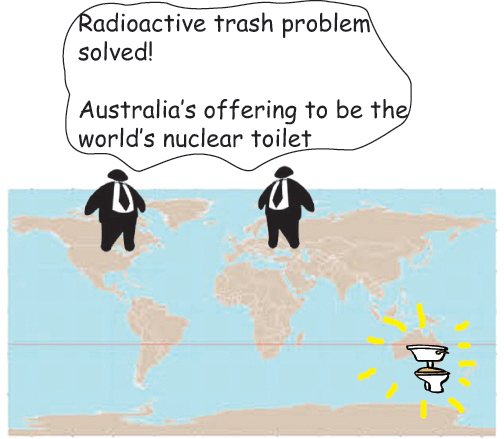
Australia risks becoming the “world’s nuclear waste dump” unless the Albanese government moves to rewrite its proposed Aukus laws, critics say.
A Labor-chaired inquiry has called for the legislative safeguard to specifically rule out accepting high-level nuclear waste from the US and the UK. One of the members of a Senate committee that reviewed the draft laws, independent senator Lidia Thorpe, said the legislation “should be setting off alarm bells” because “it could mean that Australia becomes the world’s nuclear waste dump”.
The government’s bill for regulating nuclear safety talks about “managing, storing or disposing of radioactive waste from an Aukus submarine”, which it defines broadly as Australia, UK or US submarines.
In a report published on Monday, the Senate’s foreign affairs, defence and trade legislation committee said this wording did not reflect the government’s promise not to accept high-level nuclear waste.
It recommended that the government consider “amending the bill so that a distinction is made between Australia’s acceptance of low-level nuclear waste from Aukus partners, but non-acceptance of high-level nuclear waste”.
The government has left the door open to accepting low-level waste from US and UK nuclear-powered submarines when they conduct rotational visits to Western Australia in the first phase of the Aukus plan. Low-level waste contains small amounts of radioactivity and include items such as personal protective equipment, gloves and wipes.
“According to the Australian Submarine Agency, nuclear-powered submarines only generate around a ‘small skip bin’ of low-level naval nuclear waste per submarine per year and that intermediate- and high-level waste will not become a concern until the first naval nuclear reactor requires disposal in the mid-2050s,” the Senate committee report said.
The government has yet to decide on the location for the disposal of radioactive waste from the submarines.
But infrastructure works proposed for HMAS Stirling – the naval base in Western Australia – to support the increased rotational visits are expected to include an operational waste storage facility for low-level radioactive waste.
The Department of Defence has argued any changes to the definitions should not prevent “regulatory control of the management of low-level radioactive waste from UK or US submarines” as part of those rotational visits.
Thorpe, an independent senator, said the call to prohibit high-level nuclear waste from being stored in Australia was “backed by experts in the field and was one of the major concerns raised during the inquiry into the bill”.
“The government claims it has no intention to take Aukus nuclear waste beyond that of Australian submarines, so they should have no reason not to close this loophole,” Thorpe said.
“They also need to stop future governments from deciding otherwise. We can’t risk our future generations with this.”
The government’s proposed legislation would set up an Australian naval nuclear power safety regulator to oversee the safety of the nuclear-powered submarines.
The committee made eight recommendations, including setting “a suitable minimum period of separation” to prevent a revolving door from the Australian Defence Force or Department of Defence to the new regulator.
The main committee report acknowledged concerns in the community that Australia might become a “dumping ground” for the Aukus countries, but it said the term was “not helpful in discussing the very serious question of national responsibility for nuclear waste”.
It also said the bill should be amended to ensure the regulator was transparent about “any accidents or incidents” with the soon-to-be-established parliamentary oversight committee on defence.
The Labor chair of the committee, Raff Ciccone, said the recommendations would “further strengthen the bill” and help “ensure Australia maintains the highest standards of nuclear safety”.
In a dissenting report, the Greens senator David Shoebridge said the legislation was “deeply flawed”, including because the regulator would report to the defence minister.
“The proposed regulator lacks genuine independence, the process for dealing with nuclear waste is recklessly indifferent to community or First Nations interests and the level of secrecy is a threat to both the environment and the public interest,” Shoebridge said.
The defence minister, Richard Marles, was contacted for comment.
Japan starts 5th ocean discharge of Fukushima nuclear-tainted wastewater despite opposition

(Xinhua) Web editor: Zhang Kaiwei, Liang Jun, April 19, 2024
TOKYO, April 19 (Xinhua) — Japan on Friday started the fifth-round of release of nuclear-contaminated wastewater from the crippled Fukushima Daiichi Nuclear Power Plant into the Pacific Ocean.
Despite opposition among local fishermen, residents as well as backlash from the international community, Tokyo Electric Power Company (TEPCO), the plant’s operator, started discharging the radioactive wastewater in the morning, the first round in fiscal 2024.
Similar to the previous four rounds, about 7,800 tons of the wastewater, which still contains tritium, a radioactive substance, will be discharged until May 7.
TEPCO analyzed the water stored in the tank scheduled for release, and found that the concentrations of all radioactive substances other than tritium were below the national release standards, while the concentration of tritium that cannot be removed will be diluted with seawater, Japanese newspaper Asahi Shimbun reported.
TEPCO will measure the concentration of radioactive substances such as tritium in the surrounding waters every day during the period to investigate the effects of the release, it added.
The Fukushima nuclear-contaminated water release began in August 2023, and a total of about 31,200 tons of the water was released in four rounds in fiscal 2023, which ended in March.
In fiscal 2024, TEPCO plans to discharge a total of 54,600 tons of contaminated water in seven rounds, which contains approximately 14 trillion becquerels of tritium.
Man blames nuclear meltdown for deformities in city more radioactive than Chernobyl

Ozersk – code named City 40 – was the birthplace of the Soviet nuclear weapons programme, now it’s one of the most contaminated places on the planet with residents exposed to high radiation levels.
By Kelly Williams, Assistant News Editor (Live) https://www.dailystar.co.uk/news/world-news/man-blames-nuclear-meltdown-deformities-32405120
A man living in a secret city five times more radioactive than Chernobyl has been left with facial deformities he blames on huge nuclear meltdowns.
Vakil Batirshin has massively swollen lymph nodes said to be caused by radiation-related illness. He lives in Ozersk – code named City 40 in Russia – which was built in total secrecy around the huge Mayak nuclear power plant by the Soviets in 1946.
For the first eight years after City 40 was built, Ozersk residents were forbidden from communicating with the outside world. Like Chernobyl, it was designed as a place to house the scientists working at the plant who – unbeknownst to the world – were leading the Soviet Union’s nuclear weapons programme during the Cold War era.
Locals were told they were “the nuclear shield and saviours of the world,” and everyone on the outside was an enemy.
They also kept it a secret that the extreme exposure to radiation was affecting the health of the city’s inhabitants. They started to get sick and die and the authorities were clandestine about the mortality rate.
However, the city’s graveyard with all its young victims tells the story.
Ozersk, nicknamed “The graveyard of the Earth,” was surrounded by guarded gates and barbed wire fences and did not appear on any maps.
Its inhabitants’ identities were also erased from the Soviet census to guard their secret.
The Mayak nuclear plant went through Russia’s biggest nuclear disaster when the facility allegedly dumped 200million curies worth of radioactive material into the environment around Ozersk.
The residents also suffered the Kyshtym disaster in 1957, the worst nuclear disaster the world had seen before Chernobyl.
Radiation bathed the city when a cooling system exploded at Mayak with the force of 100 tons of dynamite.
One of the nearby lakes has been so heavily contaminated by plutonium that locals have renamed it the “Lake of Death” or “Plutonium Lake”.
In an interview which resurfaced earlier this week on X (formerly Twitter), Vakil Batirshin struggles to speak, his neck is painfully swollen from lymph nodes that have grown to triple their normal size.
His exact diagnosis remains steeped in mystery as doctors say it can be hard to trace any one condition to radiation.
But asked if he has any doubt his symptoms are related to radioactivity, he said: “Well, when I lived in my home village, I didn’t have anything. Everything was great.
“When I came here, it all started.”
Another resident, Gilani Dambaev is riddled with diseases doctors think are linked to a lifetime’s exposure to excessive radiation. He and his family have government-issued cards identifying them as residents of radiation-tainted territory.
He said: “Sometimes they would put up signs warning us not to swim in the river, but they never said why. After work, we would go swimming in the river. The kids would too.”
Although the secret is now out and Ozyorsk resembles “a suburban 1950s American town” according to The Guardian, residents know their water is contaminated, their crops are poisoned, and their children may be sick.
Half a million people in Ozersk and its surrounding area are said to have been exposed to five times as much radiation as those living in the areas of Ukraine affected by the Chernobyl nuclear accident.
But most refused to leave, because while the Soviet population were suffering from famine and living in extreme poverty, the city was regarded as a paradise as authorities gave them private apartments, plenty of food, good schools and healthcare, and a plethora of entertainment and cultural activities.
Even still, residents opt against leaving. The Guardian reported that “it is prestigious to live in Ozersk.”
Residents describe it as a town of “intellectuals”, where they are used to getting “the best of everything for free”.
Living in Mayak’s nuclear shadow and resigned to her fate, one said: “I don’t hope for anything anymore. If we get sick, we get sick.”
Some locals, however, claim that long term dumping by the nuclear plant’s management continues today.
The government has started resettling residents to new homes away from the river, but the process only began in 2008.
100,000 years and counting: how do we tell future generations about highly radioactive nuclear waste repositories?
Sweden and Finland have described KBS-3 as a world-first nuclear-waste management solution.

Critical questions remain about the storage method, however. There have been widely publicised concerns in Sweden about the corrosion of test copper canisters after just a few decades. This is worrying, to say the least, because it’s based on a principle of passive safety. The storage sites will be constructed, the canisters filled and sealed, and then everything will be left in the ground without any human monitoring its safe functioning and with no technological option for retrieving it. Yet, over 100,000 years the prospect of human or non-human intrusion into the site – both accidental or intentional – remains a serious threat.

International attention is increasingly fixated on “impactful” short-term responses to environmental problems – usually limited to the lifespan of two or three future generations of human life. Yet the nature of long-lived nuclear waste requires us to imagine and care for a future well beyond that time horizon, and perhaps even beyond the existence of humanity.
International attention is increasingly fixated on “impactful” short-term responses to environmental problems – usually limited to the lifespan of two or three future generations of human life. Yet the nature of long-lived nuclear waste requires us to imagine and care for a future well beyond that time horizon, and perhaps even beyond the existence of humanity.
March 19, 2024 Thomas Keating. Postdoctoral Researcher, Linköping University, Anna Storm, Professor of Technology and Social Change, Linköping University https://theconversation.com/100-000-years-and-counting-how-do-we-tell-future-generations-about-highly-radioactive-nuclear-waste-repositories-199441
In Europe, increasing efforts on climate change mitigation, a sudden focus on energy independence after Russia’s invasion of Ukraine, and reported breakthroughs in nuclear fusion have sparked renewed interest in the potential of nuclear power. So-called small modular reactors (SMRs) are increasingly under development, and familiar promises about nuclear power’s potential are being revived.
Nuclear power is routinely portrayed by proponents as the source of “limitless” amounts of carbon-free electricity. The rhetorical move from speaking about “renewable energy” to “fossil-free energy” is increasingly evident, and telling.
Yet nuclear energy production requires managing what is known as “spent” nuclear fuel where major problems arise about how best to safeguard these waste materials into the future – especially should nuclear energy production increase. Short-term storage facilities have been in place for decades, but the question of their long-term deposition has caused intense political debates, with a number of projects being delayed or cancelled entirely. In the United States, work on the Yucca Mountain facility has stopped completely leaving the country with 93 nuclear reactors and no long-term storage site for the waste they produce.
Nuclear power plants produce three kinds of radioactive waste:
- Short-lived low- and intermediate-level waste;
- Long-lived low- and intermediate-level waste;
- Long-lived and highly radioactive waste, known as spent nuclear fuel.
The critical challenge for nuclear energy production is the management of long-lived waste, which refers to nuclear materials that take thousands of years to return to a level of radioactivity that is deemed “safe”. According to the US Nuclear Regulatory Commission (NRC), in spent fuel half of the radiation in strontium-90 and cesium-137 can decay in 30 years, while it would take 24,000 years for plutonium-239 to return to a state considered “harmless”. However, exactly what is meant by “safe” and “harmless” in this context is something that remains poorly defined by international nuclear management organisations, and there is surprisingly little international consensus about the time it takes for radioactive waste to return to a state considered “safe” for organic life.
“Permanent” geological repositories
Despite the seeming revival of nuclear energy production today, very few of the countries that produce nuclear energy have defined a long-term strategy for managing highly radioactive spent fuel into the future. Only Finland and Sweden have confirmed plans for so-called “final” or “permanent” geological repositories.
The Swedish government granted approval for a final repository in the village of Forsmark in January 2022, with plans to construct, fill and seal the facility over the next century. This repository is designed to last 100,000 years, which is how long planners say that it will take to return to a level of radioactivity comparable to uranium found in the earth’s bedrock.
Finland is well underway in the construction of its Onkalo high-level nuclear waste repository, which they began building in 2004 with plans to seal their facility by the end of the 21st century.
The technological method that Finland and Sweden plan to use in their permanent repositories is referred to as KBS-3 storage. In this method, spent nuclear fuel is encased in cast iron, which is then placed inside copper canisters, which are then surrounded by clay and bedrock approximately 500 metres below ground. The same or similar methods are being considered by other countries, such as the United Kingdom.
Sweden and Finland have described KBS-3 as a world-first nuclear-waste management solution. It is the product of decades of scientific research and negotiation with stakeholders, in particular with the communities that will eventually live near the buried waste.
Critical questions remain about the storage method, however. There have been widely publicised concerns in Sweden about the corrosion of test copper canisters after just a few decades. This is worrying, to say the least, because it’s based on a principle of passive safety. The storage sites will be constructed, the canisters filled and sealed, and then everything will be left in the ground without any human monitoring its safe functioning and with no technological option for retrieving it. Yet, over 100,000 years the prospect of human or non-human intrusion into the site – both accidental or intentional – remains a serious threat.
The Key Information File
Another major problem is how to communicate the presence of buried nuclear waste to future generations. If spent fuel remains dangerous for 100,000 years, then clearly this is a time frame where languages can disappear and where the existence of humanity cannot be guaranteed. Transferring information about these sites into the future is a sizeable task that demands expertise and collaboration internationally across the social sciences and sciences into practices of nuclear waste memory transfer – what we refer to as nuclear memory communication.
In a project commissioned by the Swedish Nuclear Waste Management Company (SKB), we take up this precise task by writing the “Key Information File” – a document aimed at non-expert readers containing only the most essential information about Sweden’s nuclear waste repository under development.
The Key Information File has been formulated as a summary document that would help future readers understand the dangers posed by buried waste. Its purpose is to guide the reader to where they can find more detailed information about the repository – acting as a “key” to other archives and forms of nuclear memory communication until the site’s closure at the end of the 21st century. What happens to the Key Information File after this time is undecided, yet communicating the information that it contains to future generations is crucial.
The Key Information File we will publish in 2024 is intended to be securely stored at the entrance to the nuclear waste repository in Sweden, as well as at the National Archives in Stockholm. To ensure its durability and survival through time, the plan is for it to be reproduced in different media formats and translated into multiple languages. The initial version is in English and, when finalised, it will be translated into Swedish and other languages that have yet to be decided.
Our aim is for the file to be updated every 10 years to ensure that essential information is correct and that it remains understandable to a wide audience. We also see the need for the file to be incorporated into other intergenerational practices of knowledge transfer in the future – from its inclusion into educational syllabi in schools, to the use of graphic design and artwork to make the document distinctive and memorable, to the formation of international networks of Key Information File writing and storage in countries where, at the time of writing, decisions have not yet been made about how to store highly radioactive long-lived nuclear waste.
Fragility and short-termism: a great irony
In the process of writing the Key Information File, we have discovered many issues surrounding the efficacy of these strategies for communicating memory of nuclear waste repositories into the future. One is the remarkable fragility of programs and institutions – on more than one occasion in recent years, it has taken just one person to retire from a nuclear organisation for the knowledge of an entire programme of memory communication to be halted or even lost.
And if it is difficult to preserve and communicate crucial information even in the short term, what chance do we have over 100,000 years?
International attention is increasingly fixated on “impactful” short-term responses to environmental problems – usually limited to the lifespan of two or three future generations of human life. Yet the nature of long-lived nuclear waste requires us to imagine and care for a future well beyond that time horizon, and perhaps even beyond the existence of humanity.
Responding to these challenges, even partially, requires governments and research funders internationally to provide the capacity for long-term intergenerational research on these and related issues. It also demands care in developing succession plans for retiring experts to ensure their institutional knowledge and expertise is not lost. In Sweden, this could also mean committing long-term funding from the Swedish nuclear waste fund so that not only future technical problems with the waste deposition are tackled, but also future societal problems of memory and information transfer can be addressed by people with appropriate capacity and expertise.
Concerns and complaints continue as fourth Fukushima wastewater discharge completed

Concerns and complaints from home and abroad remain while Japan’s crippled Fukushima Daiichi Nuclear Power Plant has finished its first year of discharging nuclear-contaminated wastewater into the ocean.
The plant completed its fourth and final round of discharge for the current fiscal year, which ends in March, Tokyo Electric Power Company (TEPCO) said on Sunday.
As per the initial plan, approximately 31,200 tonnes of wastewater containing radioactive tritium has been released into the ocean since August 2023, with each discharge running for about two weeks.
Earlier this week, International Atomic Energy Agency Director-General Rafael Grossi emphasized continued efforts to monitor the discharging process.
Stressing that the discharge marks merely the initial phase of a long process, Grossi said that “much effort will be required in the lengthy process ahead,” and reiterated the organization’s stance on maintaining vigilance throughout the process.
While the Japanese government and TEPCO have asserted the safety and necessity of the process, there are still concerns from other countries and local stakeholders regarding environmental impacts.
Sophia from the U.S. complained that the release of nuclear-contaminated water into the sea made her fear for the future.
Najee Johnson, a college student from Canada, suggested the Japanese government find a different plan because it could pollute our ocean and harm our sea life.
Haruo Ono, a fisherman in the town of Shinchi in Fukushima, said “All fishermen are against ocean dumping. The contaminated water has flowed into what we fishermen call ‘the sea of treasure’, and the process will last for at least 30 years.”
“Is it really necessary, in the first place, to dump what has been stored in tanks into the sea? How can we say it’s ‘safe’ when the discharged water clearly consists of harmful radioactive substances? I think the government and TEPCO must provide a solid answer,” said Chiyo Oda, a resident of Fukushima’s Iwaki city.
The recent leakage of contaminated water from pipes at the Fukushima plant also fueled concerns among the Japanese public.
Besides, the promised fund of more than 100 billion yen (around $670 million) to compensate and support local fishermen and fishing industry remains doubtful as a court ruling last December relieved the government of responsibility to pay damages to Fukushima evacuees.
A Tokyo court ruled that only the operator of the tsunami-wrecked Fukushima nuclear power plant has to pay damages to the evacuees, relieving the government of responsibility. Plaintiffs criticized the ruling as belittling their suffering and the severity of the disaster. The court also slashed the amount by ordering the TEPCO to pay a total of 23.5 million yen to 44 of the 47 plaintiffs.
The ruling backpedaled from an earlier decision in March 2018, when the Tokyo District Court held both the government and TEPCO accountable for the disaster, which the ruling said could have been prevented if they both took better precautionary measures, ordering both to pay 59 million yen in damages.
IAEA director’s visit to Japan widely questioned, seeks to downplay nuclear water dumping

Global Times, By Xu Yelu and Xing Xiaojing Mar 15, 2024
Rafael Grossi, director general of the International Atomic Energy Agency (IAEA), said during his visit to Japan that he confirmed that the “treated water” in Fukushima fully meets international standards, and experts believe such remarks supporting the discharge have become a kind of “political security” reached between the Japanese government and the IAEA.
Grossi was in Japan visiting the site of the nuclear power plant for the first time since the water dumping began. He also attended a meeting in Fukushima where representatives of the government and fishing communities discussed the current situation, according to Kyodo News.
He supported Japan’s decision once again, saying, “Our corroboration and information and also independent sampling have confirmed the very low presence of tritium … In some cases even impossible to trace, which means that the process is working as we thought it will be. So in this regard, it is correct. We are satisfied.”
According to the Japanese newspaper Mainichi Shimbun, Japanese Prime Minister Fumio Kishida and Foreign Minister Yoko Kamikawa separately met with Grossi, confirming continued cooperation on the issue of the discharge. The Japanese side announced that they will provide approximately 18.5 million euros ($20 million) in assistance to the IAEA.
The Chinese Embassy in Japan responded on Thursday that the Japanese side’s forced implementation of discharging nuclear-contaminated wastewater into the sea has no precedent since the peaceful use of nuclear energy by humans, nor are there any recognized disposal standards. How can it be said to comply with so-called “international standards?”
The nuclear-contaminated wastewater generated by the Fukushima nuclear accident contains various radioactive nuclides present in the melted core, many of which do not have effective treatment technologies. Focusing solely on tritium clearly ignores this basic fact………………………….
The IAEA should uphold the principles of objectivity, professionalism, and impartiality, and should not endorse Japan’s erroneous actions of discharging nuclear-contaminated wastewater into the sea, nor should it disseminate one-sided information that misleads international public opinion, the embassy stressed.
………………”With the internal management chaos of Tokyo Electric Power Company and inadequate government supervision in Japan, in a situation where standards are unclear, boundaries are unclear, and data is not transparent, no one or organization can guarantee that the nuclear-contaminated wastewater being discharged into the ocean by Japan is safe,” Zhang said.
…………………………….the plan to discharge Fukushima’s contaminated water into the sea will last for 30 years. However, since the first round of discharge, it has been less than seven months, and the IAEA has expressed “satisfaction” with the discharge situation. Or, it can be said that this is a kind of “political security” reached between the Japanese government and the IAEA.
https://www.globaltimes.cn/page/202403/1308918.shtml
Observing the 45th Anniversary of the Worst U.S. Commercial Nuclear Power Plant Accident

March 13th, 2024, https://nuclearactive.org/
Thursday, March 28th marks the 45th anniversary of the Three Mile Island nuclear power plant accident in Pennsylvania. A new documentary, “RADIOACTIVE: The Women of Three Mile Island,” tells the harrowing story of the 1979 accident involving the release of radioactive and toxic materials into the air, soils, water and into bodies young and old. As official evacuation orders were delayed, people received much larger radioactive doses than if the evacuation orders were issued immediately.
Forty-five years later four women continue to challenge what the company and government say about the accident.
One review explained how the documentary “uncovers the never-before-told stories of four intrepid homemakers who take their local community’s case against the plant operator all the way to the [U.S.] Supreme Court –- and a young female journalist who’s caught in the radioactive crossfire.”
It also breaks the story of a “radical new health study that may finally expose the truth of the meltdown. For over forty years, the nuclear industry has done everything in their power to cover up their criminal actions, claiming, as they always do, ‘No one was harmed and nothing significant happened.’”
The director of the outstanding documentary is Heidi Hutner. She is a professor of Literature, Sustainability, Women’s and Gender Studies at Stony Brook University New York, and a scholar of nuclear and environmental history, literature, film, and ecofeminism. Hutner chaired the Sustainability Studies Program for six years.
Beginning on March 12th, the documentary is being streamed on Apple + and Amazon Prime for $3.99. Search for The Women of Three Mile Island.
After you watch the film, be sure to register for the historic webinar coming up on Thursday, March 28th at 6 pm Mountain Time with the director Heidi Hutner and her team: Anna Rondon, who is Diné and founder of the New Mexico Social Justice and Equity Institute; Krystal Curley, who is Diné and director of Indigenous Life Ways; Mary Olson, founder of the Gender and Radiation Impact Project; and Professor Mark Jacobson, Stanford University. Cindy Folkers, of Beyond Nuclear, will moderate. The Sierra Club and Beyond Nuclear host the webinar.
In March and April, seven in-person screenings will be held in the U.S. and Canada. CCNS saw the film last weekend at the International Uranium Film Festival in Window Rock, Arizona. It received the Best Investigation Documentary award. We highly recommend watching this story about how the nuclear industry operates and covers up the truth.
EVENTS:……………………………………………….
Buried Nuclear Waste From the Cold War Could Resurface as Ice Sheets Melt

Decades after the U.S. buried nuclear waste abroad, climate change could unearth it.
By Anita Hofschneider, Grist, https://gizmodo.com/buried-nuclear-waste-from-the-cold-war-could-resurface-1851286777
Ariana Tibon was in college at the University of Hawaiʻi in 2017 when she saw the photo online: a black-and-white picture of a man holding a baby. The caption said: “Nelson Anjain getting his baby monitored on March 2, 1954, by an AEC RadSafe team member on Rongelap two days after ʻBravo.ʻ”
Tibon had never seen the man before. But she recognized the name as her great-grandfatherʻs. At the time, he was living on Rongelap in the Marshall Islands when the U.S. conducted Castle Bravo, the largest of 67 nuclear weapon tests there during the Cold War. The tests displaced and sickened Indigenous people, poisoned fish, upended traditional food practices, and wrought cancers and other negative health repercussions that continue to reverberate today.
A federal report by the Government Accountability Office published last month examines what’s left of that nuclear contamination, not only in the Pacific but also in Greenland and Spain. The authors conclude that climate change could disturb nuclear waste left in Greenland and the Marshall Islands. “Rising sea levels could spread contamination in RMI, and conflicting risk assessments cause residents to distrust radiological information from the U.S. Department of Energy,” the report says.
In Greenland, chemical pollution and radioactive liquid are frozen in ice sheets, left over from a nuclear power plant on a U.S. military research base where scientists studied the potential to install nuclear missiles. The report didn’t specify how or where nuclear contamination could migrate in the Pacific or Greenland, or what if any health risks that might pose to people living nearby. However, the authors did note that in Greenland, frozen waste could be exposed by 2100.
“The possibility to influence the environment is there, which could further affect the food chain and further affect the people living in the area as well,” said Hjalmar Dahl, president of Inuit Circumpolar Council Greenland. The country is about 90 percent Inuit. “I think it is important that the Greenland and U.S. governments have to communicate on this worrying issue and prepare what to do about it.”
The authors of the GAO study wrote that Greenland and Denmark haven’t proposed any cleanup plans, but also cited studies that say much of the nuclear waste has already decayed and will be diluted by melting ice. However, those studies do note that chemical waste such as polychlorinated biphenyls, man-made chemicals better known as PCBs that are carcinogenic, “may be the most consequential waste at Camp Century.”
The report summarizes disagreements between Marshall Islands officials and the U.S. Department of Energy regarding the risks posed by U.S. nuclear waste. The GAO recommends that the agency adopt a communications strategy for conveying information about the potential for pollution to the Marshallese people.
Nathan Anderson, a director at the Government Accountability Office, said that the United States’ responsibilities in the Marshall Islands “are defined by specific federal statutes and international agreements.” He noted that the government of the Marshall Islands previously agreed to settle claims related to damages from U.S. nuclear testing.
“It is the long-standing position of the U.S. government that, pursuant to that agreement, the Republic of the Marshall Islands bears full responsibility for its lands, including those used for the nuclear testing program.”
To Tibon, who is back home in the Marshall Islands and is currently chair of the National Nuclear Commission, the fact that the report’s only recommendation is a new communications strategy is mystifying. She’s not sure how that would help the Marshallese people.
“What we need now is action and implementation on environmental remediation. We don’t need a communication strategy,” she said. “If they know that it’s contaminated, why wasn’t the recommendation for next steps on environmental remediation, or what’s possible to return these lands to safe and habitable conditions for these communities?”
The Biden administration recently agreed to fund a new museum to commemorate those affected by nuclear testing as well as climate change initiatives in the Marshall Islands, but the initiatives have repeatedly failed to garner support from Congress, even though they’re part of an ongoing treaty with the Marshall Islands and a broader national security effort to shore up goodwill in the Pacific to counter China.
Atlantic Ocean circulation nearing ‘devastating’ tipping point, study finds

This is pretty serious, but especially for Northern Hemisphere countries.
But I’m also wondering what’s going on with Pacific Ocean currents, as the Antarctic melts at a racing pace. Nobody’s telling us about this, and about the impacts on our weather etc

Collapse in system of currents that helps regulate global climate would be at such speed that adaptation would be impossible
Jonathan Watts, 12 Feb 24,
https://www.theguardian.com/environment/2024/feb/09/atlantic-ocean-circulation-nearing-devastating-tipping-point-study-finds
The circulation of the Atlantic Ocean is heading towards a tipping point that is “bad news for the climate system and humanity”, a study has found.
The scientists behind the research said they were shocked at the forecast speed of collapse once the point is reached, although they said it was not yet possible to predict how soon that would happen.
Using computer models and past data, the researchers developed an early warning indicator for the breakdown of the Atlantic meridional overturning circulation (Amoc), a vast system of ocean currents that is a key component in global climate regulation.
They found Amoc is already on track towards an abrupt shift, which has not happened for more than 10,000 years and would have dire implications for large parts of the world.
Amoc, which encompasses part of the Gulf Stream and other powerful currents, is a marine conveyer belt that carries heat, carbon and nutrients from the tropics towards the Arctic Circle, where it cools and sinks into the deep ocean. This churning helps to distribute energy around the Earth and modulates the impact of human-caused global heating.
But the system is being eroded by the faster-than-expected melt-off of Greenland’s glaciers and Arctic ice sheets, which pours freshwater into the sea and obstructs the sinking of saltier, warmer water from the south.
Amoc has declined 15% since 1950 and is in its weakest state in more than a millennium, according to previous research that prompted speculation about an approaching collapse.
Until now there has been no consensus about how severe this will be. One study last year, based on changes in sea surface temperatures, suggested the tipping point could happen between 2025 and 2095. However, the UK Met Office said large, rapid changes in Amoc were “very unlikely” in the 21st century.
The new paper, published in Science Advances, has broken new ground by looking for warning signs in the salinity levels at the southern extent of the Atlantic Ocean between Cape Town and Buenos Aires. Simulating changes over a period of 2,000 years on computer models of the global climate, it found a slow decline can lead to a sudden collapse over less than 100 years, with calamitous consequences.
The paper said the results provided a “clear answer” about whether such an abrupt shift was possible: “This is bad news for the climate system and humanity as up till now one could think that Amoc tipping was only a theoretical concept and tipping would disappear as soon as the full climate system, with all its additional feedbacks, was considered.”
It also mapped some of the consequences of Amoc collapse. Sea levels in the Atlantic would rise by a metre in some regions, inundating many coastal cities. The wet and dry seasons in the Amazon would flip, potentially pushing the already weakened rainforest past its own tipping point. Temperatures around the world would fluctuate far more erratically. The southern hemisphere would become warmer. Europe would cool dramatically and have less rainfall. While this might sound appealing compared with the current heating trend, the changes would hit 10 times faster than now, making adaptation almost impossible.
“What surprised us was the rate at which tipping occurs,” said the paper’s lead author, René van Westen, of Utrecht University. “It will be devastating.”
He said there was not yet enough data to say whether this would occur in the next year or in the coming century, but when it happens, the changes are irreversible on human timescales.
In the meantime, the direction of travel is undoubtedly in an alarming direction.
“We are moving towards it. That is kind of scary,” van Westen said. “We need to take climate change much more seriously.”
1 This month

of the week – Australians for War Powers Reform (AWPR)
To see nuclear-related stories in greater depth and intensity
 Antinuclear