Hidden costs? Cheaper energy? ‘Farcical’ locations? Debunking the hype around nuclear
29 June 2024 , By Charis Chang, SBS News

Seven nuclear power plants could be built in Australia if the Coalition wins the next election, but will they live up to the hype?
Australians are being promised a brighter future with nuclear as the answer to rising energy costs.
As concerns grow over the cost of living and rollout of renewables, the Coalition has announced an alternative vision, promising to build seven nuclear power plants across the country if elected.
Last week, it confirmed it would push for nuclear power plants to be built at Tarong and Callide in Queensland, Liddell and Mount Piper in NSW, Port Augusta in South Australia, Loy Yang in Victoria and Muja in Western Australia.
“We have a vision for our country: to deliver cleaner electricity, cheaper electricity and consistent electricity,” Opposition leader Peter Dutton said on 19 June.
But can nuclear in Australia live up to the hype?
Can nuclear bring down electricity prices?
One of the biggest claims the Coalition makes is that
nuclear energy could bring down the price of electricity
in Australia.
Dutton told the Today show on 21 June: “In Ontario, for example — they have 60 per cent nuclear in the mix there, their electricity prices are a quarter of what it is here in Australia”.
But Tim Buckley, director of think tank Climate Energy Finance, questioned how a form of energy that would produce “zero” electricity for the next 15 to 20 years, could bring down power prices.
In the meantime, the Coalition’s plan would undermine investor confidence so Australia didn’t get as much electricity supply from other sources, Buckley said.
“Less supply means higher prices — that’s economics 101.”
He believes the Coalition’s nuclear strategy could increase electricity prices by 20-50 per cent over the next decade because of the need for more government intervention and funding to extend the life of coal plants.
Buckley said the GenCost report — produced by Australia’s national science agency, the CSIRO — found power from nuclear could also be double the price of firmed renewables.
“Therefore power prices go up, not down,” he said.
GenCost looked at the levelised cost of electricity, which is the estimated price that would need to be charged so the generator could cover its costs including a return on investment.
It found electricity generated by large-scale nuclear would be $155/MWh (per megawatt hour) to $252/MWh.
Integrating renewables such as solar photovoltaic (PV) and wind into the grid, including the cost of storage and transmission lines, was estimated to be much cheaper, costing between $90/MWh and $100/MWh.
The GenCost report noted overseas electricity costs may not reflect the prices that could be charged in Australia because of differences in installation, maintenance and fuel costs.
Other countries may also be benefiting from older projects where the costs to build the power plant had already been recovered by investors or governments.
“Such prices are not available to countries that do not have existing nuclear generation such as Australia,” the report said.
Batteries will need to be ‘ripped down’ for nuclear
The Coalition plans to locate its nuclear power plants in the locations of old and retiring coal-fired power plants to “avoid much of the new spending needed for Labor’s ‘renewables-only’ system”.
An electricity grid with a large proportion of intermittent renewables requires many new transmission poles and wires, “all of which will be passed on in the form of higher bills”, Opposition energy spokesperson Ted O’Brien has said.
But Buckley points out that most retired coal-fired power sites are already being used for new battery plants. This includes a 500-megawatt battery plant announced last year on the site of the old Liddell plant in NSW’s Hunter Valley.
Ted O’Brien and Peter Dutton are proposing nationalisation of private assets, and then they’re going to have to rip down the batteries that have just been built at billions of dollars in cost … in order to then wait for 20 years while they build their nuclear power plants,” he said.
“It’s a little bit farcical to me.”
An ambitious 13-year timeline
In a press release announcing its policy, O’Brien said large-scale nuclear would be built by 2037, in 13 years.
But the CSIRO has estimated a nuclear power plant in Australia would take at least 15 years to build.
Australia’s federal nuclear ban would have to be overturned and the government may also have to override several state-level bans
Site selection and acquisition, design, impact studies and environmental permits would then need to be completed before construction could even begin.
Buckley said getting the relevant planning approvals was a time-consuming hurdle for any energy project, let alone one that had never been done in Australia before.
Nuclear ‘will need to be refurbished after 30 years’
Dutton has said nuclear is “an investment for 80 years” and this longevity makes the technology superior to renewable sources of power such as wind energy.
“These nuclear plants can produce and provide 24/7 power for 80 to 100 years … wind turbines last 19 years, so you’ve got to cycle them in and out three or four times,” he told the Today show on 21 June.
Buckley said Coalition statements underestimated the life of renewable projects, noting that nuclear power plants needed to be refurbished after around 30 years.
Warranties on new solar modules now covered them for more than 20 years, he said. And those on batteries had doubled from 10 to 20 years.
“Most solar projects have a design life of 25 years, wind projects have a design life of 30,” he said.
Buckley said the price of refurbishment should also be included in the capital costs for nuclear, and so should decommissioning expenses, which can cost about $10 billion once the plant reaches the end of its life.
‘Who’s going to pay for other costs?’
Eventually, funding will also have to be found to store the nuclear waste generated, which has to be securely stored for tens of thousands of years.
“Who’s going to pay for 10,000 years of nuclear waste disposal?” Buckley said.
Even based purely on the initial construction cost, nuclear does not come out ahead.
Who’s going to pay for 10,000 years of nuclear waste disposal? Tim Buckley, Climate Energy Finance director
The GenCost report estimated the cost of a large-scale nuclear plant in Australia would be $8.6 billion for a 1,000kW plant built in 2023, although the first one would likely be much more expensive.
A small modular reactor (SMR) was estimated to be even more expensive, at $28.6 billion.
In comparison, onshore wind is estimated to cost $3 billion for 1000kW of generation, while large-scale solar PV is even cheaper, at $1.5 billion.
Costs for offshore wind rise to between $5.5 billion and $7.7 billion.
The capital cost for firming technologies such as batteries is separate, but — as mentioned above — the levelised cost of renewables is estimated to be $90-$100/MWh, even including the cost of storage and transmission lines.
Meanwhile, the levelised cost of nuclear is between $155-$252/MWh.
The Coalition hasn’t yet released costings for its nuclear plan, only saying they would come “very soon”.
Analysis from the Smart Energy Council suggests it could cost between $116-$600 billion to build seven nuclear reactors, and they would only supply 3.7 per cent of Australia’s energy mix in 2050.
Michael Preuss, director of research infrastructure at Monash University’s faculty of engineering, has previously told SBS News that while the initial investment in nuclear is expensive, those upfront costs could be recovered.
“There’s a huge upfront investment and once they’re built and they start operating, they’re relatively inexpensive to operate and then you recoup the investment. But it takes a long time,” he said.
There will also be ongoing costs to buy the fuel required to run the nuclear power plant, something renewables can source for free.
Australian communities facing an un-insurable risk?
The Coalition has dismissed concerns about government funding of the plants, saying local communities would welcome the investment.
“You can imagine what this means to local communities, to mums and dads and their kids as they look to the future,” O’Brien told reporters on 19 June.
But Buckley said government funding was required because nuclear power plants were not commercially viable without taxpayer subsidies. He said no private company could afford the insurance risk of a nuclear catastrophe………………………..
Is the world embracing nuclear?
Dutton told Today on 21 June: “I think if you look at the top 20 economies of the world, Australia is the only one that hasn’t embraced or hasn’t signed up to nuclear.”
But Buckley believes this statement is misleading.
“America has closed more nuclear units in the last two decades than they’ve opened so how is that embracing nuclear?”……………………………………………………….
He said other countries that had embraced nuclear did not have the wind and solar resources that Australia did.
“Why would Australia go and choose the most expensive source of electricity with massive water consumption issues, with massive site rehabilitation and massive waste disposal risks, when we don’t need to?
“When there’s a lower cost, commercially proven technology today?” https://www.sbs.com.au/news/article/hidden-costs-cheaper-energy-farcical-locations-debunking-the-hype-around-nuclear/7rd5ewmbr
EDF extends heat-related warning cuts at 3 nuclear plants

This warning from France is a warning to Australia, too. France, the poster boy for nuclear power, is being affected by global heating – making its nuclear reactors less effective and more expensive with rising temperatures.
Australia, a water-short continent, will be even more vulnerable to climate change affecting a nuclear industry
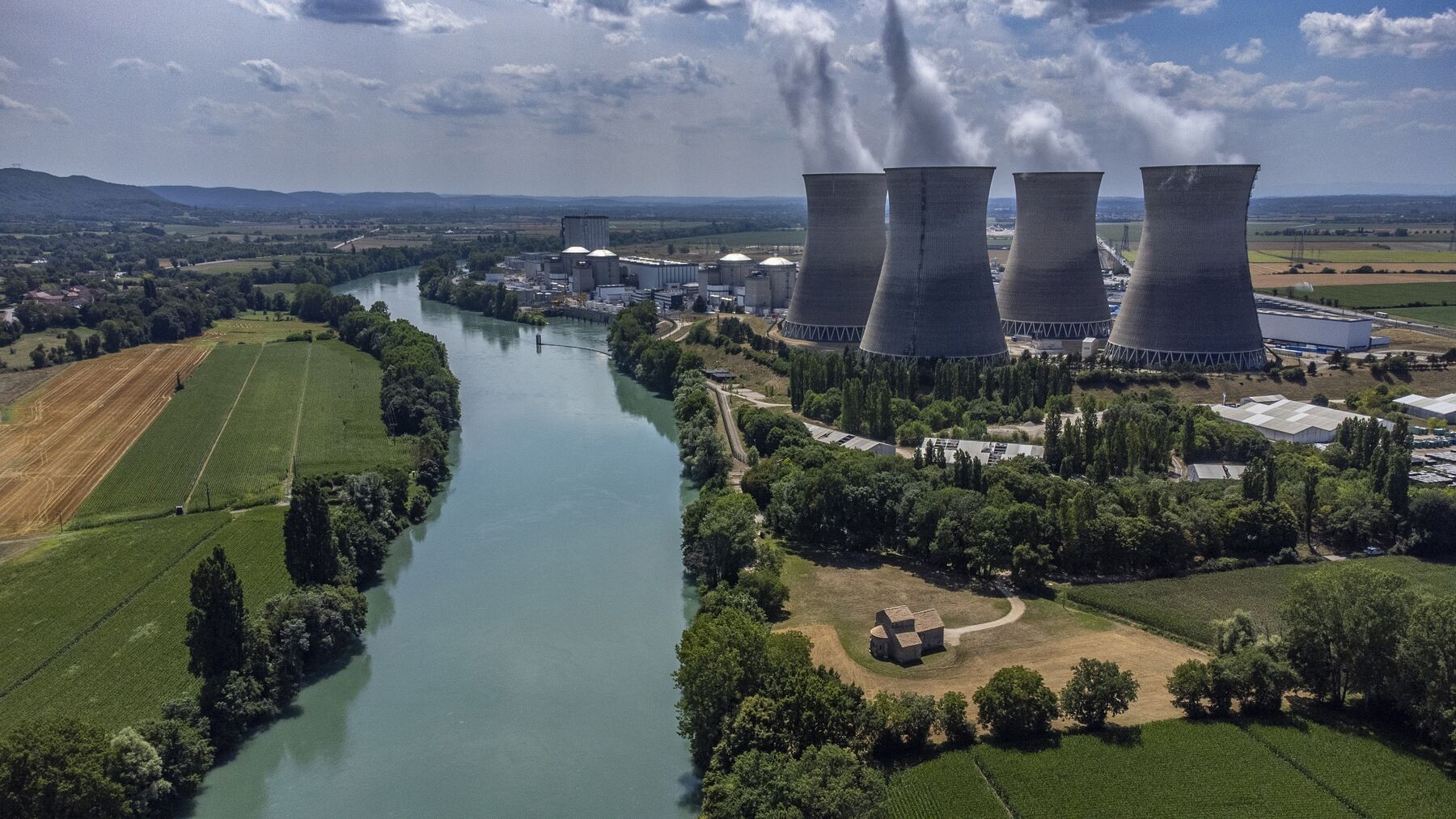
(Montel) French utility EDF has extended by two days a warning of power output curbs at three nuclear power plants – totalling 10 GW – along the river Rhone in southeastern France from tomorrow until Friday next week due to high temperatures.
Reporting by: Muriel Boselli, 08 Aug 2024, https://montelnews.com/news/f1e0a4b4-61b8-4d45-8027-d549192b910e/edf-warns-of-heat-related-cuts-at-3-nuclear-plants-10-gw
EDF could curb output at 3.6 GW Tricastin, 3.6 GW Bugey and 2.6 GW St Alban, the state-owned utility said on Thursday.
Weather service Meteo France has forecast temperatures to intensify in southeast France over the next few days, with peaks reaching 35C.
At some power plants, EDF uses river water to cool reactors. However, it could reduce output if river water temperatures or levels are too warm or too low.
Separately, EDF has extended a capacity cut warning at its 2.6 GW Golfech nuclear power plant in southwest France by three days to 17 August, due to warm temperatures.
Counteracting the nuclear spin, and more – week to 29 July

Some bits of good news. The Gambia’s decision to uphold ban on Female Genital Mutilation (FGM) a critical win for girls’ and women’s rights. Oceana Canada Celebrates Major Conservation Victory: Underwater Mountains off the Coast of B.C. Now Permanently Protected, under indigenous guidance. Great Green Wall has revived Africa’s degraded landscapes
**************************************
TOP STORIES.
What the top UN court’s ruling means for Israel. Netanyahu Commands, US Obeys.
Rolling stewardship of nuclear waste.
Young Changemakers Advocate for Nuclear-Free Future through Educational Journey in Kazakhstan.
Climate. Severe heatwave in Iran forces shops and public institutions to close
Noel’s notes. Militarism: How NATO is co-opting women and young people – with a veneer of peace and fun. The digital system threatens the nuclear industry – it’ll get worse with AI. Absolutely fed up with Facebook and Google’s censorship of nuclear issues.
************************************************
AUSTRALIA. Dutton’s nuclear delusion an exercise in stupidity. Czech nuclear deal shows CSIRO GenCost is too optimistic, and new nukes are hopelessly uneconomic. Aussies react to Dutton’s Nuclear Policy – https://www.youtube.com/watch?v=9o4S335dXM4
Canada rejects AUKUS nuclear submarine deal. AUKUS and the pride of politicians.
From the archives. Gina Rinehart’s threat to the proud independence of Australia’s Fairfax newspapers.
Respect and responsibility: Jabiluka safe as uranium mining lease for Kakadu site not renewed8.
Lots more Australian news at https://antinuclear.net/2024/07/23/australian-nuclear-news-headlines-22-29-july/
NUCLEAR ITEMS
CLIMATE. Hungary to allow nuclear plant to exceed Danube water temperature limit. Huge wildfire rips into California.
ECONOMICS.
- Critical AUKUS contract doubles in price and now a year late.
- ‘ Regulated Asset Base’ system mulled in Japan to add nuke plant construction costs to rates.
- Point Lepreau nuclear station down till at least September, costing utility extra $71M ALSO AT https://nuclear-news.net/2024/07/24/3-b1-point-lepreau-nuclear-station-down-till-at-least-september-costing-utility-extra-71m/ A New Brunswick reaction to the exorbitant costs of Point Lepreau nuclear power station.
- Spain: Nuclear Industry Reels After Tax Increase.
- UK / New Energy Minister Underlines ‘Absolute Support’ For SMRs, But Less Certain On Wylfa Plans.
- French nuclear giant ORANO slips into the red following Niger-French breakup. EDF looks towards future projects after flagging tough second half.
| EDUCATION. Bangor University to collaborate with Rolls Royce and the University of Oxford to develop nuclear power for space. | ENERGY. Solar doesn’t need a toxic “friendship” with nuclear power. | ETHICS and RELIGION. A letter to the children of tomorrow. “Nuclear disarmament is a right to life issue” – Catholic Archbishop John C Wester. |
EVENTS. 30 July Webinar: Halt Holtec – the Nuclear Mafia Atomic People will be broadcast on Wednesday 31 July on BBC Two and BBC iPlaye 6 August WEBINAR. Never Again! Remembering the Atomic Bombing of Hiroshima and Nagasaki
| LEGAL. A $36.8 billion lesson from Georgia– “The most expensive electricity in the world”Potential claims against NANO Nuclear Energy Inc. The World Court Has Cleared the Fog Hiding Western Support for Israel’s Crimes.Hundreds protesting Netanyahu visit arrested at US Capitol. Two legal actions against the hasty commissioning of Flamanville nuclear reactor. | MEDIA. BBC correspondent exposes ‘collapse of journalistic norms’ after 7 Oct. Meta’s Policy On Zionism Exposed: Cyberwell Scrambles After Israel Ties Revealed. U.S. media downplays and ignores ICJ ruling declaring Israeli occupation illegal. We published an analysis from a leading economist on soaring nuclear costs. Facebook removed it |
OPPOSITION to NUCLEAR . Nuclear energy not the way to go: coalition Taiwan. UK Nuclear Free Local Authorities back joint statement condemning AUKUS nuclear proliferation. Nuclear Free Local Authorities congratulate marchers on Lakenheath protest.
| PEACE. 2024 Golden Rule Voyage Begins! | PERSONAL STORIES. ‘Atomic bomb hell must never be repeated’ say Japan’s last survivors. | PLUTONIUM. Is nuclear waste able to be recycled? Would that solve the nuclear waste problem? |
| SAFETY Safety warnings as cracks rise at Torness nuclear plant. Japan Nuclear Restart Suffers Major Setback. | TECHNOLOGY. Humans should teach AI how to avoid nuclear war—while they still can. | WASTES. Radioactive Wastes from Nuclear Reactors. |
| WAR and CONFLICT. Israel nearing ‘all-out war’ – foreign minister. Washington gives Netanyahu ‘full backing’ to expand war on Lebanon: Israel Report. While Netanyahu is feted in U.S. Congress, Israeli airstrike hits a school sheltering people in Gaza, killing at least 30. Scottish parliamentarian highlights ‘nuclear annihilation risk’ in major UN speech | WEAPONS and WEAPONS SALES. Will US defend Japan with nukes or turn it into the line of fire? US Forces Japan to be upgraded to warfighting command. Tit for tat? Putin warns Russia may resume production of intermediate-range nuclear weapons. EU sets date of transfer of Russian money to Ukraine for arms purchases. |
We published an analysis from a leading economist on soaring nuclear costs. Facebook removed it
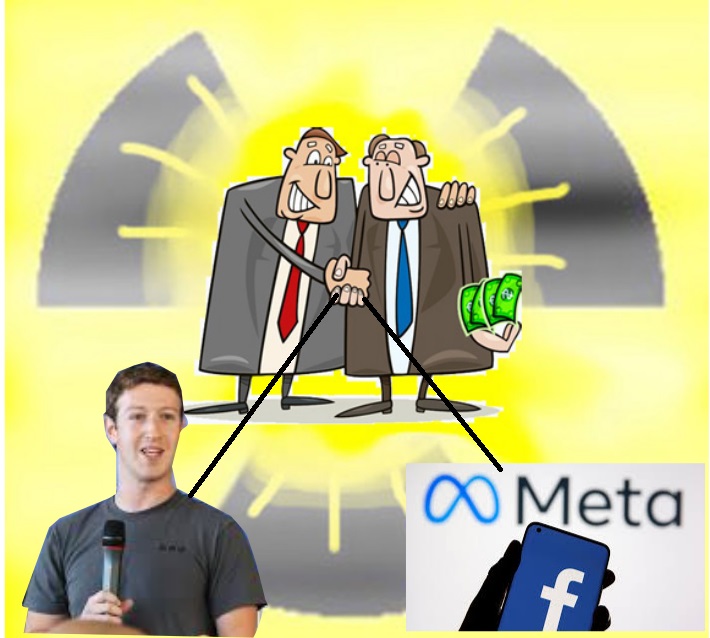
Facebook pages all still full of articles and videos making outrageous claims about renewables and nuclear. But that, it seems, is OK for the social media giant.
Giles Parkinson, Jul 22, 2024 https://reneweconomy.com.au/we-published-an-analysis-from-a-leading-economist-on-soaring-nuclear-costs-facebook-removed-it/—
On Sunday, Renew Economy published an analysis on the soaring cost of nuclear power by leading economist John Quiggin. On Monday we attempted to post it in our feed on social media.
Facebook removed the item, saying it was an attempt to generate clicks by providing misleading information. We’d like to know on what basis this decision was made, but Facebook has yet to provide an answer.
It’s a concerning development, and not the first time one of our posts has been removed by Facebook.
Social media platforms including Facebook, X, YouTube, TikTok, and Instagram – are full of unchecked and misleading information about climate change and energy technologies. Much of it is complete nonsense creating FUD – fear, uncertainty and doubt – about new technologies.
It appears to be part of a well-funded and orchestrated plan by vested interests, and the fossil fuel industry in particular, to demonise renewables, electric vehicles, battery storage and other emerging competitors.
Much of this is amplified in mainstream media, where outrageous claims against renewables – and claims of blackouts, economic collapse and environmental failure – are repeatedly given voice.
Social media platforms including Facebook, X, YouTube, TikTok, and Instagram – are full of unchecked and misleading information about climate change and energy technologies. Much of it is complete nonsense creating FUD – fear, uncertainty and doubt – about new technologies.
It appears to be part of a well-funded and orchestrated plan by vested interests, and the fossil fuel industry in particular, to demonise renewables, electric vehicles, battery storage and other emerging competitors.
Much of this is amplified in mainstream media, where outrageous claims against renewables – and claims of blackouts, economic collapse and environmental failure – are repeatedly given voice.
Quiggin notes that the Czechia deal suggests the opposite is true, and confirms the widely held view in the energy industry itself that GenCost underestimates rather than overestimates the costs of nuclear. Nuclear, he says, is really really expensive.
But Facebook has now ruled that such analysis is misleading, and it won’t allow its users to view such information. Over the last few months, this has happened on several occasions to Renew Economy and its sister site The Driven.
Just last week, another article on the certification of green hydrogen technologies in Australia was pulled down. Last month, it was a story on how households will be a driving force of the energy transition. A few months earlier, an analysis on nuclear costs by Jeremy Cooper, the former deputy chair of ASIC and chair of the 2009/10 Super System Review, was also removed.
Over on The Driven, a story on how EVs are actually suitable for farmers in regional communities, was also pulled down. No explanation was provided. Despite protests, the posts were not reinstated.
Yet Facebook allows media groups such as Sky News Australia to post misleading information about renewables and climate without a check.
It’s a shocking development, and one that points to the manipulation of information by naysayers and vested interests. Some attribute it to the work of the Atlas Network, a shadowy group with strong Australian fossil fuel links that has campaigned against renewables, the Voice referendum, climate action, and climate protests.
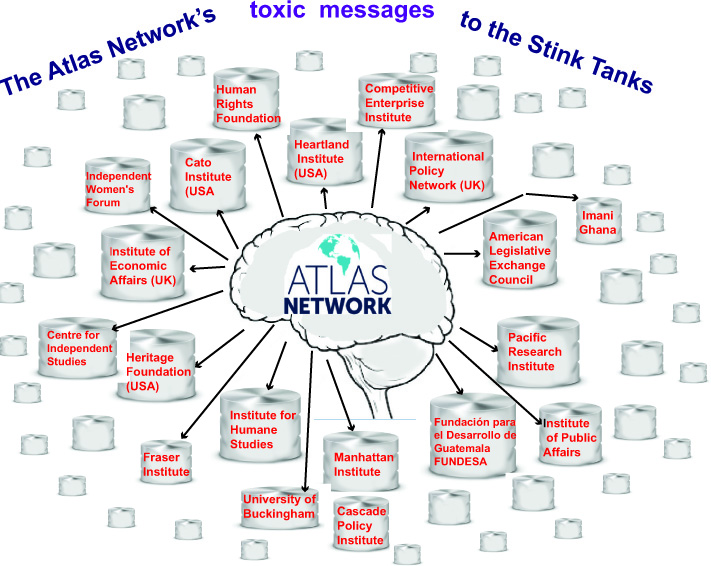
Researchers say that the whole point of the Atlas network of organisations and so called “institutes” and think tanks – which this article in New Republic says includes Australia’s Centre for Independent Studies, which has launched loud attacks against institutions such as the CSIRO, AEMO, and renewables in general – is to drown out actual academic expertise.
The Atlas Network does this, researchers say, to reduce the capacity for public and government influence with its own corporate propaganda that is dressed up as “research.”
George Monbiot, a columnist for the Guardian, calls many of the 500 institutions linked with the Atlas Network “junk tanks.” Jeremy Walker, from the University of Technology in Sydney, wrote in a paper that the network in Australia includes the CIS and the Institute for Public Affairs, both strongly anti renewable, and pro nuclear.
Their Facebook pages all still full of articles and videos making outrageous claims about renewables and nuclear. But that, it seems, is OK for the social media giant.
This week – nuclear news to 22 July

Some bits of good news. Support for parents and children from birth. Montenegro signs the Declaration on Children, Youth and Climate Action
TOP STORIES.
Nuclear industry faces acute cybersecurity threats – report.
International Court of Justice Tells Israel to End Occupation of Palestinian Territories, Pay Reparations.
- History of Ionizing Radiation and Human Health.
- ‘Low level’ ionizing radiation, and the history of debate about its effects.
- Time to confront to cover-up of the harm of low-level radiation.
- History of the medical profession’s role in illnesses and death caused by nuclear radiation. (Originals at https://ionizingradiationandyou.blogspot.com/)
From the archives. An unacceptable risk to children
Climate. 27 Ways Heat Can Kill You – Update 2024
Noel’s notes. The cover-up of the danger of nuclear radiation and health, but who is speaking for our grandchildren? Nuclear power -costs, wastes, etc, but what about the children? More American media madness.
********************************************
AUSTRALIA.
- Behind the plans for Australia to become a nuclear dumping ground and leverage synergies with the US military alliance and civilian nuclear.
- What are the steps (and the COSTS) to building nuclear power stations – by Peter Farley
- Greens up pressure against nuclear.
- Dutton’s Quixotic Proposal: Nuclear Lunacy Down Under.
- Can the Voices model help communities fight off nuclear reactors? Agriculture ministers raise ‘serious’ concern over nuclear plans,
- Australia: Opposition’s nuclear power plans open the door for nuclear weapons.
- Australia’s secret support for the Israeli assault on Gaza, through Pine Gap.
- How close are we to chaos? It turns out, just one blue screen of death. Lots more Australian nuclear news at https://antinuclear.net/2024/07/17/australian-nuclear-news-headlines-week-to-22-july/
………………………………………….
NUCLEAR ITEMS.
| ART and CULTURE. The chilling map that shows the devastation of a nuclear attack on Scotland. | ATROCITIES. Israeli soldiers tell story of savage cruelty in Gaza – one given blessing by the West. | CIVIL LIBERTIES. Never Forget Julian Assange. https://www.youtube.com/watch?v=5ZLbFkv7I4k |
| ECONOMICS. Premier of New Brunswick Higgs suggests New Brunswick’s Small Nuclear Reactors may not win race to commercialization. ALSO AT https://nuclear-news.net/2024/07/19/2-b1-premier-of-new-brunswick-higgs-suggests-n-b-s-smrs-may-not-win-race-to-commercialization/ France’s EDF faces fresh setback after losing Czech nuclear bid. | ENERGY. China is installing the wind and solar equivalent of five large nuclear power stations per week. Nuclear does not mean reliable power for Australia – by Peter Farley. |
| ENVIRONMENT. EDF’s plans to create new saltmarsh. | EVENT. Cold War Scotland – Exhibition National Museum of Scotland24 July. Rally – Washington – Stop the Gaza Genocide . |
| HEALTH. Radiation.New Book. The Scientists Who Alerted us to Radiation’s Dangers.Mounting evidence of cancer risk from low dose radiation in childhood, or in the uterus.Specific Radioactive Elements and Their Effects on Health – (Original at https://ionizingradiationandyou.blogspot.com/) | INDIGENOUS ISSUES. In New Mexico, a Walk Commemorates the Nuclear Disaster Few Outside the Navajo Nation Remember. | LEGAL. Overwhelming ICJ Ruling against Israeli Occupation Highlights Need for UN Action. ActionAid welcomes the historic judgment of the International Court of Justice. |
| MEDIA. With Media Enamored by US Presidential Race, Israeli Massacres in Gaza Get Even Deadlier. | OPPOSITION to NUCLEAR . Anti-nuclear weapons activists to camp outside RAF base for ten days. Nuclear Free Local Authorities challenge UK government on New Cleo’s application for “justification” of its small nuclear “fast” reactor. Nuclear convoys travelling to Coulport should be peacefully stopped |
| PERSONAL STORIES. Testimonies from the Mawasi massacre: 90 people buried in the sand. | PLUTONIUM . North Korea’s Yongbyon Nuclear Complex: New evidence of increased activity |
| POLITICS.J.D. Vance unlikely to advance peace advancing to Vice Presidency.UK: Ed Miliband unveils plans for mini-nuclear reactors ALSO AT https://nuclear-news.net/2024/07/22/1-b1-uk-ed-miliband-unveils-plans-for-mini-nuclear-reactors/Campaigners against Sizewell C hopeful new MPs will take their concerns to parliament.Absent but not missed: No mention of nuclear in King’s Speech.80 CANADIAN ORGANIZATIONS CALL ON FEDERAL GOVERNMENT TO RESCIND APPOINTMENT OF NUCLEAR REGULATORY AGENCY PRESIDENT. | POLITICS INTERNATIONAL and DIPLOMACY.AUKUS – Australia-United Kingdom-United States nuclear pact endangers us all.Saudi Arabia wants to fully recognize Israel in exchange for arms, nuclear facility — Biden.Nuclear-weapon states are disregarding political commitments accepted under the nuclear Non-Proliferation Treaty (NPT), |
| SAFETY. Major failure at southern Russia’s largest nuclear plant, 1 power unit shut down.‘Near miss’ incident reported at nuclear waste site near Carlsbad. High hopes and security fears for next-gen nuclear reactors | SPACE. EXPLORATION, WEAPONS. Space-Based Warfare: America’s Dominance Challenged.Please, No Weapons and Wars in Space. |
| SPINBUSTER. Shiny New MP’s Fizzingly Push For More Nuclear Waste – Hotter the better! And a Complaint to Advertising Standards – Standards? What Standards!. | TECHNOLOGY. Massive IT outage spotlights major vulnerabilities in the global information ecosystem. Small Modular Nuclear Reactors (SMRs)– Dirty Dangerous Distractions from Real Climate Action. | WASTES. Pacific leaders, Japan, agree on Fukushima nuclear wastewater discharge (not everyone is happy). Fukushima plant ends 7th round of treated water release into sea. |
| WAR and CONFLICT. Nuclear War Is Imminent. Exposing the Myth of the ‘Good War’US Ally South Korea Threatens Nuclear-Armed North Korea With Regime Destruction. | WEAPONS and WEAPONS SALES.Democrats to Keep Unconditional Military Aid to Israel in Party Platform. NATO’s Obscure Relations With Israel and its weapons industry. NATO/US Complicity in Israel’s Relentless Genocide of Gaza. Israel using water as weapon of war as Gaza supply plummets by 94%, creating deadly health catastrophe: Oxfam. North Korean nuclear weapons, 2024. China Stops Arms Control Talks With the US Over Arms Sales to Taiwan. Russia Says It May Deploy Nuclear Missiles in Response to New US Missile Deployment to Germany. |
Nuclear news – week to 15 July

Some bits of good news – Ancient conservation practice restoring the Middle East. Restoration of Maple River offers hope for future conservation initiatives. China cleans up its air and water.
TOP STORIES
NATO SUMMIT: Collectively Losing Their Minds. For 75 Years, NATO Has Been Terrorizing the Globe. German Parliamentarian in Washington Says No to NATO – Yes to Peace.
The Atlas Network and the Council for National Policy: America’s global revolution. The Atlas Network’s transnational revolution. https://johnmenadue.com/the-atlas-networks-transnational-revolution/ https://www.youtube.com/watch?v=bZ_AG6irJ_g
Climate. Temperatures 1.5C above pre-industrial era average for 12 months, data show.
Noel’s notes. The NATO statement – absurdity and collective suicide? The insanity of rampant mindless new technology.
****************************************************
AUSTRALIA.
- Experts argue for an Australian ban on nuclear weapons ahead of UN Summit.
- Book – “Nuked” on Aukus ‘fiasco’ says decision to embrace pact will ‘haunt’ Labor for years.
- South Australia’s renewable triumph is stunning proof that Dutton’s nuclear plans are a folly. No room for nuclear: AGL Energy, Australia’s biggest supplier of AGL baseload power, says flexibility is key as it plans to dump coal for renewables in a decade.
- Aboriginal supporter of right-wing racism, Warren Mundine’s interests in mining uranium -not doing too well.
- The Institute of Public Affairs (IPA) just exploded their argument that the “Atlas Network” is tinfoil hat conspiracy.
- Don’t make my home a nuclear power hub– nuclear reactors in Latrobe Valley unsafe and unrealistic ALSO AT https://antinuclear.net/2024/07/12/2-a-dont-make-my-home-a-nuclear-power-hub-nuclear-reactors-in-latrobe-valley-unsafe-and-unrealistic/
- Decoded: Defence Department’s deadly deceits.
- Power-hungry data centres are booming in Australia. Can the grid cope?
- Game of Mates. The Australian War Memorial and its military industrial conflicts of interest.
- More Australian nuclear news at https://antinuclear.net/2024/07/09/nuclear-and-associated-news-to-16-july
NUCLEAR ITEMS
| ATROCITIES. The Lancet study estimates death toll in Gaza 186,000 or even more. Counting the dead inGaza: difficult but essential. ‘Horrific Massacre’: Israel Bombs Gaza School Used as Refugee Camp, Killing Dozens. | CLIMATE. Texas Nuclear Power Plant Hit By Hurricane Beryl. | ECONOMICS.Analyst Says Nuclear Industry Is ‘Totally Irrelevant’ in the Market for New Power Capacity.New Brunswick’s nuclear-powered rate hikes.New nuclear is ‘too expensive’ for UK zero-carbon energy target.EDF pulls out of competition to build mini-nuclear reactors in Britain.€130 Billion Nuclear Dream in Europe Meets Financial Reality. |
| EMPLOYMENT. With global race to decarbonize electricity sector, demand for skilled nuclear workers heats up.https://nuclear-news.net/2024/07/09/2-b-with-global-race-to-decarbonize-electricity-sector-demand-for-skilled-nuclear-workers-heats-up/ | ENERGY.“The Sun has won”: exponentially growing solar destroys nuclear, fossil fuels on price.Solar power will lead globally- says Rocky Mountain Institute (RMI). South Australia locks in federal funds to become first grid in world to reach 100 per cent net wind and solar. U.S. Solar and Wind Power Generation Tops Nuclear for First Time. | ENVIRONMENT. NATO’s nuclear bases have poisoned water and fish. |
| ETHICS and RELIGION. The false equivalency of nuclear disarmament and nuclear abolition. | EVENTS. 13 – 25th July PROTEST ACTION AT LAKENHEATH -Stop nuclear weapons returning to Lakenheath UK –sign on at https://lakenheathallianceforpeace.org.uk/sign-up/ 24 July. Rally – Washington – Stop the Gaza Genocide | HISTORY.July 16 – New Mexico anniversaries – of first nuclear weapons test, and of Church Rock radioactive waste disaster. The dirty history of ‘Nukey Poo’, the reactor that soiled the Antarctic. ALSO AT https://antinuclear.net/2024/07/12/2-a-the-dirty-history-of-nukey-poo-the-reactor-that-soiled-the-antarctic/ |
| LEGAL. First Nation challenges nuclear waste decision in federal court. | MEDIA. The Corporate News Media at Work, Julian Assange And The Criminalization of Journalism: A Story Of Moral Injury And Moral Courage. Book “Nuked” , on Aukus ‘fiasco’ says decision to embrace pact will ‘haunt’ Australia’s Labor for years. NATO member to fight ‘pro-war propaganda’ – official. 16 July marks 79 years since the Trinity test. | OPPOSITION to NUCLEAR . Anti-nuclear protestors to march from Norwich to Lakenheath. First Nations and allies resist proposed radioactive waste repository. Hundreds of Scientists Urge Biden to Cancel $100 Billion Nuclear Weapons Boondoggle. |
| POLITICS.Biden’s press conference and the war hysteria of American imperialismUS Mayors for Peace Call for Dialogue in a Time of Nuclear Danger. Tracking Dissent: US Officials Who Have Resigned Over The War on Gaza.Newly Signed Bill Will Boost Nuclear Reactor Deployment in the United States. Joe Biden Just Signed a Popular, Bipartisan Nuclear Power Bill. Advocates Say It’s a Sign of Things to Come. Biden signs ADVANCE Act. Now what?Scottish Nuclear Free Local Authorities Convenor seeks ‘respect’ for Scotland’s stance on nuclear power | POLITICS INTERNATIONAL and DIPLOMACY.NATO Washington Summit Declaration – a delusional March of Folly.NATO: From Cold War Defensive Coalition to Global Military Behemoth- https://www.youtube.com/watch?v=1vDfxo653cY NATO at 75: obsolete but still risking nuclear war, seeking dragons to slay.Medea Benjamin DISMANTLES Biden NATO Reelect Pitch. https://www.youtube.com/watch?v=sJDvmAWcuUIInside the NATO Summit in Washington, D.C. Serbia’s Nuclear Energy Quest Opens Geopolitical Flash Point For China, Russia, And The West. |
| SAFETY. US bases in Europe on high alert for possible terrorist attack: US Department of Defense. | SECRETS and LIES. US-made missile suddenly ‘transformed’ into a ‘Russian’ one and killed 40 civilians. Sellafield bosses ignored and punished this whistleblower. | SPINBUSTER. Kiev missile attack. What happened? [i] |
| TECHNOLOGY. Hinkley Point C, the £46 billion mega-project digging tunnels under the sea Blow to Miliband’s nuclear ambitions as top mini-nuke lab faces closure. Point Lepreau nuclear power plant has a generator ‘issue,‘ says NB Power. Utility doesn’t know how long it will take to fix. | WASTES. Radioactive Real Estate: Finding a Forever Home for Nuclear Waste. Ignace, Ontario, betrayed by Council, on nuclear waste decision, Radioactive Waste: Symposium Primer -Samuel Lawrence Foundation – https://www.youtube.com/watch?v=l4c28c3jLY0 Water leaks reported at Germany’s Asse II radwaste facility. Decommissioning. Radiation levels assessed for on-site burial plan at old nuclear power station |
| WAR and CONFLICT. Gaza deal must allow Israel to keep fighting -Netanyahu. How Netanyahu Has Systematically Foiled Talks to Release Hostages From Hamas Captivity. US war games in Pacific seek global participation in imperialist maneuvers. | WEAPONS and WEAPONS SALES. Pentagon keeps commitment to Sentinel nuclear missile as costs balloon. Wall Street Journal finally admits high-tech Western weapons ‘useless’ in Ukraine conflict. Russian Officials Vow Response to US Missile Deployment to Germany. |
For Australia – a cautionary nuclear tale from New Brunswick, Canada

New Brunswick’s nuclear-powered rate hikes, Commentary, by Janice Harvey, July 8, 2024, https://nbmediacoop.org/2024/07/08/new-brunswicks-nuclear-powered-rate-hikes/
The abject failure of this and previous governments’ energy policies is on full display these days. In the 1970s, New Brunswick was one of only three provinces that bought into the federal government’s agenda to build out a civilian nuclear power industry. Quebec has since shut its nuclear generators down, leaving only Ontario and New Brunswick as the nuclear flag-bearers. How has that worked out for us?
NB Power has come to the Energy and Utilities Board (EUB) with a request for the biggest rate hikes in the utility’s history. While the details are buried in thousands of pages of documents filed with the EUB, evidence from previous EUB hearings makes it crystal clear that the utility’s single greatest financial liability driving up power rates is the much-vaunted Point Lepreau Nuclear Generating Station.
Point Lepreau has been a financial white elephant since its construction ended up costing three times the original price tag. Its planned 30-year lifespan (over which all this extra cost was to be amortized) was cut short by premature aging of critical reactor components, prompting a decision to undergo an expensive refurbishment, which was to extend the life of the plant by a fantastical 40 years. At the time, the then-PUB determined based on the evidence that refurbishment was too big a financial risk for New Brunswickers to handle and recommended against it. The Lord government went ahead anyway.
Like the original construction, the refurbishment went way over the timeline and budget. The result has been very poor performance, a miserable 60 per cent in 2022 compared to the wildly optimistic 90 per cent capacity assumption that the EUB rejected. The costs of replacement power alone during these shutdowns have repeatedly sabotaged annual financial performance projections. Now, Point Lepreau is facing even more expensive upgrades to fix problems that were not dealt with during the refurbishment.
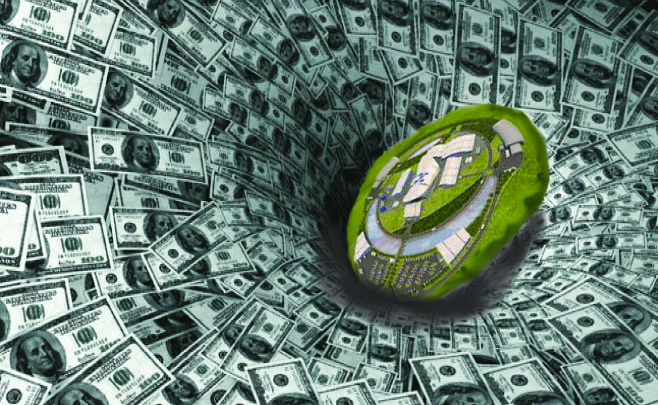
In short, Point Lepreau is the most unreliable and most expensive power generator on the grid, responsible for the lion’s share of NB Power’s debt. It is not going to get any better. Keeping it afloat until 2040, its new end-of-life target, is going to mean more of the same – throwing scarce money down a deep, black hole paid for by ever-rising power rates.

Despite the overwhelming evidence that New Brunswickers cannot afford nuclear power, the Higgs government has doubled down on nuclear, floating an equally fantastical proposition that the next generation of nukes – so-called small modular reactors – will quarterback New Brunswick’s climate change strategy, while an SMR export industry is expected to drive economic growth. To that end, New Brunswick taxpayers have already fronted a total of $35 million to two private nuclear upstarts, neither of which has designed or built a reactor. This is despite lots of reasons to put their rosy promises of “clean” nuclear-fueled prosperity in the same wishful thinking category as JOI Scientific’s power-from-water scheme that so beguiled NB Power executives.
Just as the EUB rate hearings got underway, an entirely predictable hitch in the Higgs’ nuclear dream occurred. It seems like the SMR upstart ARC Clean Energy is on its way down and out, taking $25 million provincial dollars and $7 million federal with it. If we’re lucky, Moltex Energy, propped up by $10 million in provincial and $50.5 million in federal tax dollars, will be close behind, and we can breathe a sigh of financial relief. The longer this nonsense persists, the more of our tax dollars will go into the nuclear black hole, and the greater the delay in meeting our climate change pollution targets.
Even if Moltex hangs on, or some other SMR promoter replaces them, any electricity that might eventually flow from an SMR will be, like Point Lepreau, the most expensive power on the grid – entirely unaffordable and unnecessary. The Higgs government knows this, passing legislation this spring requiring NB Power to buy electricity from the planned privately-owned SMRs regardless of price, a silent admission that electricity from SMRs, should they ever see the light of day, will be more expensive than any alternative. In other words, SMRs will drive up your power bill.
Meanwhile, the June 22nd issue of The Economist features the exponential growth of solar energy worldwide, the cost of which – even with storage – is falling exponentially. Other than home retrofits, this is the cheapest new power on offer.
The nuclear cost numbers are there for all to see. For elected representatives to support this industry, knowing people cannot tolerate higher power rates, is grossly irresponsible and a betrayal of trust. Renewables naysayers are depriving New Brunswickers of the benefits of this global energy transition. This – and our nuclear-powered rate hikes – need to be on the ballot on October 21.
Janice Harvey is the chair of the Environment and Society program at St. Thomas University
“The Sun has won”: exponentially growing solar destroys nuclear, fossil fuels on price

Given Dutton’s claims about solar power costing more than nuclear are made ridiculous by the fact that solar’s break-even price has fallen by a factor of more than 1000 and the trend is continuing.
Meanwhile cost overruns in nuclear are endemic and SMR’s only exist in Dutton’s imagination.
By Noel Turnbull, Jul 11, 2024, https://johnmenadue.com/the-sun-has-won-exponentially-growing-solar-destroys-nuclear-fossil-fuels-on-price/—
It’s not known if Peter Dutton reads The Economist but if he does, he must probably think from time to time that it is sometimes dangerously left wing.
In the 22 June issue, it had a special essay on solar power – headlined ‘The Sun Machine’. The sub-head was “An energy source which gets cheaper the more you use it marks a turning-point in industrial history’.
The essay is a total contradiction of almost everything Dutton is claiming about nuclear and renewable energy.
“What makes solar energy revolutionary is the rate of growth which brought it to this just-beyond the marginal state”, the essay says.
They cite a veteran energy analyst, Michael Liebreich, who shows that in 2004 it took a year to install a gigawatt of solar power capacity; in 2010 it took a month; in 2016 a week; and in single days in 2023 there were a gigawatt of installation worldwide.
Current projections are that solar will generate more electricity than all the world’s nuclear plants in 2026; than wind turbines in 2027; dams in 2028; gas-fired plants in 2026; and coal-fired ones in 2032.
All that well before Dutton’s nuclear plants – if at all – start generating power. Moreover, unlike nuclear power which notoriously always takes longer to build than predicted, predictions about the rate of solar power roll-out are consistently under-estimates.
The Economist points out that in in 2009 The International Energy Agency (IEA) predicted solar would increase from 23GW to 244GW by 2030. It hit that milestone in 2016 – less than a third of the predicted time. The world capacity was 1419GW by 2023.
Ironically, one of the few organisations which got their predictions roughly right was Greenpeace – yet even their prediction was an under-estimate.
Given Dutton’s claims about solar power costing more than nuclear are made ridiculous by the fact that solar’s break-even price has fallen by a factor of more than 1000 and the trend is continuing. Meanwhile cost overruns in nuclear are endemic and SMR’s only exist in Dutton’s imagination.
Dutton is stronger on ideology and outrageous claims than economics, but the manufacture of photovoltaics is a classic example of the benefits of mass production – benefits which have always eluded the nuclear power industry.
As The Economist points out solar cells are standardised products all made in basically the same way and “they have no moving parts at all, let alone the fiendish complexity of a modern turbine.”
“Manufacturers compete on cost, by either making cells that make fractionally more electricity, by either making cells that make fractionally out of a given amount of sunshine or which cost less.”
Economics 101 teaches us that a commoditised product does not lead to more and more aggressive competition on the supply side – simply in this case by getting more electricity out of any given amount of sunshine or by costing less.
Rob Carlson, a technology investor, told The Economist: “There is no other energy-generation tech where you can install one million or one of the same thing depending on your application.”
“The Sun has won” he says.
The Economist said: “From the mid-1970 to the early 2020s cumulative shipments of photovoltaics increased by a factor of a million which is 20 doublings. At the same time prices dropped by a factor of 500. That is a 27% decrease in cost of doubling of installed capacity, which means a halving of costs every time installed capacity increases by 360%.
Adair Turner, an eminent economist and financial services executive, was Chair of Britian’s Climate Change Committee which was set up to help transition to zero emissions.
He told The Economist: “We totally failed to see that solar would come down so much.”
BloombergNEF estimated, in 2015, that the cost for solar on a global basis was $122 per MWH – higher than on shore wind and coal. Today both solar and onshore wind are almost half the cost of coal.
Meanwhile, Dutton has welcomed Keir Starmer’s election win by pointing to his support for nuclear power. Which, given that the UK has already installed nuclear power, the cautious Starmer is unlikely to announce that he is closing it down.
Moreover, Starmer’s major problem with nuclear is managing the spiralling delays in, and cost of, nuclear plants being constructed following typical Tory blunders.
The question which Dutton needs to answer is why he knows more about nuclear and solar power than The Economist reporters, Bloomberg, Adair Turner, Rob Carlson, many major investment funds and the overwhelming majority of Australian scientists?
He might ponder all that while the Murdoch media is becoming a tad critical of him – criticising his policy on supermarket divestment and speculating on who might be the Liberal Party leader if Dutton loses the next election.
Meanwhile, notwithstanding their doubts about Dutton’s chances and policies (other than nuclear) The Australian never totally loses its manic opposition to anything progressive. The inimitable Greg Sheridan opined on The Australian front page (6/7) that Labour had not won but the Tories had lost. Partly true obviously, but his piece was enough to prompt the subs to headline the piece with “Self-described socialist is set to drag Britain far to the left”.
Sheridan also rehearsed his regular hates and speculated how it would all come undone.
Jeremy Corbyn would love that to be the case but Starmer not so.
Perhaps the funniest lines in Sheridan’s’ piece were: “Starmer is brainy and works hard. Too deep immersion in the law has rendered it impossible for Starmer to write felicitous prose or create memorable images.”
From a journalist who year after year simply reproduces the same old opinions on the same old subjects that is, to say the least, a bit much.
Nuclear and associated news -week to 8th July

Some bits of good news. Conservation and economic development go hand in hand, more often than expected. Peru has protected 6,449 hectares of an endemic fog oasis that hosts hundreds of rare and threatened species.
TOP STORIES
Trump has a strategic plan for the country: Gearing up for nuclear war.
How do you convince someone to live next to a nuclear waste site?
Nuclear power would put our energy security into Russian hands– ALSO AT https://nuclear-news.net/2024/07/05/1-a-nuclear-power-would-put-our-energy-security-into-russian-hands/
Climate. Climate hazards impact more than four-fifths of cities worldwide, study finds. How record-breaking Hurricane Beryl is a sign of a warming world.
Noel’s notes. Australia further in the grip of the USA, with the Amazon data spy hub – paid for by Aussie tax-payers. The world must stop creating nuclear garbage.
AUSTRALIA. Australians being kept in the dark about Pine Gap expansion. Australia to build ‘top-secret’ cloud for intelligence agencies in $2bn deal with Amazon. Political Mastermind: a toxic waste of everyone’s time. https://www.youtube.com/watch?v=R4HGJ42c2Kg With its nuclear energy policy, Peter Dutton seems to have forgotten the Liberal Party’s core beliefs. See more Australian news at Australian nuclear news headlines this week.
NUCLEAR ISSUES
| ATROCITIES. Israel Has Forcibly Displaced 1.9 Million Palestinians in Gaza. | CLIMATE. Can the climate survive the insatiable energy demands of the AI arms race? | ECONOMICS. French nuclear giant scraps SMR plans due to soaring costs, will start over. EDF’s Nuward U-turn shows risk of betting on Small Nuclear Reactors – analysts. Labour must act fast to fire up Rolls-Royce nuclear reactor deals.Too uncertain, too slow: funds rule out financing Australia’s Dutton nuclear plan. |
| EMPLOYMENT. Talent Shortage Threatens Europe’s Nuclear Renaissance. | EVENTS. 10 July Rally to oppose nuclear mega-dump and support Kebaowek First Nation – at noon in Ottawa https://www.stopnuclearwaste.com/ | LEGAL. Why Julian Assange couldn’t outrun the Espionage Act. | MEDIA. Book. Nuclear is Not the Solution. The Folly of Atomic Power in the Age of Climate Change. |
POLITICS.
- Now Keir Starmer Has to Decide If He’d Use Nukes. https://www.youtube.com/watch?v=NQO6rJsVNkw . Tory accused of exaggerating chances of new nuclear plant. SCOTTISH GREENS WILL OPPOSE ALL PLANS FOR NEW NUCLEAR ENERGY. Work to show UK nuclear ‘environmentally sustainable’ incomplete, 16 months after government announcement. ‘Letters of last resort’: deciding response to a nuclear attack among first of Starmer’s tasks.
- Trump Advisers Call for U.S. Nuclear Weapons Testing if He Is Elected. . Congressional group on nuclear arms sets July hearing for embattled missile program.
- Starmer’s role in Assange’s prosecution.
- Masoud Pezeshkian: Iranian reformer who wants to end Tehran’s nuclear stand-off.
- Public Vote on Nuclear Power Plant Sparks Debate in Kazakhstan.
| POLITICS INTERNATIONAL and DIPLOMACY.Europe is Quietly Debating a Nuclear Future Without the US.Trusting the ‘Five Eyes’ OnlyUkraine to be warned it’s ‘too corrupt’ for NATO .What does Iran’s Nuclear Policy look like with the new president? | SAFETY. Russia might restart the Zaporizhzhia Ukrainian nuclear plant it seized. | SECRETS and LIES. Former New Brunswick energy minister joins nuclear industry after resigning in June. Australian Opposition leader Dutton’s claim about G20 nuclear energy use doesn’t add up. |
| SPINBUSTER. The nuclear and renewable myths that mainstream media can’t be bothered challenging. The overblown hype of the nuclear “bros”. | TECHNOLOGY.The commissioning of the Flamanville EPR, nuclear reactor is proving difficult.Unable to effectively operate its lone existing nuclear reactor, New Brunswick is betting on advanced options ALSO AT https://nuclear-news.net/2024/07/04/1-b1-unable-to-effectively-operate-its-lone-existing-nuclear-reactor-new-brunswick-is-betting-on-advanced-options/World’s Largest Nuclear Fusion Reactor Delayed . ITER nuclear fusion reactor hit by massive decade-long delay and €5bn price hike. Fusion power could transform how we get our energy — and worsen problems it’s intended to solve.Constellation Energy plans restart of Three Mile Island nuclear plant. |
| WAR and CONFLICT. Ukrainian drones injure Zaporizhzhia nuclear power plant workers, say Russian-backed officials.Tensions with Iran spotlight Israel’s hidden nuclear arsenal.The obsolescence of war. | WEAPONS and WEAPONS SALES.You Don’t Want to Live in America’s ‘Nuclear Sponge’ .NATO Members Agree To Give Ukraine $43 Billion in Military Aid for 2025. US announces more than $2 billion package for Ukraine.US nuclear missile program costs soar to around $160 billion, sources say. Trump allies are peddling a catastrophic idea for U.S. nuclear weapon policy.Philippines Says US Will Pull Out Controversial Mid-Range Missile System. |
Dutton’s claim about G20 nuclear energy use doesn’t add up
William Summers , July 5, 2024, https://www.aap.com.au/factcheck/duttons-claim-about-g20-nuclear-energy-use-doesnt-add-up/
WHAT WAS CLAIMED
Australia is the only G20 nation that doesn’t use nuclear power.
OUR VERDICT
Misleading. Five other G20 nations don’t generate nuclear power, and two of those don’t use it.
AAP FACTCHECK – Federal Opposition Leader Peter Dutton claims Australia is the only country not to use nuclear energy out of the world’s 20 largest economies.
This is misleading. Five other nations in the top 20 – Germany, Italy, Turkiye, Saudi Arabia and Indonesia – do not generate nuclear energy.
Germany, Italy and Turkiye import very small amounts of electricity generated from nuclear sources, but Indonesia and Saudi Arabia don’t consume any nuclear power.
Australia is the only top 20 economy that doesn’t generate, import or have a plan to do so.
Mr Dutton has made the claim at least four times in interviews about the coalition’s plan to build seven nuclear power stations in Australia without clarifying that he’s counting countries planning to use nuclear power among those that are actually using it.
Mr Dutton said nuclear power was “used by 19 of the 20 biggest economies in the world” at a June 18 press conference in NSW.
He again claimed that of the top 20 economies in the world, “Australia is the only one that doesn’t have nuclear” in a June 20 interview on Sky News.
That same day, the opposition leader spoke out about how Australia could benefit from nuclear power “as 19 of the world’s top 20 economies have done” in an ABC News Breakfast interview.
Mr Dutton again said Australia was the only one of the 20 biggest economies that “doesn’t operate” nuclear at a press conference on July 5.
When asked to clarify his claims, the opposition leader’s spokeswoman told AAP FactCheck that he’s counting countries that have nuclear power and those “taking steps towards embracing nuclear”.
Mr Dutton accurately stated 19 of the world’s 20 biggest economies used nuclear power or “have signed up to it” in another press conference on June 19, and a Today Show interview on June 21.
He also said Australia was the only G20 member that didn’t use or plan to use nuclear power in an ABC TV interview on April 21.
The G20 is a global forum for countries with large economies. Despite its name, the G20 includes only 19 nations, plus the African Union and the European Union. Spain is invited to the G20 as a permanent guest.
It’s unclear if Mr Dutton is referring to the G20 countries plus Spain, or the 20 largest nations by gross domestic product, as he’s used both interchangeably.
However, AAP FactCheck has analysed the former because the nations that don’t generate nuclear power and the nations that only import small amounts of it are exactly the same for both groupings, as per World Bank 2023 GDP data.
Fourteen G20 countries operate nuclear power plants: Argentina, Brazil, Canada, China, France, India, Japan, Mexico, Russia, South Africa, South Korea, Spain, the UK and the US.
Three G20 nations that don’t generate nuclear power but import small amounts are Germany, Italy and Turkiye.
Germany shut down its final three reactors in April 2023. That year, about 0.5 per cent of the electricity consumed there was imported from France, which generates about two-thirds of its electricity from nuclear sources.
Italy closed its last reactors in 1990. About six per cent of its electricity consumption is imported nuclear power.
The country effectively banned nuclear power in 2011, but the current government wants to restart it.
Turkiye is building a plant that could start generating electricity from 2025. The country is also planning to build two other nuclear plants.
In 2022, the country imported a tiny amount of the electricity it consumed, including 0.8 per cent from Bulgaria, which generates about 35 per cent of its electricity from nuclear sources.
Therefore, a fraction of Turkiye’s electricity consumption could be produced from nuclear – likely less than half a per cent.
Saudi Arabia doesn’t use any nuclear energy either but it’s taking steps towards doing so in future.
Indonesia doesn’t have any nuclear reactors but has tentative plans to build some in the coming decades.
Dr Yogi Sugiawan, a policy analyst at the Indonesian government agency responsible for developing nuclear energy policies and plans, told AAP FactCheck that his country doesn’t generate or import nuclear energy.
However, Dr Sugiawan says Indonesia’s government is considering nuclear power, with an initial plant “expected to be commissioned before 2040”.
THE VERDICT
The claim that Australia is the only G20 nation that doesn’t use nuclear power is misleading.
Evidence and experts say six G20 countries do not generate any nuclear energy, and three of those don’t consume it either.
Misleading – The claim is accurate in parts but information has also been presented incorrectly, out of context or omitted.
AAP FactCheck is an accredited member of the International Fact-Checking Network. To keep up with our latest fact checks, follow us on Facebook, Twitter and Instagram.
Queensland LNP excludes nuclear from agenda at conference ahead of state election

ReNeweconomy, Fraser Barton, Jul 5, 2024
There are 173 items on the discussion list for the annual Queensland LNP conference, but nuclear energy is not one of them.
The three-day event starting in Brisbane on Friday is not due to canvass the major policy which has sparked a divide between some federal and state Liberal and Nationals party members.
Queensland-based federal Opposition Leader Peter Dutton has unveiled plans to build seven nuclear power plants if the federal coalition wins government in 2025.
The policy was backed by Queensland based Nationals leader David Littleproud, who is due to join Mr Dutton at the LNP conference on Saturday, and by another Queensland-based LNP member, the federal energy spokesman Ted O’Brien.
Their approach to nuclear is not supported by Queensland’s Liberal National Party leader David Crisafulli.
Ahead of Queensland’s October election, Mr Crisafulli has confirmed nuclear is “not part of our plan” when asked about Mr Dutton’s policy.
The state convention’s list of resolutions is lengthy but makes no mention of nuclear energy, although Mr Dutton and Mr Littleproud might raise the issue during their addresses to the conference on Saturday.
Mr Crisafulli will address the event on Sunday.
“When you see hundreds of people coming to a venue to be able to debate the future of the state, the future of party, that’s really, really healthy,” Mr Crisafulli said ahead of the convention. ………………… https://reneweconomy.com.au/queensland-lnp-excludes-nuclear-from-agenda-at-conference-ahead-of-state-election/
The nuclear and renewable myths that mainstream media can’t be bothered challenging

Mark Diesendorf, Jul 4, 2024, https://reneweconomy.com.au/the-nuclear-and-renewable-myths-that-mainstream-media-cant-be-bothered-challenging/
Nuclear energy proponents are attempting to discredit renewable energy and promote nuclear energy and fossil gas in its place. This article refutes several myths they are disseminating that are receiving little or no challenge in the mainstream media.
Myth: Renewables cannot supply 100% electricity
Denmark, South Australia and Scotland already obtain 88, 74 and 62 per cent of their respective annual electricity generations from renewables, mostly wind. Scotland actually supplies 113 per cent of its electricity consumption from renewables; the difference between its generation and consumption is exported by transmission line.
All three jurisdictions have achieved this with relatively small amounts of hydroelectricity, zero in South Australia. Given the political will, all three could reach 100% net renewables generation by 2030, as indeed two northern states of Germany have already done. The ‘net’ means that they trade some electricity with neighbours but on average will be at 100% renewables.
Computer simulations by several research groups – using real hourly wind, solar and demand data spanning several years – show that the Australian electricity system could be run entirely on renewable energy, with the main contributions coming from solar and wind. System reliability for 100% renewables will be maintained by a combination of storage, building excess generating capacity for wind and solar (which is cheap), key transmission links, and demand management encouraged by transparent pricing.
Storage to fill infrequent troughs in generation from the variable renewable sources will comprise existing hydro, pumped hydro (mostly small-scale and off-river), and batteries. Geographic dispersion of renewables will also assist managing the variability of wind and solar. For the possibility of rare, extended periods of Dunkelflaute (literally ‘dark doldrums’), gas turbines with stores of biofuels or green hydrogen could be kept in reserve as insurance.
Myth: Gas can fill the gap until nuclear is constructed
As a fuel for electricity generation, fossil gas in eastern Australia is many times more expensive per kilowatt-hour than coal. It is only used for fuelling gas turbines for meeting the peaks in demand and helping to fill troughs. For this purpose, it contributes about 5% of Australia’s annual electricity generation. But, as storage expands, fossil gas will become redundant in the electricity system.
The fact that baseload gas-fired electricity continues temporarily in Western Australia and South Australia is the result of peculiar histories that will not be repeated. Unlike the eastern states, WA has a Domestic Gas Reservation Policy that insulates customers from the high export prices of gas.
However, most new gas supplies would have to come from high-cost unconventional sources. South Australia’s ancient, struggling, baseload, gas-fired power station, Torrens Island, produces expensive electricity. It will be closed in 2026 and replaced with renewables and batteries.
Myth: Nuclear energy can co-exist with large contributions from renewables
This myth has two refutations:
- Nuclear is too inflexible in operation to be a good partner for variable wind and solar. Its very high capital cost necessitates running it constantly, not just during periods of low sun or wind. Its output can only be ramped up and down slowly, and it’s expensive to do that.
- On current growth trends of renewables, there will be no room for nuclear energy in South Australia, Victoria or NSW. The 2022 shares of renewables in total electricity generation in each of these states were 74%, 37% and 33% respectively.
Rapid growth from these levels is likely. It’s already too late for nuclear in SA. Provided the growth of renewables is not deliberately suppressed in NSW and Victoria, these states too could reach 100% renewables before the first nuclear power station comes online.
As transportation and combustion heating will be electrified, demand for electricity could double by 2050. This might offer generating space for nuclear in the 2040s in Queensland (23% renewables in 2022) and Western Australia (20% renewables in 2022). However, the cost barrier would remain.
Myth: There is insufficient land for wind and solar
The claim by nuclear proponents that wind and solar have “vast land footprints” is misleading. Although a wind farm can span a large area, its turbines, access road and substation occupy a tiny fraction of that area, typically about 2%.
Most wind farms are built on land that was previously cleared for agriculture and are compatible with all forms of agriculture. Off-shore wind occupies no land.
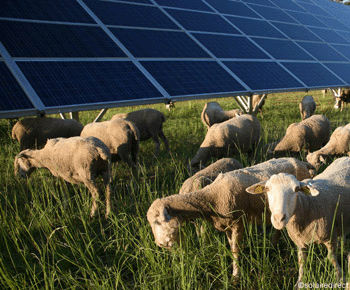
Solar farms are increasingly being built sufficiently high off the ground to allow sheep to graze beneath them, providing welcome shade. This practice, known as agrivoltaics, provides additional farm revenue, which is especially valuable during droughts. Rooftop solar occupies no land.
Myth: The longer lifetime of nuclear reactors hasn’t been taken into account
The levelised cost of energy method – used by CSIRO, AEMO, Lazard and others – is the standard way of comparing electricity generation technologies that perform similar functions.
It permits the comparison of coal, nuclear and firmed renewables. It takes account automatically of the different lifetimes of different technologies.
Myth: We need baseload power stations
The recent claim that nuclear energy is not very expensive “when we consider value” is just a variant of the old, discredited claim that we need baseload power stations, i.e. those that operate 24/7 at maximum power output for most of the time.
The renewable system, including storage, delivers the same reliability, and hence the same value, as the traditional system based on a mix of baseload and peak-load power stations.
When a nuclear power reactor breaks down, it can be useless for weeks or months. For a conventional large reactor rated at 1000 to 1600 megawatts, the impact of breakdown on electricity supply can be disastrous.
Big nuclear needs big back-up, which is expensive. Small modular reactors do not exist––not one is commercially available or likely to be in the foreseeable future.
Concluding remarks
We do not need expensive, dangerous nuclear power, or expensive, polluting fossil gas. A nuclear scenario would inevitably involve the irrational suppression of renewables.
The ban on nuclear power should be maintained because nuclear never competes in a so-called ‘free market’. Renewables – solar, wind and existing hydro – together with energy efficiency, can supply all Australia’s electricity.
Mark Diesendorf is Honorary Associate Professor at the Environment & Society Group in the School of Humanities & Languages and Faculty of Arts, Design & Architecture at UNSW. First published in Pearls and Irritations. Republished with permission of the author.
Nuclear more costly and could ‘sound the death knell’ for Australia’s decarbonisation efforts, report says
Peter Hannam Economics correspondent, Guardian, Fri 28 Jun 2024
A nuclear-powered Australian economy would result in higher-cost electricity and would “sound the death knell” for decarbonisation efforts if it distracts from renewables investment, a report by Bloomberg New Energy Finance (BNEF) argues.
The report comes as ANZ forecast September quarter power prices will dive as much as 30% once government rebates kick in. A separate review by the market watchdog has found household energy bills were 14% lower because of last year’s rebates.
BNEF said the federal opposition’s plan to build nuclear power stations on seven sites required “a slow and challenging” effort to overturn existing bans in at least three states, for starters.
Even if they succeeded, the levelised cost of electricity – a standard industry measure – would be far higher for nuclear power than renewables. Taking existing nuclear industries in western nations into account, their cost would still be “at least four times greater than the average” for Australian wind and solar plants firmed up with storage today, Bloomberg said.
“Nuclear could play a valuable, if expensive, role in Australia’s future power mix,” the report said. “However, if the debate serves as a distraction from scaling-up policy support for renewable energy investment, it will sound the death knell for its decarbonisation ambitions – the only reason for Australia to consider going nuclear in the first place.”
Bloomberg’s analysis complements CSIRO’s GenCost report that also found nuclear energy to be far more costly than zero-carbon alternatives. Australia’s lack of experience with the industry would result in a learning “premium” that would double the price of the first nuclear plant, according to the CSIRO.
Bloomberg also found that assuming the opposition’s seven plants had a generation capacity of 14 gigawatts, they would supply only a fraction of the total market.
If governments tried to rely on inflexible generators – whether coal-fired or nuclear – as renewables increased, they would have to resort to subsidies and other market interventions at a cost to taxpayers, Bloomberg said.
“This report speaks for itself,” the energy minister, Chris Bowen, said. “It’s another example of experts confirming that nuclear energy is too slow, too expensive and too risky for Australia.
“The Albanese government’s plan is the only plan backed by experts to deliver clean, cheap, renewable power available 24/7, and get us to net zero by 2050.”
Guardian Australia sought comment from the opposition energy spokesperson, Ted O’Brien.
ANZ, meanwhile, expects residential electricity prices to begin to see big falls starting from next month as federal and state rebates take effect.
@ANZ_Research predicts electricity prices in the September quarter could fall by 30% as fresh rebates kick in. That would lop a large 0.7 percentage points off the inflation rate (to be recovered later unless the rebates continue). pic.twitter.com/fjHWP8duEn— @phannam@mastodon.green (@p_hannam) June 27, 2024
From 1 July, all households in Queensland get a $1,000 rebate, those in Western Australia the first of two $200 rebates and nationally the first of four $75 rebates from the federal government will arrive.
In the September quarter, ANZ estimates consumer prices will fall 0.7 percentage points, temporarily dampening overall inflation – assuming those rebates aren’t extended again.
The Australian Competition and Consumer Commission will also release its annual market inquiry report on Friday. It showed that without the federal government’s energy rebates in the May 2023 budget the median residential energy bill would have been 14%, or $46.64, higher across all regions…………………………………….more https://www.theguardian.com/australia-news/article/2024/jun/28/nuclear-energy-report-australia-expensive-decarbonisation-renewables
Small Modular Nuclear Reactors cost concerns challenge industry optimism
Reuters, Paul Day, Jun 27, 2024
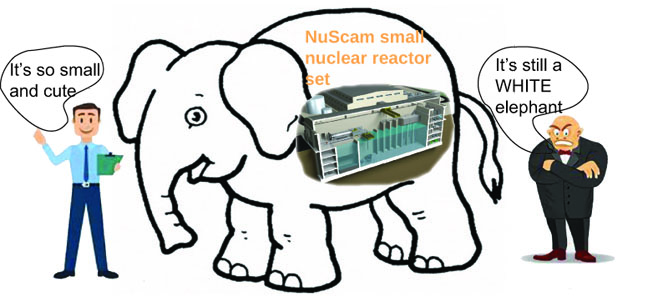
Concerns over the potential cost of small modular reactors (SMRs) and the electricity they produce continue to cast a shadow over growing optimism for new nuclear.
Proponents say that the recent faltering history of large nuclear projects missing schedules and running over budget are just teething problems for a new industry in the midst of a difficult economic climate.
However, critics claim it as proof that nuclear is not economically viable at all, and it will take too long faced with pressing climate issues.
There is little doubt that new nuclear will, at least initially, be more expensive to develop, build, and run than many are hoping.
New Generation IV reactors, such as SMRs, are likely to produce hidden costs inherent in the development of first-of-a-kind technology, while high commodity and building material prices, stubbornly high inflation, and interest rates at levels not seen for decades are adding to mounting expenses for the new developers.
NuScale’s cancelled deal to supply its SMRs to a consortium of electricity cooperatives due to rising power price estimates prompted The Breakthrough Institute’s Director for Nuclear Energy Innovation Adam Stein to write that advanced nuclear energy was in trouble.
Speaking during an event at the American Nuclear Society (ANS) 2024 Annual Conference in June, Stein said nothing had changed to fix the fundamental challenges nuclear faces since he wrote that in November, but there was a greater sense of urgency.
“Commodity prices have come down slightly, though interest rates are largely still the same and those are risks, or uncertainties, that are outside of the developer’s control,” Stein said during an event at the American Nuclear Society (ANS) 2024 Annual Conference.
“Until those can be considered a project risk, instead of unknown uncertainties, they are not going to be controlled at all and can drastically swing the price of any single project.”
Enthusiastic hype
These criticisms clash with growing enthusiasm (critics say ‘hype’) surrounding the new technology.
Twenty two countries and 120 companies at the COP28 conference in November vowed to triple global nuclear capacity by 2050, and developers are making sweeping promises about the capabilities and affordability of their latest creations, many of which will not be commercially available in North America or Europe until the early 2030s.
SMRs, defined as reactors that generate 300 MW or less, cost too much, and deployment is too far out for them to be a useful tool to transition from fossil fuels in the coming 10-15 years, according to a recent study by the Institute for Energy Economics and Financial Analysis (IEEFA).
“SMRs are not going to be helpful in the transition. They’re not going to be here quick enough. They’re not going to be economic enough. And we really don’t have time to wait,” says co-author of the study Dennis Wamsted.
Existing SMRs in China (Shidao Bay), Russia (floating SMR such as the Akademik Lomonosov), and in Argentina (the still under-construction CAREM) have all cost significantly more than originally planned, the IEEFA says in the study ‘Small Modular Reactors: Still too expensive, too slow, and too risky.’
Construction work on the cutting-edge CAREM project has been stalled since May due to cost-cutting measures by Argentina’s President Javier Milei, the head of National Atomic Energy Commission (CNEA) told Reuters.
The billions of dollars the U.S. and Canadian governments are pouring into nuclear power through subsidies, tax credits, and federally funded research, would be better spent on extra renewables, Wamsted says.
Some 260,000 MW of renewable energy generation, mostly solar, is expected to be added to the U.S. grid just through to 2028, the study says citing the American Clean Power Association, way before any new nuclear is expected to be plugged in.
“Federal funds to nuclear is, in our opinion, a waste of time and money,” says Wamsted.
High uncertainty…………………………………………….
https://www.reutersevents.com/nuclear/smr-cost-concerns-challenge-industry-optimism
Peter Dutton’s nuclear power plans are an ironic backflip to nationalisation for the Liberal Party

With a mantra of small government and minimal interference in the economy, the Liberal Party has long stood for the rights of the individual and free enterprise.
Until last week.
If Dutton’s nuclear ambitions come to fruition, control of Australia’s energy market, will end up in the hands of the federal government.
https://www.abc.net.au/news/2024-06-25/dutton-nuclear-power-renewable-energy-liberal-party/104016288
By chief business correspondent Ian Verrender 25 June 24
Ben Chifley is considered one of the giants of Labor politics.
As treasurer, he guided the nation through the arduous task of financing World War II and later, after John Curtin’s death, went on to lead the country in the immediate post-war era.
But, in August 1947, concerned that rival banks would undermine the roles of the Commonwealth Bank and the federal government in operating monetary policy, he announced a plan to nationalise Australia’s banking system.
Politically, it was a disaster after the High Court ruled against it. From wartime hero, Labor was swept from power in the 1949 elections by the Robert Menzies-led Liberal Party and spent the next 23 years in the political wilderness.
With a mantra of small government and minimal interference in the economy, the Liberal Party has long stood for the rights of the individual and free enterprise.
Until last week. Rather than allowing market forces to dictate how Australia should respond to the global challenge of reducing greenhouse emissions, the Coalition under Peter Dutton has turned that ethos on its head with a plan to embark upon one of the biggest government-funded investment programs in history.
It is a radical plan that not only throws future private investment in the energy sector into a state of uncertainty, it threatens to undermine the value of privately owned renewable energy investment made during the past 15 years.
On some estimates, depending upon how big the nuclear rollout will be, a capital expenditure program of more than half a trillion dollars will be required to fund this sudden shift in energy policy.
To operate efficiently and to minimise cost, nuclear power plants need to be permanently going full pelt, leaving little room for any other source of power generation.
If Dutton’s nuclear ambitions come to fruition, control of Australia’s energy market, having been privatised largely under Coalition-run state governments since Jeff Kennett made the first move in Victoria, will end up in the hands of the federal government.
Who cares about cost?
It is not the first time the Coalition has up-ended its free-market ethos when it comes to energy policy.
Under Tony Abbott, Australia abandoned the carbon tax established under the Gillard government which put a price on carbon emissions. Instead, it was replaced by a direct subsidy program, the Emissions Reduction Fund, which allocated billions of taxpayer dollars to private enterprise.
Australia’s energy and climate policies have been a mess, the battleground of a bitter raging war between both sides of politics for most of the past 20 years. It has resulted in an underinvestment in new electricity generation as the industry has watched policy lurch between the two extremes.
While many senior Coalition members have openly questioned whether climate change exists with Abbott labelling climate science as “crap”, both sides of politics finally appeared to be on a unity ticket in November 2021 when then-prime minister Scott Morrison signed up to the Paris agreement on emissions reductions.
Since then, gas shortages, Russia’s invasion of Ukraine and the shutdown of our aging coal-fired generators have sent retail electricity prices soaring.
While Dutton claims the first nuclear station could be operational by midway through the next decade, realistically, they are likely to take far longer.
By that stage, however, almost all our coal-fired plants would have been retired, creating massive energy shortfalls in the meantime. Those supporting the opposition and its nuclear policy argue the coal generators’ life should be extended.
That means either building new ones or refurbishing the existing ones at enormous expense which would then detract from the economics of replacing them with nuclear. And our emissions reduction targets would be blown.
The French experience
Whenever any kind of debate on nuclear power plants erupts, France enters the conversation.
More than 70 per cent of France’s electricity is generated from nuclear power plants. And as the proponents will highlight, the French enjoy much lower power prices than most of their European neighbours who now rely on imported fossil fuels.
That’s because the vast bulk of them were built decades ago, they are all government-owned and their costs largely have been sunk.
France has more than 55 nuclear plants dotted around the country that are run by a government entity EDF.
They were built in reaction to the 1973 energy crisis under a plan put forth by then prime minister Pierre Messmer given the country had little if any fossil fuel resources.
Economists Steven Hamilton and Luke Heeney argue that France has made its nuclear system work largely because the technology dominates the power generation system and because it has neighbours that can absorb the excess.
“Countries like France can only make nuclear work by exporting large amounts of energy when it’s surplus to demand,” they wrote recently.
Almost half the plants are more than 40 years old and many are in need of upgrades, a process that has been delayed by debate about whether they should be decommissioned or their life extended.
In September 2022, more than 30 plants were shut because of technical or maintenance problems while the extended European drought created havoc with plant cooling facilities.
Water is essential for nuclear plants, a challenge the opposition appears to have overlooked in its plan to roll them out on the world’s driest continent.
Instead, it has opted to place them on the sites of retired coal-fired generators. But those sites were selected because they were close to coal fields.
Nuclear not compatible with renewables
For all the talk about the cost of building nuclear stations, the cost involved in running them has taken a back seat.
They are horrendously expensive to build. But, even if you don’t take the build cost into account, they are hugely expensive to run.
Even when they are running flat out, the cost of electricity generation is much higher than for renewables, according to the CSIRO and most reputable economists and analysts.
To maximise their efficiency, they need to be running full-time at maximum capacity. But the opposition has hinted nuclear power would somehow complement renewables, that they could switch on to fill the breach when renewables fall short.
As investment banker David Leitch argues, renewables flood the system during daylight hours, sending wholesale power prices to zero and even lower on many days, which would cripple the economics of nuclear power.
“Generation technology choices do not live in isolation from the system in which they operate,” he says.
“For those not already tired of the debate around small, modular reactors, the fact is they are not a technology designed to deal with the reality of a system that has lots of renewables and specifically lots of solar.”
That means much higher generation prices on top of an extraordinarily expensive and long build time that will come into effect long after our coal-fired generators have bitten the dust.
Chifley’s experience still looms large over Labor. So, for the next few years, prepare to be entertained by a Labor Party preaching market forces butting heads with a Coalition hell-bent on nationalising a key segment of the economy.
The irony.
1 This month

of the week – Australians for War Powers Reform (AWPR)
To see nuclear-related stories in greater depth and intensity
 Antinuclear