Nuclear: In Flamanville, the EPR farce continues
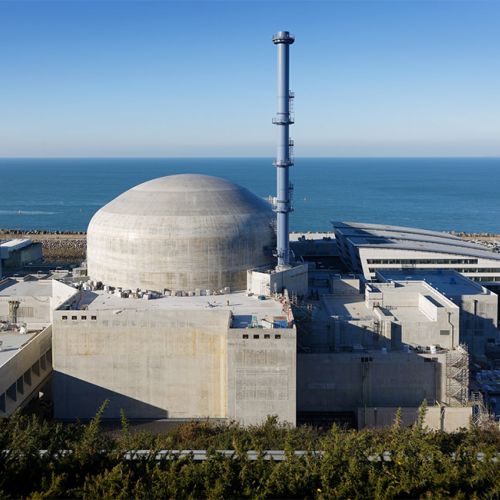
During a meeting of the local information commission on April 12, the Nuclear Safety Authority (ASN) assured that it could give the green light to the start-up of the reactor by the beginning of May. However, not all technical problems are resolved. And now a new one – of vibrations – appeared at the end of last year on the primary circuit. Revelations.
Blast, Thierry Gadault , 22 Apr 24
A few kilometers from the Flamanville nuclear power plant, Les Pieux (Manche) is typical of the many nuclear communities that we cross along the Rhône and Loire valleys: stone facades scrubbed with a toothbrush, paved sidewalks shiny as a new penny, innumerable municipal facilities that a town of some 3,500 inhabitants could never hope to afford, even in its wildest dreams, if it were not for the millions poured every year by EDF into the Department………………………..
Dialogue of the deaf in the basement
Behind the town hall, an old mansion which dominates the village, is the Pieux proximity center. In the basement of the building, which houses part of the municipal services, an auditorium with around fifty seats hosts the meetings of the Local Information Commission (CLI), a consultative body bringing together EDF, the Nuclear Safety Authority (ASN), local elected officials, the State and association representatives.
April 12, 2024, there was a crowd for the extraordinary meeting of the CLI. The menu was potentially copious: it was a question of taking stock of the EPR, before the ASN gave the green light to EDF to install the nuclear fuel in the vessel. While the independent authority was in full public consultation (it ended on April 17), an essential prerequisite for its decision-making, the associations had obtained this appointment in the form of a last-chance meeting, to try to derail the process.
But neither the ASN representative, Gaëtan Lafforge, the head of the Caen division, nor that of EDF, Alain Morvan, the director of the Flamanville EPR project, had the intention of revealing the reality of the numerous problems which still affect the reactor. And it was a dialogue of the deaf that the participants engaged in.
On the ASN and EDF side, the speech can easily be summarized: officially, everything is in order and the objective is now to gradually bring the reactor to operate at full power, at the end of the year. The authority also specified that the green light will be given by the beginning of May. Alain Morvan, with slides reduced to the strict minimum, simply outlined the process of starting up the new reactor.
On April 12, questioned on this subject by Yannick Rousselet, nuclear safety consultant at Greenpeace, the ASN representative had the greatest difficulty in answering the question clearly. “I can’t tell you that there won’t be anything left, there could be possible deviations during the tests,” stammered Gaëtan Lafforge. This then led to a short lunar exchange with the anti-nuclear activist, which triggered laughter from the audience.
On the anti-nuclear activist side, the troops left after two hours with their questions. In particular, lo and behold, a new vibration problem on the primary circuit detected last year.
The information was given to Blast by Julien Collet, the deputy director general of ASN, during the authority’s annual press conference organized at the end of last January. The DGA then told us that EDF was in the process of investigating this umpteenth glitch on the EPR.
On April 12, questioned on this subject by Yannick Rousselet, nuclear safety consultant at Greenpeace, the ASN representative had the greatest difficulty in answering the question clearly. “I can’t tell you that there won’t be anything left, there could be possible deviations during the tests,” stammered Gaëtan Lafforge. This then led to a short lunar exchange with the anti-nuclear activist, which triggered laughter from the audience.
Strangely, Alain Morvan, who could have provided technical details, remained silent. And no one thought to give him the floor. Especially since the president of the CLI, perhaps impatient to go to lunch, hastened to close the session. Questioned by Blast after the meeting, the director of the EPR project, cornered by a member of EDF communications, refused to answer us.
Hardly any more luck with the Parisian communications department, a few moments later. “The vibrational issues have been dealt with and technical solutions put in place,” she simply responded in the usual wooden language. In short, move around, there is nothing to see.
Yes, but here it is: questioned by a journalist from Presse de la Manche, the local daily which covered the event, EDF gave another answer : “There is no new vibration subject,” said the electrician. to our colleague. Um… we should know: has the subject been covered or does it not exist?
It’s not me, it’s him !
To try to see things clearly, Blast turned to the Institute of Radiation Protection and Nuclear Safety (IRSN), the public research establishment which provides technical advice to the ASN.
Perhaps concerned about its future – following the merger with the ASN imposed by the government and ratified by the National Assembly and the Senate – the establishment informed us through its press manager that the subject was not his responsibility. And to send us back to the ASN…
Unfortunately, ASN did not answer our questions. As Martine Aubry, the mayor of Lille and former candidate defeated in the 2011 socialist primary, said about François Hollande, “when it’s vague, there’s a wolf…”
The lid saga
This new problem… sorry “subject” vibration is therefore added to the numerous unresolved technical files that EDF has decided to leave as is, with the agreement of the ASN, to provide a response only after the commissioning of the reactor – it is unusual, we will agree. Starting obviously with the lid of the tank, weakened by a manufacturing defect (positive carbon segregation also present in the bottom of the tank). When the authority finally authorized the use of the tank and its lid in 2018, when it was no longer possible to exclude the risk of rupture but only to prevent it (which does not have the same meaning), she had asked EDF to change the cover no later than December 2024.
……………………………………..Questioned by activists to know why the company was not waiting for this new cover, Alain Morvan got confused in his explanations. He first suggested that it was not finished, and that it would therefore not be installed before the summer of 2025, before contradicting himself to finally assure that it would be delivered to the nuclear power plant at the end of the year…
In fact, the public group has nothing to do with it: in 2023, Framatome obtained from the ASN to postpone the replacement of the cover by one year, without giving any justification for such a postponement. According to the order issued by the authority last year, it must now be replaced during the first full inspection of the installation, after its start-up.
While it was possible to change this part in complete safety for the health of workers, if the new one had been installed before start-up, this postponement changes everything. The current cover will be irradiated and it will in fact become nuclear waste. In other words, an object that cannot be handled like that.
Apart from the fact that this unnecessarily exposes workers to taking doses during operations to replace it, this poses another problem. This question has not been resolved to date by EDF: that of the storage of this contaminated part, when it is removed. ASN asked the EDF group to construct a building for this purpose which would allow it to be stored safely on the power plant site. Which still doesn’t seem to be done…
Radioactivity, haphazardly
Emblematic, the tank cover file is not the only one which demonstrates EDF’s lack of consideration for nuclear employees, whether they are in-house agents or subcontracting employees. A second major project, also planned after the start-up of the reactor, will expose those involved to radioactive risks. Here again, this intervention could have been carried out in complete safety before the installation was started: the modification of the cooling system of the reactor auxiliary networks (RRI) and rescued raw water (SEC). Essential elements, particularly during reactor shutdown…………………………………………………………………………………………………………………….
Later, again
Still in the same logic, EDF has postponed the modification of the tank internals until later, more precisely the lower plenum which directs the distribution of the hydraulic flow in the tank. Since the incident that occurred on one of the two EPRs at Taishan in China, in 2021, we have had some feedback: it has been established that this equipment generates poor distribution of hydraulic flow which causes greater fluctuations. greater than expected in the neutron flux, which could lead to difficulties in controlling the nuclear reaction. Although ASN asked EDF to modify the lower plenum, the studies are still in progress………………………………………………………….
In China, to avoid major problems while waiting for the modification of the lower plenum, the power of the reactors (officially 1,750 MW) would have been limited to 1,500 MW. Will this also be the case for the Flamanville EPR? Questioned during the CLI meeting on April 12 by Yannick Rousselet, neither ASN nor EDF deigned to respond.
Let’s cross our fingers, hoping that there will be no runaway nuclear reaction in the Flamanville EPR tank. Especially since Libération revealed in July 2022, two systems of probes and sensors essential for operating the reactor, installed either in the tank or outside, are malfunctioning.
The EPR, political totem
“It would have been smarter to do all this work before the reactor was started,” exasperates Gilles Reynaud, the president of Ma Zone Contrôlée , which brings together nuclear subcontracting employees. But EDF wants to put the EPR into production to say: “that’s it, it works.” Doing all this work afterwards, I don’t find it very respectful for the workers and the population. »
No matter the cost
“We are starting at all costs for purely political reasons,” judge Yannick Rousselet, interviewed by Blast at the end of the CLI on April 12. As President Macron announced the relaunch of nuclear power with the construction of new EPRs, they want to send the message that we are out of the rut. » For Rousselet, this is a very short-term vision: “Even if this reactor shuts down in a few months for a long period, no one cares. We must be able to say: “That’s it, the Flamanville EPR is loaded. He started.” This is what is most dangerous. We don’t try to solve the problems first. »
The secrets of an engineer
And then, potentially, there is another problem in the medium term. Recently, an engineer, Thierry C, contacted Blast to tell us about his short experience in nuclear power.
………………………………. “When I took the file, I quickly realized that most of the valves that had to be installed could not meet the temperature and pressure conditions planned during these requalification tests,” he explains to Blast. Of the approximately 650 pipes equipped with valves, there were approximately 450 that had to be cut to remove the equipment and replace it with a temporary device to block the pipes. » A not really reassuring observation. “I spoke about it to my superiors who asked me to keep quiet and not talk to EDF about it. »
The documents and plans consulted by Blast seem to confirm these remarks. Which poses a problem: the requalification tests must be carried out with the valves to be validated. However, this analysis work was carried out in 2008-2009, when the EPR construction site, which had just started, was still in the civil engineering stage. Thierry C. left the group shortly after carrying out this study. What has happened since then? Has the error made by Alstom on the technical characteristics of the valves been corrected? Impossible to know: neither EDF, nor ASN, nor IRSN wanted to answer us.
Overall, given these unresolved problems and the lack of transparency from EDF and ASN regarding the technical setbacks of the installation, within the Flamanville CLI but also vis-à-vis the press, the long nightmare of the EPR construction site may not be over. This bad dream led to its bill exploding – which reached some 19.1 billion euros . A farce that could end up boring and no longer make anyone laugh. https://www.blast-info.fr/articles/2024/nucleaire-a-flamanville-la-farce-de-lepr-se-poursuit-G9PeKawaRwmShmxp6sJL3g
Civil and military nuclear mutuality

‘The UK government is pursuing an uneconomic nuclear programme in large part so as to maintain & renew military nuclear capabilities’.
Rishi Sunak backs both civil and military nuclear: ‘Safeguarding the future of our nuclear deterrent and nuclear energy industry is a critical national endeavour’. French president Emmanuel Macron is even more upfront about it all: ‘Without civil nuclear power, no military nuclear power, without military nuclear, no civil nuclear.’ With the USA, China and Russia also evidently locked into similar paths, the global future doesn’t look too good.
‘The UK government is pursuing an uneconomic nuclear programme in large part so as to maintain & renew military nuclear capabilities’.
backs both civil and military nuclear: ‘Safeguarding the future of our nuclear deterrent and nuclear energy industry is a critical national endeavour’. French president Emmanuel Macron is even more upfront about it all: ‘Without civil nuclear power, no military nuclear power, without military nuclear, no civil nuclear.’ With the USA, China and Russia also evidently locked into similar paths, the global future doesn’t look too good.
Renew Extra Weekly, 13 Apr 24
Until recently, the UK government has always said that civil and military nuclear technologies were separate things, for example in response to claims that expansion of civil nuclear power capacity could lead to proliferation of nuclear weapons making capacity. But, as researchers at the University of Sussex have relentlessly catalogued, there seems to have been a change of view underway, culminating formally in March in a new policy document from No. 10 Downing Street. Entitled ‘Building the Nuclear Workforce of Tomorrow’ it claims that ‘domestic [civil] nuclear capability is vital to our national defence and energy security, underpinning our nuclear deterrent and securing cheaper, more reliable energy for UK consumers’. So they are intertwined and mutually beneficial- we need both!
UK Prime Minister Sunak says that ‘in a more dangerous and contested world, the UK’s continuous at-sea nuclear deterrent is more vital than ever’ and that civil nuclear power is the ‘perfect antidote to the energy challenges facing Britain- it’s green, cheaper in the long term and will ensure the UK’s energy security for the long term’.
There are many issues raised by these claims. Leaving aside all the major moral and political issues associated with nuclear weapons, it is not at all clear that new nuclear reactors will be as costs effective as renewables. Indeed, the cost of renewables has fallen dramatically in recent years while the cost of nuclear projects has continued to escalate. It could be that, recognising this imbalance in cost, what we are now seeing is the government trying to provide a compensating justification for new civil nuclear- it will aid defence. Even if, arguably, it makes little economic sense as Business Green argued: ‘The UK government is pursuing an uneconomic nuclear programme in large part so as to maintain & renew military nuclear capabilities’.
Basically, as the Sussex University researchers have argued, it does seem that the government is just responding to military pressures. More specifically though, it’s a matter of rapidly expanding skill requirements- and shortages. Matthew Lay, Head of EDF Nuclear Skills Alliance, says that ‘the UK Government’s commitment to nuclear power must be seen in the context of a steady increase of nuclear capacity worldwide as well as growth in defence expenditure,’ and especially the growth in the ‘defence industry’s demand for nuclear skills, to deliver established and new nuclear submarine programmes’. So it’s about expanding nuclear skills for building nuclear sub power plants and civil reactors, including possibly Small Modular Reactors (SMRs), which have some similarities. Presumably also about making fuels for them both too.
Some may be happy about civil-military skill sharing, but it’s a long way from the old rhetoric about ‘atoms for peace’. In 1953 President Eisenhower called for nuclear bomb technology to be turned to peaceful ends around the world, with US help e.g. in transferring nuclear plant technology to developing countries. That had floundered due, in part, to the high cost of nuclear plants. According to a review by Drogan, a State Department Intelligence Report, circulated in January 1954, ‘Economic Implications of Nuclear Power in Foreign Countries’, noted that ‘nuclear power plants may cost twice as much to operate and as much as 50 percent more to build and equip than conventional thermal plants’. So it warned that the introduction of nuclear power would ‘not usher in a new era of plenty and rapid economic development as is commonly believed’. You could say that we are still waiting!
There were also potential conflicts between the ‘atoms for peace’ idea and proliferation issues. Indeed that is now even more of a problem, with some newly developing countries, following the UAE’s lead, looking to have nuclear plants, which, in theory, could give them the ability to make bombs. And (the Nuclear Proliferation Treaty apart!) why not, if nuclear weapons states like the UK are seen as no longer maintaining a clear separation between civil and military nuclear technology? Except of course the high cost of civil nuclear may make renewables a much better deal- especially solar, of which many countries (in the Middle East and Africa for example) have plenty. ……………………………………………………………………………..
Clearly UK Prime Minister Sunak doesn’t see it this way- he backs both civil and military nuclear: ‘Safeguarding the future of our nuclear deterrent and nuclear energy industry is a critical national endeavour’. French president Emmanuel Macron is even more upfront about it all: ‘Without civil nuclear power, no military nuclear power, without military nuclear, no civil nuclear.’ With the USA, China and Russia also evidently locked into similar paths, the global future doesn’t look too good.
Do we really have to continue with all this? In 1995, Sir Michael Atiyah, then retiring as President of the Royal Society, said ‘I believe history will show that insistence on a UK nuclear capability [weapons and energy] was fundamentally misguided, a total waste of resources and a significant factor in our relative economic decline over the past 50 years’. He may have been right. https://renewextraweekly.blogspot.com/2024/04/civil-and-military-nuclear-mutuality.html
“Nuclear comes last”

the tail-between-legs exit of the Nuclear Summit conferees declared in a headline: “Taxpayers are needed to foot the bill to achieve 2050 targets.”
Banks reject nuclear funding, stocks nosedive and the industry says it should, believe it or not, slow down
By Linda Pentz Gunter https://beyondnuclearinternational.org/2024/03/31/nuclear-comes-last/

NuScale, the company whose small modular reactor project collapsed so spectacularly last November, is “burning cash at the rate of $185 million per year”. On March 22, the company’s CEO, John Hopkins, sold 59,768 of his shares in the company. This is the same CEO who declared NuScale’s SMR project, aptly named VOYGR, “a dead horse.” It’s clearly on a journey to nowhere.

Wells Fargo, with an eye on prudent investments, has declared, “We think investor enthusiasm for SMR is misguided”. As The Motley Fool reported, “NuScale’s VOYGR nuclear power product has ‘no secure customers’ and is ‘not cost competitive’ says the analyst.”
The splashy cheerleading Nuclear Energy Summit organized by the International Atomic Energy Agency in Brussels on March 21 proved to be just that. The participants arrived floating on the hot air of their misplaced enthusiasm but “left humbled by the tepid reaction of bankers assessing the price tag of their ambitions”.
European Investment Bank Vice President Thomas Ostros, told Summit attendees to their face that “The project risks, as we have seen in reality, seem to be very high”. Representatives from the European and Latin American banking worlds said that “their lending priorities lean toward renewables and transmission grids” and that “nuclear comes last”.

Even the US Nuclear Regulatory Commission couldn’t quite bring itself to slam down its rubber stamp on Oklo’s chalet-in-the-woods micro reactor, the Aurora, which remains about as real as its namesake fairy tale princess.
In January 2022, the NRC denied Oklo’s license application outright because it “continues to contain significant information gaps in its description of Aurora’s potential accidents as well as its classification of safety systems and components,” wrote the NRC.
Oklo reapplied nine months later but according to the NRC docket there is “no further action”.
Nevertheless, Oklo brags on its website that it “made history” simply by developing “the first advanced fission combined license application to the U.S. Nuclear Regulatory Commission”, which sums up the second nuclear “renaissance” perfectly: Make a drawing. Hit ‘send’.
Meanwhile, the US military canceled its contract for an Aurora reactor originally intended for the Eielson Air Force Base near Fairbanks, Alaska.
And finally, an executive from the industry that has consistently delivered its latest new reactors decades late and billions over the original budget — in one case $20 billion over — suggested they should all just slow down. Said Ian Edwards, chief executive of Canadian reactor producer, Atkins Realis, “we all become too optimistic. We have this optimism bias towards being able to deliver faster. Really we should probably slow things down a little bit.”
But nuclear power is the answer to our current climate crisis! Ya think?
It’s tempting to ask whether things can get any worse for the nuclear power industry, but they almost certainly will. Unless we end up paying for it all. As the Bloomberg article that related the tail-between-legs exit of the Nuclear Summit conferees declared in a headline: “Taxpayers are needed to foot the bill to achieve 2050 targets.”
At the moment, a majority in the US Congress seem intent on making sure that is exactly what will happen. Because after all, why should multi-billionaire, Bill Gates, be forced to pay for his own nuclear toys when he can milk (read ‘bilk’) US taxpayers instead?

The US government has already pledged $2 billion of our money to Gates for his proliferation-friendly liquid sodium-cooled molten salt fast reactor produced by his company, TerraPower (more properly, TerrorPower). Gates can’t wait to export it the United Arab Emirates. Nuclear weapons anyone?
The strokey-white-beard-named ADVANCE Act, has been passed by the US House with 365 voting in favor and only 36 Democrats-with-a-conscience voting against it. By its own description, the ADVANCE ACT aims to “advance the benefits of nuclear energy by enabling efficient, timely, and predictable licensing, regulation, and deployment of nuclear energy technologies.” In other words, do away with burdensome — and expensive — safety regulations.
Indeed, New Mexico Democrat, Senator Martin Heinrich, told E&E News in January that “These regulatory timelines do not lend themselves to fighting the climate crisis.” Oh those wascally wegulations!
Meanwhile, Democratic senator Joe Manchin of West Virginia doesn’t want to seat any new NRC commissioners who might be “too focused on safety.”
The NRC’s motto is “protecting people and the environment,” a mandate it demonstrably endeavors to avoid already, but even some vestige of interest in safety is probably better than none. Not that safety oversight will be needed of course because, hey, SMRs are “walkaway safe” and “meltdown proof” and any new light water reactors are too “advanced” to be a safety risk.

This makes the insistence by SMR manufacturers that they must be covered by the Price-Anderson Act (PAA) all the more curious. Price-Anderson, due to expire in 2025, was culled out of the ADVANCE ACT, now moving out of Senate committee and working its way through the reconciliation process, and handled separately. The Senate adopted the House version of the PAA, giving it a 40-year extension to 2026, and expanded limited liability for a major accident to just over $16 billion per reactor.
President Biden duly signed it into law, marking another misstep on what is becoming an increasingly problematic presidency.
Ed Lyman, Nuclear Power Safety Director at the Union of Concerned Scientists, told Nuclear Intelligence Weekly that “The nuclear industry’s push for a 40-year Price-Anderson Act extension is a sure sign that it doesn’t believe its own messaging about how safe the next generation of nuclear reactors is going to be.”
But in a joint statement, Senator Shelley Moore Capito (R-W.Va.) and Senator Tom Carper (D-Del.) declared that “The extension of the Price-Anderson Act in the minibus sends a clear message that we are committed to the advancement of this safe and reliable power source.”
The “clear message” this actually sends is that, in the event of a major nuclear accident, US taxpayers will be thrown under that minibus. The $16 billion coverage will be chicken feed and we will all be stuck with the bill. Let’s remember that the Chornobyl and Fukushima nuclear disasters are each racking up costs in the hundreds of billions of dollars and counting. We have been warned.
But a bi-partisan group of Representatives and Senators think it’s perfectly fine for all of us to pay for such an eventuality. Meanwhile, if you own a home and are forced to abandon it in the path of a nuclear accident, you cannot claim a dime off your homeowner’s insurance. It will just be a total loss. Think about that for a moment.
Are we outraged yet?
Linda Pentz Gunter is the international specialist at Beyond Nuclear
Nuclear news for the last week of March

Some bits of good news. More Teens Than You Think Understand the Positive and Negative Aspects of Smartphones–Survey. India makes significant progress on malaria. Renewables blew gas away in the UK.
TOP STORIES
UK Court Gives Biden Chance to Dodge Assange Appeal by “Assuring” His Rights .
Spending Unlimited – The Pentagon’s Budget Follies Come at a High Price.
Air attacks on Ukraine have again put the Zaporizhzhia nuclear power plant(ZNPP), under Russian control, in danger. ALSO AT ………
Nuclear waste clean-up company to be prosecuted over alleged cyber blunders, lax security.
THE R.A.F’S NUCLEAR FLIGHTS OVER BRITAIN AND THE ATLANTIC.
Is Nuclear Fusion Really The Ultimate Solution to AI’s Crazy Power Use?
Climate. Oil company chief urges investment in fossil fuels, as world heats at a record pace. Antarctic sea ice ‘behaving strangely’ as Arctic reaches ‘below-average’ winter peak. Copernicus online portal offers a terrifying view of climate emergency.
Noel’s notes. Sellafield scandals – a case study in why the nuclear industry must be shut down. A world run by 11 year-old boys? The tiresome spin of the nuclear lobby in Australia.
******************************************************************
AUSTRALIA.
- Australian government seeks top quality PR team to persuade Aborigines that a nuclear waste dump is a good thing.
- The AUKUS Cash Cow: Robbing the Australian Taxpayer. Australia’s move on nuclear submarines raises concern.
- Nuclear ranks last on list of good investments by big institutions. IFM Investors steers clear of nuclear projects.
- Liberal Coalition twisting itself into knots over nuclear policy. Opposition’s nuclear policy must be based on facts. ‘They don’t have a plan’: Chris Bowen slams Opposition push for nuclear.
- UN Security Council ceasefire resolution a turning point in Gaza war.
NUCLEAR ISSUES
ART and CULTURE. Decades of Dissent: Anti-Nuclear movement explored in LSE Library exhibition, London.
CIVIL LIBERTIES. The Empire Slowly Suffocates Assange Like It Slowly Suffocates All Its Enemies.
Arrested for peaceful protest against Israeli-owned military technology company.
ECONOMICS.
- UK’s ever more expensive nuclear submarines will torpedo spending plans for years to come.
- ‘Nuclear Dinosaurs’ Roam New Brunswick, Ontario as ‘Jurassic’ Partnership Looms.
- Nuclear energy everywhere costs an arm and a leg.
- EDF Names New Head of Nuclear Plant Projects Amid Cost Overruns.
- United Arab Emirates signals interest in European nuclear energy investments.
- Famous UK seaside town ‘decimated’ by £46bn nuclear power station and huge Pontins change.
| EDUCATION. Nuclear and weapons industry propaganda to schools. Missing Links in Textbook History: War | EMPLOYMENT. Sellafield’s head of information security to step down. | ETHICS and RELIGION. A Genocide Foretold. |
EVENTS. The First Annual Plutonium Trail Caravan is on Saturday April 6th – Join Us!
| LEGAL. Assange Extradition Delayed Unless US Provides ‘Assurances’ He Won’t Be Executed for Revealing the Truth. Chris Hedges: The Crucifixion of Julian Assange. Purgatorial Torments: Assange and the UK High Court. Now there are three court challenges against Ontario nuclear waste disposal facility. The Decision That Wasn’t A Decision. The Office for Nuclear Regulation (ONR) will prosecute Sellafield Ltd on charges of security offences. British nuclear site Sellafield to be prosecuted for cybersecurity failures. Court Allows Ageing Japanese Nuclear Plants to Continue Operations. | MEDIA. This is how nuclear war would begin – in terrifying detail. ‘My jaw dropped’: Annie Jacobsen on her scenario for nuclear war. Review: Annie Jacobsen’s ‘Nuclear War: A Scenario’ Will Make You Start Worrying And Hate The Bomb. The Rising Nuclear Threat: Readers respond to the “At the Brink” series of Opinion articles Einstein’s vision for peace. Oppenheimer: Monaghan man, Daniel A. McGovern, who captured nuclear devastation. |
| OPPOSITION to NUCLEAR . Scotland’s National Party attacks £200m extra for nuclear deterrent and industry. | POLITICS. Whaat! Romania’s state-owned Nuclearelectrica to partner with NuScale to build small nuclear reactors- U.S, government to give $1.52 billion loan guarantee to Holtec to resuscitate Palisades Nuclear Plant. IAEA Warns Of Iraq-Like Scenario For Iran Without Transparency |
| POLITICS INTERNATIONAL and DIPLOMACY. New NATO member Finland admits US pact ‘restricts sovereignty’. Biden claims binding UN Security Council Gaza ceasefire resolution is ‘non-binding.’ | PUBLIC OPINION. Most Americans now disapprove of Israel’s military action in Gaza new poll reveals as tensions rise between allies. | SAFETY. Atomic blackmail – Russia-Ukraine war and Ramberg’s theory of vulnerability. NRC admits San Onofre Holtec nuclear waste canisters are all damaged. Special nuclear flights between the US and UK: the dangers involved. Security concerns as UAE Eyeing Investments in Europe’s Nuclear Energy Sector. |
| SECRETS and LIES. IAEA Unaware Of Secret Iranian Nuclear Site Targeted By Israel. | SPINBUSTER.ChatGPT’s boss claims nuclear fusion is the answer to AI’s soaring energy needs. Not so fast, experts say. Cancer “epidemic” in the Young as Radioactive Wastes are Increasingly Dispersed to the Environment meanwhile Nuclear given “green” status in Brussels.. | TECHNOLOGY. Weaponizing Reality: The Dawn of Neurowarfare. New nuclear reactor types will not solve waste and safety issues. |
| WASTES. UK nuclear watchdog takes Sellafield nuclear waste operator to court over alleged IT breaches. Experts from Japan and China held talks on treated radioactive wastewater. Decommissioning. How much will extra decades of nuclear decommissioning work at Dounreay cost? Dounreay decommissioning date ‘never achievable’ says Caithness councillor Also at https://nuclear-news.net/2024/04/01/1-b1-dounreay-decommissioning-date-never-achievable-says-caithness-councillor/. | WAR and CONFLICT. Putin says Russia will not attack NATO, but F-16s will be shot down in Ukraine. Atrocities. Israel Remains Intent on Genocide Despite World Court Orders. Michigan Republican congressman says Gaza should be destroyed with nuclear bomb ‘like Nagasaki and Hiroshima’, as he slams US for sending humanitarian aid. | WEAPONS and WEAPONS SALES.Biden Is Quietly Funding Nuclear Weapons Upgrades That Could Imperil the Planet. The Nuclear Explosion That Makes US Aid to Israel Illegal. US secretly sending more bombs to Israel – Washington Post.. U.S., Germany Supplied 99% of Israel Weapons Import Despite Pressure: Data.France will help Brazil develop nuclear-powered submarines, Macron says.Nabbed Australian Protestors Stopping Military Shipment to Israel.UK to test new ‘Astraea’ nuclear warheads without detonation. |
Nuclear energy everywhere costs an arm and a leg

By Jean-François Julliard, Mar 30, 2024, https://johnmenadue.com/nuclear-energy-everywhere-costs-an-arm-and-a-leg/
The contribution of nuclear power to electricity generation is the lowest for thirty years and its price twice that of renewables.
It crackles like a Geiger counter in a uranium mine: in 2023, Emmanuel Macron announced plans for six additional EPR [European Pressurised Reactor] nuclear power plants. Hang on, no, perhaps fourteen in the long term.
In reviving nuclear in the name of the struggle against global warming, the European Union has followed suit. Japan is promising new developments on the nuclear front. The US is experimenting with miniature reactors. China is building with gusto … All these ‘ionising’ projects seem to indicate that fission-based nuclear power is in full swing.
In fact, it is to the contrary. A report of experts published in December 2023, the World Nuclear Industry Status Report 2023 [549pp!], using data supplied by the International Atomic Energy Agency and national states, provides the evidence. The part of electricity generation due to nuclear power is the lowest in 30 years (9.2 percent), compared to near double that figure in the 1990s.
Over twenty years, the cost of a nuclear kilowatt hour has increased slightly, whereas the cost of solar and wind has plummeted (‘melted’), these days coming in at roughly half that of nuclear. In 2022, the report highlights, €35 billion has been invested in nuclear globally, compared to … €455 billion in renewables.
France is still trying to recover from an annus horribilis in 2022. In addition to higher costs associated with the war in Ukraine, reactor shutdowns have multiplied. In August 2023, 60 % of France’s 56 reactors were dysfunctional. During 2023, production has augmented, but it has stayed at the level of … 1995.
Showcases of French savoir-faire, the EPR reactors are not ‘making sparks’, accumulating shutdowns, delays (twelve years for Flamanville, on the English Channel, and thirteen years for Olkiluoto, in Finland) as well as cost blowouts (the bill multiplied by 1.7 [for now] at Hinkley Point, in Great Britain, by 3 at Olkiluoto and by 6 at Flamanville!).
During this time, plutonium (for which every gram is of fearsome toxicity), an essential fuel for these ‘toys’, piles up. The accumulated stock for France has reached an unprecedented level of 92 tonnes.
Small problem: how can EDF [Électricité de France], which has acquired a debt of €65 billion, finance the announced projects? This question doesn’t stop Brussels from supporting them – in spite of the industrial disaster on course. No matter that, for several years, within the EU, renewable energy (hydraulic, wind and solar) has generated the most electricity, ahead of nuclear, followed by gas and coal.
South Korea was formerly one of the principal international competitors of EDF for conquering foreign markets. These days South Korea shows itself more reluctant, especially after a calamitous 2022. Kepco, the national electrician, has lost more than €22 billion, adding to a debt of €131 billion – a record. Nuclear contributes 29.6 % to production, currently less than coal. But the promises – within ten years coal’s contribution is supposed to be cut in half and that of renewables tripled. As for nuclear, it will grow by … 5 %.
Japan only starts to pick up with the atom after the closure of several reactors following Fukushima. To the subsequent shortage of electricity add the financial dimension of the catastrophe: in 2021, the government estimated it at more than €200 billion. Thirteen years after the event, the Prime Minister, Fumio Kishida, wants to rekindle nuclear (‘accelerate the particles’) but furnishes no details on new reactors.
Last year, production in Japan was at its lowest level (equivalent to that of the 1970s), and only 6 % of electricity was of nuclear origin. In spite of announcements, distrust persists, especially since the discovery of misrepresentations (modification of results of chemical analyses, falsification of measures of resistance of materials) of Japan Steel Works, manufacturer of components for reactors, selling them worldwide and notably to France.
China is the country the most committed to the atom. On 58 reactors currently under construction globally, 23 (40 %) are in the Middle Kingdom. However, if nuclear trots, renewables gallop, flat out. Nuclear represents 5 % of electricity, whereas wind and solar furnish 15 %, progressing more quickly than coal, which remains far and away the main ‘source of the juice’. Other vexation: Beijing exports little of its savoir-faire. This because the US, among others, which have blacklisted Chinese enterprises, accused of having siphoned American technology for its military ambitions. Slanderous!
The United States remains the champion of nuclear energy but its brainpower has not kept pace (‘their neutrons are not very quick’). In 2022, the contribution of nuclear to electricity generation has fallen to 18.2 % – the lowest rate since 1987 – less than coal and renewables, the latter passed for the first time to pole position. American reactors are on average the oldest in the world (42 years), and only two reactors have been brought into service in the last twenty-five years.
And what a debut! The AP1000 (variation of the EPR) of Vogtle (Georgia) began operation in March 2023, eight years later than planned and, above all, at an estimated cost of €28.5 billion, more than double the initial estimate. Les Echos [French business newspaper] (25/1/22) has kindly described the feat as a local ‘Flamanville’. This financial debacle has much contributed to the failure of Westinghouse, giant of nuclear reactor manufacture. The event has also provoked the shutdown of the construction site (nine years work) of two other AP1000s in South Carolina. Living fossils!
As a consequence, the US is paying more attention to mini reactors, or SMR [small modular reactors]. Save that NuScale, the champion of the type, last November, cancelled a vast construction program of six of these miniatures, for which the budget had almost tripled …
Russia is the veritable world champion of the ‘civil atom’. That said, however, it produces only 20 % of the country’s electricity. Rosatom, the Russian EDF, foreshadows a small increase to 25 %, but in … 2045. It is overseas where business is booming. Russia, a nation at war, is building reactors in countries as peaceful as Iran, Egypt, India or Turkey. Without forgetting China, one of Russia’s best customers.
Russia’s commercial secret? Its discounted prices, its turnkey packages and, above all, its control of the indispensable enriched uranium. Russia furnishes much of the latter to Europe but also to the US, 31 % of its supplies coming from Russia. All this while imposing sanctions on Putin’s country, which toys with the nuclear threat, going so far as to bomb the vicinity of Ukraine’s nuclear reactor at Zaporizhzhia – the largest such in Europe.
BASE study: Alternative reactor concepts do not solve the repository problem

A new scientific study commissioned by the Federal Office for the Safety of Nuclear Waste Management (BASE) indicates that the market launch of alternative reactor concepts (also known as “Generation IV”) is currently not on the horizon.
“Despite some intensive advertising by manufacturers, we currently see no development that would make the construction of alternative reactor types on a large scale likely in the coming years. On the contrary: “From a safety perspective, we should expect the potential advantages of these reactor concepts to be outweighed by the disadvantages and the questions that remain unresolved,” says BASE President Christian Kühn, and emphasises that “The concepts solve neither the need to find a repository for radio-active waste nor the pressing issues of climate protection.”
The alternative reactor concepts, which include SMRs, are also often linked to the hope that they can minimise or even resolve the safety risks and disposal problems associated with nuclear power. To examine these claims, BASE commissioned the “Analysis and evaluation of the development status, the safety and the regulatory framework for so-called novel reactor concepts” study. The scientific work was carried out by the Öko-Institut, the Technical University of Berlin and the Physikerbüro Bremen.
“No alternative reactor type would make a repository superfluous”
The study analysed seven technology lines for alternative reactor concepts, which have been discussed internationally for many years, and are sometimes referred to as “fourth-generation reactors”. These include, for example, so-called lead and gas-cooled reactors, molten salt reactors and accelerator-driven systems. “Anyone who is euphoric about alternative reactor concepts today is ignoring unanswered questions and safety risks. As far as the safety of nuclear waste management is concerned, one thing is clear: no alternative reactor type makes the construction of a repository superfluous,” thus BASE President Kühn.
According to their developers, the reactors of the generation IV reactors will offer advantages over today’s nuclear power plants in terms of fuel utilisation, safety and reliability, economic efficiency and nuclear non-proliferation. Another advantage is said to be that less high-level radioactive waste is produced or that even existing waste can be disposed of with the help of these reactors.
The study compared the reactor concepts in terms of their safety, efficiency, proliferation resistance and fuel consumption.
“Individual technology lines could – with a systematic design – achieve potential advantages over today’s light water reactors regarding some of the criteria. However, none of the technology lines can be expected to have an overall advantage; in some areas, disadvantages compared to today’s light water reactors are also possible,” says Christoph Pistner of the Öko-Institut.
An analysis of six countries revealed as follows: “Even in an international context, alternative reactor concepts neither call into question the current trend towards light water reactors, nor do they represent a feasible, economical option for future energy supply,” says Christian von Hirschhausen of TU Berlin. “The study explains this on the basis of six detailed country studies (USA, Russia, China, South Korea, Poland, Belgium). Especially the United States, who are often the subject of public discussion, have not achieved any breakthroughs in the development of non-light water reactors, and have even cancelled previously announced inventions (“travelling wave reactor”).”
Findings of the study
The BASE-funded research project draws the following conclusions:
- State of development: All the concepts that are currently being discussed as belonging to the term “Generation IV” have been under development for decades, in some cases since the 1950s, and have not yet reached market maturity. There is still a considerable need for research and development. If the technical hurdles and safety issues can be resolved, further development would most likely take several decades. Against this background, we cannot assume that such reactor concepts will be used on a relevant scale by the middle of this century. In particular, individual country studies show that a system change from light water reactors to alternative reactor concepts ready for series production is not in sight.
- Waste generation: The alternative reactors would still generate high-level radioactive waste, some of which would be very different to the waste from light water reactors, for example because it would not be present as solid fuel elements but as molten salt. This would make waste treatment much more difficult, as current repository plans are generally not designed for this kind of waste. The volume of high-level radioactive waste could be reduced in conjunction with reprocessing technologies, but the volume of intermediate and low-level radioactive waste would increase significantly.
Transmutation properties: Some of the reactor concepts studied could, in theory, be used to split (transmute) individual parts of the existing high-level radioactive waste. This would involve a great deal of effort over a long period of time. However, the foreseeable effect of these measures would only make a comparatively small contribution to reducing the space requirements of a repository and to its long-term safety. This is due, in particular, to the fact that the substances with the greatest impact on safety (long-lived fission products) are difficult to transmute, and are therefore not intended for this purpose.- Regulations: The regulations of international organisations (e.g. IAEA) and national regulations (USA, Canada and the UK) examined in this study sometimes make very detailed, technology-specific provisions based on decades of operating experience with light water reactors. These regulations are, therefore, not directly applicable to the alternative reactor concepts studied. Revisions are currently underway, but due to a significantly lower level of operating experience, the time required to produce a similarly well-founded set of rules is likely to be very long.
Transmutation properties: Some of the reactor concepts studied could, in theory, be used to split (transmute) individual parts of the existing high-level radioactive waste. This would involve a great deal of effort over a long period of time. However, the foreseeable effect of these measures would only make a comparatively small contribution to reducing the space requirements of a repository and to its long-term safety. This is due, in particular, to the fact that the substances with the greatest impact on safety (long-lived fission products) are difficult to transmute, and are therefore not intended for this purpose.- Regulations: The regulations of international organisations (e.g. IAEA) and national regulations (USA, Canada and the UK) examined in this study sometimes make very detailed, technology-specific provisions based on decades of operating experience with light water reactors. These regulations are, therefore, not directly applicable to the alternative reactor concepts studied. Revisions are currently underway, but due to a significantly lower level of operating experience, the time required to produce a similarly well-founded set of rules is likely to be very long.
Conclusion: The expectation expressed both in public debate and by developers that the alternative reactor concepts can make a significant contribution to solving today’s problems in nuclear technology cannot be considered realistic in view of the current state of development of these systems and the actually proven and expected advantages and disadvantages of the individual technology lines.
The summary of the study results (in German only)
Conclusion: The expectation expressed both in public debate and by developers that the alternative reactor concepts can make a significant contribution to solving today’s problems in nuclear technology cannot be considered realistic in view of the current state of development of these systems and the actually proven and expected advantages and disadvantages of the individual technology lines
Nuclear news this week – 25 March

Some bits of good news –
- Amid all the climate gloom, let’s not ignore the good news. also at https://nuclear-news.net/2024/03/23/1-b1-amid-all-the-climate-gloom-lets-not-ignore-the-good-news/
- Full Recovery for Coral Reef Within 4 Years – The Speed of Restoration They Saw was ‘Incredible.
- A leading university halted donations from big oil.
- Finland has retained its status as the ‘world’s happiest nation’ in the latest World Happiness Report.
TOP STORIES. Julian Assange and the Plea Nibble. Report: Justice Department Considering Plea Deal for Assange.
House Democrats Tell Biden To Enforce US Law and Suspend Military Aid to Israel.
Dozens of countries pledge support for nuclear power, despite lingering concerns.
Filling Nuclear Power’s $5 Trillion Hole Is Beyond the Banks.Glorious new financial jargon from the nuclear lobby – the “International Bank for Nuclear Infrastructure (IBNI)”.
The International Atomic Energy Agency (IAEA) Cannot Both Police Proliferation and Promote Nuclear Power.
BASE study: Alternative reactor concepts do not solve the repository problem.
Climate .
Mainstream climate scientists run the risk of becoming the new climate deniers. Hundreds of groups for climate action reject nuclear power at Brussels Summit.
State of the Global Climate 2023.
Environment. Where have all the insects gone?
Noel’s notes. Antony Blinken would get into bed with the devil, if it meant lucrative sales of USA weapons and nukes to Hell. Desperation of the nuclear lobby! Its new financial fantasy scheme, couched in impenetrable jargon!” In talking about nuclear matters, why is money the only game in town?
*********************************************
AUSTRALIA. AUKUS: Red flag for arms industry corruption. UK and Australia set to elevate defence relationship to NATO level with new ‘status of forces’ agreement. Australia moves to prop up Aukus with $4.6bn pledge to help clear Rolls-Royce nuclear reactor bottlenecks in UK.
Financiers shun nuclear, upbeat on climate investment . Chief scientist backs renewables, calls nuclear power ‘expensive’ – https://www.youtube.com/watch?v=uxP-6vsditI&t=389s Forget nuclear: would Peter Dutton oppose a plan to cut bills and address the climate crisis? Australia’s big electricity generators say nuclear not viable for at least a decade. “Prohibitive:” Australia’s biggest energy consumers and producers say no to nuclear, but is Coalition listening?
Peter Dutton in standoff with state Liberal leaders over federal Coalition’s nuclear plan. Dutton’s bid for nuclear power: hoax or reckless endangerment? On nuclear, Coalition prefers the optimism of misleading, decade-old, unverified claims.
ERA applies to extend lease on Jabiluka uranium mine against traditional owners’ wishes.
********************************************
NUCLEAR ISSUES
ARTS and CULTURE. A One-State Solution Could Transform the World.
ECONOMICS.
- Deadlines, costs, production: France’s nuclear company EDF in a moment of truth.
- Bulgarian nuclear experts question economic viability of new nuclear project.
- Money is “The Achilles Heal” of the nuclear state.
- New Brunswick’s Point Lepreau nuclear plant ranked as poor performer among international peers. IAEA’s Rafael Grossi in Iraq to market nuclear reactors.
- The West’s Nuclear Power Revival Could Be Slower Than Hoped.
- This is why Sizewell C construction poses ‘possible risk’ to new hospital build.
- The extraordinary financial costs of ‘small’ nuclear power stations.
| ENERGY. For France’s EPR at Flamanville, the objective of loading fuel before the end of March is no longer tenable. | ENVIRONMENT. Oceans. Fourth discharge of treated Fukushima water completed. Canadian officials found radiation levels in these northern Ontario homes ‘well above’ the safe limit. Their response: ‘¯\_(ツ)_/¯’ also at https://nuclear-news.net/2024/03/23/1-a-canadian-officials-found-radiation-levels-in-these-northern-ontario-homes-well-above-the-safe-limit-their-response-%c2%af_%e3%83%84_-%c2%af/ Canadian Coalition for Nuclear Responsibility – Re: Radiation in Elliot Lake homes . | ETHICS and RELIGION. Just Seeing Through The Propaganda Isn’t Enough – We’ve Got To Open Our Hearts As Well. |
| HEALTH. Nuclear test veterans demand compensation and medical records access. | INDIGENOUS ISSUES. Heavy resistance to Canada’s 1st nuclear waste repository, while Nuclear Waste Management Organization (NWMO) says it is safe.. | MEDIA. Normalizing starvation and massacres: Flour Massacre Called ‘Aid-Related Deaths’—Rather Than Part of Israel’s Engineered Famine. |
| PUBLIC OPINION. In Japan, Opposition to restarting nuclear power plants has grown, especially among women | SECRETS and LIES. “Anonymous” claims it has infiltrated Israel’s nuclear plant in Dimona. | SPACE. EXPLORATION, WEAPONS. US and Japan seek UN resolution calling on all nations to ban nuclear weapons in outer space. Space tourists and crew suffer high radiation risks – regulation is needed to protect them. To Mars and Back: Will NASA’s Ambitious Endeavor Be Worth It? |
| SPINBUSTER. The Lying Piper of Nukeland: the IAEA’s nuclear fairy tales are leading nations — and all of us — into climate catastrophe. Zion Lights and her lying, climate-denying mentor Michael Shellenberger | TECHNOLOGY. The questionable promises behind new nuclear power. |
| WASTES. 100,000 years and counting: how do we tell future generations about highly radioactive nuclear waste repositories? Japan finishes first-year ocean discharge of nuclear-tainted wastewater amid backlash. Inside Fukushima: Eerie drone footage reveals first ever look at melted nuclear reactor with 880 tonnes of radioactive fuel still inside – 13 years after disaster. The Waste Isolation Pilot Plant (WIPP) Opened 25 Years Ago; It Was Supposed to Close Next Week. | WAR and CONFLICT. Ukraine’s losses ‘in the millions’ – retired Polish general. Atrocities. ‘We are the masters of the house’: Israeli channels air snuff videos featuring systematic torture of Palestinians | WEAPONS and WEAPONS SALES.How Biden’s budget plunged the Aukus submarines pact into doubt. Can the U.S. Develop A Nuclear Bomb Without Ever Testing It? We’re About to Find Out.US Air Force tests very expensive third-stage rocket motor for next nuclear missile NATO Builds Largest Europe Base Near Black Sea. Nuclear weapons: France to restart tritium production with EDF.Nuclear Deterrence At Sea – France Begins Work On ‘Cutting Edge’ Nuke-Powered Ballistic Missile Submarine.Canada to stop arms sales to Israel – Foreign Minister. UK launches ‘national endeavour’ to reinforce nuclear deterrent. Iranian Cleric Calls For Nuclear Arms. |
Filling Nuclear Power’s $5 Trillion Hole Is Beyond the Banks

“We need to find a way to make it predictable, stable, bankable and affordable.”
“The project risks, as we have seen in reality, seem to be very high,” said European Investment Bank Vice President Thomas Ostros. – the world’s biggest multilateral lender recommends that countries needing power quickly focus on renewables and energy efficiency,
Nuclear-energy officials arrived in Brussels this week amid a growing wave of public support for atomic power. They left humbled by the tepid reaction of bankers assessing the price tag of their ambitions.
Bloomberg News, Jonathan Tirone, https://financialpost.com/pmn/business-pmn/filling-nuclear-powers-5-trillion-hole-is-beyond-the-banks/wcm/0d2062d5-7120-4480-b53a-a52e70ef2b45/amp/ 22 Mar 24,
The International Atomic Energy Agency convened a summit to build momentum for a low-emissions technology that many expect will be critical for hitting climate targets. A group of mostly Western countries pledged to triple nuclear generation by 2050. But lenders balked at the eyewatering cost of doing so.
“If the bankers are uniformly pessimistic, it’s a self-fulfilling prophecy,” former US Energy Secretary Ernest Moniz said Thursday after listening to a panel of international lenders explain why they’re unwilling to provide the $5 trillion the industry needs by mid-century.
“The bankers are calling for a proven business case,” said Jozef Sikela, the Czech Republic’s industry and trade minister. “We need to find a way to make it predictable, stable, bankable and affordable.”
Projects in Western economies have been plagued by construction delays and ballooning costs in recent decades. The newest reactor in the European Union — Olkiluoto 3 in Finland — started generating power last year, more than a decade late and three times over budget. Similarly in the US, Southern Co.’s Vogtle facility came in seven years behind schedule and $16 billion over estimates.
“The project risks, as we have seen in reality, seem to be very high,” said European Investment Bank Vice President Thomas Ostros. While the world’s biggest multilateral lender won’t close the door on nuclear, it recommends that countries needing power quickly focus on renewables and energy efficiency, he said.
China and Russia are building the most reactors. But their state-owned model of development is at odds with the European and US emphasis on private capital. That will likely need to change if Western economies want to maintain nuclear’s market share.
“We need state involvement, I don’t see any other model,” Ostros said. “Probably we need quite heavy state involvement to make projects bankable.”
Ines Rocha, a director at the European Bank of Reconstruction and Development, and Fernando Cubillos, a banker at the Development Bank of Latin America, also said their lending priorities lean toward renewables and transmission grids. “Nuclear comes last,” Cubillos said.

Potential new investors could include sovereign wealth funds or philanthropists, according to Charles Oppenheimer, who advocates for nuclear energy at The Oppenheimer Project.
“If it’s a safe and secure investment with a predictable return, there’s a huge amount of capital,” said the grandson of J. Robert Oppenheimer, the US physicist who ran the Manhattan Project. “What is lacking generally is capital for that risky build.”
Europe and the US have been trying to engineer nuclear out of its malaise, proposing a new generation of smaller reactors that can be factory-made and assembled on-site. Theoretically, that approach could cut costs, but has yet to be proven.
In the meantime, with global temperatures soaring and international climate targets in peril, some nuclear advocates say the focus on such innovations may be misguided.
“We’ve heard a lot about a leapfrogging to the next generation of nuclear technologies,” Moniz said. “I would submit it might just be better to focus on getting some technologies deployed right now.”
—With assistance from John Ainger.
Glorious new financial jargon from the nuclear lobby – the “International Bank for Nuclear Infrastructure (IBNI)”

International Bank for Nuclear Infrastructure (IBNI) will become the ‘Gold Standard’ of nuclear finance.
the IBNI will have an estimated 30+ sovereign governmental member shareholders, each with aligned views on nuclear energy and other global policy objectives. …….. IBNI – as a specialised ‘global nuclear infrastructure bank’ – will have a global mandate to finance and support nuclear sector projects, programmes and industries in all its member countries .
where the bank aims to achieve the most significant global impacts will be in catalysing a highly significant ‘capital multiplier impact’, which represents the total quantum of global financial markets capital mobilised relative to each dollar of public investment (by sovereign shareholder member states) in the bank.
IBNI will become the ‘Gold Standard’ of nuclear finance.
Why nuclear energy needs exclusive global multilateral infrastructure bank By Daniel Dean, 18 Mar 2024 https://www.nsenergybusiness.com/features/why-nuclear-energy-needs-exclusive-global-multilateral-infrastructure-bank/—
The mobilisation of trillions of dollars of global capital necessary for the nuclear sector to scale in the near-term can be supported by a new kind of financial institution – an international multilateral infrastructure bank focused exclusively on nuclear energy, writes Daniel Dean, IBNI-IO SAG chairman.
Attaining current policy objectives, including 2050 Net Zero, will require global nuclear technologies to scale to an unprecedented magnitude and at breakneck speed.

COMMENT on Lie number 1. Attaining 2050 Net Zero may well be impossible anyway, but there is zero likelihood of nuclear power to have anything meaningful to do with it, other than to slow down real solutions – energy conservation and renewable energy .
This historically unmatched scaling will also require the very rapid mobilisation of multiple trillions of dollars of capital into the sector.quick online loans. Existing nuclear project delivery and financing mechanisms rely mainly on governmental support and attract very limited risk appetite from the global financial markets. Such existing models will be insufficient for catalyzing the very significant quanta of capital necessary required to enable nuclear to scale as quickly as possible to achieve multiple 100s of GW’s of additional global nuclear generation capacity. If the world is going to achieve its ambitious climate, clean energy, energy transition and energy security goals in this short period of time, there simply needs to be a fundamental change in the approach toward financing nuclear infrastructure.
Scaling of the nuclear sector faces numerous and multidimensional impediments. These interrelated impediments span a broad spectrum and include among others: public policy; regulatory, markets and ESG frameworks; social license; geopolitical; commercial and risk allocation models; and perhaps most importantly, affordability and accessibility. Each of the nuclear sector’s impediments is manifested in the form of financial risk. Clearly, the nuclear industry will need to do its part through increased on-time and on-budget performance and other progressive improvements, alongside the key roles of governments, owner-operators, end-users/ratepayers and all other stakeholder groups that will each need to do their part. However, the ‘sum of these parts’ (e.g. what each stakeholder can individually do) does not add up to a solution that will enable nuclear to scale.
The mobilisation of the necessary capital required for nuclear to scale, requires formulation of systemic and multidimensional risk mitigation solutions. The nuclear sector is currently caught in a ‘vicious circle’, whereby nuclear cannot and will not scale without access to a ‘runway’ of cost-efficient capital and such capital is not accessible unless nuclear becomes sufficiently de-risked due to scaling. Nuclear’s ‘vicious circle’ needs to be very rapidly transformed into a ‘virtuous circle’, which will require immediate risk mitigation solutions and unlocking capital flows well before scaling can begin.
From a financial risk management perspective, the nuclear sector poses excessive financial risk as it is measured in the form of the Value at Risk (“VaR”) metric. From a financier’s perspective, VaR can be described simply as: the amount of at-risk capital deployed and the probability of loss.
Because nuclear sector financings are both highly capital intensive and the real and perceived risks of the sector are viewed to be high, it is intuitive that the nuclear sector’s VaR profiles currently compare unfavourably against many other alternative asset classes.

Well that one sure is true!
A new nuclear investor
The proposed International Bank for Nuclear Infrastructure (IBNI) will be a new multilateral nuclear infrastructure bank that will be focused on enabling nuclear technology to rapidly scale and become both highly affordable and accessible within all its member countries, globally. Importantly, IBNI will finance and support both the production and supply chain (supply side) as well as the customer side (demand side) of the nuclear sector in member countries ranging from developing countries to highly developed ‘nuclear mature’ countries. The bank will act as the global early and long-term patient capital provider and it will finance and support all areas of the nuclear value spectrum on a technology-, vendor-, and country-neutral basis including new-build (Gen. III/ III+, Gen IV and future fusion, other); life-extensions and re-starts; refinancing and restructurings; fuel cycle (mining through repository); production and supply chains; nuclear infrastructure; and decommissioning and nuclear waste management projects, programs and industries.
IBNI will be capitalised, governed and operated using models similar to those that have been proven mission-successful by the world’s major global multilateral banks, which have been in existence for many decades. Those models include the World Bank Group (WBG); the European Bank for Reconstruction and Development (EBRD); and the Asian Development Bank (ADB). In other words, the IBNI will have an estimated 30+ sovereign governmental member shareholders, each with aligned views on nuclear energy and other global policy objectives. Whereas those existing ‘multilateral development banks’ like the WBG, EBRD and ADB are generally focused on missions such as economic development and poverty eradication (and generally, within defined geographies, developmental and/or income strata), IBNI – as a specialised ‘global nuclear infrastructure bank’ – will have a global mandate to finance and support nuclear sector projects, programmes and industries in all its member countries (not limited to geography, developmental status or income level). The existing multilateral banks are currently not providing any material support for the nuclear sector. While the change in longstanding policies of these institutions toward nuclear is highly encouraged and would be complimentary (not competitive), these institutions are ill-equipped to be seen as a substitute for IBNI’s proposed role as the global nuclear financing institution.
On the one hand, the bank will use its own capital to directly co-finance and support qualified nuclear projects based on the principle of ‘additionality’ (i.e. ‘bridging gaps’ throughout the nuclear value spectrum where existing public and private funding and financing are not adequately accessible on a cost-efficient basis). It is anticipated that the bank’s main commercial operating arm, the IBNI Ordinary Operations Fund will be a self-sustaining entity that will issue long-term debt in the global ‘sovereign and supranational bond markets’. Based on the strong shareholder liquidity and support offered by the bank’s shareholders, it is envisaged that the fund will achieve ‘triple-A’ credit ratings or the highest credit quality that will allow IBNI to borrow funds at the lowest cost and in turn, pass along lowest cost financing for the benefit of the bank’s programme participants. Certainly, accessing least-cost capital is one critical element that will drive down nuclear generation costs and enable nuclear technologies to achieve affordability targets, which are critical for enabling nuclear to scale.
On the other hand, and most importantly, where the bank aims to achieve the most significant global impacts will be in catalysing a highly significant ‘capital multiplier impact’, which represents the total quantum of global financial markets capital mobilised relative to each dollar of public investment (by sovereign shareholder member states) in the bank. IBNI’s advisory team projects that the bank should reasonably target a ‘capital multiplier impact’ of more than 100x, from the bank’s targeted establishment date in 2024/25 through 2050. Accordingly, the potential for the highly significant ‘capital multiplier impact’ effect targeted by IBNI will provide the highest value for money for each public dollar invested. Thus, a comparative investment in the bank would represent the most efficient means of achieving both national and global policy objectives, relative to strictly inward investments in a countries own nuclear sector’s domestic and bilateral initiatives (which the bank would not compete with).
COMMENT: utterly convincing? Not really.
Managing nuclear risk
In order to accomplish the bank’s core mission of scaling nuclear to attain a sustainable 2050 Net Zero World, IBNI will need to enable multidimensional risk mitigation solutions that will rapidly and sufficiently reduce nuclear sector VaR profiles to levels that become acceptable and in line with other similar infrastructure asset classes.
IBNI will implement programmes and offer customised financial product lines that will be engineered to systemically and progressively ‘flatten’ the VaR curves all across the nuclear sector. This ambition goes well beyond the necessary goal of developing market confidence through the necessary demonstration of global fleet deployments of serialised, repeatable, successful nuclear projects delivered within schedule and budget. IBNI will also serve as a global aggregator of an adopted set of universal nuclear-specific standards and criteria and the bank will aim to become a global institutional repository of nuclear financing expertise, which will become relied upon by investors, lenders and financing institutions for their own evaluation of nuclear sector financing transactions. Borrowing from the World Bank’s phraseology, IBNI will become the ‘Gold Standard’ of nuclear finance. While currently there are discrete elements of nuclear-specific financing standards and expertise available (from the International Atomic Energy Agency, Organisation of Economic Cooperation and Development, and Equator Principles IV, International Finance Corporation Standards, for example), there is, by no means, the necessary comprehensive set of nuclear-specific financing standards and criteria, such as those that pertain to every other asset class which are available from the existing major multilateral financing institutions like the World Bank. Nuclear is a very unique asset class that deserves its own global financial institution that would have deep expertise within the sector and an understanding of the unique multidimensional risk elements of nuclear finance. Such an institution would be able to adopt a set of standards and criteria specific to these unique elements.
Without an IBNI, and despite the valiant combined efforts of individual governments, sporadic international cooperation and the nuclear industry itself, the nuclear sector’s ability to scale will most likely continue to be constrained and the ‘vicious circle’ will persist unbroken.
COMMENT. Yes – agreed – the nuclear sector’s ability to scale will most likely continue to be constrained and the ‘vicious circle’ will persist
IBNI offers a unique ‘whole of the world’ proposition that will enable the global nuclear sector to rapidly and efficiently break the ‘vicious circle’ that persistently plagues the sector. Only through a global and systemic approach toward mitigating nuclear’s multidimensional risk elements and sufficiently ‘flattening’ the nuclear sector’s VaR curves can the sector’s ‘vicious circle’ be transformed into a ‘virtuous circle’. IBNI offers this unique global risk mitigation solution which will enable the mobilisation of trillions of dollars of global capital necessary for the nuclear sector to scale in the near term.

This article first appeared in Nuclear Engineering International magazine.
100,000 years and counting: how do we tell future generations about highly radioactive nuclear waste repositories?
Sweden and Finland have described KBS-3 as a world-first nuclear-waste management solution.

Critical questions remain about the storage method, however. There have been widely publicised concerns in Sweden about the corrosion of test copper canisters after just a few decades. This is worrying, to say the least, because it’s based on a principle of passive safety. The storage sites will be constructed, the canisters filled and sealed, and then everything will be left in the ground without any human monitoring its safe functioning and with no technological option for retrieving it. Yet, over 100,000 years the prospect of human or non-human intrusion into the site – both accidental or intentional – remains a serious threat.

International attention is increasingly fixated on “impactful” short-term responses to environmental problems – usually limited to the lifespan of two or three future generations of human life. Yet the nature of long-lived nuclear waste requires us to imagine and care for a future well beyond that time horizon, and perhaps even beyond the existence of humanity.
International attention is increasingly fixated on “impactful” short-term responses to environmental problems – usually limited to the lifespan of two or three future generations of human life. Yet the nature of long-lived nuclear waste requires us to imagine and care for a future well beyond that time horizon, and perhaps even beyond the existence of humanity.
March 19, 2024 Thomas Keating. Postdoctoral Researcher, Linköping University, Anna Storm, Professor of Technology and Social Change, Linköping University https://theconversation.com/100-000-years-and-counting-how-do-we-tell-future-generations-about-highly-radioactive-nuclear-waste-repositories-199441
In Europe, increasing efforts on climate change mitigation, a sudden focus on energy independence after Russia’s invasion of Ukraine, and reported breakthroughs in nuclear fusion have sparked renewed interest in the potential of nuclear power. So-called small modular reactors (SMRs) are increasingly under development, and familiar promises about nuclear power’s potential are being revived.
Nuclear power is routinely portrayed by proponents as the source of “limitless” amounts of carbon-free electricity. The rhetorical move from speaking about “renewable energy” to “fossil-free energy” is increasingly evident, and telling.
Yet nuclear energy production requires managing what is known as “spent” nuclear fuel where major problems arise about how best to safeguard these waste materials into the future – especially should nuclear energy production increase. Short-term storage facilities have been in place for decades, but the question of their long-term deposition has caused intense political debates, with a number of projects being delayed or cancelled entirely. In the United States, work on the Yucca Mountain facility has stopped completely leaving the country with 93 nuclear reactors and no long-term storage site for the waste they produce.
Nuclear power plants produce three kinds of radioactive waste:
- Short-lived low- and intermediate-level waste;
- Long-lived low- and intermediate-level waste;
- Long-lived and highly radioactive waste, known as spent nuclear fuel.
The critical challenge for nuclear energy production is the management of long-lived waste, which refers to nuclear materials that take thousands of years to return to a level of radioactivity that is deemed “safe”. According to the US Nuclear Regulatory Commission (NRC), in spent fuel half of the radiation in strontium-90 and cesium-137 can decay in 30 years, while it would take 24,000 years for plutonium-239 to return to a state considered “harmless”. However, exactly what is meant by “safe” and “harmless” in this context is something that remains poorly defined by international nuclear management organisations, and there is surprisingly little international consensus about the time it takes for radioactive waste to return to a state considered “safe” for organic life.
“Permanent” geological repositories
Despite the seeming revival of nuclear energy production today, very few of the countries that produce nuclear energy have defined a long-term strategy for managing highly radioactive spent fuel into the future. Only Finland and Sweden have confirmed plans for so-called “final” or “permanent” geological repositories.
The Swedish government granted approval for a final repository in the village of Forsmark in January 2022, with plans to construct, fill and seal the facility over the next century. This repository is designed to last 100,000 years, which is how long planners say that it will take to return to a level of radioactivity comparable to uranium found in the earth’s bedrock.
Finland is well underway in the construction of its Onkalo high-level nuclear waste repository, which they began building in 2004 with plans to seal their facility by the end of the 21st century.
The technological method that Finland and Sweden plan to use in their permanent repositories is referred to as KBS-3 storage. In this method, spent nuclear fuel is encased in cast iron, which is then placed inside copper canisters, which are then surrounded by clay and bedrock approximately 500 metres below ground. The same or similar methods are being considered by other countries, such as the United Kingdom.
Sweden and Finland have described KBS-3 as a world-first nuclear-waste management solution. It is the product of decades of scientific research and negotiation with stakeholders, in particular with the communities that will eventually live near the buried waste.
Critical questions remain about the storage method, however. There have been widely publicised concerns in Sweden about the corrosion of test copper canisters after just a few decades. This is worrying, to say the least, because it’s based on a principle of passive safety. The storage sites will be constructed, the canisters filled and sealed, and then everything will be left in the ground without any human monitoring its safe functioning and with no technological option for retrieving it. Yet, over 100,000 years the prospect of human or non-human intrusion into the site – both accidental or intentional – remains a serious threat.
The Key Information File
Another major problem is how to communicate the presence of buried nuclear waste to future generations. If spent fuel remains dangerous for 100,000 years, then clearly this is a time frame where languages can disappear and where the existence of humanity cannot be guaranteed. Transferring information about these sites into the future is a sizeable task that demands expertise and collaboration internationally across the social sciences and sciences into practices of nuclear waste memory transfer – what we refer to as nuclear memory communication.
In a project commissioned by the Swedish Nuclear Waste Management Company (SKB), we take up this precise task by writing the “Key Information File” – a document aimed at non-expert readers containing only the most essential information about Sweden’s nuclear waste repository under development.
The Key Information File has been formulated as a summary document that would help future readers understand the dangers posed by buried waste. Its purpose is to guide the reader to where they can find more detailed information about the repository – acting as a “key” to other archives and forms of nuclear memory communication until the site’s closure at the end of the 21st century. What happens to the Key Information File after this time is undecided, yet communicating the information that it contains to future generations is crucial.
The Key Information File we will publish in 2024 is intended to be securely stored at the entrance to the nuclear waste repository in Sweden, as well as at the National Archives in Stockholm. To ensure its durability and survival through time, the plan is for it to be reproduced in different media formats and translated into multiple languages. The initial version is in English and, when finalised, it will be translated into Swedish and other languages that have yet to be decided.
Our aim is for the file to be updated every 10 years to ensure that essential information is correct and that it remains understandable to a wide audience. We also see the need for the file to be incorporated into other intergenerational practices of knowledge transfer in the future – from its inclusion into educational syllabi in schools, to the use of graphic design and artwork to make the document distinctive and memorable, to the formation of international networks of Key Information File writing and storage in countries where, at the time of writing, decisions have not yet been made about how to store highly radioactive long-lived nuclear waste.
Fragility and short-termism: a great irony
In the process of writing the Key Information File, we have discovered many issues surrounding the efficacy of these strategies for communicating memory of nuclear waste repositories into the future. One is the remarkable fragility of programs and institutions – on more than one occasion in recent years, it has taken just one person to retire from a nuclear organisation for the knowledge of an entire programme of memory communication to be halted or even lost.
And if it is difficult to preserve and communicate crucial information even in the short term, what chance do we have over 100,000 years?
International attention is increasingly fixated on “impactful” short-term responses to environmental problems – usually limited to the lifespan of two or three future generations of human life. Yet the nature of long-lived nuclear waste requires us to imagine and care for a future well beyond that time horizon, and perhaps even beyond the existence of humanity.
Responding to these challenges, even partially, requires governments and research funders internationally to provide the capacity for long-term intergenerational research on these and related issues. It also demands care in developing succession plans for retiring experts to ensure their institutional knowledge and expertise is not lost. In Sweden, this could also mean committing long-term funding from the Swedish nuclear waste fund so that not only future technical problems with the waste deposition are tackled, but also future societal problems of memory and information transfer can be addressed by people with appropriate capacity and expertise.
There is no such thing as a “nuclear waste-eating” reactor

Contrary to popular belief, the French nuclear industry is by no means “triumphant”, “the best in the world” or “at the cutting edge of technology”: in fact, EDF (bankrupt), Areva (renamed Orano after filing for bankruptcy) and CEA (subsidized by public money) are constantly making fools of themselves and leaving the French with astronomical bills.
A magic reactor killed by environmentalists?
By Stéphane Lhomme by beyondnuclearinternational, https://beyondnuclearinternational.org/2024/03/17/a-magic-reactor-killed-by-environmentalists/
On the contrary, a “nuclear waste-eating reactor” does not exist
Appearing as a guest on several TV channels (BFM, Cnews, etc.), a certain Fabien Bouglé managed to fool both viewers and journalists (most of whom are totally ignorant about nuclear power) with a series of fibs, each more enormous than the last. Here are a few clarifications.
There is no such thing as a “nuclear waste-eating” reactor
The smooth-talking Bouglé left his ignorant interlocutors stunned and bewildered as he talked about “waste-eating” reactors that would have already solved the radioactive waste issue if an infamous green lobby, “betraying France to Germany” (sic!), hadn’t “prevented” the advent of such reactors.
So, like throwing a log on the fire, all you have to do is put the radioactive waste produced by today’s power plants into a “magic” reactor, and the waste will disappear.
Mr. Bouglé finally divulged his “secret”: the so-called “waste-eating” reactors are simply… breeder reactors: a type of reactor that the global nuclear industry has failed to operate for 70 years, like Superphénix in France! And, even if it did work, it would in no way eliminate radioactive waste. What’s more, less than 1% of nuclear fuel (the most radioactive waste) could theoretically have its lifespan reduced, but without disappearing and while becoming even more radioactive! In the nuclear industry, as elsewhere, miracles do not exist.
The Astrid project was not “on the way to success” and was not “taken over by Bill Gates”
Despite its pretty name, the Astrid reactor project was nothing more than a little Superphénix: a sodium-cooled breeder reactor. Look at the “progress”: 40 years after the launch of Superphénix (1240 MW), the CEA wanted to make another attempt with a reactor half as powerful (600 MW), before giving up altogether.
Japan’s Monju fast-breeder reactor was definitively shut down after countless failures, a terrible fire and sodium leaks; Germany’s Kalkar fast-breeder reactor was never commissioned; and the USA has abandoned the sector. Only Russia manages to keep its BN800 hobbling along… but it doesn’t perform any of the miracles expected of it (producing “more fissile material than it consumes”, “eating” radioactive waste and other nonsense).
As for Bill Gates, he’s one of the dummies who, in recent years, have announced various types of miraculous reactors, always claiming to be able to produce electricity “cheaply, safely and with little waste” (blah blah blah). Beginning in 2006, Bill Gates and his company Terrapower first tried to make a “travelling wave” reactor work, then a “molten salt” one, both abandoned after wasting billions. Now Gates is dreaming of developing… a sodium-cooled fast-neutron reactor: back to Superphénix and 70 years of failure for the global nuclear industry.

France’s nuclear woes are caused by… France’s nuclear woes!
The “evil anti-nuclear environmentalists” and the so-called “traitors in the pay of Germany” denounced by Inspector Bouglé have nothing to do with the disasters of French nuclear power: EDF, Areva (now Orano) and the CEA are doing just fine on their own! For example:
- Industrial and financial disasters at the EPR sites in Finland, Flamanville and England: 15 to 20 years (instead of four and a half) to build a reactor costing 20 billion Euros instead of 3 billion, and with serious defects.
- The unprecedented scandal of the thousands of defective parts (including the famous Flamanville EPR vessel) produced by Areva in its Le Creusot plants.
- Catastrophic and ruinous flops at the Iter (fusion) and RJH reactor sites.
- Stress corrosion (up to 32 reactors out of 56 shut down at the same time in 2022)
And so on.
Contrary to popular belief, the French nuclear industry is by no means “triumphant”, “the best in the world” or “at the cutting edge of technology”: in fact, EDF (bankrupt), Areva (renamed Orano after filing for bankruptcy) and CEA (subsidized by public money) are constantly making fools of themselves and leaving the French with astronomical bills.
The Fessenheim closure is not the cause of electricity shortages in France and imports from Germany
Mr. Bouglé claims that France was an exporter to Germany before the closure of Fessenheim and that it has suddenly become an importer because of the plant’s closure in 2020. He’s talking nonsense.
In reality, there are exchanges (in both directions) between the two countries throughout the year. When the balance sheet is drawn up on December 31, France is still an importer from Germany (*), and has been for over 25 years (**), long before Fessenheim was shut down.
This phenomenon is mainly due to the absurd choice of electric heating, developed on a massive scale in France to “justify” nuclear power: as soon as it gets cold, electricity consumption is such that it far exceeds the capacity of the French nuclear fleet, even when it’s working properly!
It’s also worth noting the ridiculous claim that life was wonderful in France with 58 reactors, and that it has suddenly gone into crisis with “only” 56 reactors, which in reality is an insane number. For the record, during the stress corrosion crisis, France was saved by importing massive amounts of electricity from neighboring countries, which have only a few reactors, if any at all.
(*) Of course, we can criticize the fact that a significant proportion of Germany’s electricity is generated by coal-fired power plants (even if the share of renewables is increasing exponentially), but the fact is that it’s this “dirty” electricity that heats France every winter, and French nuclear enthusiasts don’t go so far as to refuse this electricity and stay in the cold and dark!
(**) Except, very narrowly, in 2011: following the Fukushima disaster, Germany immediately shut down 8 reactors. But by 2012, France was once again a net importer from Germany.
The joke about waste-eating reactors
Let’s start by noting that nuclear reactors continually produce insane quantities of radioactive waste of various kinds, from nuclear fuel to the tools and clothing used in power plants, which are contaminated… and can’t be “eaten”!
But let’s concentrate on the most radioactive, the spent fuel that comes out of the reactor core after use.
Spent fuel comprises four types of element: plutonium, uranium, fission products and minor actinides. Note that the vast majority of radioactivity is contained in these last two categories.
To attempt reuse this waste fuel, separation work must already be carried out in a gigantic plant such as La Hague. These operations require huge amounts of electricity and using large quantities of terribly corrosive and dangerous chemicals: a far cry from the “clean” energy that could “save the planet”.
– Plutonium
Listening to Mr. Bouglé, the uninformed viewer (and the ignorant journalist) think that all they have to do is recover this fuel and put it in the so-called “waste-eating reactor”, which will make this waste disappear… while producing electricity! Jackpot, bravo and thanks for everything. But Santa Claus doesn’t exist, and it’s all poppycock. And here’s why.
It is used by the military for their atomic weapons. Some of this plutonium can be recovered to make fuel (known as “mox”) for use in today’s power plants, which exacerbates the consequences of an accident when it occurs. Various studies show that this option reduces only slightly the amount of uranium needed from mining. But in no case is this plutonium “eaten” or “incinerated”; it is almost entirely recovered after use.
– Uranium
The uranium resulting from these separation operations, known as “reprocessed uranium”, can theoretically be reused in place of mined uranium, but in reality, this option poses a number of technical problems. EDF has been trying to use it for years in its Cruas power plant (Ardèche), after re-enrichment… in Russia (thanks Putin!). But this remains very marginal, and in no case is this uranium “eaten” or “incinerated”; it is almost entirely recovered after use.
– Fission products
There’s nothing we can do with them, except vitrify them and store them for millennia!
– Minor actinides
These are the only elements of radioactive waste that could theoretically have their lifespan reduced in breeder reactors… while becoming even more radioactive! But even if such a “feat” were to happen (provided we finally manage to operate breeder reactors properly), minor actinides would not be “eaten”, “incinerated” or “disintegrated”. In fact, they are vitrified like fission products and have to be stored for millennia.
Conclusion
Of course, there is no technology that can “eat” nuclear waste. At most, it is theoretically possible (but not in practice) to degrade a tiny fraction of it, and even then, at the cost of new radioactive and chemical contamination and very high energy consumption.
Once and for all, let’s remember that there will never be a nuclear miracle, be it with magic reactors, or by replacing uranium with thorium (the thorium sector is also that of fast-breeder reactors!), or with fusion, or by calling old projects that have never worked “4th generation” or “SMR”.
Stéphane Lhomme is Director of the Nuclear Observatory.
Japan Ramps Up Drive to Restart World’s Biggest Nuclear Plant

Stephen Stapczynski and Aya Wagatsuma, Bloomberg News, 15 Mar 24
Japan’s government is ramping up an effort to secure local approval to resume operations at the world’s biggest nuclear power plant, according to a report, amid a wider push by the nation to restart its idled fleet of reactors.
Minister of Economy, Trade and Industry Ken Saito will next week request Niigata Governor Hideyo Hanazumi to endorse the restart of Tokyo Electric Power Co’s Kashiwazaki-Kariwa nuclear power station, according to the Niigata Nippo newspaper. METI didn’t respond to a request for comment.
The governor’s approval is one of the last hurdles before the nuclear plant can resume…………………………….
The head of the International Atomic Energy Agency this week said that the organization would provide technical assistance for the plant, and send a team of experts to assist Tepco’s effort to gain public trust.
Kashiwazaki Kariwa, which has seven reactors totaling 8.2 gigawatts in capacity, is located about 250 kilometers (155 miles) north of Tokyo. The nation’s regulator said in 2017 that reactor units 6 and 7 met post-Fukushima safety protocols.
–With assistance from Winnie Hsu and Shoko Oda. https://www.bnnbloomberg.ca/japan-ramps-up-drive-to-restart-world-s-biggest-nuclear-plant-1.2047179—
Observing the 45th Anniversary of the Worst U.S. Commercial Nuclear Power Plant Accident

March 13th, 2024, https://nuclearactive.org/
Thursday, March 28th marks the 45th anniversary of the Three Mile Island nuclear power plant accident in Pennsylvania. A new documentary, “RADIOACTIVE: The Women of Three Mile Island,” tells the harrowing story of the 1979 accident involving the release of radioactive and toxic materials into the air, soils, water and into bodies young and old. As official evacuation orders were delayed, people received much larger radioactive doses than if the evacuation orders were issued immediately.
Forty-five years later four women continue to challenge what the company and government say about the accident.
One review explained how the documentary “uncovers the never-before-told stories of four intrepid homemakers who take their local community’s case against the plant operator all the way to the [U.S.] Supreme Court –- and a young female journalist who’s caught in the radioactive crossfire.”
It also breaks the story of a “radical new health study that may finally expose the truth of the meltdown. For over forty years, the nuclear industry has done everything in their power to cover up their criminal actions, claiming, as they always do, ‘No one was harmed and nothing significant happened.’”
The director of the outstanding documentary is Heidi Hutner. She is a professor of Literature, Sustainability, Women’s and Gender Studies at Stony Brook University New York, and a scholar of nuclear and environmental history, literature, film, and ecofeminism. Hutner chaired the Sustainability Studies Program for six years.
Beginning on March 12th, the documentary is being streamed on Apple + and Amazon Prime for $3.99. Search for The Women of Three Mile Island.
After you watch the film, be sure to register for the historic webinar coming up on Thursday, March 28th at 6 pm Mountain Time with the director Heidi Hutner and her team: Anna Rondon, who is Diné and founder of the New Mexico Social Justice and Equity Institute; Krystal Curley, who is Diné and director of Indigenous Life Ways; Mary Olson, founder of the Gender and Radiation Impact Project; and Professor Mark Jacobson, Stanford University. Cindy Folkers, of Beyond Nuclear, will moderate. The Sierra Club and Beyond Nuclear host the webinar.
In March and April, seven in-person screenings will be held in the U.S. and Canada. CCNS saw the film last weekend at the International Uranium Film Festival in Window Rock, Arizona. It received the Best Investigation Documentary award. We highly recommend watching this story about how the nuclear industry operates and covers up the truth.
EVENTS:……………………………………………….
This week in nuclear news

A vertical garden at Medellin’s City Hall.
Ralph Nader: Stop the Worsening Undercount of Palestinian Casualties in Gaza.
The horrors of nuclear weapons testing.
March 11 – reflecting on Fukushima.
********************************************
Climate. Climate change is warping the seasons. The world is not moving fast enough on climate change — social sciences can help explain why.Europe unprepared for rapidly growing climate risks, report finds.
Noel’s notes. The need for clear thinking on the Holocaust in Gaza. Oh for a bit of sanity and genuine leadership! Normalising the unthinkable – the 16th Annual Nuclear (so-called) Deterrence Summit.
AUSTRALIA.
- The Campaign to Free Assange: Reflections on ‘Night Falls’.
- Prime Minister of Australia, and Henchmen, Referred to International Criminal Court for Support of Gaza Genocide. Shock as Australian Prime Minister learns that he is not above international law.
- AUKUS: Are nuclear-powered submarines a good idea for Australia?
- Australia has had many significant inquiries into nuclear power, over the past 60 years.
- The Coalition wants nuclear power. Could it work – or would it be an economic and logistical disaster? Peter Dutton’s climate denial is morphing into a madcap nuclear fantasy. The ban should stay. Nuclear power: Peter Dutton changes gear in favour of big reactors not small modular ones. Peter Dutton’s nuclear implosion after Dunkley byelection loss. Tell him he’s dreaming’: Bowen rubbishes Coalition claim Australia could have nuclear power in a decade. Peter Dutton won’t back down on the Coalition’s desire to take its nuclear energy policy to the next election. Nuclear slow and expensive, renewables fast and cheap: Bowen slaps down Coalition “fantasy”. Dutton’s nuclear option would condemn us to pricey power and blackouts. Market has ‘made its decision’ about nuclear energy being too expensive. Coalition must come clean on how its nuclear vision would work.
- Coalition’s plan to go nuclear puts five regions on the table as favoured locations for nuclear reactors. MP says coalition ‘must’ explain plan for nuclear power near Anglesea on the Victorian Surf Coast. Top scientist explains nuclear process and risks: Sunshine Coast previously considered for facility. Talk of nuclear power plant sites ‘conjecture’, says Liberal MP amid internal division on Dutton’s policy. Western Australia’s Premier Cook goes nuclear on Dutton’s ‘simplistic, ridiculous’ power plan.
- Senior Western Australia Liberal calls for Australia to become nuclear weapons power.
- Australia nuclear facility installs massive rooftop solar system to save $2 million.
- Events. Peace! – No AUKUS, No War! Australia wide events and protest actions for Peace, end AUKUS, cancel nuclear submarines and mobilise against war 14 – 24 March
NUCLEAR ISSUES
| EMPLOYMENT. Fukushima fishers strive to recover catches amid water concerns. | ENVIRONMENT. Hinkley Point Responds to Environmental Concerns Over Bristol Channel Eel Populations. | ETHICS and RELIGION. Aiding Those We Kill: US Humanitarianism in Gaza. The West has set itself on a path of collective suicide — both moral and economic’ Oceans. Could Fukushima’s radioactive water pose lasting threat to humans and the environment? |
| HISTORY. The lesson from the criminal H Bomb Bravo “test”– Hibakusha remind us. Oppenheimer feared nuclear annihilation – and only a chance pause by a Soviet submariner kept it from happening in 1962 | MEDIA. New York Times: Nuclear Risks Have Not Gone Away.US Media and Factcheckers Fail to Note Israel’s Refutation of ‘Beheaded Babies’ Stories. ‘Mr Dutton is right’: Murdoch’s News Corp papers grant nuclear power glowing coverage. NewsGuard AI Censorship Targets People Who Read Primary Sources To Fact-Check The News. – (a pro-Trumpist article?- but probably true) | OPPOSITION to NUCLEAR . ‘It’ll be a shortlist of one!’ Villagers in England fear nuclear dump proposal. An Open Letter from Hollywood On Oppenheimer and Nuclear Weapons. Kenya. Senator Omtatah to take the Uyombo nuclear power plant war international. |
| POLITICS Australia’s Opposition party’s nuclear red herring is a betrayal of the Australian people . – also at https://antinuclear.net/2024/03/11/1-a-coalitions-nuclear-red-herring-is-a-betrayal-of-the-australian-people/ . Scottish National Party ministers to set out plans for removing nuclear weapons after independence. UK Labour versus Green. UK Budget: Government confirms £160m deal to acquire Hitachi nuclear sites. U.S. Congress about to fund revival of nuclear waste recycling to be led by private start-ups. | SAFETY. Greenpeace warns on danger of restarting Zaporizhzhia nuclear plant . Improvement notice served over storage of hazardous materials at Dounreay. ‘Sometimes I can’t sleep at night’: Adi Roche warns of nuclear risks of Ukraine conflict as she picks up peace award. Aberdeen shipping logistics company warned over nuclear transport safety failings.. | SPACE. EXPLORATION, WEAPONS. China outlines position on use of space resources. Russia says it is considering putting a nuclear power plant on the moon with China. Russia and China announce plan to build shared nuclear reactor on the moon by 2035, ‘without humans’. |
WEAPONS and WEAPONS SALES.
- The West’s over-involvement in Ukraine.
- F-35A aeroplanes officially certified to carry thermonuclear bomb. NATO bringing missiles closer to Russia – member state.
- Plutonium. Plutonium pit ‘panic’ threatens America’s nuclear ambitions. Does the US Need New Plutonium Pits?.
- Biden is building for Israel a super weapon to replace the Iron Dome.
- Coalition Kill Chain for the Pacific: Lessons from Ukraine. U.S. Sells ‘Link 16’ Battlefield Communications System to Taiwan – https://www.youtube.com/watch?v=SfF4In5Q99Q
WOMEN. Our International Women’s Day Heroine: Rosalie Bertell.
[Episode #219] – Nuclear Illusions
Energy Transition Show 6th March 2024 https://xenetwork.org/ets/episodes/episode-219-nuclear-illusions/—
In Episode #209, we peeled back the layers on civilian nuclear power, revealing its history as a facade for the nuclear weapons industry with a corresponding legacy of deception.
Yet, the allure of small modular reactors (SMRs) has recently been touted as the nuclear industry’s saving grace and a beacon of hope with the potential to sidestep a muddled past. Despite all the fanfare and substantial investments, the crumbling of prominent SMR initiatives exposes the continuation of the industry’s tradition of overpromising and underdelivering, a pattern all too familiar to those who’ve been watching closely.
Joining us in this episode is Jim Green from Friends of the Earth Australia, a seasoned nuclear journalist with three decades of experience in critiquing nuclear energy. Jim offers an unparalleled depth of insight into the industry’s persistent shortcomings and the realities behind the SMR hype. Together, we delve into the track record of conventional nuclear power, the latest trends in nuclear plant construction and retirements worldwide, and examine the companies at the forefront of the SMR push, offering a candid exploration of the nuclear power industry’s claims versus its actual performance.
Guest:
Jim Green is the National Nuclear-Free Campaigner with Friends of the Earth Australia, a member of the Nuclear Consulting Group (nuclearconsult.com), and former editor of the World Information Service on Energy’s ‘Nuclear Monitor’ newsletter. He has a First Class Honours degree in Public Health and a Doctorate in Science and Technology Studies for his thesis on the debates over the replacement of Australia’s nuclear research reactor.
1 This month

of the week – Australians for War Powers Reform (AWPR)
To see nuclear-related stories in greater depth and intensity
 Antinuclear