UK Nuclear Free Local Authorities back joint statement condemning AUKUS nuclear proliferation

The UK/Ireland Nuclear Free Local Authorities have joined environmental and peace groups around the world in endorsing a statement that will be delivered to a conference at the United Nations.
The 2024 Nuclear Non-Proliferation Treaty Preparatory Committee will meet today to begin work to make preparations for the next conference of signing to the Nuclear Non-Proliferation Treaty (or NPT).
The statement will be delivered to committee delegates by Jemila Rushton, Acting Director of the International Campaign to Abolish Nuclear Weapons Australia. The NFLAs are a member of ICAN.
Particular reference is made to the adverse impact of AUKUS, the military alliance forged between Australia, the United Kingdom, and the United States in opposition to China, on geopolitics in the Pacific.
Amongst its more controversial elements is the provision of nuclear-powered submarines by the other partners to Australia. We share the concern of other signatories that AUKUS violates in spirit both the Nuclear Non-Proliferation Treaty and the Rarotonga – South Pacific Nuclear Free Zone Treaty. The submarines will be powered by weapons-grade nuclear fuel, supplied by the other partners and will operate from Australian bases within a nuclear free zone.
Although present plans provide for these submarines to be conventionally armed, it is not inconceivable that over time they could be rearmed with nuclear weapons. The Leader of the Opposition in the Australian Parliament, Peter Dutton, is currently actively lobbying for Australia to establish a civil nuclear programme and such a programme is critical to support the development of nuclear weapons capacity.
The statement has also been endorsed by our colleagues Labrats, CND Cymru and Together against Sizewell C.
For more information please contact the NFLA Secretary Richard Outram by email to richard.outram@manchester.gov.uk
TODAY. Time to abandon the hypocrisy about Israel’s nuclear weapons – they are now a perilous target
For many decades, the world, led by the USA, has swallowed the lie that nuclear weapons keep us safe.
“Deterrence” – what a hollow, hypocritical notion that is!
Along with that huge deception, there has been the deception that Israel does not have nuclear weapons -(it has 90 nuclear warheads, with fissile material stockpiles for about 200 weapons.)
Greedy, unethical, leaders of weapons manufacturers have continued to ply their wares – especially in the USA, but also among other Western powers, and Russia, and China, India, Pakistan, and Middle Eastern powers. And public and politicians have bought the lie, as clever lobbying preys on emotions of fear and patriotism.
Suddenly, the lie is all too apparent.
Why did Israel evacuate 91,000 citizens recently?
They feared an attack by Hezbollah.
Now that fear is starkly real – as Israel perpetrates atrocities on the Muslim people of Gaza, other Muslims are enraged and seek revenge.
What better target than Israel’s supposedly non-existent stash of nuclear weapons?
Apart from this current very real anxiety about Israel, this situation demonstrates the reality that nuclear weapons sites – (and indeed all nuclear sites) are the very opposite of public safety facilities.
It is almost comic, that politicians, and communities, seem comfortable with the idea of being incinerated, as long as the other side is incinerated too!
If by some magic, a nuclear conflagration in the Middle East is now avoided, perhaps the world will wake up to the peril of our safety deterrents being really our suicidal threats.
Countering the nuclear lobby’s spin – and more, this week

Some bits of good news – Incredible global progress on water, sanitation, and hygiene. The incredible comeback of Britain’s Barn Owls.
TOP STORIES The Military-Industrial Complex Is Killing Us All.
The omnicidal and unnecessary Nuclear Triad.
Energy buffs give small modular reactors a gigantic reality check.
Stockpiling nuclear weapons? That will do nothing for national security, Keir Starmer.
From the archives. Jeremy Corbyn was smeared for rejecting the use of nuclear weapons – but he was right.
Climate. Global warming happening at fastest speed in history. Climate crisis made May heatwaves 1.5C hotter in India, study says.
Noel’s notes. Time to get real about anti-semitism – the renewed danger. A voice of sanity in the UK– Jeremy Corbyn is back! Turning Point: The Bomb and the Cold War -Episode 5 – War Games – and then Glasnost, a welcome thaw.
AUSTRALIA. Opposition’s nuclear-energy policy would increase defence risk .Dutton to ditch Paris Agreement: analysis reveals nuclear impact on emissions.
Dutton’s nuclear policy a disaster for Australia. Dutton spruiks gas and nuclear to win back Victoria. Experts unite to condemn Coalition nuclear policy meltdown. Peter Dutton proposes decades of delay on climate: Federal Liberals still with no climate plan.
If regional communities don’t want a windfarm, why would they accept a nuclear power station? Resources Minister Madeleine King challenges Peter Dutton to name Western Australia nuclear power station sites.
The network of conservative think-tanks out to kill the switch to renewables.
Eraring deal signals death of baseload power in Australia, and Dutton’s nuclear fantasy.
Submarine boss refuses to answer questions over multi-billion-dollar AUKUS payments, A Detectable Subservience – Australia’s ill-fated nuclear submarine deal? Will Port Adelaide, Fremantle or Port Kembla be the Australian Chernobyl? Lockheed Martin deletes Australian F-35 ties.
Was ABC’s firing of Antoinette Lattouf influenced by a pro-Israel group? | Real Talk – Online.
NUCLEAR ISSUES
| ATROCITIES. Report: Vast Majority of Children Under 5 in Gaza Going Full Days Without Food. | CIVIL LIBERTIES. Journalist, critic of U.S. Ukraine policy, pulled off plane, U.S. seizes his passport. | CULTURE. How Nato seduced the European Left. The anti-war movement has fallen for a progressive circus. |
| ECONOMICS. Should USS Investment Builder invest in nuclear power? | EDUCATION. University of Ghent to cease all collaboration with Israeli institutions. | EMPLOYMENT. Allegations managing director of Scotland nuclear complex was ‘shipped out‘ over long-running pay dispute. |
| ENERGY. The ugly truth behind ChatGPT: AI is guzzling resources at planet-eating rates. | HEALTH. Radiation Exposure Compensation for impacted downwind communities is expiring Friday. Speaker Johnson, bring it to a vote.Samsung workers treated for exposure to radiation in South Korea |
| HISTORY. “In Ukraine, a war for memory.”. | LEGAL. ‘We Want Peace’: Spain Applies to Join ICJ Genocide Case Against Israel. | MEDIA. CNN’s Israel bias has been laid bare. But CNN is the norm, not the exception. |
| POLITICS Keir Starmer’s Trident triple lock: how Britain’s obsession with nuclear weapons has become part of election campaigns. Labour pledges to launch Great British Energy ‘within months’ of general election victory: it includes nuclear power. UK Labour talks up nuclear weapons to banish Corbyn’s shadow. UK’s nuclear deterrent key to Starmer’s plans to keep Britain safe.Scots urged to vote in anti-nuclear MPs to ‘take target off our backs’ We should aim for nuclear disarmament – Plaid leader, UK.Corporate lobbying heats up around governments’ nuclear power plans despite concerns from anti-nuclear advocates….ALSO AT https://nuclear-news.net/2024/06/06/1-b1-corporate-lobbying-heats-up-around-governments-nuclear-power-plans-despite-concerns-from-anti-nuclear-advocates/. 42 House Democrats Help GOP Pass Bill Targeting ICC Officials Over Israel. Dutch government is socialist when it comes to funding nuclear power. | POLITICS INTERNATIONAL and DIPLOMACY. Senior U.S. Diplomats, Journalists, Academics and Secretaries of Defense Say: the U.S. Provoked Russia in Ukraine. Peace talks without Russia ‘laughable’ – John Mearsheimer.Putin warns West over Ukraine armaments, nuclear arsenal in news conference. UN offers nuclear inspection deal to Iran’s new leadership. Nuclear watchdog votes to censure Iran for non-cooperation with inspectors. Why a substantive and verifiable no-first-use treaty for nuclear weapons is possible. |
| SAFETY. Restarting Zaporizhzhia nuclear plant ‘difficult to envisage’ during war, says IAEA chief. | SECRETS and LIES. President Biden’s subliminal D Day speech in France |
TECHNOLOGY. U.S. Micro Nuclear Reactors happy to join with NATO military.
URANIUM. The weapons potential of high-assay low-enriched uranium.
| WASTES. No nuke waste down under: Nuclear Free Local Authorities spokesperson receives assurance MOD still committed to decommissioning British nuclear subs at home. China urges long-term supervision over Japan’s radioactive water discharge. | WAR and CONFLICT. NATO plans Europe-wide escalation of war against Russia. Russia doesn’t need nuclear weapons to succeed: Putin. Ralph Nader -on Joe Biden: Pushing America Deeper into the Russian/Ukrainian War. Guterres warns humanity on ‘knife’s edge’ as AI raises nuclear war threat. Israel kills over 200 Palestinians to rescue 4 captives; U.S. allegedly involved in operation- https://www.youtube.com/watch?v=xJnF2CLbibw |
WEAPONS and WEAPONS SALES.
- US Bombs Used in Israeli Massacre of 40 in Gaza Refugee Camp. – https://www.youtube.com/watch?v=m2hjy3e1i2o
- U.S. Considers Expanded Nuclear Arsenal, a Reversal of Decades of Cuts – ALSO AT https://nuclear-news.net/2024/06/09/2-a-u-s-considers-expanded-nuclear-arsenal-a-reversal-of-decades-of-cuts/ US issues major nuclear weapons alert amid fears of all-out war: ‘If that day comes…’
- A Nuclear-Armed European Union? A Proposal Under Fire. European Nuclear Deterrent a Harebrained Illegal Proposal.
- Blinken Confirms Biden Change On Policy Toward Ukraine Using U.S. Weapons Inside Russia. France to give fighter jets to Ukraine – Macron.
- What’s Next for Battlefield America? Israel’s High-Tech Military Tactics Point the Way.
- China: US nuclear weapons in South Korea would undermine its security.
- Russia nuclear-powered submarine to visit Cuba amid rising tensions with US.
TODAY. Turning Point .The bomb and the cold war. Episode 4: The Wall – outlines the nuclear weapons race.
Introduction: 2019, with Donald Trump in power Mike Pompeo, Secretary of announces that USA is ls leaving the Arms Control Treaty – the Intermediate Range Nuclear Forces Treaty with Russia. Only the New Start Treaty remains, due to expire soon . USA-Russia relations at a low point because of Ukraine, Russia withdraws from nuclear communications. Now other nations also have nuclear weapons, increasing the danger of confrontation, not co-operation, and of nuclear war.
************************
The Soviets were always insecure about American power. Americans also afraid of Soviet might. So Kruschev exaggerated Soviet nuclear weapons, to impress Americans. So USA in 1956 devised U2 spy plane. 1957 – Soviets develop Sputnik satellite- a space win, increasing USA’s fear. CIA satellite spying showed Soviet nuclear weapons much fewer. Daniel Ellsberg (Rand Corporation analyst 1959- 64) shows that Soviets were not trying for a first strike capability, not trying to dominate the world militarily. That discovery should have led to a change in USA thinking.
But it didn’t. USA propaganda continued, with the fraudulent belief that Russia ‘s foreign policy was world domination
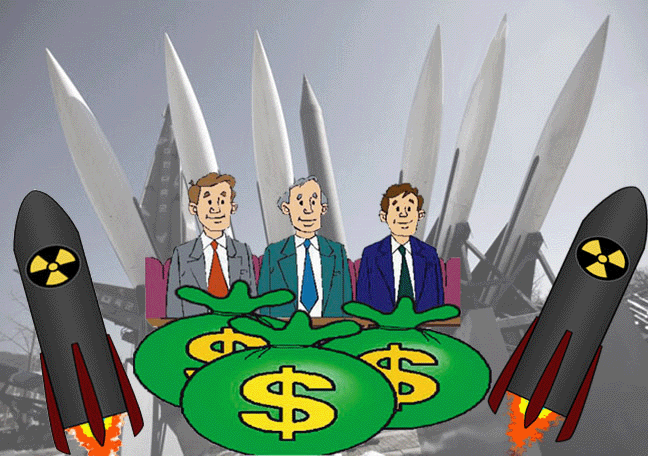
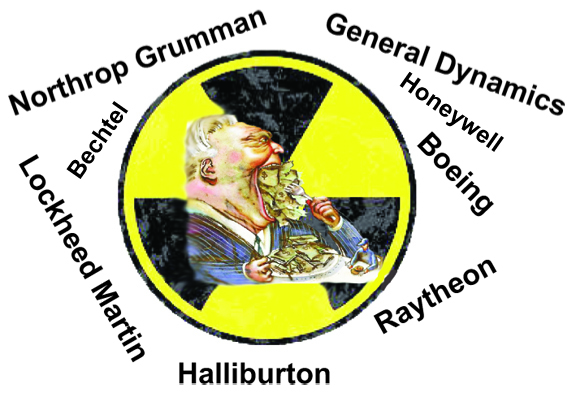
Why has this totally fraudulent belief persisted all this time? Because there are jobs in it, and it’s very profitable. So many companies – Boeing, Lockheed, IBM, Martin and more become reliant on the government and the defense industry, becoming “a nuclear-headed hydra”. It changed universities, with 75% of natural science funding coming from defense industries. Society becomes oriented around defense, security and nuclear weapons. Exponential increase in the number and diversity of weapons, with an unlimited budget. (Good visuals of many types of nuclear weapons) By 1961 23000 nuclear weapons, most of them thermonuclear- a thousand times more powerful than the one dropped on Nagasaki. Eisenhower finally realised what a threat that this permanent armaments industry was to democracy – and warned against the “military-industrial-complex”. So many congressmen were reliant on the armaments jobs in their district. Armaments were seen as good business by Republicans and Democrats.
Presidents Richard Nixon and then John Kennedy push for the weapons industry aiming to race the Soviets, beat the so-called “missile gap”. Confrontation increasing, between Kruschev and Kennedy, (told by Kruschev’s great-granddaughter). Focus on Berlin, – graphic coverage of the Wall going up, the guards, the repression, the “death strips” .
Meanwhile American missiles set up in Europe, aimed at Russia., in Turkey aimed at the Kremlin. So Soviets tried to set up a threat to USA in Cuba’s communist regime. A CIA-led insurgency there had failed, (told by veterans) .
Pressure on Kennedy to invade Cuba, but he was reluctant. Castro urged Kruschev to attack USA, but Kruschev was reluctant. Tortuous secret diplomacy. Privately both Kennedy and Kruschev wanted no nuclear war. But they were not really in control, and they publicly threatened with nuclear weapons. This crisis led to the PARTIAL NUCLEAR TEST BAN TREATY putting nuclear testing underground.
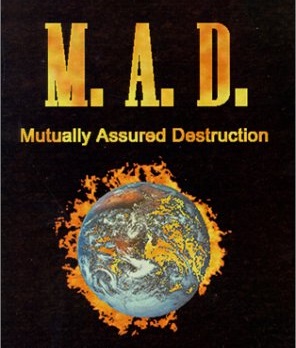
1963: Kennedy assassinated, 1964 – Kruschev deposed. Brezhnev took over, aiming to be ahead in nuclear missiles. Both USA and Soviet union raced for nuclear missile superiority, but aiming to never use these weapons – use would be a mutual suicide pact. They developed the policy of Mutually Assured Destruction. Use of thousands of these weapons within 30 minutes – would kill of the entire earth, cut out sunlight and plant growth, and coat the earth with radioactive fallout.
So – the battles between the Soviets and the USA were proxy battles in other countries, intervening in other countries ‘ civil wars – Nicaragua, Angola, North Yemen, Domenica, Bangladesh, East Timor, Mozambique. Congo, (brutish visuals) . In Vietnam China and Russia supported the North Vietnamese, while many Asian allies supported USA. USA used Latin American countries to mobilise the Cold War. In Chile USA orchestrated the overthrow of President Allende, and the takeover by fascist Augusto Pinochet. U.S. intervention left a chaotic rule in Guatemala , an authoritarian rule in Iran. Far from spreading democracy, USA “got into bed with anyone who called themselves anti-communist“.
1969 President Richard Nixon- publicly blustered about the evils of Soviet communism, but in reality, talked with the Soviets about negotiation, introducing “detente”. The Strategic Arms Limitation Agreement (SALT 1) 1n 1972, the first agreement to limit intercontinental ballistic missiles. The U.S. Anti Ballistic Missile System. But the number of warheads was increasing in both USA and Russia – to a total of 70.000 nuclear weapons. A movement in USA to not trust the Soviets will culminate in the 19080s with President Ronal Reagan. Still, Reagan’s hatred of nuclear weapons brought him and Russia’s Mikhail Gorbachev together.
Nukes in space: Why a very very stupid idea just became more likely

Fears of a Cold War nightmare are resurfacing.
Tom Howarth, May 4, 2024, https://www.sciencefocus.com/space/nukes-in-space
Could a nuke be used in space? Last month, Russia seemingly took a step toward making the idea a reality. In defiance of a US and Japan-sponsored UN resolution, the country vetoed plans to prevent the development and deployment of off-world nuclear weapons.
Fortunately, the country didn’t actually threaten to launch such a device into space, an act that would violate the 1967 Outer Space Treaty. However, the UN representative for Russia did call the new resolution a “cynical ploy” and claimed “we are being tricked”.
But what would actually happen if Russia – or any other country – detonated a nuke above Earth? The worrying answer: such an explosion could be as devastating as one on ground level.
What happens if you detonate a nuclear warhead in space?
There are some pretty stark differences between setting off a nuke at ground level and up in orbit.
“When nuclear weapons go off on the ground, a lot of energy is initially released as X-rays,” Dr Michael Mulvihill, vice chancellor research fellow at Teesside University, tells BBC Science Focus.
“Those X-rays superheat the atmosphere, causing it to explode into a fireball – that’s what produces the shockwave and characteristic mushroom cloud that sucks up dirt and produces fallout.”
But in space there is no atmosphere. So no mushroom clouds or shockwaves are formed when you set off a nuke in space. That doesn’t mean the effects are any less terrifying, however.
“In space, a nuclear explosion releases a huge amount of energy as X-rays, gamma rays, intense flows of neutrons and subatomic charged particles. It also produces what’s known as an electromagnetic pulse, or EMP,” Mulvihill says.
An EMP is effectively a burst of electromagnetic energy; when one interacts with the upper atmosphere, it strips electrons from it, blinding radar systems, knocking out communications and wiping out power systems.
After the initial explosion, a belt of radiation wraps around the Earth that persists for months, possibly even years – no one knows for sure. The radiation can damage satellites and, as Mulvihill points out, would pose a serious risk to anyone in space at the time – such as astronauts on the ISS.
“The EMP would knock out power systems on the ISS, effectively destroying the life support systems and everything that circulates the atmosphere within the space station. And I imagine the astronauts would be exposed to high levels of radiation too,” Mulvihill explains.
“It would be highly hostile to life in orbit.”
Space is becoming more and more crowded with satellites – approximately 10,000 satellites are in low earth orbit right now, and tens of thousands more are planned for launch in the coming years. This significantly raises the stakes of unleashing nuclear energy in space, as we become more reliant on the systems we put into orbit.
From ground level, however, other than blowing power grids and disrupting communications, the effects could also be somewhat beautiful.
As charged particles from the explosion interact with the Earth’s magnetic field and the atmosphere, they would cause brilliant auroras, stretching across huge distances that could last for days. So there’s that, at least.
Have nuclear explosions reached space before?
Unsurprisingly, during the Cold War, global superpowers (namely, the US and Russia) tested nukes in just about every scenario imaginable. On land, underwater, in a mountain – you name it, they tried blowing it up.
It comes as no surprise then, that detonating nuclear weapons in space has been done before. In total, the US conducted five space nuclear tests in space; the most famous of which, according to Mulvihill, occurred on 9 July 1962 near(ish) to the Pacific island paradise of Hawaii.
Starfish Prime was launched 400km (250 miles) above Johnston Island and had an explosive power of 1.4 megatons – about 100 times more powerful than the Hiroshima bomb.
The EMP was much larger than expected, compromising the classified nature of the test as streetlights and phone lines were knocked out in Hawaii 1,450 km (900 miles) away from the detonation point.
The ensuing red auroras stretched across the Pacific Ocean and lasted for hours.
“At the time there were around 22 satellites in space, of which around a third were knocked out,” Mulvihill says. The casualties included the world’s first TV communication satellite, Telstar 1, which had been a beacon of US technological development until Starfish Prime caused it to prematurely fail after just seven months in orbit.
In the following years, everyone came to their senses a bit and decided that testing nuclear warheads in space constituted a bad idea. Thus, the Outer Space Treaty (OST) was born.
Signed in 1967 by the US, UK and Soviet Union, the OST now has over 100 signatories and designates space as free for all to use for peaceful purposes only. The world breathed a sigh of relief and got on with using space for nice things like astronomy, space stations and WiFi for the next 60 years. So, what’s changed?
How worried should we be?
Rumours of a change in the orbital security situation began swirling when earlier this year the US House Intelligence Committee chairman Mike Turner issued a vague warning about a “serious national security threat” posed by Russia.
Following this, news outlets began reporting that the threat pertained to a possible “nuclear weapon in space”.
“It’s certainly concerning, but don’t lose sleep over it,” Mulvihill says. “Russia is still a signatory of the OST, so any sort of weapon in space would be absolutely illegal.”
He also points out that as Starfish Prime demonstrated, nuclear weapons in space are indiscriminate, meaning any detonation would do just as much damage to Russia and its allies as anyone else.
“It wouldn’t just knock out Starlink [the SpaceX system of satellites that provides internet to 75 countries]. It would knock out Chinese satellites and everyone else’s too.”
Another possibility, Mulvihill thinks, is that countries could develop nuclear-powered ‘jammers’. In other words, not a bomb (phew), but something that uses nuclear power to generate a signal that could disrupt, rather than destroy, other satellites.
Ultimately, though, this could all be little more than geopolitical posturing. “Deterrence is all about messaging and trying to persuade somebody that you would do it without ever actually getting there. I think that’s probably the psychology that’s going on with this,” Mulvihill concludes.
TODAY. Saint Rafael Grossi on the road to Damascus.

On the road to Damascus is where you get an epiphany. Well, Saint Paul did, anyway. He was on his way to Damascus to do punishing stuff to Christians, when he had a divine revelation and was transformed into an apostle, all aglow with Christian love.
Well, I don’t know that Rafael Grossi had any such revelation, in going to Damascus. But it seems clear that he decided that the proliferation of nuclear weapons is really nothing to worry about, certainly not when compared with the mission of the International Atomic Energy Agency, which is to promote the nuclear industry.
We always knew that countries that get nuclear weapons first get a “civil” nuclear industry. Except for the USA, which started the whole thing off the other way around, with the atrocity of the bombs for Hiroshima and Nagasaki. They then launched enthusiastically into the hypocrisy of the “peaceful nuke.
Britain’s leader Rishi Sunak, and France’s Emmanuel Macron have both publicly made it clear that “commercial” nuclear power is essential for their nuclear weapons industry. (So it doesn’t matter if commercial nuclear is a financial catastrophe.) The USA and Russia don’t seem to care, as long as they can sell all kinds of nuclear technology to anybody, really.
The new “advanced” small nuclear reactors make the problem worse, as they use enriched uranium, and reprocessing technologies that provide a great cover for making weapons grade fuel .
Rafael Grossi is well known for his earnest and pious statements about nuclear safety. Indeed, didn’t we all think that this is his job, to ensure the safety and non-weapons-proliferation of the world’s reactors?
But when did Rafael’s epiphany happen? When did he realise that safety and non-weapons proliferation did not matter now?
Rafael doesn’t seem to understand that all nuclear facilities become a target for terrorism, and a target in war-time. He has said a few cautionary words about the Zaporizhzhia Nuclear Power Station in Ukraine, but he’s quite OK with Ukraine setting up new nuclear power stations.
Rafael has expressed worthy worries about Saudi Arabia and nuclear weapons, but nevertheless “expressed his delight and admiration for Saudi Arabia’s nuclear capabilities” – and promoted them .
Syria is a place, and with a leader, prone to military disruptions, and , like Saudi Arabia, to human rights abuses, but that doesn’t seem to worry Grossi, over there to arrange for a Syrian nuclear industry.
An epiphany? Or did Rafael know all the time that his job is to be a nuclear salesman ?
Blatant hypocrisy
New civil nuclear programmes crossing over into military nuclear programmes

New Nuclear Dual-Use Risk: Beating Swords into Ploughshares? By Dr. Paul Dorfman, https://nct-cbnw.com/new-nuclear-dual-use-risk-beating-swords-into-ploughshares/ 24 Apr 24.
Dr. Paul Dorfman discusses whether new civil nuclear programs could cross over into military nuclear programs, and what this means for global non-proliferation efforts.
According to key global finance advisory and asset management firm Lazard, new nuclear power systems perform poorly compared to renewables’ storage, energy efficiency, cost, roll-out speed, and management. So why invest in new nuclear?
Prof. Andy Stirling and Dr. Phil Johnstone, from the University of Sussex Science Policy Research Unit (SPRU), argue that the answer lies in the clear and present link between civil and military nuclear infrastructure. This is because civil nuclear energy maintains the skills and supply chains also needed for military nuclear programs, without which the costs of nuclear military capabilities could become politically unsupportable.
As they point out, the U.K. Government’s ‘Civil Nuclear: Roadmap to 2050’ report includes sets of statements on civil and military nuclear ambitions in order to “identify opportunities to align the two across government”, strengthening existing interconnections between civil and military industries’ research and development, and thereby minimizing costs for both the weapons and power sectors.
More recently, in March 2024, U.K. Prime Minister Rishi Sunak explicitly linked military nuclear weapons production capability with civil nuclear power generation development. French President Emmanuel Macron has gone further, saying that “without civil nuclear power, no military nuclear power, without military nuclear, no civil nuclear”. And the fact is that 90% of all new nuclear construction projects worldwide involve corporations controlled by states with nuclear weapons
New Nuclear, New Proliferation Risk
The increasingly tense geopolitical environment makes nuclear a controversial issue, with nation states concerned that neighbors might use notionally civilian nuclear programs for military ends. In this sense, there are unique challenges and perceived opportunities when it comes to new civil nuclear ambitions.
Choice of offensive or defensive doctrine affects the way other states evaluate their respective security and, in turn, influences the probability of cross-over between civil and military nuclear capacity. Indeed, current movements in military doctrines share the common denominator of adopting more offensive postures.
Meanwhile, according to the U.K. Royal Society, all forms of nuclear production pose weapons development risks, as “there is no proliferation proof nuclear fuel cycle – the dual use risk of nuclear materials and technology and in civil and military applications cannot be eliminated.”
Unhelpfully, Small Modular Nuclear Reactors (SMRs), which are the best new hope for fissile fuel, could make the weapons proliferation problem even worse as any potential SMR roll-out to either developed or developing countries is likely to increase nuclear proliferation and security risks. This is especially so if any of those states prove politically unstable or have relatively limited resources to support a robust nuclear security and regulatory infrastructure.
Nuclear Cross-over in an Increasingly Unstable World
Unless uranium enrichment and reprocessing technologies are effectively regulated against the diversion of civil materials for military purposes, the reality is that new nuclear plants can provide the cover to develop and make nuclear weapons. Whether that capability is turned into actual weapons depends largely on political inclination.
Saudi officials have made it clear on more than one occasion that there’s another reason for their interest in civil nuclear energy technology which was not captured by the royal decree on the Saudi nuclear program – the relationship of the civil program to nuclear weapons. More recently, Saudi Arabia is pushing for the right to produce nuclear fuel, a move that poses further significant proliferation risk. The International Atomic Energy Agency (IAEA) has voiced concerns about Saudi intentions and safeguards.

Unfortunately, the IAEA’s support for Saudi’s civil nuclear clashes with their position on the Kingdom’s military ambition. This is not the first time that the UN nuclear regulator has been caught in this uncomfortably dualist situation.
More worryingly, the Director General of the IAEA, Rafael Grossi, has just met with Syrian President Bashar al-Assad in Damascus to “agree on a new engagement between Syria and IAEA with a view to providing confidence in the peaceful uses of nuclear energy for the benefit of its people”. Given the deeply problematic military and human rights history of al-Assad’s regime, the IAEA’s actions seem profoundly concerning, and bring the IAEA’s role in the global nuclear arena into sharp focus.
Thinking this through, an important question springs to mind. Due to the apparent potential for civil-military nuclear cross-over, could the IAEA’s mission – to work for “the safe, secure and peaceful application of nuclear science and technology” – inevitably result in weapons proliferation by default?
Irrational Paradoxes
Back in Eastern Europe, although Ukraine runs a substantive civil nuclear power program, it’s no longer a nuclear weapons state. Ukraine, once briefly the third-largest nuclear power in the world, made the decision to give up nuclear weapons on the basis that the U.S., U.K., and Russia would guarantee Ukraine’s security via the Budapest Memorandum.
In this sense, both Putin’s invasion of an independent state and subsequent nuclear weapons threats highlight the very real practical distinction between unilateral and multilateral nuclear weapons disarmament in an increasingly unstable world.
And then there’s Zaporizhzhia, where a civil nuclear power plant has become a target of war at the very same time that Russia’s role as a major player in the global civil nuclear power sector continues to expand via Moscow-backed international nuclear new-build projects and technology, uranium supply and enrichment, and spent nuclear fuel management.
Direction of Travel
While it appears reasonably clear that civil and military nuclear can enmesh, one must ask whether one inevitably leads to the other. While the usual concern is that civil nuclear infrastructure leads to military development, according to former Australian Prime Minister Scott Morrison, Australia is bucking the trend: “Let me be clear: Australia is not seeking to establish […] a civil nuclear capability […] a civil nuclear energy industry is not a requirement for us to go through the submarine program.”
In other words, despite the new nuclear submarine AUKUS deal, the current Australian government has no plans to develop new civil nuclear infrastructure.
So, does that start to negate the civil-military nexus hypothesis? Well, it’s not that nuclear military interests are the sole drivers of support for civil nuclear power, but for some states dual-use technology may comprise a significant complementary factor.
In the end, it’s the direction of travel that counts. While all key energy institutes and research organizations agree that renewables will do the heavy-lifting for the net-zero energy transition, it’s worth considering the implications of U.S. Energy Secretary Jennifer Granholm’s speech to Australia’s Energy Forum: “No country has ever been held hostage for access to the sun. No country has ever been held hostage for access to the wind. They have not ever been weaponized, nor will they be.”
Dr. Paul Dorfman is the Chair of the Nuclear Consulting Group, a Visiting Fellow at the Science Policy Research Unit (SPRU) of the University of Sussex, U.K., a Member of the Irish Government’s Radiation Protection Advisory Committee, and a Former Advisor to the U.K. Ministry of Defence Nuclear Submarine Dismantling Project.
What’s Inside the President’s Nuclear Football

the creation of the Football, the president’s emergency satchel. But what about the nuclear war plans inside? And what about the Black Book? As surprising as this now seems, until 1960, several of the U.S. military branches had their own individual plans for nuclear war. What this meant was that the Army, Navy, and Air Force chiefs each had authority over a uniquely designated stockpile of nuclear weapons—including the delivery systems for those weapons and lists of targets to strike—for them to use at their own discretion in the event of nuclear war. When incoming Secretary of Defense Robert McNamara learned about these multiple, competing nuclear war plans, he ordered them integrated into a single plan. This is how the Single Integrated Operational Plan, or SIOP, got its name.
What began as the Single Integrated Operational Plan is now the Operational Plan, or OPLAN.
The Operation Plan for nuclear war is a colossal and cumbersome set of documents, too large to be carried around in the Football. Parsed down to a more manageable size, the plans become nuclear strike options as delineated in the Black Book.
plan for “mass extermination.” “evil beyond any human project ever,” “the destruction of most cities and people in the northern hemisphere.”
BY ANNIE JACOBSEN, APRIL 11, 2024 https://time.com/6965539/u-s-presidents-nuclear-footb
Jacobsen’s new book is Nuclear War: A Scenario
Nuclear threats have reemerged on the world stage. Frequently, Vladimir Putin warns the West that Russia is ready for nuclear war. “Weapons exits in order to use them,” Putin says. North Korea accuses the U.S. of having, “a sinister intention to provoke a nuclear war.” Entwined with the rising rhetoric, one physical object stands alone—the president’s emergency satchel, also known as the nuclear Football.
This bulging leather briefcase remains with the president at all times, carried by a military aide, and never more than an arm’s length away. It’s an iconic reminder of preeminent power and national mystery. A “nominally secret command-and-control system used to assure presidential control of nuclear use decisions,” historian William Burr says of the Football. Items located inside the president’s emergency satchel confirm his identity and connect him, as commander in chief, to the National Military Command Center, a nuclear bunker located beneath the Pentagon.
Also inside the Football is the Black Book. This cryptic set of documents, parsed down from a much larger operational plan for nuclear war, provides the commander in chief with nuclear launch options should policy dictate the president needs to act. This includes which targets to strike, which delivery systems to use, and the timing of action. “It’s called the Black Book because it involves so much death,” says Dr. Glen McDuff, a nuclear weapons engineer who served as the classified museum historian at Los Alamos National Laboratory in New Mexico.
The Football is with the president at all times. The first publicly-released photograph of the Football is from May 1963, at the Kennedy Family Compound in Hyannis Port, Massachusetts. It can be seen swinging from the military aide’s hand as he walks directly behind the president. The Football accompanied President Regan to the Red Square in Moscow, in 1988. When President George H.W. Bush was photographed out on jog, his military aide—also in running shorts and sneakers—can be seen just a few steps behind, carrying the iconic briefcase in her left hand.
The Football is always within a few feet of the president of the U.S. Once, when President Clinton was visiting Syria, President Hafez al-Assad’s handlers tried to prevent Clinton’s military aide from riding in an elevator with him. “We could not let that happen, and did not let that happen,” former Secret Service director Lewis Merletti says. Merletti was the special agent in charge of President Clinton’s detail at that time. “The Football must always be with the president,” he asserts. “There are no exceptions.” How the Football came to be has long been shrouded in mystery. “Its origins remain highly classified,” journalist Michael Dobbs wrote in Smithsonian Magazine in 2014. And then, just a few months ago, Los Alamos National Laboratory finally declassified the Football’s origin story. It goes like this.
One day in December 1959, a small group of officials from the Joint Committee on Atomic Energy visited a NATO base in Europe to examine joint-custody nuclear bomb protocols. The NATO pilots stationed there flew Republic F84F jets, the first U.S. Air Force fighter-bomber aircraft designed to carry nuclear bombs. Operation Reflex Action was in effect, air crews were trained and ready to strike predetermined targets in the Soviet Union in less than fifteen minutes from the call to nuclear war. One of the men on this visit was Harold Agnew, a Los Alamos scientist with a unique history.
Agnew was one of the three physicists assigned to fly on the Hiroshima bombing mission as a scientific observer. He carried a movie camera with him and took the only existing film footage of the atomic bombing of Hiroshima, as seen from the air. Now, in 1959, Agnew was at Los Alamos overseeing thermonuclear bomb tests; he later became the lab’s director. During the trip to the NATO base, Agnew noticed something that made him wary. “I observed four F84F aircraft . . . sitting on the end of a runway, each was carrying two MK 7 [nuclear] gravity bombs,” he wrote in a document declassified in 2023. What this meant was that “custody of the MK 7s was under the watchful eye of one very young U.S. Army private armed with a M1 rifle with 8 rounds of ammunition.” Agnew told his colleagues: “The only safeguard against unauthorized use of an atomic bomb was this single G.I. surrounded by a large number of foreign troops on foreign territory with thousands of Soviet troops just miles away.”
Back in the U.S., Agnew contacted a project engineer at Sandia Laboratories named Don Cotter and asked “if we could insert an electronic ‘lock’ in the [bomb’s] firing circuit that could prevent just any passerby from arming the MK 7.” Cotter got to work. He put together a demonstration of a device, a lock and coded switch, that functioned as follows: “[a] 3-digit code would be entered, a switch was thrown, the green light extinguished, and the red light illuminated indicating the arming circuit was live.”
Agnew and Cotter went to Washington, D.C., to demonstrate this locking device—first to the Joint Committee on Atomic Energy, then to the president’s top science advisor and finally to the president himself. “We presented it to President Kennedy, who ordered it be done,” Agnew recalled. The military objected. The man in charge of nuclear weapons at the time, General Alfred D. Starbird, opposed the idea. Glen McDuff, who coauthored (with Agnew) the now declassified paper on the subject, summed up the general’s documented concerns. “How is a pilot, U.S. or foreign, somewhere around the world, going to get a code from the President of the United States to arm a nuclear weapon before being overrun by a massively superior number of Soviet troops?” For the U.S. military, the locking device issue opened Pandora’s box. “If gravity bombs were coded,” McDuff explains, “why not all nuclear weapons including missile warheads, atomic demolition munitions, torpedoes, all of them.” The president decided they needed to be.
The answer came in the creation of the Football, the president’s emergency satchel. But what about the nuclear war plans inside? And what about the Black Book? As surprising as this now seems, until 1960, several of the U.S. military branches had their own individual plans for nuclear war. What this meant was that the Army, Navy, and Air Force chiefs each had authority over a uniquely designated stockpile of nuclear weapons—including the delivery systems for those weapons and lists of targets to strike—for them to use at their own discretion in the event of nuclear war. When incoming Secretary of Defense Robert McNamara learned about these multiple, competing nuclear war plans, he ordered them integrated into a single plan. This is how the Single Integrated Operational Plan, or SIOP, got its name.
Starting in December 1960, for the first time in the nuclear age, the SIOP gave the president, not the military, control of America’s nuclear arsenal. This new locking device designed by Agnew and Cotter, called a Permissive Action Link, or PAL, became an integral part of this new system. Only with the invention of the Football would the order to launch nuclear weapons—and the ability to physically arm them—come from the president alone. “This is how the president got the Football,” writes Agnew.
Over the years, the name for the nuclear war plan has changed. What began as the Single Integrated Operational Plan is now the Operational Plan, or OPLAN. For the Nuclear Information Project, in consort with the Federation of American Scientists, project director Hans Kristensen and senior researcher Matt Korda have identified the current Operational Plan as OPLAN 8010-12. It consists of “‘a family of plans’ directed against four identified adversaries: Russia, China, North Korea, and Iran,” the authors write. The Operation Plan for nuclear war is a colossal and cumbersome set of documents, too large to be carried around in the Football. Parsed down to a more manageable size, the plans become nuclear strike options as delineated in the Black Book.
The number of individuals who have written out their first-hand impressions of the SIOP is extremely limited. John Rubel, an avionics expert who served as an assistant secretary of defense under President Kennedy, wrote about the SIOP in his 2008 memoir, Doomsday Delayed. He liked it to a plan for “mass extermination.” Daniel Ellsberg reflected on the SIOP in his 2017 memoir, The Doomsday Machine: Confessions of a Nuclear War Planner. “It depicted evil beyond any human project ever,” Ellsberg wrote. A plan that calls for “the destruction of most cities and people in the northern hemisphere.”
As for the Black Book, few details exist on the public record. In 2015, U.S. Strategic Command battle watch commander Colonel Carolyn Bird shared with CNN previously unreported details. An identical Football resides inside the Stratcom nuclear bunker, viewers learned, locked in a safe beneath Offutt Air Force Base in Nebraska. “The [Black Book inside the] president’s football and our black book are duplicates,” Bird told CNN. “They contain the same information in the same way so that we are talking off the same documents when we are discussing nuclear options.”
In an interview with the History Channel, President Clinton’s former military aide, a colonel named Robert “Buzz” Patterson, likened the Black Book to a “Denny’s breakfast menu.” He made the analogy that choosing retaliatory targets from a predetermined nuclear strike list was as simple as deciding on a combination of food items at a restaurant. “It’s like picking one out of Column A and two out of Column B,” Patterson said.
Dr. Theodore Postol has seen the contents of the Black Book. His thoughts provide unsettling context to Patterson’s observations. From 1982 to 1984 Postol served as the assistant for weapons technology to the chief of naval operations. In this capacity, he worked on technical details regarding submarine launched ballistic missiles, or SLBMs. “Nitty gritty features,” Postol generalizes.
“Seeing the contents of the Black Book,” he recalls, “I was freaked out beyond belief.” Not for reasons he expected; as a weapons technologist Postol was familiar with the mass carnage involved. Instead of being confronted with a succinct summary of these horrifying facts—the targeting of cities, the death tolls in the millions—
Postol found the contents of the Black Book to be an obfuscation of the facts. The nuclear launch plans, he says, “had been sterilized down to military terminology designed to remove you from the reality of what would be happening.” An attempt at sanitizing nuclear war into a seemingly more palatable event. “My first thought,” Postol remembers, was “how would a president understand what these attack options actually mean?” This censoring of grim truths about nuclear war extends to the public as well, Postal contends. “You don’t want your population to know you’re planning genocide.”
What, if any, is the solution to this madness? Between the saber rattling and the secrecy, nuclear matters can present themselves as intractable. And yet, in reporting this story I witnessed a change in attitude from an unlikely source: the Los Alamos National Laboratory, a federal government organization that I’ve covered as a reporter for fifteen years.
“It’s the Oppenheimer effect,” Dr. Glen McDuff told me of this new attitude, “as in Oppenheimer the film.” Ever since the release of Christopher Nolan’s 2023 feature film, “the lab has been inundated with public curiosity about the bomb,” McDuff clarifies. “With requests about nuclear weapons.” And, he says, the lab has done its best to respond. The popularity of the film has renewed dialogue about the existential dangers nuclear weapons pose. And it led to the declassification (at this reporter’s behest) to one of the laboratory’s long-held secrets—the origin story of the Football.
Were the President of the United States to be called upon to open the Football, the situation that would follow would almost certainly spiral out of control. “The world could end in the next couple of hours,” former Stratcom commander General C. Robert Kehler (ret) says of nuclear war.
Nuclear war is the only scenario other than an asteroid strike that could end civilization in a matter hours. The soot from burning cities and forests will blot out the sun and cause a nuclear winter. State-of the art climate modeling predicts five billion humans will die. In the words of Nikita Khrushchev, “the survivors will envy the dead.”
And yet, threats abound. Vladimir Putin insists he is “not bluffing” about the possibility of using weapons of mass destruction. North Korea has test launched more than 100 missiles since January 2022, including nuclear-capable weapons that can hit the U.S. United Nations Secretary General António Guterres warns the world, “Humanity is one misunderstanding, one miscalculation away from nuclear annihilation.” The world balances on the razor’s edge. “This is madness,” Guterres says, “we must reverse course.” Change is possible. Help reverse course. “A nuclear war cannot be won and must never be fought,” President Ronald Reagan and Soviet General Secretary Mikhail Gorbachev cautioned the world in a joint statement in 1985. Conversations between these two leaders led to the reduction in nuclear weapons from an all-time high of 70,481 warheads, to some 12,500 today. Dialogue matters. Join the conversation about nuclear weapons now, while we are all still able to have one.
Einstein’s vision for peace

By Lawrence S. Wittner https://beyondnuclearinternational.org/2024/03/31/einsteins-vision-for-peace/
Aghast at the use of nuclear weapons, he threw himself into efforts to prevent worldwide nuclear annihilation
Although the popular new Netflix film, Einstein and the Bomb, purports to tell the story of the great physicist’s relationship to nuclear weapons, it ignores his vital role in rallying the world against nuclear catastrophe.
Aghast at the use of nuclear weapons in August 1945 to obliterate the cities of Hiroshima and Nagasaki, Einstein threw himself into efforts to prevent worldwide nuclear annihilation. In September, responding to a letter from Robert Hutchins, Chancellor of the University of Chicago, about nuclear weapons, Einstein contended that, “as long as nations demand unrestricted sovereignty, we shall undoubtedly be faced with still bigger wars, fought with bigger and technologically more advanced weapons.” Thus, “the most important task of intellectuals is to make this clear to the general public and to emphasize over and over again the need to establish a well-organized world government.”
Four days later, he made the same point to an interviewer, insisting that “the only salvation for civilization and the human race lies in the creation of a world government, with security of nations founded upon law.”
Determined to prevent nuclear war, Einstein repeatedly hammered away at the need to replace international anarchy with a federation of nations operating under international law. In October 1945, together with other prominent Americans (among them Senator J. William Fulbright, Supreme Court Justice Owen Roberts, and novelist Thomas Mann), Einstein called for a “Federal Constitution of the World.”
That November, he returned to this theme in an interview published in the Atlantic Monthly. “The release of atomic energy has not created a new problem,” he said. “It has merely made more urgent the necessity of solving an existing one. . . . As long as there are sovereign nations possessing great power, war is inevitable.” And war, sooner or later, would become nuclear war.
Given Einstein’s fame and his well-publicized efforts to avert a nuclear holocaust, in May 1946 he became chair of the newly-formed Emergency Committee of Atomic Scientists, a fundraising and policymaking arm for the atomic scientists’ movement. In the Committee’s first fund appeal, Einstein warned that “the unleashed power of the atom has changed everything save our modes of thinking, and thus we drift toward unparalleled catastrophe.”
Even so, despite the fact that Einstein, like most members of the early atomic scientists’ movement, saw world government as the best recipe for survival in the nuclear age, there seemed good reason to consider shorter-range objectives. After all, the Cold War was emerging and nations were beginning to formulate nuclear policies. An early Atomic Scientists of Chicago statement, prepared by Eugene Rabinowitch, editor of the Bulletin of the Atomic Scientists, underscored practical considerations.
“Since world government is unlikely to be achieved within the short time available before the atomic armaments race will lead to an acute danger of armed conflict,” it noted, “the establishment of international controls must be considered as a problem of immediate urgency.” Consequently, the movement increasingly worked in support of specific nuclear arms control and disarmament measures.
In the context of the heightening Cold War, however, taking even limited steps forward proved impossible. The Russian government sharply rejected the Baruch Plan for international control of atomic energy and, instead, developed its own atomic arsenal. In turn, U.S. President Harry Truman, in February 1950, announced his decision to develop a hydrogen bomb―a weapon a thousand times as powerful as its predecessor.
Naturally, the atomic scientists were deeply disturbed by this lurch toward disaster. Appearing on television, Einstein called once more for the creation of a “supra-national” government as the only “way out of the impasse.” Until then, he declared, “annihilation beckons.”
Despite the dashing of his hopes for postwar action to end the nuclear menace, Einstein lent his support over the following years to peace, nuclear disarmament, and world government projects.
The most important of these ventures occurred in 1955, when Bertrand Russell, like Einstein, a proponent of world federation, conceived the idea of issuing a public statement by a small group of the world’s most eminent scientists about the existential peril nuclear weapons brought to modern war. Asked by Russell for his support, Einstein was delighted to sign the statement and did so in one of his last actions before his death that April.
In July, Russell presented the statement to a large meeting in London, packed with representatives of the mass communications media. In the shadow of the Bomb, it read, “we have to learn to think in a new way. . . . Shall we . . . choose death because we cannot forget our quarrels? We appeal as human beings to human beings: Remember your humanity, and forget the rest.”
This Russell-Einstein Manifesto, as it became known, helped trigger a remarkable worldwide uprising against nuclear weapons in the late 1950s and early 1960s, culminating in the world’s first significant nuclear arms control measures. Furthermore, in later years, it inspired legions of activists and world leaders. Among them was the Soviet Union’s Mikhail Gorbachev, whose “new thinking,” modeled on the Manifesto, brought a dramatic end to the Cold War and fostered substantial nuclear disarmament.
The Manifesto thus provided an appropriate conclusion to Einstein’s unremitting campaign to save the world from nuclear destruction.
Lawrence S. Wittner is Professor of History Emeritus at SUNY/Albany and the author of Confronting the Bomb (Stanford University Press).
The Nuclear Explosion That Makes US Aid to Israel Illegal

President Carter noted in his White House dairy at the time, “We have a growing belief among our scientists that the Israelis did indeed conduct a nuclear test explosion in the ocean near the southern end of Africa.”
Under US law, Israel must be banned from receiving its annual package of billions of dollars and arsenal of bombs.
Americans are being deliberately lied to by their own government as to Israel’s vast and deadly nuclear stockpile, largely built with nuclear materials stolen from the United States.
At the same time that US administrations were failing to enforce the ban on nuclear weapons testing by Israel, they also deliberately engaged in a campaign of censorship, lies, and disinformation to hide the truth from the American public
Israel’s nuclear program has been in violation of international law for decades, rendering it ineligible for American assistance.
JAMES BAMFORD, 1 April 24 https://www.thenation.com/article/world/israel-nuclear-weapons/
The researchers were startled as they looked up and saw the coal-black sky suddenly turn into a brilliant, multicolored aurora. As geophysicists with Tokyo’s Earthquake Research Institute, they were wintering over at an isolated ice station near Antarctica’s Queen Maud Land, a place where the temperature has dropped to as low as minus-50 degrees Fahrenheit. At about the same time, half the earth away in Puerto Rico, the giant 1,000-foot Arecibo radio telescope picked up an unusual disturbance. An odd and powerful electromagnetic ripple appeared on the lower surface of the ionosphere. And 1,200 miles to the north on the Atlantic coast of Florida, in a secret US government lab, long thin styluses like a spider’s legs began swinging back and forth tracing two hump-shaped images on a rolling sheet of graph paper.
The computer’s action was triggered by a signal from a satellite in the frigid blackness of deep space, 67,000 miles above Earth. Shaped like a giant, 26-sided Christmas tree ornament and hanging weightlessly in the empty void, VELA 6911 was one of a series of satellites designed to act as America’s sentinels in space, watching for signs of nuclear detonations on any part of the planet. And in the early morning of September 22, 1979, at 00:52:43 UTC, VELA 6911’s sensitive instruments recorded what appeared to be a very bright flash, followed quickly by a second. They were the classic indicators of a powerful nuclear explosion. Somewhere down below, as close as someone can come to terra incognita, a rogue country had set off a nuclear bomb. A rogue country that was hoping not to get caught. It was the first and only time in history that a clandestine nuclear blast has taken place. And based on its analysis, US intelligence agencies concluded that the rogue country was Israel.
Now, 45 years later, that explosion could play a significant role in bringing an end to Israel’s genocidal assault on Gaza by using American lawfare to halt Israeli warfare—finally enforcing US laws that would cut off all aid, including the billions and billions of dollars and the tons and tons of weapons Israel now receives. For decades, these laws, enacted by Congress to halt harmful and destructive actions by rogue actors, have been deliberately ignored with regard to Israel. Clearly, they must now be enforced.
Just this week, Francesca Albanese, the UN special rapporteur on human rights in the occupied Palestinian territories, issued a report titled, “Anatomy of a Genocide.” It declared that “there are reasonable grounds to believe that the threshold indicating the commission of the crime of genocide against Palestinians as a group in Gaza has been met.” A few days earlier, the Office of the UN High Commissioner for Human Rights had warned that “any transfer of weapons or ammunition to Israel” could violate international humanitarian law. This week, a Gallup poll indicated that most Americans disapprove of Israel’s war in Gaza as well as of sending them military aid to fight it.
Hours after the sky lit up from the blast, confirmation that it was a nuclear explosion came from another US government facility, this one on remote Ascension Island. A bleak and rugged volcanic speck in the middle of the South Atlantic Ocean, it lies near the equator between Africa and South America and is one of the most secret places on the planet. No one is allowed on the island without the approval of the US and British governments. In addition to a massive British eavesdropping base that targets countries on both continents, the island is also home to an American facility that monitors all undersea activity throughout the Atlantic. And because, at a certain depth, hydroacoustic signals travel through the water at about 5,000 feet per second, the sound of the massive blast was detected about 110 minutes after it took place.
In the netherworld of US intelligence, the rogue atomic explosion was shocking. The Jimmy Carter White House was quickly notified, and, following a series of highly classified meetings, spy agencies became unanimous in their view. “The Intelligence Community has high confidence, after intense technical scrutiny of satellite data, that a low yield atmospheric nuclear explosion occurred in the early morning hours of September 22,” said a Secret/Sensitive Department of State document.
Attention, as a result, turned immediately to Israel. Its nuclear facility in the desert at Dimona had long since ceased to be a secret, and the question wasn’t whether Israel could construct a nuclear weapon but how many it had already built. However, while constructing them secretly inside a building is one thing, secretly testing them out in the open without getting caught is much more difficult. Addressing the issue of “A Secret Test by Israel,” another CIA document outlined a number of reasons the state might have wanted to carry out a hidden nuclear test. Among them was “developing the fission trigger [an atom bomb] for a thermonuclear weapon [an hydrogen bomb]…. A low-yield nuclear test conducted clandestinely at sea could have enabled them to make basic measurements of the device’s performance.”
The report concluded, “Indeed, of all the countries which might have been responsible for the 22 September event, Israel would probably have been the only one for which a clandestine approach would have been virtually its only option.” And President Carter noted in his White House dairy at the time, “We have a growing belief among our scientists that the Israelis did indeed conduct a nuclear test explosion in the ocean near the southern end of Africa.”
The VELA satellite system was designed in particular to watch for rogue tests by nuclear pariah states like Israel, one of the very few countries that had refused to sign both the 1970 Nuclear Non-Proliferation Treaty and the 1975 Biological Weapons Convention, in spite of the fact that it had an illegal hidden arsenal of nuclear weapons and a secret biological weapons program. The problem for Israel—and a key reason for the secrecy involving the tests—was the Glenn Amendment to the US Arms Export Control Act. Passed by Congress in 1977, the amendment aimed particularly at the nuclear pariah states. It mandated an end to arms assistance, and an automatic application of extensive US sanctions, if the president determined that any state (other than the nuclear states authorized by the Nuclear Non-Proliferation Treaty) detonated a nuclear explosive after 1977. The nuclear test was also a clear violation of the 1963 Limited Test Ban Treaty, to which Israel was a party.
Under US law, Israel must be banned from receiving its annual package of billions of dollars and arsenal of bombs. In a 2016 Haaretz column, Victor Gilinsky, a physicist and former commissioner of the US Nuclear Regulatory Commission, laid out the penalties: “The sanctions for detonating a nuclear explosion are tough: termination of assistance under the Foreign Assistance Act, termination of sales of defense equipment and military financing, prohibition of loans from US banks, and more. In other words, if the U.S. government were to conclude Israel detonated a nuclear explosion after 1977, the law, unless waived, would effectively end all US aid to Israel.” Newell Highsmith, who spent three decades with the State Department and was responsible for legal issues related to nonproliferation, agrees. “Glenn Amendment sanctions for detonation or receipt of a nuclear explosive device have been viewed as a ‘death sentence’ because of the breadth of sanctions and because there is no presidential waiver,” he wrote last year for the Carnegie Endowment for International Peace.
In addition to the violation of the Glenn Amendment, Israel is also in violation of the Symington Amendment, which has similar penalties for any country that delivers nuclear materials and technology to another country. Israel had a long history of friendship and cooperation with apartheid South Africa, and in addition to supplying millions of dollars worth of weapons to help violently suppress the country’s Black majority population, it also provided nuclear weapons materials and offered to sell the racist regime nuclear warheads to keep it in power. In return, Israel received uranium from South Africa to develop its weapons.
For decades, US presidents and members of Congress have willfully turned a blind eye to Israel’s extensive violations of American laws. Earlier this month, Maryland Democratic Senator Chris Van Hollen and seven other senators, including Bernie Sanders of Vermont and Jeff Merkley of Oregon, sent a strong letter to President Joe Biden. It urged him to enforce section 6201 of the Foreign Assistance Act by requiring Israel to stop restricting humanitarian aid access to Gaza or forfeit military aid from the US. The law prohibits the sale and transfer of military weapons to any nation that restricts the delivery of US aid, precisely what Israel is doing in its deliberate war of starvation against Palestinian civilians in Gaza. “We need the president and the Biden administration to push harder and to use all the levers of US policy to ensure people don’t die of starvation,” Van Hollen told The Guardian.
At the same time that US administrations were failing to enforce the ban on nuclear weapons testing by Israel, they also deliberately engaged in a campaign of censorship, lies, and disinformation to hide the truth from the American public. The Clinton White House even promulgated a regulation that threatens past and present government employees with harsh actions, including firing, if they publicly acknowledge that Israel has nuclear weapons. “All US government employees are forced to pretend they know nothing about Israeli nuclear weapons,” former NRC commissioner Gilinsky wrote in the Bulletin of the Atomic Scientists. “Since everyone knows it’s not true, the pretense hobbles America’s policy on restraining the spread of nuclear weapons in the Middle East.”
Because of this official gag order, Americans are deliberately kept in the dark regarding the dangerousness of Israel’s illegal stockpile of nuclear weapons—weapons that have never been subject to international inspection and are therefore of questionable safety. And then there is the problem of that secret cache of nuclear weapons being controlled by a number of top Israeli officials whose extreme positions would sanction their use. Last November, Israeli Minister Amichai Eliyahu said one of Israel’s options in the war is to drop a nuclear bomb on Gaza. “That’s one way,” he said. Another Israeli official, Revital “Tally” Gotliv, urged her government to use “everything in its arsenal,” including “doomsday” weapons, against Hamas. “Who would have imagined that, just as we have been worrying about Pakistani weapons falling into the hands of Islamic fanatics, we would come to the point where we have to fear Israel’s nuclear weapons falling into the hands of Israeli fanatics?” said Gilinsky.
With hundreds of drone attacks in the region and missiles flying back and forth, there is also the danger of one of them deliberately or accidentally hitting Israel’s Dimona nuclear weapons plant and setting off a nuclear catastrophe. Last October, according to Israeli reports, “Incoming rocket sirens are sounding in the Southern Negev region, close to the southern city of Dimona.” Adding to the danger is more than half a century’s worth of volatile nuclear waste, numbering hundreds of tons, in shallow trenches at the nuclear weapons complex—material that, unless carefully disposed of, could turn Dimona into another Chernobyl.
Americans are being deliberately lied to by their own government as to Israel’s vast and deadly nuclear stockpile, largely built with nuclear materials stolen from the United States. For those on Capitol Hill and in the White House, the incentive for keeping Israel’s secret—and thus allowing it to avoid US laws—is money and power. Millions in campaign donations from wealthy pro-Israel supporters and PACs, and power from lobbies like AIPAC. In 1979, rather than take any actions against Israel, President Carter, like those in the White House before and after him, did nothing. Carter has acknowledged this in years since, writing that the “reluctance to criticize any policies of the Israeli government is because of the extraordinary lobbying efforts” of AIPAC.
The strength of AIPAC is something CNN’s Wolf Blitzer knows a great deal about. Before his gig with cable news, he was a top propagandist for AIPAC. There is, he noted, “a widely held attitude among Israeli officials that Israel can get away with the most outrageous things. There is a notion among many Israelis that their American counterparts are not too bright, that they can be ‘handled.’”
Vermont Senator Bernie Sanders apparently agrees, having repeatedly warned that Israel is violating both international and US laws. “To pretend that Israel is not violating international law or interfering with US humanitarian aid is absurd on its face,” he said this week. “The State Department’s position makes a mockery of US law and assurances provided to Congress.” Nevertheless, he concluded that “relatively few Democrats are prepared to pull the trigger and say, ‘You know what, hey, Mr. Netanyahu. You continue that and you’re not getting another nickel in American aid.’ Why’s that so? I guess it has a lot to do with AIPAC.”
Sanders then pointed his finger at the White House. “And it’s a lot to do with the president,” he said. Indeed, Joe Biden, during his time in the Senate, was the number-one recipient in Congress of pro-Israel millions—which apparently put him at the top of Israel’s list of “not-too-bright American politicians” that can be “handled” with bags of cash. While vice president in 2011, Biden gave an address to a group of fundraisers and supporters of the Yeshiva Beth Yehuda school in Detroit. “I’ve raised more money from AIPAC than some of you have,” he said to applause. “You think I’m kidding, don’t you,” he added. “I’m not.”
For the White House and Congress, it’s time to rip off the gag, stop being “handled,” reject the cash, and enforce the law with Israel—including the Glenn and Symington amendments. If its leaders want to secretly explode nuclear weapons, sell nuclear materials to racist countries, violate treaties, commit war crimes, and engage in ethnic genocide, America’s billions, bombs, and backing should not be making it possible.
Nuclear news for the last week of March

Some bits of good news. More Teens Than You Think Understand the Positive and Negative Aspects of Smartphones–Survey. India makes significant progress on malaria. Renewables blew gas away in the UK.
TOP STORIES
UK Court Gives Biden Chance to Dodge Assange Appeal by “Assuring” His Rights .
Spending Unlimited – The Pentagon’s Budget Follies Come at a High Price.
Air attacks on Ukraine have again put the Zaporizhzhia nuclear power plant(ZNPP), under Russian control, in danger. ALSO AT ………
Nuclear waste clean-up company to be prosecuted over alleged cyber blunders, lax security.
THE R.A.F’S NUCLEAR FLIGHTS OVER BRITAIN AND THE ATLANTIC.
Is Nuclear Fusion Really The Ultimate Solution to AI’s Crazy Power Use?
Climate. Oil company chief urges investment in fossil fuels, as world heats at a record pace. Antarctic sea ice ‘behaving strangely’ as Arctic reaches ‘below-average’ winter peak. Copernicus online portal offers a terrifying view of climate emergency.
Noel’s notes. Sellafield scandals – a case study in why the nuclear industry must be shut down. A world run by 11 year-old boys? The tiresome spin of the nuclear lobby in Australia.
******************************************************************
AUSTRALIA.
- Australian government seeks top quality PR team to persuade Aborigines that a nuclear waste dump is a good thing.
- The AUKUS Cash Cow: Robbing the Australian Taxpayer. Australia’s move on nuclear submarines raises concern.
- Nuclear ranks last on list of good investments by big institutions. IFM Investors steers clear of nuclear projects.
- Liberal Coalition twisting itself into knots over nuclear policy. Opposition’s nuclear policy must be based on facts. ‘They don’t have a plan’: Chris Bowen slams Opposition push for nuclear.
- UN Security Council ceasefire resolution a turning point in Gaza war.
NUCLEAR ISSUES
ART and CULTURE. Decades of Dissent: Anti-Nuclear movement explored in LSE Library exhibition, London.
CIVIL LIBERTIES. The Empire Slowly Suffocates Assange Like It Slowly Suffocates All Its Enemies.
Arrested for peaceful protest against Israeli-owned military technology company.
ECONOMICS.
- UK’s ever more expensive nuclear submarines will torpedo spending plans for years to come.
- ‘Nuclear Dinosaurs’ Roam New Brunswick, Ontario as ‘Jurassic’ Partnership Looms.
- Nuclear energy everywhere costs an arm and a leg.
- EDF Names New Head of Nuclear Plant Projects Amid Cost Overruns.
- United Arab Emirates signals interest in European nuclear energy investments.
- Famous UK seaside town ‘decimated’ by £46bn nuclear power station and huge Pontins change.
| EDUCATION. Nuclear and weapons industry propaganda to schools. Missing Links in Textbook History: War | EMPLOYMENT. Sellafield’s head of information security to step down. | ETHICS and RELIGION. A Genocide Foretold. |
EVENTS. The First Annual Plutonium Trail Caravan is on Saturday April 6th – Join Us!
| LEGAL. Assange Extradition Delayed Unless US Provides ‘Assurances’ He Won’t Be Executed for Revealing the Truth. Chris Hedges: The Crucifixion of Julian Assange. Purgatorial Torments: Assange and the UK High Court. Now there are three court challenges against Ontario nuclear waste disposal facility. The Decision That Wasn’t A Decision. The Office for Nuclear Regulation (ONR) will prosecute Sellafield Ltd on charges of security offences. British nuclear site Sellafield to be prosecuted for cybersecurity failures. Court Allows Ageing Japanese Nuclear Plants to Continue Operations. | MEDIA. This is how nuclear war would begin – in terrifying detail. ‘My jaw dropped’: Annie Jacobsen on her scenario for nuclear war. Review: Annie Jacobsen’s ‘Nuclear War: A Scenario’ Will Make You Start Worrying And Hate The Bomb. The Rising Nuclear Threat: Readers respond to the “At the Brink” series of Opinion articles Einstein’s vision for peace. Oppenheimer: Monaghan man, Daniel A. McGovern, who captured nuclear devastation. |
| OPPOSITION to NUCLEAR . Scotland’s National Party attacks £200m extra for nuclear deterrent and industry. | POLITICS. Whaat! Romania’s state-owned Nuclearelectrica to partner with NuScale to build small nuclear reactors- U.S, government to give $1.52 billion loan guarantee to Holtec to resuscitate Palisades Nuclear Plant. IAEA Warns Of Iraq-Like Scenario For Iran Without Transparency |
| POLITICS INTERNATIONAL and DIPLOMACY. New NATO member Finland admits US pact ‘restricts sovereignty’. Biden claims binding UN Security Council Gaza ceasefire resolution is ‘non-binding.’ | PUBLIC OPINION. Most Americans now disapprove of Israel’s military action in Gaza new poll reveals as tensions rise between allies. | SAFETY. Atomic blackmail – Russia-Ukraine war and Ramberg’s theory of vulnerability. NRC admits San Onofre Holtec nuclear waste canisters are all damaged. Special nuclear flights between the US and UK: the dangers involved. Security concerns as UAE Eyeing Investments in Europe’s Nuclear Energy Sector. |
| SECRETS and LIES. IAEA Unaware Of Secret Iranian Nuclear Site Targeted By Israel. | SPINBUSTER.ChatGPT’s boss claims nuclear fusion is the answer to AI’s soaring energy needs. Not so fast, experts say. Cancer “epidemic” in the Young as Radioactive Wastes are Increasingly Dispersed to the Environment meanwhile Nuclear given “green” status in Brussels.. | TECHNOLOGY. Weaponizing Reality: The Dawn of Neurowarfare. New nuclear reactor types will not solve waste and safety issues. |
| WASTES. UK nuclear watchdog takes Sellafield nuclear waste operator to court over alleged IT breaches. Experts from Japan and China held talks on treated radioactive wastewater. Decommissioning. How much will extra decades of nuclear decommissioning work at Dounreay cost? Dounreay decommissioning date ‘never achievable’ says Caithness councillor Also at https://nuclear-news.net/2024/04/01/1-b1-dounreay-decommissioning-date-never-achievable-says-caithness-councillor/. | WAR and CONFLICT. Putin says Russia will not attack NATO, but F-16s will be shot down in Ukraine. Atrocities. Israel Remains Intent on Genocide Despite World Court Orders. Michigan Republican congressman says Gaza should be destroyed with nuclear bomb ‘like Nagasaki and Hiroshima’, as he slams US for sending humanitarian aid. | WEAPONS and WEAPONS SALES.Biden Is Quietly Funding Nuclear Weapons Upgrades That Could Imperil the Planet. The Nuclear Explosion That Makes US Aid to Israel Illegal. US secretly sending more bombs to Israel – Washington Post.. U.S., Germany Supplied 99% of Israel Weapons Import Despite Pressure: Data.France will help Brazil develop nuclear-powered submarines, Macron says.Nabbed Australian Protestors Stopping Military Shipment to Israel.UK to test new ‘Astraea’ nuclear warheads without detonation. |
F-35A aeroplanes officially certified to carry thermonuclear bomb

The designation marks the first time that a stealth fighter can carry a nuclear weapon, in this case the B61-12 thermonuclear gravity bomb.
Breaking DEFENSE, By MICHAEL MARROW, March 08, 2024
WASHINGTON — The F-35A Joint Strike Fighter has been operationally certified to carry the B61-12 thermonuclear gravity bomb, a spokesman for the F-35 Joint Program Office (JPO) tells Breaking Defense.
In a statement, JPO spokesman Russ Goemaere said the certification was achieved Oct. 12, months ahead of a pledge to NATO allies that the process would wrap by January 2024. Certain F-35As will now be capable of carrying the B61-12, officially making the stealth fighter a “dual-capable” aircraft that can carry both conventional and nuclear weapons.
“The F-35A is the first 5th generation nuclear capable aircraft ever, and the first new platform (fighter or bomber) to achieve this status since the early 1990s. This F-35 Nuclear Certification effort culminates 10+ years of intense effort across the nuclear enterprise, which consists of 16 different government and industry stakeholders,” Goemaere said. “The F-35A achieved Nuclear Certification ahead of schedule, providing US and NATO with a critical capability that supports US extended deterrence commitments earlier than anticipated.”
Responding to follow-up questions from Breaking Defense, Goemaere said US disclosure policy prohibits the release of information on dual-capable aircraft among NATO partners. According to analysis by the Federation of American Scientists, as of 2023 approximately 100 older variants of B61 bombs are housed by NATO allies Belgium, Germany, Italy, the Netherlands and Turkey, who share the alliance’s nuclear strike mission. The first four nations are all planned F-35 operators, with the need to have a nuclear-capable aircraft a key reason for Germany signing onto the program.
The F-35A is certified to only carry the newer B61-12 variant, which will replace the older models………………………………………………………………………………………………………………………………
Hans Kristensen, director of the Nuclear Information Project with the Federation of American Scientists, noted the announcement is another milestone in America’s ongoing nuclear modernization effort.
“The stage is set for the tactical nuclear weapons upgrade in Europe with full-scale production of the B61-12 and four NATO allies and the US fighter wing at Lakenheath upgrading to operate the bomb on the F-35A,” he said……………….. more https://breakingdefense.com/2024/03/exclusive-f-35a-officially-certified-to-carry-nuclear-bomb/—
The horrors of nuclear weapons testing

I think that enough time has gone by that the longer-term dangers of nuclear weapons, such as radioactive fallout, have largely disappeared from the public consciousness—much to the agony and despair of those afflicted to this day.
Radioactive fallout and its long-term effects—things that the average person today does not really appreciate—would be the result from any future nuclear weapons explosion that touched the Earth’s surface. Fallout does not just affect the target, but also the surrounding areas—which could be as far as hundreds of miles away. And the effects could last for years, if not decades thereafter.
Bulletin By Walter Pincus, March 7, 2024
There has been talk in the national security community lately about the so-called “merits” of resuming underground or even atmospheric nuclear weapons tests. I think this would be a grave mistake for many reasons—chief among them is that it forgets the horrific health effects that resulted from some previous nuclear tests.
To be clear, since 1963, atmospheric tests of nuclear weapons have been banned, as have tests in outer space and under water. And underground explosive tests have been banned ever since the 1996 Comprehensive Nuclear Test Ban Treaty, or CTBT. (Technically speaking, while the United States and China have signed the CTBT, neither has ratified it. Russia did both sign and ratify the treaty but on November 2, 2023 Russia announced it had rescinded its ratification. All three countries, however, have so far abided by the CTBT treaty.)
Meanwhile, sub-critical nuclear tests—which use tiny amounts of plutonium but do not create self-sustaining, exponentially-growing, nuclear chain reactions—have continued to this day, in laboratories or in specially constructed underground tunnels. The US is building new tunnels for sub-critical tests at the Nevada Nuclear Test Site where they are expected to help in designing the new, US W93 nuclear warhead now under development.
Presumably, then, what we are referring to when we talk about the possible resumption of nuclear testing is not the latter sub-critical testing, but some version of atmospheric, outer space, underwater, or underground explosives testing.
And here things get tricky.
Because I think that enough time has gone by that the longer-term dangers of nuclear weapons, such as radioactive fallout, have largely disappeared from the public consciousness—much to the agony and despair of those afflicted to this day.
I believe that the more people understand and even can visualize the immediate and long-term dangers of nuclear weapons use, the less likely it is that they may be used. Several nuclear scientists have told me they have memories of specific past nuclear atmospheric tests, most memorably two who were involved in the Manhattan Project—Harold Agnew and Hans Bethe.
Agnew photographed the Hiroshima mushroom cloud from the US aircraft that followed the Enola Gay that dropped the atomic bomb. Agnew almost always brought up the effect that had on him when we met.
For his part, Bethe, at 88—on the 50th anniversary of the birth of the atomic bomb—wrote: “I feel the most intense relief that these weapons have not been used since World War II, mixed with horror that tens of thousands of such weapons have been built since that time—one hundred times more than any of us at Los Alamos could ever imagine.”
In an interview years earlier at Cornell University where he was teaching, Bethe had told me something similar—and at 91, I have never forgotten those words.
The closer you are to nuclear weapons, the more you are aware of the dangers if they were to be used again. However, I believe, most people today have forgotten, if they ever knew, what a single nuclear weapon could do.
Seeing is believing. But believing in this case should make you work to oppose their use, as can be seen in a very rough sort of timeline of my own life…………………………………………………………………………………………………………………
It was in February 1966, well after the 1963 atmospheric test ban treaty, that I first wrote about the impact of nuclear weapons. It was a rather flip, three-paragraph note in The Reporter Magazine, which no longer exists. The story concerned a law that had passed Congress the previous month, a measure which required the US Government to pay $11,000 to each of the 82 men, women and children—or their survivors—who had been on Rongelap Atoll in the Marshall Islands in the central Pacific on March 1, 1954 when the United States detonated Test Bravo from a tower on an artificial island built within Bikini Atoll, more than 120 miles west of Rongelap.
Bravo was the first US test of a deliverable thermonuclear bomb and was expected to have a six-megaton yield, the equivalent of six million tons of TNT. In fact, the explosion was more than double that—15 megatons—and one thousand times more powerful than the atomic bomb that destroyed Hiroshima.
Thanks in good part to thousands of documents on nuclear weapons declassified and released during the Clinton Administration, I was able to describe details about the Bravo explosion two years ago in my book, Blown To Hell: America’s Deadly Betrayal of the Marshall Islanders, as follows:
In a few seconds the fireball, recorded at one hundred million degrees, had spread nearly three miles in diameter, then quickly spread to ten miles. The sandspit and nearby reef where Bravo had stood, along with coral island areas, were vaporized down almost two hundred feet into the sea, creating a crater about one mile in diameter.
It was estimated that three hundred million tons of vaporized sand, coral and water shot up into the air as the fireball rose, and one-hundred-mile-an-hour winds created by the blast pulled additional debris up into the fireball. Within one minute, the fireball had gone up forty-five thousand feet with a stem four miles wide filled with radioactive debris. It continued to zoom upward, shooting through the troposphere and into the stratosphere within five minutes.
Later data showed the cloud bottom was at fifty-five thousand feet, the secondary mushroom cloud bottom was at one-hundred-fourteen thousand feet, and the upper cloud hit one-hundred-thirty thousand feet.
Ten minutes after detonation the mushroom cloud had widened and measured seventy-five miles across just below the stratosphere.
Original projections had predicted Bravo radioactive fallout would emanate from a fifteen-mile-wide cylinder that could stretch into the stratosphere. Instead, it turned out to be a one-hundred-mile-wide cloud where “debris was carried up and dispersed over a much larger area than was thought possible,” wrote Dr. William Ogle, the test’s task force commander of the scientific group that dealt with radioactivity.
Radioactive fallout and its long-term effects—things that the average person today does not really appreciate—would be the result from any future nuclear weapons explosion that touched the Earth’s surface. Fallout does not just affect the target, but also the surrounding areas—which could be as far as hundreds of miles away. And the effects could last for years, if not decades thereafter. These effects are worth spelling out in detail, using what happened downwind of the test as an example.
That March 1, 1954 morning, the Japanese fishing boat Lucky Dragon, with a crew of 23 aboard, was trawling its nets 90 miles east-northeast of Bikini. A crewman at the stern rail saw a whitish flare in the west that briefly lit up the clouds and the water. It grew in size, turned to yellow-red, then orange. After a few minutes, the colors faded and shortly thereafter the ship was rocked by the blast of an explosion.
The Lucky Dragon’s captain and the fishing master, who had read ship warnings before they left port, realized they might have strayed into a nuclear test area. They quickly decided to haul in their fishing nets and head back to Japan, almost 2,500 miles away.
It was another two or three hours before a fine white dust began to come down on the boat. With a light rain, the radioactive dust continued to settle on crewmen and the fish on the deck as they worked for another two hours to bring in their lines.
On Rongelap about 30 miles further east, at about 11:30 a.m., a similar powdery, radioactive ash began falling in the area. It stuck to the Marshallese people’s skin, hair, and eyes; many walked barefoot and the powder stuck to their toes; it fell on fish drying on wooden racks that would be eaten that night. Rain briefly fell as the fallout continued into afternoon, dissolving the powdery ash on roofs and carrying it down drains into water barrels that provided drinking water to each household.
On parts of Rongelap Island, where most people lived, the almost five hours of fallout led to drifts of up to one-inch or more high on the ground, on roofs, and along the beach. People recalled that when the moon broke through the clouds that night, it looked like patches of snow on the ground.
It would be two days before the Marshallese were evacuated from Rongelap and taken to the Kwajalein Navy Base by a US Navy destroyer. By then, most of the Rongelapese people had suffered from acute radiation exposure and nausea; some had experienced skin lesions as well.
Since the Bravo test was highly classified, a decision was made in Washington to keep the fallout incident secret, although the Atomic Agency Commission (AEC) had released a statement on March 1, 1954 that a nuclear test had taken place in the Marshall Islands Pacific Proving Ground. That had generated a small front page story in the March 2, 1954, edition of The New York Times. It was not until March 11, 1954, that the AEC admitted people “unexpectedly exposed to some radioactivity” had been moved to Kwajalein “according to a plan as a precautionary measure.”
Two weeks passed before the Lucky Dragon returned to its home port in Japan. It was only then that on March 16, 1954, the first story appeared in the Japanese Yomiuri Shimbun newspaper of what had happened to the boat’s crew and their fish—not what happened to the Marshallese. That story immediately triggered initial worldwide attention to the dangers of fallout from nuclear weapons.
However, it was not until President Eisenhower’s March 31, 1954 press conference that AEC Chairman Lewis Strauss, who had just returned from observing post-Bravo nuclear tests, admitted publicly that the Bravo test was “in the megaton range” and “the yield was about double that of the calculated estimate.” ……………………………………………………………………………………………………….
The early part of the 1955 report described the blast and heat effects of early atomic bombs detonated in the air, before discussing fallout from Bravo and other detonations. “In the air explosion, where the fireball does not touch the earth’s surface, the radioactivity produced in the bomb condenses only on solid particles from the bomb casing itself and the dust which happens to be in the air. In the absence of materials drawn up from the surface, these substances will condense with the vapors from the bomb and air dust to form only the smallest particles. These minute substances may settle to the surface over a very wide area—probably spreading around the world—over a period of days or even months. By the time they have reached the earth’s surface, the major part of their radioactivity has dissipated harmlessly in the atmosphere and the residual contamination is widely dispersed.”
The report then turned to what fallout would occur if the fireball hit the ground. “If however the weapon is detonated on the surface or close enough so that the fireball touches the surface, then large amounts of material will be drawn up into the bomb cloud. Many of the particles thus formed are heavy enough to descend rapidly while still intensely radioactive. The result is a comparatively localized area of extreme radioactive contamination, and a much larger area of some hazard. Instead of wafting down slowly over a vast area, the larger and heavier particles fall rapidly before there has been an opportunity for them to decay harmlessly in the atmosphere and before the winds have had an opportunity to scatter them.”
It described the Bravo fallout as looking like snow “because of calcium carbonate from coral,” and then noted its “adhesive” quality thanks to moisture picked up in the atmosphere as it descended. In the end it contaminated “a cigar-shaped area extending approximately 220 statute miles downwind, up to 40 miles wide,” from Bikini. It “seriously threatened the lives of nearly all persons in the area who did not take protective measures,” the report said.
The report then talked about radioactive strontium in fallout as having a long, average lifetime of nearly 30 years, noting it could enter the human body either by inhaling or swallowing. Deposited directly on edible plants, the strontium could be eaten by a human or animal. While rainfall or human washing of the plants would remove most of the radioactive material, radioactive strontium deposited directly on the soil or in the ocean, lakes, or rivers could be taken up by plants, animals, or fish. There it would lodge in their tissue where it could later be eaten by humans…………….
The other radioactive element in fallout described specifically as a threat in the report was radioactive iodine. Even though the average life of radioactive iodine was only 11.5 days, it was described as a serious hazard because, if inhaled, it concentrated in the thyroid gland where it could damage cells, depending on dosage………………………………………………………………………………………………………………………………………………………………..
Back on Rongelap, despite some cleanup, there are few in residence. A study published in the Proceedings of the National Academy of Sciences in July 2019, done by researchers from Columbia University, found that levels of plutonium and cesium in the soil on Rongelap and other Marshall Island atolls were “significantly higher” than levels that resulted from fallout existing from the July 1986 Chernobyl nuclear power accident—which occurred 28 years after US nuclear tests had ended in the Marshalls.
The Rongelap Marshallese as well as the Japanese seamen who were exposed to fallout on March 1, 1954, can be seen as surrogates for anyone caught in a future nuclear war. Rongelap Atoll, as well as Bikini Atoll, for the most part still cannot be inhabited despite attempts to decontaminate them. Think of what today’s cities would be like if hit by a thermonuclear weapon whose fireball struck the ground and created radioactive fallout.
Within weeks it will be 70 years since the Bravo test. The more the US public and the world are reminded of that test and the resulting Rongelap story, the more they should work to deter any potential use of nuclear weapons. https://thebulletin.org/premium/2024-03/the-horrors-of-nuclear-weapons-testing/?utm_source=Newsletter&utm_medium=Email&utm_campaign=ThursdayNewsletter03072024&utm_content=NuclearRisk_NuclearTestingHorrors_03072024
New York Times: Nuclear Risks Have Not Gone Away

The overriding question is how to reduce the risk of nuclear war, a topic that will no doubt be addressed as the Times series continues to be rolled out
William Hartung, https://www.forbes.com/sites/williamhartung/2024/03/06/new-york-times-nuclear-risks-have-not-gone-away/?sh=1a2848863efe
For most Americans, nuclear weapons are a relic of the Cold War, out of sight and out of mind. But a surge of attention over the past year may put these world-ending weapons on the public agenda again, in a way that has not been seen since the rise of the disarmament movement of the 1980s.
First came the announcement that the Doomsday Clock of the Bulletin of the Atomic Scientists – which expresses the view of a panel of experts of how close we are to ending life as we know it through a nuclear conflagration or the accelerating impacts of climate change – was maintained at an uncomfortably close 90 seconds to midnight.
Then came the release a few months later of Christopher Nolan’s biopic Oppenheimer, which told the story of the man pundits of his time called “the father of the atomic bomb.” The film followed the arc of Oppenheimer’s life and career, including his support for the dropping of the bombs on HIroshima and Nagasaki because he thought that once their sheer destructive power was understood, the human race would abandon war as a way of resolving disputes. He was tragically wrong, but the success of Oppenheimer and its prominent place in Hollywood’s awards season offers an opportunity to reflect anew on the history and consequences of the bomb, including issues that were largely ignored in the film, like the plight of the people exposed to lethal radiation from bomb tests in the U.S. and the Pacific, the devastating health problems of uranium miners, and, most terribly of all, the bombing of Hiroshima and Nagasaki, with a death toll estimated by independent experts of over 140,000 people.
In the wake of these reminders of the nuclear danger, The New York Times NYT +1.2% has come out with a timely and urgently important series called At the Brink, which looks at current day nuclear risks based on nearly a year of reporting and research. It is a much needed corrective to our false sense of security regarding the continued presence and costly “modernization” of the world’s nuclear arsenals.
The opening essay of the series, written by longtime national security journalist and current New York Times opinion writer W.J. Hennigan, notes up front that “In the fall of 2022, a U.S. intelligence assessment put the odds at 50-50 that Russia would launch a nuclear strike to halt Ukrainian forces if they breached its defense of Crimea.” He later notes that the risk of nuclear escalation in Ukraine is now relatively low, but that the overall state of the world has created the greatest risk of the use of nuclear weapons since the height of the Cold War. Hennigan also gives a graphic presentation of the devastating impact of even a relatively small nuclear weapon – the exact kind of sobering depiction that was omitted from Oppenheimer.
The Times piece reminds us of the vast scope of the Cold War nuclear arms race, as well as the current one among the U.S., Russia, and China – a competition that is all the more dangerous because the last U.S.-Russia nuclear arms control treaty, New START, is hanging by a thread, set to expire in February 2026.
The overriding question is how to reduce the risk of nuclear war, a topic that will no doubt be addressed as the Times series continues to be rolled out. The only way to be truly safe from nuclear weapons is to eliminate them altogether, as called for in the Treaty on the Prohibition of Nuclear Weapons, which entered into force in January 2021 and has been ratified by 70 nations. Conspicuously missing from that list are the world’s nuclear weapons states, which still hold onto the illusion that a nuclear balance of terror can be sustained indefinitely. As wars proliferate from Ukraine to Gaza to Sudan and beyond, the added risk posed by nuclear weapons underscores the need to move beyond outmoded rationales for continuing to build and deploy these devastating weapons. As the issue of nuclear weapons returns to public consciousness after years of denial, there is an opportunity to have a serious debate about whether and how to eliminate them before they eliminate us. We can’t afford to miss that chance.
Today. My dilemma in writing about nuclear issues.

This might be a peculiarly Australian dilemma. I don’t know. The thing is – most people seem able to tolerate a bit of criticism of the nuclear industry. And indeed, when I post articles on my websites – nuclear-news.net and antinuclear.net, or on my newsletter, – that’s OK.
But if I bring in the subject of Ukraine, or especially of Gaza and Israel, – people get upset. What has that got to do with the nuclear industry? (Well, a lot really – as both situations bring us ever closer to the brink of nuclear war).
The big problem is this. As part of an Australian, and indeed worldwide, movement, for a safe clean nuclear-free world, my stuff is accepted as worthwhile. But, when I digress into examining what is going on in Ukraine, or worse, in Israel – then I am no longer to be trusted. Indeed, I am sometimes being called a Putin-lover, a communist. a terrorist – and especially anti-semitic.
As a consequence, then my anti-nuclear coverage is not to be trusted, either. It’s OK to be anti-nuclear – that’s a respectable opinion, as long as you’re pro Ukraine and pro Israel.
I really don’t know how to deal with this. It seems that, to be respected at all, it is necessary to conform to certain dogmas, such as “Russia is always evil” and “Israelis are holy victims”.
In my view – Putin is a murderous thug, but Russia is not always to blame, and Russian policies and aspirations should be viewed fairly.
Similarly, I think that the Jews, over history, have been terribly persecuted and murdered, but that doesn’t give Israel the licence to now do mass murder of the Gazan people.
There’s a dreadful conformity in Australia, and perhaps in all supposedly-white, English speaking countries. We must side with Ukraine, no matter what. And we must not be seen to be anti-semitic, no matter what.
So – I am left with the dilemma – should I ignore those two nuclear-war-trigger situations, in order to sound credible about nuclear matters?
Should I act “nice” about what Israel is doing, and pretend that I don’t notice? That is all too easy to do, in Australia, with its relentless media focus on sport.
1 This month

of the week – Australians for War Powers Reform (AWPR)
To see nuclear-related stories in greater depth and intensity
 Antinuclear