A $36.8 billion lesson from Georgia, USA, – “The most expensive electricity in the world”

In May, the plaintiffs along with four other prominent Georgia consumer groups released a report, Plant Vogtle: The True Cost of Nuclear Power in the United States. The analysis detailed how the U.S. Department of Energy, Georgia Power, and the Georgia Public Service Commission (PSC), conspired to force Georgians into purchasing the most expensive electricity in the world, costing ratepayers $10,784 per kilowatt, compared to $900 to $1,500 per kilowatt (KW) for wind or solar. Recent Georgia Power electricity bills have shown the bill increase to be in the 30-40% range.
Again and again, the Georgia Public Service Commission (PSC) was warned about the astronomical cost of the Vogtle reactors and the financial toll it will bear on Georgians for decades to come.
Ratepayers beware. New nuclear power plants will gouge customers
From Georgia Conservation Voters Education Fund and Georgia WAND
Georgia consumer groups have filed a major lawsuit against the State of Georgia [AF1] in federal court, alleging Georgia lawmakers violated the state’s constitution by unilaterally postponing Georgia Public Service Commission (PSC) elections. According to the lawsuit, the PSC election’s unlawful postponement allowed the sitting commission members to rubberstamp the largest utility rate increases in Georgia history and grant utility companies the authority to charge Georgians for cost-overruns and mishaps. The groups argue that the charges may not have been passed onto consumers if elections were held as regularly scheduled.
House Bill 1312, which Georgia legislators passed in April, delays the election of new PSC members until at least 2025, giving multiple sitting PSC members an extra two years in office. Georgia’s constitution requires that PSC terms shall be six years, and therefore cannot be lengthened without a constitutional amendment. All PSC members have had their office terms extended to eight years, and one nine years as a result.
…………………………………….Brionté McCorkle, plaintiff and executive director of Georgia Conservation Voters Education Fund, said: “Georgians are fighting every month to stay ahead of rising costs for food, housing, and now energy. These aren’t optional costs. They’re things we need to survive. Public Service Commissioners like Tricia Pridemore, Fitz Johnson, and Tim Echols have allowed Georgia Power to take money out of the pockets of hard-working Georgians – and it has to end.”
In May, the plaintiffs along with four other prominent Georgia consumer groups released a report, Plant Vogtle: The True Cost of Nuclear Power in the United States. The analysis detailed how the U.S. Department of Energy, Georgia Power, and the Georgia Public Service Commission (PSC), conspired to force Georgians into purchasing the most expensive electricity in the world, costing ratepayers $10,784 per kilowatt, compared to $900 to $1,500 per kilowatt (KW) for wind or solar. Recent Georgia Power electricity bills have shown the bill increase to be in the 30-40% range.
Additional Key findings in the May Vogtle report included:
- Plant Vogtle allowed Georgia Power to expand its rate base, the assets on which they earn a guaranteed rate of return, by over $11 billion. Yet their share of Vogtle is 1,020 megawatts, making it the most expensive electricity in the world at $10,784/KW. Normal (wind, solar, natural gas) generation prices range from $900 to $1500/KW.
- Vogtle Units 3 & 4 took 15 years to build and cost $36.8 billion, well over twice the projected timeline and cost.
- Vogtle independent construction monitors documented that Georgia Power provided materially false cost estimates for at least ten years, falsehoods used to justify expanding Plant Vogtle. Similar false cost estimates sent South Carolina utility executives to jail for that state’s failed nuclear plant, which started construction at the same time as Plant Vogtle.
Patty Durand, consumer advocate, founder of Cool Planet Solutions and a recent candidate for the Georgia PSC, said:
“Again and again, the Georgia Public Service Commission (PSC) was warned about the astronomical cost of the Vogtle reactors and the financial toll it will bear on Georgians for decades to come. Commissioners repeatedly declined to protect ratepayers from cost overruns and ignored PSC staff recommendations to cancel the project. People went to prison for actions like this in South Carolina, yet we have had no accountability for the same, and worse, behavior here. Instead, the state legislature decided to shield current commissioners from facing voters by delaying PSC elections indefinitely. This is clearly unconstitutional. This is un-American.” https://beyondnuclearinternational.org/2024/07/28/a-36-8-billion-lesson-from-georgia/
South Australia locks in federal funds to become first grid in world to reach 100 per cent net wind and solar
And to underline the difference in federal politics, the announcement was made at Port Augusta, the site of a former coal fired power station that the federal Coalition wants to turn nuclear, but which has already become a hub for green energy and green industry.
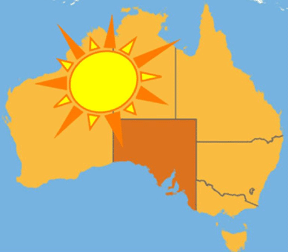
And to underline the difference in federal politics, the announcement was made at Port Augusta, the site of a former coal fired power station that the federal Coalition wants to turn nuclear, but which has already become a hub for green energy and green industry.
Giles Parkinson, Jul 10, 2024, https://reneweconomy.com.au/south-australia-locks-in-federal-funds-to-become-first-grid-in-world-to-reach-100-per-cent-net-wind-and-solar/
South Australia has locked in federal funding to ensure that it becomes the first non-hydro grid in the world to reach 100 per cent net renewables.
The funding deal – through what’s known as a Renewable Energy Transformation Agreement – means that the federal government will underwrite a minimum one gigawatt of new wind and solar generation capacity and another 400 MW (1,600 MWh) of storage – to ensure it meets its target of 100 per cent net renewables by 2027.
South Australia already leads Australia – and the world – with a wind and solar share of around 70 per cent over the last 12 months. The addition of the new capacity, along with the new Project Energy Connect transmission link from NSW, will enable it to become the first in the world to reach 1`00 per cent net renewables based around wind and solar.
That does not mean it will be powered at all times by wind and solar. But the amount of wind and solar generated and stored each year will be equivalent to what it consume each year. The state will export power at times and import at other times, and can fall pack on existing peaking gas plants to fill in the gaps.
Reaching that milestone will be a landmark for the state, and for advocates of the renewable energy transition, particularly as conservative and legacy fossil fuel interests continue to push back on the idea that a modern economy can be powered by renewables and storage.
The irony about South Australia is that the target of 100 per cent net renewables was originally committed by the state Liberal government. The state Labor government merely accelerated it from 2030 to 2027.
And to underline the difference in federal politics, the announcement was made at Port Augusta, the site of a former coal fired power station that the federal Coalition wants to turn nuclear, but which has already become a hub for green energy and green industry.
“South Australia has been a renewable energy pioneer – so much so that we recently brought forward our renewable energy target by three years, committing to ensure electricity generation can be sourced from net 100 per cent renewables by 2027,” state energy minister Tom Koutsantonis said in a statement.
“So we warmly welcome this agreement to accelerate the roll out of renewables while ensuring the reliability of the energy system.
“Our government is committed to working with the Commonwealth to establish a secured grid, supporting the power needs of South Australian households and businesses.”
South Australia has not added a new wind or solar project to the grid for around two years, although the biggest wind project in the state – the 412 MW Goyder South wind farm – is about to connect and send its first power to the grid.
Several new battery projects are also under construction – at Blyth, Hallett, Clements Gap and Templers and another, Tailem Bend, still waiting to be commissioned.
These projects will help propel the state towards 80 per cent renewables over the coming year, while the additional capacity of 1,000 MW of wind and solar, 400 MW of battery capacity (plus the minimum 200 MW included in the current CIS auction) will take it towards 100 per cent net renewables by 2027.
South Australia is also building the world’s first green hydrogen power plant at Whyalla, which will be accompanied by a 250 MW green hydrogen electrolyser and storage facilities, which will also be the world’s biggest when complete.
The state is also fielding huge number of inquiries from industry keen to source zero emissions and low cost green energy – with the local transmission company ElectraNet reporting that more than 2 gigawatts of load inquiries have been made.
Federal energy and climate minister Chris Bowen says the signing of the Renewable Energy Transformation Agreement means that South Australia is the first state to lock in the funding required to meet its targets under the federal government’s Capacity Investment Scheme.
The CIS aims to contract an additional 32GW of renewable generation and storage across the country to help it deliver most of the capacity needed to meet its 82 per cent renewable energy target by 2032.
The first tender of 6 gigawatts of new wind and solar capacity has been flooded with interest, with more than 40 GW of projects showing interest, while the first storage tender – for 600 MW, 2,400 MWh in Victoria and South Australia – was also heavily oversubscribed with some 19 GW of proposals.
Bowen says the bilateral agreements have been designed specifically to address the barriers developers, communities, and governments face in delivering renewable projects, and to replace ageing infrastructure that was built half a century ago.
“The Albanese Government is delivering the certainty and confidence the market spent a decade asking for,” Bowen said in a statement.
“The more renewable energy we have in our grid, the more downward pressure it puts on energy bills because it is the cheapest form of energy to power households and industry.
“Giving the market the confidence to build new projects is good; signing an agreement to collaborate with South Australia on practical steps to get the best out of this energy transformation for South Australian workers, communities and industry, is great.
“The Albanese Government’s Reliable Renewables Plan is the only plan supported by experts to deliver the clean, cheap, reliable and resilient energy system that Australians deserve. This is in sharp contrast to Peter Dutton’s anti-renewables nuclear plan – which remains uncosted and unexplained.”
As part of the deal, South Australia, will establish its own specific grid reliability mechanism and benchmark to be used in place of the national framework, and to be responsible for identifying and delivering new projects and technologies that will maintain reliability to that standard.
Renew Economy is seeking more information to understand what that means in practice.
The nuclear and renewable myths that mainstream media can’t be bothered challenging

Mark Diesendorf, Jul 4, 2024, https://reneweconomy.com.au/the-nuclear-and-renewable-myths-that-mainstream-media-cant-be-bothered-challenging/
Nuclear energy proponents are attempting to discredit renewable energy and promote nuclear energy and fossil gas in its place. This article refutes several myths they are disseminating that are receiving little or no challenge in the mainstream media.
Myth: Renewables cannot supply 100% electricity
Denmark, South Australia and Scotland already obtain 88, 74 and 62 per cent of their respective annual electricity generations from renewables, mostly wind. Scotland actually supplies 113 per cent of its electricity consumption from renewables; the difference between its generation and consumption is exported by transmission line.
All three jurisdictions have achieved this with relatively small amounts of hydroelectricity, zero in South Australia. Given the political will, all three could reach 100% net renewables generation by 2030, as indeed two northern states of Germany have already done. The ‘net’ means that they trade some electricity with neighbours but on average will be at 100% renewables.
Computer simulations by several research groups – using real hourly wind, solar and demand data spanning several years – show that the Australian electricity system could be run entirely on renewable energy, with the main contributions coming from solar and wind. System reliability for 100% renewables will be maintained by a combination of storage, building excess generating capacity for wind and solar (which is cheap), key transmission links, and demand management encouraged by transparent pricing.
Storage to fill infrequent troughs in generation from the variable renewable sources will comprise existing hydro, pumped hydro (mostly small-scale and off-river), and batteries. Geographic dispersion of renewables will also assist managing the variability of wind and solar. For the possibility of rare, extended periods of Dunkelflaute (literally ‘dark doldrums’), gas turbines with stores of biofuels or green hydrogen could be kept in reserve as insurance.
Myth: Gas can fill the gap until nuclear is constructed
As a fuel for electricity generation, fossil gas in eastern Australia is many times more expensive per kilowatt-hour than coal. It is only used for fuelling gas turbines for meeting the peaks in demand and helping to fill troughs. For this purpose, it contributes about 5% of Australia’s annual electricity generation. But, as storage expands, fossil gas will become redundant in the electricity system.
The fact that baseload gas-fired electricity continues temporarily in Western Australia and South Australia is the result of peculiar histories that will not be repeated. Unlike the eastern states, WA has a Domestic Gas Reservation Policy that insulates customers from the high export prices of gas.
However, most new gas supplies would have to come from high-cost unconventional sources. South Australia’s ancient, struggling, baseload, gas-fired power station, Torrens Island, produces expensive electricity. It will be closed in 2026 and replaced with renewables and batteries.
Myth: Nuclear energy can co-exist with large contributions from renewables
This myth has two refutations:
- Nuclear is too inflexible in operation to be a good partner for variable wind and solar. Its very high capital cost necessitates running it constantly, not just during periods of low sun or wind. Its output can only be ramped up and down slowly, and it’s expensive to do that.
- On current growth trends of renewables, there will be no room for nuclear energy in South Australia, Victoria or NSW. The 2022 shares of renewables in total electricity generation in each of these states were 74%, 37% and 33% respectively.
Rapid growth from these levels is likely. It’s already too late for nuclear in SA. Provided the growth of renewables is not deliberately suppressed in NSW and Victoria, these states too could reach 100% renewables before the first nuclear power station comes online.
As transportation and combustion heating will be electrified, demand for electricity could double by 2050. This might offer generating space for nuclear in the 2040s in Queensland (23% renewables in 2022) and Western Australia (20% renewables in 2022). However, the cost barrier would remain.
Myth: There is insufficient land for wind and solar
The claim by nuclear proponents that wind and solar have “vast land footprints” is misleading. Although a wind farm can span a large area, its turbines, access road and substation occupy a tiny fraction of that area, typically about 2%.
Most wind farms are built on land that was previously cleared for agriculture and are compatible with all forms of agriculture. Off-shore wind occupies no land.
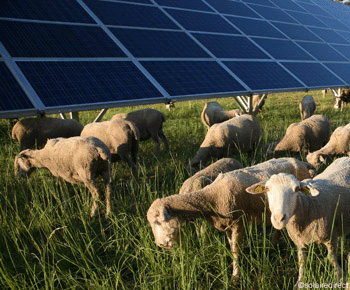
Solar farms are increasingly being built sufficiently high off the ground to allow sheep to graze beneath them, providing welcome shade. This practice, known as agrivoltaics, provides additional farm revenue, which is especially valuable during droughts. Rooftop solar occupies no land.
Myth: The longer lifetime of nuclear reactors hasn’t been taken into account
The levelised cost of energy method – used by CSIRO, AEMO, Lazard and others – is the standard way of comparing electricity generation technologies that perform similar functions.
It permits the comparison of coal, nuclear and firmed renewables. It takes account automatically of the different lifetimes of different technologies.
Myth: We need baseload power stations
The recent claim that nuclear energy is not very expensive “when we consider value” is just a variant of the old, discredited claim that we need baseload power stations, i.e. those that operate 24/7 at maximum power output for most of the time.
The renewable system, including storage, delivers the same reliability, and hence the same value, as the traditional system based on a mix of baseload and peak-load power stations.
When a nuclear power reactor breaks down, it can be useless for weeks or months. For a conventional large reactor rated at 1000 to 1600 megawatts, the impact of breakdown on electricity supply can be disastrous.
Big nuclear needs big back-up, which is expensive. Small modular reactors do not exist––not one is commercially available or likely to be in the foreseeable future.
Concluding remarks
We do not need expensive, dangerous nuclear power, or expensive, polluting fossil gas. A nuclear scenario would inevitably involve the irrational suppression of renewables.
The ban on nuclear power should be maintained because nuclear never competes in a so-called ‘free market’. Renewables – solar, wind and existing hydro – together with energy efficiency, can supply all Australia’s electricity.
Mark Diesendorf is Honorary Associate Professor at the Environment & Society Group in the School of Humanities & Languages and Faculty of Arts, Design & Architecture at UNSW. First published in Pearls and Irritations. Republished with permission of the author.
Nuclear more costly and could ‘sound the death knell’ for Australia’s decarbonisation efforts, report says

Peter Hannam Economics correspondent, Guardian, Fri 28 Jun 2024
A nuclear-powered Australian economy would result in higher-cost electricity and would “sound the death knell” for decarbonisation efforts if it distracts from renewables investment, a report by Bloomberg New Energy Finance (BNEF) argues.
The report comes as ANZ forecast September quarter power prices will dive as much as 30% once government rebates kick in. A separate review by the market watchdog has found household energy bills were 14% lower because of last year’s rebates.
BNEF said the federal opposition’s plan to build nuclear power stations on seven sites required “a slow and challenging” effort to overturn existing bans in at least three states, for starters.
Even if they succeeded, the levelised cost of electricity – a standard industry measure – would be far higher for nuclear power than renewables. Taking existing nuclear industries in western nations into account, their cost would still be “at least four times greater than the average” for Australian wind and solar plants firmed up with storage today, Bloomberg said.
“Nuclear could play a valuable, if expensive, role in Australia’s future power mix,” the report said. “However, if the debate serves as a distraction from scaling-up policy support for renewable energy investment, it will sound the death knell for its decarbonisation ambitions – the only reason for Australia to consider going nuclear in the first place.”
Bloomberg’s analysis complements CSIRO’s GenCost report that also found nuclear energy to be far more costly than zero-carbon alternatives. Australia’s lack of experience with the industry would result in a learning “premium” that would double the price of the first nuclear plant, according to the CSIRO.
Bloomberg also found that assuming the opposition’s seven plants had a generation capacity of 14 gigawatts, they would supply only a fraction of the total market.
If governments tried to rely on inflexible generators – whether coal-fired or nuclear – as renewables increased, they would have to resort to subsidies and other market interventions at a cost to taxpayers, Bloomberg said.
“This report speaks for itself,” the energy minister, Chris Bowen, said. “It’s another example of experts confirming that nuclear energy is too slow, too expensive and too risky for Australia.
“The Albanese government’s plan is the only plan backed by experts to deliver clean, cheap, renewable power available 24/7, and get us to net zero by 2050.”
Guardian Australia sought comment from the opposition energy spokesperson, Ted O’Brien.
ANZ, meanwhile, expects residential electricity prices to begin to see big falls starting from next month as federal and state rebates take effect.
@ANZ_Research predicts electricity prices in the September quarter could fall by 30% as fresh rebates kick in. That would lop a large 0.7 percentage points off the inflation rate (to be recovered later unless the rebates continue). pic.twitter.com/fjHWP8duEn— @phannam@mastodon.green (@p_hannam) June 27, 2024
From 1 July, all households in Queensland get a $1,000 rebate, those in Western Australia the first of two $200 rebates and nationally the first of four $75 rebates from the federal government will arrive.
In the September quarter, ANZ estimates consumer prices will fall 0.7 percentage points, temporarily dampening overall inflation – assuming those rebates aren’t extended again.
The Australian Competition and Consumer Commission will also release its annual market inquiry report on Friday. It showed that without the federal government’s energy rebates in the May 2023 budget the median residential energy bill would have been 14%, or $46.64, higher across all regions…………………………………….more https://www.theguardian.com/australia-news/article/2024/jun/28/nuclear-energy-report-australia-expensive-decarbonisation-renewables
Is rooftop solar a fatal flaw in the Coalition’s grand nuclear plans?

Unlike nuclear, solar is also extraordinarily cheap, at least up-front, and large-scale projects can be delivered for comparative peanuts — and with blinding speed.
There are now almost 4 million homes spread across the country with solar installations, and the electricity they generate accounted for about 12 per cent of Australia’s needs last year.
It’s a constituency that politicians would tackle at their peril.
By energy reporter Daniel Mercer, https://www.abc.net.au/news/2024-06-24/rooftop-solar-potentially-lethal-flaw-in-coalition-nuclear-plans/104008864—
Earlier this year, the Coalition made a curious, significant move.
David Littleproud, the leader of the National Party, broke cover and wholeheartedly threw his support behind rooftop solar and household batteries.
The Nationals, he said, were not against renewable energy, only large-scale projects such as wind farms and transmission lines that were “tearing up the environment”.
Quite the opposite — the National Party wanted as many Australian households to get solar and batteries as would have them.
The pitch, which was quickly backed by opposition leader Peter Dutton, evidently had a few purposes.
For starters, it clearly distinguished the opposition from the Labor government, whose plan to decarbonise the power system rests largely on big-ticket renewable energy and transmission items.
In one fell swoop, the Coalition was able to say it was pro-renewable energy while being able to attack the government’s own green plans as environmentally and economically dangerous.
What’s more, the shift was a clear nod — or a sop, depending on who you ask — to the enormous and growing political clout of Australia’s solar-owning class.
Lastly, as both Mr Littleproud and Mr Dutton have repeatedly since pointed out, rooftop solar was an ideal complement for the central plank of the Coalition’s energy plans — nuclear.
Dangers in the detail?
The thinking behind that pivot has been on full display in recent days after the Coalition finally unveiled the major details of its energy policy for the upcoming federal election.
Under the plans, Australia would get seven nuclear power plants by the middle of the century — five large-scale ones across New South Wales, Queensland and Victoria and two small ones across South Australia and Western Australia.
No longer would the renewable emphasis be on scores of new wind and solar farms in regional areas and the high-voltage power lines needed to plug them into the grid.
It would instead be directed towards people’s rooftops, “an environment that you can’t destroy”, according to Mr Littleproud.
But hiding behind this veil of logic from the Coalition, energy experts reckon, is a potentially fatal flaw.
Solar power and nuclear power don’t play nicely together.
“That’s another untested and questionable part of this whole strategy,” said Dylan McConnell, a senior researcher and energy analyst at the University of NSW.
“What happens if we look into a system that is largely dominated by … a significant proportion of … behind-the-meter solar?
“People are going to continue to install rooftop solar and, in fact, the Coalition is supportive of that.
At the heart of this tension are the differing — and some argue incompatible — characteristics of nuclear and solar power.
On the one hand, nuclear reactors are the quintessential base-load generators that can — and want to — run at or near full capacity all the time.
Not only are they well-suited to the task technically, nuclear plants also have an economic imperative to operate flat-out given their monumental development costs.
These development costs are typically exacerbated by very long lead times — lead times subject to significant blowouts — in which debts are incurred and eye-watering amounts of interest can accrue.
The hare and the tortoise
Paying off those debts is paramount for the owner of a nuclear plant.
Failure to do so can be financially ruinous.
And the way to do that is to produce and sell as much electricity as is technically possible.
By contrast, solar power — specifically from photovoltaic cells typical of suburban rooftops — are the archetypal source of variable renewable energy.
They produce the most power when the sun is shining during the day, none when it’s not, and their output can be highly variable depending on the conditions.
Unlike nuclear, solar is also extraordinarily cheap, at least up-front, and large-scale projects can be delivered for comparative peanuts — and with blinding speed.
For a household, the cost of a 10-kilowatt system — an installation capable of meeting much of an average customer’s needs — can be done for a few thousand dollars.
In other words, if nuclear power is the proverbial tortoise, solar is the hare.
None of which is to dismiss the technical and economic challenges that solar presents, namely, how to back it up when it’s not producing — a very big task indeed.
But there is another crucial way in which solar and nuclear — or any base-load power such as coal, for that matter — clash.
Solar generation, by its very nature, peaks in the middle of the day.
As ever-more Australians install seemingly ever-more solar panels on their roofs, that peak in solar output is becoming truly epic in its proportions.
Rooftop solar is a beast
or example, there are times in South Australia when rooftop solar alone can account for more than the entire demand for electricity in the state.
To ensure South Australia’s electricity system doesn’t blow up, virtually all other generators have to pare back their output to a bare minimum or switch off entirely.
And even then, South Australia’s surplus rooftop solar generation has to be exported to other states or wasted.
Rooftop solar can do this because it’s largely uncontrolled and flows simply by dint of the sun shining.
It was partly for this reason that South Australia’s only base-load coal plant retired in 2016.
Of course, there are many more times when rooftop solar provides precisely 0 per cent of South Australia’s power needs.
But it all goes to illustrate the very real challenges that base-load nuclear would face, and the very real trends that are unlikely to grind to a halt between now and 2035, by when the Coalition hopes to have the first of its nuclear reactors up and running.
A quick glance at the numbers will tell you all you need to know about the popularity — and power — of rooftop solar in Australia.
There are now almost 4 million homes spread across the country with solar installations, and the electricity they generate accounted for about 12 per cent of Australia’s needs last year.
Bruce Mountain, the director of the Victoria Energy Policy Centre, summed it up this way: “Rooftop solar has few opponents.”
“It’s the one thing that keeps on growing despite the impasse at a national level,” Professor Mountain said.
“And I think there’s much more to go to realise the potential for that, most notably on factory roofs.”
Something has to give
Professor Mountain said “I’m kind of open to the idea of nuclear”, noting that it was being taken seriously by many other developed countries seeking to decarbonise their electricity supply.
He also pointed out that Australia’s development of large-scale renewable energy projects and, particularly, the transmission lines needed to support them, had hardly been a glowing success to date.
In any case, Professor Mountain suggested the fact the Coalition was proposing to own and operate any nuclear power stations was an acknowledgement that there was no commercial case for the technology in Australia.
On that point, Dr McConnell from the University of NSW agreed.
Dr McConnell said the economic obstacles in front of nuclear in Australia were enormous, and a big one was rooftop solar.
He said that in the almost inevitable event that nuclear and solar power clashed, something would have to give.
“The way you might achieve that in a system with lots of rooftop solar is by curtailing [switching off] rooftop solar,” Dr McConnell said.
“And that may not be politically popular either.”
Robert Barr, a power industry veteran and a member of the lobby group Nuclear for Climate, did not shy away from the potential for future tensions, noting that coal was already getting squeezed out of the system by solar.
But Dr Barr said any clash could be easily managed through a combination of price signals that encouraged householders to use more of their solar power and export less, and new reactor technology that could ramp up and down more effectively.
You could probably drop down from 100 per cent down comfortably to like 60 per cent output and on a daily basis,” Dr Barr said of new nuclear technology.
Ultimately, however, Dr Barr argued it may need to be households with solar panels that gave way to nuclear energy for the greater benefit of the electricity system.
Don’t mention the solar wars
Right now, he said, renewable energy was benefiting from taxpayer-funded subsidies that allowed wind and solar projects to make money even when the price of power was below $0.
These subsidies applied to both utility-scale projects and rooftop solar panels, through the large- and small-scale green energy targets introduced by the Rudd Labor government.
They effectively allow such projects to sell their electricity for less than zero — up to a point — and still be in the money.
In the future, Dr Barr said, those subsidies would no longer exist and renewable energy projects would start to be penalised each time the price of electricity went negative.
“I think what will happen is that nuclear will just tend to push out solar,” he said.
“There’ll be an incentive for customers to back off.
“And I think it wouldn’t be that difficult to build control systems to stop export of power at the domestic level.
“It’d be difficult for all the existing ones but for new ones, it just might require a little bit of smarts in them to achieve that particular end — it can be managed.”
Much like the Coalition’s grand policy pitch, those comments might be considered bold given the political heft wielded by millions of solar households.
Last decade, politicians of all stripes got into all manner of trouble when they tried to wind back subsidies known as feed-in-tariffs, which paid customers for their surplus solar power generation.
Solar households, egged on by the industry, mobilised, went on the attack and in many cases forced governments to bend to their will.
And that was at a time when the number of households with solar was a fraction of what it is now.
It’s a constituency that politicians would tackle at their peril.
Dutton’s plan to build nuclear plants on former coal sites not as easy as it seems

Dr Katherine Woodthorpe said it would be impractical for nuclear facilities to use existing poles and wires. CREDIT:LOUIE DOUVIS
By Bianca Hall, June 21, 2024, https://www.theage.com.au/environment/climate-change/dutton-s-plan-to-build-nuclear-plants-on-former-coal-sites-not-as-easy-as-it-seems-20240620-p5jnbo.html
Experts have cast doubt on the central pillar of Peter Dutton’s nuclear pitch to voters, saying it would take decades to fill in coal mine voids and make contaminated power station sites safe, during which time fragile and valuable transmission lines would be left to deteriorate.
Operators at several of the seven sites identified by the Coalition for nuclear plants already have well-advanced plans to transform their sites into renewable energy hubs with grid-scale batteries, hydrogen and solar once the coal runs out.
Announcing a future Coalition government would build seven nuclear power stations on the sites of existing coal-fired power stations, Dutton said nuclear facilities could be built on the sites of retired coal power plants using existing transmission poles and wires.
“Each of these locations offer important technical attributes needed for a zero-emissions nuclear plant, including cooling water capacity and transmission infrastructure,” he said.
“That is, we can use the existing poles and wires.”
Dr Katherine Woodthorpe, president of the Australian Academy of Technological Sciences and Engineering, said overseas examples like the United Kingdom’s Hinkley Point C showed it could take decades to approve and build new nuclear facilities – leaving aside the time needed to remediate dirty and geologically unstable former mine sites.
Woodthorpe said even if it only took 25 years to get a new nuclear facility up and running, that meant the existing transmission potential could lie dormant for 25 years after a coal plant closed.
“In theory it could be done, but when you look at the actual practicality of doing it they’d pretty well have to replace it all,” she said.
University of Sydney professor Glenn Platt, who specialises in energy policy, markets and grids, said there was already high demand for dormant transmission networks among renewables operators.
“The unknown bit [about the Coalition policy] is what happens to those poles and wires between now and when somebody wants to build the nuclear plant, because everybody else is trying to use those poles and wires today for wind and solar and battery projects,” he said.
“The landowners many of these sites are already deploying wind and solar or batteries on those sites. They would use up the available poles and wire infrastructure.”
AGL, which owns the Liddell Power Plant in the Hunter Valley, and Loy Yang A in the Latrobe Valley, said it was well-advanced in plans to transform the sites into industrial energy hubs with renewables, batteries and associated industries.
A spokesman referred this masthead to a statement made by chief executive Damien Nicks in March.
“AGL is already developing our coal and gas power station sites into low-emissions industrial energy hubs,” he said.
“As the owner of these sites, nuclear energy is not a part of these plans. There is no viable schedule for the regulation or development of nuclear energy in Australia, and the cost, build time and public opinion are all prohibitive.”
Many observers are looking to now-closed mine sites for clues about how Dutton’s policy could work on a practical level.
French energy giant Engie, which is rehabilitating Victoria’s closed coal mine Hazelwood, has estimated it could take up to 35 years under a worst-case scenario to finish filling the enormous mine void to a maximum depth of 116m and surface area of 1145 hectares.
Engie Australia and New Zealand manager of environment and planning Adam Moran, who has led the rehabilitation, said a nuclear facility could in theory be put on the site of a former coal power station.
“Could it be done? Yes, but if you had to choose a location, would you choose next to a mine void that’s been rehabilitated and full of water, or would you put it some distance further away?” he said.
“You would probably err on the side of caution, and move it well outside of the geological buffer zone that would exist around a rehabilitated coal mine.”
At Hazelwood, which had a 1600-megawatt transmission capacity when the coal mine operated, operators have installed a 150-megawatt-hour battery, which is now plugged into the mine’s existing transmission network.
In November, Yancoal announced plans to transform the coal mine at Stratford in the Hunter Valley, slated for closure this year, into a major 330-megawatt solar farm and pumped hydro facility capable of producing 300 megawatts in a 12-hour period.
A spokesman for EnergyAustralia, which operates the Mt Piper mine in Lithgow, said the company spoke regularly with governments and regulators.
“To date, we have not discussed the use of any EnergyAustralia sites in the context of nuclear,” he said
With its Mt Piper plant due to close in 2040, and Yallourn this decade, EnergyAustralia is increasingly looking to diversify, he said.
“We are focused on continuing to roll out existing, readily available technologies,” he said, which included gas and batteries.
“We are developing more batteries in multiple states, pumped hydro at Lake Lyell in Lithgow and working with partners to underpin further renewable energy.”
The Australian Manufacturing Workers’ Union and Climate Action Network Australia commissioned a report identifying industry and workforce opportunities presented by the renewable energy shift.
National secretary Steve Murphy said with government backing, coal workers could retrain and reap the benefits of renewable technologies.
“This is coming, so let’s get involved and get the best results for our members,” he said.
“We’re in a global race for the jobs of the future, and we spent 10 years standing still, [but] we can catch up very quickly with the natural advantages that we’ve got, provided that there is government support.”
Coalition’s climate and energy policy in disarray as opposition splits over nuclear and renewables

Simon Birmingham contradicts Nationals’ leader, saying renewables are ‘an important part of the mix’ while Queensland LNP leader rules out nuclear.
Paul Karp and Andrew Messenger, Tue 18 Jun 2024
The federal Coalition’s climate and energy policy is in disarray, with a senior Liberal contradicting the Nationals’ anti-renewables push and the Queensland LNP leader ruling out allowing nuclear energy in that state.
After the Nationals further undermined the push for net zero by 2050 by claiming the Coalition would “cap” investment in large-scale renewable energy, the Liberal leader in the Senate, Simon Birmingham, declared on Tuesday it is an “important part of the mix”.
On Monday the Nationals leader, David Littleproud, said Australia did not need “large-scale industrial windfarms” such as those proposed for an offshore zone south of Sydney. That position was backed by Nationals senator, Matt Canavan, a longstanding opponent of net zero who nevertheless revealed the position had not been to their party room
On Tuesday Birmingham contradicted the junior Coalition partner’s stance. The leading member of the Liberals’ moderate faction told Sky News that there is “absolutely a place for large-scale renewables, as part of a technology-neutral approach” and they are an “important part of the mix”.
Birmingham said that renewables and other sources of power should be judged on reliability – “which is why nuclear is important” – price, including the cost of transmission, and the “social licence” aspects about whether local communities support them.
“There will be difficult discussions on that journey [to net zero by 2050]. We’ve been having them in relation to nuclear energy. The Albanese government has stuck its head in the sand.”…….
As the federal Coalition attempts to ramp up pressure on Labor for refusing to lift the ban on nuclear energy, it also faces opposition at the state level from its own side of politics, as Guardian Australia revealed in March.
In Queensland the Nuclear Facilities Prohibition Act 2007 bans “the construction and operation of particular nuclear reactors and other facilities in the nuclear fuel cycle”.
On Tuesday, the Queensland Liberal National party leader, David Crisafulli, was asked whether he would consider repealing the legislation if his federal colleagues proposed a nuclear plan that stacked up.
“The answer is no, and I’ve made my view very clear on that … contrary to some of the most childish memes that I’ve seen getting around social media from the Labor party,” he said.
Crisafulli said nuclear is a “matter for Canberra” and it is “not on our plan, not on our agenda”. “The things that we are offering are real and they are tangible, I understand there is that debate in Canberra, fair enough, but I can’t be distracted by it”…………..
CSIRO’s Gencost report found that electricity from large-scale nuclear reactors would cost between $141 a megawatt hour and $233 a MW/h compared with combining solar and wind at a cost of between $73 and $128 a MW/h – figures that include building transmission lines and energy storage.
The Albanese government on Saturday gave the green light to a 1,022 sq km area, 20km off the Illawarra coast, in the first stage of a process for it to become the country’s fourth dedicated windfarm zone.
Littleproud declared the Coalition was opposed to it and promised to “send the investment signals that there is a cap on where [the Coalition] will go with renewables and where we will put them”.
The energy and climate change minister, Chris Bowen, seized on the remarks which he said showed “while the world races to cleaner cheaper reliable renewables, the Nationals wants to stop new investment”.
“Peter Dutton would be worse on climate than Abbott or Morrison and David Littleproud would be worse than Barnaby Joyce,” he posted on X…………………………………………………………..
Scrutiny of the Coalition’s climate policy is increasing after Dutton announced a plan to oppose the 43% emissions reduction target by 2030, in contradiction of the Paris agreement.
On Tuesday Forrest warned that the proposal would hit Australian exports with penalty carbon taxes, and also cautioned against new limits on large-scale renewables.
“If we flip-flop between policies, if we go back to the past of uncertainty then it of course makes employing people and investing very difficult to impossible,” he told Radio National. “So that would be Australia kicking an own goal.”
With Graham Readfern https://www.theguardian.com/australia-news/article/2024/jun/18/coalition-climate-energy-policy-opposition-split-nuclear-renewables
Nuclear plan is fiscal irresponsibility on an epic scale and rank political opportunism

The LNP wants to burn untold tens of billions of public money in a nuclear debt bin fire because nuclear is 100% uncommercial – no private investor will touch it with a ten foot pole short of massive multi-decade subsidies.
The LNP wants to burn untold tens of billions of public money in a nuclear debt bin fire because nuclear is 100% uncommercial – no private investor will touch it with a ten foot pole short of massive multi-decade subsidies.
Tim Buckley & AM Jonson, ReNeweconomy, Jun 19, 2024
While the Coalition has failed to release any detail or costings, today we have confirmation that if it gets into office, Australians will be paying a mult-billion dollar “nukebuilder” tax for generations to come for a national build out of government-owned nuclear reactors across seven locations, including on the sites of former coal-fired power stations.
It beggars belief that opposition leader Peter Dutton proposes nationalising a nuclear public debt bomb and detonating it at the heart of energy policy in this country.
This exacerbates the problem that electricity generated from nuclear is two to four times as expensive as power from firmed renewables – as the CSIRO has confirmed – and would permanently lock in higher energy prices for consumers already crushed by cost of living pressures.
The medium term energy price implications are horrendous. Electricity prices would skyrocket as private investment in new replacement capacity is crowded out, resulting in undersupply for the next 15-25 years while we wait for the LNP’s nuclear white elephants to arrive.
We know that firmed renewables – utility scale solar and wind, backed by big batteries, and orchestrated with accelerated deployments of distributed consumer energy resources such as rooftop solar, storage and EVs in a modernised grid – can and will keep the lights on, delivering consistent, secure, reliable and affordable supply at a fraction of the cost. This transition is already underway and accelerating.
Critically, the Coalition’s announcement puts at serious and imminent risk planned private capital investments in clean energy as policy uncertainty and chaos make proposals uninvestable – especially in light of public statements by Nationals Leader David Littleproud that the LNP would, bizarrely, “cap” renewables investment here.
The thought bubble released this week threatens to undermine our energy and economic security and our future prosperity as it creates sovereign risk.
By destroying investor confidence, it deters the private clean energy capital we need to attract at speed and scale – capital for which we are competing with the rest of the world.
The LNP wants to burn untold tens of billions of public money in a nuclear debt bin fire because nuclear is 100% uncommercial – no private investor will touch it with a ten foot pole short of massive multi-decade subsidies.
As the Investor Group on Climate Change, representing energy investors with $35tn in assets, said, there is “no interest” among investors in nuclear, when nuclear has time blowouts up 15+ years and cost blowouts in the tens of billions, and lowest-cost technologies – renewables, batteries and so on – are available to deploy now.
Further, to model our energy transition on the great government-owned public infrastructure debacles of the last quarter century – Snowy 2.0 and the NBN – is an egregious blunder with dire consequences now and for future generations.
The LNP’s Snowy 2.0 was due to be operational in 2021 at a cost of $2bn. After a rolling series of crises, it’s now expected to come online around 2028 and is likely to cost Australians $15bn, a budget blowout of 700%. And we have been lumped with one of the world’s worst, slowest (64th fastest in the world) and most expensive NBNs after a litany of LNP mismanagement.
The idea that nuclear could be up and running in 2035-37 is fanciful. Community opposition, inevitable protracted state and federal legal challenges, technological hurdles and the requirement that nationwide legislative bans on nuclear be overturned make a 2035 timeline impossible.
There is zero mention of how Australia plans to deal with nuclear waste for many centuries to come, or provide for the $10bn per nuclear plant end of life closure costs, another two LNP debt burdens dumped on future generations. The people of Japan are funding the US$200bn cleanup of the Fukushima disaster for the next century.
The international experience shows that the western nuclear industry is plagued with massive delays and cost blowouts. There is zero reason to expect Australia would be any different when the risks for us are higher, as we have no history of deployment of nuclear energy generation here.
The Vogtle nuclear power plant expansion debacle in Georgia, US, is a case point, massively delayed and the most expensive public works project in US history at $35bn, with consumers left to carry the can for the runaway costs.
And the £33bn Hinkley Point C nuclear plant in England – with completion now delayed to 2031 – is a millstone around UK citizens’ necks for the next 60 years or so, even as owner EDF of France took a €12bn writedown on this white elephant after China General Nuclear (CGN) walked away.
Dutton now centres Australian energy and climate policy on nuclear against the explicit and unequivocal advice of our flagship national scientific agency, the CSIRO, which warned that nuclear would take until at least 2040 to stand up in Australia, if legislative bans and other barriers could be overcome, and the energy generated would cost at least twice that of firmed renewables. …………………………………………………………………………… more https://reneweconomy.com.au/nuclear-plan-is-fiscal-irresponsibility-on-an-epic-scale-and-rank-political-opportunism/
Coalition set to announce long-awaited nuclear details

Jacob Shteyman June 19, 2024, https://www.aap.com.au/news/coalition-set-to-announce-long-awaited-nuclear-details/
Opposition Leader Peter Dutton is poised to announce his nuclear energy policy, including multiple proposed sites for power plants.
The Liberal leader plans to reveal the location of up to three sites for nuclear energy plants should the coalition win the next federal election, according to media reports.
Mr Dutton is set to hold a press conference on Wednesday alongside Nationals leader David Littleproud and deputy Liberal leader Sussan Ley.
His party’s MPs are expected to be briefed on the plans that morning.
Mr Dutton has said he will oppose Australia’s legally binding 2030 climate target, a 43 per cent emissions reduction on 2005 levels, if he is elected.
The coalition remains committed to reaching net-zero emissions by 2050, senior party members have said.
A report by the CSIRO found nuclear power plants wouldn’t be built at the earliest until 2040.
The latest report on the technology’s feasibility has found nuclear power is a “dangerous distraction” to Australia’s renewable energy transition because it would take too long and cost too much to build.
Even if nuclear restrictions were lifted tomorrow, it would still be at least 20 years before a reactor could be operational, the paper released by the Australian Conservation Foundation says.
By that time, all or nearly all Australia’s remaining coal-fired power plants will be closed, meaning carbon emissions-intensive fossil fuels will likely have to be prolonged.
Even ignoring the lead time required to establish a nuclear industry, it would be unable to compete financially with renewables and require taxpayer subsidies worth tens or hundreds of billions of dollars.
Another hurdle is convincing Australians nuclear poses no safety risk.
Major insurers, including AAMI, Allianz and NRMA, specifically exclude coverage to homes, cars or possessions from nuclear accidents.
“Proposals to introduce nuclear power to Australia make no sense,” concludes the report, which was led by anti-nuclear campaigner Jim Green and released on Wednesday.
The paper was written in response to a federal coalition plan to replace coal-fired power stations with nuclear, rather than relying on increased investment in renewable energy and storage to reach net zero.
Mr Dutton argues baseload nuclear is necessary to achieve the energy transition without sacrificing affordability or reliability.
“I want to make sure that we’ve got renewables in the system,” he told reporters on Tuesday.
“I’m happy for batteries, but we can’t pretend that batteries can provide the storage.
“We need to make sure that as we decarbonise and as the economy transitions, that we do it in a sensible way.”
The latest edition of the benchmark GenCost report, released by the CSIRO and Australian Energy Market Operator in May, found the cost of building a large-scale nuclear power plant would be at least $8.5 billion.
Farmers who graze sheep under solar panels say it improves productivity. So why don’t we do it more?
Guardian, by Aston Brown, 14 June 24
Allowing livestock to graze under renewable developments gives farmers a separate income stream, but solar developers have been slow to catch on.As a flock of about 2,000 sheep graze between rows of solar panels, grazier Tony Inder wonders what all the fuss is about. “I’m not going to suggest it’s everyone’s cup of tea,” he says. “But as far as sheep grazing goes, solar is really good.”
Inder is talking about concerns over the encroachment of prime agricultural land by ever-expanding solar and windfarms, a well-trodden talking point for the loudest opponents to Australia’s energy transition.
But on Inder’s New South Wales property, a solar farm has increased wool production. It is a symbiotic relationship that the director of the National Renewables in Agriculture Conference, Karin Stark, wants to see replicated across as many solar farms as possible as Australia’s energy grid transitions away from fossil fuels.
“It’s all about farm diversification,” Stark says. “At the moment a lot of us farmers are reliant on when it’s going to rain, having solar and wind provides this secondary income.”
In exchange, the panels provide shelter for the sheep, encourage healthier pasture growth under the shade of the panels and create “drip lines” from condensation rolling off the face of the panels.
“We had strips of green grass right through the drought,” Dubbo sheep grazier Tom Warren says. Warren has seen a 15% rise in wool production due to a solar farm installed on his property more than seven years ago.
Despite these success stories, a 2023 Agrivoltaic Resource Centre report authored by Stark found that solar grazing is under utilised in Australia because developers, despite saying they intend to host livestock, make few planning adjustments to ensure that happens……………………………………………………………………………….
According to an analysis by the Clean Energy Council, less than 0.027% of land used for agriculture production would be needed to power the east coast states with solar projects – far less than the one-third of all prime agricultural land that the rightwing thinktank the Institute of Public Affairs has claimed will be “taken over” by renewables. That argument, which has been heavily refuted by experts, has been taken up by the National party, whose leader, David Littleproud, said regional Australia had reached saturation point with renewable energy developments.
Queensland grazier and the chair of the Future Farmers Network, Caitlin McConnel, has sold electricity to the grid from a dozen custom-built solar arrays on her farm’s cattle pastures for more than a decade.
“Trial and error” and years of modifications have made them structurally sound around cattle and financially viable in the long-term, she says.
“As far as I know, we are the only farm to do solar with cattle,” McConnel says. “It’s good land, so why would we just lock it up just for solar panels?” https://www.theguardian.com/australia-news/article/2024/jun/13/farmers-who-graze-sheep-under-solar-panels-say-it-improves-productivity-so-why-dont-we-do-it-more
CSIRO stands by nuclear power costings that contradict Coalition claims

The Coalition has attacked the GenCost report that found nuclear power plants would be at least 50% more expensive than solar and wind
Graham Readfearn, 29 May 24, https://www.theguardian.com/australia-news/article/2024/may/29/csiro-nuclear-power-plant-australia-cost-peter-dutton-liberal-coalition
The CSIRO says it stands by its analysis on the costs of future nuclear power plants in Australia after the Coalition attacked the work, which contradicted its claims reactors would provide cheap electricity and be available within a decade.
The opposition’s energy spokesperson, Ted O’Brien, claimed on Tuesday in the Australian newspaper that the CSIRO should re-run its modelling to account for longer life-spans and running times of nuclear generators in other countries with nuclear programs.
Last week the CSIRO released its GenCost report on the costs of different generation technologies, saying nuclear would be at least 50% more expensive than solar and wind and would not be available any sooner than 2040.
The Coalition has yet to reveal any detail on its nuclear plan, including what type of reactors it would build, how large they would be and where they would put them.
A CSIRO spokesperson told Guardian Australia: “CSIRO provides impartial and independent advice and does not undertake modelling for specific policy directions.
“While we stand by the data provided, any alternative scenarios assessed by others would not carry CSIRO’s endorsement.”
O’Brien pointed to an assumption used in the GenCost report that nuclear plants would have a “capacity factor” – how often they are generating electricity relative to their maximum capacity – of between 53% and 89%.
O’Brien wanted the CSIRO to use a higher figure of 92.7% for nuclear based on the performance of plants in the US.
But the GenCost report discusses the reasons for setting capacity factors, saying new baseload generators such as nuclear “are expected to struggle to present the lowest cost bids to the dispatch market” and would, therefore, likely be generating less often.
O’Brien also wanted the CSIRO to model the full lifespan of nuclear plants – which could be as long as 80 years – and to add a start date of 2035 to its modelling.
The report provides cost estimates for power from different generation technologies, including both large and small reactors, for the years 2023, 2030 and 2040.
The CSIRO spokesperson said: “Specific issues in regard to economic life of generation assets and capacity utilisation, including large scale nuclear, have been assessed by the GenCost team as part of the consultation process for the 2023-24 report.”
Australia has never built a nuclear reactor for electricity and the technology has been banned since 1998.
The CSIRO report said if a decision was made in 2025 to adopt nuclear power, it would be at least 15 years until a reactor was producing power.
The report said: “Nuclear technologies need to undergo more extensive safety and security permitting, nuclear prohibitions need to be removed at the state and commonwealth level and the safety authorities need to be established.”
The report estimated if Australia could establish a nuclear industry, then a 1,000MW plant would cost $8.6bn, but the first reactors could cost double that amount – more than $17bn.
The report said: “Given the lack of a development pipeline and the additional legal and safety and security steps required, the first nuclear plant in Australia will be significantly delayed. Subsequent nuclear plant could be built more quickly as part of a pipeline of plants.”
Renewables and storage still cheapest option, nuclear too slow and costly in Australia – CSIRO

Giles Parkinson, May 22, 2024, https://reneweconomy.com.au/renewables-and-storage-still-cheapest-option-nuclear-too-slow-and-costly-in-australia-csiro/
Australia’s main scientific body, the CSIRO, has reaffirmed its assessment that integrated renewable energy is by far the cheapest option for Australia, and that nuclear – be it large scale or small modular reactors – is too slow and too costly.
The CSIRO’s findings have been consistent since the first of its now annual GenCost reports was released under the then Coalition government in 2018. In fact the gap between renewables and nuclear has widened, despite the addition of integration and transmission costs to wind and solar, even with up to a 90 per cent renewable share.
Its draft report released late last year re-affirmed that nuclear – the chosen technology of new Coalition leader Peter Dutton and his energy spokesman Ted O’Brien, remained by far the costliest energy choice for Australia.
Dutton is digging in on nuclear, and amid furious attacks from right wing media and so-called think tanks, the Coalition has tried to discredit the CSIRO GenCost report, which is produced in conjunction with energy experts at the Australian Energy Market Operator.
The nuclear boosters were particularly frustrated by the CSIRO’s costings on SMR (small modular reactors), which was based on the NuScale project in the US, the only SMR in the western world to get close to construction, but which was abandoned because of soaring costs that caused its customers to withdraw their support.
The nuclear boosters, and the federal Coalition, want the CSIRO and AEMO to accept the cost forecasts from salesmen for SMR technologies that remain largely on the drawing board and which – unlike the failed NuScale project – have no real world verification.
The CSIRO has now released its final GenCost report, prepared in conjunction with AEMO, and which it describes as the most comprehensive assessment of generation costs ever produced in this country.
The CSIRO has bent over backwards to respond to the criticism from the nuclear lobby, and added an estimated cost in Australia for large scale nuclear. It says is not as pricy as SMR technology, but is still at least double the cost of integrated renewables, and wouldn’t be possible before 2040 even if a commitment was made now.
That’s important, because Australia is the midst of a renewable energy transition that aims for an 82 per cent renewable energy share by 2030. Climate science dictates that speed of emissions cuts is now critically important, and by 2040 the country should be at or close to 100 per cent renewables.
The addition of large scale nuclear was one of a number of changes to the GenCost report from its 2023 edition, including a return to calculations for solar thermal, a technology hoping for its own renaissance, the inclusion of spilled energy from wind and solar, and – in response to more feedback – including integration costs incurred before 2030.
It doesn’t change the picture that much. Wind and solar are still by far the cheapest, in 2023 and in 2030, even though an expected cost reduction for wind energy – whose prices spiked after the Covid pandemic and energy crisis – is now not expected to take much longer until the mid 2030s.
Solar costs, however, are still falling, and it’s important to note that renewable integration costs for 80 per cent renewables in 2030 are less than $100/MWh. Even assuming the money is spent now, before expected cost reductions, the cost for an 80 per cent wind and solar grid in 2023 is put at $120/MWh.
Compare that to the estimated costs for nuclear, which in terms of the political and public debate, are the most revealing, and just a little inconvenient for the Coalition, whose attacks on the CSIRO and AEMO ignore the fact that the same conclusions were reached under its own governance.
The final GenCost report highlights how the favoured technologies of the conservatives – be they nuclear, gas, gas with CCS and coal with CCS – are so much higher than solar and wind with firming. SMRs are four to six times the cost of integrated renewables, and the first projects are likely to be significantly higher.
Large scale nuclear is twice as expensive, again without considering the first of its kind costs which would be necessary in Australia, and without considering the considerable costs of added reserve capacity needed because the plants are so big.
It also does not take into account how nuclear, with its “always on” business model could fit into a future grid already dominated by renewables and needing flexible capacity to support it, not redundant baseload.
Even with the full integrated costs itemised for both the 2023 and the 2030 assessments, the difference is clear.
CSIRO says that its draft GenCost received more submissions than any previous edition, with most of the 45 submissions coming from individuals who support nuclear.
This is not surprising given that no one in the Australian energy industry is the slightest bit interested in the technology, because of its costs and the timelines. As US energy expert Amory Lovins wrote for Renew Economy this week, nuclear “has no place in Australia’s energy future. No one who understands energy markets would claim otherwise.”
Indeed, two of the most prominent public faces of the pro-nuclear campaign in Australia have been a school student and an emergency doctor from Ontario, who have both received remarkable amounts of publicity in mainstream media despite their lack of industry knowledge.
The CSIRO points out that the large scale nuclear costs are at best estimates, because there is no nuclear industry in Australia, and no regulatory framework. First of its kind developments are likely to be exorbitant, but even basing its estimates on the South Korea experience puts the costs of large scale nuclear at a multiple of renewables.
The nuclear lobby has been insistent that wind and solar costs need to factor in the integration costs of the technologies in the grid, including storage and transmission, so no doubt they will insist that the CSIRO now does the same with large scale nuclear.
It is not likely to be cheap. As CSIRO notes, large scale nuclear units normally ranges in size from 1 GW to 1.4 GW or more, far bigger than the biggest coal unit in Australia, which is 750 MW. That will require added reserve capacity of equivalent size in case of an unexpected outage or unplanned maintenance.
In the UK, the regulator estimated that the additional reserve capacity of the Hinkley C nuclear plant would be in the order of $12 billion, on top of the now blown out costs of up to $92 billion for that reactor.
The project that had promised to be “cooking turkeys” by 2017, looks to be a cooked turkey itself by the time it gets switched on in 2031.
Federal energy minister Chris Bowen said the GenCost report validated the Labor government’s focus on renewables, and underlined the risky nature of the Coalition’s “half-baked” goal of keeping ageing coal fired power plants operating until nuclear can be delivered in the 2040s.
“Were small modular nuclear reactors able to be up and running in Australia by 2030, which they aren’t, the ‘first of a kind’ scenario is a cost of between $294/MWh and $764/MWh,” Bowen said. “Meaning small modular nuclear reactors would be up to more than nine times more expensive than firmed large-scale wind and solar.
“We know that Australia has the best solar resources in the world, and today’s report shows large-scale solar alone is 8 per cent cheaper to build than a year ago,” he said.
“We know Australia doesn’t have that time (to wait for nuclear) – 24 coal plants announced their closure dates under the previous government, and 90% of Australia’s coal-fired power is forecast to close by 2035.”
Giles Parkinson is founder and editor of Renew Economy, and is also the founder of One Step Off The Grid and founder/editor of the EV-focused The Driven. He is the co-host of the weekly Energy Insiders Podcast. Giles has been a journalist for more than 40 years and is a former business and deputy editor of the Australian Financial Review. You can find him on LinkedIn and on Twitter.
Nuclear option costs ‘six times more’ than renewables
By Marion Rae, May 18 2024, https://www.canberratimes.com.au/story/8632826/nuclear-option-costs-six-times-more-than-renewables/—
The high upfront costs and burden on consumers of adding nuclear to Australia’s energy mix have been confirmed in an independent review.
Building nuclear reactors would cost six times more than wind and solar power firmed up with batteries, according to the independent report released on Saturday by the Clean Energy Council.
“We support a clear-eyed view of the costs and time required to decarbonise Australia and right now, nuclear simply doesn’t stack up,” the industry body’s chief executive Kane Thornton said.
Taxpayers needed to understand the decades of costs if they were forced to foot the bill for building a nuclear industry from scratch, Mr Thornton warned.
The analysis prepared by construction and engineering experts Egis also found nuclear energy had poor economic viability in a grid dominated by renewable energy.
Renewable energy will provide 82 per cent of the national electricity market under current targets for 2030, which is at least a decade before any nuclear could theoretically be operational.
Further, nuclear power stations are not designed to ramp up and down to align with renewable energy generation.
Adding to the cost challenges, Australia has no nuclear energy industry because it is prohibited under commonwealth and state laws, which would all need to be changed.
Mr Thornton said the analysis confirmed that building nuclear power stations instead of renewables would cause power prices to “explode”.
The analysis was based on the CSIRO’s GenCost 2023-24 consultation draft, the Mineral Council of Australia’s Small Modular Reactors study and the industry benchmark Lazard Levelized Cost of Energy Report.
These reports did not include waste management and decommissioning of a nuclear plant in cost calculations, which meant the true cost could be even higher, Mr Thornton said.
Nuclear hype in meltdown

The latest nuclear power ‘renaissance’ is going in reverse.
Dr Jim Green , 23rd January 2024, https://theecologist.org/2024/jan/23/nuclear-hype-meltdown
Nuclear power went backwards last year and shrunk to below 10 percent of global electricity generation despite all the hype about a new nuclear ‘renaissance’. Meanwhile, renewables enjoyed record growth for the 22nd consecutive year and now accounts for more than 30 percent.
The nuclear renaissance of the late-2000s was a bust due to the Fukushima disaster and catastrophic cost overruns with reactor projects. The latest renaissance is heading the same way – nowhere.
There were five reactor start-ups and five permanent closures in 2023 with a net loss of 1.7 gigawatts (GW) of capacity. There were just six reactor construction starts in 2023, five of them in China.
Hype

Due to the ageing of the reactor fleet, the International Atomic Energy Agency (IAEA) anticipates the closure of 10 reactors (10 GW) per year from 2018 to 2050.
Therefore the industry needs an annual average of 10 reactor construction starts, and 10 reactor startups (grid connections), just to maintain its current output. Over the past decade (2014-23), construction starts have averaged 6.1 per year and reactor startups have averaged 6.7.
The number of operable power reactors is 407 to 413 depending on the definition of operability, well down from the 2002 peak of 438.
Nuclear power’s share of global electricity generation has fallen to 9.2 percent, its lowest share in four decades and little more than half of its peak of 17.5 percent in 1996.
Over the two decades 2004-2023, there were 102 power reactor startups and 104 closures worldwide: 49 startups in China with no closures; and a net decline of 51 reactors in the rest of the world.
In China, there were five reactor construction starts in 2023 and just one reactor startup. Put another way, there was just one reactor construction start outside China in 2023. One. So much for the hype about a new nuclear ‘renaissance’.
Deployment

Small modular reactors (SMRs) are the subject of endless hype but there were no SMR construction starts or startups last year.
Indeed, the biggest SMR news in 2023 was NuScale Power’s decision to abandon its flagship project in Idaho despite securing astronomical subsidies amounting to around US$4 billion from the US Government. The company is far more likely to go bankrupt than to break ground on its first reactor.
The pro-nuclear Breakthrough Institute noted in a November 2023 article that efforts to commercialise a new generation of ‘advanced’ nuclear reactors “are simply not on track” and it warned nuclear advocates not to “whistle past this graveyard”.
The Institute said: “The NuScale announcement follows several other setbacks for advanced reactors. Last month, X-Energy, another promising SMR company, announced that it was canceling plans to go public. This week, it was forced to lay off about 100 staff.
“In early 2022, Oklo’s first license application was summarily rejected by the Nuclear Regulatory Commission before the agency had even commenced a technical review of Oklo’s Aurora reactor.
“Meanwhile, forthcoming new cost estimates from TerraPower and XEnergy as part of the Department of Energy’s Advanced Reactor Deployment Program are likely to reveal substantially higher cost estimates for the deployment of those new reactor technologies as well.”
Installed

The International Energy Agency (IEA) has just released its ‘Renewables 2023’ report and it makes for a striking contrast with the nuclear industry’s malaise.
Nuclear power suffered a net loss of 1.7 GW capacity in 2023, whereas renewable capacity additions amounted to a record 507 GW, almost 50 percent higher than 2022. This is the 22nd year in a row that renewable capacity additions set a new record, the IEA states.
Nuclear power accounts for a declining share of global electricity generation (currently 9.2 percent) whereas renewables have grown to 30.2 percent.
The IEA expects renewables to reach 42 percent by 2028 thanks to a projected 3,700 GW of new capacity over the next five years in the IEA’s ‘main case’.
The IEA states that the world is on course to add more renewable capacity in the next five years than has been installed since the first commercial renewable energy power plant was built more than 100 years ago.
Milestones
Solar and wind combined have already surpassed nuclear power generation and the IEA notes that several other milestones are in sight:
‒ In 2025, renewables surpass coal-fired electricity generation to become the largest source of electricity generation
‒ In 2025, wind surpasses nuclear electricity generation
‒ In 2026, solar PV surpasses nuclear electricity generation
‒ In 2028, renewable energy sources account for over 42 percent of global electricity generation, with the share of wind and solar PV doubling to 25 percent.
An estimated 96 percent of newly installed, utility-scale solar PV and onshore wind capacity had lower generation costs than new coal and natural gas plants in 2023, the IEA states.
Tripling
The IEA states in its ‘Renewables 2023’ report that: “Prior to the COP28 climate change conference in Dubai, the International Energy Agency (IEA) urged governments to support five pillars for action by 2030, among them the goal of tripling global renewable power capacity.
“Several of the IEA priorities were reflected in the Global Stocktake text agreed by the 198 governments at COP28, including the goals of tripling renewables and doubling the annual rate of energy efficiency improvements every year to 2030.
“Tripling global renewable capacity in the power sector from 2022 levels by 2030 would take it above 11 000 GW, in line with IEA’s Net Zero Emissions by 2050 (NZE) Scenario.”
It adds: “Under existing policies and market conditions, global renewable capacity is forecast to reach 7300 GW by 2028. This growth trajectory would see global capacity increase to 2.5 times its current level by 2030, falling short of the tripling goal.”
In the IEA’s ‘accelerated case’, 4,500 GW of new renewable capacity will be added over the next five years (compared to 3,700 GW in the ‘main case’), nearing the tripling goal. The goal of tripling renewables by 2030 is a stretch but it is not impossible. Conversely, the ‘pledge’ signed by just 22 nations at COP28 to triple nuclear power by 2050 is absurd.
Military-strategic
China’s nuclear program added only 1.2 GW capacity in 2023 while wind and solar combined added 278 GW. Michael Barnard noted in CleanTechnica that allowing for capacity factors, the nuclear additions amount to about seven terrawatt-hours (TWh) of new low carbon generation per year, while wind and solar between them will contribute about 427 TWh annually, over 60 times more than nuclear.
Barnard commented: “One of the things that western nuclear proponents claim is that governments have over-regulated nuclear compared to wind and solar, and China’s regulatory regime for nuclear is clearly not the USA’s or the UK’s.
“They claim that fears of radiation have created massive and unfair headwinds, and China has a very different balancing act on public health and public health perceptions than the west. They claim that environmentalists have stopped nuclear development in the west, and while there are vastly more protests in China than most westerners realise, governmental strategic programs are much less susceptible to public hostility.
“And finally, western nuclear proponents complain that NIMBYs block nuclear expansion, and public sentiment and NIMBYism is much less powerful in China with its Confucian, much more top down governance system.
“China’s central government has a 30-year track record of building massive infrastructure programs, so it’s not like it is missing any skills there. China has a nuclear weapons programme, so the alignment of commercial nuclear generation with military strategic aims is in hand too. China has a strong willingness to finance strategic infrastructure with long-running state debt, so there are no headwinds there either.
“Yet China can’t scale its nuclear program at all. It peaked in 2018 with seven reactors with a capacity of 8.2 GW. For the five years since then then it’s been averaging 2.3 GW of new nuclear capacity, and last year only added 1.2 GW…”
This Author
Dr Jim Green is the national nuclear campaigner with Friends of the Earth Australia and a member of the Nuclear Consulting Group.
IEA: Global renewable capacity grows over 50% YoY in 2023

George Heynes, Current News, 12 Jan 24
The International Energy Agency (IEA) has released a new report revealing that 50% more renewable capacity was added globally in 2023 than in 2022, but financing remains an issue.
As the globe hurtles towards impending net zero targets – and with the recently signed pledge by 118 countries to triple renewables by 2030 at the recent COP28 summit in Dubai – the recent release of the IEA’s Renewables 2023 report will be welcome. But the publication does include some key challenges that must be addressed to bolster net zero efforts.
Crucially, the standout figure from this year’s document is that global annual renewable capacity additions increased to 510GW in 2023. This represents the fastest growth rate that has been witnessed in the past two decades.
Now this should serve as huge praise to all throughout the global renewable value chain who have worked tirelessly to bolster the energy transition and maintain the Paris Agreement’s legislation to keep global warming increase well below 2°C with a target to limit it to 1.5°C.
Turning our attention to GB, the nation has seen its renewable capacity bolstered significantly over the past year and saw various wind generation records broken. The result saw low-carbon energy sources contribute 51% of the electricity used by Britain with fossil fuels having made up 33% of GBs electricity mix across 2023. Carbon Brief attributed the decline of fossil fuels to two factors: renewables increasing sixfold (by 113TWh) from 2008, and reduced electricity demand, which decreased by 21% (83TWh) since 2008.
Of the renewable energy sources added, solar PV accounted for three-quarters of additions worldwide with China being where the largest growth occurred. For readers wanting to learn more about solar across 2023, our sister site PV-Tech provided its own analysis to the IEA report.
China also saw huge growth in its wind sector with additions having risen by 66% year-on-year. This staggering total has seen the nation become the largest developer of wind in the world, something that could come as a blow to the UK with its offshore wind pipeline having dropped below China over the course of 2023……………………………………..
The need to support emerging and developing economies
Another crucial aspect of the IEA report is its view into the global race to net zero. As referenced by the organisation, G20 countries account for almost 90% of global renewable power capacity today meaning that much must be done to support emerging and developing economies and countries as they transition away fossil fuels……………………..
An eye to the future
The IEA referenced various major milestones that could be achieved by 2028. Firstly, should the current trajectory continue at its rate, the globe could well bring online more renewable capacity between 2023 and 2028 than has been installed since the first commercial renewable power plant was built more than 100 years ago.
Indeed, this showcases the opportunity and collective movement to ensure net zero targets are met. However, this may not be enough. As mentioned previously, more time and resources must be allocated to support developing countries in their own net zero journeys to ensure that the Paris Agreement targets are met and maintained.
Other key milestones include:
- In 2024, wind and solar PV together generate more electricity than hydropower.
- In 2025, renewables surpass coal to become the largest source of electricity generation.
- Wind and solar PV each surpass nuclear electricity generation in 2025 and 2026 respectively.
- In 2028, renewable energy sources account for over 42% of global electricity generation, with the share of wind and solar PV doubling to 25%.
With the push to bolster renewable generation capacity expected to ramp up further into the decade, it will be interesting to see how the UK government manages its expectations and is able to take a global leadership role in the fight for net zero. https://www.current-news.co.uk/iea-global-renewable-capacity-grows-over-50-yoy-in-2023/
1 This month

of the week – Australians for War Powers Reform (AWPR)
To see nuclear-related stories in greater depth and intensity
 Antinuclear