Decentralised energy – you can start with a mixture of grid power and off-grid solar
 Hybrid solar: How to kiss the grid goodbye , REneweconomy, By Jeff Bye 30 March 2012 If ever there were a need to develop off-grid power systems it would have to be now, when transmission costs are now up to around 60 per cent of non-solar power bills.
Solar systems have historically been classified into two broad camps – “grid connected” or “off-grid” systems. This distinction has arisen due to historical segments of the market that needed solar to do different things. The vast majority of systems we see around Australia’s towns and cities are grid connected and have been driven by feed-in-tariffs and consumer desires to cut electricity costs and do something positive for the environment.
Off-grid systems have historically been the preserve of regional customers seeking to avoid expensive network augmentation costs to provide power to their remote locations. Off-grid systems are usually a lot more expensive as they require battery storage, more complicated control technology and often diesel backup generators to ensure the lights will always shine. Battery technology has also been a culprit as the memory effect of old-style lead-acid batteries has meant that battery arrays are oversized to ensure the depth of discharge is not high and hence battery life is extended.
An emerging trend though is for so-called hybrid systems which take a little from column A, and a little from column B. Such systems could either be described as an off-grid system which uses the grid as the standby generator or a grid-connected system with some added battery storage. Either way, these systems don’t require expensive diesel generators since the grid provides that service, and the size of the battery arrays can be downgraded as the cost of back-up power using off-peak grid electricity is much lower than that provided by diesel generators.
The technology that is making this possible is a new generation of products capable of directing energy flows as the consumer best desires….
Increasingly the electricity grid is moving towards Grid 2.0. Eventually, the networks will cease to become simply a delivery mechanism for electrons to your home and will morph into a shared network designed to help each energy user effectively manage their surplus or deficit of electrons to meet their needs. With this will come enormous changes to the business models of the network operators as customers gradually become more and more self-sufficient and use less and less from the grid….. http://reneweconomy.com.au/2012/hybrid-solar-how-to-kiss-the-grid-goodbye-59957
Success of solar energy electricity prices is frightening power generator industries
 Why power generators are terrified of solar http://www.crikey.com.au/2012/03/27/why-generators-are-terrified-of-solar/ Crikey.com by Giles Parkinson, of RenewEconomy, 28 March 12, ”….. the merit order effect and the impact that solar is having on electricity prices in Germany; and why utilities there and elsewhere are desperate to try to rein in the growth of solar PV in Europe.
It may also explain why Australian generators are fighting so hard against the extension of feed-in tariffs in this country….. that solar PV is not just licking the cream off the profits of the fossil fuel generators — as happens in Australia with a more modest rollout of PV — it is in fact eating their entire cake….. Continue reading
Premier Campbell Newman to stop Queensland’s solar thermal energy program
 Huge solar project in limbo as Newman pulls funding SMH, March 29, 2012 The first chance to test whether solar thermal energy can provide large-scale alternative power in Australia may be in doubt under the new LNP state government. The incoming Queensland government wants to pull out of an agreement formed by its predecessor to provide $75 million towards the $1.2 billion Solar Dawn solar research and power plant at Chinchilla, west
of Toowoomba, Premier Campbell Newman said yesterday.
The Solar Dawn project is set to be one of the largest of its kind in the world….. Solar Dawn is a 250 megawatt solar thermal project using sun-heated water in tubes to produce steam-driven energy, and is backed by the federal government and was supported by former Premier Anna Bligh. It is part of the federal government’s Solar Flagship Program. A similar project at Moree, in New South Wales, has received federal funding under the same program.
The University of Queensland has developed a $60 million research project to link to Solar Dawn.
UQ’s Professor Paul Meredith, the head of the university’s renewable energy research, said he was worried the LNP’s decision would damage what he thought was a worthwhile project and one that provided almost
400 jobs. http://www.brisbanetimes.com.au/queensland/huge-solar-project-in-limbo-as-newman-pulls-funding-20120328-1vynx.html#ixzz1qXtf3XFT
Ballarat, Victoria launches drive for big solar energy
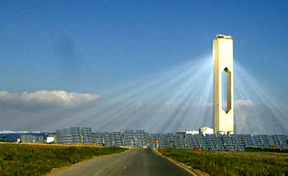 National campaign aims to shine spotlight on big solar. ABC Ballarat, By Margaret Burin, 26 March, 2012 Renewable energy advocates have begun a national campaign to promote large-scale solar power generation. About 50 groups around Australia are behind a campaign to push building large solar energy plants.
Supporters from Ballarat are the latest to launch the movement. Andrew Bray from the 100% Renewables group says large-scale solar energy is an underutilised resource in Australia. “We’re the sunniest country on Earth pretty much and we have no operating large-scale solar stations,” he says.
Mr Bray says large-scale solar power projects – which includes building solar towers and constructing panels in paddocks – are economically viable and can counter coal-fired power stations. “To give you some proportion, the normal coal-fired station is 750 to 1000 megawatts, and there’s no reason why solar power stations can’t scale up to that size.
“There’s a lot of know-how, lots and lots of know-how, in fact some of the major solar advances have come out of Australian universities and CSIRO, but industry needs to start putting out modest sized ones to learn how to do it and teach the financiers that the risks are quite modest.”
The Gillard Government has committed $10billion towards a new commercial fund, the Clean Energy Finance Corporation. Mr Bray says if parliament passes the legislation, it will help drive funding for big solar projects….
http://www.abc.net.au/local/audio/2012/03/26/3464085.htm
Huge commercial rooftop photovoltaic solar system for Port Melbourne
Australia’s Largest Rooftop Commercial Solar Power Project Announced, by Energy Matters, 19 Mar 12, NEXTDC Limited (ASX:NXT) (“the Company” or “NEXTDC”) has made another unprecedented move for the Australian data centre industry by committing to build what will be Australia’s largest privately-owned rooftop photovoltaic solar system at its Port Melbourne data centre called “M1”.
NEXTDC will spend approximately $1.2 million to install up to 400kW of solar panels to generate around 550 MWh (megawatt hours) of electricity per annum. A system of this size will offset over 670 tonnes of CO2 per annum. This equates to taking around 200 cars off the road, or powering NABERS 4 star office space for over 890 people….
NEXTDC has already incorporated energy efficient measures into its new-build data centres such as trigeneration plant and outside free air-cooling. After successful deployment of the solar panels at M1, additional investments will be made at their other data centres around Australia.
“We are proud to be the first data centre operator in Australia to invest in solar energy,” Mr Slattery said. “In fact, we are also committing to install up to 1MW of solar energy within the next 12 months at our upcoming data centre facilities”….
http://www.energymatters.com.au/index.php?main_page=news_article&article_id=3109
7,200 jobs to be lost in Australian govt’s sudden closure of solar hot water rebate
GREEN DEALS: Solar surprise, Climate Spectator, Daniel Palmer, 7 March The federal government’s decision to abandon the solar hot water rebate (Renewable Energy Bonus Scheme) on Tuesday afternoon has been a major talking point, with manufacturers critical of the lack of consultation.
An initiative of the Coalition government in 2007, the Renewable Energy Bonus Scheme offered rebates of up to $1,000 for households that installed solar hot-water systems. It was always slated to end after five years (i.e. 2012) but the exact date for its cessation was widely expected to be June 30, the end of the financial year (and basically five years from its beginning on July 17, 2007). Hence the move to end the offer for rebated as of close of business Tuesday was met with more than a hint of surprise from the industry.
The industry has said that as many as 7,200 jobs (1,200 in manufacturing and 6,000 in installation) could be at stake. It is a blow to the likes of Dux and Rheem, but Dreyfus indicated that the government would be offering no special assistance……http://www.climatespectator.com.au/commentary/green-deals-solar-surprise
Solar energy a good financial deal for Australian homes
 Double quick time for solar returns, The Border Mail, 22 Feb 12, Solar power systems are offering a return on investment in half the time it took a decade ago, according to an industry leader. Eco-Kinetics general manager South Australia, Mark Hofner, said solar power investments today would pay for themselves in about five years.
“A return on investment a decade ago would have taken 10 years,” Mr Hofner said. “Today it is around half the time; even a little 1.5 kilowatt system is under three-and-a-half years for a return. Solar is a good deal.” Continue reading
Australia’s has inadequate renewable energy policy , in opposing solar feed-in tariffs
 The Australian laws – dubbed the ”clean energy future package” by the government….The package also includes a
$10 billion Clean Energy Finance Corporation to invest in and underwrite the development of fledgling technologies.
But the government opposes feed-in tariffs and is reducing a national solar incentive scheme. State solar feed-in tariffs have been wound back
German experience: clean energy requires subsidies, The Age, Adam Morton February 18, 2012 AN ARCHITECT of Germany’s rapid growth in clean energy – it has nearly half the world’s rooftop solar power – has warned that Australia’s climate policies will not alone drive a switch to greenhouse-gas-free electricity.
Germany reached its 2020 target of generating a fifth of its electricity from renewable sources nine years ahead of schedule, largely through feed-in tariffs that guarantee new power forms an inflated rate for the power they use to make them competitive.
It installed 3 gigawatts of solar photovoltaic panels in December alone – roughly enough for 1.5 million homes. Australia has less than half this in total. Continue reading
Australian research: solar heat + power, plus energy efficiency
 Australian Made Solar Roofing Panels Provide Heat And Power by Energy Matters, 14 Feb 2012, In an effort to bring Australia in line with an international zero-emissions building code, researchers from the University of New South Wales (UNSW) are working on a system to better harness the power of solar energy to generate electricity and heating for homes.
A prototype rooftop solar power system developed by UNSW’s School of Photovoltaic and Renewable Engineering (SPREE) that combines photovoltaics with thermal technology has demonstrated the ability to produce warm air throughout winter.
Unlike conventional PV systems with solar cells mounted on top of the roof of a house, the UNSW technology is designed to be integrated into roofing panels, allowing excess heat generated by the panels – which would otherwise be wasted – to warm the home.
 The research is part of a series of ‘carbon-positive’ products that will be tested and further developed by the Cooperative Research Centre (CRC) for Low-Carbon Living at UNSW later this year; aimed at bringing Australia in line with Europe and the UK, which plan to introduce a zero-carbon building code in 2016. Professor Deo Prasad, head of the CRC, says when it comes to lowering Australia’s carbon footprint, the biggest savings can be made in energy efficient buildings.
“The built environment is responsible for 40 per cent of energy use and Australia’s homes account for 16.5 per cent of our emissions in electricity use alone, without accounting for energy embodied during the production and disposal of building materials.”….. http://www.energymatters.com.au/index.php?main_page=news_article&article_id=3049
Small scale, decentralised solar energy paying off for Queensland
 Queensland has embraced small scale solar – and that is set to continue.
Queensland Aims For 9000 Gigawatt Hours Of Renewable Energy Generation, by Energy Matters, 10 Feb 12, Queensland Renewable Energy Plan (QREP) 2012 has been launched by Energy Minister Stephen Robertson – and the future of solar in the state continues to look bright.
“QREP 2012 places Queensland front and centre of Australia’s clean energy future. It positions Queensland to leverage up to $8.9 billion in renewable energy investment and deliver 9000 gigawatt hours of renewable energy generation by 2020,” said Minister Robertson.
The Minister sees the state benefiting from the Australian Government’s Clean Energy Future initiative.
“Substantial opportunities will emerge for Queensland from this national plan. With a strong ongoing program of initiatives and new focus on collaboration and capacity building, QREP 2012 aims to position Queensland as a primary beneficiary.” Continue reading
Grattan Institute”s misleading attack on Solar Feed-in Tariffs

 The new Grattan, FOOT OFF THE GAS:GRATTAN WRONG ON SOLAR WRONG ON FEED-IN TARIFFS, Beyond Zero Emissions, 6 Feb 2012 Institute report “No quick fix for Australia’s future energy challenge” contains misleading comparisons, flawed analysis and glaring omissions on vital energy issues confronting Australia.
#1. The report makes a misleading comparison between the cost of wholesale fossil fuel electricity and the cost of solar photovoltaic electricity which currently competes in the retail electricity market and not the wholesale market.
“We do not expect a suburban Woolworths to compete with food prices at the Footscray Wholesale Fruit and Veg market. Yet this is what the Grattan Institute has done by ignoring the differences between the wholesale and retail electricity markets” says Matthew Wright,
Executive Director of Beyond Zero Emissions. “Rooftop Solar photovoltaic has halved in price in the last 24 months. This is a staggering cost reduction, and is in stark comparison to rapidly increasing rising gas prices”.
#2 The report claims that there are no viable energy storage options for renewable energy.
Matthew Wright explained that the Grattan Institute report’s conclusions “ignores Solar Thermal Power (Molten Salt Power Towers with integrated thermal storage tanks). It ignores this game-changing technology, already commercially deployed in baseload, intermediate and peaking configurations in Spain and under construction at a number of sites in the US. This technology is commercially available, off the shelf and ready for deployment in Australia. Rapid cost reductions have been projected by the International Energy Agency, the US Continue reading
How Australia’s Energy Minister sabotages renewable energy
ARENA Needed To Address Solar Flagships ‘Mess’ : Milne, by Energy Matters, 6 Feb 2012, Australia’s Solar Flagships program has faced continual delays and problems, sparking a call from the Greens to expedite the setting up of the Australian Renewable Energy Agency (ARENA) to take over the administration of the scheme.
Australian Greens Deputy Leader, Senator Christine Milne has blasted Energy Minister Martin Ferguson for his handling of Solar Flagships to date, an initiative designed to see construction of large-scale, grid connected solar farms.
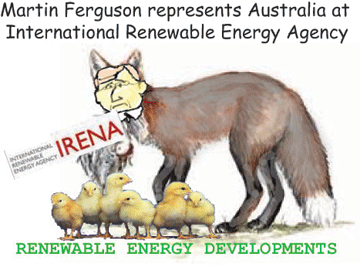
“Martin Ferguson has mismanaged this process from start to finish, helping to keep renewable energy from challenging coal’s dominance,” said Senator Milne.
“It is vital to see ARENA get off the ground as soon as possible to take political interference out of renewable energy scheme design and decisions and put them in the hands of a statutory independent authority.”…. Continue reading
Solar power and energy efficiency save money for Queensland hospital
Hervey Bay solar projects keep powering on, My Sunshine Coast, 2 Feb 12, Energy Minister Stephen Robertson has welcomed another key milestone in the Bligh Government’s $4 million plan to help power Hervey Bay with clean energy.
Mr Robertson said Queensland Health had now completed contractual arrangements with ABB Australia to install a $1.3 million 266 kilowatt solar panel system at the Hervey Bay Hospital.
“Depending on the weather, installation will begin within a few weeks on a solar panel system that will generate approximately 385 megawatt hours of energy each year, saving the hospital around $20,000 per year on electricity costs,” Mr Robertson said. “It will also help to reduce the hospital’s carbon emissions by 400
tonnes a year.
“An interactive web-kiosk and large screen television showing the energy being produced by the system daily, monthly and annually will also be installed in the hospital’s foyer as an education tool for visitors.
“This project and the $2.7 million Fraser Coast Community Solar Farm are part of the Bligh Government’s commitment to renewable energy
projects…. “ABB will draw from our global expertise in the solar industry to deliver a solar power system which operates at high efficiency, providing a lower cost per kilowatt production. “Our innovative technology and expertise is gained by our involvement in many of the world’s largest turnkey solar projects.
“The hospital has already reduced its energy consumption significantly by implementing a number of energy efficiency initiatives, and with the addition of the renewable energy from this system, they will become more self sufficient.”
http://www.mysunshinecoast.com.au/articles/article-display/hervey-bay-solar-projects-keep-powering-on,246
Australia’s Professor Martin Green spells it out on solar cell technology
Solar guru receives Australia Day honour , 26 January 2012, Anna Salleh ABC Science, http://www.abc.net.au/science/articles/2012/01/26/3415244.htm Australia needs to look to Germany if it is to realise the potential of solar cell technology, says an expert who is being honoured today. Professor Martin Green of the University of New South Wales has been made a Member of the Order of Australia(AM) for his work on photovoltaics.
“Germany has been the only country that’s had a sensible long-term program in place to promote the use of renewables,” says Green.
Some argue solar cells are not a competitive option for reducing carbon emissions, and are limited by the fact that they don’t generate energy unless the Sun is shining.
But according to Green, the “stars are aligning for conventional roof mounted solar” and it is ripe for a new kick start from governments. Continue reading
Australia’s National Solar Schools Program takes off in Tasmania
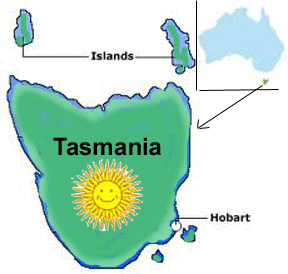 Solar funds for schools, THE MERCURY | January 25, 2012 FIFTEEN Tasmanian schools have won funding to install solar and other renewable-power systems to improve energy efficiency. The National Solar School Programs announced that more than $25 million would be distributed to 784 Australian schools for measures to tackle climate change.
Southern schools to receive grants are Bruny Island District ($50,000), Cygnet Primary ($45,333), Fahan ($47,687), Moonah Primary ($49,689), Peregrine, Nichols Rivulet ($42,197), Risdon Vale Primary ($49,975), St Paul’s Catholic School, Bridgewater ($39,440), Tasman District ($50,000) and Warrane Primary ($50,000).
The final round of applications for the grants will open on February 13. http://www.themercury.com.au/article/2012/01/25/295171_tasmania-news.html
1 This month

of the week – Australians for War Powers Reform (AWPR)
To see nuclear-related stories in greater depth and intensity
 Antinuclear