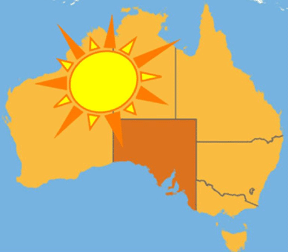
South Australia locks in federal funds to become first grid in world to reach 100 per cent net wind and solar
And to underline the difference in federal politics, the announcement was made at Port Augusta, the site of a former coal fired power station that the federal Coalition wants to turn nuclear, but which has already become a hub for green energy and green industry.
And to underline the difference in federal politics, the announcement was made at Port Augusta, the site of a former coal fired power station that the federal Coalition wants to turn nuclear, but which has already become a hub for green energy and green industry.
Giles Parkinson, Jul 10, 2024, https://reneweconomy.com.au/south-australia-locks-in-federal-funds-to-become-first-grid-in-world-to-reach-100-per-cent-net-wind-and-solar/
South Australia has locked in federal funding to ensure that it becomes the first non-hydro grid in the world to reach 100 per cent net renewables.
The funding deal – through what’s known as a Renewable Energy Transformation Agreement – means that the federal government will underwrite a minimum one gigawatt of new wind and solar generation capacity and another 400 MW (1,600 MWh) of storage – to ensure it meets its target of 100 per cent net renewables by 2027.
South Australia already leads Australia – and the world – with a wind and solar share of around 70 per cent over the last 12 months. The addition of the new capacity, along with the new Project Energy Connect transmission link from NSW, will enable it to become the first in the world to reach 1`00 per cent net renewables based around wind and solar.
That does not mean it will be powered at all times by wind and solar. But the amount of wind and solar generated and stored each year will be equivalent to what it consume each year. The state will export power at times and import at other times, and can fall pack on existing peaking gas plants to fill in the gaps.
Reaching that milestone will be a landmark for the state, and for advocates of the renewable energy transition, particularly as conservative and legacy fossil fuel interests continue to push back on the idea that a modern economy can be powered by renewables and storage.
The irony about South Australia is that the target of 100 per cent net renewables was originally committed by the state Liberal government. The state Labor government merely accelerated it from 2030 to 2027.
And to underline the difference in federal politics, the announcement was made at Port Augusta, the site of a former coal fired power station that the federal Coalition wants to turn nuclear, but which has already become a hub for green energy and green industry.
“South Australia has been a renewable energy pioneer – so much so that we recently brought forward our renewable energy target by three years, committing to ensure electricity generation can be sourced from net 100 per cent renewables by 2027,” state energy minister Tom Koutsantonis said in a statement.
“So we warmly welcome this agreement to accelerate the roll out of renewables while ensuring the reliability of the energy system.
“Our government is committed to working with the Commonwealth to establish a secured grid, supporting the power needs of South Australian households and businesses.”
South Australia has not added a new wind or solar project to the grid for around two years, although the biggest wind project in the state – the 412 MW Goyder South wind farm – is about to connect and send its first power to the grid.
Several new battery projects are also under construction – at Blyth, Hallett, Clements Gap and Templers and another, Tailem Bend, still waiting to be commissioned.
These projects will help propel the state towards 80 per cent renewables over the coming year, while the additional capacity of 1,000 MW of wind and solar, 400 MW of battery capacity (plus the minimum 200 MW included in the current CIS auction) will take it towards 100 per cent net renewables by 2027.
South Australia is also building the world’s first green hydrogen power plant at Whyalla, which will be accompanied by a 250 MW green hydrogen electrolyser and storage facilities, which will also be the world’s biggest when complete.
The state is also fielding huge number of inquiries from industry keen to source zero emissions and low cost green energy – with the local transmission company ElectraNet reporting that more than 2 gigawatts of load inquiries have been made.
Federal energy and climate minister Chris Bowen says the signing of the Renewable Energy Transformation Agreement means that South Australia is the first state to lock in the funding required to meet its targets under the federal government’s Capacity Investment Scheme.
The CIS aims to contract an additional 32GW of renewable generation and storage across the country to help it deliver most of the capacity needed to meet its 82 per cent renewable energy target by 2032.
The first tender of 6 gigawatts of new wind and solar capacity has been flooded with interest, with more than 40 GW of projects showing interest, while the first storage tender – for 600 MW, 2,400 MWh in Victoria and South Australia – was also heavily oversubscribed with some 19 GW of proposals.
Bowen says the bilateral agreements have been designed specifically to address the barriers developers, communities, and governments face in delivering renewable projects, and to replace ageing infrastructure that was built half a century ago.
“The Albanese Government is delivering the certainty and confidence the market spent a decade asking for,” Bowen said in a statement.
“The more renewable energy we have in our grid, the more downward pressure it puts on energy bills because it is the cheapest form of energy to power households and industry.
“Giving the market the confidence to build new projects is good; signing an agreement to collaborate with South Australia on practical steps to get the best out of this energy transformation for South Australian workers, communities and industry, is great.
“The Albanese Government’s Reliable Renewables Plan is the only plan supported by experts to deliver the clean, cheap, reliable and resilient energy system that Australians deserve. This is in sharp contrast to Peter Dutton’s anti-renewables nuclear plan – which remains uncosted and unexplained.”
As part of the deal, South Australia, will establish its own specific grid reliability mechanism and benchmark to be used in place of the national framework, and to be responsible for identifying and delivering new projects and technologies that will maintain reliability to that standard.
Renew Economy is seeking more information to understand what that means in practice.
Is rooftop solar a fatal flaw in the Coalition’s grand nuclear plans?

Unlike nuclear, solar is also extraordinarily cheap, at least up-front, and large-scale projects can be delivered for comparative peanuts — and with blinding speed.
There are now almost 4 million homes spread across the country with solar installations, and the electricity they generate accounted for about 12 per cent of Australia’s needs last year.
It’s a constituency that politicians would tackle at their peril.
By energy reporter Daniel Mercer, https://www.abc.net.au/news/2024-06-24/rooftop-solar-potentially-lethal-flaw-in-coalition-nuclear-plans/104008864—
Earlier this year, the Coalition made a curious, significant move.
David Littleproud, the leader of the National Party, broke cover and wholeheartedly threw his support behind rooftop solar and household batteries.
The Nationals, he said, were not against renewable energy, only large-scale projects such as wind farms and transmission lines that were “tearing up the environment”.
Quite the opposite — the National Party wanted as many Australian households to get solar and batteries as would have them.
The pitch, which was quickly backed by opposition leader Peter Dutton, evidently had a few purposes.
For starters, it clearly distinguished the opposition from the Labor government, whose plan to decarbonise the power system rests largely on big-ticket renewable energy and transmission items.
In one fell swoop, the Coalition was able to say it was pro-renewable energy while being able to attack the government’s own green plans as environmentally and economically dangerous.
What’s more, the shift was a clear nod — or a sop, depending on who you ask — to the enormous and growing political clout of Australia’s solar-owning class.
Lastly, as both Mr Littleproud and Mr Dutton have repeatedly since pointed out, rooftop solar was an ideal complement for the central plank of the Coalition’s energy plans — nuclear.
Dangers in the detail?
The thinking behind that pivot has been on full display in recent days after the Coalition finally unveiled the major details of its energy policy for the upcoming federal election.
Under the plans, Australia would get seven nuclear power plants by the middle of the century — five large-scale ones across New South Wales, Queensland and Victoria and two small ones across South Australia and Western Australia.
No longer would the renewable emphasis be on scores of new wind and solar farms in regional areas and the high-voltage power lines needed to plug them into the grid.
It would instead be directed towards people’s rooftops, “an environment that you can’t destroy”, according to Mr Littleproud.
But hiding behind this veil of logic from the Coalition, energy experts reckon, is a potentially fatal flaw.
Solar power and nuclear power don’t play nicely together.
“That’s another untested and questionable part of this whole strategy,” said Dylan McConnell, a senior researcher and energy analyst at the University of NSW.
“What happens if we look into a system that is largely dominated by … a significant proportion of … behind-the-meter solar?
“People are going to continue to install rooftop solar and, in fact, the Coalition is supportive of that.
At the heart of this tension are the differing — and some argue incompatible — characteristics of nuclear and solar power.
On the one hand, nuclear reactors are the quintessential base-load generators that can — and want to — run at or near full capacity all the time.
Not only are they well-suited to the task technically, nuclear plants also have an economic imperative to operate flat-out given their monumental development costs.
These development costs are typically exacerbated by very long lead times — lead times subject to significant blowouts — in which debts are incurred and eye-watering amounts of interest can accrue.
The hare and the tortoise
Paying off those debts is paramount for the owner of a nuclear plant.
Failure to do so can be financially ruinous.
And the way to do that is to produce and sell as much electricity as is technically possible.
By contrast, solar power — specifically from photovoltaic cells typical of suburban rooftops — are the archetypal source of variable renewable energy.
They produce the most power when the sun is shining during the day, none when it’s not, and their output can be highly variable depending on the conditions.
Unlike nuclear, solar is also extraordinarily cheap, at least up-front, and large-scale projects can be delivered for comparative peanuts — and with blinding speed.
For a household, the cost of a 10-kilowatt system — an installation capable of meeting much of an average customer’s needs — can be done for a few thousand dollars.
In other words, if nuclear power is the proverbial tortoise, solar is the hare.
None of which is to dismiss the technical and economic challenges that solar presents, namely, how to back it up when it’s not producing — a very big task indeed.
But there is another crucial way in which solar and nuclear — or any base-load power such as coal, for that matter — clash.
Solar generation, by its very nature, peaks in the middle of the day.
As ever-more Australians install seemingly ever-more solar panels on their roofs, that peak in solar output is becoming truly epic in its proportions.
Rooftop solar is a beast
or example, there are times in South Australia when rooftop solar alone can account for more than the entire demand for electricity in the state.
To ensure South Australia’s electricity system doesn’t blow up, virtually all other generators have to pare back their output to a bare minimum or switch off entirely.
And even then, South Australia’s surplus rooftop solar generation has to be exported to other states or wasted.
Rooftop solar can do this because it’s largely uncontrolled and flows simply by dint of the sun shining.
It was partly for this reason that South Australia’s only base-load coal plant retired in 2016.
Of course, there are many more times when rooftop solar provides precisely 0 per cent of South Australia’s power needs.
But it all goes to illustrate the very real challenges that base-load nuclear would face, and the very real trends that are unlikely to grind to a halt between now and 2035, by when the Coalition hopes to have the first of its nuclear reactors up and running.
A quick glance at the numbers will tell you all you need to know about the popularity — and power — of rooftop solar in Australia.
There are now almost 4 million homes spread across the country with solar installations, and the electricity they generate accounted for about 12 per cent of Australia’s needs last year.
Bruce Mountain, the director of the Victoria Energy Policy Centre, summed it up this way: “Rooftop solar has few opponents.”
“It’s the one thing that keeps on growing despite the impasse at a national level,” Professor Mountain said.
“And I think there’s much more to go to realise the potential for that, most notably on factory roofs.”
Something has to give
Professor Mountain said “I’m kind of open to the idea of nuclear”, noting that it was being taken seriously by many other developed countries seeking to decarbonise their electricity supply.
He also pointed out that Australia’s development of large-scale renewable energy projects and, particularly, the transmission lines needed to support them, had hardly been a glowing success to date.
In any case, Professor Mountain suggested the fact the Coalition was proposing to own and operate any nuclear power stations was an acknowledgement that there was no commercial case for the technology in Australia.
On that point, Dr McConnell from the University of NSW agreed.
Dr McConnell said the economic obstacles in front of nuclear in Australia were enormous, and a big one was rooftop solar.
He said that in the almost inevitable event that nuclear and solar power clashed, something would have to give.
“The way you might achieve that in a system with lots of rooftop solar is by curtailing [switching off] rooftop solar,” Dr McConnell said.
“And that may not be politically popular either.”
Robert Barr, a power industry veteran and a member of the lobby group Nuclear for Climate, did not shy away from the potential for future tensions, noting that coal was already getting squeezed out of the system by solar.
But Dr Barr said any clash could be easily managed through a combination of price signals that encouraged householders to use more of their solar power and export less, and new reactor technology that could ramp up and down more effectively.
You could probably drop down from 100 per cent down comfortably to like 60 per cent output and on a daily basis,” Dr Barr said of new nuclear technology.
Ultimately, however, Dr Barr argued it may need to be households with solar panels that gave way to nuclear energy for the greater benefit of the electricity system.
Don’t mention the solar wars
Right now, he said, renewable energy was benefiting from taxpayer-funded subsidies that allowed wind and solar projects to make money even when the price of power was below $0.
These subsidies applied to both utility-scale projects and rooftop solar panels, through the large- and small-scale green energy targets introduced by the Rudd Labor government.
They effectively allow such projects to sell their electricity for less than zero — up to a point — and still be in the money.
In the future, Dr Barr said, those subsidies would no longer exist and renewable energy projects would start to be penalised each time the price of electricity went negative.
“I think what will happen is that nuclear will just tend to push out solar,” he said.
“There’ll be an incentive for customers to back off.
“And I think it wouldn’t be that difficult to build control systems to stop export of power at the domestic level.
“It’d be difficult for all the existing ones but for new ones, it just might require a little bit of smarts in them to achieve that particular end — it can be managed.”
Much like the Coalition’s grand policy pitch, those comments might be considered bold given the political heft wielded by millions of solar households.
Last decade, politicians of all stripes got into all manner of trouble when they tried to wind back subsidies known as feed-in-tariffs, which paid customers for their surplus solar power generation.
Solar households, egged on by the industry, mobilised, went on the attack and in many cases forced governments to bend to their will.
And that was at a time when the number of households with solar was a fraction of what it is now.
It’s a constituency that politicians would tackle at their peril.
IEA: Global renewable capacity grows over 50% YoY in 2023

George Heynes, Current News, 12 Jan 24
The International Energy Agency (IEA) has released a new report revealing that 50% more renewable capacity was added globally in 2023 than in 2022, but financing remains an issue.
As the globe hurtles towards impending net zero targets – and with the recently signed pledge by 118 countries to triple renewables by 2030 at the recent COP28 summit in Dubai – the recent release of the IEA’s Renewables 2023 report will be welcome. But the publication does include some key challenges that must be addressed to bolster net zero efforts.
Crucially, the standout figure from this year’s document is that global annual renewable capacity additions increased to 510GW in 2023. This represents the fastest growth rate that has been witnessed in the past two decades.
Now this should serve as huge praise to all throughout the global renewable value chain who have worked tirelessly to bolster the energy transition and maintain the Paris Agreement’s legislation to keep global warming increase well below 2°C with a target to limit it to 1.5°C.
Turning our attention to GB, the nation has seen its renewable capacity bolstered significantly over the past year and saw various wind generation records broken. The result saw low-carbon energy sources contribute 51% of the electricity used by Britain with fossil fuels having made up 33% of GBs electricity mix across 2023. Carbon Brief attributed the decline of fossil fuels to two factors: renewables increasing sixfold (by 113TWh) from 2008, and reduced electricity demand, which decreased by 21% (83TWh) since 2008.
Of the renewable energy sources added, solar PV accounted for three-quarters of additions worldwide with China being where the largest growth occurred. For readers wanting to learn more about solar across 2023, our sister site PV-Tech provided its own analysis to the IEA report.
China also saw huge growth in its wind sector with additions having risen by 66% year-on-year. This staggering total has seen the nation become the largest developer of wind in the world, something that could come as a blow to the UK with its offshore wind pipeline having dropped below China over the course of 2023……………………………………..
The need to support emerging and developing economies
Another crucial aspect of the IEA report is its view into the global race to net zero. As referenced by the organisation, G20 countries account for almost 90% of global renewable power capacity today meaning that much must be done to support emerging and developing economies and countries as they transition away fossil fuels……………………..
An eye to the future
The IEA referenced various major milestones that could be achieved by 2028. Firstly, should the current trajectory continue at its rate, the globe could well bring online more renewable capacity between 2023 and 2028 than has been installed since the first commercial renewable power plant was built more than 100 years ago.
Indeed, this showcases the opportunity and collective movement to ensure net zero targets are met. However, this may not be enough. As mentioned previously, more time and resources must be allocated to support developing countries in their own net zero journeys to ensure that the Paris Agreement targets are met and maintained.
Other key milestones include:
- In 2024, wind and solar PV together generate more electricity than hydropower.
- In 2025, renewables surpass coal to become the largest source of electricity generation.
- Wind and solar PV each surpass nuclear electricity generation in 2025 and 2026 respectively.
- In 2028, renewable energy sources account for over 42% of global electricity generation, with the share of wind and solar PV doubling to 25%.
With the push to bolster renewable generation capacity expected to ramp up further into the decade, it will be interesting to see how the UK government manages its expectations and is able to take a global leadership role in the fight for net zero. https://www.current-news.co.uk/iea-global-renewable-capacity-grows-over-50-yoy-in-2023/
1 This month

of the week – Australians for War Powers Reform (AWPR)
To see nuclear-related stories in greater depth and intensity
 Antinuclear