Loves coal, hates solar, friendly to nuclear – Tony Abbott’s Energy White Paper
The energy white paper also continues its attack on solar…..
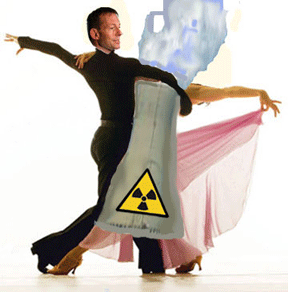 Interestingly, it says it recognises the argument that nuclear is a costly alternative to renewables, uses lots of water and has waste-disposal issues. But it also says others argue that it is “adequate” affordable and reliable, and has significant environmental benefits and public health advantages over other existing base-load technologies. It says it will consider the outcomes of the South Australian Royal Commission into the nuclear fuel cycle, including its use as an energy source.
The winners and losers of Abbott’s energy white paper (SPOILER: Tony likes coal),  Crikey, GILES PARKINSON | APR 08, 2015 In many ways, the Coalition’s energy white paper is a predictable piece of backward-looking falsehoods. But it does make some surprising concessions to a future of renewable energy. Today, the Coalition government released its energy white paper — the document that is supposed to outline the nation’s energy vision for the short and long term future. But there are no surprises for guessing that this is a document that is largely focused on the rear-view mirror.
The energy white paper begins with a false assumption: that “Australia’s large quantities of traditional energy resources provide low cost, predictable and reliable power for Australia and the world”.
They don’t. Coal might be cheap to shovel into a boiler, but it is mighty costly to transport. Grid (delivery) costs make electricity in Australia some of the most expensive in the world. Transport and shipping costs make coal and gas expensive, to the point where they are now being undermined by local, renewable alternatives — or a new focus on environmental policy — even in major markets such as India and China.
Like the Abbott government’s discussion paper on emission reduction targets released late last month, this document also works on the principle that the world will do nothing new to address climate change. The energy white paper’s assumptions are based on the International Energy Agency’s “new policies” scenario, which sets the scene for what would be a catastrophic rise in temperatures to an average 4 degrees.
No matter, the Abbott government concludes: “Ongoing access to large volumes of coal and gas will also underpin our energy generation mix for some decades.” Although it does at least acknowledge that these fuels will be “increasingly exposed to competition from renewable energy”.
Not that it intends to accelerate that transition. Quite the opposite. Unlike the actions of the US, China, Europe and other emerging economies, there is no talk of environmental impacts, emissions standards, enhanced renewable energy targets, or climate goals. It is almost entirely focused on the technologies of the past, rather than the future.
When the green paper was released last August, RenewEconomy did a quick analysis that found that in the 78-page document, gas was mentioned 434 times, coal 100 times, followed by nuclear on 67. Storage got 32 mentions, solar 26, and wind energy just 13 mentions.
The ratio is pretty much the same in the more discursive 81-page white paper, even if the numbers are different……..
The energy white paper also continues its attack on solar. It describes interventions, such as the Renewable Energy Target and solar feed-in-tariffs, as market-distorting signals that cause “unintended disruptions” to competitive energy markets………
the energy white paper does acknowledge that the development of cost-effective energy storage could bring about a “paradigm change” in the way Australia produces, transports and consumes energy.
The most profound effect, it says, will be in renewable energy, as storage can help overcome current limitations of intermittency in generation. And with Australia’s long, thin electricity grid and large share of remote power generators, Australia could benefit significantly from major advances in storage technologies, as Ergon Energy is already finding.
And the energy white paper notes that as affordable storage develops, it is important that Australia’s existing regulatory framework can accommodate this change. It makes mention of the Future Grid Forum work led by CSIRO — which, 18 months ago, warned that nearly half of all demand could be sourced by “local or on-site generation” and that, unless utilities adapted their business models, one-third of customers could choose to leave the grid.….
- It will be keeping an open mind on nuclear energy. Interestingly, it says it recognises the argument that nuclear is a costly alternative to renewables, uses lots of water and has waste-disposal issues. But it also says others argue that it is “adequate” affordable and reliable, and has significant environmental benefits and public health advantages over other existing base-load technologies. It says it will consider the outcomes of the South Australian Royal Commission into the nuclear fuel cycle, including its use as an energy source.
8 Comments »
Leave a comment
1 This month.
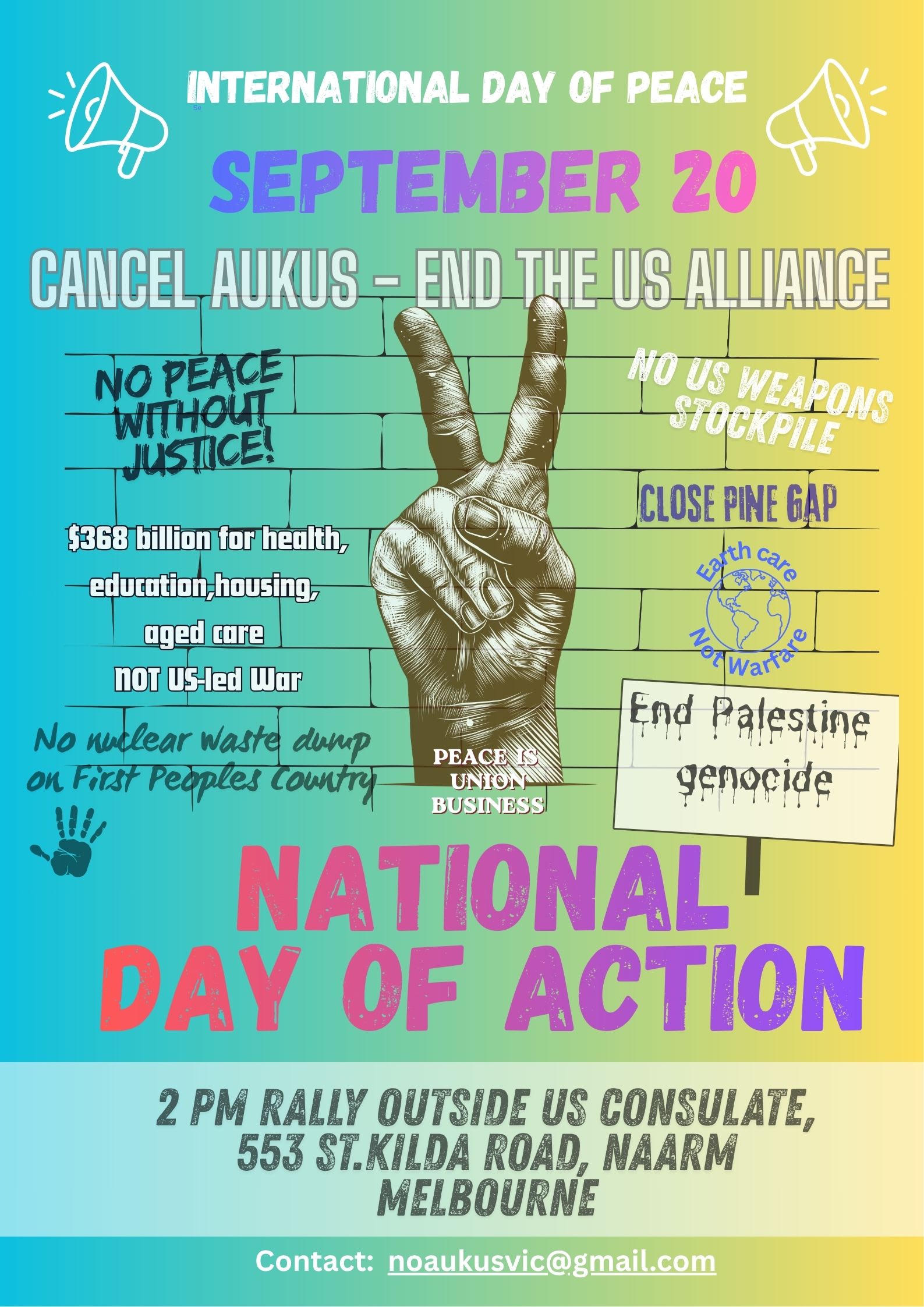
20 September –National Day of Action in Melbourne on the International Day of Peace


Help Aunty Sue Protect Her Land and Sacred Sites From Destructive Rocket Testing.
.

Australians deserve the truth
about
AUKUS – https://aukuspublicinquiry.com/

PETITION – To: Prime Minister Anthony Albanese and the Australian Labor Government

of the week – Australians for War Powers Reform (AWPR)
To see nuclear-related stories in greater depth and intensity
 Antinuclear
Can I change your picture to Tony dancing with a dude nuclear bomb? LoL.
LikeLike
Sure. I am assuming that you are not like the pro #thorium #nuclear Twitter shills, who repeatedly plagiarise my graphic for THEIR cause.
LikeLike
I am pretty sure I am not. I will offer you a sample. https://instagram.com/p/0lxYnTpfy_/?taken-by=leswanderinpoet
LikeLike
I am pretty sure that you are OK. Loved the pic of Gina and Tony!
LikeLiked by 1 person
haha. I have more on the ol instagram.
LikeLike
I am flat out today. Shall look later. If ever you want to send me one – with full attribution – very good. This is a totally unfunded website – with the glorious dream of waking Australians up.
LikeLiked by 1 person
I write a lot about Australia actually. I have friends there that I met online.
I’m pretty astonished by what I find.
LikeLike
https://twitter.com/WanderinPoet/status/586379524364873729
LikeLike