Tesla batteries to the rescue for South Australia’s electricity system?
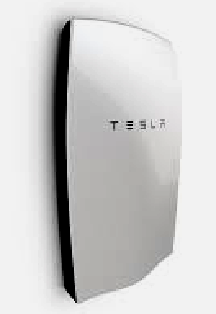 Greens say Elon Musk’s plan is a game changer Australian
  Greens Senator for South Australia Sarah Hanson-Young says Elon Musk’s proposal to solve South Australia’s energy crisis with battery storage is the game changer our state needs to switch back on.
“We live in the perfect state for wind and solar. Battery technology allows us to make hay while the sun shines, storing the power so we can use it when we want and need. While chairing a senate inquiry into battery storage, I’ve heard evidence that if 20,000 homes with solar panels had a battery as well, the load shedding that cut off the air conditioning when we needed it most last month wouldn’t have happened.
“This is the innovation Malcolm Turnbull promised when he declared he would be the ‘Innovation Prime Minister’
Elon Musk says his Tesla battery company could solve South Australia’s energy crisis in 100 days Luke Griffiths, Lauren Novak, The Advertiser March 11, 2017 TECH billionaire Elon Musk on Saturday confirmed he’s spoken personally with Jay Weatherill to discuss his company’s plans to build a battery farm to help SA solve its power woes – amid support from the Australian Greens, who say his plan to build a batter farm could be “game changer”.
Michio Kaku – Musk & Game Changing Tesla Powerwall Battery
1 Comment »
Leave a comment
1 This month.
20 September –National Day of Action in Melbourne on the International Day of Peace



Help Aunty Sue Protect Her Land and Sacred Sites From Destructive Rocket Testing.
.

Australians deserve the truth
about
AUKUS – https://aukuspublicinquiry.com/


PETITION – To: Prime Minister Anthony Albanese and the Australian Labor Government

of the week – Australians for War Powers Reform (AWPR)
To see nuclear-related stories in greater depth and intensity
 Antinuclear
The Editor
The Advertiser
It’s disappointing that the Weatherill government has chosen to focus on only one side of the electricity grid supply-demand problem.
Grid supply solutions such as new power stations and large scale energy storage tend to be complex, capital intensive, and slow to implement. Demand solutions such as double glazing, solar hot water storage and rooftop solar+battery systems tend to be simple, labour intensive, and quick to implement. The former often requires imported technology and equipment, whilst the latter uses local expertise and services.
A supply-only approach ensures that electricity grid problems don’t go away, while a demand approach tends to keep a lid on the problem. The supply-only approach is reminiscent of the approach to water in SA, an approach that led to an expensive, un-utilised drain on SA taxpayers.
SA consumers are taking things into their own hands by installing rooftop solar panels with battery storage. This will decrease the demand for power stations which are increasingly under threat of being expensive stranded assets.
Dennis Matthews
LikeLike