But no less a concern for Flynn and his partners was the moribund U.S. nuclear industry, which was losing out to Russian and even South Korean contractors in the region. Or as Stuart Solomon, a top executive along with Hewitt at his new venture, IP3 (International Peace, Power and Prosperity), put it in a recent speech to industry executives, “We find ourselves…standing on the sidelines and watching the competition pass us by.” Continue reading
Quiet shipment of uranium from Australia to India – non signatory to Non-Proliferation Treaty
 Australia quietly makes first uranium shipment to India three years after supply agreement, ABC Radio The World Today By South Asia correspondent James Bennett, 18 Jul 17 Three years after signing a civilian nuclear supply treaty, the Federal Government confirmed overnight the first shipment of Australian uranium has left for India.
Foreign Minister Julie Bishop provided little detail about the inaugural sale, saying only that it was subject to commercial negotiations.
The supply deal with India, signed in 2014, is the first of its kind Australia has made with a country not party to the nuclear non-proliferation treaty…….
Details of inaugural shipment unclear
It is not clear how big the shipment is, where it departed from, or where in India it might be heading.
Indian officials were unable to immediately provide comment, while the Department of Foreign Affairs and Trade said only that the details were subject to commercial negotiation.
Parliament only passed the final legislation enabling sales last December, following years of debate about supplying uranium to a country with a strategic nuclear weapons program and that refuses to sign the non-proliferation treaty.
Parliamentary hearings to ratify the supply treaty in 2014 heard the International Atomic Energy Agency still had concerns about India’s safeguards.
Ongoing tensions between India and its neighbour Pakistan, which also has not signed the non-proliferation treaty, have raised the spectre of armed confrontation in the past……..http://www.abc.net.au/news/2017-07-19/australia-quietly-makes-first-uranium-shipment-to-india/8722108
Grand nuclear power scheme: Russia, USA, Saudi Arabia and Michael Flynn
the genius idea developed by Flynn and Co. was a U.S.-Russian partnership to build and operate nuclear plants and export the dangerous spent fuel under strict controls
It would be “funded entirely by Saudi Arabia and other Gulf countries” The kingdom’s upfront cost? “Close to a trillion dollars”
the Saudis would recoup their costs by selling energy to Egypt, Jordan, Yemen and Gulf Cooperation Council (GCC) members Kuwait, Bahrain, Oman, the United Arab Emirates and Qatar—

 MICHAEL FLYNN, RUSSIA AND A GRAND SCHEME TO BUILD
  NUCLEAR POWER PLANTS IN SAUDI ARABIA AND THE AND THE ARAB WORLD http://www.newsweek.com/flynn-russia-nuclear-energy-middle-east-iran-saudi-arabia-qatar-israel-donald-623396
BY JEFF STEIN ON 6/9/17 By the time Michael Flynn was fired as President Donald Trump’s nationalsecurity adviser in February, he had made a lot of bad decisions. One was taking  money from the Russians (and failing to disclose it); another was taking money under the table from the Turks. But an overlooked line in his financial disclosure form, which he was forced to amend to detail those foreign payments, reveals he was also involved in one of the most audacious—and some say harebrained—schemes in recent memory:
In 2015 and 2016, according to his filing, Flynn was an adviser to X-Co Dynamics Inc./Iron Bridge Group, which at first glance looks like just another Pentagon consultancy that ex-military officers use to fatten their wallets. Its chairman and CEO was retired Admiral Michael Hewitt; another retiredadmiral, Frank “Skip” Bowman, who oversaw the Navy’s nuclear programs, was an adviser. Other top guns associated with it were former National Security Agency boss Keith Alexander and retired Marine Corps General James “Hoss” Cartwright, former vice chief of the Joint Chiefs of Staff, whose stellar career was marred when he was prosecuted last year for lying to the FBI during a leak investigation.
In the summer of 2015, knowledgeable sources tell Newsweek, Flynn flew to Egypt and Israel on behalf of X-Co/Iron Bridge. His mission: to gauge attitudes in Cairo and Jerusalem toward a fantastical plan for a joint U.S.-Russian (and Saudi-financed) program to get control over the Arab world’s rush to acquire nuclear power. At the core of their concern was a fear that states in the volatile Middle East would have inadequate security for the plants and safeguards for their radioactive waste—the stuff of nuclear bombs.
As ERA’s Ranger Uranium mine lease to expire, town of Jabiru’s future is not clear
Kakadu National Park: Jabiru residents in limbo as governments, mining company contemplate town’s future, ABC, By Sara Everingham, 18 July 17, If the Northern Territory’s mining town of Jabiru near Kakadu National Park is to stay afloat, decisions will need to be made soon to avoid the loss of essential services, infrastructure and people, a report commissioned by Energy Resources of Australia has warned.
ERA, which operates the Ranger Uranium mine, is planning for the expiry of its lease agreements in 2021.
The company is required to return the town of Jabiru, which is also a service hub for the national park, to its pre-development state, removing housing and critical infrastructure, including power and water services.
Jabiru, which has a population of about 1,100, was built in 1982 as a mining residential and service hub, and the majority of its residents, whether they work at the mine or not, live in the town.
Even if there’s a consensus that Jabiru should continue to exist, it’s not clear what services would remain, particularly if there’s a sharp population decline once ERA departs………
The NT and Federal Governments have been in talks with traditional owners, the Northern Land Council, and ERA about a plan for the future of the town, but have not yet reached an agreement.
Traditional owners have also been in talks with the Commonwealth about a new township lease over Jabiru.
In the absence of any final agreements, ERA was planning for the closure of the town in four years’ time…….
ERA’s lease on the Ranger Uranium Mine expires in 2021, and the rehabilitation of the Ranger Mine has to be completed by 2026.
ERA had proposed prolonging the life of the Ranger mine by developing the underground 3 Deeps project, but in 2015 that plan lost the support of traditional owners and Rio Tinto, the majority shareholder of ERA.
The Mirrar traditional owners “absolutely” want to see the town continue and have been intensely lobbying the Federal Government since 2003, said Justin O’Brien, CEO of the Gundjeihmi Aboriginal Corporation.
“If you want security of tenure, if you want to avoid the bulldozers and the base case scenario that’s still the only option on the table, sadly, you negotiate very speedily the township lease that the traditional owners have put on the table, which we’ve commenced negotiating with the Australian Government,” he said. “If the Government engages quickly in the next several months with traditional owners then yes, it’s got a great future in terms of tourism and service provision. It’s a really positiveplace.” http://www.abc.net.au/news/2017-07-18/jabiru-residents-in-limbo-as-uranium-mining-draws-to-a-close/8718432
Japanese government fears radioactive terrorism at 2020 Olympic Games
 Japan taps tech to foil nuclear terrorism ahead of Tokyo Olympics, Japan Times, KYODO
At a meeting of the Education, Culture, Sports, Science and Technology Ministry in December, Mitsuru Uesaka, president of the Atomic Energy Society of Japan and a professor at the University of Tokyo, said it was important to “enhance nuclear security” ahead of the games.
There have been numerous incidents overseas involving attempts to smuggle nuclear materials……
There are also fears that the radical militant group Islamic State might have made a “dirty bomb” capable of scattering radioactive materials. Unlike nuclear weapons, such devices can be made relatively cheaply without advanced skills.
To stop nuclear materials from entering Japan through airports, the agency developed a device to detect very small amounts of uranium concealed in luggage by irradiating luggage with a beam of neutrons. The result is available in less than a second.
Baggage screening at domestic airports usually uses X-rays, but an expert at the agency said conventional screening is not effective in detecting nuclear materials…..
As of the end of 2015, there were 454 confirmed incidents around the world involving unauthorized possession of nuclear materials and related criminal activities, 762 incidents involving reported theft or loss of such materials, and 1,622 incidents involving other unauthorized activities and events related to such materials, according to an International Atomic Energy Agency report. http://www.japantimes.co.jp/news/2017/07/19/national/japan-taps-tech-foil-nuclear-terrorism-ahead-tokyo-olympics/#.WW8OgBWGPGg
19 July MORE REneweconomy news

-
COAG: Can democracy weed out climate deniers?Turnbull’s recent use of the word “delusional” reminds us that climate denial is still alive and kicking in mainstream Australian politics.Australian coal, gas miners seek renewable energy projectsAustralian oil, gas and coal mining body, NERA, issues call for cleantech, renewable energy partnerships, says timing is “spot on” for collaboration.Base-cost renewables: When wind and solar finally kill coalBNEF says building new solar plants will be cheaper than shovelling coal into existing coal generators within 15 years. This will trigger a complete re-make of the energy system, and a share of wind and solar far beyond that contemplated by the Finkel Review.Frydenberg says Zibelman “doing really great job” at AEMOFrydenberg defends AEMO chief Audrey Zibelman from attacks by conservative commentators.
-
Greens Senator for SA visits battery storage facility in Southern CaliforniaAustralian Greens Senator for South Australia Sarah Hanson-Young has called on Malcolm Turnbull to intervene to end the delay in fixing energy market rules, including the 5-minute rule, to allow battery storage to compete fairly.
-
Leaders’ pledge to galvanise renewable energy leaders to champion gender diversityBetter gender diversity across the renewable energy industry requires leaders from both genders to step up and drive change, the Clean Energy Council said in launching its Women in Renewables Leaders’ Pledge today.
-
Business slowly wakes up to reality that renewables are cheapARENA report shows less than half Australian businesses have tapped renewables. But there’s no doubt the idea is starting to catch on.
Doubts and anxieties about the much touted Small Modular Nuclear Reactors
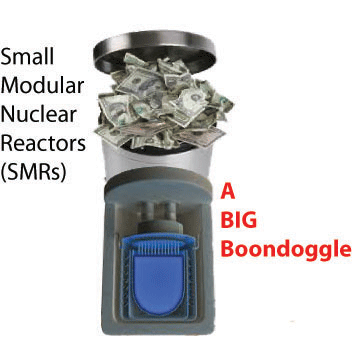 The reactor that could kick-start the nuclear sector comes in a very small package, True Viral New 17.07.2017 “………..we won’t know how economically the plants can really operate until they’re up and running. And a shift toward smaller but more numerous nuclear reactors could raise new kinds of proliferation dangers, some observers warn.
The grand promise of commercial SMRs is that they would be compact enough to prefabricate in factories and ship to their destination, where they could be stacked together to produce whatever level of energy generation is needed. …….
A number of other companies and research institutions are pursuing so-called fourth-generation SMR technologies, including molten-salt and high-temperature gas. But in general, those face tougher technical challenges, as well as regulatory ones, and may take longer to develop.
NuScale’s main financial backer is the large engineering firm Fluor, which took a majority stake in the company in 2011. In 2013, the U.S. Department of Energy awarded the company $217 million under the SMR Licensing Technical Support Program. But the Trump administration’s budget proposal includes sharp cuts to the DOE’s nuclear programs, which could jeopardize the company’s ability to secure the remaining $47 million of that grant…….
a number of Republican lawmakers urged President Trump in a letter in May to support the development of SMRs…….
Despite the promise of SMRs, the technology is not a sure bet. Notably, even if capital outlays are considerably lower, that doesn’t necessarily mean it will yield competitive electricity costs, particularly against low-cost natural gas.
Some players have reportedly already pulled back from SMRs, including Westinghouse and Babcock & Wilcox, at least in part because of competition from cheaper energy sources.
“The cost per megawatt-hour doesn’t necessarily come down just because you’re building a smaller plant,” says Ryan Fitzpatrick, deputy director of the clean-energy program at the think tank Third Way. “There have to be cost savings derived through other processes.”
Those could include things like shorter construction times and new design features that reduce regulatory expenses. But the key to driving down costs would be setting up factories to crank out a lot of reactors, says Neil Todreas, a professor of nuclear science and engineering at MIT…..
That, however, may present a bit of a chicken-and-egg challenge: securing financing to build the plants will probably require a lot of orders, but it would be hard for a company to obtain those orders before it could reliably produce reactors cheaply.
In addition, the Union of Concerned Scientists has raised separate questions about how safe and secure the plants will really be. Among other issues, the group noted that a widely distributed network of smaller but more numerous reactors could make it harder to safeguard nuclear material that, among other dangers, can be used to make dirty bombs.
In the end, SMRs may or may not end up being the ideal or most economical way to add significant nuclear generation to the grid. But in a nation where it’s become nearly impossible to build any new nuclear plants, it could simply be the technology needed to get the industry moving forward again at all, Todreas says.
“I am not sure there will be a march toward small modular reactors across the U.S. for decades, or that they will completely replace large power plants,” he says. “But certainly in the near term, they’re very important for the health of nuclear power in the U.S.” In the end, SMRs may or may not end up being the ideal or most economical way to add significant nuclear generation to the grid. But in a nation where it’s become nearly impossible to build any new nuclear plants, it could simply be the technology needed to get the industry moving forward again at all, Todreas says.
“I am not sure there will be a march toward small modular reactors across the U.S. for decades, or that they will completely replace large power plants,” he says. “But certainly in the near term, they’re very important for the health of nuclear power in the U.S.”
Britain’s financial shock, as Hinkley nuclear plan costs balloon towards £50 billion.
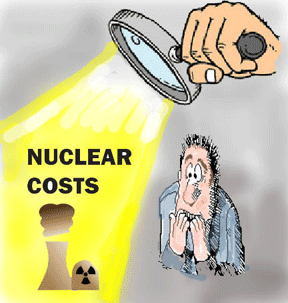
 Times 19th July 2017, The storm surrounding the construction of the Hinkley Point C nuclear plant was set to break out anew today after it emerged last night that the cost to consumers could mushroom to £50 billion.
The new official estimate is more than eight times higher than the £6 billion that the National Audit
Office estimated the plant would cost consumers when ministers first struck a subsidy deal to support it in 2013. The spark that ignited the explosion in the estimate is a decline in electricity prices, which in turn have hugely inflated the subsidies that the project is expected to require.
Under the terms of the deal, which was confirmed, after some delay, last autumn by Theresa May, the nuclear developers EDF, of France, and CGN, of China, will foot the up-front construction cost in return for a guaranteed price of £92.50 for every megawatt- hour of power that the plant generates for 35 years.
If wholesale prices are below that level, the difference will be subsidised by consumers through levies on their energy bills. Wholesale prices and projections of future prices have both fallen significantly
since 2013 as the cost of fossil fuels used in conventional power generation has plunged. This has increased the estimates of the subsidy payments that will be required for Hinkley Point, making the project appear increasingly poor value. Government figures show that, as of September last year, the lifetime costs of Hinkley Point C were estimated at £49.9 billion. That compares with an estimate of £36.9 billion in 2015 and £14.5 billion in 2014. https://www.thetimes.co.uk/edition/business/hinkley-point-cost-could-soar-to-50bn-6brnph9q7
Southern Europe: crops devastated by drought
RPT-One of worst droughts in decades devastates South Europe crops,
* Crops damaged include olives, almonds and durum wheat
* Farmers in southern Europe question their long term future.
By Isla Binnie and Paul Day ROME/MADRID, July 14 (Reuters) – Italian durum wheat and dairy farmer Attilio Tocchi saw warning signs during the winter of the dramatic drought to come at his holding a mile away from the Tuscan coast.
“When it still hadn’t rained at the beginning of spring we realised it was already irreparable,” he said, adding that he had installed fans to try and cool his cows that were suffering in the heat.
Drought in southern Europe threatens to reduce cereal production in Italy and parts of Spain to its lowest level in at least 20 years, and hit other regional crops including olives and almonds.
Castile and Leon, the largest cereal growing region in Spain, has been particularly badly affected, with crop losses estimated at around 60 to 70 percent……By Isla Binnie and Paul Day
ROME/MADRID, July 14 (Reuters) – Italian durum wheat and dairy farmer Attilio Tocchi saw warning signs during the winter of the dramatic drought to come at his holding a mile away from the Tuscan coast.
“When it still hadn’t rained at the beginning of spring we realised it was already irreparable,” he said, adding that he had installed fans to try and cool his cows that were suffering in the heat.
Drought in southern Europe threatens to reduce cereal production in Italy and parts of Spain to its lowest level in at least 20 years, and hit other regional crops including olives and almonds.
Castile and Leon, the largest cereal growing region in Spain, has been particularly badly affected, with crop losses estimated at around 60 to 70 percent.
Canada once again experiencing massive wildfires
 Echoes of Fort McMurray — Massive Wildfire Forces the Emptying of Another Canadian City https://robertscribbler.com/2017/07/16/echoes-of-fort-mcmurray-massive-canadian-wildfire-forces-the-emptying-of-another-canadian-city/?utm_campaign=crowdfire&utm_content=crowdfire&utm_medium=social&utm_source=twitter#350509998-tw%231500228804052
A little more than a year after a massive wildfire forced the full evacuation of Fort McMurray in Alberta, another set of extreme wildfires in British Columbia is again forcing major population centers to empty. In the region of Williams Lake and Cariboo City, 17,400 people have been forced to flee as a wildfire is threatening the major highway exiting the area. As the fire expands, another 27,000 in the broader province may also be asked to leave. This mass evacuation has been enough to empty large urban centers — turning them into ghost towns as fires rage through the surrounding countryside.
On Saturday, 40 mph winds, hot temperatures in the 90s (F), and lightning strikes fanned flames in the region — considerably worsening the fire situation and spurring more comprehensive evacuation orders. Heavy rains earlier in the year caused rapid vegetation growth. But as much warmer than normal temperatures accompanied by dry, windy conditions entered the region in June and July, the new growth has turned into tinder — adding a serious fire hazard.
Scores of very large wildfires rage across British Columbia on July 15 — casting smoke plumes that now stretch across most of Canada. For reference, bottom edge of this image frame covers roughly 550 miles. Image source: NASA Worldview.)
Presently, 160 wildfires are now burning across British Columbia. This number is down from more than 200 fires earlier in the week. However, many of the larger fires have grown in size. The result is that the province is still under a very severe alert level 4 with a mass mobilization of firefighting resources underway. On July 15, the fires were clearly visible in NASA satellite imagery (see above).
Precipitation extremes and increasingly warm temperatures are a hallmark signal of human caused climate change resulting from continued fossil fuel burning. And it is these kinds of conditions that have dominated British Columbia over recent months. Both the strong swing from wet to dry conditions accompanied by much warmer than normal summer temperatures is climate change related and has likely served to increase the fire danger throughout British Columbia this year.
19 July REneweconomy news
-
Coal has lost the energy war, so why are we still fighting?The political fight for coal power in Australia is already lost. Meanwhile, we are missing all the clean energy opportunities that have fallen into our lap.LO3 unveils ‘game-changing’ solar sharing microgrid in South AustraliaUS-based energy sharing company LO3 partners with Yates Electrical to build 6MW solar microgrid in SA Riverland region.Turnbull’s coal delusions as COAG “changes course” on energyIf COAG did change the course of energy in Australia, it is not immediately obvious, given Turnbull’s coal delusion comments. Much will depend on how Finkel recommendations are put in place, and the storage equation and the make-up of the energy security board are critical.Know your NEM: Generator Reliability Option might be dumb ideaThe COAG endorsement of the Finkel Review (apart from the CET) won’t mean much in the short term, but the generator reliability option might be a dumb idea. Meantime, smart companies are showing how to save costs with solar and storage.National Electricity Market has served its purpose – it’s time to move onThe NEM has failed. Its very narrow economic objective was to provide low prices, reliable and safe energy, and to act in the long term interests of consumers. It hasn’t.
18 July REneweconomy news
-
GE: Some Australia regions to be 100% renewable in 5-10 yearsGE says parts of Australia will soon get all electricity from renewables, at least for a few days a year, as utility business models disrupted.
-
AGL’s Vesey: Clean Energy Target should recognise Paris climate agreementAGL adds pressure to Turnbull government, saying CET needs to be adopted, and needs to reflect Paris climate targets.
-
Australia’s $10 billion renewable energy boom: But then what?A $10 billion clean energy investment boom in 2017 could quickly fade without longer term policies. Labor tries to wedge Turnbull on climate policy, just as it did in 2009, while the Greens also say they would look at a Clean Energy Target.
-
Clean-tech stocks outperform general market again, as smart investors buy inIt is no surprise that, regardless of the fickleness of environmental politics, smart investors are buying into the businesses that are redefining how we live.
-
NSW launches home battery guide, as race to “plug hole” threatens industryNew South Wales issues set of home battery storage guidelines, as industry warns against “jumping to an endgame” on safety.
-
Peer-to-peer electric vehicle charging network launched in SydneySydney start-up Everty launches P2P platform allowing electric vehicle owners to rent out their parking space, and home charger, to others.
-
Barnaby’s warning: Biggest threat to renewables is lights out in SydneyDeputy PM says Sydney blackout could be end of road for renewables, although NSW Coalition minister earlier praised role of wind and solar in preventing blackout.
1 This month
Chernobyl: The Lost Tapes – A good documentary on Chernobyl on SBS available On Demand for the next 3 weeks– https://www.sbs.com.au/ondemand/tv-program/chernobyl-the-lost-tapes/2352741955560
15 April – Zoom –Nuclear Power is Not the Solution
Apr 15, 2026 01:00 AM in Canberra, Melbourne, Sydney

Join the International Physicians for the Prevention of Nuclear War (IPPNW) on Tuesday, April 14th for a timely webinar exploring the risks associated with nuclear power and challenging the myth that it offers a simple, safe, carbon-free solution to the climate crisis

21 April Webinar: No Nuclear Weapons in Australia
Start: 2026-04-21 18:00:00 UTC Canberra, Melbourne, Sydney (GMT+10:00)
End: 2026-04-21 19:30:00 UTC Canberra, Melbourne, Sydney (GMT+10:00)
Event Type: Virtual
A virtual link will be communicated before the event.
Host Contact Info: australia@icanw.org

of the week – Australians for War Powers Reform (AWPR)
To see nuclear-related stories in greater depth and intensity
 Antinuclear