Conditions for Informal Labour Employed in Japan’s Nuclear Power Stations
Sworn to secrecy,12 after a superficial safety education drill, they are sent into highly contaminated, hot and wet labyrinthine areas.
Irregular workers’ oral contracts with tehaishi are often illegal or dangerous, and are sometimes imposed on workers through threats or use of force.
Over the past 40 years, poor monitoring and record-keeping has meant that many former nuclear workers who develop leukaemia and other illnesses have been denied government compensation due to their lawyers’ inability to prove the etiological link between their disease and employment.
Informal Labour, Local Citizens and the Tokyo Electric Fukushima Daiichi Nuclear Crisis: Responses to Neoliberal Disaster Management, ANU, Adam Broinowski, 7 Nov 17, “…
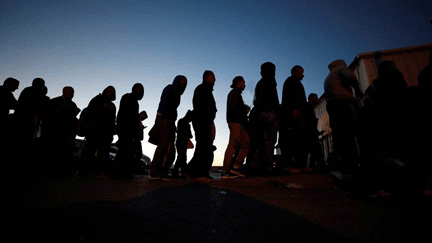 Conditions for Informal Labour Employed in Nuclear Power Stations The phenomenon of assembling and recruiting a relatively unskilled labour pool at the cheapest rate possible is typical in nearly all of Japan’s large-scale modern industrial projects in the 20th century. As early as the late 19th century, however, non-criminal homeless men were recruited for such projects, whether forced, coerced or voluntarily from the major day-labourer (hiyatoi rōdōsha 日雇い労働者) sites (yoseba) established in Sanya (Tokyo), Kotobuki (Yokohama), Kamagasaki (Osaka) and Sasashima (Nagoya). In pre–World War II and wartime Japan, yakuza tehaishi (手配師 labour recruiters) operated forced labour camps known as takobeya (たこ部屋 octopus rooms) for Korean and Chinese labourers who had been transported to work mainly in coal mines and on construction sites.6………
The rapid build of nuclear power stations was planned in the 1960s by a consortium of major investment banks, electric utilities and construction companies and/or industry manufacturers (Mitsubishi, Tōshiba, Hitachi, Sumitomo, etc.), and was carried out in the 1970s, with increased momentum in response to the oil crisis of 1974–76. Through an intensive ‘regional development’ program of rural industrialisation from the early 1970s, politically disempowered communities were targeted as potential cheap labour as their environs were designated as sites for nuclear projects by investment capital. In a combination of regulatory capture and economic dependency, utilities moved in to provide employment opportunities to communities while the same communities steadily lost control over their resources and subsistence economies. In the process, they lost political agency as their political representatives often received corporate and state inducements for these projects. As TEPCO owns the electricity distribution system in Fukushima Prefecture, which includes hydroelectric and thermal power stations as well as nuclear, and is a major employer and investor in Fukushima Prefecture,10 it has considerable sway in the political process as well as over electricity bills.
By the early 1980s, irregular workers came to comprise nearly 90 per cent of all nuclear workers.11 As nuclear reactors grow increasingly contaminated and corroded by radiation over time, informal labour became fodder for regular maintenance, cleaning, repairing and/or venting and refuelling of these nuclear reactors to reduce exposures to permanent company employees such as scientists and engineers. Continue reading
As in Australia, France lobbies hard to sell its nuclear submarines to India
 India Wants Second Nuclear Submarine From Russia. Lies By Lobbyists Erupt
Russian news portal Kommersant reported that the Indian Navy allowed a US technical crew into top secret compartments of India’s existing Russian-built nuclear submarine, the INS Chakra NDTV All India by Vishnu Som ovember 10, 2017 NEW DELHI:
According to Kommersant, which referred to this as “an unprecedented scandal,” the incident “threatens to seriously complicate the negotiations both on the lease of the second nuclear submarine, and on other projects in the field of military-technical cooperation.”
The Chakra, an Akula-2 class submarine, widely considered among the world’s most sophisticated, has been leased by India for 10 years but all ownership rights reside with Russia.
Today, another Russian news portal, NEWS.ru, has debunked the account of the Kommersant and states that French lobbyists have an ulterior role in spreading misinformation to further their own chances of selling a nuclear-powered attack submarine to India. NEWS.ru quotes a source stating “there is complete confidence that the throw-in is organised by the lobbyists of France, and it’s pretty high quality.” According to this source, “In addition to the contract for the construction of non-nuclear boats such the Scorpene [now being inducted by the Indian Navy,] the French have a great desire to enter the Indian nuclear fleet.”
France, the article states, is also aggressively trying to participate in India’s programme to construct a second home-grown aircraft carrier. The first indigenous carrier, INS Vikrant is being built in Kochi using technology from a host of countries including Russia……..
At the time, the French newspaper Le Monde, quoting multiple sources had said that the leak of this data was driven by competition between the French designer of the Scorpene Class submarine and a German firm as they compete to win international orders. https://www.ndtv.com/india-news/not-true-that-us-officers-allowed-on-russian-submarine-in-vizag-sources-1773761
Informal Labour, Local Citizens and the Tokyo Electric Fukushima Daiichi Nuclear Crisis
On the mediated surface, Fukushima Daiichi has been used to prove to the world that a nuclear disaster of significant scale can be overcome and that people can survive and return to their normal lives. The government has concentrated on proving that it is safe for the Olympics, safe for tourism, safe to consume local produce, and safe to restart nuclear reactors.
The authorities have furnished people with the means by which to normalise sickness and pathologise anxiety to justify the return to nuclear power reliance, while suppressing those who seek to resist it.
And so we return to the basic problem that no nuclear reactor can operate without radiation-exposed labour,
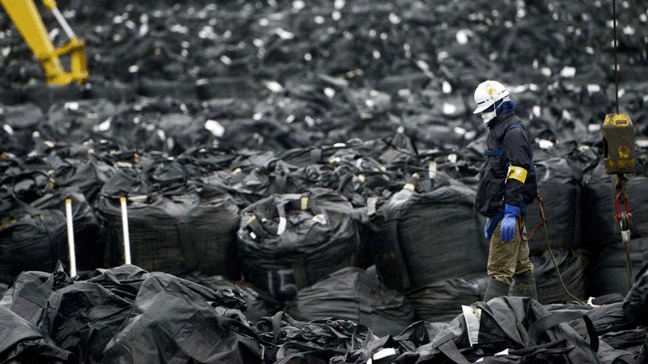
Informal Labour, Local Citizens and the Tokyo Electric Fukushima Daiichi Nuclear Crisis: Responses to Neoliberal Disaster ManagementANU, Adam Broinowski, 8 Nov 17
Nuclear workers are important as sentinels for a broader epidemic of radiation related diseases that may affect the general population.1
We live with contradictions everyday.2
Introduction
The ongoing disaster at the Fukushima Daiichi nuclear power station (FDNPS), operated by Tokyo Electric Power Company (TEPCO), since 11 March 2011 can be recognised as part of a global phenomenon that has been in development over some time. This disaster occurred within a social and political shift that began in the mid-1970s and that became more acute in the early 1990s in Japan with the downturn of economic growth and greater deregulation and financialisation in the global economy. After 40 years of corporate fealty in return for lifetime contracts guaranteed by corporate unions, as tariff protections were lifted further and the workforce was increasingly casualised, those most acutely affected by a weakening welfare regime were irregular day labourers, or what we might call ‘informal labour’. Continue reading
11 November REneweconomy news
-
Koutsantonis slams NEG, says it is an attack on renewablesSA energy minister Tom Koutsantonis says cannot support NEG, says it an attack on renewables, designed to keep alive dirty coal.
-
Graphs of the Day: Australia the global climate laggardIf the Turnbull government was setting the standard for global climate action… we’d be going to hell in a handcart, says new report.
-
Renewable energy for industry next big thing for Australia, says IEAInternational Energy Agency says solar, hydro and and wind have enormous potential for use in industrial processes – particularly in places like Australia, where the cost will be $USUS30/MWh.
-
Energy incumbents are going on a ‘gorging spree’Big fossil-fuel-based utilities are overcharging their customers, going on a “’gorging spree” while they still can.
-
Australia adds 107MW rooftop solar in October as 2017 heads for record yearCommercial solar growth helps push Australia’s total PV installs to 107MW in October, almost guaranteeing 1GW record for 2017.
Australia can expect ‘increased bushfire and storm danger’ due to climate change
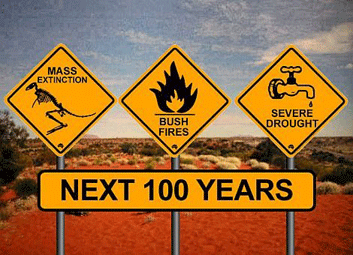 Climate change causing ‘increased bushfire and storm danger’ across Australia https://www.9news.com.au/national/2017/11/09/17/50/extreme-weather-is-getting-worse-in-south-east-australia
Climate change, refugees, and borders

Climate change will be the border control of the future https://qz.com/1124055/climate-change-will-be-the-border-control-of-the-future/ 9 Nov 17, After 300 years of continuous human settlement, Hurricane Irma destroyed everything on the island of Barbuda and forced the relocationof its more than 1,600 residents, demonstrating that climate-induced migration is no longer a future possibility, but a present-day reality. A week and a half later, Hurricane Maria knocked out power for Puerto Rico’s 3.4 million residents and left much of the island without potable water. Fifteen percent of Puerto Rico’s population is expected to leave the island in the coming year.
Estimates vary, but the consensus is that there will be at least 200 million people displaced by climate change by 2050. In order to address this already unfolding reality, we need to reconsider the relationship between borders and climate change now.
It might seem that borders have no impact on climate change: Hurricanes destroy human settlements in the Philippines and the United States alike. Winds blow dust, pollution, and rains across borders. Sea level rise affects the countries that produced pollution and those that did not. But in reality, environmental change is shaped by borders and sovereignty in several significant ways.
First, there is a strong geographic pattern to where environmental pollution was historically produced and where environmental changes will most severely be felt today. Beginning with the industrial revolution, countries in Europe and North America produced 68% of all emissions, while only accounting for about one-sixth of the world’s population. Nevertheless, the latest Intergovernmental Panel on Climate Change report finds that the countries that have historically polluted the environment will be less negatively affected by climate change. The report identifies sub-Saharan Africa and small island states, like Antigua and Barbuda, as the most vulnerable to climate change because they do not have the resources or infrastructure to adequately adapt to environmental changes.
Second, bounded sovereignty also makes it difficult to create effective international agreements to combat climate change. The sovereign rights of the state are revered by nationalist leaders because they endow them the ability to put the needs of their people above all others. In his UN speech on Sept. 19, US president Donald Trump mentioned some variation of the word sovereignty 21 times. Although some criticize the UN as a form of global government, the charter of the United Nations enshrines the right to absolute sovereignty within borders and UN-sanctioned agreements — including the Paris Agreement — do not infringe on these rights.
In the Paris Agreement, states determine their own contribution, monitor their own progress, and face no consequences if they do not meet the goals they set. As long as local economic factors trump global environmental impacts, climate agreements are bound to fail.
Finally, and perversely, the countries that produced the majority of the emissions that cause climate change are now building walls and securing borders to prevent the movement of people who are displaced by it. As late as the year 2000, there were 15 border walls around the world, but today there are almost 70. Borders and sovereignty mean that countries can decide who has the right to move and can turn away even the most desperate people displaced by climate change.
There have been some early efforts to address the problem of climate induced migration. The Paris Agreement established funds for least developed countries and for adaptation, but these are focused on mitigating risks and rebuilding after disasters. Additionally, Germany and Bangladesh have been leading the Platform on Disaster Displacement, which is an intergovernmental effort to prepare for disasters through prevention and awareness. These meager efforts are well intentioned but do not go nearly far enough.
International institutions are meant to address issues that are not confined to single states but cross political borders. There is already agreement that a few very narrow issues including genocide and state-sponsored terrorism are exempted from the protection of state sovereignty.
The environment and the displacement of people from environmental changes are cross border issues that extend beyond the authority of a single country. In order to realistically address the climate crisis, two more exceptions to absolute state sovereignty are required: the right of people to move from one territory to another and the right of the global community, not individual countries, to regulate the emissions of climate changing pollutants. This does not mean getting rid of sovereignty entirely, but it does mean countries must give up sovereignty over decisions that involve issues that have significant cross-border impacts.
Opening borders and removing sovereignty from environmental decisions will be seen as radical proposals by some. However, the more radical choice is to build walls and ignore climate change, pushing us headlong into a rapidly arriving dystopian future of walled states, violent borders, and hundreds of millions of displaced environmental migrants struggling to survive rising seas, heat waves, and devastating environmental change.
This post originally appeared on Undark Magazine. We welcome your comments at ideas@qz.com. Learn how to write for Quartz Ideas.
Energy Efficiency: the foundation of the climate transition
Energy efficiency: the foundation of the climate transition, REneweconomy, By Andrew McCallister on 10 November 2017 I’m preparing for a trip to your fine nation later this month to speak at the National Energy Efficiency Conference in Melbourne, so I’ve been reading up on Australian energy policy debate. It’s been fascinating.
I still have a lot to learn about your energy system, but so far one thing stands out: the discussion in Australia seems overly focused on the transition underway on the supply side of the market.
Don’t get me wrong – the decarbonisation of the world’s energy supply is crucial, and you won’t find a stronger advocate for renewables than me. Way back in the 1990s, I installed many small, remote PV and wind systems with my own two hands, and trained others to do the same.
More recently I ran two of California’s signature renewables programs – the California Solar Initiative and Self-Generation Incentive Program.
However, focusing solely on the move to low carbon generation without pursuing demand side opportunities in an ambitious, systematic way actually makes the transition harder.
Energy efficiency and demand response are just as important to the energy transition as renewables are, as we’ve learnt in California. Today’s technology helps us utilise energy smartly; and indeed the least expensive and cleanest unit of energy is the one not needed at all.
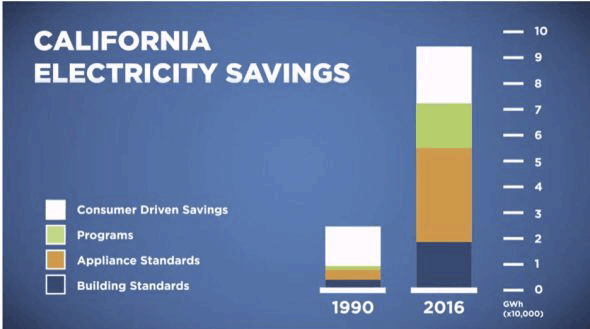
Energy efficiency has been a central contributor to California’s energy mix since the 1970s.∗Efficiency is responsible for an annual reduction in statewide electric consumption of 90 TWh (Figure 1), the equivalent of 30 percent of the state’s current electricity consumption and enough to power around eight million households.
California’s per capita electricity use has remained flat since the mid-1970s, despite a fourfold increase in real economic output, larger homes and the proliferation of consumer appliances and electronics.
Since 2000, the state’s overall carbon emissions are down 8 percent while its economy has grown by 28 percent. California’s deliberate, consistent focus on energy efficiency has played an important role in these successes.
Going forward, the California legislature and Governor Brown have established a goal to double the flow of efficiency savings by 2030. The estimated impacts of this doubling effort are shown in Figure 2. Achieving the goal will see per capita consumption decline around 25 percent by 2030. California’s suite of energy efficiency activities includes:
- Building energy efficiency standards. The 2019 Standards update will require residential new construction to have advanced building shells, high-performing water heating and mechanical systems, all-LED lighting and, for the first time, sufficient self-generation (typically PV) to offset all electric load. Incremental costs are shown to be cost-effective.
- Appliance efficiency standards. California has explicit authority to develop efficiency standards where national standards do not exist. Recent standards adopted include general service LEDs, computers, and battery chargers. Many appliance standards are currently in development (e.g. industrial fans and blowers, certain compressors and pumps, and room air conditioners)……
Modern energy management complements renewable energy supply
Highly efficient products and practices increasingly bundle with digital communication and control features to support demand-side responsiveness to the momentary needs of the grid. Good design of buildings and industrial processes, together with advanced energy management systems, can provide both beautifully tailored performance for customers and valuable and much-needed grid services that aid seamless incorporation of renewable energy into the supply mix.
Energy efficiency optimises the distribution grid
Energy efficiency frees capacity in the distribution grid, allowing new electric loads to be served with only moderate added investment. That ‘headroom’ will be essential, since California’s clean energy path will include widespread electrification: pervasive adoption of electric vehicles, heat pumps, induction cooking and other electric end use technologies. Electrification brings additional benefits, such as avoiding both investment in new retail gas distribution infrastructure and the risks to health and safety from indoor combustion.
Energy efficiency creates jobs and builds economic resilience…… Andrew McCallister is a Commissioner at the California Energy Commission, the state’s primary energy policy and planning agency. He will be the international keynote speaker at the National Energy Efficiency Conference in Melbourne on 20th and 21st November 2017. http://reneweconomy.com.au/energy-efficiency-foundation-climate-transition-48098/
10 November More REneweconomy news
-
We’ll keep lights on, states can worry about emissions: ESBESB chair Kerry Schott says it will be up to the states to act if they want higher emissions targets.
-
Schott defends NEG modelling, says wind and solar at “low end”Schott says NEG modelling assumes “low end” of wind and solar costs, defying recent evidence. But ESB did admit there is much work to do on policy, dispatchability had yet to be defined, new coal unlikely to get a look in, and states free to pursue own targets.
-
Queensland coal plant has a photo – now all it needs is a massive subsidyA mock-up image of a new coal plant has been created, as part of the increasingly intense campaign to have one built – and funded by taxpayers – in north Queensland.
-
Video of the Day: The end of coal generation in South AustraliaBoilers of old Northern coal fired generator brought down, bringing end of coal era in South Australia and paving way for huge investment in renewables and storage.
-
DP Energy appoints contractors to build Australia’s largest hybrid renewable power stationInternational renewable energy company DP Energy has appointed preferred suppliers Vestas and Downer to develop Stage 1 of its Port Augusta Renewable Energy Park, which when complete will be Australia’s largest hybrid renewable power station
-
JinkoSolar claims record 23.5% efficiency for PERC solar cellJinko sets new efficiency record for PERC solar cell and sees big future in “half cell” modules.
-
American City Council passes resolution against uranium transport

 Flagstaff council passes resolution against uranium transport, Arizona Daily Sun CORINA VANEK Sun Staff Reporter, Nov 8, 2017
10 Nov REneweconomy news
 RenewEconomy
-
We need to talk about rooftop solarSo you’ve installed rooftop solar – but is it performing as well as you expected? A new APVI web-based survey aims to help improve the quality of PV system components, installations and system designs.
-
Flinders Island makes switch to renewables, with solar, wind and energy storage HubFlinders Island’s Hybrid Energy Hub is already taking the previously diesel powered Tasmanian island to levels of 80% renewables, and should manage to supply 100 per cent of demand before the year is out.
-
Chevy Bolt set to catch Tesla in US EV raceLuxury price tags have not stopped Tesla from dominating the US electric vehicle market so far, but is all that about to change?
-
WA’s Synergy to bring in Dutch fund to bankroll wind and solar farmsWA government owned utility Synergy looking to bring in outside investors to bankroll investments in new wind and solar farms and meet RET obligations.
-
Wind, solar costs continue fall, and fossil fuels can’t stop themLatest analysis from Lazard points to continuing falls in cost of wind and solar, and a growing divide between renewables and fossil fuels. And the cost of storage is falling too.
-
You heard right: Trump administration is bailing out coal plantsConsumers paying more on electric bills is exactly what might happen if the US DoE goes through with plan to bail out uneconomic coal plants.
-
Photon Energy reports a profitable third quarterBuilding on the strong half-year results, the company confirmed continuing revenue growth at 6.8% compared to 2016Q3 and a 2,5-fold increase in net profit compared to last year’s result.
-
Australia wins early Fossil award as Syria leaves US alone on climateAustralia wins first Fossil of the Day award at Bonn climate talks, as Syria signs up to leave the US isolated as the world’s only non-member state.
Climate Change Related Drought Bakes the Iberian Peninsula

“Suddenly what was once thought to be a problem confined to the third world has arrived in southern Europe.” — Euronews. ***** We’ve been taught that human-caused climate change through fossil fuel burning only affects poor people. That it only affects the third world. That if you’re rich, or if you live in places like […]
via Climate Change Related Drought Bakes the Iberian Peninsula — robertscribbler
1 This month
To see nuclear-related stories in greater depth and intensity
– go to https://nuclearinformation.wordpress.com/


 Antinuclear