Busting the lies of the Australian Government about “new” nuclear reactors
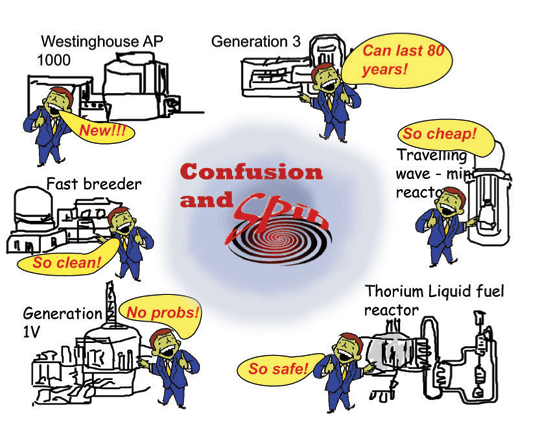
The core propositions of non-traditional reactor proponents – improved economics, proliferation resistance, safety margins, and waste management – should be reevaluated.
Before construction of non-traditional reactors begins, the economic implications of the back end of these nontraditional fuel cycles must be analyzed in detail; disposal costs may be unpalatable………. reprocessing remains a security liability of dubious economic benefit
Non-traditional” is used to encompass both small modular light water reactors (Generation III+) and Generation IV reactors (including fast reactors, thermal-spectrum molten salt reactors, and high temperature gas reactors)
|
Burning waste or playing with fire? Waste management considerations for non-traditional reactors Full Text
The Industry Push to Force Nuclear Power in Australia https://nonuclearpowerinaustralia.wordpress.com/2020/03/02/burning-waste-or-playing-with-fire-waste-management-considerations-for-non-traditional-reactors-full-text/ by nuclearhistory March 2, 2020 The following paper is copied here in order to counter the false, incorrect and erroneous propaganda published by the Australian Government and its Parliamentary Committee for lying to the Australian people about so-called new nuclear reactor designs, all of which were rejected by competent authorities in the 1950s, 1960s, and 1970s. The residues produced by these test reactors continue to cost the American taxpayer money and continue to present the American people with stored, hazardous radioactive waste which is also high chemically reactive.
Burning waste or playing with fire? Waste management considerations for non-traditional reactors Lindsay Krall & Allison Macfarlane To cite this article: Lindsay Krall & Allison Macfarlane (2018), Bulletin of the Atomic Scientists, 74:5, 326-334, DOI: 10.1080/00963402.2018.1507791 To link to this article: https://doi.org/10.1080/00963402.2018.1507791 Published online: 31 Aug 2018.. To measurably contribute to greenhouse gas emissions reductions, nuclear power generation must expand by a factor of two to three while dealing with this technology’s financial, safety, and proliferation risks – not to mention the radioactive waste management challenges that it has presented until now. To advance their cause, proponents of non-traditional nuclear reactors have reimagined them as a solution to each of these core obstacles. In regard to waste management, particularly, these advocates point to reductions in spent fuel volumes and total radiotoxicity at the back end of these new reactors (Hobbs Baker, Fitzpatrick, and Estus 2017). For instance, TerraPower (backed by Bill Gates) intends to reduce spent fuel volumes by 80 percent, using a sodium cooled fast reactor (TerraPower 2015). Likewise, Transatomic had claimed that its conceptual “waste annihilating” molten salt reactor could reduce the mass of long-lived actinide waste by 96 percent, though this figure was revised to 53 percent following a peer-review of the reactor’s design (Transatomic 2016a, 2016b). Non-traditional reactor designs weren’t always marketed as solutions to our radioactive waste disposal problems. In the 1950s and 1960s, fast reactors were promoted as a means to “breed” plutonium and thereby expand the availability of fissile material. But as it became clear that these reactors were difficult and costly to build, alternative arguments were devised to justify continued research and development. In the 1980s, proponents began to proclaim that fast reactor fuel cycles would reduce the long-term radiotoxicity of spent fuel and thereby simplify its disposal (e.g. Beaman 1980). By 2006, the US-led Global Nuclear Energy Partnership supported these technologies purportedly for similar back-end, waste-disposal benefits (GNEP 2006). However, non-traditional reactors – designed to enhance the breeding and burning of fissile material – cannot eliminate the need for a geologic repository. The reductions in spent fuel volume, longevity, and total radiotoxicity that are said to be achievable within these fuel cycles are of little value in planning the repository that will be needed to store the associated long-lived nuclear waste. Repository performance is more dependent upon the natural system that surrounds it, spent fuel chemistry, and the distribution of radionuclides throughout the fuel cycle infrastructure than it is on spent fuel volumes and total radiotoxicity.2 If decarbonization of the economy by 2050 is indeed the goal, then the more pragmatic path to it involves improvements to light water reactor technologies, adoption of expert recommendations on spent fuel management, and strong incentives for commercially mature, carbon-free energy technologies. Conservation laws and radioactive waste Nuclear electricity is derived from the energy released when the nucleus of an atom splits. Byproducts of this reaction include two or three neutrons plus two larger fission products, which vary significantly in radioactivity and chemical properties. The liberated neutrons may go forth to propagate the fission reaction, breed transuranic actinides (e.g. plutonium 239 and americium 241), or generate radioactive activation products in the coolant and near-core reactor components (Bodansky 2007). Materials containing any of these three groups of radioisotopes (fission products, activation products, and actinides) in sufficient concentrations warrant geologic disposal. Waste-centric arguments for a closed fuel cycle emphasize actinides as the main cause of concern. These isotopes contribute the bulk of the long-term spent fuel radiotoxicity but, in theory, can fuel a nontraditional reactor. If the entire inventory of spent fuel actinides is converted to fission products, then the radiotoxicity of the spent fuel would, after 300 years, be lower than that from light water reactors. Nevertheless, certain fission products (technetium 99, selenium 79, and iodine 129), which are mobile in all bedrock environments and readily assimilated into biological tissue, require several hundred thousand years to appreciably decay. In fact, evolutionary models for most geologic repositories ascribe the bulk of the future radiation dose risk to long-lived fission products such as selenium 79 and iodine 129 and the activation products carbon 14 and chlorine 36 rather than to the actinides (National Research Council 1996). The long-acknowledged need for geologic repositories. In the 1970s, the US Energy Department compared several approaches to the management of commercially generated high-level waste, including disposal in deepmined geologic repositories, parallel development of actinide transmutation technologies with very deep borehole disposal, and no action (i.e. indefinite surface storage). Ultimately, the department concluded that the least costly approach to radiation protection was through the development of deep-mined repositories for high-level waste, and this was codified with the Nuclear Waste Policy Act of 1982 (1981; Department of Energy 1980; NWPA 1982). Although fission products are very highly radioactive for at least 300 years, US regulatory compliance periods for these materials cover up to 1 million years due to the presence of long-lived and toxic fission products (e.g. NRC 2005). In the 40 years since the NWPA was passed, expert panels, such as the National Research Council (1996) and the Blue Ribbon Commission on America’s Nuclear Future (2012), have reassessed the merit of actinide recycle in waste management schemes, only to reaffirm the original conclusions of the Energy Department. In summary, nuclear science and waste regulations invalidate the non-traditional nuclear industry’s proposition that waste disposal will be simplified by enhancing actinide fission. Actinides are the predominant source of spent fuel radiotoxicity between the 1,000- and 100,000-year time horizon; repositories are typically sited to minimize the mobility of these elements. That is, systems are designed to contain the spent fuel for some thousands of years, until the radioactivity decreases by several orders of magnitude. After this containment period, releases will be further delayed if the repository environment promotes the chemical stability of the waste form.3 For instance, uranium-dioxide (UO2) fuels4 are corrosionresistant in slow-flowing and oxygen-free groundwaters (Bruno and Ewing 2006), conditions found typically some hundreds of meters beneath the surface and below the water table. Since plutonium, americium, and neptunium are chemically bound in the uranium dioxide matrix, the release of these actinides is inhibited under such conditions. The same mechanism will limit the release of most fission products if a canister fails prematurely (Bruno and Ewing 2006). Decades of research, including studies of natural analogues,5 support the proposition that uranium dioxide will serve to immobilize radionuclides in oxygen-free environments. The site that the United States chose for a repository (before then abandoning it), Yucca Mountain, is exceptional with respect to actinide mobility. Because of the oxygen-rich conditions (i.e. uranium-dioxide soluble) at the repository horizon6 and the rapid groundwater transport paths there, actinides stored in that area would indeed pose an important risk to future populations. This risk is compounded by – rather than exchanged for – the risks posed by long-lived fission and activation products (e.g. Swift et al. 2014). The situation at Yucca Mountain seems to have fueled the non-traditional nuclear industry’s focus on actinide content in the waste produced by newer reactor designs. Except for Yucca Mountain, however, most repository evolution scenarios indicate that the radiological risk to future populations is controlled by the amount of fission products and their associated radioactivity. Reducing the amount of actinides or the volume of high-level waste via non-traditional nuclear fuel cycles is, therefore, of dubious value to long-term safety and repository planning. A durable waste form in a stable geochemical environment is an indispensable final line of defense against a repository leaking radionuclides into the surrounding environment. Molten salt reactors The molten salt reactor was originally conceived in 1946 as a way to power aircraft; because of unresolved cost and safety risks, that concept never took off. But researchers at the Oak Ridge National Laboratory revised the molten salt reactor concept to suit electricity generation and conducted the Molten Salt Reactor Experiment from 1965 to 1969, using uranium 235, uranium 233, and plutonium 239 fuels. A molten salt breeder reactor, based on a thorium 232–uranium 2337 fuel cycle, was under design when the program was terminated in 1969 (Rosenthal 2009). These early molten salt reactors form the technical basis for the 550 to 1250 megawatts-thermal (250 to 520 megawatts-electric) concepts promoted by Transatomic, Terrestrial Energy, ThorCon, and Flibe. Each vendor plans to utilize a liquid fuel based on lithium and/or sodium fluoride that also serves as a coolant together with a graphite moderator, although Transatomic prefers a zirconium hydride moderator. Proposed fuel cycles vary considerably, ranging from once-through use of fuel to incorporation of non-traditional reprocessing schemes, to separate the fission product poisons8 ; only the latter designs, using reprocessing, could experience higher fuel burnups9 and reduced spent fuel actinide contents. To sustain criticality in a molten salt reactor utilizing standard low-enriched uranium fuel (i.e. uranium enriched to roughly five percent uranium 235 content), an “offgas system” is needed to continuously vent the gaseous fraction of fission products10 from the reactor and through a series of filters (Betzler, Powers, and Worrall 2017). Offgas filters will trap some of the vented radionuclides, but the remainder will ultimately be bottled and stored as compressed gas. Another filter inside of the reactor will remove the fraction of fission products that are not gaseous but do not dissolve in the molten salt (e.g. Transatomic 2016c). The precise distribution of radionuclides throughout the offgas systems of future molten salt reactor systems is unclear. But materials recovered from the Molten Salt Reactor Experiment contained short- and long-lived fission products, as well as trace amounts of actinides that had attached to particulate matter and migrated out of the reactor (Houtzeel and Dyer 1972). At least one vendor considers the contaminated filters and bottled radioactive gases to be “operational waste” streams (Transatomic 2016c), which implies that they might be suited for shallow land burial. But these materials will contain the same radionuclides that are separated during reprocessing and so will meet the Nuclear Regulatory Commission definition of “highlevel waste.11” The vendors appear to neglect to take account of these materials in their waste estimates. After up to 60 percent of the fission products are removed by filters in the reactor and the offgas system, the burnup is limited by the remaining 40 percent that are more difficult to separate from the salt (e.g. Betzler, Powers, and Worrall 2017). To increase fuel burnup (and thereby the cost-effectiveness of the reactor), many vendors propose to recover fissile material from the used fuel salt through a multi-stage reprocessing scheme conceived by Oak Ridge National Lab in the 1970s (e.g. McNeese, Ferris, and Nicholson 1972). This would be performed onsite (Transatomic and Flibe) or at a centralized facility (ThorCon) (Transatomic 2016c; Flibe Energy 2016; Martingale 2016). Transatomic expects this reprocess to increase fuel burnups and to decrease the mass of actinide wastes by approximately 50 percent relative to light water reactor fuels (Transatomic 2016b). ThorCon suggests that utilization of 20 percent-enriched fuel together with reprocessing will further increase the burnup12 (Martingale 2016). These reprocessing methods are not commercially mature and may prove uneconomic. For a oncethrough molten salt reactor fuel cycle, Terrestrial Energy estimates the burnup of five percent-enriched fuel to be only about 26 megawatt-days per kilogram – approximately half the efficiency of a modern light water reactor. Terrestrial further proposes to completely replace the reactor cores every seven years and transfer them, with the spent fuel, to a waste treatment facility (Terrestrial Energy 2016). Spent molten salt reactor fuel, predominately in the form of uranium tetrafluoride, will be highly radioactive due to the fission products that were not sent to the offgas system. Since uranium tetrafluoride is not known to occur in nature, it is unclear which, if any, disposal environment could accommodate this high-level waste. In speculative studies on the management of depleted uranium, the Energy Department and Nuclear Regulatory Commission found uranium tetrafluoride unsuitable for geologic disposal (DOE 1999) because reactions with water yield hydrofluoric acid, a corrosive acid that would degrade concrete and steel barriers (NRC 1992, 1994). Extending these conclusions to a potential uranium tetrafluoride waste form for spent fuel, direct disposal would not be acceptable. So regardless of whether a closed fuel cycle is pursued, it will be necessary to process the spent uranium tetrafluoride fuel to remove the fluorine and stabilize the uranium, fission products, and actinides for disposal. This processing will generate additional waste streams – and costs. If commercialization of non-traditional processing technologies takes longer than expected, long-term storage of the spent uranium tetrafluoride fuel may be necessary. But fluoride salts are very sensitive to radiation, so regulations to ensure the stability of stored fuel would need to be put in place. In 1985, the Energy Department thought that the used Molten Salt Reactor Experiment fuel could be safely stored for decades (Notz 1985). But by 1994, workers observed that radiolytic decomposition of uranium tetrafluoride had generated fluorine gases and uranium hexafluoride enriched in fissile isotopes, which had migrated throughout the offgas system and generated corrosive hydrofluoric acid. The likelihood of a criticality accident was high under these conditions (DNFSB 1995). This prompted the Energy Department to use the fluoride volatility method, originally conceived for salt fuel reprocessing, to purge uranium from the tanks into which the salt was drained and stored following termination of the Molten Salt Reactor Experiment.13 The Energy Department has yet to manage the fission product-laden fuel salts stored at Oak Ridge, either due to the lack of a viable disposal path or to the complications in handling the highly radioactive mass. In 2017, the department proposed its disposal at the Waste Isolation Pilot Project (WIPP) in Carlsbad, NM or entombment (Huotari 2017), but safety analyses for either of these disposal paths are unavailable. It is complicated to identify appropriate geologic environments for disposal of this high-level waste. The chemical compounds formed from mixtures of fission products and fluoride fuel salt, combined with their response to radiation and heat, are poorly understood. Compared to the uranium-dioxide compounds that make up light water reactor fuel, lithium-, sodium-, and uranium-fluoride compounds are more easily dissolved in water, with which they react to form corrosive and toxic hydrofluoric acid (e.g. Giffaut et al. 2014). Therefore, disposal of fluoride-salts in waterbearing environments is less than ideal, limiting the potential media for disposal to anhydrous salt formations like WIPP. However, the safety of placing heat-emitting packages into salt formations is uncertain; fluids can penetrate and degrade this rock at elevated temperature (e.g. Ghanbarzadeh et al. 2015). Clearly, neither storage nor direct disposal of a fluoride-based spent fuel is viable. To reduce spent fuel actinide contents using a molten salt reactor will require several rounds of reprocessing, which involves the separation of fissile material; this scheme will not decrease the inventories of short- and long-lived fission products in need of geologic disposal. But regardless of whether a closed fuel cycle is pursued, waste processing and conditioning is required and should be integral to reactor licensing. These waste (re)processing activities imply the production of additional waste streams. Sodium -cooled fast reactors In the 1950s, the liquid metal fast breeder reactor, typically cooled by liquid sodium14 and moderator-free,15 was anticipated to fuel civilization into perpetuity by simultaneously producing energy and fissile resources. A plutonium-enriched16 uranium core (i.e. “driver fuel”) would fission to produce heat and supply neutrons to a “blanket” of fertile depleted uranium, in which plutonium 239 was bred to drive the next burn-breed cycle. Since fissile requirements for the driver fuel were substantial, researchers thought it necessary to recover plutonium from spent light water reactor fuel for the initial fast breeder cycles. Thereafter, recovery of plutonium from the fast breeder blankets would “close” the fuel cycle. Concerns over energy resources during the 1970s provoked a few countries to foster a closed fuel cycle, beginning with the reprocessing of spent fuel from light water reactors. The reclaimed plutonium was stockpiled as fuel for an elusive fleet of fast breeder reactors (Cochran, Feiveson, and Von Hippel 2009), which – plagued by technical challenges such as sodium fires17 – failed to emerge. Nevertheless, reprocessing persisted in France, Japan, and the United Kingdom, resulting in the accumulation of more than 290 tons of separated plutonium at various civilian facilities (IPFM 2018). Recently, a few companies – including GE-Hitachi, TerraPower, and Oklo – have reinvigorated the sodium fast reactor with designs similar to the Experimental Breeder Reactor and the Fast Flux Test Facility developed by the Energy Department in the 1960s and 1970s. Although mixed-oxide fuels are preferred internationally (IAEA 2009), the three companies embrace the same sodium-bonded metallic uranium fuel developed within the US fast breeder program (Triplett, Loewen, and Dooies 2012; TerraPower, 2017; Oklo Inc 2016).18 The Energy Department has cited operational safety to justify the use of metallic fuels in the sodium fast reactor but has also heralded its compatibility with pyroprocessing,19 without which the fuel burnup will be limited (Walters 1999). The limited fuel burnup implies that disposal pathways for the sodium-bonded spent fuel are needed, if society decides to forego reprocessing. Volumes of heavy metal in need of disposal may be reduced by a factor of two to four per unit of energy output. However, fission product activities and heat loads will be similar to those of spent light water reactor fuels, and so repository requirements (including space and packaging materials) will not be meaningfully decreased.20 Furthermore, the Energy Department discovered impediments to the geologic disposal of their sodium-bonded fuels after the Experimental Breeder Reactor and the Fast Flux Test Facility were defunded in 1994. Citing repository criteria of the NRC21 and the Office of Civilian Radioactive Waste Management22 that prohibit the presence of pyrophoric and/or chemically reactive materials in waste packages, the Energy Department decided to electro-metallurgically treat the sodiumbonded spent fuel using the Idaho National Lab pyroprocessing technology before emplacement in a repository. The department explained its reasoning this way: [T]he metallic sodium is highly reactive. The metallic uranium is also reactive and potentially pyrophoric, and in some cases the fuel contains highly enriched uranium, which would require criticality control measures (DOE 2000a). Several parties, including the Environmental Protection Agency, noted the underwhelming scientific and economic bases for the decision to chemically deactivate the fuel by electrometallurgical treatment. Nevertheless, the Energy Department dismissed direct disposal or alternative treatment options, then planned to pyroprocess 26 metric tons of sodium-bonded fuel by 2013 at a cost of approximately $550 million; the process would include conversion of the byproducts – metallic uranium and a sodium chloride-based mixture of plutonium and fission products – to oxide and zeolite-based waste forms, respectively (DOE 2000b). Neither the deadline nor the budget was met, and internal Energy Department documents have revealed that the untreated fuel is degrading in storage, after corrosion of stainless-steel claddings allowed oxygen and moisture to penetrate some of the fuel elements. In at least one case, reaction between water and metallic uranium caused the fuel to burn (literally). The compromised fuel pins are no longer candidates for pyroprocessing and so will remain in storage indefinitely (Lyman 2017; DOE 2014a). These experiences undermine the back end schemes proposed by GE-Hitatchi and TerraPower, the only US sodium fast reactor vendors that have provided technical data to the International Atomic Energy Agency. TerraPower has been averse to reprocessing and has alluded to direct disposal of spent fuel in deep boreholes (e.g. Gilleland, Petroski, and Weaver 2016). GEHitachi, on the other hand, markets the PRISM as having a flexible fuel cycle that can breed plutonium for separation at an “optional” onsite “Advanced Reprocessing Center” 23 or can “burn” plutonium and forego the pyroprocessing. GE-Hitachi has presented the latter option to the United Kingdom as a plutonium-disposition option24 (NDA 2014), although net plutonium production is expected from even the plutonium-consumption PRISM fuel cycle (Triplett, Loewen, and Dooies 2012). Furthermore, the need to chemically treat spent sodium-bonded fuels by pyroprocessing – the sole treatment technology acknowledged by the Energy Department – invalidates the direct disposal and plutonium-disposition proposals of TerraPower and GE-Hitachi. Strategies to enhance fuel burnup in new reactor designs may reduce the energy-normalized mass of heavy metal requiring disposal, in comparison to light water reactors. But it will not reduce the inventory of short- or long-lived fission products. Instead, fission products will be intermixed with plutonium and flammable sodium-uranium metals until the spent fuel is pyroprocessed at remarkable expense.25 Thereafter, the fission products – along with plutonium if a oncethrough fuel cycle is pursued – will be dissolved in a bath of molten sodium chloride, which over an undefined period of time must cool to solidification through radioactive decay. Then, this high-level waste must be stored until the zeolite-based waste forms envisioned by the Energy Department become available (DOE 2014b). The uranium (and plutonium, if a closed fuel cycle is pursued) will be recovered in metallic form through electrochemical reactions. And this reactive metal must be stored until it can be converted to a stable waste form or purified and fabricated into a useable sodium-bonded fuel. The timeframe over which the high-level waste salt can be safely stored is unclear, as the long-term effects of radiation and heat on this material remain poorly understood. Furthermore, sodium chloride-based salt, like the previously discussed fluoride salts, is significantly more soluble and corrosive than uranium dioxide (Giffaut et al. 2014). For storage of the uranium metal, safety considerations include the pyrophoric qualities of the material, as well as criticality risks. All areas of this extensive back-end infrastructure – the pyroprocessing vessels, the equipment to condition the salt and metal into zeolite and oxide waste forms, the interim storage cannisters (for salt, uranium metal, zeolite, and oxides), etc. – will become contaminated by fission products and actinides. This may become intermediate-level waste that, per IAEA standards, warrants geologic disposal. The policy implications of new reactors with back-end problems The core propositions of non-traditional reactor proponents – improved economics, proliferation resistance, safety margins, and waste management – should be reevaluated. The metrics used to support the waste management claims – i.e. reduced actinide mass and total radiotoxicity beyond 300 years – are insufficient to critically assess the short- and long-term safety, economics, and proliferation resistance of the proposed fuel cycles. Furthermore, the promised (albeit irrelevant) actinide reductions are only attainable given exceptional technological requirements, including commercial-scale spent fuel treatment, reprocessing, and conditioning facilities. These will create low- and intermediate-level waste streams destined for geologic disposal (e.g. NWMO 2015), in addition to the intrinsic high-level fission product waste that will also require conditioning and disposal. Before construction of non-traditional reactors begins, the economic implications of the back end of these nontraditional fuel cycles must be analyzed in detail; disposal costs may be unpalatable. The reprocessing/treatment and conditioning of the spent fuel will entail costs, as will storage and transportation of the chemically reactive fuels. These are in addition to the cost of managing high activity operational wastes, e.g. those originating from molten salt reactor filter systems. Finally, decommissioning the reactors and processing their chemically reactive coolants represents a substantial undertaking and another source of non-traditional waste (IAEA 2007). As significant as back-end economics is a management question: Who will be responsible for the handling and disposal of these materials? At present, the Nuclear Waste Policy Act dictates the responsibility of repository development to the Energy Department, but who will be accountable for treatment costs and operations? The federal government? The reactor owner operator? A third party? Issues of spent fuel management (beyond temporary storage in cooling pools, aka “wet storage”) fall outside the scope of the NRC’s reactor design certification process, which is regularly denounced by nuclear advocates as narrowly applicable to light water reactor technology and insufficiently responsive to new reactor designs (e.g. Nuclear Innovation Alliance, Nuclear Energy Institute, and U.S. Nuclear Infrastructure Council 2018). Nevertheless, new reactor licensing is contingent on broader policies, including the Nuclear Waste Policy Act and the Continued Storage Rule. Those policies are based on the results of radionuclide dispersion models described in environmental impact statements. But the fuel and barrier degradation mechanisms tested in these models were specific to oxide-based spent fuels, which are inert, compared to the compounds that nontraditional reactors will discharge. The Continued Storage Rule explicitly excludes most non-oxide fuels, including those from sodium-cooled fast reactors, from the environmental impact statement. Clearly, storage and disposal of non-oxide commercial fuels should require updated assessments and adjudication. Finally, treatment of spent fuels from non-traditional reactors, which by Energy Department precedent is only feasible through their respective (re)processing technologies, raises concerns over proliferation and fissile material diversion. Pyroprocessing and fluoride volatility-reductive extraction systems optimized for spent fuel treatment can – through minor changes to the chemical conditions – also extract plutonium (or uranium 233 bred from thorium). Separation from lethal fission products would eliminate the radiological barriers protecting the fuel from intruders seeking to obtain and purify fissile material (e.g. Bari et al. 2009; Ashley et al. 2012). Accordingly, cost and risk assessments of predisposal spent fuel treatments must also account for proliferation safeguards. Radioactive waste cannot be “burned”; fission of actinides, the source of nuclear heat, inevitably generates fission products. Since some of these will be radiotoxic for thousands of years, these high-level wastes should be disposed of in stable waste forms and geologic repositories. But the waste estimates propagated by nuclear advocates account only for the bare mass of fission products, rather than that of the conditioned waste form and associated repository requirements. These estimates further assume that the efficiency of actinide fission will surge, but this actually relies on several rounds of recycling using immature reprocessing technologies. The low- and intermediate-level wastes that will be generated by these activities will also be destined for geologic disposal but have been neglected in the waste estimates. More important, reprocessing remains a security liability of dubious economic benefit, so the apparent need to adopt these technologies simply to prepare non-traditional spent fuels for storage and disposal is a major disadvantage relative to light water reactors. Theoretical burnups for fast and molten salt reactors are too low to justify the inflated back-end costs and risks, the latter of which may include a commercial path to proliferation. Reductions in spent fuel volume, longevity, and total radiotoxicity may be realized by breeding and burning fissile material in non-traditional reactors. But those relatively small reductions are of little value in repository planning, so utilization of these metrics is misleading to policy-makers and the general public. We urge policymakers to critically assess non-traditional fuel cycles, including the feasibility of managing their unusual waste streams, any loopholes that could commit the American public to financing quasi-reprocessing operations, and the motivation to rapidly deploy these technologies. If decarbonization of the economy by 2050 is the end-goal, a more pragmatic path to success involves improvements to light water reactor technologies, adoption of Blue Ribbon Commission recommendations on spent fuel management, and strong incentives for commercially mature, carbon-free energy technologies. Notes 1. “Non-traditional” is used to encompass both small modular light water reactors (Generation III+) and Generation IV reactors (including fast reactors, thermal-spectrum molten salt reactors, and high temperature gas reactors). 2. Here we characterize back-end material flows for several non-traditional reactor concepts through a recount of the experiences at the US Experimental Breeder Reactor II and the US Molten Salt Reactor Experiment and then discuss the implications for waste management. This analysis can begin to guide designers and regulators toward responsible decisions on long-term safety before these non-traditional technologies are deployed. 3. The material that directly incorporates the radionuclides for disposal. 4. All light-water reactor fuels are uranium-dioxide (UO2) fuels. 5. Materials found in nature that, through geoscientific studies, have been shown to have endured for millions or billions of years in certain environments. 6. The repository horizon at Yucca Mountain is located far above the water table, and thus if spent fuel is emplaced there, it will be subject to corrosion (Ewing and Macfarlane, Science). 7. Contrary to popular belief, the uranium 233 used in Molten Salt Reactor Experiment was sourced externally – and not bred in situ. 8. Nuclear fuel does not become “spent” due to depletion of its fissile material. Rather, over time, fission products that “poison” the chain reaction by absorbing neutrons build-up in the fuel. Thus, separating fission products from the fuel should increase its energy output. 9. the amount of energy extracted per mass unit of heavy metal (i.e. fuel). 10. noble gases (e.g. Kr, Xe) and and other mobile isotopes (e.g. I, Se, Tc, etc). 11. NRC’s Part 63 contains the following definition for high-level radioactive waste or HLW, which is similar to the Nuclear Waste Policy Act: (1) The highly radioactive material resulting from the reprocessing of spent nuclear fuel, including liquid waste produced directly in reprocessing and any solid material derived from such liquid waste that contains fission products in sufficient concentrations; (2) Irradiated reactor fuel; and (3) Other highly radioactive material that the Commission, consistent with existing law, determines by rule requires permanent isolation. 12. To more than 250 megawatt-days per kilogram. 13. Within the high-radiation fields emitted by uranium 232 and uranium 233, workers eventually trapped the uranium hexafluoride by placing filters in the reactor offgas system. In 1998, the Energy Department decided to convert the uranium hexafluoride to a more stable uranium oxide for long-term storage and disposal, but to this day, processing of uranium 233 is a major activity at Oak Ridge (Bechtel, 2006; DOE 2019). 14. Sodium is commonly used because it has a low melting temperature but is less toxic than bismuth or lead. 15. In this case, fast neutrons are more desirable than thermal neutrons because: 1) Fission by fast neutrons liberates more neutrons and 2) fission is a more likely result of a neutron adsorption reaction. 16. Plutonium is considered an attractive driver fuel because more neutrons are liberated through plutonium fission than through fission of uranium isotopes. 17. Sodium reacts violently with air or water. 18. Sodium-bonded fuel refers to a fuel pin that has a sodium-filled gap between the fuel element and the stainless-steel cladding, designed to accommodate swelling of the metallic fuel. 19. This approach to spent fuel reprocessing that utilizes electrorefining to produce purified U and/or Pu metals from a feedstock of chopped cladding containing spent fuel. 20. For a once-through cycle, a maximum burnup of 200 megawatt-day/kilogram was achieved by the Experimental Breeder Reactor, but this required fuel enriched to 20 percent plutonium (Walters 1999). Without recycling, the GE PRISM system might attain average burnups of about 100 megawatt-day/kilogram through use of 16 percent plutonium fuel (Triplett, Loewen, and Dooies 2012). For the Travelling Wave Reactor, TerraPower intends to forego reprocessing but states that maximum burnups of 300 megawatt-day/kilogram can be attained using fuel enriched to less than 20 percent uranium 235 (TerraPower 2017). However, the stainless-steel fuel cladding is unlikely to endure past burnups of 200 megawatt-day/kilogram in the extreme, fast neutron environment (Ludewig and Todosow 2016). 21. 10CFR60.135(b)(1). 22. Waste Acceptance Systems Document (Office of Civilian Radioactive Waste Management 1999): Only SNF and HLW not subject to regulation under RCRA, subtitle C, will be accepted for disposal. 23. Equivalent to the electro-metallurgical treatment (i.e. pyroprocessing technology) developed by Idaho National Laboratory. 24. The UK has accumulated a particularly large stock of civil plutonium from the reprocessing of spent fuel between the 1950s and 1990s. This separated plutonium is particularly rich in fissile 239Pu due to the UK preference for graphite-cooled Magnox reactors, which are also less amenable to mixed-oxide fuels than light water reactors. 25. Lyman (2017) shows the normalized cost of the pyroprocessing at INL to exceed $50 million/tonne (excluding conditioning into a viable waste form), compared to direct disposal of LWR fuel at less than $2 million/tonne. Disclosure statement No potential conflict of interest was reported by the authors. Funding This research was generously supported by the MacArthur Foundation and George Washington University’s Elliott School of International Affairs. |
|
No comments yet.
1 This month.

Help Aunty Sue Protect Her Land and Sacred Sites From Destructive Rocket Testing.
29 August – UN International Day Against Nuclear Tests -HOW WE CAN PREVENT ANUCLEAR WAR DURING TRUMP’S PRESIDENCY
12:30 PM – 4 PM Saturday August 29 Pilgrim Church, Adelaide. Joint presentation afternoon with Doctors for the Environment Australia & Medical Association for the Prevention of War (SA)https://www.mapw.org.au/ Speakers are Professor Dale Bagshaw, internationally renowned mediator; Dr Kate Wylie, National Executive Officer of Doctors for the Environment (DEA);
Dr Teresa Pham, Drs for the Environment; Ben Crouch MPhil, Medical Physicist, and Amanda Ruler, PhD. – and hear expert opinion on how peaceful mediation and negotiation can prevent a nuclear war during Trump’s presidency.

Australians deserve the truth
about
AUKUS – https://aukuspublicinquiry.com/

PETITION – To: Prime Minister Anthony Albanese and the Australian Labor Government

of the week – Australians for War Powers Reform (AWPR)
To see nuclear-related stories in greater depth and intensity
 Antinuclear
Leave a comment