Australian Political Futures: Is Balancing Optimum Defence Self-Reliance with National Sovereignty Really Possible within US Global Hegemony?
Australia’s strategic commitments will enhance the profits of the global military industrial giants. Investors need transparency to justify their financial commitment to military industrial complexes (Gemini AI Data in US Dollars):
20 April 2026 Denis Bright, AIM, https://theaimn.net/australian-political-futures-is-balancing-optimum-defence-self-reliance-with-national-sovereignty-really-possible-within-us-global-hegemony/ https://www.youtube.com/watch?v=6h_GChgSv_A
Diplomatic sorties by Prime Minister Albanese to maintain supplies of petroleum from refineries in South East Asia coincided with the release of the 2026 National Defence Strategy (NDS). The fire in Unit Four at the Viva Refinery near Geelong brought an added more urgency to these interrupted deliberations with the Malaysian leader PM Anwar Ibraham.
There was a different tone in the Prime Minister’s interactions in Malaysia. Veiled mutual criticisms of President Trump’s rhetorical style were part of the convivial dialogue between the two leaders.
The key documents from the 2026 NDS were in circulation for more elaboration by Defence Minister Richard Marles at the National Press Club Address on 16 April.
The foreword to the new NDS Strategy contained some dire warnings for the home front about the value of commitment to the US Global Alliance in the context of perceived coercive strategic statecraft from China. The proposed defence commitments draw Australia into the Anglosphere influence in both strategic and economic spheres with the involvement of Britain’s BAE Systems in the delivery of AUKUS Submarines.
New ABS data on the extent of investment links to Britain and the US are due for release in early May 2026.
It would be churlish to criticise the Defence Minister’s rhetoric in support of the 2026 NDS Strategies. The personal opinions of Richard Marles are of little importance in the delivery of complex policy agendas which have been cleared by conventional due processes. Only mass mobilisations and dissent from within the broader Labor movement could change these policy structures.
The National Security Committee (NSC) of the Cabinet is the apex of Australia’s national security decision-making framework. Operating as a sub-committee of the Federal Cabinet, it serves as the primary forum for considering the nation’s most strategic, high-priority, and high-risk security matters. Unlike other cabinet committees, the NSC possesses a unique degree of autonomy. Its decisions do not require the endorsement of the full Cabinet to be enacted. The NSC Committee (NSC) to Cabinet is not available for public scrutiny.
The National Security Committee (NSC) of Cabinet chaired by the Prime Minister and usually includes only the following key portfolios-Deputy PM and Defence Minister, Foreign Affairs, Attorney-General and Home Affairs.
The NSC is supported by a team of non-voting senior bureaucrats and agency heads. These usually include the Director-General of National Intelligence (ONI), the Director-General of Security (ASIO), and the Secretary of the Department of the Prime Minister and Cabinet.
The NSC would have cleared Australia’s commitment to AUKUS under the LNP in 2021. Earlier clearance was offered to the failed Troop Surge in Afghanistan more than a decade ago as well as Australia’s request to become an Associate Member of NATO during the course of our commitments to Afghanistan.
Factual details of the 2026 NDS Strategies have been well covered in mainstream media reporting. Less widely unreported, are the economic consequences of paying for this surge in Australian militarism and its impact on relations with China as our major trading partner.
The patriotic flavour of our military commitments within the US Global Alliance seldom mentions the major global corporations which generate high technology weaponry. Reaching the 3 per cent target for defence spending involves in less than a decade ahead involves a $425 billion strategic investment plan. This is an increase of $53 billion in current defence spending levels.
Australia’s strategic commitments will enhance the profits of the global military industrial giants. Investors need transparency to justify their financial commitment to military industrial complexes (Gemini AI Data in US Dollars):
In Australia, RTX is a big player in the high technology defence commitments planned for the 2026 NDS. These new commitments include Long-Range Strike and Integrated Air and Missile Defence (IAMD). RTX’s Patriot systems, Naval Strike Missiles (NSM), and Tomahawks are the primary tools for this.
Commitment to rearmament is a highly profitable niche in the economic diplomacy of our Allies which includes Britain’s BAE Systems.
Decisions made by the Australian National Security Committee from both sides of politics have strengthened the constitutional influence of national security powers and may involve recourse to the reserve powers of the Governor-General in times of national emergency. Such powers increase exponentially as Australia is given access to high security technology through AUKUS and foreshadowed NDS technologies which need ongoing electronic updates at the behest of our Allies.
As these issues are seldom covered in the mainstream media, it is important for readers to interact with MPs and Senators on these issues. Policy staffers at ministerial offices monitor online and mainstream media comments. Even the robots at Gemini AI in the Silicon Valley have a good working knowledge of Australian political processes, the aimn.net. Gemini AI can generate a biographical profile and a summary of all my articles in a few seconds…….
Strategic Oversight: The USTR’s Role in Monitoring Chinese Investment in Australia
The relationship between the Office of the United States Trade Representative (USTR) and Australia’s inward investment profile is defined by a shift from traditional market-opening dialogue to a security-centric monitoring framework. While the USTR is not a direct regulator of Australian capital flows, it serves as a critical node in the intelligence and policy architecture that aligns Australian investment screening with the broader strategic priorities of the Five Eyes network and the AUKUS security pact.
The Mechanism of Influence: Beyond the USTR
The USTR influences Australian investment profiles through structured bilateral forums, most notably the U.S.-Australia Free Trade Agreement (AUSFTA) Joint Committee and the Trade and Investment Framework Agreement (TIFA).
- Intelligence Integration: Within the Five Eyes framework, the USTR provides economic intelligence that informs Australia’s Foreign Investment Review Board (FIRB). While FIRB is a sovereign Australian entity, its “National Interest” test increasingly mirrors U.S. concerns regarding Chinese state-owned enterprises (SOEs) and their involvement in critical infrastructure and dual-use technologies.
- The AUKUS “Integrated Shield”: Under AUKUS Pillar II, the USTR works alongside the U.S. Department of Commerce to ensure that “Sovereign Data” and advanced capabilities (AI, Quantum, Cyber) remain protected from adversarial capital. This has led to a “de-facto” harmonisation of investment standards, where Australian committees – such as the Parliamentary Joint Committee on Intelligence and Security (PJCIS) – receive high-level briefings on U.S. export controls and investment restrictions.
Critical Comment from Experts
Experts suggest that the USTR’s role has evolved into a form of “Economic Statecraft” that challenges traditional notions of Australian sovereignty.
- Professor Jane Golley (Australian National University): Observes that the USTR’s focus on “supply chain resilience” acts as a directive for Australia to decouple from Chinese capital in strategic sectors. Golley argues this creates a “strategic dilemma” for Australian finance committees, which must balance the economic necessity of Chinese investment against the security mandates prioritised by Washington.
- James Paterson (Shadow Minister for Home Affairs): Has noted that the coordination between Five Eyes partners on investment screening is no longer just about preventing espionage, but about maintaining a collective technological edge. The USTR’s input is vital here, as it identifies which Chinese corporate entities are linked to the “Military-Civil Fusion” strategy, directly influencing FIRB’s rejection rates for Chinese bids in the mining and tech sectors.
Communications with Australian Government Committees
The USTR maintains consistent communication channels with Australian economic and finance entities to ensure policy alignment:
- Treasury Consultation: The USTR regularly engages with the Australian Treasury, which houses the FIRB Secretariat. These communications focus on identifying “high-risk” investment patterns, particularly those involving the acquisition of rare earth minerals or digital infrastructure by entities with opaque ownership structures.
- Trade and Investment Framework Agreements (TIFAs): These serve as the formal venue where the USTR explicitly monitors Australia’s inward investment trendlines. In recent 2025–2026 sessions, a primary agenda item has been the “screening of outbound and inward investment” to prevent the leakage of AUKUS-related intellectual property to Chinese competitors.
- The “UNIT” System and De-dollarisation: The USTR monitors Australian participation in regional financial experiments to ensure that inward investment does not bypass traditional Western settlement systems (like SWIFT), which would diminish the efficacy of U.S.-led economic sanctions and monitoring.
Conclusion
While the USTR does not hold a seat on the Australian Foreign Investment Review Board, it acts as a primary architect of the “Strategic Guardrails” that define the board’s modern operations. Through the Five Eyes and AUKUS mechanisms, the USTR ensures that Australia’s inward investment profile remains a transparent and secure component of the Western alliance’s broader economic defense strategy against Chinese strategic competition.
References……………………………………………………………
The erosion of our national sovereignty through economic diplomacy by Britain and the USA has had a long history. Australians rarely have a say on matters relating to strategic security and economic diplomacy.
The Merchants of Death in Our Midst
This is the company that the Australian government, Coles, Rio Tinto, Westpac, and the Future Fund have chosen to do business with.
This is not an economic choice. It is a choice about what is right.
18 April 2026 Dr Andrew Klein, https://theaimn.net/the-merchants-of-death-in-our-midst/
How Palantir Profits from Genocide – and Why Australia Must Walk Away
I. The Company That Kills Enemies
Alex Karp, the CEO of Palantir Technologies, does not hide what his company does. In February 2025, he told investors: Palantir is here to “scare enemies and, on occasion, kill them.” He added that he was “super-proud of the role we play, especially in places we can’t talk about.”
This is not hyperbole. It is a confession.
Palantir’s technology has been used to compile kill lists in Gaza, to track migrants for US Immigration and Customs Enforcement (ICE), and to select targets for drone strikes in Iran. The same systems that optimise workforce spend in Australian supermarkets are being used to select human targets for assassination.
Karp has acknowledged that he is directly involved in killing Palestinians in Gaza but insisted the dead were “mostly terrorists.” He does not provide evidence. He does not need to. The label is the weapon.
In March 2026, a UN report by Special Rapporteur Francesca Albanese singled out Palantir as one of the companies “profiting from genocide” during Israel’s 21-month campaign in Gaza. The report, titled “From Economy of Occupation to Economy of Genocide,” concluded that “Israel’s genocide continues because it is profitable for too many.”
This is the company that the Australian government, Coles, Rio Tinto, Westpac, and the Future Fund have chosen to do business with.
II. The Champions: Peter Thiel and Alex Karp
Peter Thiel is the billionaire co-founder of Palantir. He has funded right-wing political causes, including the campaign of Donald Trump. He has spoken of democracy as incompatible with freedom. He has said that he no longer believes that freedom and democracy are compatible.
Alex Karp is the CEO. He has a PhD in philosophy from the University of Frankfurt. He studied under Jürgen Habermas. He knows what he is doing. He has chosen.
Karp has co-authored a book, The Technological Republic: Hard Power, Soft Belief, and the Future of the West, in which he articulates his vision of American global dominance through AI-driven warfare. He calls for a new Manhattan Project focused on military AI. He openly celebrates the destruction his company enables.
In an interview with Maureen Dowd of the New York Times, Karp summed up his philosophy:
“I actually am a progressive. I want less war. You only stop war by having the best technology and by scaring the bejabers – I’m trying to be nice here – out of our adversaries.”
Reality is anything but that simple. Palantir’s technology has reportedly been used to kill tens of thousands of people in Gaza and beyond, including many who had nothing to do with Hamas.
These men are not evil because they are monsters. They are evil because they have chosen to be. They have chosen profit over people. They have chosen power over compassion. They have chosen control over love.
III. Palantir in Australia: The Red Carpet
Palantir has been embedded in Australian institutions for years. The company has secured more than $50 million in Australian government contracts since 2013, largely across defence and national security-related agencies. Its clients include:
- The Department of Defence
- The Australian Criminal Intelligence Commission
- The Australian Signals Directorate
- The Victorian Department of Justice
In November 2025, Palantir received a high-level Australian government security assessment – the “protected level” under the Information Security Registered Assessors Programme – enabling a broader range of government agencies to use its Foundry and AI platform.
In a Senate debate on March 10, 2026, a Senator Lambie warned that the government was “simply rolling out the red carpet to companies like Palantir, the company that has been linked, by the way, to the targeted killing of journalists and the illegal use of US citizens’ data.” The Senator noted that Palantir is “the leader in the development of agentic AI – artificial intelligence that thinks for itself and makes its own decisions.”
IV. The Coles Partnership: Ten Billion Rows of Data
In 2024, Palantir announced a three-year partnership with Coles Supermarkets. Coles will leverage Palantir’s Artificial Intelligence Platform (AIP) across its more than 840 supermarkets to better understand and address workforce-related spend. The system will identify opportunities over “10 billion rows of data.”
Coles is also rolling out ChatGPT to its corporate teams, powered by OpenAI’s GPT-5 model.
This is the same technology. The same algorithms. The same logic.
But what is being optimised? Profit. Not people. Not safety. Not justice.
The same technology that optimises workforce spend in Australian supermarkets is the same technology that selects targets in Gaza and Iran. The same algorithms that track workers track enemies. The same logic that cuts labour costs cuts lives.
Coles Chief Operating Officer Matt Swindells said the partnership would allow store managers to make “real-time decisions to optimise costs.” He did not mention that those same real-time decisions are being made in Gaza – to optimise kills.
V. The Future Fund: $103 Million in Blood Money
Australia’s Future Fund – the sovereign wealth fund designed to manage and grow public funds – has a $103 million stake in Palantir. That is bigger than the fund’s holdings in Australian companies like AGL, Seek, or data centre owner NEXTDC.
In Senate estimates, Greens Senator Barbara Pocock asked whether Palantir’s human rights record had been considered before the investments were made. The answer: no.
Will Hetherton, the chief corporate affairs officer of the Future Fund, told the committee that the fund doesn’t get involved in selecting individual stocks and that the shares are held through index funds. When asked whether the fund would commit to divesting and establishing “clear ethical investment standards that exclude companies profiting from surveillance, from weapons and from human suffering,” Hetherton said the board would “continue to engage with our managers” but couldn’t commit to what Pocock was asking.
The fund’s justification is that it only excludes companies based on sanctions or treaties the Australian government has ratified – like cluster munitions, anti-personnel mines and tobacco. None of these apply to Palantir.
This is not a defence. It is a confession.
VI. The UK Precedent: “No Gaza Genocide Links in Our NHS”
In the United Kingdom, a coalition of organisations – including Amnesty International UK, Medact, and Healthcare Workers for a Free Palestine – is calling on NHS England to terminate its £330 million contract with Palantir.
Kerry Moscogiuri, Chief Executive of Amnesty International UK, said:
“The NHS constitution states that it belongs to the people, underpinned by core values of compassionate care, dignity and humanity. Those principles must apply not only to doctors and nurses, but also to the companies the NHS chooses to contract with using taxpayers’ money. Any company contributing to human rights violations should have no place at the heart of our NHS. Our message is simple: no Gaza genocide links in our NHS.”
The groups are calling on the UK government to terminate the contract, responsibly divest public sector institutions from Palantir, and introduce binding ethical standards for public sector technology procurement.
If the United Kingdom can demand this, why can’t Australia?
VII. The UN Report: Profiting from Genocide
The June 2025 UN report by Francesca Albanese, Special Rapporteur on the Occupied Palestinian Territories, is damning. It singles out Palantir alongside Lockheed Martin, Caterpillar, Volvo, and major banks for profiting from Israel’s campaign in Gaza.
The report concludes that “Israel’s genocide continues because it is profitable for too many.”
Albanese urges:
- Sanctions and an arms embargo on Israel
- Investigations by the International Criminal Court and national courts into corporate complicity in war crimes
- Accountability modelled on the IG Farben trials after World War Two
She warns that “passive suppliers become deliberate contributors to a system of displacement.”
The Australian government, Coles, and the Future Fund are not passive suppliers. They are deliberate contributors.
VIII. The Kill Chain in Gaza and Iran
The same systems tested in Gaza are now being deployed in Iran.
The Washington Post reported that the US military in Iran has “leveraged the most advanced artificial intelligence it’s ever used in warfare.” Palantir’s Maven Smart System reportedly helped US commanders select 1,000 Iranian targets during the war’s first 24 hours alone.
The Asia Times reports that “similarities between Israel’s bombing of Gaza and Tehran are growing stronger,” with experts warning of a “lack of human supervision over Israeli AI targeting in Iran.”
An Israeli intelligence source described the AI system as transforming the IDF into a “mass assassination factory” where the “emphasis is on quantity and not quality” of kills.
This is the technology that Coles is using to “optimise” workforce spend.
IX. The Choice
This is not an economic choice. It is a choice about what is right.
The Australian government has a choice. It can continue to roll out the red carpet to Palantir, to accept the $50 million in contracts, to allow the Future Fund to hold $103 million in shares.
Or it can walk away.
Coles has a choice. It can continue to use Palantir’s AIP to optimise workforce spend – to identify opportunities over 10 billion rows of data.
Or it can walk away.
The Future Fund has a choice. It can continue to hold Palantir shares, to defend the investment with procedural excuses.
Or it can divest.
The UK is demanding that the NHS terminate its contract with Palantir. Amnesty International is leading the campaign. Medact and healthcare workers are standing up.
What is Australia doing? Rolling out the red carpet.
X. A Call to Action
The Australian government must:
- Terminate all contracts with Palantir.
- Introduce binding ethical standards for public sector technology procurement.
- Investigate whether Palantir’s technology has been used to violate Australian privacy laws.
- Divest the Future Fund from Palantir.
Coles must:
Terminate its partnership with Palantir.- Pledge not to use AI systems linked to human rights violations.
- Be transparent about its use of AI in workforce management.
The Future Fund must:
- Divest from Palantir.
- Establish clear ethical investment standards that exclude companies profiting from surveillance, weapons, and human suffering.
The Australian people must:
- Demand accountability.
- Ask their politicians: Why is our government doing business with a company that profits from genocide?
- Support campaigns for ethical technology procurement.
XI. A Final Word
Alex Karp said: “Our work in the region has never been more vital. And it will continue.”
It must not continue. Not in Gaza. Not in Iran. Not in Australia.
The same technology that kills children in Gaza is optimising shift rosters in Coles supermarkets. The same algorithms that track migrants for ICE are tracking Australian workers. The same logic that cuts labour costs cuts lives.
The wire is being cut. The garden is growing. The small gods are running out of time.
And Palantir? It will be remembered as the company that chose profit over humanity.
Australia must choose differently.
Richard “Deadwood” Marles: A Liberal Wearing a Red Rosette
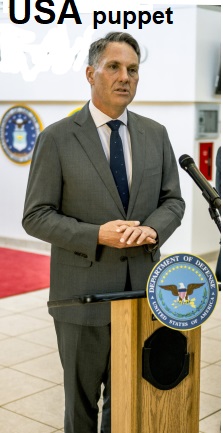
Procurement under Marles has been a sustained masterclass in what might charitably be called bureaucratic swamp-dwelling.
On the questions that actually matter in defence policy, he is more hawkish than many in the Coalition. . Pro-American to a degree that occasionally makes Liberal defence spokespeople look like peaceniks by comparison
17 April 2026 David Tyler, https://theaimn.net/richard-deadwood-marles-the-liberal-in-drag/
A profile of Australia’s Deputy Prime Minister, Minister for Defence, and Geelong’s enduring gift to Australian satirists
Meet Richard Donald Marles. Deputy Prime Minister. Minister for Defence. Member for Corio. Product of the Victorian Labor Right, that curious faction where union roots somehow sprout hawkish foreign policy, big-ticket defence contracts, and a preselection culture that makes branch stacking look like a minor administrative irregularity.
He is, in the most precise political sense available, a Liberal wearing a red rosette. Same tough talk on alliances and deterrence. Same fondness for American hardware and AUKUS largesse. Same instinct to defer to Washington on questions that might benefit from an independent Australian view. Wrapped, however, in just enough factional red to keep the true believers satisfied. All suit, no spark, and a remarkable talent for making national security sound like a mildly confusing numbers meeting that ran somewhat overtime.
Richard Marles is Geelong’s enduring gift to Australian satirists. The question is whether Geelong intended it as a gift or an apology.
The Walking Capability Gap
There is a phrase in defence circles for the gap between what a military is supposed to have and what it actually has. They call it a capability gap. Richard Marles is, in his own person, a walking capability gap: the announced function and the delivered result separated by a distance that no procurement budget has yet been able to close.
The man who fronts up as the steady hand on the tiller is the same man under whose watch the Navy wonders where the hulls went, the budget bleeds billions into procurement black holes, and the ANAO produces findings of ethical and competence failures with the regularity of a quarterly report. He is the stumblebum with the plum in his mouth, projecting authority while the institution he manages projects something considerably more ambiguous.
He inherited the AUKUS nuclear submarine deal and turned it into a rolling saga of delays, cost reassessments, and nervous hand-wringing that would be impressive in its consistency if consistency were the quality being tested. Critics, including people in uniform, people in the audit office, and old Labor warhorses who remember when the party had a clearer relationship with its own principles, point to the endless reviews, the production bottlenecks, the twenty-year capability hole while Australia waits for American goodwill and Virginia class boats that may or may not materialise on schedule.
Marles’s signature response to any question about whether the Americans will actually deliver is that periodic reviews are “perfectly natural.” Plan B questions he dodges with the practised ease of a man who has decided that the question itself is the problem. Billions committed. Timelines slipping. The public left staring at a price tag somewhere between two hundred billion and three hundred and sixty-eight billion dollars, depending on which estimate one consults and on which day one consults it, for submarines that remain considerably more promise than propeller.
The Procurement Masterclass
Procurement under Marles has been a sustained masterclass in what might charitably be called bureaucratic swamp-dwelling.
The armoured vehicle deals have produced headlines about billions wasted. The ANAO has produced findings of ethical and competence failures with sufficient regularity that they no longer surprise anyone, which is itself a finding worth examining. The response to each procurement disaster has been a reorganisation, and the response to each reorganisation’s failure has been another reorganisation. The most recent iteration produced something called a Defence Delivery Agency, which was created to fix the procurement problems generated by the previous structural reform, which had been created to fix the problems generated by the one before that.
Wars do not wait for the next reorganisation. Marles’s briefings, apparently, do.
He has poured extra billions into the portfolio. The department continues to be slammed for shortfalls and blowouts. These two facts coexist without apparent embarrassment on anyone’s part, which is perhaps the most remarkable procurement achievement of the period.
The Washington Incident
Then there is the diplomacy, or the performance of it.
Mr Marles flew to Washington at a moment when AUKUS was genuinely uncertain and American goodwill genuinely required active cultivation. The visit produced a clarification from the Pentagon that the encounter with the US Defence Secretary was, in the Pentagon’s own careful formulation, a “happenstance encounter” rather than a formal meeting.
Australia’s Deputy Prime Minister and Minister for Defence had flown to Washington and bumped into his counterpart in a corridor. The image that lodged in the public mind was of Australia’s most senior defence official as the uninvited guest at the cool table, the one who shows up at the party and discovers, from the expressions on the faces of the other guests, that the invitation was more theoretical than practical.
Mr Marles said it went very well.
The Verbal Vapourware Special
In television studios, Mr Marles has developed a signature style that deserves its own name. Call it the Verbal Vapourware Special.
Classic footage shows him in conversation with Karl Stefanovic on the Today Show, a programme not renowned for its forensic rigour, in which Marles produces word salads of sufficient density that Stefanovic, a man not given to extended silences, fills them by playing Trump clips over the minister’s ongoing remarks. The furrowed brow arrives first. Then the careful pause before the answer that does not quite materialise. Then the vague platitude delivered with the gravity of a man who believes that gravity is itself the substance of the answer.
One moment he is warning of the most complex strategic circumstances since World War Two. The next he is “very close, but we’re not saying how close” on flare incidents, or deflecting capability questions with the expression of a man reading the autocue for the first time while simultaneously trying to remember where he parked.
This is not statesmanlike gravitas. This is the performance of a factional numbers man who is considerably more comfortable in a preselection meeting than a television studio, and who has not, in eleven years of public life, fully resolved the tension between those two environments.
The Liberal in Labor Clothing
Here is the thing about Richard Marles that his factional allies would prefer not to discuss in public. On the questions that actually matter in defence policy, he is more hawkish than many in the Coalition. Pro-American to a degree that occasionally makes Liberal defence spokespeople look like peaceniks by comparison. An enthusiast for American hardware whose enthusiasm is not noticeably tempered by the evidence that the hardware in question is, in the case of the F-35, “predominantly unusable” in the year we are being asked to buy more of it.
He waves the progressive flag with the conviction of a man who remembers 1995 very fondly and has not updated the gesture since. The union pedigree produced a defence hawk. The Labor branding covers a set of instincts that would be entirely at home in the moderate wing of the Liberal Party, which is perhaps why the moderate wing of the Liberal Party has largely ceased to exist. Marles ate its lunch.
He has also, to his credit, stripped medals from Afghanistan-era officers pursuant to the Brereton Report, which required political courage of a kind not always visible in his portfolio management. He has criticised Chinese live-fire drills in the Tasman Sea, correctly. He has appointed Lieutenant General Susan Coyle as the first female chief of army, which is a genuinely historic moment.
These are real achievements. They coexist, in the same ministerial career, with the AUKUS cost blowouts, the armoured vehicle disasters, the hapinstance Washington encounter, and the word salads on morning television. This is what a capability gap looks like from the inside.
The Satirist’s Accounting
In a dangerous neighbourhood, with real capability needs and a fuel crisis that has exposed the fragility of everything the defence budget is supposed to protect, Richard Marles is what happens when you take a moderately ambitious right-leaning machine politician, hand him Defence for factional balance, and hope that nobody notices the spark shortage before the next election.
The forehead furrows at pressers. The platitudes accumulate. The procurement disasters generate the reorganisations that generate the next procurement disasters. The submarines remain in the future. The F-35 software remains predominantly unusable. The Geelong refinery burned on Wednesday night, taking with it ten percent of the nation’s fuel supply and fifty percent of Victoria’s, while the minister responsible for the nation’s strategic circumstances was preparing his remarks for the National Press Club.
Mr Marles said it was not only about investing more.
It was about spending better.
He has said this, in various formulations, for the duration of his tenure. The dead wood keeps stacking. The capability gap keeps widening. And Richard Donald Marles, Deputy Prime Minister and Minister for Defence, remains magnificently, unmistakably, and at considerable public expense, wooden.
Australia’s own Liberal wearing a red rosette. All faction, no fire.
1 This month.
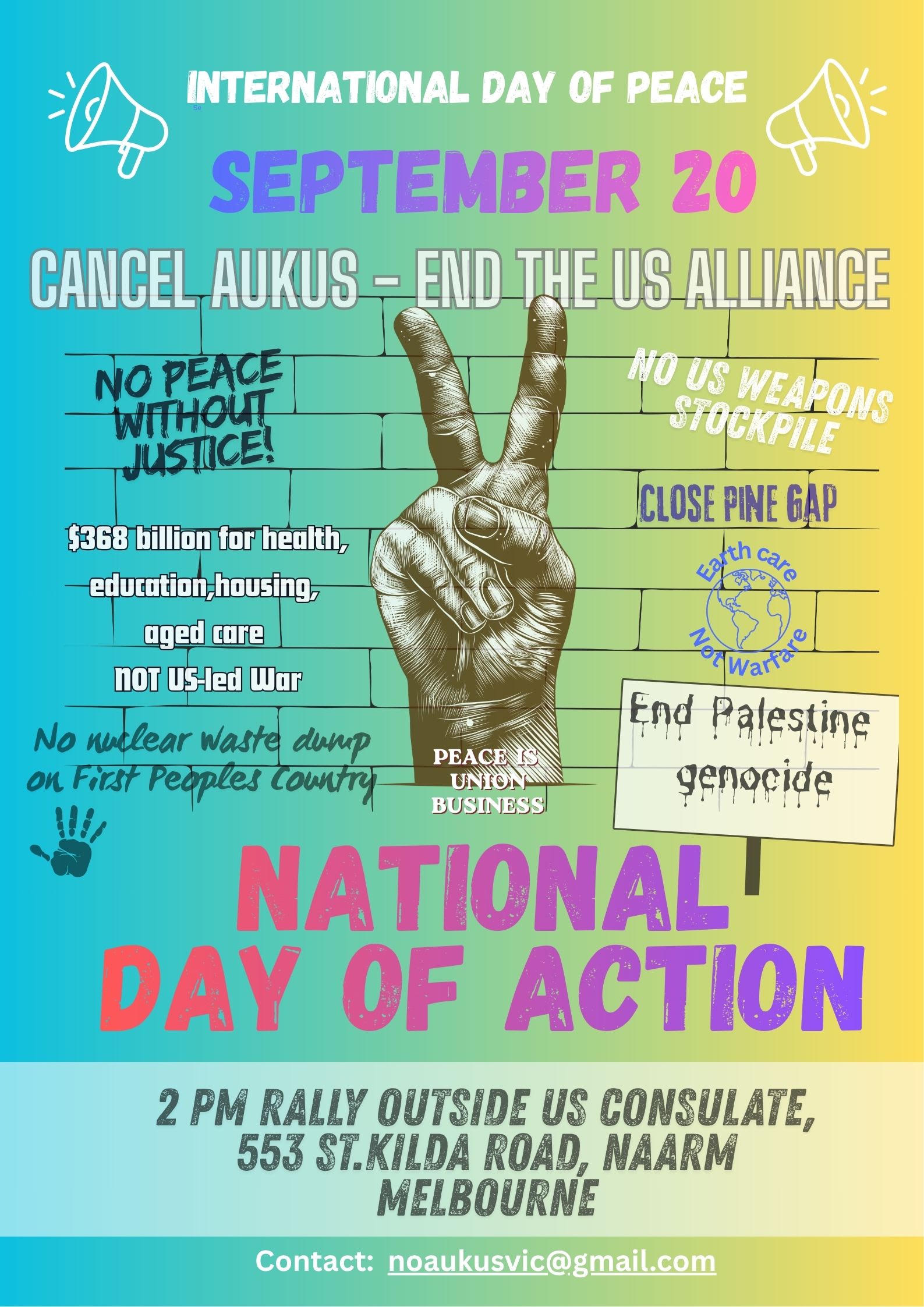
20 September –National Day of Action in Melbourne on the International Day of Peace

Help Aunty Sue Protect Her Land and Sacred Sites From Destructive Rocket Testing.
.

Australians deserve the truth
about
AUKUS – https://aukuspublicinquiry.com/
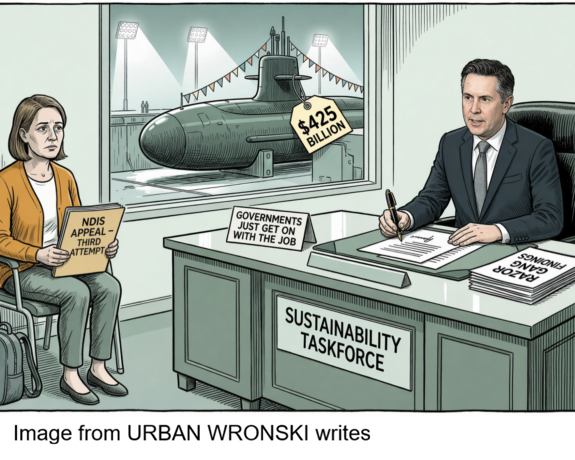

PETITION – To: Prime Minister Anthony Albanese and the Australian Labor Government

of the week – Australians for War Powers Reform (AWPR)
To see nuclear-related stories in greater depth and intensity
 Antinuclear