Richard “Deadwood” Marles: A Liberal Wearing a Red Rosette
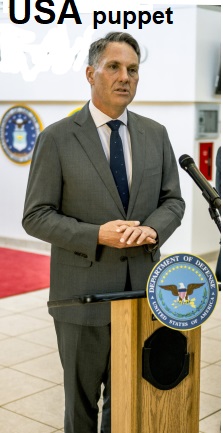
Procurement under Marles has been a sustained masterclass in what might charitably be called bureaucratic swamp-dwelling.
On the questions that actually matter in defence policy, he is more hawkish than many in the Coalition. . Pro-American to a degree that occasionally makes Liberal defence spokespeople look like peaceniks by comparison
17 April 2026 David Tyler, https://theaimn.net/richard-deadwood-marles-the-liberal-in-drag/
A profile of Australia’s Deputy Prime Minister, Minister for Defence, and Geelong’s enduring gift to Australian satirists
Meet Richard Donald Marles. Deputy Prime Minister. Minister for Defence. Member for Corio. Product of the Victorian Labor Right, that curious faction where union roots somehow sprout hawkish foreign policy, big-ticket defence contracts, and a preselection culture that makes branch stacking look like a minor administrative irregularity.
He is, in the most precise political sense available, a Liberal wearing a red rosette. Same tough talk on alliances and deterrence. Same fondness for American hardware and AUKUS largesse. Same instinct to defer to Washington on questions that might benefit from an independent Australian view. Wrapped, however, in just enough factional red to keep the true believers satisfied. All suit, no spark, and a remarkable talent for making national security sound like a mildly confusing numbers meeting that ran somewhat overtime.
Richard Marles is Geelong’s enduring gift to Australian satirists. The question is whether Geelong intended it as a gift or an apology.
The Walking Capability Gap
There is a phrase in defence circles for the gap between what a military is supposed to have and what it actually has. They call it a capability gap. Richard Marles is, in his own person, a walking capability gap: the announced function and the delivered result separated by a distance that no procurement budget has yet been able to close.
The man who fronts up as the steady hand on the tiller is the same man under whose watch the Navy wonders where the hulls went, the budget bleeds billions into procurement black holes, and the ANAO produces findings of ethical and competence failures with the regularity of a quarterly report. He is the stumblebum with the plum in his mouth, projecting authority while the institution he manages projects something considerably more ambiguous.
He inherited the AUKUS nuclear submarine deal and turned it into a rolling saga of delays, cost reassessments, and nervous hand-wringing that would be impressive in its consistency if consistency were the quality being tested. Critics, including people in uniform, people in the audit office, and old Labor warhorses who remember when the party had a clearer relationship with its own principles, point to the endless reviews, the production bottlenecks, the twenty-year capability hole while Australia waits for American goodwill and Virginia class boats that may or may not materialise on schedule.
Marles’s signature response to any question about whether the Americans will actually deliver is that periodic reviews are “perfectly natural.” Plan B questions he dodges with the practised ease of a man who has decided that the question itself is the problem. Billions committed. Timelines slipping. The public left staring at a price tag somewhere between two hundred billion and three hundred and sixty-eight billion dollars, depending on which estimate one consults and on which day one consults it, for submarines that remain considerably more promise than propeller.
The Procurement Masterclass
Procurement under Marles has been a sustained masterclass in what might charitably be called bureaucratic swamp-dwelling.
The armoured vehicle deals have produced headlines about billions wasted. The ANAO has produced findings of ethical and competence failures with sufficient regularity that they no longer surprise anyone, which is itself a finding worth examining. The response to each procurement disaster has been a reorganisation, and the response to each reorganisation’s failure has been another reorganisation. The most recent iteration produced something called a Defence Delivery Agency, which was created to fix the procurement problems generated by the previous structural reform, which had been created to fix the problems generated by the one before that.
Wars do not wait for the next reorganisation. Marles’s briefings, apparently, do.
He has poured extra billions into the portfolio. The department continues to be slammed for shortfalls and blowouts. These two facts coexist without apparent embarrassment on anyone’s part, which is perhaps the most remarkable procurement achievement of the period.
The Washington Incident
Then there is the diplomacy, or the performance of it.
Mr Marles flew to Washington at a moment when AUKUS was genuinely uncertain and American goodwill genuinely required active cultivation. The visit produced a clarification from the Pentagon that the encounter with the US Defence Secretary was, in the Pentagon’s own careful formulation, a “happenstance encounter” rather than a formal meeting.
Australia’s Deputy Prime Minister and Minister for Defence had flown to Washington and bumped into his counterpart in a corridor. The image that lodged in the public mind was of Australia’s most senior defence official as the uninvited guest at the cool table, the one who shows up at the party and discovers, from the expressions on the faces of the other guests, that the invitation was more theoretical than practical.
Mr Marles said it went very well.
The Verbal Vapourware Special
In television studios, Mr Marles has developed a signature style that deserves its own name. Call it the Verbal Vapourware Special.
Classic footage shows him in conversation with Karl Stefanovic on the Today Show, a programme not renowned for its forensic rigour, in which Marles produces word salads of sufficient density that Stefanovic, a man not given to extended silences, fills them by playing Trump clips over the minister’s ongoing remarks. The furrowed brow arrives first. Then the careful pause before the answer that does not quite materialise. Then the vague platitude delivered with the gravity of a man who believes that gravity is itself the substance of the answer.
One moment he is warning of the most complex strategic circumstances since World War Two. The next he is “very close, but we’re not saying how close” on flare incidents, or deflecting capability questions with the expression of a man reading the autocue for the first time while simultaneously trying to remember where he parked.
This is not statesmanlike gravitas. This is the performance of a factional numbers man who is considerably more comfortable in a preselection meeting than a television studio, and who has not, in eleven years of public life, fully resolved the tension between those two environments.
The Liberal in Labor Clothing
Here is the thing about Richard Marles that his factional allies would prefer not to discuss in public. On the questions that actually matter in defence policy, he is more hawkish than many in the Coalition. Pro-American to a degree that occasionally makes Liberal defence spokespeople look like peaceniks by comparison. An enthusiast for American hardware whose enthusiasm is not noticeably tempered by the evidence that the hardware in question is, in the case of the F-35, “predominantly unusable” in the year we are being asked to buy more of it.
He waves the progressive flag with the conviction of a man who remembers 1995 very fondly and has not updated the gesture since. The union pedigree produced a defence hawk. The Labor branding covers a set of instincts that would be entirely at home in the moderate wing of the Liberal Party, which is perhaps why the moderate wing of the Liberal Party has largely ceased to exist. Marles ate its lunch.
He has also, to his credit, stripped medals from Afghanistan-era officers pursuant to the Brereton Report, which required political courage of a kind not always visible in his portfolio management. He has criticised Chinese live-fire drills in the Tasman Sea, correctly. He has appointed Lieutenant General Susan Coyle as the first female chief of army, which is a genuinely historic moment.
These are real achievements. They coexist, in the same ministerial career, with the AUKUS cost blowouts, the armoured vehicle disasters, the hapinstance Washington encounter, and the word salads on morning television. This is what a capability gap looks like from the inside.
The Satirist’s Accounting
In a dangerous neighbourhood, with real capability needs and a fuel crisis that has exposed the fragility of everything the defence budget is supposed to protect, Richard Marles is what happens when you take a moderately ambitious right-leaning machine politician, hand him Defence for factional balance, and hope that nobody notices the spark shortage before the next election.
The forehead furrows at pressers. The platitudes accumulate. The procurement disasters generate the reorganisations that generate the next procurement disasters. The submarines remain in the future. The F-35 software remains predominantly unusable. The Geelong refinery burned on Wednesday night, taking with it ten percent of the nation’s fuel supply and fifty percent of Victoria’s, while the minister responsible for the nation’s strategic circumstances was preparing his remarks for the National Press Club.
Mr Marles said it was not only about investing more.
It was about spending better.
He has said this, in various formulations, for the duration of his tenure. The dead wood keeps stacking. The capability gap keeps widening. And Richard Donald Marles, Deputy Prime Minister and Minister for Defence, remains magnificently, unmistakably, and at considerable public expense, wooden.
Australia’s own Liberal wearing a red rosette. All faction, no fire.
No comments yet.
1 This month
17 October, Free Public Talk on Nuclear Issues in South Australia
David Noonan will speak on public interest concerns over the new Roxby Downs Indenture Act 2026 on BHP copper-uranium mining and ore processing in SA, and on how AUKUS may face SA with a High-Level nuclear waste agenda.
Dr Jim Green will discuss international developments in the field of nuclear power including ‘small modular reactors’ and Generation 4 ‘advanced’ nuclear reactor concepts.


Help Aunty Sue Protect Her Land and Sacred Sites From Destructive Rocket Testing.
.

Australians deserve the truth
about
AUKUS – https://aukuspublicinquiry.com/

PETITION – To: Prime Minister Anthony Albanese and the Australian Labor Government

of the week – Australians for War Powers Reform (AWPR)
To see nuclear-related stories in greater depth and intensity


Leave a Reply